



Abstract
Musician and journalist Suna Alan gives an account of some of the songs she performs and loves. These are mainly Kurdish music. Suna describes the Dengbej tradition to which much of the music belongs. However, her summary of some songs, and excerpts from the lyrics, also draws on music by Sephardi Jews and the Armenians, other cultural groups who lived, like the Kurds, under the Ottoman Empire. The lyrics and Suna’s contextualization of them in terms of the history they tell and from which they emerge reveal the oppression and suffering of these transcultural groups under the Ottoman Empire, but also their fight against injustice. The music remembers their loves as well as their losses.
Suna Alan
Kurdish musicians in Turkey
Dengbej is a tradition that reaches back to pre-Islamic times. It was started by women whereby, when illness or death befell a family, they would start singing to alleviate the pain. The terms bard or troubadour are sometimes used alluding to the long epic songs that dengbêjs would recite on their journeys through villages and communities. However, criminalization of the Kurdish language after the military coup of 1980 in Turkey finally silenced the dengbêjs storytellers, and many songs were lost. Every recording found by the authorities was destroyed, and the people associated with the recordings were arrested and beaten. It seems that not one cassette was saved from the fascist period under Kenan Evren’s rule of Turkey. In Kurdistan, but mainly in the Turkish part, over many decades, hundreds of Kurdish singers have been murdered, on the grounds of their identity and because of their fight against injustice and oppression. For example, in the late 1970s, while even listening to Kurdish music was considered a crime, Hozan Hemido was singing Kurdish revolutionary songs in public in the province of Merdin. As a result, he was imprisoned and repeatedly tortured. His fingernails were removed so that he could no longer play the baglama (figure 1). He was murdered by JITEM (Turkish Gendarmerie Intelligence Organization) in 1993.
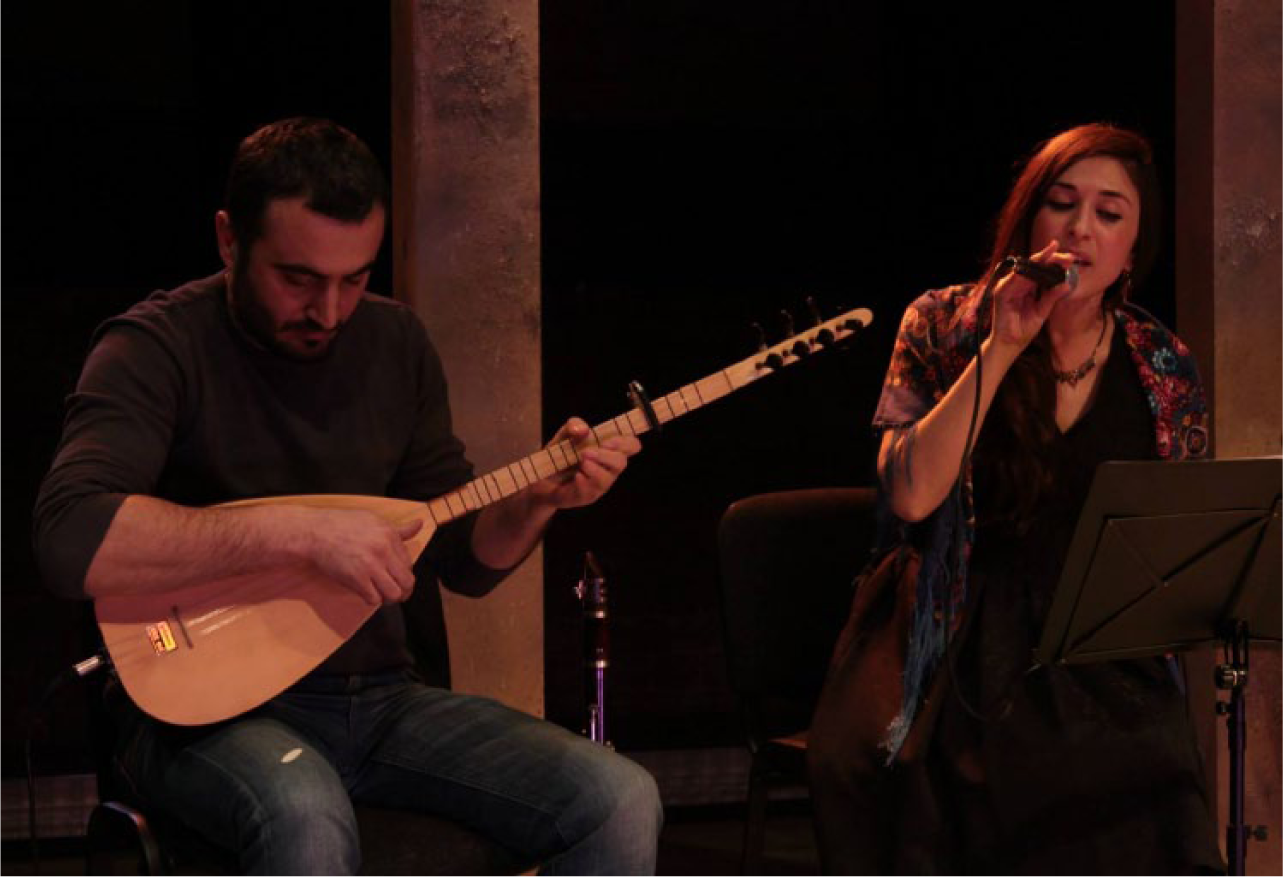
Suna Alan, with Sonar Golbas playing the baglama. Playing such traditional Kurdish instruments can result in prison and torture for Kurds in Turkey. (Copyright Suna Alan.)
Even recently, in 2015, Nûdem Durak, a young female singer who was teaching Kurdish folk songs to children in her town of Cizre in Turkey, was imprisoned for 10.5 years in prison.
The government falsely tried to link her to both Kurdish political organizations, KCK and PKK, but Nûdem’s family says that the real reason she was arrested is because she tries to keep Kurdish culture and language alive.
There are many more examples of Kurdish musicians who have been subjected to severe repression, torture and death due to their identity.
The following are some examples of songs both by Kurds and by other cultural groups within the Ottoman Empire, including Sephardi Jews and Armenians. The hyperlinks take you to recordings of these performances of these songs, mostly by Suna Alan herself.
This song commemorates a historical event which took place in Turkey in 1988. The woman named in the song Ayten Tekin (Rojin) is my maternal aunt.
In April 1988, 20 Kurdish freedom fighters, members of the People’s Liberation Army of Kurdistan (ARGK) lost their lives after they put up a big fight against the Turkish army. The battle took place at Bagok mountain. It was the greatest battle involving the Turkish military and the ARGK fighters, who found themselves encircled by thousands of soldiers and village guards.
The words of the song say, “Çiyayê bagokê bi dar e / Leşker hat ser bi hezar e / Li wir bu bû axir dewran / Li ser serê çend hevalan"
[Bagok Mountain is forested / soldiers came there in their thousands / to fight against a handful of comrades.]
Êzdeen Shêr, who was allied with the Ottomans, became Mir (ruler) of Botan area of Kurdistan, after the uprising of Bedirkhan Beg was suppressed and he was exiled to Crete. However, Êzdeen Shêr somehow failed to develop good relations with the surrounding tribes and always remained under life-threatening conditions. He became weakened as a result of conflict between Bouncer Khelef of Shouvee; and eventually, he had to make peace with Khelef. Khelef was a kind of Robin Hood, living in the high mountains of Kurdistan with his men. The song describes a dueling scene, with its enthusiastic singing and rhythms. There is a Kurdish dance associated with this song. The lyrics consist of words which Khelef shouts to Ezdeen Sher during their showdown. Among other things he says, Hey Ezdeen Sher Hey Botan beg (ruler) Who is the one holding his back to the Turks? Do you think Khelef is scared of fighting? Come and let’s settle our accounts Let’s see who is a lamb and who is a ram Come forward.
Helîme was a beautiful young girl born in the Botan area of Kurdistan. Helîme and a young farmer in the village fall in love. However, Helîme’s parents do not consent to their marriage. Hence, Helîme and her lover elope and go to another village. In the meantime, a war starts between Kurds and the Ottomans. Thousands of Kurds are detained and killed. Helîme’s young lover is wounded and sent into exile. He expresses his longing for Helîme and helplessness through this elegy.
This song is about the sufferings of an Ottoman Greek woman during World War I and its aftermath. According to various sources, several hundred thousand Ottoman Greeks died under the Ottoman Empire during this period. The Lyrics says “when people are born, a trouble (pain, grief) is born / when war intensified, blood cannot be measured.”
Meryem is a beautiful young Arab Alawi (Nusayri) girl from a village of Hatay. Meryem means Mary in English. It is between 1910 and 1914. In those years, Hatay lands were under French occupation. Ottoman soldiers were on their way to Syria. Meryem was kidnapped by an Ottoman soldier and her lover was killed. The lyrics says “Ottoman soldiers took Meryem /Meryem, my Meryem/ My eyes, Meryem/ And this wounded heart wants Meryem back.”
For 300 years following the expulsion from Spain, the prosperity and creativity of the Ottoman Jews rivaled that of the Golden Age of Spain. Four Turkish cities—Istanbul, Izmir, Safed and Salonica—became the centers of Sephardic Jewry.
The lyrics say, “Oh my Pink Rose/What kind of a beauty is this you have/As if you were a golden coin of the moneychanger/I plated you so slowly.”
The Adana massacre occurred in the Adana province of the Ottoman Empire in April 1909. Reports estimated that the massacres in Adana province resulted in the deaths of as many as 20,000 to 30,000 Armenians; 1300 Assyrians are also reported to have been killed during the massacre.
The lyrics says, “Keepers of the sword, marched in one accord / Striking down the weak, without a single word / Ruthlessly they came, with one deadly aim / Kill all who believed in Jesus” name.
Footnotes
Funding
The author(s) received no financial support for the research, authorship, and/or publication of this article.