




Abstract
Accurate differentiation between focal and non-focal EEG activity remains a challenging task due to the nonlinear and nonstationary nature of neural signals. This work proposes a novel hybrid framework that combines multi-stage signal filtering, multi-domain feature extraction, and ensemble learning to improve automated neurodynamic analysis. The framework employs a dual-path design: the first path extracts linear, nonlinear, and hybrid signal descriptors, while the second path generates dimensionality-reduced representations that are fused with these descriptors to form a comprehensive, information-rich feature set. Performance was rigorously evaluated across eight machine learning paradigms, including conventional, ensemble, and hybrid models, ensuring methodological rigor and reproducibility. Results demonstrate that fusing nonlinear features with reduced-dimensional embeddings, when processed through a stacked ensemble classifier, achieves superior discrimination between focal and non-focal EEG patterns. The framework's scalability, computational efficiency, and adaptability establish a robust foundation for automated EEG-based neurodynamic analysis, offering strong potential for future studies in cognitive signal processing, neural dynamics modeling, and epilepsy research.
Keywords
Introduction
Epilepsy is a chronic neurological disorder characterized by recurrent seizures arising from abnormal and unpredictable electrical activity in the brain. Accurate differentiation between focal and non-focal EEG patterns is critical for understanding seizure dynamics and advancing computational analyses. However, the nonstationary and nonlinear nature of EEG signals, coupled with noise and artifacts, makes automated classification challenging (Chaddad et al., Jul. 01, 2023; Prabhakar & Won, 2023). Traditional visual inspection remains subjective and prone to error, highlighting the need for stable computational frameworks.
Preprocessing is a critical stage in EEG analysis, as noise suppression and compact signal representation are essential for reliable classification. Given the inherent complexity of EEG signals, single-stage preprocessing techniques are often insufficient to simultaneously address broadband noise and preserve diagnostically relevant temporal and spectral features. As a result, preprocessing strategies that integrate complementary mechanisms such as frequency-selective filtering and time–frequency decomposition have gained attention for improving signal fidelity. Similarly, dimensionality reduction techniques that jointly consider variance preservation and class separability enable the construction of low-dimensional representations that remain informative for subsequent analysis.
Earlier investigations have primarily addressed focal and non-focal EEG classification using individual filtering techniques and end-to-end deep learning models, with an emphasis on model-centric performance evaluation and filter ranking (Rai B et al., Nov. 2025a). Separately, hybrid filtering and hybrid dimensionality reduction approaches have been explored to enhance EEG signal representation and class separability at the preprocessing level (Rai B et al., Dec. 2025b). While these studies provide important insights into preprocessing optimization and model selection, they largely treat these components as independent stages and offer limited analysis of how optimized representations interact with feature-level information across multiple domains.
Feature extraction from EEG signals can be broadly categorized into linear, nonlinear, and hybrid approaches. Linear features primarily capture amplitude and frequency characteristics, while nonlinear features reflect complex temporal and dynamic patterns. Hybrid approaches combine both perspectives, improving classification performance. However, most existing studies consider these features independently or apply dimensionality reduction without integrating multiple feature domains, which limits their ability to exploit the complementary information inherent in EEG signals. Recent studies have highlighted the benefits of multi-domain feature integration for EEG classification. A 3D CNN–LSTM hybrid model demonstrated improved spatial-temporal feature representation for motor imagery EEG classification (Hao & Cheng, Dec. 2025). Similarly, a multiresolution feature fusion framework for EEG-based schizophrenia diagnosis showed that integrating features across multiple scales enhances discriminative capability (Ranjan & Sahana, Oct. 2024).
Although deep learning architectures have achieved remarkable accuracy in EEG classification, they typically require large-scale labeled datasets and their black-box nature can limit interpretability. This motivates alternative approaches that balance predictive performance with transparency and robustness (He et al., Dec. 17, 2021). In this context, the proposed framework integrates multi-domain feature fusion with dimensionality-reduced representations to enhance discriminative capability while maintaining interpretability across different feature domains.
The novel contribution of this work is the development of a multi-domain feature fusion framework for classifying focal and non-focal EEG signals. This framework integrates linear, nonlinear, and hybrid features with dimensionality-reduced representations, forming a comprehensive, enriched feature space that captures multiple aspects of the same signal. By leveraging this fused representation, the framework enhances discriminative capability, and interpretability, outperforming methods that rely solely on single-domain features or dimensionality reduction.
Through the systematic integration of optimized preprocessing, dimensionality reduction, and multi-domain feature fusion, the proposed framework establishes a interpretable and scalable computational approach for automated EEG classification. This methodology lays a foundation for future applications in neurodynamic modeling, cognitive studies, and computational support in epilepsy research.
Literature Review
EEG-based monitoring of brain electrical activity plays a crucial role in the diagnosis of epileptic disorders. In particular, distinguishing between focal and non-focal epilepsy remains a key challenge in automated EEG analysis. Recent studies have explored various preprocessing, feature extraction, dimensionality reduction, and classification techniques to improve this discrimination.
Traditional filters, such as Butterworth, Chebyshev, and notch filters, have long been employed to reduce artifacts in EEG signals. Among these, Butterworth filters are particularly favored due to their flat passband, smooth frequency response, and minimal signal distortion. EEG signals preprocessed with a Butterworth bandpass filter demonstrated improved quality, enhancing sensitivity and specificity in epilepsy classification (Saemaldahr & Ilyas, Jul. 2023). The effectiveness of Butterworth filtering was also evident in another study, where wavelet decomposition combined with a hybrid CNN model yielded improved classification performance (Hassan et al., 2022a).
Given the inherently non-stationary nature of EEG signals, time–frequency analysis methods, such as Short-Time Fourier Transform (STFT) and Wavelet Transform (WT), have proven highly effective. While conventional bandpass and notch filters remove low-frequency drifts, high-frequency noise, and power-line interference, they are often insufficient in suppressing non-stationary artifacts such as eye blinks and muscle activity (Luján et al., Dec. 01, 2021). In response to these challenges, adaptive techniques like Empirical Mode Decomposition (EMD) have been applied, decomposing signals into Intrinsic Mode Functions (IMFs) and enabling selective reconstruction by excluding noise-dominated components. The data-driven nature of EMD makes it highly suitable for analyzing non-linear and non-stationary signals (Chaddad et al., Jul. 01, 2023). Additionally, dimensionality reduction methods, including Principal Component Analysis (PCA) and t-distributed Stochastic Neighbor Embedding (t-SNE), have been employed to emphasize the most informative features (Alalayah et al., Jun. 2023). Nevertheless, challenges remain in optimizing EMD and dimensionality reduction for real-time processing and multi-channel EEG systems.
Higher-level decomposition methods, such as Independent Component Analysis (ICA) and Wavelet Packet Decomposition (WPD), have further advanced artifact removal by isolating neural activity from noise. ICA effectively eliminates components corresponding to eye blinks or muscle activity, improving signal clarity and facilitating more accurate classification (Jung et al., 2000). Similarly, wavelet-based approaches decompose EEG signals into time–frequency components, allowing selective artifact attenuation while preserving neural signal integrity (Rai et al., Jun. 01, 2025c; Bashashati et al., Jun. 01, 2007). The adaptability of time–frequency filtering has been demonstrated even in low-density electrode arrays (Liu et al., Feb. 2020). However, selecting the optimal decomposition level and threshold for different datasets remains an open problem.
Recent studies have explored hybrid denoising approaches that combine linear and nonlinear methods to achieve superior signal quality. For example, integrating STFT with bidimensional EMD significantly reduces high-frequency noise (Yan & Wu, Nov. 2022), while Hybrid Wavelet Transform (HWT) techniques, combining Discrete Wavelet Transform and Wavelet Packet Transform, effectively minimize ocular artifacts (Ferdous et al., 2021). Additional approaches, including EMD with stacked autoencoders (Sohaib et al., Oct. 2022) and discrete wavelet transform combined with Pisarenko harmonic decomposition and deformable convolutional networks (Sahoo & Mohapatra, 2022), have demonstrated further improvements in EEG denoising. Collectively, these hybrid strategies highlight the growing emphasis on combining complementary methods to enhance signal reliability in EEG-based applications and brain–computer interfaces. Yet, developing standardized hybrid frameworks that generalize across different EEG datasets remains a challenge.
Feature extraction translates raw EEG signals into discriminative representations for classification. Time-domain features such as mean, variance, and zero-crossing rate provide high discriminative power with low computational cost, making them particularly suitable for real-time epilepsy detection (Sharmila & Geethanjali, May 2020). Hjorth parameters — Activity, Mobility, and Complexity capture variance and frequency characteristics, further improving EEG classification (Al-Nafjan et al., Dec. 01, 2017). Wavelet-based feature extraction methods, including Discrete Wavelet Transform (DWT) (al-Qerem et al., Mar. 2020), Multidepth Wavelet Packets (Rafiuddin et al., 2022), and Dual-tree Complex Wavelet Transform (Al-Salman et al., Mar. 2022), have also been widely applied. Advanced wavelet features, such as peak detection and phase-space reconstruction, contribute to enhanced classification performance (Jang & Lee, Aug. 2020). However, selecting optimal features and handling the curse of dimensionality remain significant hurdles for EEG classification. EEG-based epilepsy classification has employed a variety of linear and nonlinear techniques. Radial Basis Function (RBF) models integrating linear and nonlinear features have shown strong performance (Zhou & Li, Jun. 2020), while Gradient Boosting Decision Trees (GBDT) combined with entropy-based features improved seizure prediction (Xu et al., Sep. 2022). Hurst exponent and Adaptive Fractal Analysis, in combination with GBDT and Support Vector Regression, have effectively classified complex EEG signals (Buchanna et al., Feb. 2022). Furthermore, wavelet-based features combined with SVM using RBF kernels and Particle Swarm Optimization for feature selection have demonstrated superior discrimination of epileptic patterns (Hemachandira & Viswanathan, 2022). Fusion frameworks integrating time-domain, frequency-domain, and nonlinear features have further enhanced classification accuracy (Chen et al., 2023). Despite these advances, generalization to unseen patients and cross-dataset validation remains a persistent challenge.
Time-frequency and complexity-based features have also contributed significantly to improved EEG characterization. Techniques such as quadratic time-frequency distributions (Alazrai et al., Aug. 2018), Multiscale Permutation Lempel-Ziv Complexity (MPLZC) (Borowska, Jul. 2021), Multi-scale PCA with AR modeling (Jukic et al., Sep. 2020), and Tunable Q-factor Wavelet Transform (Sadiq et al., 2021) have been proposed to capture subtle signal dynamics. Additionally, derivative-based reconstruction combined with Higuchi Fractal Dimension (HFD) features supports detection of epileptic activity (Brari & Belghith, 2021). Nonetheless, effectively integrating these complex features into real-time systems without excessive computational cost is a challenge.
Machine learning frameworks increasingly leverage hybrid feature extraction and optimization strategies. For instance, DWT combined with Binary Particle Swarm Optimization facilitates dimensionality reduction while enhancing computational efficiency (Tran et al., Nov. 2022). Deep learning architectures such as TF-HybridNet integrate STFT with 1D and 2D convolutions, improving localization of epileptic foci (Sui et al., 2021). Image-based EEG classification using Gramian Angular Summation Field representations, with SIFT and ORB features classified via Random Forests, further highlights the potential of automated EEG analysis (Krishnan et al., 2024). However, interpretability and deployment of such hybrid models in clinical settings remain challenging.
Standard classifiers, including SVM with linear kernels and KNN with City Block distance, provide reliable baselines (Mardini et al., 2020). Deep learning models, particularly 1D-CNNs, outperform ensemble models such as XGBoost, Random Forest, and TabNet in capturing temporal patterns (Hussain, Jun. 2018). For multiclass seizure classification, XGBoost effectively integrates features across time, frequency, and time–frequency domains (Kode et al., 2024). Hybrid CNN-classical frameworks balance deep feature learning with interpretability (Abirami et al., 2024), while metaheuristic optimization techniques, such as Cuckoo Search with Gaussian Mixture Models, enhance performance in complex feature spaces (Hassan et al., 2022b). Dimensionality reduction techniques like DWT, PCA, and t-SNE, when combined with Random Forest and MLP, improve signal separability and computational efficiency (Deepa et al., 2022). EEG-based Brain–Machine Interface studies further demonstrate the effectiveness of LDA, SVM, and bi-objective Invasive Weed Optimization classifiers (Tahernezhad-Javazm et al., Feb. 19, 2018). Advanced preprocessing strategies, including channel selection and deep learning-based data augmentation, continue to improve EEG-based BCI performance, although computational complexity and interpretability remain challenges (Sun & Mou, 2023). Future research should focus on scalable, interpretable frameworks that balance accuracy with computational feasibility.
Methodology
The proposed methodology follows a structured, multi-stage pipeline encompassing signal filtering, feature engineering, dimensionality reduction, feature fusion, classification. A schematic overview of the overall framework is presented in Figure 1, while the subsequent subsections provide a detailed description of each stage to ensure clarity and reproducibility of the proposed approach.
Dataset
The analysis in this work is based on the complete Bern-Barcelona intracranial EEG dataset (Andrzejak et al., Oct. 2012), a curated collection designed to explore the neurophysiological characteristics of focal and non-focal brain activity in epilepsy. This dataset includes a total of 7500 signal pairs—3750 pairs each for focal and non-focal categories—captured from five patients undergoing presurgical monitoring for drug-resistant epilepsy. Each pair comprises recordings from two spatially adjacent electrodes (labeled X and Y), with focal pairs obtained from regions clinically marked as part of the epileptogenic zone and non-focal pairs drawn from areas uninvolved in seizure generation. The EEG segments are 20 s in duration, recorded at a sampling rate of 512 Hz.
All signals represent interictal activity, meaning they were recorded outside of seizure episodes. The inter-electrode distance is maintained at approximately 10 millimeters, allowing the capture of localized neuronal interactions. Due to its balanced class distribution, consistent signal length, and precise anatomical mapping, the Bern-Barcelona dataset provides a strong foundation for training and evaluating EEG-based classification frameworks in epilepsy research.
The temporal characteristics of focal and non-focal EEG signals is shown in Figure 2. The top two plots depict focal EEG signals (channels X and Y), showing high-amplitude bursts and rhythmic activity indicative of epileptogenic regions. The bottom plots show non-focal EEG, characterized by smoother, more consistent waveforms.
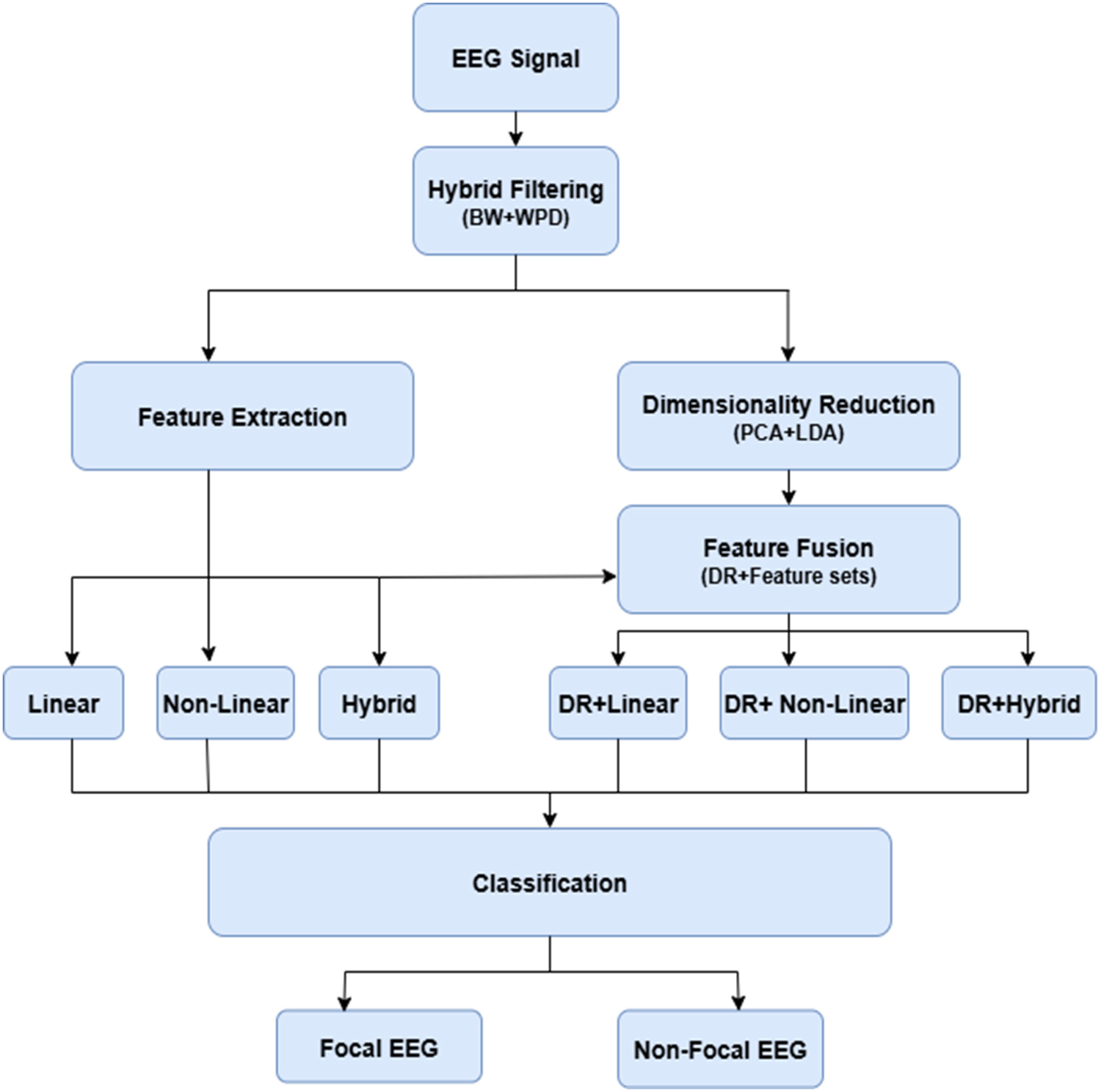
Block diagram of the EEG signal classification framework using hybrid filtering and feature fusion.
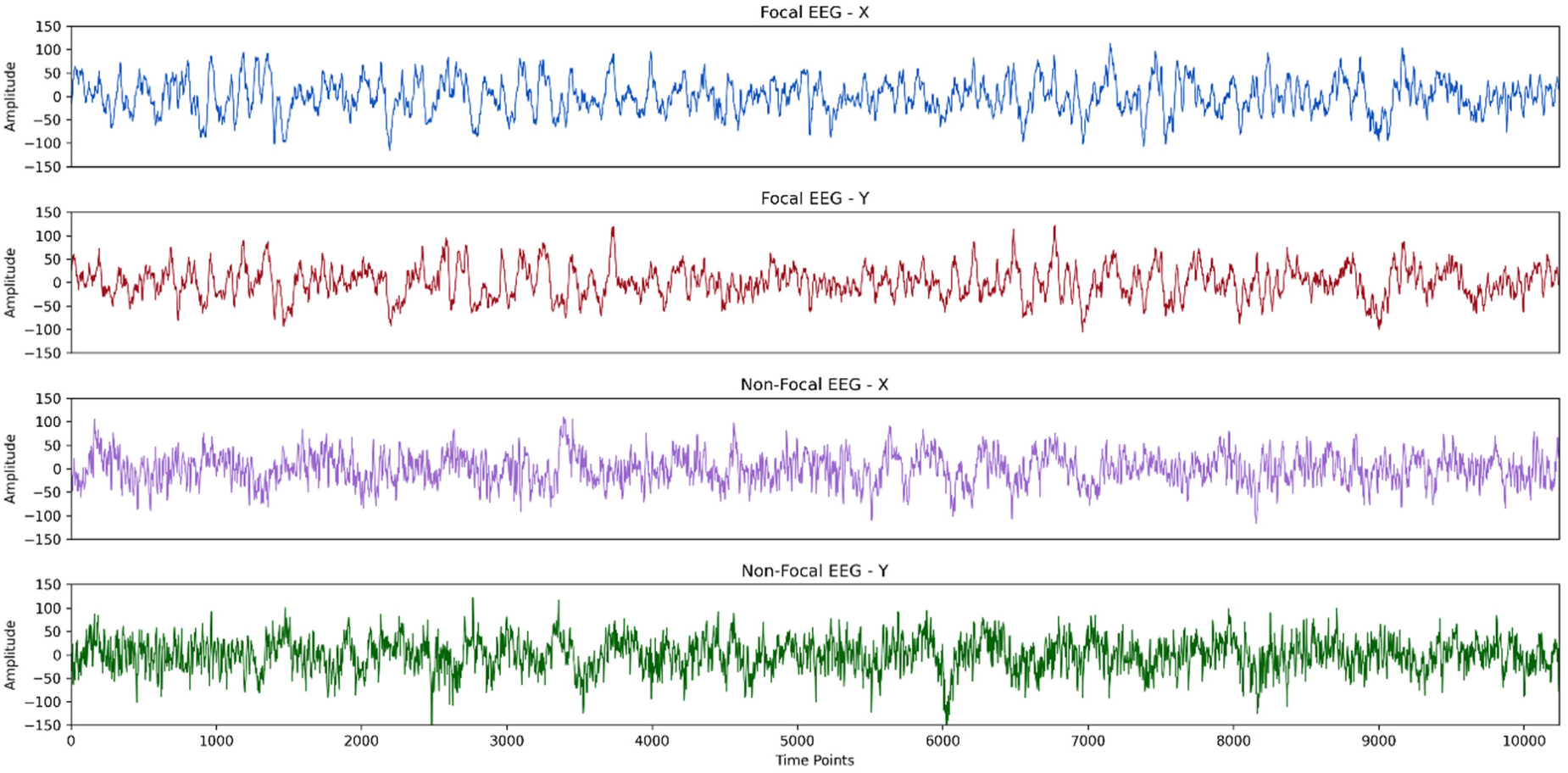
Focal and non-focal EEG signals.
EEG recordings are inherently susceptible to various types of noise, such as muscle artifacts, line interference, and background electrical activity. To address this, a hybrid filtering technique is employed, combining Butterworth (BW) filtering with Wavelet Packet Decomposition (WPD). The BW filter is known for its maximally flat frequency response in the passband, making it effective in removing baseline drifts and muscle artifacts without introducing sharp transitions (Savadkoohi et al., Jul. 2020). However, it lacks the ability to capture localized time-frequency patterns. To overcome this, WPD is subsequently applied, enabling the decomposition of EEG signals into multiple frequency sub-bands with fine temporal resolution (Sairamya et al., Jan. 2021; Yuan et al., Aug. 2017). This dual-stage approach enhances the signal's interpretability without compromising its physiological integrity (Rajani Rai & Martis, 2021). A comparative analysis of the raw and filtered EEG signals, as illustrated in Figure 3, indicates a noticeable reduction in high-amplitude noise fluctuations and irregular artifacts after preprocessing. The filtered signals exhibit smoother temporal variations and improved structural consistency while preserving key signal characteristics, suggesting effective noise suppression without distortion of underlying EEG dynamics. This improvement in signal stability enhances the quality of subsequent feature extraction and contributes to improved classification performance. The effects of pre and post filtering is shown in Figure 3.
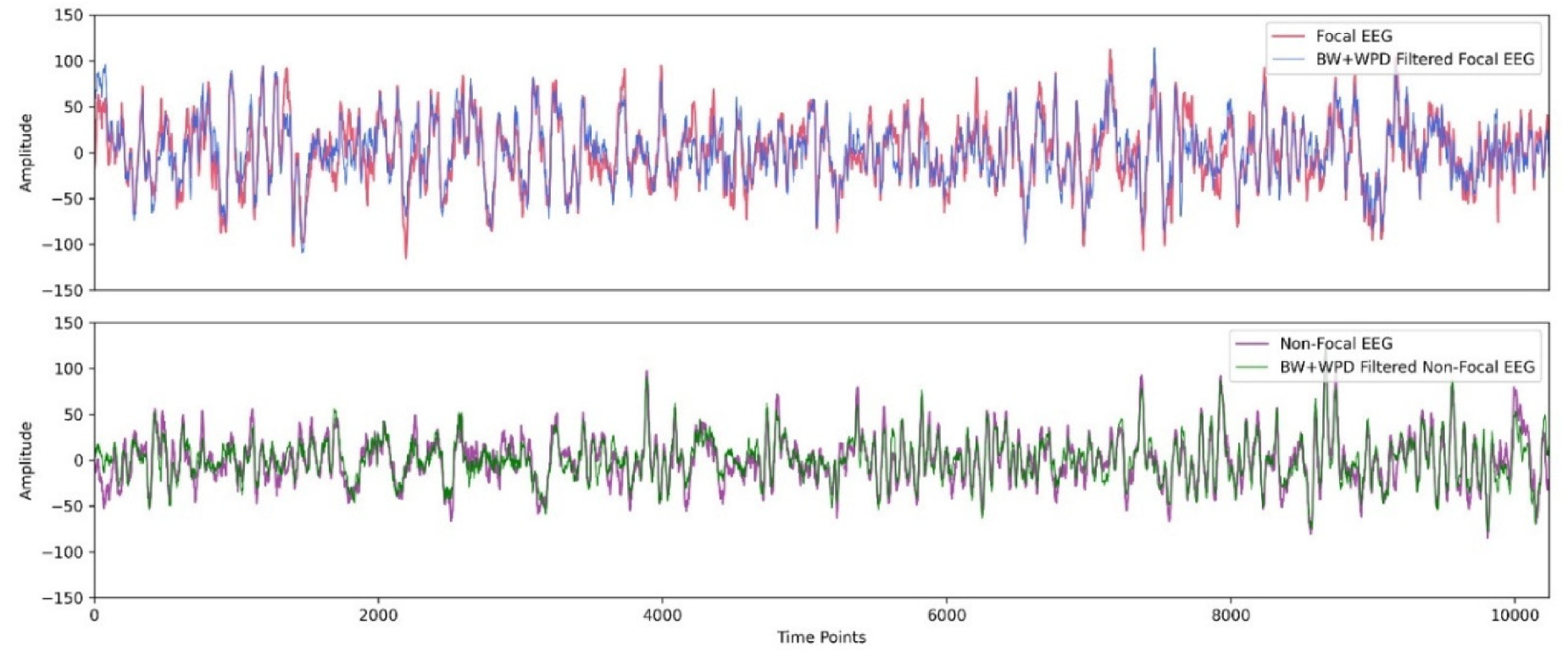
Filtered focal and non-focal EEG signal.
The performance of an EEG classification framework critically depends on the discriminative strength of the extracted features. Following the filtering stage, the denoised EEG signals are subjected to feature extraction to obtain a comprehensive set of representative descriptors. This process captures the intrinsic temporal and spectral characteristics of the signals, thereby enhancing the differentiation between focal and non-focal EEG patterns with improved sensitivity and clinical relevance.
In the present work, a comprehensive feature extraction strategy is employed, integrating linear, non-linear, and hybrid approaches to capture the complex dynamics of EEG signals. Linear features include statistical measures, wavelet energy coefficients, Hjorth parameters, and functional connectivity derived from coherence, collectively reflecting both temporal and spectral variations. Given the inherently non-stationary and complex nature of EEG, linear descriptors alone may not fully characterize signal dynamics. To address this, non-linear features are extracted, comprising fractal dimensions (e.g., Higuchi and Petrosian), entropy-based metrics (e.g., sample entropy, Shannon entropy, permutation entropy), graph-theoretic measures (e.g., clustering coefficient, global efficiency), and manifold learning representations via Isomap. Graph-theoretic features are computed by constructing a weighted undirected graph for each EEG segment, where the two EEG channels (X and Y) are treated as nodes and the edge weight is defined using the Pearson correlation coefficient between the two channel signals. No thresholding is applied, and the edge weights are directly obtained from the correlation values computed over the entire signal segment. These non-linear descriptors capture the intrinsic chaotic and topological properties of neural activity. Although the graph consists of two nodes, the computed graph measures are used as functional connectivity descriptors that quantify the strength of interaction between the two channels rather than large-scale network topology. The hybrid feature set synergistically combines linear descriptors, which provide interpretable physiological insight, with non-linear features that improve reliability against variability and noise, thereby forming a rich, multidimensional representation suitable for discriminating focal and non-focal EEG patterns.
Figure 4 provides a visual summary of the types of linear, non-linear, and hybrid features extracted from the pre-processed EEG signals.
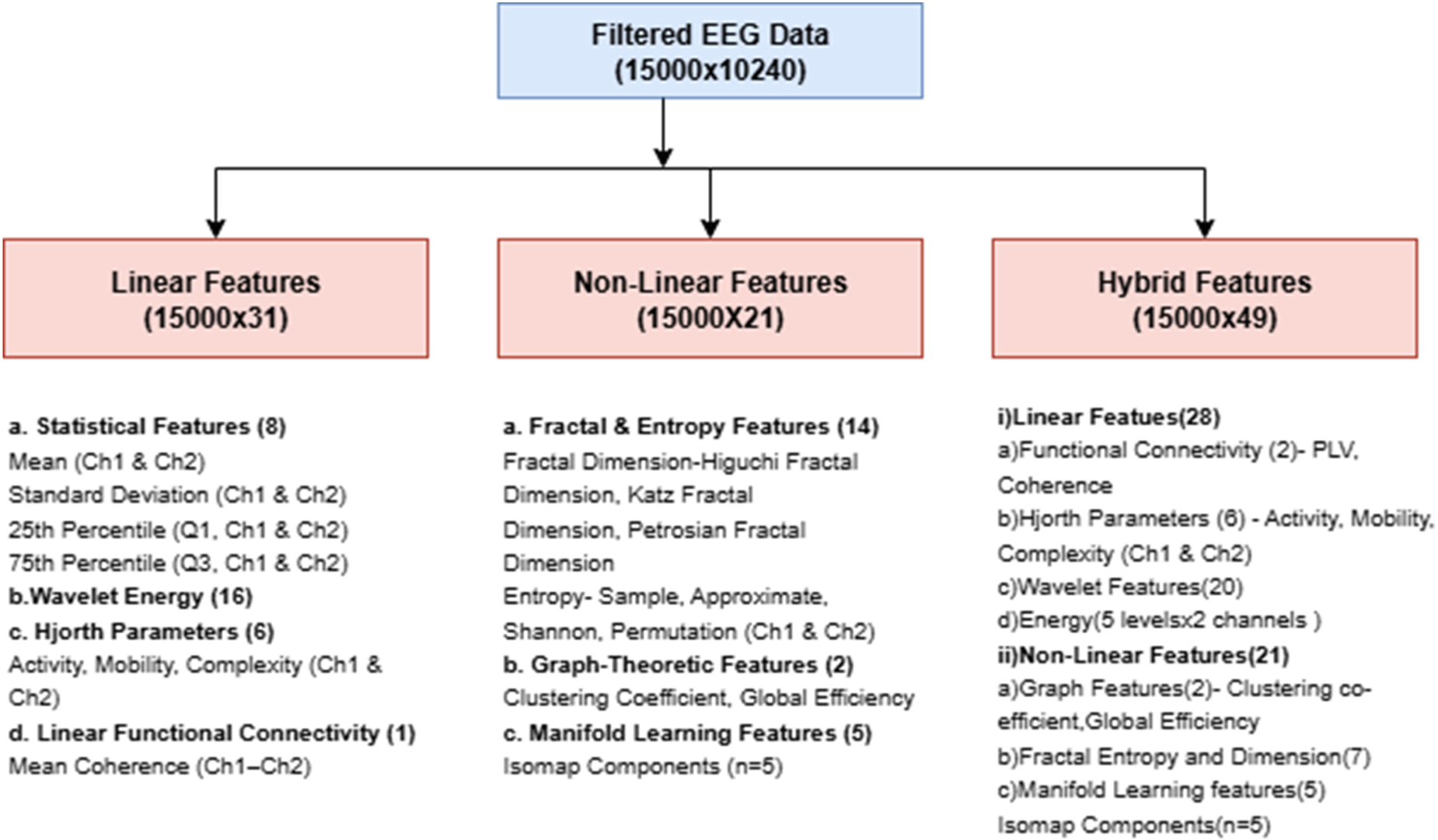
Overview of extracted linear, non-linear, and hybrid EEG features from pre-processed signals.
Linear features, representing the statistical and morphological aspects of EEG signals, are summarized in Table 1.
Linear Features Extracted from EEG Signals.
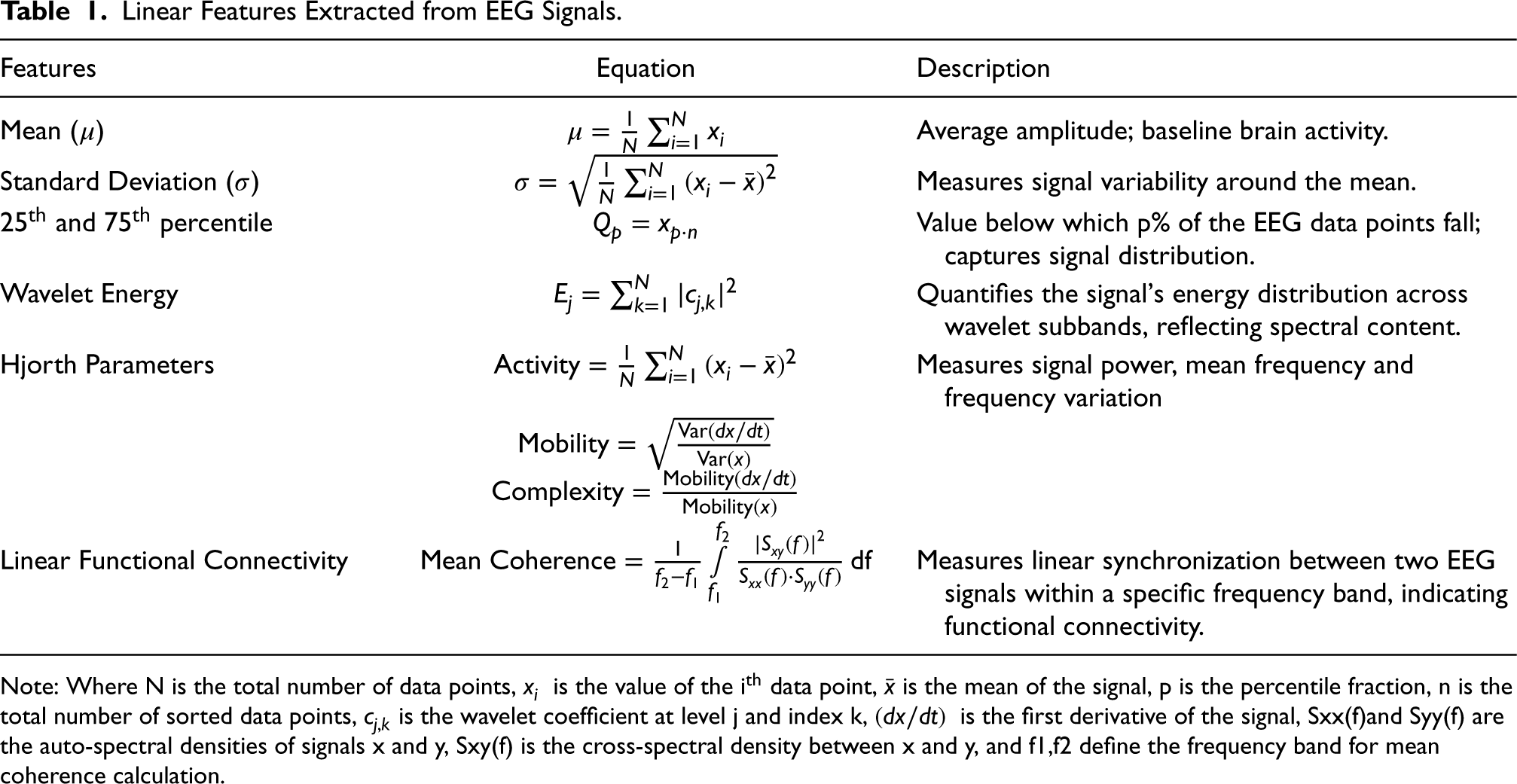
Linear Features Extracted from EEG Signals.
Note: Where N is the total number of data points,
Nonlinear characteristics of EEG signals, capturing their intrinsic complexity and dynamical behavior, are summarized in Table 2.
Nonlinear Features Capturing the Dynamical Characteristics of EEG Signals.
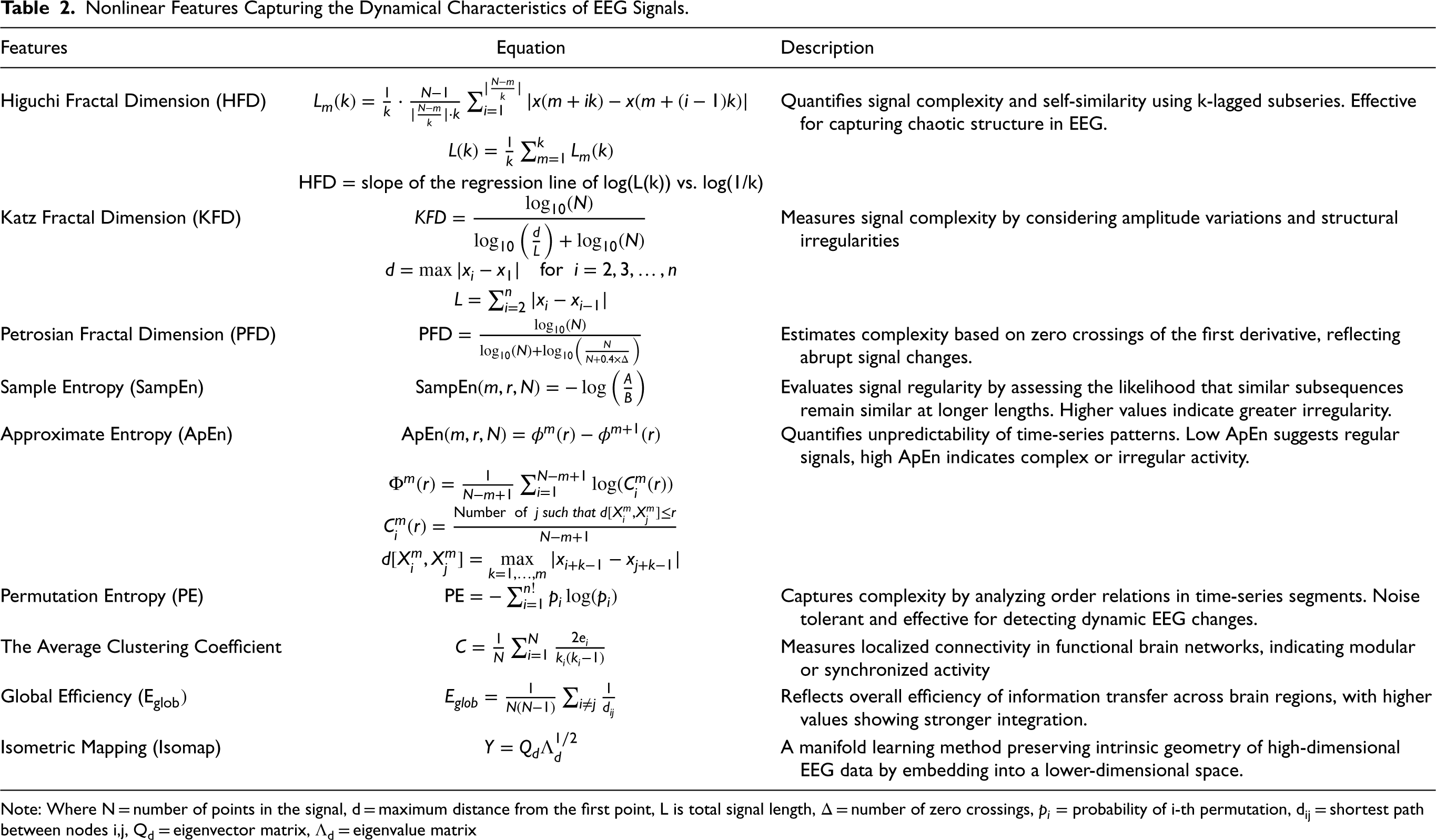
Nonlinear Features Capturing the Dynamical Characteristics of EEG Signals.
Note: Where N = number of points in the signal, d = maximum distance from the first point, L is total signal length, Δ = number of zero crossings,
A hybrid feature set was constructed by integrating linear and nonlinear descriptors to capture both statistical properties and complex dynamical patterns of EEG signals. This composite representation improves the ability of the framework to characterize diverse neural activity. Additional parameters that further enhance discriminability are outlined in the subsequent section. Hybrid feature setare shownm in Table 3.
Hybrid Feature Set Integrating Linear and Nonlinear Descriptors for EEG Signals.
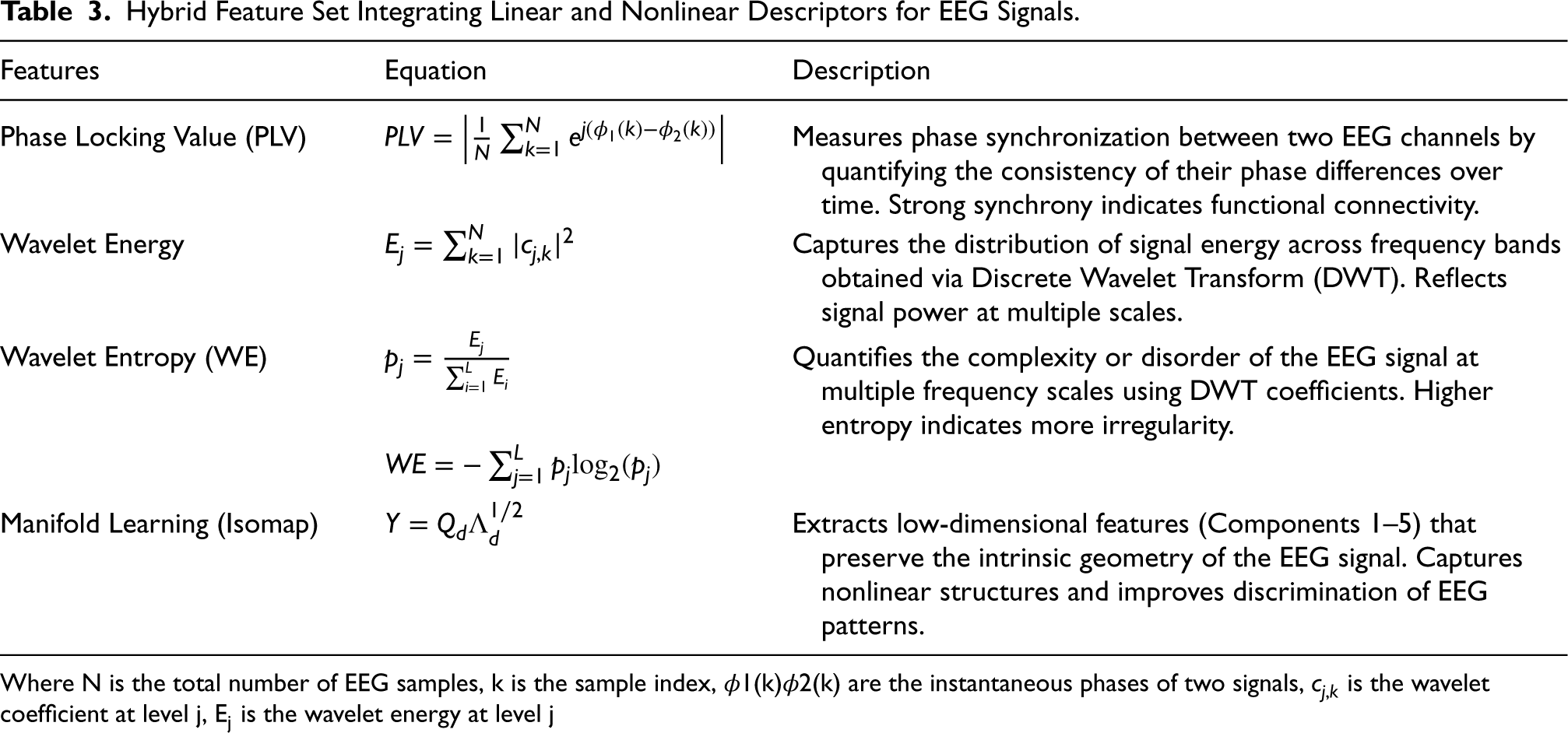
Hybrid Feature Set Integrating Linear and Nonlinear Descriptors for EEG Signals.
Where N is the total number of EEG samples, k is the sample index, ϕ1(k)ϕ2(k) are the instantaneous phases of two signals,
Different classifiers were utilized to evaluate the performance of the extracted and augmented feature sets. The models include traditional supervised approaches, ensemble-based methods, and hybrid combinations that integrate multiple learning strategies. The stacked ensemble classifier was implemented using a cross-validated stacking strategy. The dataset was divided using a stratified train–test split, and feature selection was performed on the training data using Recursive Feature Elimination with Cross-Validation (RFECV) with stratified cross-validation. The stacking classifier internally generates out-of-fold predictions from the base learners to train the meta-learner, ensuring that the meta-learner is trained on predictions from unseen data and preventing data leakage. Hyperparameters of the individual classifiers were selected based on cross-validation during model development to ensure optimal performance and generalization.
Table 4 summarizes each classifier with a brief model description, its corresponding learning type, and the key hyperparameters applied during training.
Summary of Classifiers with Model Descriptions, Learning Types, and Hyperparameters Used.
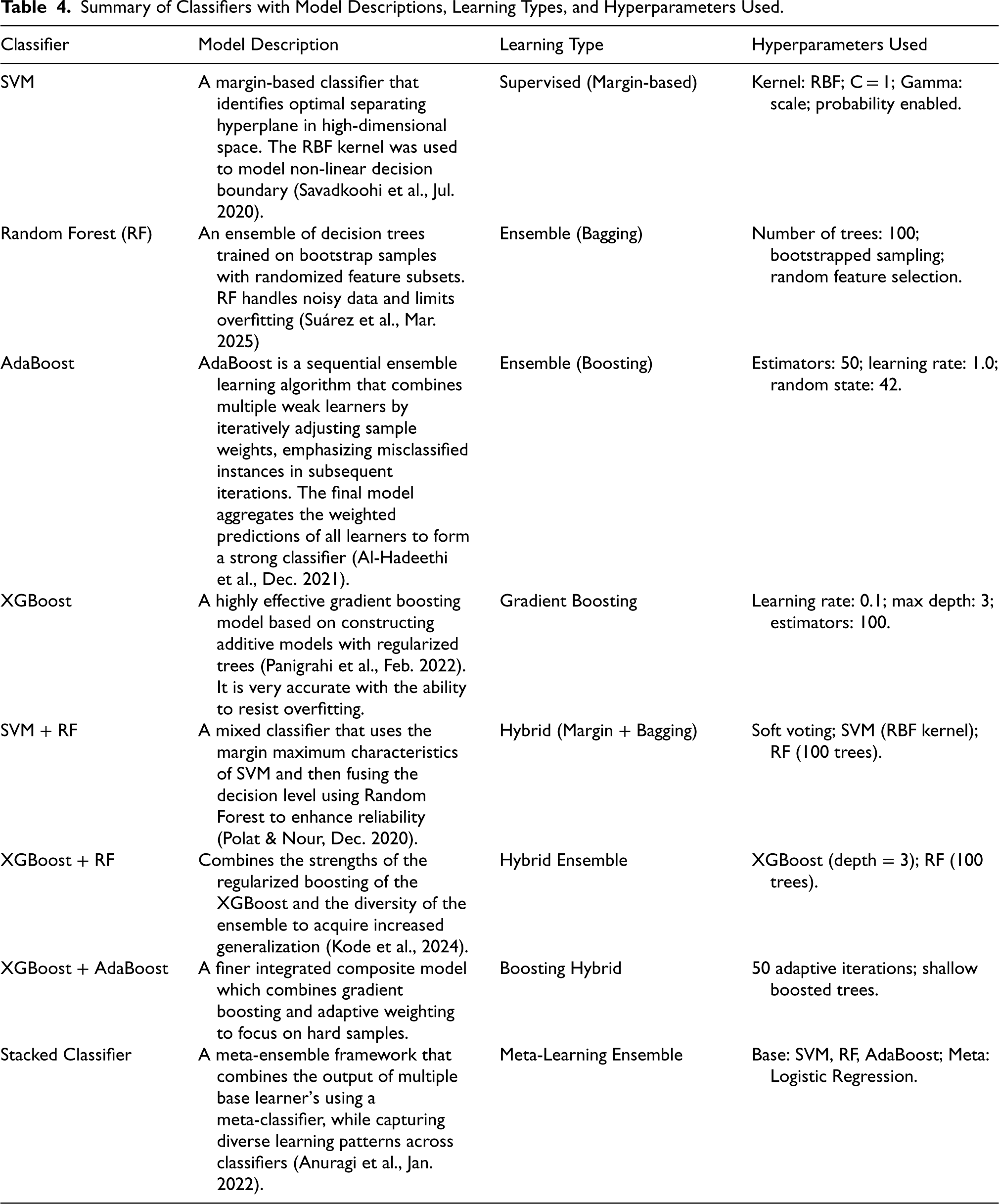
Summary of Classifiers with Model Descriptions, Learning Types, and Hyperparameters Used.
High dimensional feature space often contains redundant features that can impair classifier performance and increase computational cost. To address this, dimensionality reduction techniques were applied to transform the feature space into a lower-dimensional representation. A sequential dimensionality reduction framework combining Principal Component Analysis (PCA) and Linear Discriminant Analysis (LDA) were adopted to enhance model performance. PCA was initially applied to reduce noise and redundancy by projecting the data onto a lower-dimensional space that captures the most significant variance. The number of principal components retained after PCA was set to 100 to preserve the most significant variance while reducing dimensionality. Since PCA does not utilize class label information, it may overlook features that are critical for class discrimination. To address the above, LDA was subsequently applied to the PCA-transformed data to maximize class separability by optimizing the ratio of inter-class to intra-class variance. As this work involves binary classification, LDA produces a single discriminant component, resulting in a one-dimensional discriminative subspace
To prevent data leakage, PCA was fitted using only the training data and the learned transformation was applied to the test data; similarly, LDA was fitted using the PCA-transformed training data and corresponding labels, and the learned projection was applied to the test data. The combined PCA–LDA pipeline not only improves computational efficiency and numerical stability but also consistently yields superior results in EEG-based classification tasks by preserving discriminative structure in a reduced feature space. The resulting PCA–LDA subspace represents a noise-reduced and class-discriminative embedding, which was fused with the extracted feature sets to improve class separability and overall classification performance.
Data Fusion
To enhance class separability, a Dimensionality Reduced–Fused Feature strategy integrates multi-domain descriptors with their low-dimensional embeddings, yielding a compact representation that preserves essential EEG dynamics while improving generalization across classifiers.
Unlike conventional fusion schemes that rely on either raw EEG signals or isolated feature domains, the present framework integrates dimensionality reduction with multi-domain feature representations to achieve enhanced discriminative capability. EEG signals were first denoised using a hybrid Butterworth–WPD filter, after which three independent feature sets—linear, nonlinear, and hybrid were extracted. In parallel, a combined PCA–LDA dimensionality reduction process was applied to the filtered signals to generate a compact subspace optimized for class separability. This reduced representation was subsequently fused with each feature domain, forming three distinctive Dimensionality Reduced–Fused (DR–Fused) feature sets: Linear–DR, Nonlinear–DR, and Hybrid–DR. The fusion process retained domain-specific characteristics while embedding low-dimensional discriminative structure, thereby enriching the feature space with complementary, non-redundant information. Both the original and fused features were evaluated using multiple classifiers to ensure generalizable differentiation between focal and non-focal EEG patterns.
The last phase uses the same classifiers as in Section 3.4, to test the effect of dimensionality reduction and fusion on classification accuracy. Since there is uniformity in the classification models, it is possible to directly compare the results of both the pre-fusion and post-fusion feature sets.
Experimental Setup and Implementation Details
All experiments were implemented in Python using scientific computing and machine learning libraries, including NumPy, SciPy, Pandas, PyWavelets, Scikit-learn, etc. The experiments were conducted on a system with an Intel Core i7 processor and 16 GB RAM. The proposed framework is based on feature engineering and classical machine learning models; therefore, GPU acceleration was not required.
Signal preprocessing was performed using a Butterworth bandpass filter (0.5–50 Hz) followed by Wavelet Packet Decomposition (WPD) using the Daubechies wavelet (db6) up to level 7 for denoising. Linear, nonlinear, and hybrid features were extracted from the filtered EEG signals. Dimensionality reduction was performed using Principal Component Analysis (PCA) followed by Linear Discriminant Analysis (LDA), and the reduced features were fused with the original feature domains to construct fused feature sets.
The dataset was divided into training and testing sets using stratified random sampling to maintain class balance, with 80% of the data used for training and 20% used for testing. To ensure stability and reduce bias due to random partitioning, Stratified K-Fold cross-validation (k = 5) was performed on the training set during model development. Feature scaling was performed using standardization prior to classification. Multiple classifiers, including individual, ensemble, hybrid, and stacked models, were used to evaluate the effectiveness of the proposed feature fusion framework. The hyperparameters used for each classifier are summarized in Table 5. Model performance was evaluated using accuracy, sensitivity, specificity, F1-score, AUC, and Brier score.
Experimental Setup and Parameter Configuration.
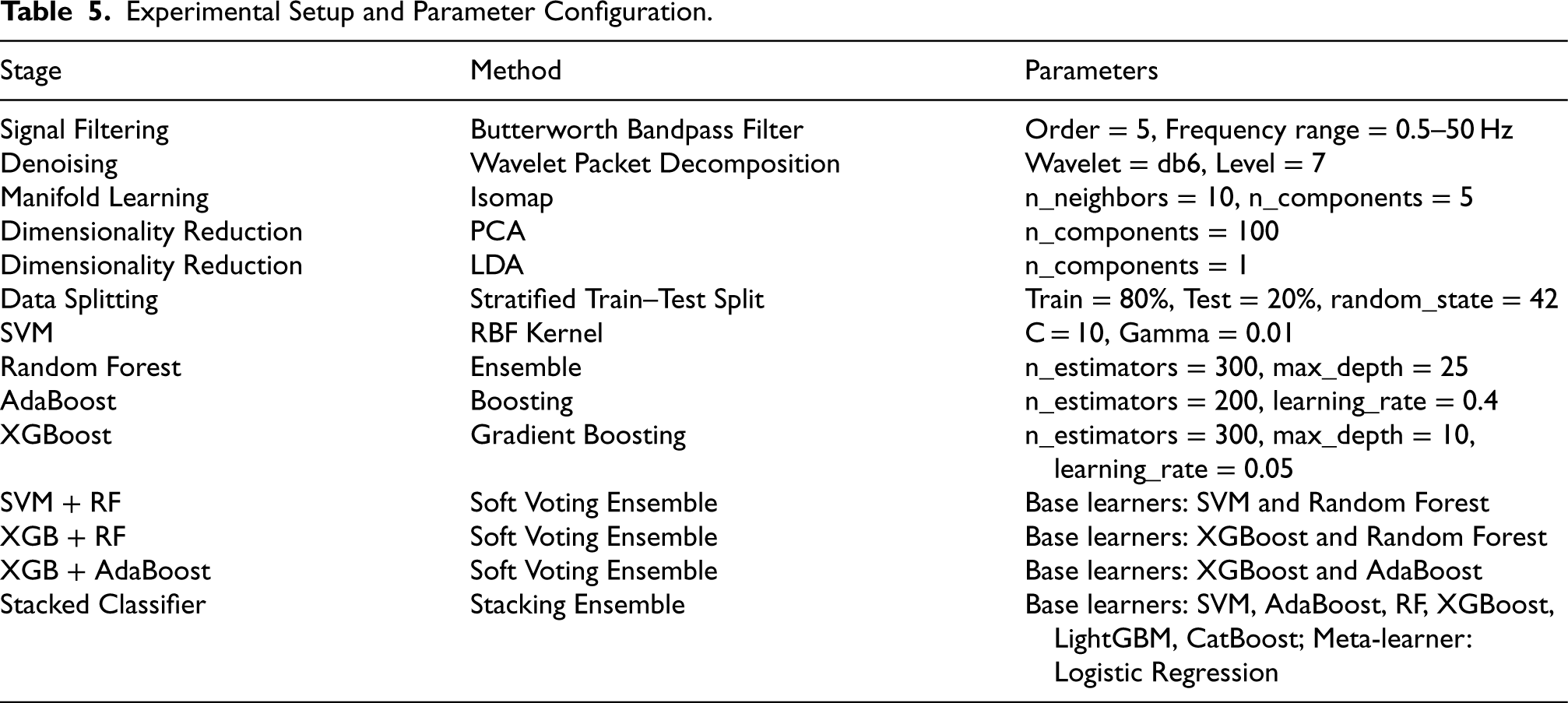
Experimental Setup and Parameter Configuration.
The computational cost of the proposed framework arises from multiple stages, including preprocessing, feature extraction, dimensionality reduction, and classification. The preprocessing stage involves Butterworth filtering and Wavelet Packet Decomposition (WPD), which are computationally optimised signal processing operations and are performed once per signal. The feature extraction stage includes linear, nonlinear, and graph-theoretic features, which introduce moderate computational complexity due to entropy, fractal, and connectivity calculations. However, these features provide highly discriminative information, reducing the need for very complex classifiers. The classification stage includes single, hybrid, and stacked models. Among these, stacked and hybrid models require higher computational time compared to single classifiers due to the combination of multiple learning algorithms. However, the use of dimensionality reduction significantly reduces the feature space, which helps in reducing the overall training time and computational complexity.
Overall, the proposed framework does not require GPU acceleration and can be implemented on a standard computing system. Compared to deep learning-based approaches that require large training data and high computational resources, the proposed method is computationally efficient while still achieving high classification performance, making it suitable for practical EEG analysis applications.
This section presents a critical evaluation of the classification framework developed for distinguishing focal from non-focal EEG signals. The analysis is structured according to the sequential stages of the pipeline, highlighting the influence of hybrid filtering approaches, the benefits conferred by dimensionality reduction, the role of feature extraction, and the impact of multi-domain data fusion on classifier performance. Observations emphasize how the integration of these components contributes to enhanced signal discrimination and classification process.
Feature Visualization of Filtered EEG Signals
To gain a comprehensive understanding of the nonlinear dynamics inherent in the filtered EEG signals, visual feature representations were utilized. These representations offer complementary insights into the temporal and dynamical characteristics of the system. In particular, the Poincaré Section and Recurrence Plot analyses were employed to elucidate distinctive spatiotemporal patterns corresponding to focal and non-focal EEG activities, thereby facilitating a more nuanced characterization of signal dynamics.
Poincaré Section Representation (PSR)
To characterize the nonlinear dynamics of EEG signals beyond conventional time- and frequency-domain analyses, Phase Space Reconstruction (PSR) was applied. PSR provides a geometrical depiction of signal evolution by mapping trajectories in a two-dimensional phase plane, capturing stability, periodicity, and potential chaotic behavior.
As illustrated in Figure 5, focal EEG signals exhibit widely dispersed trajectories, reflecting higher dynamical variability and the presence of irregular events such as bursts or spikes, which are typically associated with epileptogenic regions. In contrast, non-focal signals demonstrate compact, clustered trajectories indicative of stable and periodic dynamics. A quantitative comparison of trajectory dispersion reveals that focal EEG signals exhibit significantly higher spread, with visibly larger spatial occupation in the phase space compared to non-focal signals, whose trajectories remain confined within a narrow region. This increased dispersion indicates higher variance and complexity in focal signals, whereas the tightly clustered structure of non-focal signals reflects lower variability and more regular dynamics. Furthermore, the presence of irregular loops and extended trajectory deviations in focal signals, as opposed to the smoother and more consistent patterns observed in non-focal signals, highlights the difference in underlying dynamical behavior. These distinct visual features—trajectory divergence, loop formations, and clustering—serve as markers for discriminating between focal and non-focal EEG activity, highlighting the utility of PSR for enhancing classification performance.
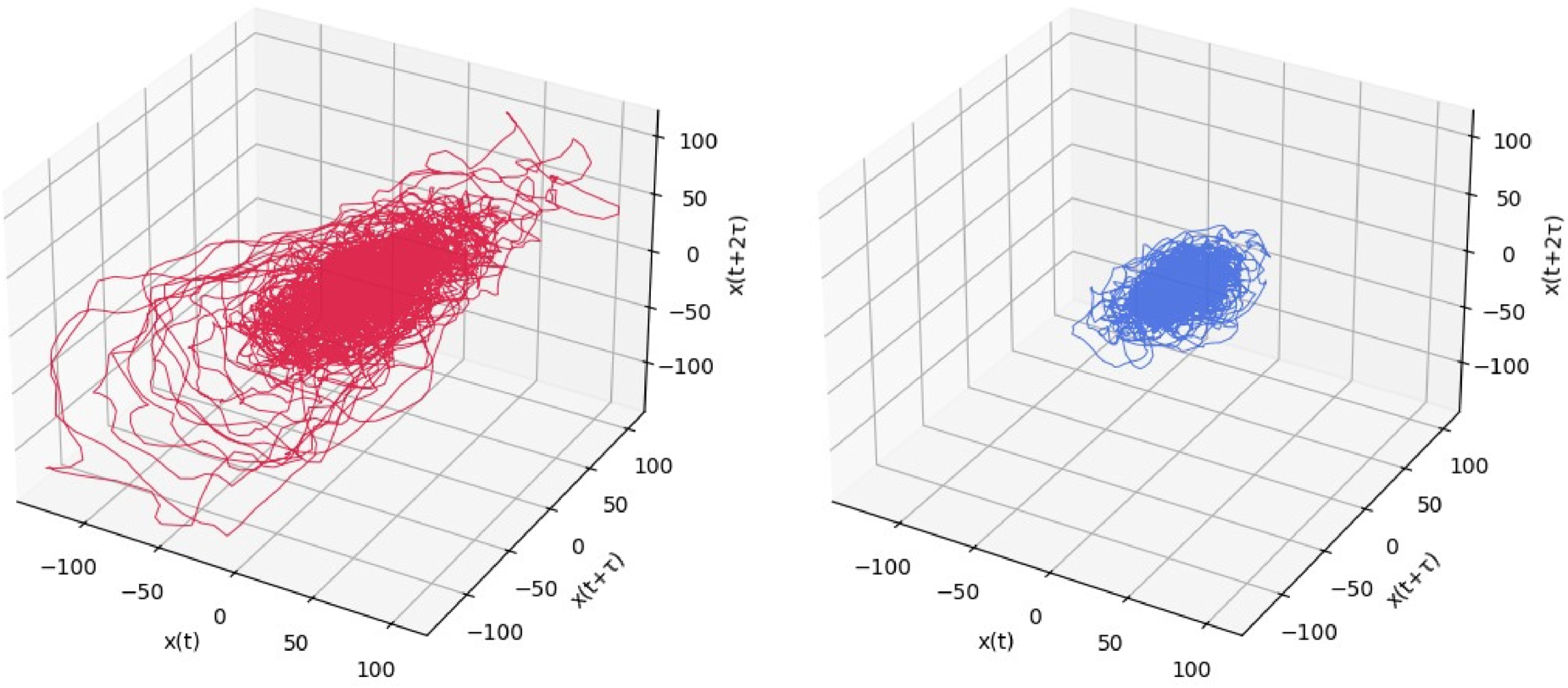
Poincaré section representation of filtered EEG signals focal (left) and non-focal(right).
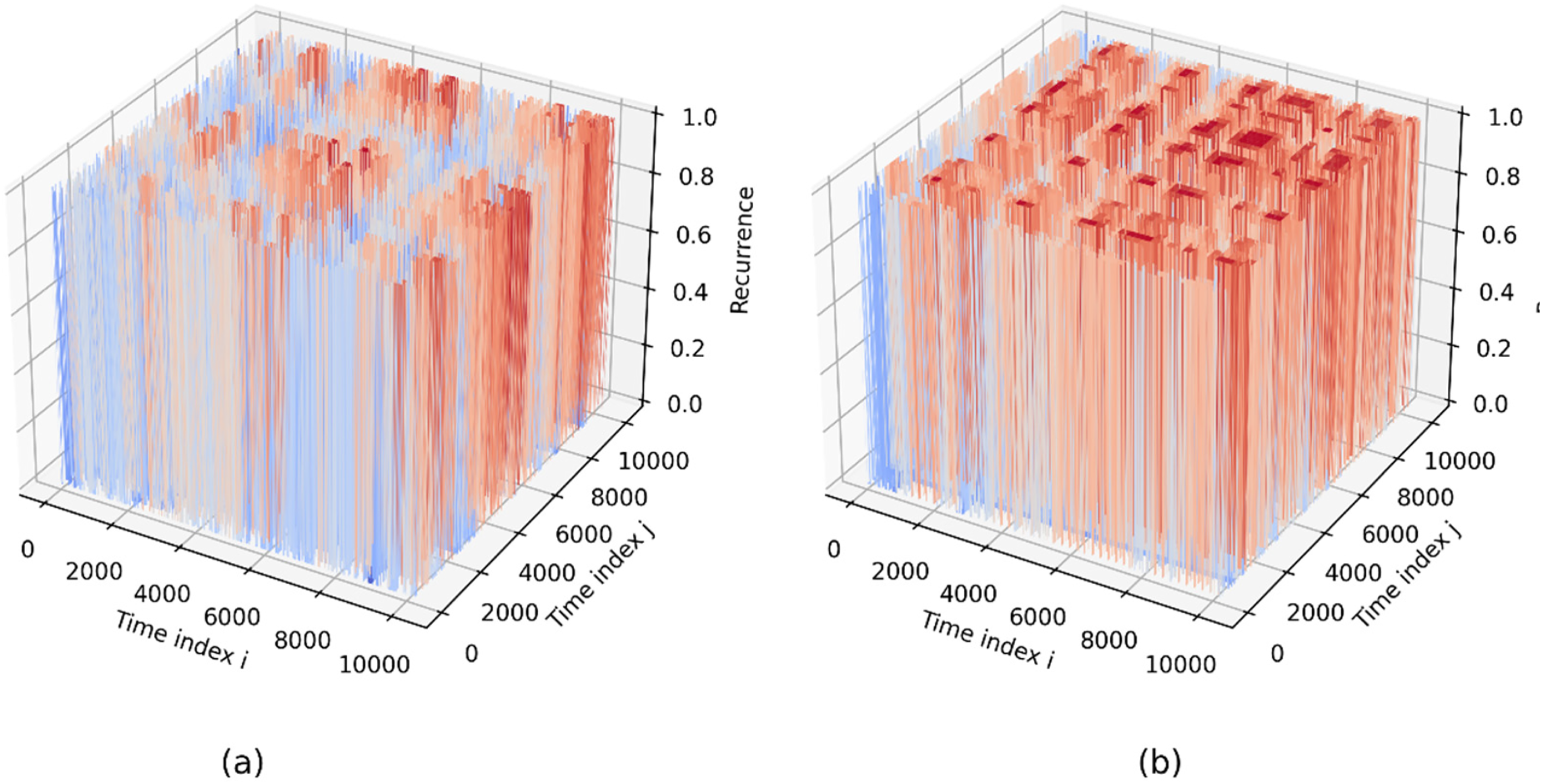
3D recurrence plot visualization of filtered EEG signals (a) focal (b) non-focal.
To further investigate the temporal recurrence characteristics of EEG dynamics, Recurrence Plot (RP) analysis was employed. RP identifies points at which the system revisits similar states, providing insight into periodicity and chaotic behavior. Figure 6 presents three-dimensional recurrence surfaces for focal and non-focal EEG segments. Focal signals display irregular, fragmented recurrence patterns, indicative of highly unstable and chaotic transitions commonly associated with epileptogenic activity. In contrast, non-focal signals exhibit structured, repetitive patterns, reflecting stable and periodic dynamics. A quantitative interpretation of the recurrence structure reveals that focal EEG signals exhibit lower recurrence uniformity and higher variability, as evidenced by the uneven distribution and discontinuity of recurrence intensities across the surface. In comparison, non-focal signals demonstrate higher recurrence density and consistency, with more uniformly distributed recurrence values indicating stable temporal evolution. The increased fragmentation and irregularity observed in focal signals correspond to higher dynamical complexity, whereas the smoother and more continuous recurrence patterns in non-focal signals reflect lower complexity and stronger periodic behavior. These visual distinctions underscore the greater dynamical complexity of focal EEG signals and highlight RP analysis as a valuable tool for discriminating between focal and non-focal activity, thereby supporting improved classification outcomes.
Classifier Output
This section presents a detailed analysis of the experimental outcomes derived from the proposed EEG classification framework. Classification was performed at two critical stages: (i) immediately after feature extraction and (ii) following the application of dimensionality reduction and feature fusion. To ensure consistency and comparability, identical classifiers were employed across both stages. A total of eight classifiers—comprising traditional (SVM), ensemble (AdaBoost, Random Forest, XGBoost), and hybrid models (SVM + RF, XGB + RF, XGB + AdaBoost, and Stacked)—were evaluated on six feature configurations, namely Linear, Nonlinear, Hybrid, and their respective dimensionality-reduced (DR) fused counterparts. To enhance model robustness and eliminate redundant features, RFECV was applied prior to classification. Model evaluation was performed using stratified 5-fold cross-validation to ensure balanced class representation across folds. The variation in performance across folds was minimal, with deviations observed in the range of approximately 0.001–0.008, indicating stable and consistent model performance. Performance evaluation was conducted using accuracy, sensitivity, specificity, F1-score, AUC, and Brier score as key metrics.
For clarity and brevity, Table 6 reports only the results of the best-performing classifiers, including XGBoost (individual), XGB + AdaBoost (hybrid), and the Stacked Classifier (meta-ensemble), to illustrate the impact of feature complexity, dimensionality reduction, and model architecture on classification performance.
Performance Comparison of Classification Models Using Various Feature Sets (Pre- and Post- Fusion).
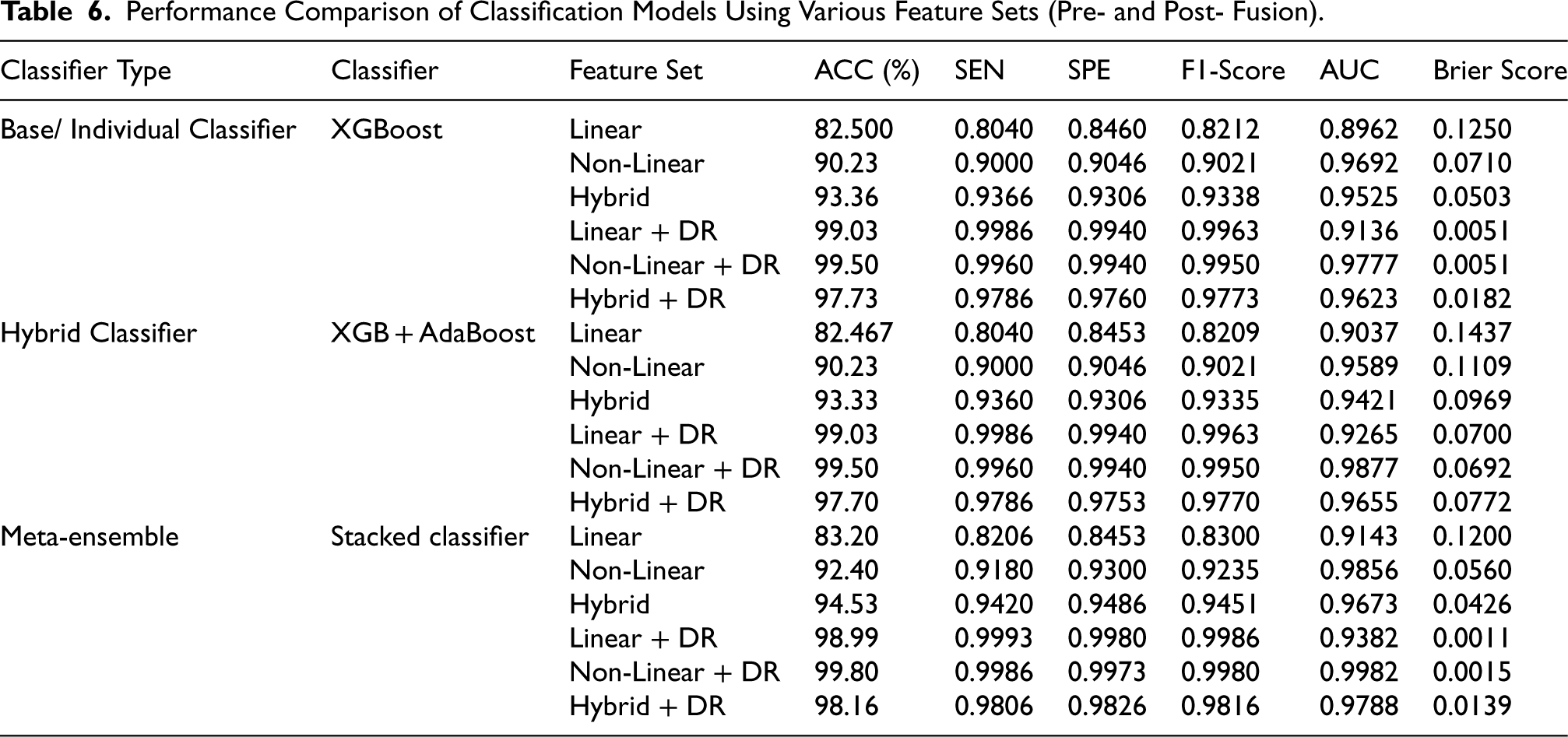
Performance Comparison of Classification Models Using Various Feature Sets (Pre- and Post- Fusion).
Table 6 summarizes the classification performance of the three best-performing models-XGBoost, XGB + AdaBoost, and the Stacked Classifier—evaluated across six distinct feature configurations. The results reveal a consistent performance improvement when dimensionality reduction (DR) is applied to fused feature sets, highlighting its role in enhancing discriminative capability by minimizing feature redundancy while retaining essential information.
The Non-linear + DR and Hybrid + DR feature configurations achieve near-optimal outcomes across all evaluation metrics. The Non-linear + DR feature set in particular attains the highest overall performance, with the stacked ensemble achieving an accuracy of 99.80%, AUC of 0.99, and the lowest Brier score (0.015). This superior result indicates excellent calibration, reliability, and generalization, affirming that the combination of nonlinear features with dimensionality reduction best captures the intrinsic chaotic and complex dynamics of EEG signals.
The XGB + AdaBoost hybrid model also demonstrates strong discriminative performance (ACC = 99.50%, SEN = 0.996, SPE = 0.994, Brier = 0.0692), but the Stacked Classifier marginally outperforms it across all metrics. Although the numerical difference is small, the stacked model exhibits enhanced stability benefiting from the integration of complementary decision boundaries from multiple base learners.
Linear feature sets, in contrast, produce relatively modest results (<84% accuracy) and higher Brier scores, reflecting their limited ability to capture the nonlinear variability of EEG dynamics. Hybrid and nonlinear feature domains, particularly when fused with DR, exhibit substantial gains in sensitivity, specificity, and F1-scores, confirming their superior discriminative strength.
Overall, the findings conclusively demonstrate that feature fusion integrated with dimensionality reduction yields the most reliable and high-performing EEG classification outcomes, with the Non-linear + DR configuration emerging as the most effective representation and the Stacked Classifier providing the most consistent and generalizable performance across all feature types.
Figure 7 illustrates the comparative classification accuracies achieved across eight classifiers for all six feature configurations. A clear trend is observed wherein feature sets fused with dimensionality reduction (DR) consistently outperform their non-fused counterparts, reaffirming the effectiveness of DR in enhancing discriminative representation. Specifically, DR-based feature configurations demonstrate an improvement of approximately 3–7% in accuracy across most classifiers when compared to their corresponding non-DR variants, indicating a consistent enhancement in model performance. For instance, in the case of ensemble classifiers such as XGBoost and Stacked models, hybrid feature sets combined with DR achieve peak accuracies approaching 99%, whereas the corresponding non-DR configurations remain below this range. Notably, configurations integrating nonlinear and hybrid features with DR achieve the highest accuracies across nearly all classifiers, demonstrating superior adaptability to the complex, nonstationary nature of EEG dynamics.
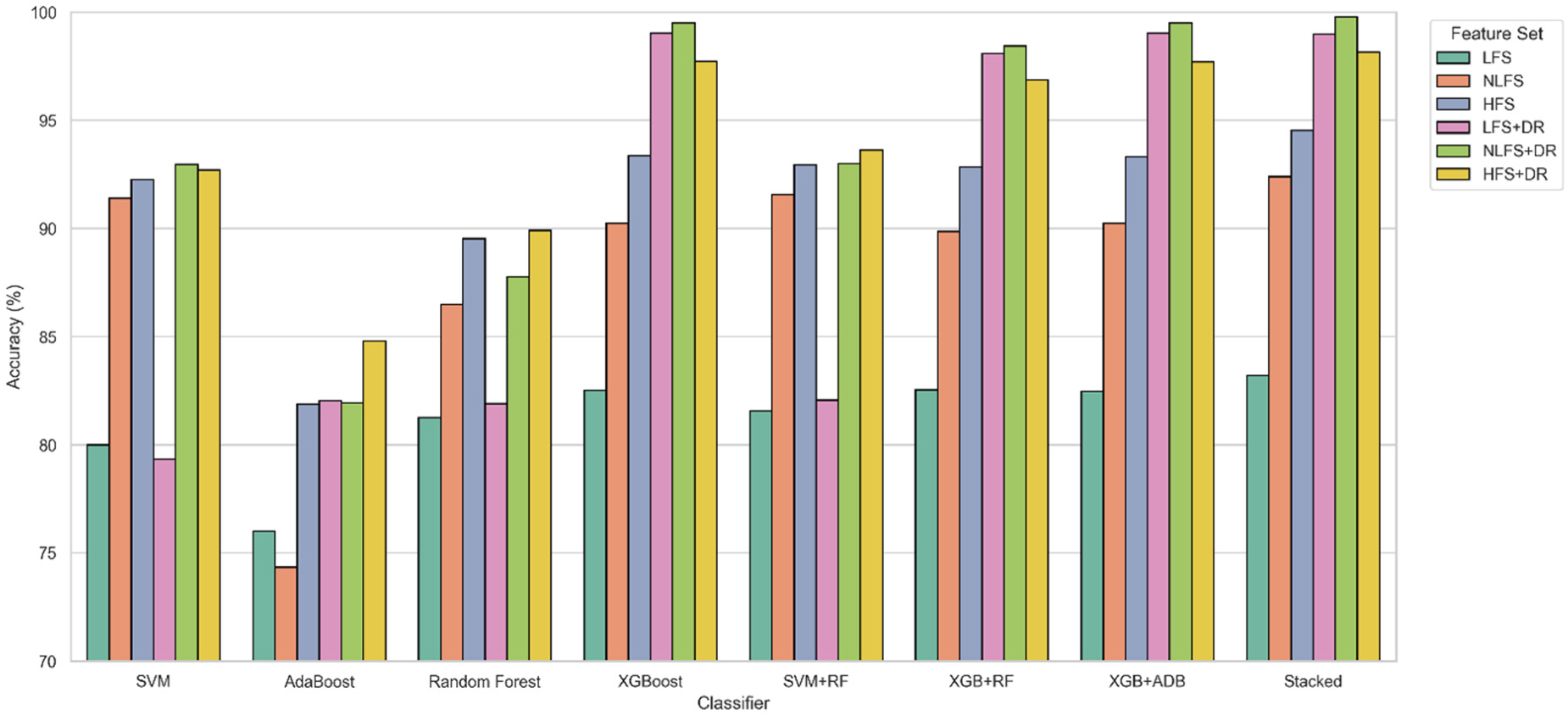
Comparative accuracy of different classifiers across feature configurations.
Among the evaluated classifiers, ensemble-based methods (XGBoost, XGB + RF, and Stacked) consistently outperform individual classifiers, achieving accuracy gains of approximately 4–8% over baseline models such as AdaBoost and Random Forest. This trend indicates that the combination of feature fusion and ensemble learning effectively captures both linear and nonlinear EEG characteristics, leading to improved classification robustness. While classification accuracy provides an initial measure of model capability, it does not fully capture aspects such as class-specific sensitivity or calibration reliability—factors critical to EEG-based clinical applications. Therefore, to obtain a more comprehensive assessment, additional evaluation metrics including sensitivity, specificity, F1-score, AUC, and Brier score were incorporated.
To enable fair cross-metric comparison, all metric values were normalized using min–max scaling between 0 and 1, ensuring that differences in scale did not bias interpretation. Subsequently, the normalized metrics were aggregated to compute an overall normalized score for each classifier–feature combination, forming the basis for ranking and further visualization through a composite heatmap (Figure 8). This approach provides a balanced and integrative view of classifier behavior, highlighting those configurations that maintain consistent performance across diverse evaluation criteria.
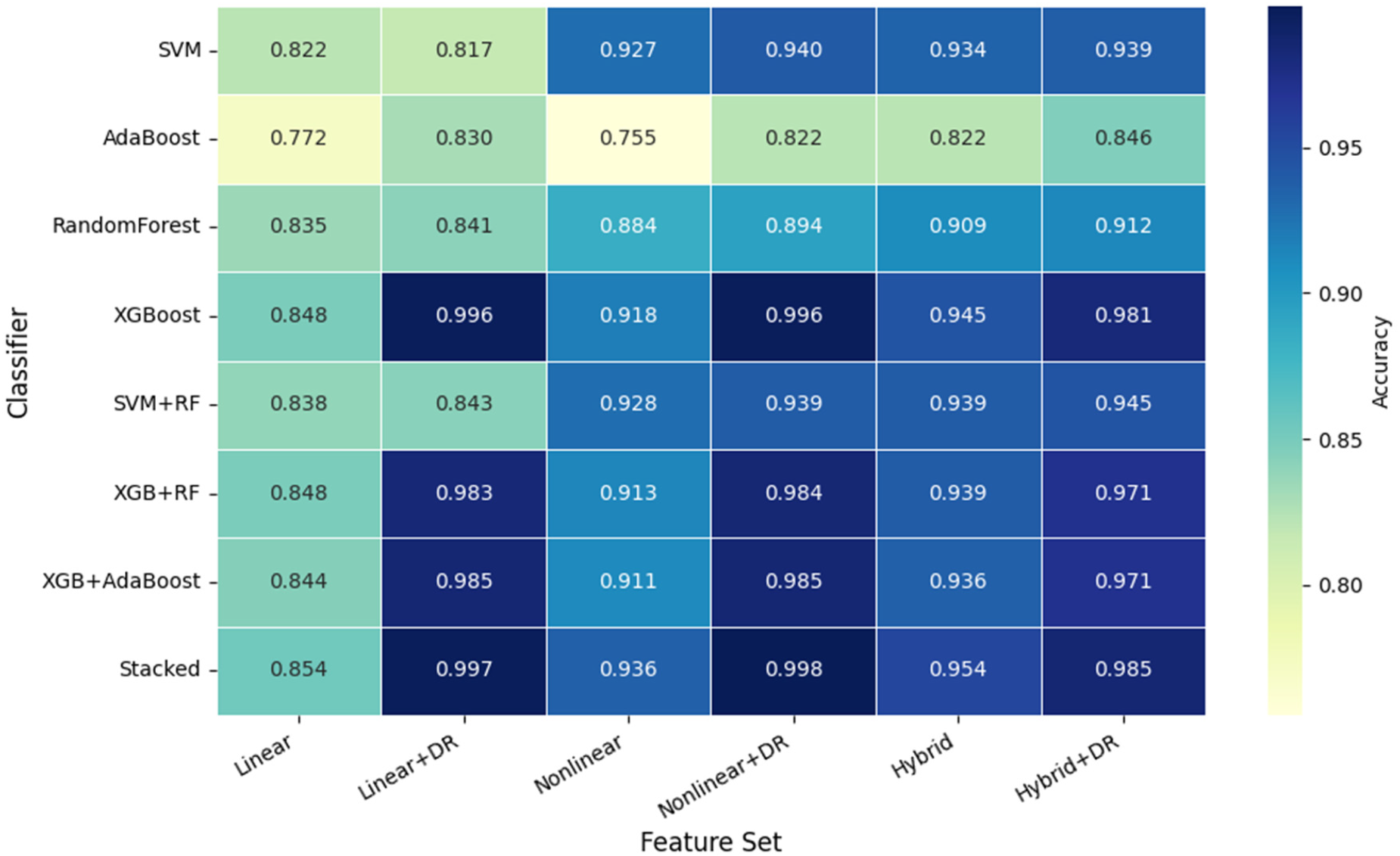
Heatmap of normalized performance scores of feature sets across classifiers.
Figure 8 presents a heatmap illustrating the normalized, multi-metric performance across all classifiers and feature configurations. The visualization provides an integrative perspective of classifier behavior, highlighting subtle yet meaningful variations that may not be evident from individual metrics alone. A quantitative inspection of the heatmap reveals that feature configurations incorporating dimensionality reduction (DR) consistently achieve higher normalized scores, typically in the range of 0.93 to 0.99, compared to non-DR configurations which generally remain below 0.90. Among the fused feature configurations, the Non-linear + DR set demonstrates the most consistent and superior performance, maintaining high normalized scores across nearly all classifiers. In particular, the Stacked classifier achieves the highest performance with a peak normalized score of approximately 0.998 under the Non-linear + DR configuration, followed closely by XGBoost and XGB-based ensemble models with scores exceeding 0.98. The Hybrid + DR configuration follows closely, displaying stable performance—particularly when coupled with ensemble and hybrid learning models.
Although the Linear + DR feature set achieves competitive results with classifiers such as XGBoost and the stacked ensemble, its performance exhibits greater variability across other models, suggesting classifier-dependent sensitivity. The heatmap thus reinforces earlier observations from the quantitative analysis, confirming that Non-linear + DR and Hybrid + DR configurations provide the most reliable and generalizable feature representations. The normalization process ensures an equitable evaluation across all metrics, allowing the heatmap to clearly emphasize configurations that maintain balanced excellence in accuracy, sensitivity, specificity, and calibration quality.
Table 7 summarizes the averaged normalized performance scores and corresponding ranks obtained for all evaluated feature set combinations. The Non-linear + DR configuration achieved the highest normalized score (0.95), followed closely by the Hybrid + DR configuration (0.94). Although these two feature sets appear visually comparable in the heatmap (Figure 8), the quantitative ranking confirms the superior discriminative capacity of nonlinear descriptors when integrated with dimensionality reduction. The Hybrid + DR feature set also demonstrated highly competitive performance, suggesting that combining linear and nonlinear feature domains enhances the overall representational richness of EEG dynamics.
Averaged Normalized Performance Scores and Ranks of Feature Sets Across Classifiers.
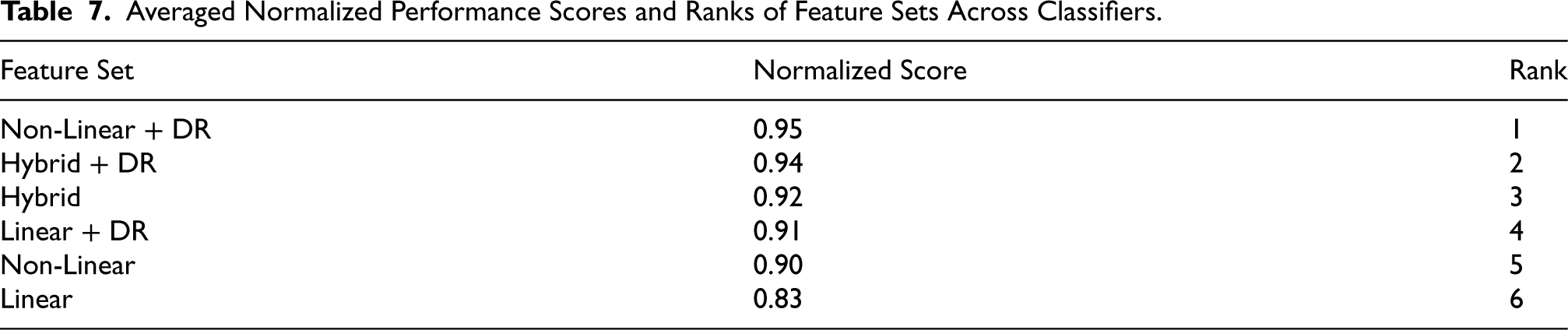
In contrast, the Linear feature set yielded the lowest normalized score (0.83), reinforcing its limited ability to capture the complex, nonstationary characteristics of EEG signals. These findings highlight the critical role of selecting appropriate feature representations and fusion strategies to achieve reliable discrimination between focal and non-focal EEG patterns.
Among all evaluated combinations, the Non-linear + DR configuration consistently emerged as the most stable and robust performer across multiple evaluation metrics, closely followed by Hybrid + DR. The integration of dimensionality reduction not only improved accuracy but also enhanced calibration and generalization, leading to more dependable classification outcomes. Furthermore, ensemble-based architectures—particularly the Stacked, XGB + RF, and XGBoost classifiers—consistently delivered superior results, demonstrating their strength in exploiting the structured variability of the reduced nonlinear and hybrid feature spaces.
To evaluate the statistical reliability of the proposed EEG classification framework, stratified cross-validation was performed and the performance metrics were analyzed using statistical measures. Table 8 presents the classification performance in terms of mean, standard deviation, and 95% confidence intervals for the best performing featureset- Nonlinear + DR. The results show very small standard deviation values (approximately 0.0005–0.008), indicating that the model performance is stable and not dependent on a specific data split. The narrow confidence intervals further confirm the reliability and consistency of the proposed method.
Cross-Validation Performance with Confidence Interval.
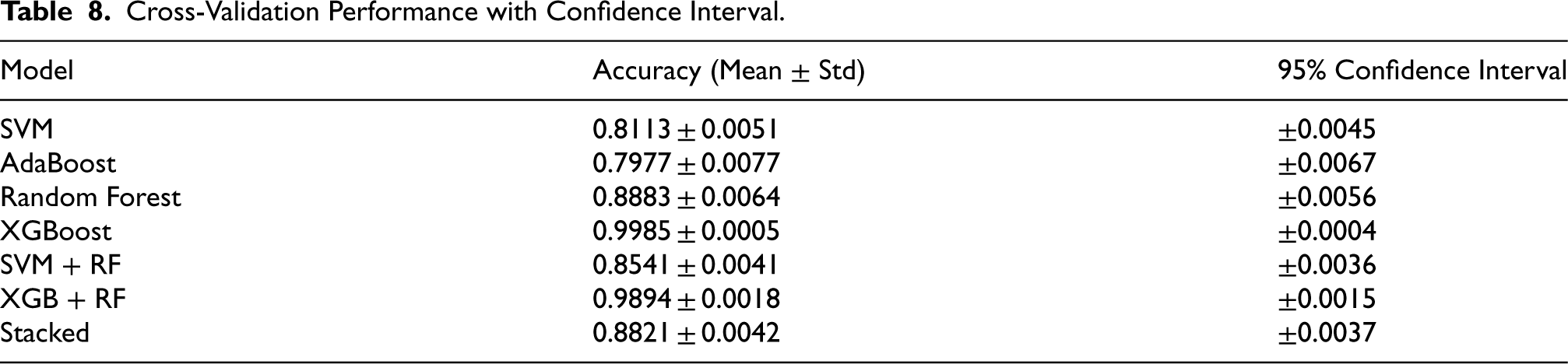
Cross-Validation Performance with Confidence Interval.
Furthermore, paired statistical tests were conducted across cross-validation folds to compare classifier performance. The statistical analysis indicated that the performance differences between classifiers are statistically significant (p < 0.05) in most cases, demonstrating that the observed performance improvements are not due to random variation but are statistically meaningful. Overall, the statistical results confirm that the proposed feature extraction and feature fusion framework provides stable and statistically reliable classification performance.
The key novelty of this work lies in the fusion of dimensionally reduced features (PCA + LDA) with the original Linear, Nonlinear, and Hybrid feature sets. Rather than relying solely on the original or reduced representations, the proposed framework reintegrates the reduced components into their corresponding feature spaces, forming enriched composite sets: Linear + DR, Nonlinear + DR, and Hybrid + DR. This design synergistically combines the variance-preserving nature of PCA and the class-discriminative strength of LDA with the intrinsic statistical and dynamical characteristics of each feature domain. Consequently, the fused representations provide a compact yet information-rich description of EEG signal behavior, improving both separability and stability. A comparative analysis between pre-fusion and post-fusion feature sets reveals a consistent improvement in classification performance across all classifiers, indicating the effectiveness of the proposed fusion strategy.
Figure 9 illustrates the normalized classification performance of all feature sets before and after fusion. As evident from the figure, the post-fusion feature sets consistently outperform their pre-fusion counterparts across all classifiers. Quantitatively, the fused feature sets demonstrate an improvement of approximately 3–6% in accuracy compared to their corresponding pre-fusion representations, with the most significant gains observed in nonlinear and hybrid configurations. The Nonlinear + DR and Hybrid + DR configurations exhibit the most pronounced improvements, demonstrating that the integration of reduced representations significantly enhances discriminative capacity.
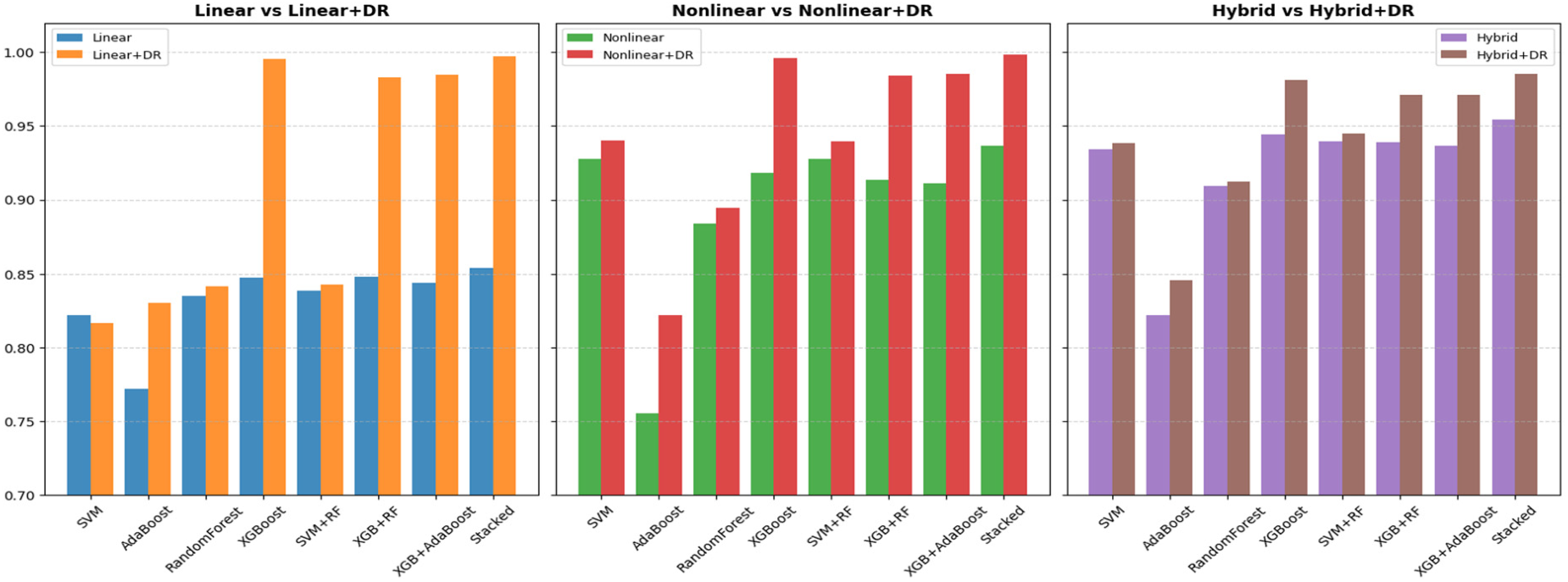
Comparison of pre-fusion and post-fusion feature set performance.
Furthermore, ensemble-based classifiers such as XGBoost, XGBoost + RF, XGBoost + AdaBoost, and Stacked show a substantial increase in performance following fusion. In particular, ensemble models consistently achieve higher accuracy after fusion, indicating that the enriched feature representation enables better learning of complex decision boundaries. This improvement highlights the complementary nature of original and reduced features, where fusion effectively reduces redundancy while preserving discriminative information
To minimize the risk of overfitting, the performance of the optimal stacked model was further validated through Receiver Operating Characteristic (ROC) curve analysis and confusion matrix evaluation. The ROC curve quantifies the model's discriminative capability across varying thresholds, whereas the confusion matrix provides a detailed representation of correct and misclassified instances, offering complementary insight into classification reliability.
Receiver Operating Characteristic (ROC) Curve
The Receiver Operating Characteristic (ROC) curve serves as a graphical tool to assess a classifier's capability to differentiate between classes across various decision thresholds. It plots the True Positive Rate (sensitivity) against the False Positive Rate (1 – specificity), thereby offering an aggregate view of classification performance. Figure 10 illustrates the ROC curves obtained for all feature sets using the best-performing stacked model. Among these, the dimensionality-reduced fused features exhibited the highest Area Under the Curve (AUC) value of 0.9982 for the Nonlinear + DR configuration, demonstrating superior discriminative strength. The remaining feature sets also achieved consistently high AUCs, ranging from 0.912 to 0.952, underscoring the model's reliability in accurately distinguishing focal from non-focal EEG signals across diverse feature representations.
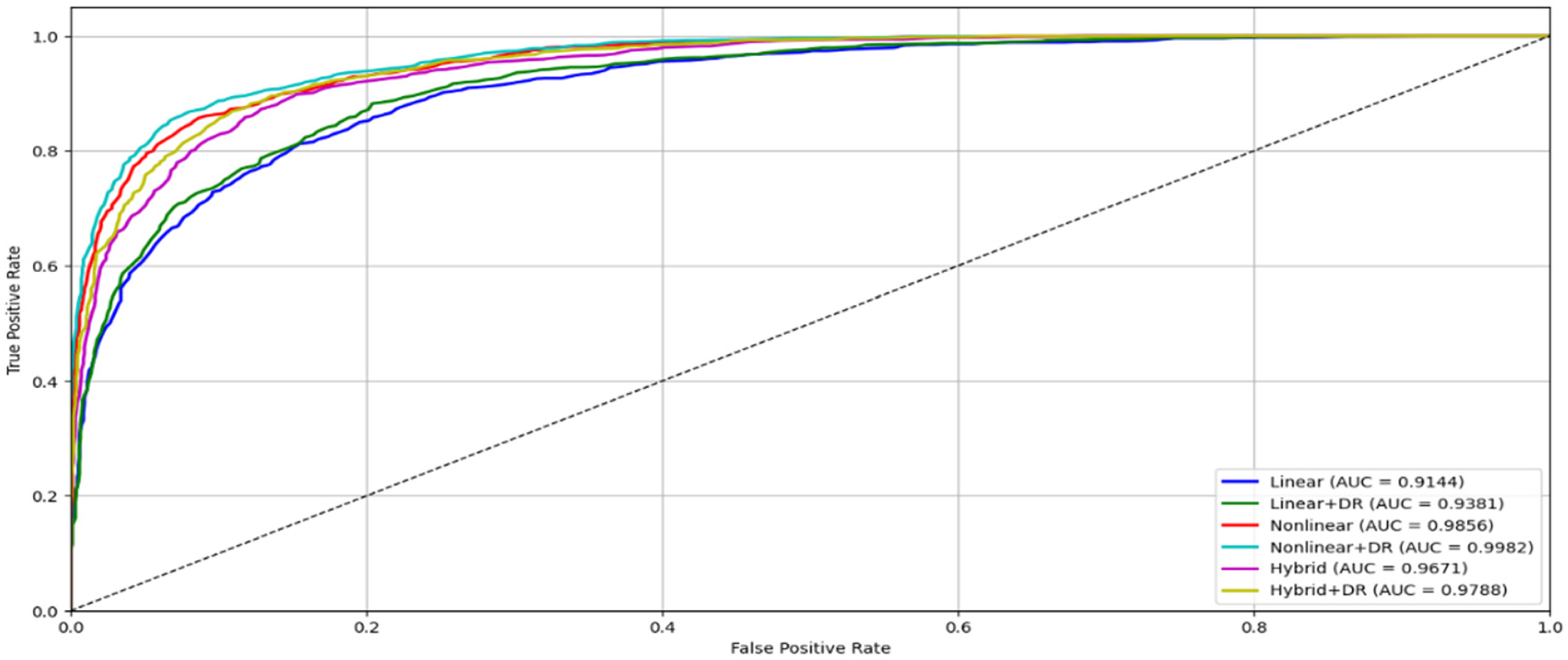
ROC curves for the feature sets using the stacked model.
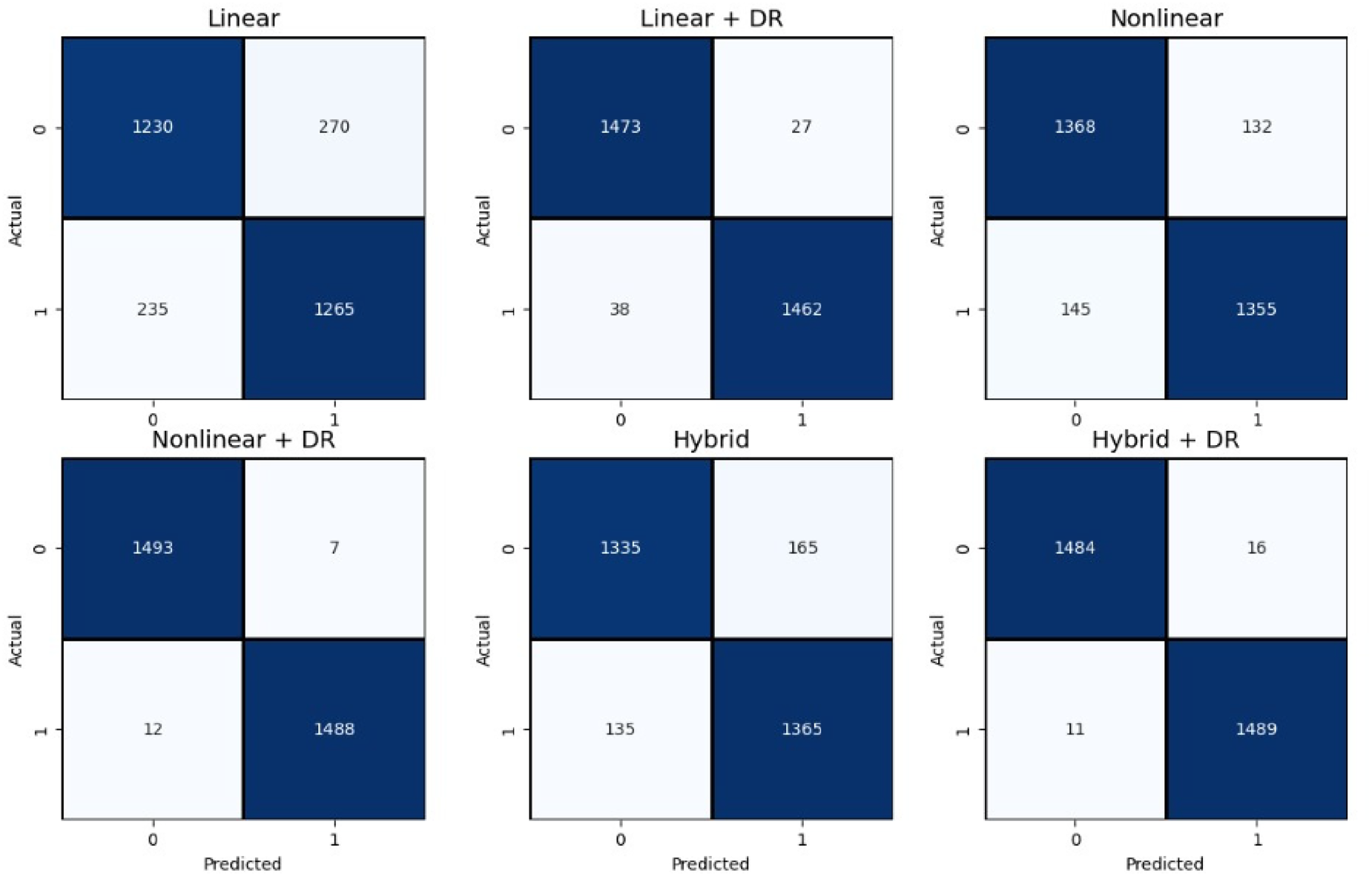
Confusion matrices for the feature sets using the stacked model.
These findings indicate that the model's superior performance results from the combined effect of feature fusion and dimensionality reduction rather than overfitting. By integrating complementary neurodynamic characteristics and minimizing redundant information, the model generalizes effectively to unseen EEG data. The corresponding confusion matrix analysis further supports this observation by highlighting consistently high true positive rates and minimal misclassifications across feature sets.
The confusion matrix provides a comprehensive assessment of the classifier's performance by displaying the counts of true positives, true negatives, false positives, and false negatives. It enables evaluation not only of the overall accuracy but also of the error distribution across classes.
Figure 11 presents the confusion matrices for all feature sets using the best-performing stacked model. The dimensionality-reduced fused features exhibit the highest discriminative capability, with the Nonlinear + DR configuration correctly identifying 1,493 focal and 1,488 non-focal samples, resulting in only a few misclassifications. Similarly, the Linear + DR and Hybrid + DR feature sets demonstrate strong predictive stability, underscoring the model's robustness in capturing subtle neurodynamic differences between focal and non-focal EEG patterns.
Comparison with Existing Methods
To contextualize the performance of the proposed framework, it was compared with recent studies on focal and non-focal EEG classification that used the same Bern–Barcelona EEG dataset. Since classification performance can vary depending on preprocessing methods, feature extraction techniques, and evaluation protocols, comparison across different datasets or experimental setups may not be directly comparable. Therefore, the comparison presented in Table 9 focuses on studies conducted on the same dataset to ensure a fair and consistent evaluation. As summarized in the table, the proposed stacked model demonstrates superior discriminative performance, highlighting the advantage of integrating feature fusion with dimensionality reduction for reliable EEG signal classification.
Comparative Analysis of the Proposed Method with Existing State-of-the-Art Approaches.
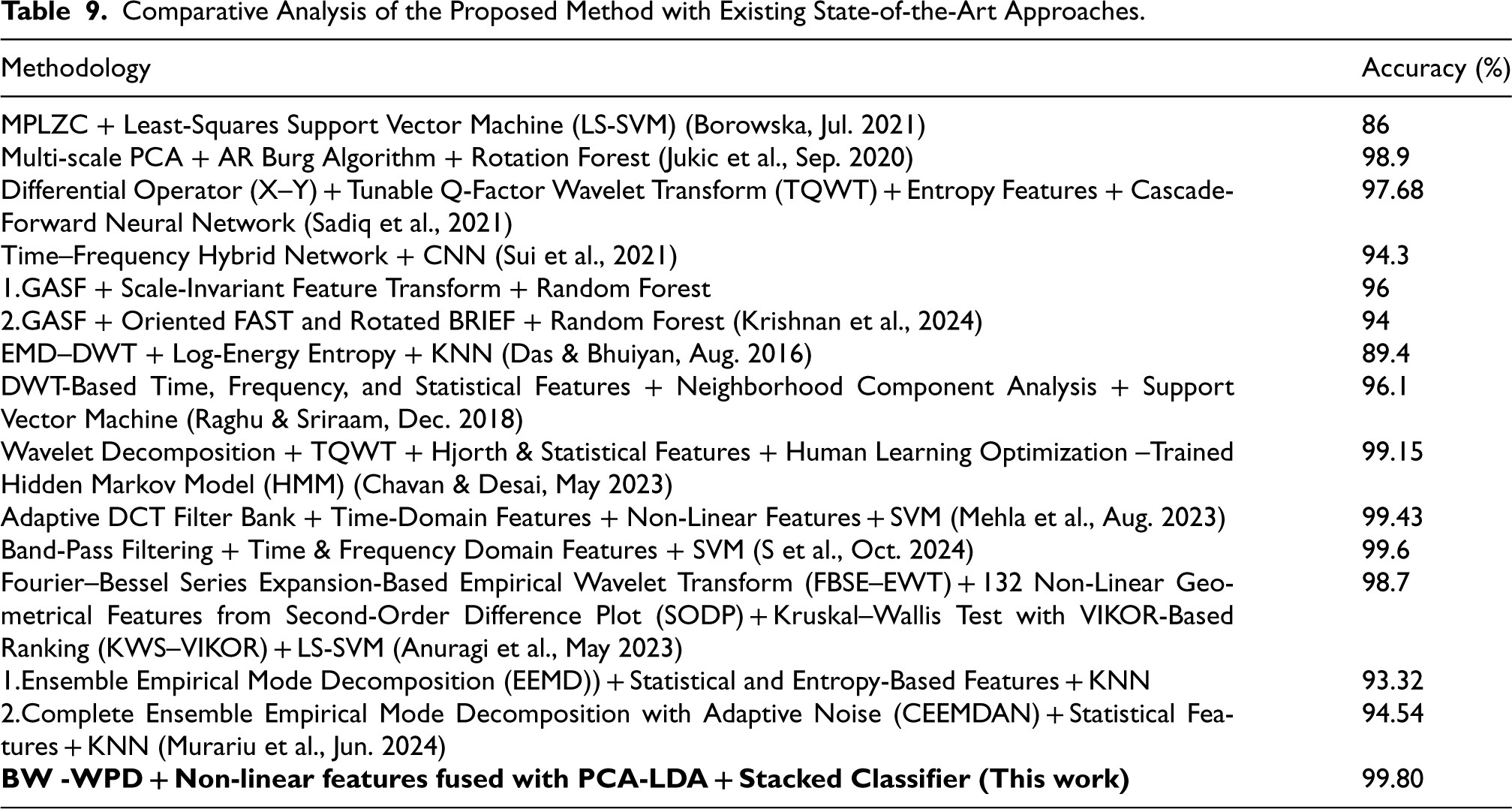
Comparative Analysis of the Proposed Method with Existing State-of-the-Art Approaches.
Although previous studies, summarized in Table 9, report relatively high accuracy in distinguishing focal from non-focal EEG signals, they predominantly emphasize accuracy alone, which may overlook important facets of classifier performance. In this work, evaluation extends beyond accuracy to include sensitivity, specificity, F1-score, area under the ROC curve (AUC), and Brier score, with all metrics normalized to facilitate unbiased comparison. Such a comprehensive assessment is essential because high accuracy by itself does not necessarily indicate clinical reliability and can obscure the presence of false negatives, which are critical in epileptic EEG diagnosis. By integrating both performance-based and loss-based measures, the proposed framework provides a more holistic and clinically meaningful appraisal of classifier efficacy.
This work presents a systematic evaluation of EEG signal classification schemes through an integrated framework that combines linear, nonlinear, and hybrid feature extraction techniques with dimensionality reduction and data fusion. The proposed framework adopts a normalized multi-metric evaluation strategy, ensuring unbiased and comprehensive performance assessment across multiple classifiers. Unlike conventional approaches that rely solely on accuracy, this multi-metric method provides deeper insights into model behavior and generalization capability.
Among the various feature combinations analyzed, nonlinear features fused with dimensionally reduced data consistently demonstrated superior performance across several evaluation metrics, including accuracy, sensitivity, specificity, F1-score, AUC, and Brier score. The Hybrid-DR fused feature set also achieved strong results, indicating that integrating diverse descriptors can be beneficial. However, its relatively lower performance compared to the Nonlinear-DR combination suggests that certain linear features may introduce redundancy. Overall, all feature sets exhibited notable improvements when fused with dimensionality-reduced representations.
The novelty of this work lies in two major contributions. First, it introduces a multi-metric normalization and ranking framework that enables a fair and unbiased comparison across experimental configurations. Second, it demonstrates that the strategic fusion of nonlinear features with dimensionally reduced data yields a compact and reliable representation of EEG signals, thereby enhancing the classification of focal and non-focal patterns.
Experimental results confirm that the Nonlinear-DR fused feature set, when integrated with ensemble classifiers, provides a reliable and computationally efficient solution for focal and non-focal EEG classification. The proposed framework achieves a balanced trade-off among accuracy, interpretability, and computational cost, making it suitable for both research and clinical applications in automated EEG-based epilepsy detection. While earlier studies have examined individual aspects of this pipeline, the present work offers a unified methodological and analytical framework that integrates these processes cohesively.
Future research should aim to validate the framework using large-scale, clinically recorded EEG datasets to ensure robustness across diverse populations. Additionally, integrating complementary neuroimaging modalities such as Magnetoencephalography (MEG) could enable multimodal analyses, offering enhanced insight into the spatiotemporal dynamics of epileptic brain activity.
Footnotes

Funding
The authors received no financial support for the research, authorship, and/or publication of this article.
Declaration of Conflicting Interests
The authors declared no potential conflicts of interest with respect to the research, authorship, and/or publication of this article.