



Abstract
Background
Neonatal respiratory distress is a major issue for many infants. When non-invasive ventilation fails, endotracheal intubation is often used to secure the airway. However, extubation moving from mechanical ventilation to spontaneous breathing also has its challenges and risks.
Objective
This randomized controlled trial aimed to compare neonatal outcomes between positive- and negative-pressure extubation methods in a cohort of neonates ready for extubation.
Methods
This randomized controlled trial was conducted at Ayatollah Taleghani Hospital in Ilam, Iran, from May 2021 to March 2023; the study enrolled 101 neonates, who were divided into three groups: positive pressure, negative pressure, and self-extubation. Neonates with congenital respiratory defects, meconium aspiration, and bacterial pneumonia were excluded from the study. The primary outcomes assessed included the duration of intubation, need for oxygen post-extubation, and length of hospitalization. Statistical analysis was performed using the independent-samples Kruskal-Wallis test, with a significance level set at p < 0.05.
Results
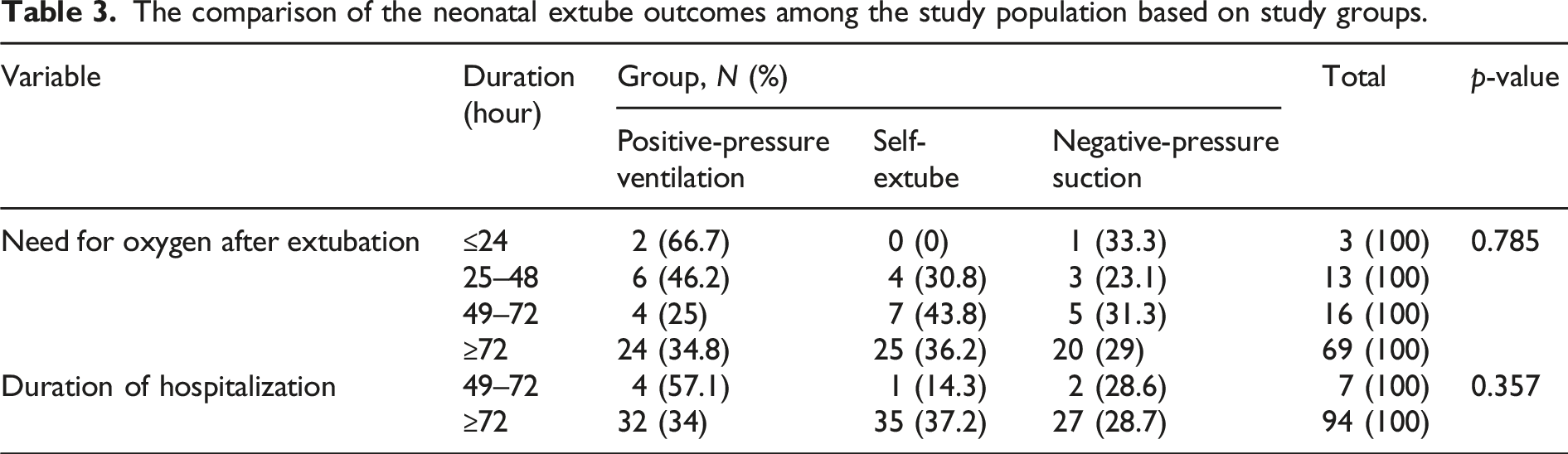
No statistically significant differences were found in the duration of intubation (p = 0.436), need for oxygen after extubation (p = 0.785), and length of hospitalization (p = 0.357) among the groups. There was a significant difference in the duration of intubation, need for oxygen after extubation, and length of hospital stay based on gestational age at birth (p = 0.000). However, there was no significant correlation between age at birth and re-intubation (p = 0.297).
Conclusion
There are no significant differences in key outcomes like intubation duration, post-extubation oxygen needs, and hospitalization length, suggesting that the choice of extubation method may not greatly affect these factors.
Background
Neonatal respiratory distress is a significant clinical challenge that affects a substantial proportion of preterm and term infants. 1 In cases where non-invasive ventilation methods are insufficient, endotracheal intubation remains a common intervention to secure the airway and ensure adequate oxygenation. 2 However, the extubation process transitioning from mechanical ventilation to spontaneous breathing presents its own challenges and risks. The timing and method of extubation can greatly influence the outcomes for neonates, making it a critical area of study. 3
Recent advancements in neonatal care have introduced various extubation strategies, with positive-pressure and negative-pressure techniques gaining attention for their potential benefits and drawbacks. 4 Positive-pressure extubation, often employed in conjunction with continuous positive airway pressure (CPAP) or high-flow nasal cannula (HFNC), aims to maintain alveolar recruitment and prevent atelectasis. 5 Conversely, negative-pressure extubation utilizes methods such as negative-pressure ventilation to facilitate respiratory support without the need for invasive airway management. 6
Newborn extubation failure is a significant concern associated with adverse outcomes. Risk factors such as shock, vasopressor use, anemia, sepsis, and post-extubation respiratory parameters play a role in predicting extubation outcomes.7–9 Neonates who fail extubation have higher rates of mortality, longer hospital stays, and increased incidence of complications like patent ductus arteriosus and intraventricular hemorrhage. 10 Studies have shown that parameters like oxygenation index, respiratory severity scores, and oxygen saturation are good predictors for extubation failure.11,12 Two effective methods for neonatal extubation have been introduced, including the negative-pressure extubation technique or continuous suctioning during the extubation, and positive-pressure extubation, although self-extubation has been reported previously. 13
Based on the results of a review study positive-pressure extubation (PPET) is not inferior to negative-pressure extubation technique (NPET) in maintaining stable vital signs and preventing complications during peri-extubation14,15 in both adults and infants and long-term indicators like length of hospital stay and cost did not differ between PPET and NPET. 16 Based on the results of a review study, PPET is not inferior to NPET in maintaining stable vital signs and preventing complications during peri-extubation in both adults and infants and long-term indicators like length of hospital stay and cost did not differ between PPET and NPET. 17
A randomized controlled trial shows that positive pressure during endotracheal tube removal in neonates reduces post-extubation atelectasis compared to negative pressure. However, no prior RCT comparing pressure techniques in neonates and limited exploration of long-term outcomes post-extubation were reported as main of the study research gap. 18
This article seeks to compare the efficacy and safety of positive and negative-pressure extubation techniques in neonates. By analyzing clinical outcomes, including rates of re-intubation, respiratory distress, and overall neonatal morbidity, we aim to provide a comprehensive overview of how these methods impact the transition from mechanical ventilation to independent breathing. Understanding the nuances of these extubation strategies is essential for optimizing neonatal care and improving long-term respiratory outcomes for vulnerable infants. Through this comparative analysis, we hope to contribute valuable insights that will inform clinical practice and guide future research in neonatal respiratory management.
Since conflicting results have been reported regarding the effectiveness of these two methods, the current, therefore we conducted a randomized controlled trial to compare the neonatal outcomes of three methods for negative-pressure extubation, positive-pressure extubation, and self-extubation. During mechanical ventilation, self-extubation occurred at a rate of 1.3 per 100 days. 19
Method
Aim
To evaluate neonatal outcomes, a clinical trial was conducted to compare the neonatal outcomes of three methods for negative-pressure extubation, positive-pressure extubation, and self-extubation.
Design and setting of the study
A Phase 2 double-blind randomized controlled trial was conducted from May 11, 2021, to March 6, 2023, at Ayatollah Taleghani Hospital, Ilam, Iran. The trial involved three independent groups. The study used a standardized effect size of 1, and the sample size was determined based on a mean comparison, with β = 80% and a significance level of 95% (Figure 1). Flow diagram of the study.
Inclusion and exclusion criteria
The study focused on neonates who were connected to a ventilator and had been approved for extubation by their physician. However, neonates with any congenital respiratory defects, meconium aspiration, or bacterial pneumonia were not included in the study.
As per the written order of the neonatologist, sedative or muscle-paralyzing drugs were discontinued 24 hours before extubation in both intervention groups. Newborns who were under 37 weeks of gestational age were administered intravenous caffeine citrate according to validated studies and the neonatologist’s written order.
The neonatologist determined that the neonates could be extubated only if they were stable both clinically and hemodynamically. The stability was assessed based on normal lab data, normal blood gas, hematocrit >30%, normal blood sugar, electrolytes, and ventilator settings: PIP 15–20 CmH2O, PaCO2< 35 mmHg. Only after receiving a written order from the attending physician and written consent from the parents of the neonates, all neonates in the intervention groups were extubated.
All newborns were divided into three groups: Intervention Group 1, Intervention Group 2, and the control group. Randomization was performed based on a 1:1 basis using random number tables in intervention groups. Intervention Group 1 underwent positive-pressure extubation, Intervention Group 2 underwent negative-pressure extubation, while the control group underwent self-extubation. All of these cases were reported to the neonatologist by the nurse caring for the newborns and were confirmed by the presence of the resident neonatologist in the neonatal intensive care unit.
A chest X-ray was taken for all eligible newborns in the two intervention groups before the procedure. Then, a neonatologist checked the correct position of the endotracheal tube.
All neonates in the intervention groups had their stomachs suctioned to prevent aspiration. In the positive-pressure group, separation was done by slowly squeezing the expandable ambu bag 3–4 times.
The neonates in the negative-pressure group were extubated using a suction catheter entered into the ETT during its removal, with a negative pressure of 80–100 mmHg applied. The self-extubation group consisted of neonates whose trachea got separated from the ventilator without any intervention.
The selection of specific thresholds for oxygenation and blood gases in neonates during extubation and re-intubation is critical for ensuring patient safety and optimizing outcomes. These thresholds are derived from clinical observations and studies18,19 that identify key physiological parameters indicative of respiratory stability. The purpose of the study was to observe the main outcome variables, which included the need for re-intubation (pH < 7.20 and PCO2 > 60 mmHg), the need for oxygen (PO2 < 50 mmHg or SpO2 < 90% with FIO2 ≥ 70%) after ETT removal, and the need for oxygen during hospitalization. Oxygenation after extubation was done using a nasal CPAP at a pressure level of 5 CmH2O, while a SaO2 of 90–95% was considered normal. Regular airway secretions were done equally for both intervention groups according to the center’s protocol. All vital signs and oxygen saturation were monitored until the stabilization of the mentioned variables. The study was conducted using a double-blind method for both neonates and researchers. Researchers received the outcome variables without knowing the assigned group.
Ethical approval
The trial was approved by the Ilam University of Medical Sciences Institutional Ethics Committee (IR.MEDILAM.REC.1400.014), and informed consent was obtained from all fathers of infants. Also, the trail was regenerated under the IRCT registration number: IRCT20110523006575N6.
Statistical analysis
The data was analyzed using the SPSS software version 20, which is developed by IBM Corporation in Chicago, IL. To investigate the normal distribution of all the continuous variables, both Kolmogorov-Smirnov and Kurtosis tests were used. The independent-samples Kruskal-Wallis test was used to compare the means of three groups, and a p-value of 0.05 was considered significant.
Results
A total of one hundred and one neonates between the ages of 26–41 weeks were included in the study. However, we randomize participants into groups to minimize the effects of confounding variables, but also, a reanalysis was conducted to answer this question. I use multivariable regression for potential confounder’s including mother age, mother job, maternal health conditions, and prenatal steroid use. Based the results (p > 0.05), we ensuring that observed neonatal outcomes can be attributed to the type of intervention rather than these confounders three groups. All the neonates were discharged alive, except for two with gestational ages of 28 and 30 weeks and birth weights of 1180 and 750 grams, respectively, who were in the intervention groups with positive and negative pressure. There were four neonates with pneumothorax, and all of them were in the preterm and intervention groups, and they needed re-intubation. One neonate was in the positive-pressure extubation group, while three neonates were in the negative-pressure extubation group.
The absolute and relative frequencies of different extubation methods among the study population based on their gestational age.

The comparison of the duration of intubation among the study population based on study groups is presented in.

The comparison of the neonatal extube outcomes among the study population based on study groups.
The relationship between G.A. at birth and some variables among the study population.

Discussion
Ventilation is crucial for premature neonates with underdeveloped lungs. They often require respiratory support to establish adequate lung function. 21
Neonatal extubation is a critical step in the care of neonates that requires proper decision-making and action. It is important to have experienced neonatologists involved to prevent complications during the process. The significance of correct decision-making and actions cannot be overstated in achieving successful outcomes in neonatal care. 22 The accumulation of secretions in the subglottic space during invasive mechanical ventilation poses a risk, as these secretions can be aspirated into the airways when the cuff is deflated and during tracheal extubation. Although this may not present immediate clinical symptoms, it has the potential to result in pneumonitis or pneumonia. 16 In our study, we compared the outcomes of neonatal extubation in three groups: self-extubation, positive-pressure extubation, and negative-pressure extubation. All neonates in the less than 37-week gestation group received intravenous caffeine citrate before extubation. Positive-pressure ventilation during extubation has several benefits based on research data. A study has shown that positive-pressure extubation techniques help maintain stable vital signs and arterial blood gas analysis, and reduce the incidence of respiratory complications. 16 In a recent study, 70 subjects who were mechanically ventilated in a tertiary ICU were randomly assigned to one of two groups in order to compare positive-pressure extubation with traditional extubation. The age range of the participants was not specified in the provided sources. The study found that positive-pressure extubation improves aeration, reduces adverse events, and leads to lower lung ultrasound scores after extubation compared to traditional extubation methods in critically ill subjects. 23
During the study, it was found that four newborns had pneumothorax, and all of them were in the intervention groups. Consequently, they had to be re-intubated. Pneumothorax is a serious complication in preterm newborns primarily due to their immature lung structure and function, reliance on mechanical ventilation, and susceptibility to various underlying conditions. Understanding these risk factors is crucial for developing strategies to prevent pneumothorax in this vulnerable population, such as careful monitoring during respiratory support and minimizing invasive procedures when possible. 18 The incidence of pneumothorax in ventilated infants varies from study to study. In another study, pneumothorax was identified as one of the complications of neonatal ventilation. Furthermore, no correlation was established between post-extubation pneumothorax and the extubation technique. 24
In a study conducted in a neonatal intensive care unit (NICU) in Portugal, pneumothorax was found to be prevalent in 1.5% of cases, with invasive mechanical ventilation (MV) being a contributing factor. 25 Another study in Saudi Arabia reported a neonatal pneumothorax incidence of 1.02%, with respiratory distress syndrome and the need for bag-mask ventilation being common predisposing factors. 26 Furthermore, a study conducted in a pediatric intensive care unit (PICU) in Egypt found that 10.4% of subjects developed pneumothorax, with a higher mortality rate among those on MV. 27
According to the findings of the present study, there was no significant difference in the duration of intubation between the groups being studied. It is important to note that the length of time that a neonate requires intubation is greatly influenced by their underlying condition and the cause of their ailment. A systematic review and meta-analysis evaluated the predictors of extubation failure in newborns. The funding of this study showed that factors such as age at extubation, anemia, inotropic use, mean airway pressure, pre extubation PCO2, mechanical ventilation duration, Apgar score, and spontaneous breathing trial were noted as possible predictors. 28
One of the important outcomes of our study was the need for oxygen. This need was determined by a PO2 level below 50 mmHg or a SpO2 level below 90% with FIO2 of 70% or higher after extubation and during the hospitalization period. The need for oxygen after infant extubation varies depending on the infant’s condition. Oxygen plays a crucial role in neonatal resuscitation by aiming to achieve normal oxygen levels promptly while avoiding excessive exposure to prevent oxidative stress. 29 Recent recommendations suggest starting resuscitation with 21% oxygen for term and late preterm infants, with adjustments based on response, while extremely low birth weight infants may require initial FiO2 between 0.21 and 0.30. 20
According to our findings, there is a correlation between the presence of gestational age G.A. at birth and the duration of intubation, requirement of oxygen after extubation, and length of hospital stay in the studied population. Our findings align with earlier research indicating that gestational age is a significant risk factor for extubation failure (EF). Infants born prematurely are at a greater risk for EF compared to those born at full term, attributable to variations in lung development, respiratory patterns, and the strength of respiratory muscles as gestational age increases. Spaggiari et al. reported that the risk of EF diminishes by 27% with each additional week of gestational age. 30
The duration of infant intubation is influenced by various factors such as birth weight, gestational age, gender, sedation, caffeine administration, hemoglobin levels, and APGAR score at 5 minutes. 31 Among extremely premature infants, a higher GA at birth was associated with successful extubation and lower oxygen requirements post-extubation. In the study, infants with a higher GA had a higher likelihood of successful extubation when extubated from conventional ventilation (CV). 32
Studies have shown that premature infants with lower gestational age tend to have longer hospital stays due to increased respiratory interventions, delayed feeding milestones, and higher rates of complications such as bronchopulmonary dysplasia.33,34
Conclusion
Approximately one-third of the neonates in the study required re-intubation, but there was no significant difference in the re-intubation frequency between the groups. This shows that both extubation methods may have similar risks for re-intubation. There were also no significant differences in key outcomes like intubation duration, post-extubation oxygen need, and hospitalization length. This suggests that the choice between extubation methods may not impact these factors.
Strengths
1. The study specifically targeted important outcome variables such as the need for re-intubation, oxygen requirements after extubation, and overall hospitalization duration. By focusing on these critical factors, the research addresses significant aspects of neonatal care that can impact clinical decision-making. 2. The comparison of self-extubation, positive-pressure extubation, and negative-pressure extubation provides a comprehensive view of different extubation methods. This diversity allows for a better understanding of the potential benefits and drawbacks of each technique in various clinical scenarios. 3. The study ensured thorough monitoring of vital signs and oxygen saturation until stabilization, which is crucial for assessing the immediate effects of extubation methods. This careful monitoring contributes to the reliability of the data collected.
Limitations
1. The underlying conditions of the neonates, which can greatly influence outcomes, were not extensively controlled or analyzed. Factors such as gestational age, birth weight, and comorbidities could have affected the results, making it difficult to isolate the effects of the extubation methods used. 2. The study reported that approximately one-third of the neonates required re-intubation, but it did not explore the reasons behind this high rate. Understanding the causes of re-intubation could provide insights into the effectiveness of the extubation methods and inform future practices. 3. Conducting the study in multicenter and larger cohort of neonates would improve the statistical power of the findings and can help ensure that the results are more generalizable and can better represent the diverse neonatal population.
Statements and declarations
Footnotes
Authors’ note
The study was performed at Ayatollah Taleghani Hospital, Ilam University of Medical sciences, Ilam, Iran.
Acknowledgements
Institutional Support: Recognition of the Ilam University of Medical Sciences Institutional Ethics Committee for approving the trial and ensuring ethical standards were met. Contributors: Thanks to the medical staff, researchers, and neonatologists who participated in the study, particularly those involved in patient care and data collection.
Author contributions
Nourollahi, S: literature search, data collection, study design, analysis of data, manuscript preparation, and review of the manuscript; Solimani, P: data collection, study design, manuscript preparation, and review of the manuscript; and Direkvand- Moghadam, A: literature search, data collection, study design, analysis of data, manuscript preparation, and review of the manuscript.
Conflicting interests
The author(s) declared no potential conflicts of interest with respect to the research, authorship, and/or publication of this article.
Funding
The author(s) received no financial support for the research, authorship, and/or publication of this article.
Ethical approval
The trial was approved by the Ilam University of Medical Sciences Institutional Ethics Committee (IR.MEDILAM.REC.1400.014), and informed consent was obtained from all fathers of infants. Also, the trail was regenerated under the IRCT registration number: IRCT20110523006575N6.
Participants
Gratitude towards the families of the neonates for their consent and participation in the study, which is essential for the validity of the research findings.
Peer review
Acknowledgment of any peer reviewers or colleagues who provided feedback on the study design or manuscript, contributing to the quality of the research.
Technical assistance
Recognition of any technical staff or laboratory personnel who assisted with the study’s methodologies or data analysis.