




Abstract
In the heart of Delhi, the capital of India, the severely polluted Yamuna River saw its water level rise to the highest in 45 years in July 2023, displacing over 27,000 people. Despite flood control measures and river rejuvenation plans, which include creating biodiversity parks, these efforts overlook the displacement and erasure of small-scale farmers, highlighting critical issues of intersectional power dynamics and socioecological impacts. Water shapes societies, and its control reflects broader sociopolitical power dynamics, influencing democracy, citizenship, and development. An environmental justice focus addresses the relationality and context of socioecological dimensions, highlighting how power and inequality intersect with environmental issues, emphasizing the need for nuanced, inclusive policies. In Delhi’s Yamuna floodplains, intersecting identities among farmers reveal complex issues of vulnerability and power. This is analyzed through qualitative interviews, secondary data, and ethnographic field notes. The study has two major findings.
Belonging, citizenship, and state–society relations are shaped by intersectional differences, challenging the assumption that dispossession affects communities uniformly. Local farmers adapt to floods using informal knowledge, a vital yet overlooked resource. Integrating their lived experience into formal planning can enhance flood resilience and foster inclusive management of Delhi’s floodplains.
Water insecurities on Delhi’s Yamuna floodplains highlight how intersecting social categories of power shape unequal experiences, making environmental justice and social inequality deeply intertwined. Addressing these issues requires an intersectional approach to water management that incorporates the voices of marginalized farmers and tackles the sociopolitical dimensions of water insecurity.
INTRODUCTION
Water (in)security is a pressing issue globally, but its impacts are often felt disproportionately by marginalized communities. In the context of the Yamuna floodplains in the National Capital Territory of Delhi (henceforth referred to as Delhi), the intersectional nature of water insecurity among small-scale farmers demands attention. This case study aims to delve into the complexities of this issue, focusing on two key aspects: floods and evictions. By examining the lived experiences of different categories of farmers based on intersecting factors such as class, religion, ethnicity, region, and gender, we seek to underscore the urgent need for a more inclusive and nuanced approach to water management.
We analyze these water-security issues through the case study of the Yamuna River, a lifeline for Delhi and one of the most polluted rivers in the country. After ten people died in 2024 due to flooding in the capital 1 the city once again experienced flooding in 2025, forcing many residents to relocate from their homes. 2 Moreover, the memory of the floods in July 2023 that displaced thousands still lingers. At the same time, floods damage the biodiversity parks that are being created to rejuvenate the river and its floodplains. Adding to the complexity, these biodiversity parks come at the cost of the eviction of thousands of small-scale farmers, erasing their socioecological history and livelihoods.
Through this case study, it is revealed that water insecurity cannot be divorced from intersecting social categories of power. Addressing these inequalities requires a holistic understanding of socioecological problems and inclusive policymaking that prioritizes environmental justice. This approach provides a nuanced understanding that dismantles social hierarchies and homogenized experiences. In other words, the empirical evidence through the case study is woven through the intersectional framework to critically analyze power, justice, and vulnerability within floods and evictions.
Intersectionality, a lens through which to analyze the multidimensionality of vulnerability, reveals how social, environmental, and economic inequalities intersect and exacerbate water insecurity. By understanding how power dynamics shape lived experiences, we can better grasp the complex challenges faced by farmers on the floodplains.
THEORIES OF INTERSECTIONAL ENVIRONMENTAL JUSTICE: UNPACKING WATER, POWER, AND SOCIO-ENVIRONMENTAL DYNAMICS
Water security is not merely a technical issue but emerges from a complex web of relationships among people, places, and ideas that influence how resources are appropriated, distributed, and contested. 3 Water shapes societies, and its control reflects larger sociopolitical power dynamics, encompassing social, economic, political, cultural, and ecological dimensions. 4 A justice-oriented lens reveals deeper questions of democracy, citizenship, and development, offering a framework for more equitable political action and decision making. 5
Environmental justice ensures fair treatment and meaningful involvement of vulnerable groups in environmental laws and policies, promoting equitable access to a healthy environment regardless of ethnicity, income, or other socioecological factors. 6 An environmental justice focus recognizes the relationality and contextuality of multiple socioecological dimensions, demanding that policies address various manifestations of injustice and violence. It critiques inequitable structures, emphasizing that nature and society are intertwined by considering factors like livelihood, survival, and identity. In Delhi, this extends to housing rights, highlighting the sociopolitical and cultural dimensions of environmentalism. By posing critical questions and acknowledging inherent value conflicts, it unpacks deeper dimensions and enhances the potential for greater success.
Power relations and local context shape how communities experience and respond to environmental change, as they navigate political and economic systems defined by deep-rooted inequalities. 7 Their views are diverse, intertwined with struggles for survival. 8 As they act within inequitable mechanisms, they might equally strengthen, rather than alleviate, the dynamics that cause the problems. 9 An intersectionality lens reveals how multidimensional vulnerabilities are created and coped with, showing that social and environmental inequalities are often intertwined. 10 This approach addresses socionatural 11 intersections based on power relations and analyzes the situated impacts of environmental degradation, challenging socioecological structures.
Oftentimes, environmental solutions and plans homogenize identities by claiming to serve the ‘public’. At the same time, certain dynamic and relational groups, often experiencing environmental degradation more violently, are villainized and blamed for causing pollution by erasing the historical and systemic inequalities faced by them. This reality becomes even more complicated as not all vulnerabilities are experienced homogeneously due to intersectional sociopolitical differences. Communities are shaped by intersecting identities, leading to unequal access to power and privileges among their members. Elites within communities often capture and exploit policies, shaping them for their specific needs at the expense of the marginalized. This shapes daily negotiations and struggles, defining the everyday lives and sense of place. 12 As a result, a nuanced approach is needed, one that recognizes intersectional identities, rejects rigid categorizations, and dismantles social hierarchies to capture the complexity of lived experiences. 13 To this end, this article contributes to existing literature on the socioecological aspects of environmental initiatives, investigating experiences of belonging, citizenship, and state–society negotiations 14 by emphasizing their intersectional nature to disrupt the notion that all ‘dispossessed’ suffer in the same way.
METHODOLOGY
The multifaceted intersections of social differences and the materialities of water reveal the lived experiences of belonging and exclusion of environmental initiatives. It is important to understand which stakeholders are involved, who are left out, for what reason, whose interests are being prioritized, and how all stakeholders use power and discourse to affect decisions. 15 The case study research was employed to form a detailed, interpretive account of social and cultural practices, capturing context, meaning, and power relations to deeply understand environmental conflicts 16 based on secondary and primary qualitative data.
In Delhi, multiple actors are present in the governance of rejuvenating the river, such as various central, state, and local governments, judiciaries, environmentalists, civil societies, industries, cultural actors, residents, and farmers. Follmann 17 highlights that environmental NGOs in Delhi moved away from the previous trend of protesting alone and instead collaborated with farmers to oppose recent elite beautification projects on Delhi’s floodplains. However, class differences persisted as Environmental NGOs prioritized their own demands over addressing social disparities. This dynamic is evident in the creation of biodiversity parks, where Environmental NGOs’ apolitical approach within institutional structures limits intersectional nuances in their discourse.
Intersectionality of class, ethnicity, region, education, and gender can be seen among farmers, situating them on various power axes simultaneously. For ease of discussion, two kinds of farmers can be categorized. Sociopolitically and economically, they both increasingly face violence due to the rejuvenation of the Yamuna plans. 18 The tenant farmers (peasants) migrated to the city around three decades ago and have several arrangements, such as crop sharing and leasing out the land from the land-claiming farmers.
On the other hand, the land-claiming farmers have been involved in the occupation in Delhi since living memory, and now are relatively powerful and claim to own the land. However, they face several challenges as the Yamuna floodplains represent a contested landscape of unstable land ownership, caught between formal state control and informal claims. With limited exceptions, legally, the floodplains are classified as state property under multiple agencies of mostly the Central government (Delhi Development Authority (DDA), Uttar Pradesh (UP) Irrigation, Forest Department, etc.). However, the reality involves a complex web of unauthorized sales, purchases, and donations. 19 Ongoing court battles in the Delhi and Allahabad High Courts highlight unresolved ownership disputes, forcing farmers to perpetually prove their legitimacy. Despite being officially marked as ‘vacant’ on official maps, 20 the floodplains are actively used for farming, residence, and leisure, creating a disconnect between bureaucratic erasure and lived reality. 21
To analyze the multi-dimensional and intersectional water insecurity faced by farmers, secondary and primary data were used. Initially, the research focused more broadly on water security and river pollution. However, the area faced unexpected floods during the fieldwork in 2022, after which it became a more central research focus. For secondary data analysis, governmental and judicial documents, as well as media coverage, focusing on efforts to rejuvenate the Yamuna River in Delhi were considered. These secondary sources were key in understanding the environmental, societal, cultural, and political views of various stakeholders involved.
Primary data collection from July 2022 to August 2023 involved interviewing 20 tenant farmers and 14 land-claiming farmers. This included 18 male and 16 female farmers; 27 Hindu and 7 Muslim farmers; 12 lower caste, 3 Pandits (priests), 4 Jats, and 6 Gujjars. This was supplemented by ethnographic field notes integrated into recorded transcripts. On top of this, we had numerous informal interactions outside of these interviews. These interviews were conducted in Hindi and lasted anywhere between 5 minutes and an hour and a half, with various people joining and leaving the conversation. They were transcribed and later translated into the English language.
For the data analysis, first, transcriptions were summarized and then grouped according to various topics. Initially, emergent categories, themes, and concepts in the data were identified. These were reiteratively coded and re-coded into finer sub-categories through critically connecting, condensing, and clustering.
The various sources of data used were cross-referenced and verified through triangulation to create a robust, detailed, rich, rounded, and comprehensive analysis. This sheds light on various dimensions of a phenomenon, such as its embedded historical sociopolitical background, enabling understanding of the complex socioecological system and the ‘realities’ of the research area. 22
Overall themes that emerged are water (in)security due to floods and housing rights issues; multidimensional and intersectional vulnerability and exclusion; and power dynamics of environmental degradation and rejuvenation.
RISING WATERS AND REJUVENATION: THE INTERSECTING CHALLENGES FACED BY SMALL-SCALE FARMERS ON THE YAMUNA FLOODPLAINS
This section explores how state-led efforts to rejuvenate the Yamuna River, through pollution control programs, nature-based solutions, and beautification projects, have fundamentally reshaped the floodplains. By unpacking these processes, the section highlights how environmental governance is deeply intertwined with power, exclusion, and socio-spatial inequalities.
Water pollution and state rejuvenation responses
Once, the Yamuna had a central place in the city, and the city was built around it. Now, the Yamuna is hidden for most Dilliwale (residents of Delhi) socio-spatially. 23 Between the 22 km stretch of the Yamuna River in the heart of Delhi, there is a flow of only sewage from 23 drains containing domestic and industrial waste, making it full of heavy metals. 24 These factors make the river the prime water source for the Capital city and the most polluted stretch in India. 25
The Yamuna River must be understood as an interconnected system encompassing not just its waters but also its floodplains, buffer zones, groundwater, and entire basin. 26 The urban planning regime classifies settlements on the floodplains as ‘illegal’ or ‘informal’ for violating land ownership and planning norms. 27 As a result, residents are left to navigate a deeply unjust and inadequate water governance system with few viable alternatives. 28 Although water tankers visit the area weekly, increasing health risks from contaminated sources force some residents in the floodplains to puncture state water infrastructure such as the Ganga water pipelines for temporary access. Others, including schoolchildren, rely on untreated groundwater. Many residents also rely on their workplaces, especially women working as domestic help. Women and girls, from school-going children to elderly women over 60, bear the primary responsibility of collecting water, although men are typically engaged in other economic activities. Young women make 5–6 daily trips to distant pipeline leaks, sacrificing education to fetch water. 29
In response to recurring floods and pollution, the state has repeatedly attempted to rejuvenate the Yamuna and its floodplains. The Yamuna Action Plan (YAP) in 1993 prioritized sewage treatment as a technical fix to address domestic sewage, Delhi’s primary river pollutant. However, though intended as a one-time intervention, it failed to reduce pollution. As a result, the YAP is now in its third phase as part of the Namami Gange mission (National Mission to clean the Ganga River) 30 with continued involvement from both the state and judiciary. Current efforts focus on constructing biodiversity parks and artificial wetlands to improve water quality, conserve the floodplains, and maintain vegetation. 31 These are prototypes to be copied in the rest of the 351 urban stretches of polluted rivers in the country. 32 As a result, Delhi’s floodplains are undergoing a dramatic spatial transformation in pursuit of a sanitized, aestheticized vision of urban nature.
Beautification and biodiversity parks
Farming on the Yamuna floodplains dates back to Delhi’s founding and has historically supported diverse, low-impact livelihoods such as agriculture, fishing, and nursery work. 33 Spread across 97 sq. km. within the city, these floodplains have been vital not only for local communities but also for groundwater recharge and ecological balance. However, over time, river beautification projects catering to elite interests have made the river increasingly inaccessible to dependent local communities, displacing thousands of small-scale farmers through evictions in the name of ‘reclaiming’ land.
In 2022, 56 settlements with 9,350 households and around 46,750 residents were present on the floodplains, nearly half of whom continue to farm despite uncertain tenure and the threat of eviction. 34 Marginalization accelerated in 2004 when the Delhi High Court order led to widespread demolitions and mass displacement. 35 These evictions coincided with the rise of elite infrastructure, including the Akshardham Temple complex, the Commonwealth Games Village, and the Indira Gandhi Indoor Stadium, marking a clear spatial shift toward formal development for privileged groups.
These projects reflect what Baviskar calls ‘bourgeois environmentalism’, a vision of nature tied to middle-class aesthetics and values that sanitizes the city, while displacing those seen as ‘out of place.’ The floodplains are reimagined not as lived landscapes but as green buffers, stripped of their socioecological history and prepared for elite consumption. 36 Singhal and Gupta 37 highlight how biodiversity parks are being developed under the dual pressures of urban beautification and elite environmentalism, excluding marginalized farmers and reinforcing socioecological injustices. Thus, the transformation of the Yamuna floodplains into a space dominated by formal urban development and selective regulation has steadily eroded access for traditional users.
Washed away: Floods and displacement
Beyond legal insecurity, farmers also face the recurring risk of floods. Since 1924, the Yamuna has crossed the danger mark nearly 40 times, with major floods occurring in 1924, 1977, 1978, 1995, 2010, and 2013. 38 In July 2023, the river rose to 208 meters, its highest level in 45 years, exceeding the danger mark by 4 m and breaching the “Planning Zone O” boundary, designated as the Yamuna floodplain by the Delhi Development Authority. 39 Several crucial areas and development projects, including Civil Lines, Interstate Bus Transit, Millennium Depot (Bus Terminal), Wazirabad Sewerage Treatment Plant on the western side, and Yamuna Bank Metro Station and Crematorium on the eastern side of the river Yamuna, were heavily affected (Fig. 1). The ongoing river rejuvenation plans are set to aggravate such floods further in the future. 40 These factors affect not only most Dilliwale, but also the small-scale farmers living in the floodplains directly.
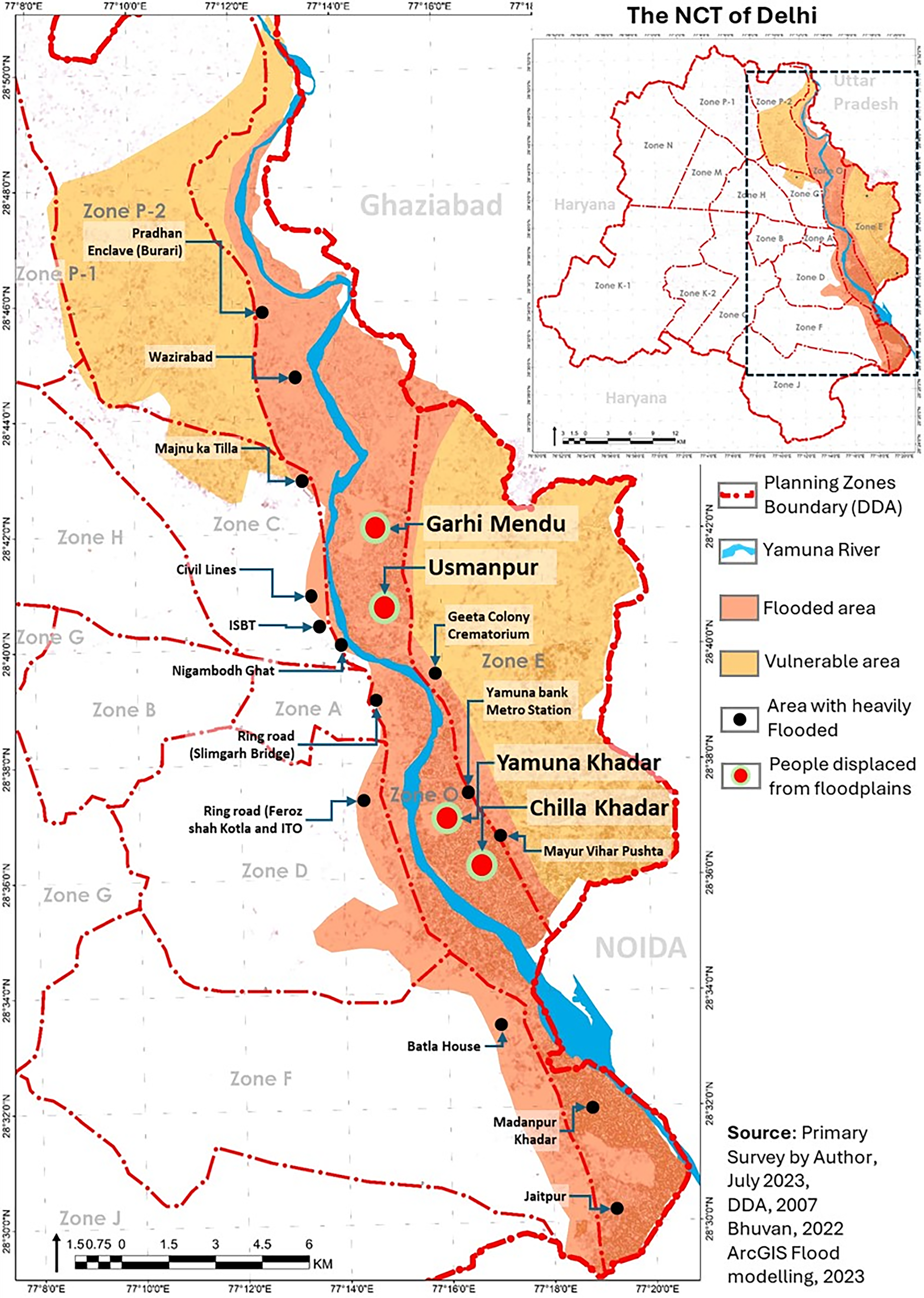
Affected areas of the Yamuna River floodplains of Delhi during floods in July 2023.
Four villages in the Yamuna Floodplains, in the eastern part of Delhi, faced evacuation. More than 27,000 people were displaced and shifted to relief tents after rescue efforts by farmers and teams appointed by the Delhi Government through boats (Fig. 2). However, most of them were not able to gather their belongings in time, leaving them without food and shelter. 41 The Delhi Government installed mobile toilets and water tankers for temporary shelter. However, they lacked a water supply and proper cleaning, exacerbating the situation.

Flooding in the Yamuna floodplains. Source: Urmila Singhal, September 2022.
These events were followed by the constitution of an apex Committee in 2022 under the Chairpersonship of the Chief Minister of Delhi to recommend, supervise, and coordinate flood control measures. However, there is no representation of the farmers in decision making within this committee.
Thus, critical questions are left to be answered regarding trade-offs, power dynamics, priorities, and choices in the implementation of the rejuvenated Yamuna initiative. This is done by identifying their socioecological nature as opposed to seeing them as technical solutions to apolitical problems. There needs to be evaluation, debate, and management of power dynamics within these decisions. 42 Therefore, a deeper and more nuanced understanding of the interactions is required. In the next section, we analyze how the rejuvenated Yamuna initiative impacts the small-scale farmers on the floodplains in an intersectional way. In other words, we analyze the intersectional sociopolitical costs of the rejuvenated Yamuna initiative.
COPING WITH FLOODS: SOCIAL CLASS DISPARITIES
Water insecurity on the Yamuna floodplains is deeply shaped by inequality and power. Using an intersectional lens, this section examines how floods and evictions affect farmers differently based on class, migration status, and tenure.
The dynamic nature of floodplains renders them inherently risky, disproportionately affecting tenant farmers who reside on these floodplains. Tenant farmers, who live and work within the floodplains, face greater risk than land-claiming farmers based in urban areas. Floods destroy their crops, homes, huts, tractors, livestock, and identity documents, worsening both financial and social vulnerability (Fig. 3). Crucial identity proofs often get destroyed, rendering the farmers even more vulnerable to the impending threat of evictions, as analyzed in the next section.

Tenant farmers were rescued from the floodplains during the monsoon in 2022. Source: Urmila Singhal, September 2022, Delhi.
Expressing the profound impact, tenant farmer (1) lamented,
“Our belongings were still here in the huts. Some survived, some got washed away. What survived was very little. The flooding was extensive. The loss is significant. There’s hardly any farmer who hasn’t incurred a loss of Rupees 50,000–40,000 (£500–400). Some have suffered a loss of Rupees 3,00,000–4,00,000 (£3,000–4,000). Tractors got washed away. The damage is substantial. The entire crop of the people was submerged. All the crops have been destroyed.” 43
Moreover, although the government installed mobile toilets and water tankers, they lacked water and proper cleaning, exacerbating the situation (Fig. 4).

Temporary arrangement by the Delhi Government during floods. Source: Ankush, August 2023, Delhi.
Tenant farmer (2) expressed the profound impact,
“There is a toilet but no water, and it’s not clean… We have to go outside in the open to relieve ourselves, but there is water everywhere, so where can we go? It has become difficult even to defecate, and don’t even ask about drinking water. There is no food, no water, and no roof over our heads. And we have been told to vacate this place by August 4th, even though the water from the Yamuna hasn’t receded yet. Where will we go if we leave?…”
Floods are not only coped with differently but are also perceived differently by various stakeholders. The state frames floodplains as sites of disease and chaos, portraying floods as destructive calamities and emphasizing nature’s wildness. By contrast, some land-claiming farmers see floods as beneficial, enriching the soil with silt and enhancing productivity. For them, ontologically, the river and floodplains are not distinct entities. This approach shifts the perspective from floods as disasters to natural cycles. The phenomena are described as the natural increase and decrease of water. Land-claiming farmer (1) states,
We do not consider it as floods… The water rises, and it is important that it does.”
Singhal 44 further explores the complex socioecological dynamics and competing environmental knowledges in the Yamuna floodplains of Delhi, highlighting the tensions between local farming practices and governmental rejuvenation efforts. However, tenant farmers, constrained by their geographical proximity to floodplains, only partially recognize this aspect of floods. Unlike land-claiming farmers who can escape the monsoon flow, tenant farmers struggle with the immediate consequences.
These contrasting experiences underscore how socipolitical hierarchies shape vulnerability, resilience, and knowledge in the floodplains.
EVICTIONS: INTERSECTING DIMENSIONS OF POWER AND EXCLUSION
Although flooding poses a substantial threat, a more persistent insecurity faced by farmers is eviction. As stated by the tenant farmer (3)
“The fear of being made to leave is massive. The government is thinking of removing us from here. And the power lies in the hands of the government. They can displace us anytime. We are simply saying that it’s been 50–50 years for us, so provide us with a place. Just let us settle somewhere. We have no place to go. No government listens to us… Now, leaving this jungle, where do we go? Even if we go to the village, there is no livelihood there. There are no homes or shops where we can reside.”
The persistent fear of eviction spanning decades, driven by government initiatives such as the rejuvenated Yamuna Initiative, forces farmers to confront water insecurity within the intricate dynamics of religion, class, ethnicity, and regional influences.
Religion and ethnicity: Shaping land ownership
Although most of the floodplain is legally state property, it is entangled in informal sales, donations, and disputes. These exchanges, formalized through titles and paperwork, however, reveal a stark power asymmetry influenced by intersecting power dynamics.
This intricate interplay can be analyzed by looking at a local Hindu religious leader establishing an Ashram in the Yamuna floodplains after being donated land with a 90-year lease. Here, the intersection of class, caste, and religion grants legitimacy to the local religious leader, conferring the authority to ‘own’ land on the floodplains.
In contrast, the majority of farmers, predominantly perceived as being Muslim (Bangladeshi) or Bihari (from the state of Bihar), by many residents of Delhi and state officials, due to historical factors, face exclusion. In reality, the land-claiming farmers are mostly Gujjar, Jats, and Pandits, while the land-leasing farmers are Yadav, Maurya, and Mallah. Interestingly, tenant farmers often encounter a similar stigma as they navigate interactions with land-owning farmers who assert their ownership rights. A land-claiming farmer (4) criminalizing the tenant farmers stated,
“These politicians allow migrants to live here. Actually, they have come from Rohingya (illegally and are Muslims).”
The roots of religious and ethnic exclusion differ, yet both contribute to violent spatial changes. The infamous eviction of Yamuna Pushta residents in 2004, primarily comprising Muslims, exemplifies this. Termed ‘terrorists,’ and told to ‘go back to Pakistan and Bangladesh,’ around 80,000 daily wage workers living here were forcibly removed. This was coupled with a widespread deletion of Muslim names from electoral lists. 45 Similarly, in 2021, 800 families from the Muslim-dominated Batla House area were evicted, further reinforcing the exclusion of vulnerable communities from the floodplains. 46 Today, the narrative continues displacing tenant farmers on the floodplains, labeling them as ‘Rohingya refugees.’ Such framings create ‘improper citizens’, 47 stripping farmers of legitimacy and enabling eviction through nationalist and moral arguments. Seen in this context, the ownership of land on the floodplains by the Hindu religious leader extends beyond monetary transactions, entering the realms of citizenship, public welfare, development, social justice, and national interest.
National citizenship, adopting an authoritarian and neo-liberal outlook, shapes a blend of ‘modern’ lifestyles and a ‘world-class’ environmental imaginary, replacing farms with parks on the rejuvenated Yamuna floodplains. A nationalist identity emerges, combining a consumerist lifestyle with ‘traditional Indian (Hindu) values,’ framing Muslims as anti-national and conspiratorial. 48 Similar to the Yamuna, India’s rising Hindu nationalism has weaponized large river-cleaning initiatives like Namami Gange, framing them as cultural revival and privileging majoritarian Hindu symbolism, exacerbating socio-religious divides under the guise of environmentalism. 49
Consequently, the constructed identity of ‘Bangladeshis,’ similar to the narrative of ‘Biharis,’ leaves the farmers marginalized in the seemingly stable world-class city of Delhi, or India, rendering them non-citizens.
Stigmatization of ‘Biharis’: Cultural and economic exclusion
Although the stigma of being a Bihari is associated with all farmers, it is mostly the tenant farmers who have migrated from UP and Bihar. The term “Bihari,” once a neutral adjective for residents of Bihar, has evolved into a derogatory label used to comment on factors such as social status and appearance, reinforcing exclusion from Delhi’s ‘world-class’ aspirations. However, Biharis form a significant portion of the white-collar upper-middle-class workers in Delhi. 50 Furthermore, there are multiple narratives at play here. The Jats and Gujjars, ethnicities of most land-claiming farmers, themselves are seen as ‘unruly’ and ‘uneducated’ by the upper-middle-classes.
The stigmatization intersects with gendered fears. An orientalist perspective portrays the ‘Bihari’ migrant as wild and savage, requiring state intervention to discipline them. Reflecting this, an upper-middle-class man stated, “When there are high-end restaurants built in the floodplains, people will start going there (the floodplains) and it will make the area safer for women”. Here, the ‘people’ referred to are the upper-middle classes. Middle-class residents often frame evictions as necessary to ‘protect women’, casting farmers as threats and elite development as a civilizing force. This might be influenced by middle-class feminism in India, driven by class dynamics. 51
Consequently, farmers, whether labeled ‘Bihari’ or ‘Rohingya’, are constructed as unruly and uneducated, excluded from rights and citizenship. Their resistance to biodiversity parks is reframed not as livelihood defense but as defiance against urban order, legitimizing their marginalization within Delhi’s neoliberal development agenda based on a particular type of discipline, rationalization, sanitation, beautification, and cleanliness. 52 This excludes them from reaping the benefits of a rejuvenated Yamuna.
Claim on leasing land: Vulnerability of tenant farmers
Similar to owning land, leasing practices expose tenant farmers to deep vulnerability. Unlike land purchases, leasing lacks a formal paper trail, rendering arrangements culturally recognized but legally illegitimate. Tenant farmer TF (4) elaborated on her decision to rent the land from a land claiming farmer,
TF(4): There is 1 big farmer. I have rented out the land from him. He lives nearby.
Q- But this land officially comes under the DDA, right?
TF(4): Whoever lets me farm here, I will pay the rent to them. If the government gives me the land on rent, I will pay them. I am just following what works here.
This power imbalance exposes tenant farmers to potential exploitation and intimidation by various actors, including agents, lawyers, land-owning farmers, politicians, Pradhans (self-appointed political spokespersons), and the police. Instances of individuals promising to secure rights in exchange for cash, only to fail in delivering results, are distressingly common. Farmers, in their pursuit of security, often take loans, aggravating their vulnerability.
This legal invisibility of tenant farming arrangements can be read as part of a broader process of socionatural erasure, where both the ecological functions of farming and the social histories tied to the land are systematically excluded from dominant narratives of environmental management.
DISCUSSION AND CONCLUSION
This article argues that the Yamuna River, as a site of environmental degradation and social injustice, illustrates how intersectional water insecurity, shaped by floods, evictions, and overlapping identities, requires a just and inclusive approach to water governance.
The eviction of farmers from their land not only erases their socioecological history but also perpetuates cycles of poverty and exclusion in an intersectional manner. Questioning someone’s citizenship makes them ‘improper citizens’ 53 and denies them ‘full citizenship.’ 54 Land politics are shaped by intersecting identities, where people navigate overlapping social positions and engage in ‘maximizing the difference’ 55 to assert legitimacy and access resources. Accordingly, upper-middle-class actors frame themselves as ‘good,’ ‘urban,’ and ‘legitimate’ citizens, entitled to the city and its environment, while distancing themselves from marginalized farmers. Meanwhile, landowning farmers assert their wealthy Hindu identities to dissociate from so-called ‘Rohingya’ and ‘Bihari’ tenant farmers, who in turn navigate internal distinctions based on ethnicity, gender, sexuality, and ability. These hierarchies reveal how all groups, in different ways, assert epistemic superiority, invalidating the displacement and dispossession of others.
Therefore, selective traits are strategically mobilized to construct new, often contradictory, citizen-subject identities. These identity negotiations ultimately underpin the contested environmentalism shaping Delhi today. Although both land-claiming farmers and tenant farmers face dispossession, the former wield greater power, revealing the intersectional disparities within the ‘dispossessed’ and challenging homogenized narratives of marginalization, vulnerability, and agency. This requires not only rethinking policies and interventions but also centering the voices and experiences of marginalized communities in decision-making processes.
The study also highlights how local farmers have adapted to seasonal floods through informal knowledge and vigilance. Land-claiming farmers, with a long-standing relationship to the floodplains, possess a deep understanding of the river system and can be partially seen as ‘living as’ nature, although tenant farmers, facing more direct exposure, tend to ‘live with’ the river. Though their vulnerabilities and grounded experiences differ, both groups hold crucial knowledge that, if integrated, can significantly improve flood management and support more inclusive, resilient planning of Delhi’s floodplains. However, it is ignored by top-down planning that favors technical criteria, enabling dominant actors to control processes. The study highlights the need for alternative governance models like participatory planning and co-management that prioritize intersectional inclusivity and justice for sustainable outcomes. 56 Although such representation is well recognized and critical, an intersectional approach unpacking various dynamic socioecological aspects is necessary for more just outcomes. A shift toward such deeply inclusive governance would ensure that environmental protection and human rights go hand-in-hand, rather than being positioned in conflict with one another.
Ultimately, achieving environmental justice in the management of water resources necessitates a paradigm shift, one that prioritizes equity, inclusivity, and sustainability. There is a need to challenge power dynamics and dismantle systems of oppression to achieve water security for all. We argue for an understanding of the nexus that recognizes and mitigates the various forms of intersectional vulnerabilities, and the ways in which different forms of resource marginalization reinforce each other.
AUTHORS’ CONTRIBUTIONS
S.S. contributed to conceptualization, data curation, formal analysis, methodology, project administration, supervision, and writing—original draft. S.S. and A. contributed to funding acquisition, investigation, software, resources, validation, visualization, and writing—review and editing.
Footnotes
ACKNOWLEDGMENTS
The authors sincerely thank Dr. Lata Narayanaswamy and Professor Anna Mdee (University of Leeds) and Professor Ashok Kumar (School of Planning and Architecture, New Delhi) for their invaluable guidance and support.
AUTHOR DISCLOSURE STATEMENT
No competing financial interests exist.
FUNDING INFORMATION
This work was supported by the Water Security and Sustainable Development Hub funded by the UK Research and Innovation’s Global Challenges Research Fund (GCRF) [grant number: ES/S008179/1].