




Abstract
Latino Americans have to navigate involvement and identification with two cultural groups—their ethnic culture and the dominant American culture. Differences in cultural identifications have been found to correlate with political affiliation and attitudes toward acculturation. Using a sample of U.S.-born Mexican Americans, we examined several correlates of political ideology including the strength of identification with both Mexican and Anglo-American cultures, acculturation attitudes, and socioeconomic status (SES). Strength of Mexican identity, stronger integration acculturation attitudes, weaker assimilation attitudes, and lower SES were associated with holding a more liberal political ideology. Furthermore, we found that integration acculturation attitudes mediated and SES moderated the relationship between Mexican identification and political ideology. These findings suggest that political campaigns should be mindful of differences in cultural identifications and acculturation attitudes when addressing their Latino constituents.
Keywords
Mexican Americans, and Latinos more broadly, are the fastest-growing U.S. ethnic group (Matsunaga, Hecht, Elek, & Ndiaye, 2010) and are a highly courted demographic in the political sphere (DeSipio & de la Garza, 2002); however, social and political psychologists have largely understudied the processes related to differences in political ideology among this group. Although the Latino group overwhelmingly swings in the democratic direction (Bowler, Nicholson, & Segura, 2006), this population is not a homogenous group who votes as a singular block (e.g., de la Garza & Cortina, 2007). There is growing evidence suggesting that the strength of one’s Latino identification can influence political ideology and partisanship (Barreto & Pedraza, 2009; Basler, 2008; Cain, Kiewiet, & Uhlaner, 1991; Coffin, 2003; Dutwin, Brodie, Herrmann, & Levin, 2005; Uhlaner & Garcia, 2005). For example, a Latino’s political party preference and ideology is related to the pancultural label—“Hispanic or Latino” versus “American”—he or she more strongly identifies with (Cain et al., 1991; Coffin, 2003; Dutwin et al., 2005; Uhlaner & Garcia, 2005).
Despite the documented variation in Latino identity, research examining the relationships between strength of cultural identification, acculturation attitudes, and political ideology still lags. The primary goal—and unique contribution—of this research is to test how key acculturation-related mechanisms mediate the relationship between ethnocultural identifications and political ideology. We will also examine the moderating role of one’s socioeconomic status (SES) on cultural identity to understand differences in political ideology.
Political Ideology Differences Among Latinos
Latinos, especially those of Mexican and Puerto Rican descent, overwhelmingly support the Democratic Party and hold more liberal ideologies (de la Garza & Cortina, 2007; Lopez & Gonzalez-Barrera, 2012). Historically, Latinos have disassociated from the Republican Party because many of the Party’s candidates espouse strong anti-immigrant rhetoric (e.g., Pat Buchanan’s, 2002, The Death of the West) and propose policies that deport immigrants who have entered the United States illegally. This rhetoric paints Latinos, and Mexicans in particular, as threats to the “American” way of life because they maintain their cultural practices and do not assimilate fully into American culture (Chavez, 2013). In one vivid example, Republicans criticized Mexicans who displayed the Mexican flag alongside the American flag (Chavez, 2013). Their argument is that immigrants must ultimately deny their allegiance to their home countries and singularly adopt American cultural practices.
Not surprisingly, this vilification of Mexican immigrants has also generalized to American-born citizens of Mexican descent who are often perceived as less American (Devos, Gavin, & Quintana, 2010) or even as “illegal aliens” (Chavez, 2013; Flores, 1997; Rosaldo, 1994). Although the Republican Party platform includes some socially conservative values that may resonate with Latinos (e.g., de la Garza & Cortina, 2007; Dutwin et al., 2005), anti-immigrant and discriminatory rhetoric toward ethnic minority groups will continue to drive possible voters to the Democratic Party (see Kuo, Malhotra, & Mo, 2014, for a similar case among Asian American voters). And yet, while many Latinos are turned off by anti-immigrant rhetoric and align more with the Democratic Party, there are still a smaller percentage of Latinos who share the beliefs of the Republican Party with respect to assimilation to American culture. To the extent that a person agrees with minimizing his or her cultural heritage in order to “be American,” the more likely he or she pursues values that align with other conservatives and the Republican Party.
To illustrate this, Dutwin and colleagues (2005) asked Latinos which pancultural label they most identified with—Latino/Hispanic or American—and which political party they most affiliated with. They found that Latinos who chose the “Latino/Hispanic” label were more likely to align with the Democratic Party and support social programs such as Social Security, Medicare, and pathways for immigrants to gain citizenship. In contrast, Latinos who chose the label American were more likely to affiliate with the Republican Party and support socially conservative policies (Dutwin et al., 2005). These results suggest that, at least for Mexican Americans and other Latinos navigating two cultures, the cultural label one identifies with is relevant and related to the values one adopts such as political party affiliation.
In a related study, Baretto and Pedraza (2009) examined differences in political partisanship among Latinos who responded to the 2006 Latino National Survey. Respondents rated the strength of their Latino identification on a dimensional (not force choice) item. Interestingly, almost 10% of the sample—many of whom were English-dominant or held fourth-generation status—did not identify or very weakly identified with the “Hispanic/Latino” label. In terms of differences in political partisanship, Baretto and Pedraza found a surprising interaction between strength of ethnic identification and generation status. For Latinos with strong ethnic identification, neither generation status nor English-language orientation lowered their commitment to the Democratic Party and, in fact, commitment to the Democratic Party grew stronger with each successive generation. In contrast, Latinos with a weak ethnic identification showed less democratic partisanship and more republican partisanship with each successive generation.
System justification theory (Jost, Banaji, & Nosek, 2004; Jost, Burgess, & Mosso, 2001) may provide one possible explanation for why weakly identified, later-generation Latinos showed more support for Republican Party. This theory suggests that people endorse and defend ideologies (e.g., protestant work ethic; political conservatism) because they provide justification for why some groups achieve more success than others. Even ethnic minorities, who do not readily benefit from these hierarchy-enhancing ideologies, still see them as legitimate, desirable, and more easily defended (Jost et al., 2001). In one study, Blacks and Latinos who were weakly identified with their cultural identity were more likely to perceive status differences between ethnic groups as fair and justified as well as identify as more politically conservative (Levin, Sidanius, Rabinowitz, & Federico, 1998).
Taken together, the findings from these studies demonstrate that Latinos who maintain identification with their ethnic culture are more likely to affiliate with the Democratic Party or hold liberal ideologies, while those with lower ethnic identification are more likely to affiliate with the Republican Party and hold conservative ideologies. However, conclusions drawn from these studies are limited because the measures they used did not permit measurement of dual cultural identification or attitudes toward acculturation. Considering that differences in Latino party affiliation seem to be closely tied to attitudes toward acculturation to American culture, we will directly measure the strength of both cultural identities (Mexican and American) as well as acculturation attitudes to examine differences in political ideology.
Acculturation Attitudes
Acculturation is the process of cultural change following intercultural contact (Berry, 1990) which can influence one’s identity, held values, and chosen cultural practices (Schwartz, Unger, Zamboanga, & Szapocznik, 2010). Early models of acculturation proposed that the learning of and adaption to a new culture involved abandoning the heritage culture—in other words, completely assimilating into the mainstream culture (Cuellar, Harris, & Jasso, 1980; Suinn, Rickard-Figueroa, Lew, & Vigil, 1987). For example, researchers often use the length of time spent living in the United States as a proxy measure of acculturation (Rogler, Cortes, & Malgady, 1991). However, newer models demonstrate that acculturation is bidimensional and includes the measurement of dual cultural identities (Flannery, Reise, & Yu, 2001; Ryder, Alden, & Paulhus, 2000; Sam & Berry, 2010; Schwartz et al., 2010; Thomson & Hoffman-Goetz, 2009). For example, immigrants and their descendants must navigate the extent to which they retain identification and involvement with their culture of origin as well as the degree to which they identify and participate in the dominant culture (Berry, 2003).
Acculturative change can occur across many dimensions including changes to one’s identity, values, attitudes, and practices (Schwartz et al., 2010). Berry and colleagues (Berry, 1990, 2003; Sam & Berry, 2010) propose four distinct attitudes toward acculturation based on the level of involvement with the ethnic and dominant cultures. Individuals who distance themselves from both the ethnic and dominant cultures fall within the marginalization category. Individuals who want to maintain their ethnic culture only and have low interest in involvement with the dominant culture fall into the separation category. Individuals who minimize the maintenance of their ethnic culture and instead adopt only dominant cultural practices fall into the assimilation category. Individuals who hold positive attitudes toward involvement with both the ethnic and dominant culture fall in the integration category. 1
Thus, Berry’s (2003) acculturation framework can clarify the results from the studies reported above. For example, those Latinos who chose to label themselves as American or who held weaker Latino identities were, by definition, assimilating to the dominant culture and minimizing their identification with their ethnic culture. Furthermore, this pattern correlated with less democratic partisanship. In contrast, later-generation and English-dominant Latinos who still maintained strong identification with their ethnic culture showed the largest democratic partisanship (Barreto & Pedraza, 2009).
We propose that, had these later-generation Latinos with strong ethnic identification been asked to complete measures of acculturation attitudes, they would score higher on integration attitudes and lower on assimilation attitudes. Furthermore, understanding how Latino individuals differ in their identity strength and attitudes toward acculturation is more informative for understanding differences in political ideology than simple categorizations based on one’s generation status or language preference. Specifically, individuals who maintain a bicultural identity with strong Latino identification are more likely to hold more liberal attitudes or affiliate with the Democratic Party.
Differences in SES
SES is another demographic characteristic that correlates with party affiliation and political ideology (Argyle, 1994). Generally speaking, individuals who have a higher SES are more likely to vote conservatively (Gelman, Shor, Bafumi, & Park, 2007). This pattern replicates among Latino voters: Those from higher social classes or who earn higher incomes are also more likely to identify themselves as Republican and vote against social programs that increase taxes (Baretto & Pedraza, 2009; Coffin, 2003; Dutwin et al., 2005).
Furthermore, SES is also correlated with holding more assimilationist attitudes. For example, Negy and Woods (1992) found that Mexican Americans of higher SES identified themselves as more “anglicized” or assimilated (Cuellar et al., 1980). This suggests that SES may moderate the relationship between cultural identifications and political ideology.
The Present Study
The use of bidimensional approaches to assess cultural identity is gaining traction. For example, researchers have explicitly asked participants about their strength of involvement with their heritage culture and with European or Anglo-American culture (e.g., Cuellar et al., 1980; Ferguson, Bornstein, & Pottinger, 2012). Similarly, we asked participants to rate their strength of involvement with both Mexican and Anglo-American culture (e.g., values, customs, and language). This choice of comparison is deliberate—many people implicitly interpret “American-ness” as being rooted in Anglo-Saxon values (e.g., individualism; agency) and tied to the English language. In fact, when asked which cultural groups are most representative of “being American,” both majority and minority group members equate being American with “being White” (Devos & Banaji, 2005). Given that all of our participants are U.S. born, we expect that many will be biculturally identified (Devos, 2006), yet participants will differ in how strongly they identify with Mexican versus Anglo-American culture (Devos et al., 2010).
Our primary goal is to demonstrate that acculturation attitudes mediate the differences in political ideology as a function of one’s cultural identifications. To test this mediation model, we will first examine all zero-order correlations among the identification and acculturation variables with political ideology. We predict that the strength of Mexican identity will correlate with a more liberal political ideology while the strength of Anglo-American identity will correlate with a less liberal political ideology. Furthermore, we predict that the strength of Mexican identity will be negatively linked with assimilation attitudes. In contrast, we predict that those who hold a more bicultural identity (i.e., high in both Mexican and Anglo-American identities) will report an acculturation pattern that is high in integration. Finally, endorsing integration attitudes will be associated with a liberal political ideology while endorsing assimilation attitudes will be linked to a less liberal political ideology.
Lastly, we will examine whether differences in SES moderate the relationship between differences in cultural identifications and political ideology. Specifically, we predict an interaction effect such that participants with a weaker Mexican identity and a higher SES will hold a less liberal political ideology.
Method
Participants
Our sample consisted of 323 U.S.-born Mexican American undergraduates recruited from large universities in the Midwest and Southern parts of United States (200 females, 123 males; Mage = 21 years, SD = 4). Participants all self-identified either as “Mexican American” or Hispanic/Latino and were born in the United States. In terms of generation status, 29% were first generation, 29% were second generation, 12% were third generation, 20% were fourth generation, and 8% were fifth generation. 2
We conducted a priori power calculations for point-biserial correlation t-test statistics using G*Power 3.1 (Faul, Erdfelder, Lang, & Buchner, 2007). Using a small effect size of r = .2, α = .05 (two tailed) and power set at .80, the estimated sample size required was 191. We also conducted post hoc power analyses using our smallest effect size r = .15 and α = .05 (two tailed); our achieved power was .78, suggesting that our final sample size provided adequate power to detect small effects.
Procedure
Participants completed a questionnaire that included standard demographic questions (gender, age, country of birth, and parents’ country of birth) as well as questions regarding their: (1) degree of cultural identifications, (2) acculturation attitudes, (3) SES, and (4) political ideology.
Predictor Variables
Dual cultural identifications
Participants responded to 2 separate items that asked: “Please rate the strength of your cultural identification with Mexican (or Mexican American, Chicano; Anglo-American) culture.” Reponses were measured on a 6-point scale and ranged from 1 (very weak) to 6 (very strong). Overall, participants reported holding a stronger Mexican identity (M = 4.92, SD = 1.17) compared to an Anglo-American identity (M = 2.93, SD = 1.56), paired t(304) = 14.69, p <. 01. The correlation between the 2 items was −.43, p < .01.
Acculturation attitudes
We measured assimilation, integration, separation, and marginalization attitudes using an updated version of Berry’s original acculturation attitudes scale (Berry, Kim, Power, Young, & Bujaki, 1989). The current version includes four 5-item subscales that address acculturation attitudes in five domains of life: cultural traditions, language, marriage, social activities, and friends. Sample items include “I feel that Mexicans should adapt to Anglo-American cultural traditions and not maintain their own” (assimilation) and “I feel that Mexicans should maintain their own cultural tradition but also adapt to Anglo-American customs” (integration) and were rated on a 7-point scale (1 = strongly disagree to 7 = strongly agree). Our α reliabilities were similar to those in prior research 3 : .61 assimilation, .48 integration, .66 separation, and .61 marginalization. Overall, the sample reported strongly supporting integration attitudes (M = 5.53, SD = .77) compared to all three other acculturation attitudes: assimilation (M = 2.70, SD = .82), separation (M = 2.85, SD = 1.01), and marginalization (M = 1.67, SD = .72), all ps < .01.
SES
Participants were asked to report their (or their family’s) social class as working class (1), lower middle class (2), middle class (3), upper middle class (4), or upper class (5). A majority of the sample reported being middle class (41%; M = 2.94, SD = 1.00) with the rest of the sample comprised of 12% working class, 14% lower middle class, 30% upper middle class, and 2% upper class.
Outcome Variable
Political ideology
Similar to the leading academic survey of American voters, the American National Election Studies (ANES, n.d.) survey, we used a single item to measure self-identified conservative–liberal ideology. 4 We asked participants to characterize their political ideology along a continuum: 1 (conservative), 3 (moderate), and 5 (liberal). The sample overall held a more liberal ideology (M = 3.84, SD = 1.27) with a breakdown of 44% very liberal, 17% moderate liberal, 25% moderate, 7% moderate conservative, and 8% very conservative. Participants from the Midwest were slightly more liberal (M = 4.06, SD = 1.26) than their Southern counterparts (M = 3.70, SD = 1.26), t(321) = 2.43, p = .02, Cohen’s d = .28. Therefore, campus location was included as a covariate in all analyses to control for sample differences.
Results
The means, standard deviations (SDs), and zero-order correlations among all the study variables are reported in Table 1.
Means, Standard Deviations, and Correlations for All Variables.
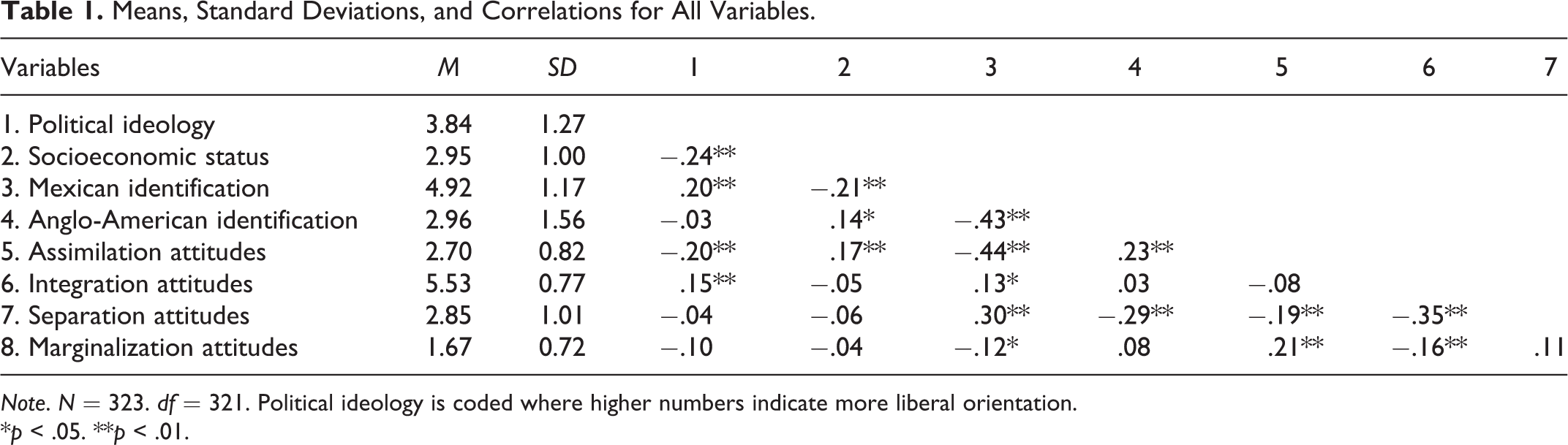
Note. N = 323. df = 321. Political ideology is coded where higher numbers indicate more liberal orientation.
*p < .05. **p < .01.
Differences in Cultural Identifications
Replicating prior research, strength of Mexican identity correlated with holding a more liberal political ideology (r = .20, p < .001). However, strength of Anglo-American identity did not correlate with political ideology (r = −.03, p = .64).
Next, we computed an interaction term between strength of Mexican and Anglo identity to test whether those who seem themselves as bicultural are more likely to hold a liberal ideology. Controlling for campus location and generation status, we found that the interaction approached significance (β = .11, p = .06). As shown in Figure 1, those who held stronger Mexican and Anglo-American identities (i.e., bicultural) were more likely to hold the most liberal attitudes (political ideology ŷ = 4.44), compared to the other combinations including those who had low Mexican, but high Anglo-American identities (political ideology ŷ = 3.62).

Political ideology as a function of strength of Mexican identification and Anglo identification. Political ideology is coded where higher numbers indicate more liberal orientation.
Differences in Acculturation Attitudes
Strength of cultural identities also correlated with acculturation attitudes in the expected ways. Strength of Mexican identity correlated with weaker assimilation attitudes (r = −.44, p < .001), stronger integration attitudes (r = .13, p = .02), stronger separation attitudes (r = .30, p < .001), and weaker marginalization attitudes (r = −.12, p = .03). Strength of Anglo-American identity correlated with stronger assimilation attitudes (r = .23, p < .001) and weaker separation attitudes (r = −.29, p < .001). Importantly, assimilation and integration attitudes were independent of each other (r = −.08, p = .17).
In terms of political ideology, holding stronger integration attitudes correlated with a more liberal ideology (r = .15, p = .007), while holding stronger assimilation attitudes correlated with a less liberal ideology (r = −.20, p < .001). Notably, neither separation attitudes nor marginalization attitudes correlated with political ideology. Because separation and marginalization did not significantly correlate with political ideology, all further analyses will focus on integration and assimilation attitudes.
Next, we tested our primary hypothesis that integration and assimilation attitudes would mediate the relationship between strength of cultural identification and political ideology. Because the strength of Anglo-American identity did not significantly correlate with political ideology, we could not conduct this specific mediation model. Thus, all further regression analyses will be conducted solely with the strength of Mexican identity as the predictor variable.
Using Hayes’ (2013) multiple mediation bootstrapping procedure (PROCESS Model 4), we entered integration and assimilation attitudes as mediators, Mexican identification as the predictor, and political ideology as the outcome (controlling for campus location and generation status). 5 Coefficients reported in Figure 2 are unstandardized regression weights using 5,000 bootstrap samples.
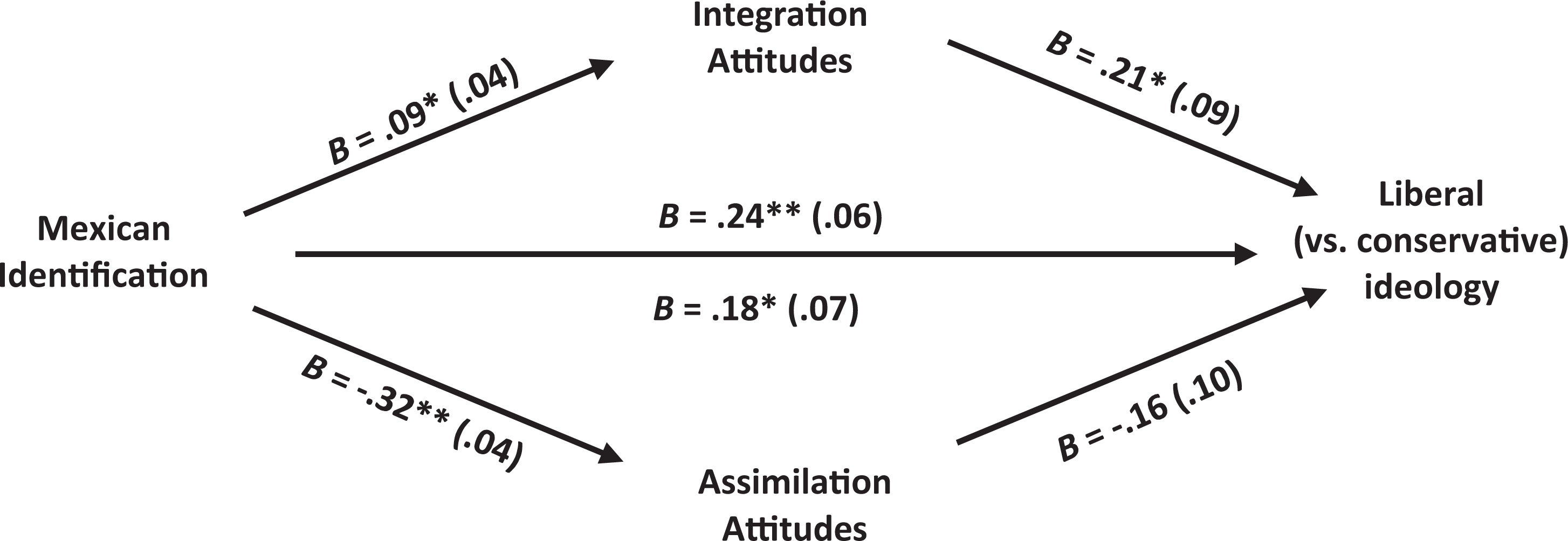
Estimates of the unstandardized regression weights (standard errors in parentheses) in the multiple mediation model with integration and assimilation attitudes as mediators. Political ideology is coded where higher numbers indicate more liberal orientation. *p < .05. **p < .01.
As shown in Figure 2, the total effect of Mexican identification on liberal ideology (B = .24, p < .001) was significantly reduced when the integration and assimilation mediators were included in the model (direct effect = .18, p = .01). Furthermore, the total indirect effect of Mexican identification on political ideology through integration and assimilation was significant, with a point estimate of .07 and a 95% bias-corrected and accelerated bootstrap confidence interval (CI) of [0.0044, 0.1398]. However, only the indirect effect through integration attitudes was a significant mediator (point estimate = .02, 95% CI [0.0020, 0.0494]). The indirect effect of Mexican identification through assimilation attitudes was not significant (point estimate = .05, 95% CI [−0.0103, 0.1192]). Thus, integration attitudes, and not assimilation attitudes, mediated the association between strength of Mexican identification and political ideology. That is, those with stronger Mexican identification were more likely to hold integration attitudes which, in turn, correlated with a more liberal ideology.
Differences in SES
We have demonstrated that integration acculturation attitudes partially mediated differences in political ideology as a function of one’s cultural identification. However, prior research has also found that individuals of high SES are less liberal and more likely to be Republican (Argyle, 1994; Gelman et al., 2007). We proposed that SES may moderate the relationship between strength of Mexican identification and political ideology. Specifically, we predicted that those with a weaker Mexican identity and higher SES will have a less liberal ideology.
Replicating prior research, we found that belonging to a higher SES correlated with a less liberal political ideology (r = −.24, p < .001). SES also correlated negatively with strength of Mexican identification (r = −.21, p < .001) and positively with strength of Anglo-American identification (r = .14, p = .02). To test our moderator hypothesis, we used Hayes’ (2013) simple moderation bootstrapping procedure (PROCESS Model 1). Both Mexican identification (B = .18, p < .01) and SES (B = −.24, p < .01) correlated with political ideology; however, these main effects were qualified by a significant interaction (B = .13, p = .03), ΔR2 = .014, F(1, 314) = 4.93, p = .03. 6
Figure 3 depicts the interaction using simple slopes of SES plotted at 25% (low), 50% (mid), and 75% (high) percentiles for participants with low (−1 SD) and high (+1 SD) degrees of Mexican identification. There were no significant conditional effects of Mexican identity for individuals in the 10th percentile (working class) or 25th percentile (lower middle class) of SES (−.0753 and .0544, respectively, both ps > .50). For those in the 50th percentile (middle class) or 75th percentile (upper middle class), there were significant conditional effects of Mexican identity (.1842 and .3139, respectively, all ps < .01). As shown in Figure 3, holding a weaker Mexican identification interacted with SES only for individuals who were of middle-class (political ideology ŷ = 3.70) or upper middle-class status (political ideology ŷ = 3.36). Individuals in these SES groups were considerably less liberal than their counterparts in the same SES groups but with a stronger Mexican identification.
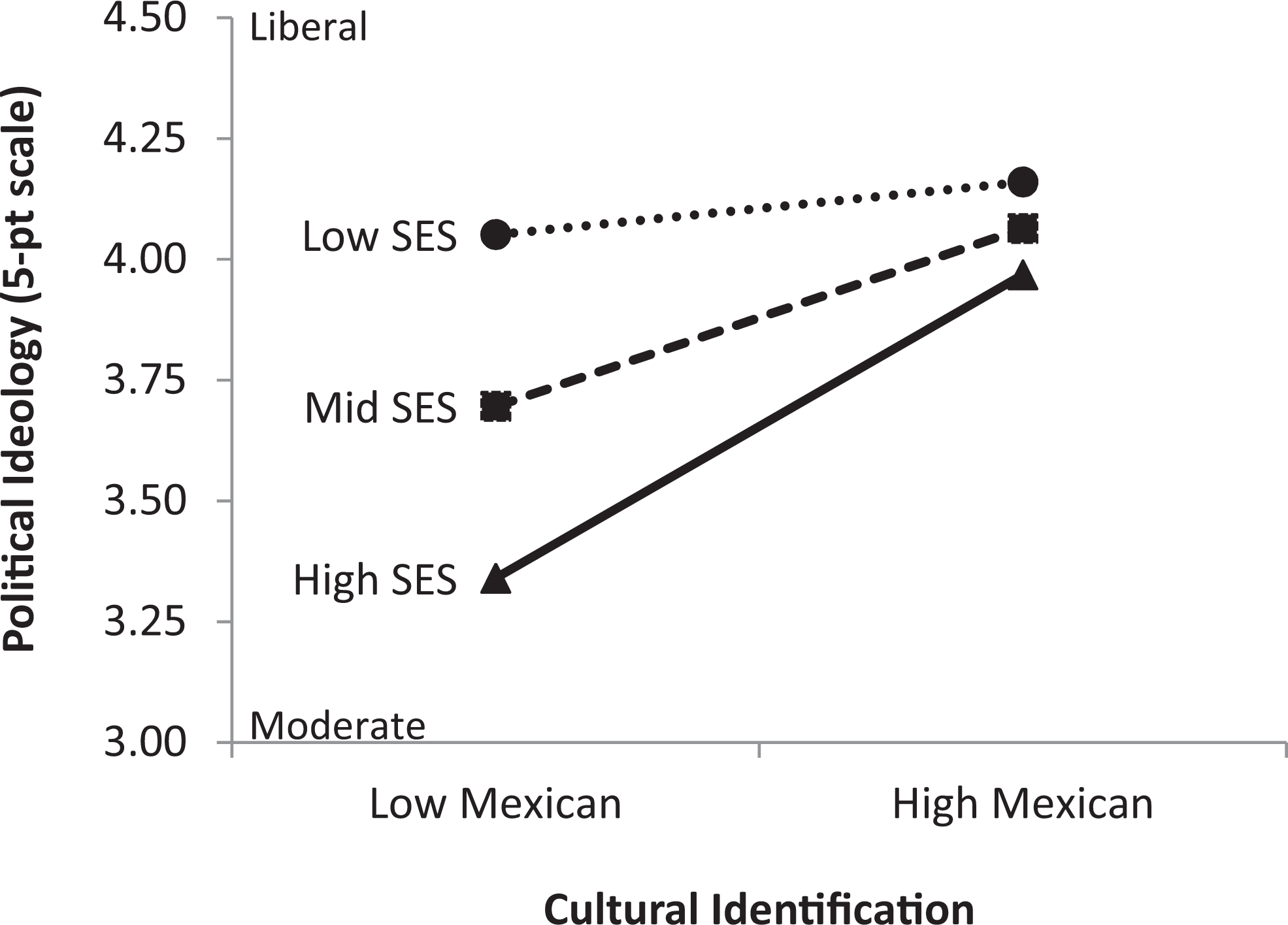
Political ideology as a function of strength of Mexican identification and socioeconomic status (SES), where low SES is the 25% percentile (lower middle class), mid SES is the 50% percentile (middle class), and high SES is the 75% percentile (upper middle class). Political ideology is coded where higher numbers indicate more liberal orientation.
We also tested whether our mediation model was conditional on the participant’s SES level (see Online Supplemental Material for analyses and figures). We found that holding weaker integration attitudes mediated the effect of Mexican identification on political ideology only for those who identified themselves as belonging to a higher SES (upper middle class or above) but not for those of lower social classes (middle class and below).
Discussion
Past research has often conflated living in the United States longer or belonging to a higher social class as indicative of a person’s assimilation to American culture. Our research supports several modes of acculturation which relate both to one’s cultural identification and political ideology. Specifically, we found that Mexican Americans holding strong dual cultural identities are more likely to hold acculturation attitudes that allow the integration of both customs into one unified identity. Furthermore, holding stronger integration attitudes partially explained holding a more liberal ideology. Thus, Latinos’ overwhelming support for the Democratic Party likely stems from valuing a political party who embraces multiculturalism (vs. nationalism) and creates policies geared at rectifying social inequality (e.g., equal rights; amnesty and not deportation).
On the other hand, we also found evidence that some Mexicans minimized the importance of their cultural identity and, in some instances, identified more strongly with an Anglo-American identity. Furthermore, belonging to a higher SES coupled with a weaker Mexican identity resulted in the most moderate ideology scores. One possible interpretation is that weakly identified Mexicans adopt Anglo-American’ values and cultural practices as a way to emphasize their commitment to being American or even to be accepted by other White Americans. For example, Basler (2008) found that some Mexican immigrants desired distancing themselves from undocumented Mexicans who entered the United States illegally. They reduced their identification with Mexican culture because they feared that White Americans would stereotype them as indolent and unwilling to learn English. These same Mexicans were also more likely to support Republican-sponsored Proposition 187 (i.e., the “Save our State” initiative) in California which prohibited undocumented immigrants from using social services such as health care and public education. Thus, one interpretation for why some Latinos support more conservative ideologies and the Republican Party is because the Party’s platform (e.g., strong patriotism to protect core American values; embracing personal responsibility and meritocracy) appeals to their stronger, more salient social identities (i.e., being American; being wealthy).
Limitations
The correlational nature of our study prevents us from asserting the directionality of our proposed mediational model. Research on ethnic identity development suggests that children as young as 6 or 7 understand which cultural group they belong and can ascribe psychological meaning to the ethnic label they choose for themselves (Bernal, Knight, Garza, Ocampo, & Cota, 1990). In this regard, one’s cultural identity may emerge prior to one’s political identity. However, identity development in adolescence is characterized as a time of exploration and commitment to many different social identities (Erikson, 1968; Marcia, 1966). Thus, ethnic identity and political identity may be developing concurrently or even shift throughout the life span, possibly even in reaction to treatment by others or by prevalent social and political discourse (e.g., Donald Trump’s anti-immigrant rhetoric).
Other limitations include that we used a single-item measure of political ideology and that our sample’s ideology was skewed in the liberal direction. However, national surveys like the ANES commonly rely on single-item measures of political affiliation and ideology. In spite of this, our sample’s distribution of ideology does reflect real trends within the Mexican American population (Bowler et al., 2006); however, future research should oversample more conservative constituents.
Another limitation is that our sample is limited to U.S.-born Mexican Americans. Future research should test if our results replicate among other Latino groups (e.g., Puerto Ricans and Cubans) or with recent immigrants (see Basler, 2008). Based on our findings, we suggest that acculturation attitudes will hold the strongest predictive validity among immigrants. The motivations for immigrating to the United States (e.g., joining family members or seeking economic advancement) will likely influence whether the person supports integrating or assimilating. Furthermore, integration attitudes only partially mediated the relationship between cultural identification and ideology; future research should examine whether the level of discrimination one has experienced may act as a mediator. Finally, experimental research could measure Latinos’ reactions to candidates who use assimilation versus integration language.
Implications
Our research suggests that there are important implications for political campaigning. For example, liberal candidates may have more success using Spanish-language campaigns or increasing visible presence of ethnic minorities in their campaign materials in order to capitalize on strongly identified Latinos’ pride and positive feelings toward their ethnic culture (e.g., Collingwood, Barreto, & Garcia-Rios, 2014). A candidate who demonstrates cultural awareness and genuine sincerity in referencing a group’s cultural traditions, practices, or language demonstrates that he or she values multiculturalism and will satisfy the needs of those with dual cultural identities.
On the other hand, conservative candidates might want to resist the urge to superficially insert themselves into Latino culture (e.g., being photographed eating Mexican food) or to speak Spanish to curry Latinos’ favor. These cultural appeals may backfire because they may make salient a cultural identity that is unimportant, or worse, lumps the Latino constituent into the cultural group that he or she has actively sought to minimize (e.g., Basler, 2008). Conservative candidates would have more success focusing on the prominent issues of their party’s platform—such as tax breaks for businesses or strong national security—that would appeal to Latinos who belong to higher social classes and endorse adopting traditional Anglo-American values.
Conclusion
Our study shows that understanding the complexities of a person’s cultural identity and attitudes toward acculturation opens a window into his or her political ideology, or said differently, into how he or she perceives the world and what he or she thinks is just.
Footnotes
Declaration of Conflicting Interests
The author(s) declared no potential conflicts of interest with respect to the research, authorship, and/or publication of this article.
Funding
The author(s) disclosed receipt of the following financial support for the research, authorship, and/or publication of this article: This research was partially supported by National Science Foundation minority postdoctoral research fellowship 0906067 to Laura P. Naumann.

Notes
References
Supplementary Material
Please find the following supplemental material available below.
For Open Access articles published under a Creative Commons License, all supplemental material carries the same license as the article it is associated with.
For non-Open Access articles published, all supplemental material carries a non-exclusive license, and permission requests for re-use of supplemental material or any part of supplemental material shall be sent directly to the copyright owner as specified in the copyright notice associated with the article.
