




Abstract

Introduction
Psychosocial care is a critical aspect of caring for oncology patients of all ages. Attending to the psychosocial needs of adolescents and young adults (AYA, 15–39 years) is particularly important given the distinct developmental impacts of a cancer diagnosis at this age. Key psychosocial aspects of AYA life include establishing autonomy and sense of self, developing peer and romantic relationships, exploring sexuality, navigating academic and vocational goals, financial independence, and family planning. 1 While a cure is a top priority for AYA during cancer treatment, AYA care about and prioritize their psychosocial wellbeing. 2 Most AYA with cancer are resilient, but they are at risk for adverse psychological outcomes during treatment for cancer, including increased emotional distress, anxiety, depression, and disrupted social functioning.3,4 Meeting the psychosocial needs of this population requires dynamic, individualized, and multidisciplinary care. 5
Important to supporting AYA is the provision of psychoeducation about the impacts of diagnosis and treatment up front, followed by routine assessment of psychosocial needs. Assessment outcomes should lead to swift and direct referrals to appropriate services offered by a range of professionals in health care settings and in the community. Psychosocial professionals providing such services include social workers, psychologists, psychiatrists, child life specialists, medical personnel, vocational counselors, and care coordinators.6,7 Despite the broad range of personnel capable of providing psychosocial care to AYA with cancer, many barriers remain that hinder AYA access to adequate psychosocial care. This essay explores current guidelines for psychosocial care of AYA with cancer, reviews barriers to implementing that care, and offers resources for overcoming such challenges.
Guidelines on Psychosocial Care
Two published guidelines that describe standards for AYA comprehensive psychosocial care are the Mattie Miracle Cancer Foundation’s Psychosocial Standards of Care (2015) and the National Comprehensive Cancer Network (NCCN) guidelines for AYA Oncology (2023). The Mattie Miracle Cancer Foundations Psychosocial Standards of Care (2015) are 15 published evidence-based standards that provide guidelines for delivering comprehensive care. These standards were developed by an international group of interdisciplinary professionals who conducted a review of evidence and formulated the final compilation of standards. 8 The professionals determined five areas of care that are critical for providing satisfactory psychosocial care to patients, including “assessment of child and family well-being and emotional functioning, neurocognitive status, psychotherapeutic interventions, school functioning, and communication, documentation, and training of psychosocial services.” 8 While an excellent project that is one of the first to provide a centralized source of information on psychosocial standards of cancer care, the evidence included in the development included studies of children and adolescents with cancer up to the age of 18. Therefore, evidence for older populations of AYA was not included, and thus some recommendations appropriate for AYA 18 years and older may be overlooked.
Fortunately, the NCCN guidelines for AYA oncology also provide a comprehensive list of guidelines for psychosocial care specifically for the AYA population. The NCCN guidelines describe three domains of psychosocial needs: individual function, relationships, and socionomic. 9 The domains offer several recommendations highlighting essential aspects of excellent psychosocial care, including conducting ongoing psychosocial assessments and providing interventions that address individual function, such as psychiatric diagnoses, coping, adherence, anticipatory guidance, and the need for psychoeducation. 9 For relationship care, recommendations focus on peer and romantic relationships, family relationships, and strengthening relationships via improved communication with health care professionals. For socioeconomic issues, recommendations review providing assistance to navigate insurance, education/employment, how to combat financial toxicity. Psychosocial issues specifically related to survivorship and palliative care, and bereavement are also reviewed. 9 Taken together, recommendations for meeting psychosocial standards of care require health care professionals to assess needs, provide access to information and interventions, and to promote collaboration across the AYA community of health care professionals, peers, and family members.
Barriers to Psychosocial Care in AYA Oncology
While the goal is to always provide comprehensive care, health care professionals may face several barriers that affect their ability to deliver services to AYA with cancer. From an organizational standpoint, the health care system is fragmented—no single professional can deliver all aspects of care, and coordinating delivery of psychosocial and medical services can be challenging. Referral pathways, scheduling, and communication across disciplines are all challenges faced by health care professionals.5,10 Psychosocial staffing and programming dedicated to AYA populations is limited. When institutions do have dedicated AYA programs, those clinics are often staffed by health care professionals who are only partially dedicated to AYA care and thus have other patient populations to treat. AYA clinic times may only be held weekly or at certain times of the day, which can limit the availability with which patients and families are able to attend their appointments. Finally, psychosocial issues may arise at any time during treatment for cancer. Inconsistent assessment of psychosocial needs throughout the treatment trajectory (and especially at critical times such as relapse or in transition to survivorship) may lead to overlooking areas where AYA require support and intervention.
Efforts to navigate health care and insurance systems can be burdensome at any age, but especially for AYA who may only just becoming independent over their schedule and finances. AYA are social and often juggling more than one responsibility, making it difficult to entice them to dedicate more time to new service referrals or interventions. While AYA may already be receiving psychological support in their communities, many therapists are not trained in the unique stressors of cancer patients. Patients may also not be feeling physically well enough to attend psychosocial appointments or participate in socialization interventions. Additionally, AYA are known to consider themselves exceptions to needing psychosocial intervention and are reluctant to share problems with health care professionals. 11 Intervention studies are needed to better understand how to address psychosocial issues during treatment for cancer. Unfortunately, research on the implementation and efficacy of psychosocial interventions is limited 12 and conducting intervention research is cumbersome. Furthermore, recruitment for psychosocial intervention studies can be difficult, and knowing which interventions to implement in practice, especially across a variety of settings, is uncertain. 13
Strategies and Recommendations for Improving AYA Psychosocial Care
Hiring personnel specifically for AYA psychosocial care is a key way to ensure psychosocial needs are assessed and addressed throughout treatment. Trained psychosocial staff are known to provide helpful clinical interventions to AYA with cancer, including mindfulness, anticipatory guidance, cognitive behavioral therapy, psychoeducation, and more to meet patient and family needs. 14 If staffing is not feasible, identifying health care professionals that can champion psychosocial support of AYA in the community setting can help. Many non-profit organizations and other community partners exist that offer virtual programming and support for AYA with cancer (see Table 1). When psychosocial teams are at play within an institution, developing an AYA-focused multidisciplinary committee or implementing rounds on AYA-aged patients is desirable for improving communication and coordination of care.10,14 To ensure consistency in care, it is also important to prioritize and document ongoing psychosocial assessments throughout the treatment trajectory and into survivorship.
Psychosocial Resources for AYA with Cancer
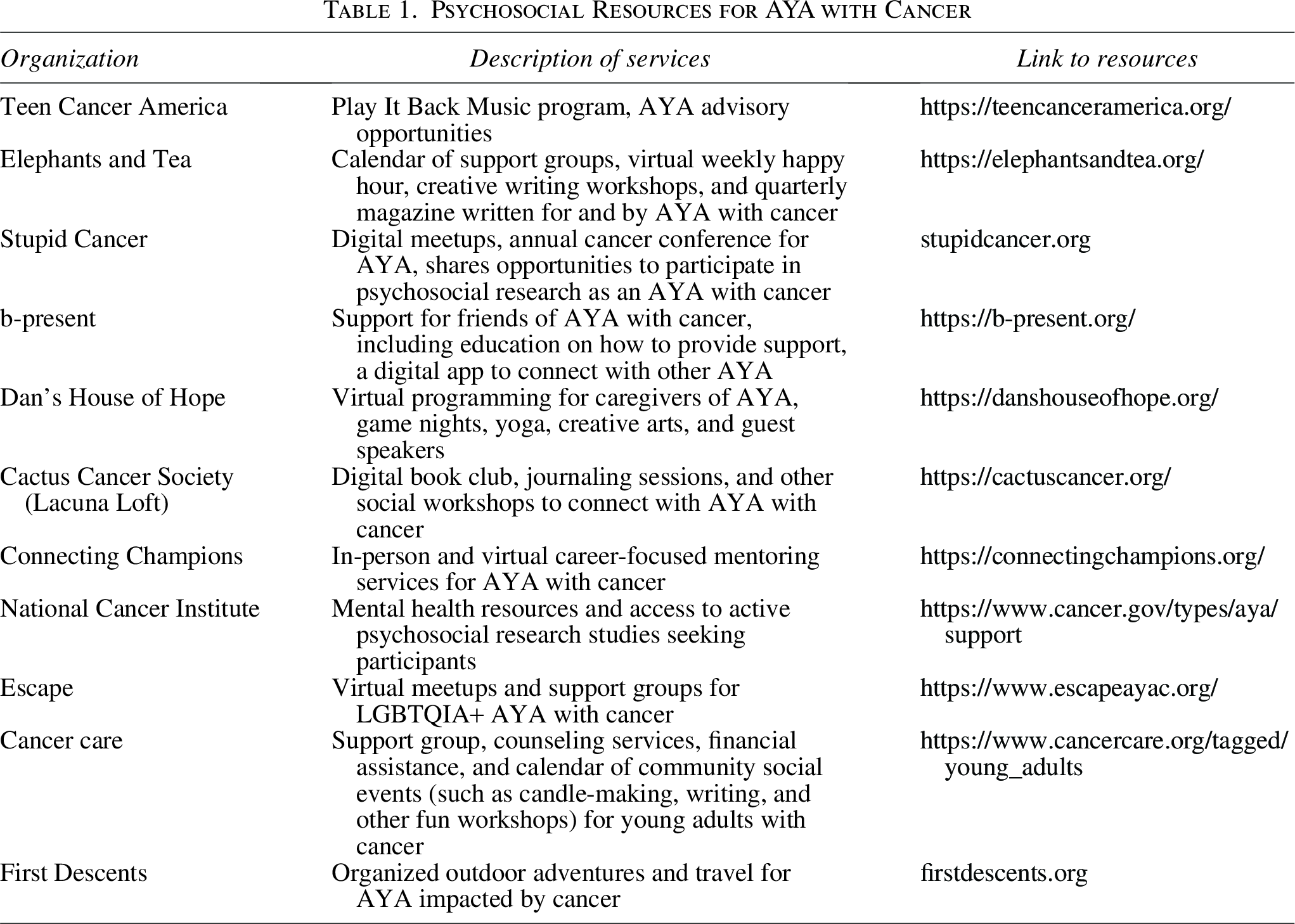
Increasing available psychosocial programming within cancer treatment settings is another strategy to meet the needs of AYA patients. Whenever possible, allocating physical space in the hospital for AYA to gather together or organizing community events for AYA helps reduce instances of isolation and promotes connection with hospital peers.7,10,15 Hospital peers and friends offer different supports to AYA with cancer, 16 so it is also important to encourage AYA to continue engaging in social activities outside of the hospital. Psychotherapy interventions, both individual and group, can be help AYA learn skills to manage the emotional effects of cancer. 17 To combat accessibility issues, virtual programming is often available. Technology can also be leveraged to provide mobile-based psychosocial care. 11 Partnering with community organizations is essential for meeting AYA needs; programs that offer financial support and vocational counseling are important for AYA in active treatment and in survivorship. 18 Finally, seek opportunities for AYA to participate in psychosocial research projects and clinical trials—from design through dissemination. 6
Conclusion
AYA are a vulnerable population with unique and often unmet psychosocial needs.7,19 Continued efforts are needed to support social and emotional distress among AYA with cancer. Addressing psychosocial well-being throughout the cancer trajectory requires strong communication between AYA and their health care team. Psychosocial assessment should be incorporated at multiple time points throughout treatment to ensure AYA have opportunities to share their needs. 5 Institutions treating AYA for cancer should consider increasing psychosocial support by offering programming opportunities for AYA to connect with one another as well as building partnerships with community organizations.
Footnotes
Author Disclosure Statement
No competing financial interests exist.
Funding Information
This project was supported by Faculty Affairs and the Department of Psychosocial Services at St. Jude Children’s Research Hospital (SJCRH). Support to SJCRH is provided by the American Lebanese Syrian Associated Charities (ALSAC). This project was supported in part by the Intramural Program of the National Institutes of Health (LW) and the Memorial Sloan Kettering NIH/NCI Cancer Center Support Grant P30 CA008748 (MB).