



Abstract
Community employment outcomes were examined for 338 transitioning youth with intellectual and other developmental disabilities in one state 18 months after exiting public school. All transitioning youth received ongoing Developmental Disability agency funding. The majority of transitioning youth (57.1%) were engaged in sheltered or nonwork activities. Only 14.2% were in integrated employment while 28.7% participated in other models of community work (e.g., enclaves, crews). Race/ethnicity, family expressed preference for paid work in the community, paid work experience, and self-management and community mobility skills were identified as predictors of community employment using multinomial logistic regression. Findings suggest the field should reexamine aspects of transition planning, including family engagement and work experience programs. Research and policy implications are also discussed.
Keywords
Preparing individuals with disabilities to transition from school to employment in the community, postsecondary education, and independent living has been a policy priority since the mid-1980s in the fields of special education and vocational rehabilitation (VR). Although strides have been made, studies documenting less than desirable employment outcomes for young adults with disabilities, especially those with low-incidence disabilities, continue to proliferate the literature (e.g., Baer, Daviso, Flexer, Queen, & Meindl, 2011; Carter, Austin, & Trainor, 2012; Newman, Wagner, Cameto, & Knokey, 2009; Sanford et al., 2011). According to the National Longitudinal Transition Study (NLTS-2) transitioning youth (TY) with low-incidence disabilities have the lowest rates of employment (Sanford et al., 2011). By special education disability label, these include 46.1% for youth with intellectual disabilities, 45.2% for youth with autism, and 46.1% for youth with multiple disabilities compared with 70.7% of youth with learning disabilities. Many of these youth meet the eligibility criteria for postschool services by their state VR agencies and for ongoing supports from their state Developmental Disability (DD) agency. For the purpose of this study, we use the term TY with intellectual and other developmental disabilities (IDD) to refer to transition-age youth with low-incidence disabilities (including intellectual disability, autism, and multiple disabilities) that were eligible for ongoing supports funded by the state DD agency after exiting school.
National studies of individuals with IDD receiving supports from VR and DD agencies depict similar dismal outcomes (Butterworth, Hall, Smith, Migliore, & Winsor, 2011; Butterworth, Smith, Hall, Migliore, & Winsor, 2008; Migliore & Butterworth, 2008). Over the past decade, the rehabilitation rate for individuals with IDD receiving VR services has declined. In 2010, only 49% of VR clients with IDD transitioned to paid employment as compared with 58% in 2002 (Butterworth et al., 2011). Of adults with IDD who received services from state DD agencies in 2009, only 20.3% of adults with IDD worked for pay in the community while the rest were engaged in sheltered or nonwork activities (Butterworth et al., 2011). These high rates of unemployment and sheltered outcomes persist despite evidence that TY with IDD and their families prefer integrated employment (Migliore, Mank, Grossi, & Rogan, 2007; Neubert & Redd, 2008) while school systems have become increasingly accountable for the postschool employment outcomes of youth who exit special education (Individuals With Disabilities Education Improvement Act [IDEA], 2004).
A number of issues exist regarding the methods to document employment outcomes for TY with IDD. First, the validity of employment outcomes that are self-reported is questionable, especially when the categories of employment outcomes are confusing and used inconsistently across studies (e.g., integrated, supported, sheltered). Follow-up studies rely on respondents (including TY with IDD, their families, and secondary school personnel) who may not know how to categorize employment outcomes. These outcomes are often categorized broadly in research reports (e.g., paid or unpaid, full-time or part-time). In a recent analysis of NLTS-2 database, Carter et al. (2012) determined that 43% of the TY with IDD who were working for pay were in jobs where most of their coworkers had disabilities. These jobs may have included group models of community employment (i.e., enclaves, mobile crews) or subminimum wage employment in a sheltered workshop. Butterworth et al. (2008) were also not able to distinguish between various models of community employment (i.e., integrated, enclaves, mobile crews). To date, these distinctions are not clearly captured in extant research. As a result, there continues to be a need to accurately document the employment outcomes of TY with IDD and to identify factors that influence the attainment of integrated employment.
Several studies have identified predictors of positive employment outcomes for adults with IDD, including (a) individual variables (e.g., self-determination skills), (b) family variables (e.g., income), and (c) community variables (e.g., the local unemployment rate) (Dixon & Reddacliff, 2001; Moore, Feist-Price, & Alston, 2002; Morgan, Elerd, Jensen, & Taylor, 2000). However, because these studies examined the outcomes of adults of all ages, they do not account for secondary school experiences or transitioning planning needs for TY with IDD. This is a critical gap given that secondary school experiences (e.g., paid work experience during secondary school, participation in career/technology and general education courses, and receipt of a standard high school diploma) are regarded as strong predictors of employment outcomes based on follow-up studies of youth who exit special education (e.g., Baer et al., 2003; Benz, Lindstrom, & Yovanoff, 2000; Fabian, 2007; Moore et al., 2002; Rabren, Dunn, & Chambers, 2002; Test et al., 2009; White & Weiner, 2004;).
Although these predictors provide some guidance in planning secondary experiences for students with disabilities, most of the existing follow-up studies of youth in special education do not disaggregate by disability. This is important because youth with IDD typically have different secondary school experiences than their peers with high-incidence disabilities, including less participation in general education classes and increased participation in alternative diploma-track programs, community-based activities, functional academic instruction, unpaid enclave work experiences, and transition programs on college campuses (Baer et al., 2011; Moon, Simonsen, & Neubert, 2011; Papay & Bambara, 2011; Wagner, Newman, Cameto, Levine, & Marder, 2003). In addition, individuals with IDD are often eligible for ongoing postschool supports, funded by state DD agencies and provided by community rehabilitation providers (CRPs). These CRPs may support individuals to work independently in the community or may provide various other models of supported work, including mobile crews/enclaves and facility-based contract work (e.g., assembly, collating). Given the vastly different experiences and possible outcomes of youth with IDD, it is critical to identify the most significant predictors of successful employment outcomes for this population.
Despite the recent emphasis in public discourse and policy initiatives (National Collaborative on Workforce and Disability, 2011) focusing on improving postschool outcomes for TY, only three published correlational studies were found that specifically examined predictors of paid work for TY with IDD (Baer et al., 2011; Bouck & Joshi, 2012; Carter et al., 2012). The outcome variables from these studies were not aligned with current definitions of integrated employment (real work for real pay in integrated settings; Alliance for Full Participation [AFP], 2010; U.S. Department of Labor, Office of Disability Employment Policy [ODEP], n.d.). The outcome variable in the Baer et al. (2011) statewide study of TY with IDD was full-time work, defined as at least 35 hr weekly. By limiting the outcome variable to full-time work, this study did not account for the TY with IDD who may have been engaged in integrated employment for less than 35 hr weekly. In this study, neither career and technical education nor work study programs were found to be significant predictors of postschool employment. It is not clear whether the TY with IDD had paid work experiences as part of their participation in these programs. Results suggest mere participation in a work program is not sufficient to prepare youth for postschool employment.
Carter et al.’s (2012) analysis of the NLTS-2 database reinforces the importance of paid work as a predictor of positive employment outcomes. They found that TY with IDD who had paid work experience while in school were 2.34 times more likely to be working for pay after exiting school. However, their outcome variable “working for pay,” did not distinguish between various types of paid employment (i.e., sheltered employment, community enclaves/crews). A unique finding for this study was the families’ expectation for paid work was the most significant unique predictor of paid work. TY with IDD whose family expressed an expectation for paid work were 3.58 times more likely to be working for pay after exiting school. Although these studies contribute to our understanding of variables that may be related to work outcomes for some TY with IDD, a few limitations exist. It is not clear whether or not the TY with IDD in either study were receiving ongoing supports (i.e., from a CRP). In both studies, the survey respondents included TY with IDD and/or their family members, rather than professionals who provide services and who may be able to better categorize employment outcomes. Thus, more research is needed to clarify the variables that are the strongest predictors of paid work in the community, especially integrated employment, for TY with IDD.
Therefore, the purposes of this study were to (a) document the postschool outcomes for TY with IDD receiving ongoing supports funded by the state DD agency 18 months after exiting school and (b) examine empirically derived individual, family, community, and school variables that predicted various models of paid work in the community for this population. The following categories were used in this study: (a) integrated employment, (b) other community work, and (c) sheltered or nonwork activities. Table 1 provides definitions and examples for each category.
Postschool Outcome Categories.
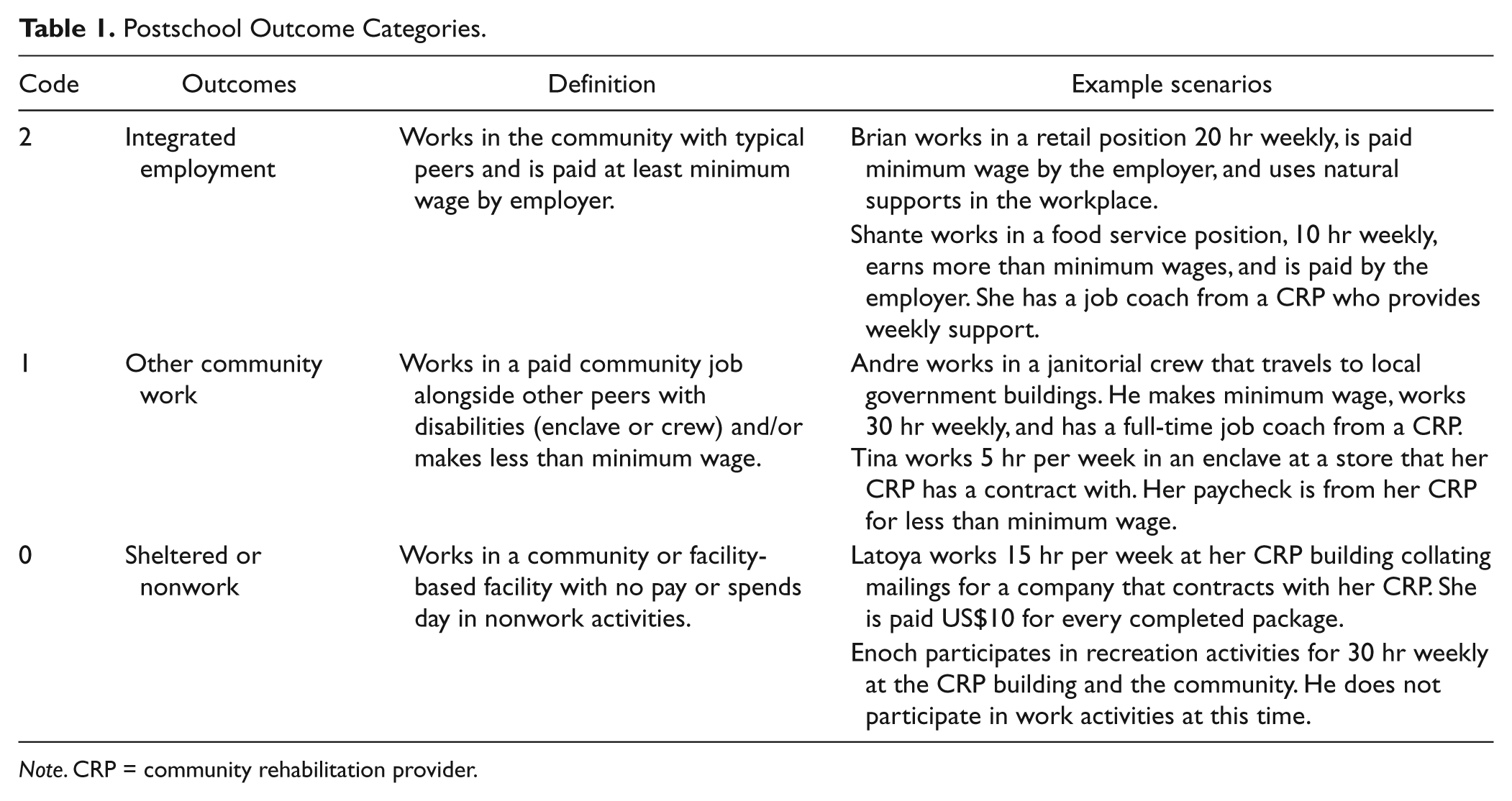
Note. CRP = community rehabilitation provider.
Method
Setting
Maryland’s diverse population of 56,000,000 includes 29.5% African American/Black, 6.3% Hispanic/Latino, 5% Asian, 58.1% White, 0.30% American Indian/Alaskan Native, 0.10% Native Hawaiian/Pacific Islander, and 1.2% as two or more races (U.S. Census Bureau, n.d.). Students with IDD, who have an Individualized Education Program (IEP) and are eligible for school until age 21, can participate in a statewide Interagency Transition Youth Initiative, which is an interagency agreement intended to promote a seamless transition from special education services to adult services (Maryland Department of Mental Health and Hygiene, 2010). The initiative articulates that the local education agencies (LEAs) provide transition services, including community-based instruction, work-based experiences (e.g., unpaid enclaves, paid internships), and related case management. It is important to note the provision of transition services (e.g., curriculum, type of work experiences, etc.) varies across each of the 24 county-based LEAs. VR participates in this initiative by paying for short-term services that should lead to employment (e.g., job development) for eligible youth. The DD agency provides the ongoing funding that allows students to choose a CRP for employment or day services with varying levels of support. Importantly, this interagency initiative allowed these TY to bypass a waiting list of 16,000 individuals waiting for DD funding (The Arc of Maryland, 2009).
TY With IDD and Respondents
TY with IDD
The State Coordinator for Transition and Employment Services of the DD agency identified all 560 TY with IDD who met the following criteria: (a) exited schools in Maryland in 2008, (b) participated in the state interagency transition initiative, and (c) were determined eligible for support services from CRPs across the state. These youth received ongoing supports from 81 different CRPs. After sending surveys to these 560 TY with IDD, surveys were completed for 338 (60.4%). These TY with IDD received ongoing supports from 57 different CRPs, including 206 males (60.9%) and 132 females (39.1%). The race/ethnicity of the TY with IDD was 48.8% Caucasian/White, 44.4% Black/African American, 1% Black/African American and Caucasian/White, 2.7% Asian, 2.7% Spanish/Latino origin, 0.3% American/Alaskan Native, and 0.3% Native Hawaiian/Other Pacific Islander, and 0.3% American Indian and Caucasian/White. A majority of the TY with IDD (74%) received Supplemental Security Income (SSI) or Social Security Disability Insurance (SSDI) benefits.
Respondents
The respondents were employees of CRPs providing services to the TY with IDD. Respondents’ titles varied, such as Case Manager, Employment Specialist, and Community Employment Associate. Respondents completed a survey for each TY with IDD that provided services through their CRP agency; therefore, some respondents completed multiple surveys. Over half (52%) of the surveys were completed by respondents who had known the participant for 13 months or more and who interacted with him or her on a daily basis. Surveys were completed predominately by female respondents (82.7%) between the ages of 26 and 45 (54%).
Survey
A Transition Youth Follow-Up Survey was developed based on a review of research to identify variables related to employment outcomes for TY and adults with IDD. Survey items were developed to measure employment outcomes for each of the TY with IDD. To reduce the effect of social stigma and improve the reliability of the employment outcome data, rather than force respondents to indicate that TY with IDD were in “integrated,” “competitive,” or “supported” employment, the survey was designed to elicit descriptive data that were used to later code the employment outcomes into three discrete categories. Using a drop-down menu, respondents indicated the (a) type of job (enclave, crew, or individual placement), (b) industry (e.g., building/grounds maintenance, health care, etc.), (c) level of support (e.g., natural supports only, full-time job coaching, etc.), and (d) wage information (e.g., subminimum wage by agency, at least minimum wage by employer) for the TY with IDD’ work outcomes. Additional items were developed to assess empirically derived demographic, school, individual, and family variables. In addition to the demographic and school variables (e.g., gender, race/ethnicity, type of school), four rating scales were included in the survey; they were designed to measure (a) self-determination skills, (b) self-management, (c) community mobility, and (d) level of family involvement. The items in each of these scales were selected from existing curriculum and assessments including (a) the Arc Self-Determination Scale (Wehmeyer & Kelchner, 1995), (b) the Syracuse Community Referenced Curriculum Guide for Students With Moderate to Severe Disabilities (Ford et al., 1989), (c) Getting Around Town: Teaching Community Mobility Skills to Students With Disabilities (Moon, Luedtke, & Halloran-Tornquist, 2010), and (d) Degree of Involvement Scale (Wandry & Pleet, 2009). Nine experts in the field of transition/employment provided feedback on the extent to which the questions measured the intended construct (content validity), as well as clarity of questions, skip patterns, and terminology. Based on these revisions, an online survey was developed using Survey Monkey (Survey Monkey Corporation, 1999–2011) and reviewed by four CRP staff members who were randomly selected from a list of CRPs in Maryland. These reviewers commented on the clarity of questions, ease of survey layout, and their ability to respond to the survey items. In addition, the first author identified the unemployment rate for the CRP’s zip code according to the U.S. Bureau of Labor and Statistics (n.d.) and manually entered the rate into the database. For additional information, operational definitions for each variable in the survey (e.g., race/ethnicity, self-determination skills), and a copy of the final study survey, see Simonsen (2010).
Procedures
The State Coordinator sent packets to 81 CRPs which provided ongoing supports to the 560 TY with IDD containing (a) a cover letter to the Executive Director explaining the purpose of the study, (b) the process for selecting a staff member to complete the survey (the respondent), and (c) directions for distributing the respondent packet. This packet contained a letter that identified the TY with IDD by name and study identification number (ID), a consent form, a raffle entry form, a self-addressed, stamped envelope to return the paper survey and directions for accessing the online version of the survey. One week later, the State Coordinator sent a reminder postcard to all CRP Executive Directors encouraging participation in the study. Completed surveys were tracked for each TY with IDD with an ID number. A second respondent packet was mailed to the CRPs with incomplete surveys.
Data Management
We manually entered data from the paper surveys into an online version of the survey. A trained graduate student conducted a reliability check on 100% of the surveys and corrected discrepancies. Data from all online surveys were exported to an Excel spreadsheet and then entered into a SPSS Statistics 18.0 database using the ID number.
The first author coded the employment outcomes using three nominal outcome variables: (a) integrated employment, (b) other community work, and (c) sheltered or nonwork activities (see Table 1). Although we acknowledge the significant distinction between sheltered work and nonwork activities in the community, by collapsing these categories, we were able to identify predictors of community work as compared with these two less desirable outcomes and increase the statistical power of the analysis. We conducted a reliability check of the outcome coding (96%) and revisited the discrepancies to determine agreement for 100% of the outcome codes for the TY with IDD.
Independent variables (e.g., race/ethnicity, self-determination skills) were coded with a numerical value. To examine the relative importance of categorical variables with multiple levels, we created dummy codes (Pedhazur, 1997). For example, we assigned dummy codes to measure work experience during secondary school including (a) paid competitively, (b) paid with a stipend, and (c) unpaid work experience, with no work experience as the reference group.
We did not code survey items that allowed CRP respondents to select “Don’t Know,” which resulted in missing data. Seventy-two of the 338 TY with IDD had missing data and would have been excluded from the study, reducing the sample size by 21.3% and resulting in a loss of power. Therefore, we eliminated two missing variables (i.e., receiving SSI and having a VR counselor) with more than 5% missing data points from the logistic regression analysis (Grace-Martin, 2010). We used mean substitution for two other variables with missing data: lives with family and school setting (Acock, 2005; Grace-Martin, 2010).
Data Analysis
We used descriptive statistics to determine the frequency and percentage of the 338 TY with IDD engaged in each of the outcome variables. The relationship of the predictor variables with community employment (both integrated employment and other community work) was analyzed by using multinomial logistic regression. Discriminant analysis and hierarchical linear modeling (HLM) are also appropriate to use with categorical outcome variables; however, discriminant analysis is most appropriate when all the predictors are continuous and HLM is used to analyze nested data, which was not the case in this study. Thus, multinomial logistic regression provided the best understanding of the multivariate determinants of community employment outcomes with the fewest variables as the outcome variable had three mutually exclusive nominal categories (Hosmer & Lemeshow, 2000; Pedhazur, 1997).
We used a three-step multinomial logistic regression model building strategy (Hosmer & Lemeshow, 2000) and included (a) screening variables by examining bivariate relationships between the predictor variables and the outcome variables, (b) testing variables that had statistically significant chi-square values in the screening model, and (c) evaluating the importance of each variable in the secondary model as measured by the significance of the chi-square value and refitting to develop a final reduced model. The multinomial logistic regression model yielded the log-odds of both categories of community work (e.g., integrated employment and other) relative to the reference category (e.g., sheltered or nonwork).
Analysis of model
To assess the overall strength of the association of the model, we examined the Nagelkerke R2, which is a pseudo R2, for the final reduced model and describes the percentage of variance that can be explained by the model. Although the Nagelkerke R2 is not directly comparable with the R2 in linear regression analysis, it is considered a better indication than the commonly used Cox and Snell R2 (Pampel, 2000).
To analyze the relationship of the predictor variables with each of the two community work outcomes—(a) integrated employment and (b) other community work—we examined the significance of the Wald Test statistic and the odds ratios from the Parameter Estimates Table in the SPSS output. SPSS labels the odds ratio “Exp(B)” and provides “Low” and “High” confidence (95%) levels for it, which is constructed to detect the significance of the odds ratios. In the case of an odds ratio, for the result to be statistically significant, the 95% confidence interval should not include the value of “1.” Next, we used tetrachoric transformations to convert the odds ratios into effect sizes as a measure of practical significance: r = (OR3/4 − 1) / (OR3/4 + 1).
Results
Outcomes
The first purpose of this study was to document the employment outcomes for TY with IDD 18 months after exiting the school system. Of the 338 TY with DD in our sample, over half of the TY with IDD (n = 193, 57.1%) spent their days at a CRP facility performing sheltered or nonwork activities. The other 145 (43%) of TY with IDD were working for pay in the community. Of these, only 48 (33%) were earning at least minimum wage in the community with a salary paid by the employer. The remaining 97 (67%) TY with IDD worked in the community as a group with direct supervision from a CRP staff member and/or earned below minimum wage. This means that, of the 338 TY with IDD included in this study, integrated employment was the postschool employment outcome for only 14.2% (n = 48).
Predictors of Community Work
The screening or first phase of the model building yielded 11 variables that had a bivariate relationship (p < .10) with community work outcomes (see Table 2). The p value of .10 was selected to avoid underfitting the model at this early stage (Hosmer & Lemeshow, 2000). During the testing phase, two variables—receiving SSI and having a VR counselor—were eliminated because there were more than 5% missing data points. A logistic regression model was run with the remaining nine variables. After repeating the process of deleting and refitting, the final model included the following five variables that most significantly predicted the TY with IDD would be engaged in community work (either integrated employment or other): family expressed preference for paid work in the community (χ2 = 24.03, p < .001), paid work during secondary school (χ2 = 9.68, p = .010), self-management skills (χ2 = 6.26, p = .050), community mobility skills (χ2 = 6.16, p = .070), and race/ethnicity (χ2 = 6.03, p = .072). Using multinomial logistic regression allowed us to examine the relative significance of each of these variables on both categories of community work. The regression coefficients, standard errors, odds ratios, 95% confidence intervals, and effect sizes for each variable in relation to both categories are reported in Table 3.
Bivariate Relationships of Predictor Variables.
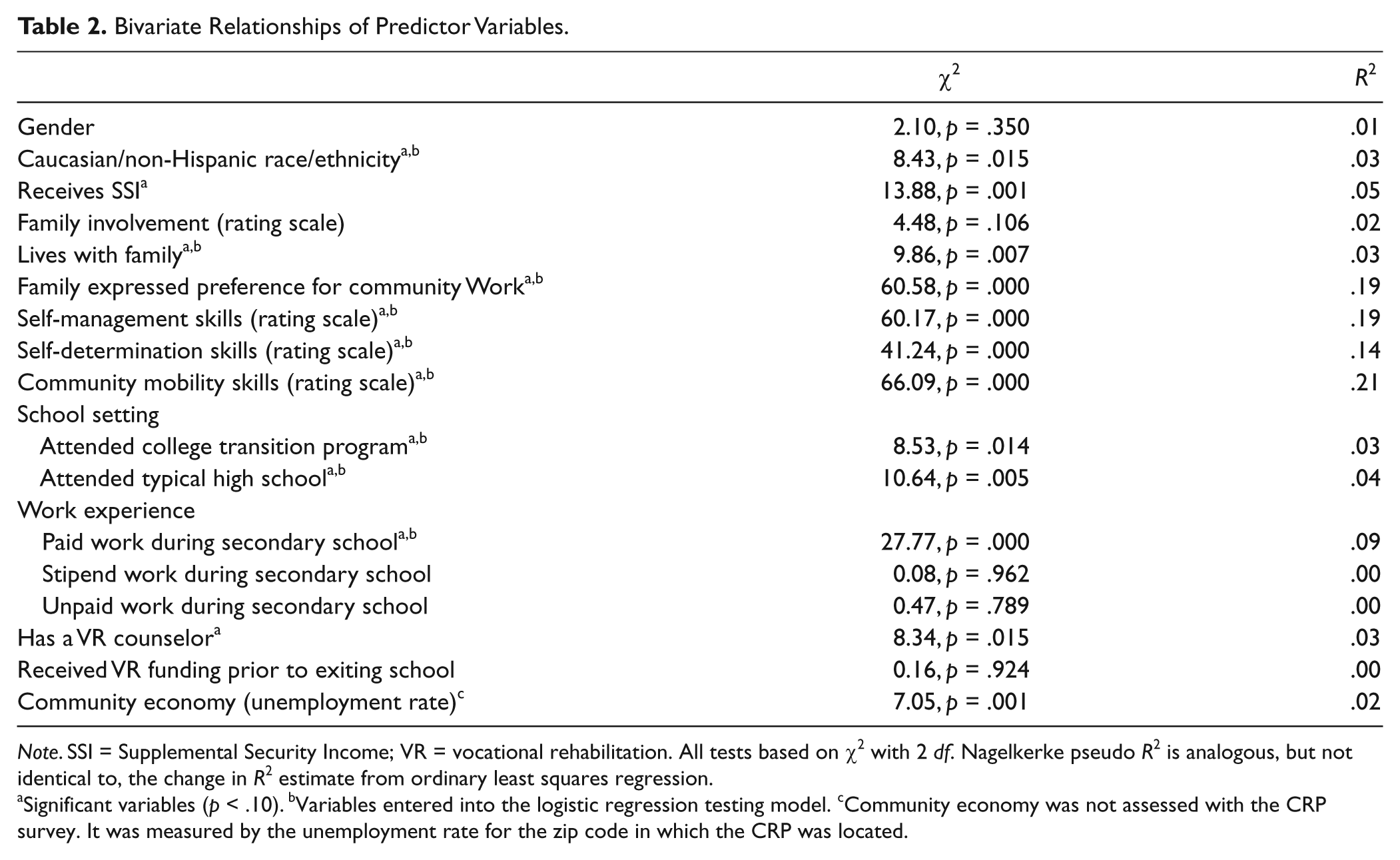
Note. SSI = Supplemental Security Income; VR = vocational rehabilitation. All tests based on χ2 with 2 df. Nagelkerke pseudo R2 is analogous, but not identical to, the change in R2 estimate from ordinary least squares regression.
Significant variables (p < .10). bVariables entered into the logistic regression testing model cCommunity economy was not assessed with the CRP survey. It was measured by the unemployment rate for the zip code in which the CRP was located.
Significance of Variables in the Final Model Relative to Each Type of Work in the Community.
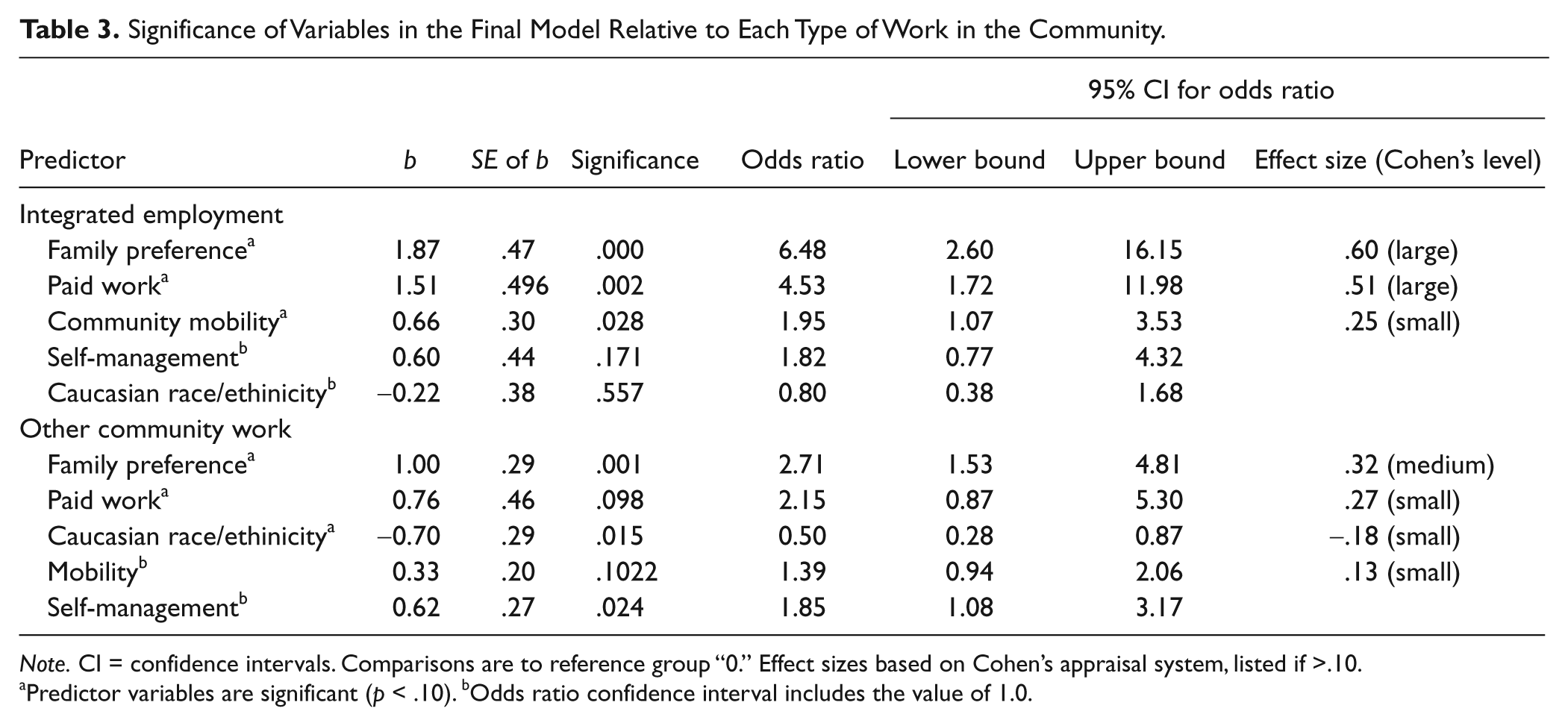
Note. CI = confidence intervals. Comparisons are to reference group “0.” Effect sizes based on Cohen’s appraisal system, listed if >.10.
Predictor variables are significant (p < .10). bOdds ratio confidence interval includes the value of 1.0.
Predictors of integrated employment
Three variables had a statistically significant effect on predicting whether a TY with IDD was engaged in integrated employment when compared with the sheltered or nonwork category: family expressed preference for paid work in the community (p < .001), paid work during secondary school (p = .002), and strong community mobility skills (p = .028). The odds ratio of 6.48 for family expressed interest for paid work in the community meant that for TY with IDD whose families’ expressed an interest in paid work were 6.48 times more likely to be in integrated employment. The odds ratio of 4.53 for paid work during secondary school meant that TY with IDD who worked for pay during secondary school were 4.53 times more likely to be in integrated employment. The odds ratio of 1.95 for community mobility meant that for every additional point on the community mobility scale, TY with IDD were 1.95 times more likely to be in integrated employment.
Predictors of other community work
Three variables had a significant unique effect on predicting whether a TY with IDD was in other paid work when compared with the sheltered or nonwork category: family expressed preference for paid community work (p = .001), race/ethnicity (p = .015), and self-management (p = .024). The odds ratio of 2.71 for family expressed preference for paid community work indicated that TY with IDD whose families expressed a preference for paid community work were 2.71 more likely to be engaged in other community work models. Caucasian race had a significant negative effect on predicting the outcome. The odds ratio of 0.50 meant that Caucasian/non-Hispanic TY with IDD were 2 times less likely to be in other integrated employment rather than the sheltered or nonwork. The odds ratio of 1.85 for self-management skills meant that TY with IDD with one point increase on the self-management scale were 1.85 times more likely to be in other community work. Although paid work during secondary school had a p value of .098, the confidence interval of the odds ratio included the value “1,” which implied no significant effect.
Discussion
The purposes of this study were to (a) document the postschool outcomes for TY with IDD receiving ongoing supports funded by the state DD agency 18 months after exiting school and (b) examine empirically derived individual, family, community, and school variables that predicted various models of paid work in the community for this population. Despite the recent policy discourse about ensuring that all students are college and career ready, the federal policy and advocacy emphasis on integrated employment and Maryland’s state transition initiative, only 145 (42.9%) of 338 participants were engaged in some type of paid work in the community. Our findings are similar to Winsor and Butterworth (2008) who reported 38% of adults with IDD in Maryland participated in paid work in the community. However, this study is one of the first to distinguish between integrated employment from other paid community work. This is significant because only 14.2% of the TY with IDD were employed in the community, earning at least minimum wage integrated employment. While other studies have included group models of employment or subminimum wage jobs in their definition of integrated employment (Butterworth et al., 2008), these models are not aligned with the vision of TY with IDD, their families, and policy initiative (real work for real pay).
In addition to documenting the types of employment outcomes for TY with IDD, this is one of the first correlational studies to examine the relationship between a number of empirically derived predictor variables and specific employment outcomes for this population. This is important because some of the variables used in this study are likely to be relevant only to TY with IDD, such as work experience with a paid stipend and participation in a college transition program for individuals with IDD ages 18 to 21.
Given the previous research on predictors for successful employment, we were surprised to find that gender was not a significant predictor of community work. Unlike many studies that identified a relationship between gender and employment outcomes (e.g., Baer et al., 2003; Fabian, 2007), the dependent variable in this study did not include a minimum number of hours worked per week. Future studies should consider the number of hours worked and wages earned specifically for TY with IDD. Another surprising finding was that Caucasian/non-Hispanic race/ethnicity had a significant negative relationship with community work outcomes. Other studies have identified Caucasian/nonminority status as positively related to employment outcomes for individuals with disabilities (e.g., Heal & Rusch, 1995; Moore et al., 2002). It is possible that our sample differed from other studies in that it was more representative of the increasingly diverse national demographics. For example, 50.6% of the participants were identified as non-Caucasian as compared with only 33% in Moore et al. (2002) and 35.4% in Heal and Rusch (1995). As our schools and communities shift become increasingly diverse, it is important to continue to examine the role that race/ethnicity plays in predicting postschool outcomes.
Surprisingly, school setting was not found to be a salient predictor in this study, suggesting that the work experiences and skill attainment in community mobility and self-management during the final secondary school years may be more important than the instructional setting itself. Self-management skill instruction has been identified as an evidence-based practice in secondary transition (Test et al., 2009) and needs to be addressed during transition assessment activities and goal development by IEP teams. The importance of community mobility skills in the present study reinforces the findings in another study where CRP staff rated the importance of transition planning activities (Moon et al., 2011). In addition to self-management skills, CRP staff reported community mobility skills were essential if TY with IDD were to work in the community.
Our findings support the vast array of studies that have identified the relationship between secondary work-based experiences and positive employment outcomes for students with various disabilities (Baer et al., 2003; Benz et al., 2000; Fabian, 2007). Although Moon et al. (2011) found that CRP staff preferred TY with IDD (rather than their families) to advocate for specific types of employment services, our findings suggest family members who expressed a preference for the TY with IDD to move toward community work were significantly more likely to ensure this outcome. This was especially true in regards to TY with IDD who transitioned to integrated employment.
Limitations
Despite the important findings of this study, limitations exist. The sample was limited to one state that had a unique transitioning funding initiative for students with IDD so the participants bypassed the usual waiting list for DD-funded services. However, the eligibility criteria, long-term funding, and service planning offered through the DD service delivery system are typical of what TY with IDD will encounter in other states. The survey developed for this study could allow other states to determine how other TY with IDD fair when similar or no transitioning initiatives are present.
There were several limitations regarding the survey and the use of CRP staff as respondents. We surveyed CRP staff rather than TY with IDD and/or their families in an effort to obtain a more accurate picture of employment options for this population and to increase the survey response rate (60.4%). However, there was not a reliability check for the employment information or secondary experiences recorded on survey by CRP staff as the data were neither linked to the participant’s name or the specific CRP staff member who filled out the survey(s). It is possible that some CRP staff did not have complete records on participants from the sending school system or did not take the time to locate all the information requested on the survey. Finally, although the variables selected to explore in this study represented the demographic, individual, family, school, and community predictors identified in previous research, the list is not exhaustive. For example, CRP respondents were not asked to report the size or organizational structure of services in their agency. It is plausible that these variables may impact the types of employment options experienced by individuals with IDD.
Suggestions for Future Research
To use follow-up study data to improve transition services and outcomes, it is essential that we accurately capture the complex nature of the employment outcomes for TY with IDD. An area of concern has to do with the manner in which Indicator 14 from IDEA (2004) defined types of targeted employment outcomes. School systems are required to report the percentage of youth who have achieved the following postschool outcomes within one year of leaving school: (a) enrolled in higher education, (b) enrolled in higher education or competitively employed, (c) enrolled in higher education or in some other postsecondary education or training program or competitively employed or in some other employment (IDEA, 2004). To document that a TY with IDD meets Indicator 14’s criteria for competitive employment, states must determine that he or she worked for pay at or above minimum wage in a setting with others who do not have disabilities for a period of 20 hr per week for at least 90 days. Whereas some TY with IDD will achieve this goal within 1 year of exiting school, many more are likely to be categorized as achieving “some other employment,” which includes integrated employment for less than 20 hr per week, other paid work, and any sheltered work for pay. By grouping these categories together, the Indicator 14 data does not adequately describe the postschool outcomes of TY with IDD and therefore does not provide sufficient guidance to school systems to improve transition services for this population.
This definition of competitive employment is aligned with neither recent policy initiatives that set the attainment of integrated employment (direct hire jobs that pay at least minimum wage) as the gold standard (AFP, 2010; Association of People Supporting Employment [APSE], 2009; ODEP, n.d.) nor the definitions used in other federal policy initiatives for employment options. Neither the definition of competitive employment included in the 1998 reauthorization of the Rehabilitation Act nor the definition of integrated employment used by ODEP includes requirements for a minimum of hours worked. The existence of overlapping terminology and inconsistent definitions across various systems (e.g., education, rehabilitation, DD) threatens the interpretability of the data. Future studies should examine the terminology and definitions across systems. More consistent terminology and definitions, along with a coordinated tracking system would give the field more accurate information and enhance the ability of policy makers to use follow-up data to guide and improve services for individuals with IDD.
In addition to clarifying the preferred outcome variables, additional studies are needed to clarify the most salient predictors of integrated employment for TY with IDD. Although secondary database analyses of large data sets (including NLTS-2) provide valuable information about the correlation between some predictor variables and employment outcomes, transition services are not consistently defined or implemented across school systems. Findings from this study indicate that the type of work experience (unpaid, stipend, paid) mattered in terms of significance to TY with IDD’s employment outcome. It is possible that other characteristics of the work experiences are significant (e.g., level of support, hours worked weekly, alignment with transition goal). Future research should incorporate mixed methods so that the field can more accurately characterize the types of employment experiences and the level of family engagement.
Implications for Practice
The four malleable variables that emerged as salient predictors of integrated employment for TY with IDD—(a) self-management skills, (b) community mobility skills, (c) family expressed preference for integrated employment, and (d) paid work experience during school—provide valuable information for TY with IDD, families, educators, and policy makers about the skills and experiences that are most critical in the secondary years. In an era of standards-based education (Brown, Shiraga, & Kessler, 2006), these findings should assist secondary teachers and transition specialists as they advocate for instruction and IEP goals that target these important skills when community employment is the intended postschool outcome for TY with IDD. Perhaps these important skills are best facilitated through paid work experiences during the secondary years. It is important to note that whereas paid work during secondary school was identified as a salient predictor of community work, unpaid and stipend-paid work experiences were not. This is a critical distinction and should provide TY with IDD who have a postschool goal of community work with the rationale to advocate for the opportunity to participate in authentic paid work experiences as part of their transition services. School systems may need to restructure personnel and resources to make this a reality. Facilitating paid work experiences for students with IDD typically requires school systems to have transition specialists and/or job development specialists who have the expertise/skills to establish relationships with community businesses, identify potential employment opportunities, and develop accommodations/supports for the individual to work as independently as possible.
In addition to facilitating acquisition of skills and experiences that are likely to lead to community work outcomes, schools should also invest increased time and resources toward meaningfully engaging families in the transition planning process. This finding suggests that families can have a strong influence over the types of employment options and supports their son/daughter obtains from a CRP. Whereas experts have long reputed the importance of family involvement for improving student performance and outcomes (e.g., Dixon & Reddacliff, 2001; Wandry & Pleet, 2009), this study reinforces the importance of family expectations in Carter et al. (2012). As the field endeavors to increase the rates of integrated employment for TY with IDD, it is not enough to focus on family involvement. Rather, transition personnel should provide individualized supports to youth and families to increase expectations for employment and to help prepare youth and families to navigate the complex adult service system. Facilitating paid work experiences during secondary school can be an opportunity for families of TY with IDD to witness their son/daughter being successfully employed in the community and to address some of their concerns about integrated employment (e.g., transportation, safety, and salary/SSI benefits). Unpaid and/or sheltered work experiences do not offer the same authentic learning situations. Transition planning must include opportunities to educate and empower TY with IDD and their families to advocate for integrated postschool outcomes within the adult service system.
Conclusion
According to the National Post-School Outcomes Center, Indicator 14 data should be used to guide and improve services (National Post-School Outcomes Center, 2011). To do so, we must ensure that we are accurately tracking the postschool outcomes of TY with IDD who may be engaged in various types of employment options. Our findings indicate that many TY with IDD have not fully benefited from the paradigm shift toward community employment outcomes. Even fewer had obtained integrated employment, which is most closely aligned with policy and advocacy efforts across disciplines. Although educators and policy makers aspire to improve the postschool outcomes for all students, including TY with IDD, surprisingly little is known about the skills and secondary experiences that ultimately lead to integrated employment. The findings from this study reaffirm the importance of factors identified by CRP staff members as critical for integrated employment (Moon et al., 2011). These include self-management and community mobility skills, paid work experience during the secondary years, and informed families who support and advocate for integrated employment as a postschool goal. Future studies should build on these findings to clarify the predictors of integrated employment for TY with IDD who will require ongoing funding and supports to work independently. By doing so, secondary and transition practices can be aligned with other federal mandates for integrated opportunities in society.
Increasingly, TY with IDD and their families, many of whom have participated in integrated educational settings, may expect opportunities for integrated employment after exiting school. For example, in a qualitative study of TY with IDD who participated in a college transition program, one student who worked for subminimum wages in a mobile crew stated, “after I graduate, I sure hope that the [CRP] finds me another job because when he kicks me out of [the mobile crew] I’ll be happy” (Neubert & Redd, 2008, p. 227). The findings from this study indicate that we have a long way to go before meeting those expectations.
Footnotes
Declaration of Conflicting Interests
The author(s) declared no potential conflicts of interest with respect to the research, authorship, and/or publication of this article.
Funding
The author(s) received no financial support for the research, authorship, and/or publication of this article.