



Abstract
This study examines esports fans’ psychological processes and pertinent behaviors through the lens of the self-determination theory (SDT). The extent to which the esports fans’ basic psychological needs—that is, competence, autonomy, and relatedness—are satisfied were assessed by using a composite latent variable model. Findings derived from the data analyses confirmed the relevance of the SDT in explaining pertinent information on need satisfaction, motivation, and related consumption behaviors. In particular, relatedness was identified as the most salient basic psychological need dimension, suggesting that satisfying this need is critically important for esports consumption. Both the inquiry protocol and the findings of this investigation contribute to the existing literature on motivation by developing an SDT model in esports media studies. Further discussions were made on deciphering the opportunities and challenges associated with the burgeoning esports industry.
The size of the esports industry has mushroomed substantially in the past few years, with global revenues reaching US$1.1 billion and the audience approaching 453.8 million (Pannekeet, 2019). One major contributor to the soaring popularity is online viewership, demonstrating a profound change in the consumption of media products in the digital era (Qian, Wang, et al., 2019; Qian, Zhang, et al., 2019). The growing importance of esports as a part of participatory media culture has given rise to a subset of digital media research (Jenkins, 2006). There have been multidisciplinary endeavors to delve into the psychological mechanisms that are instrumental to explaining esports fans’ behaviors, with many of the investigations devoted to scale development and modeling in an attempt to understand the motives that drive esports media consumption (e.g., Cianfrone & Zhang, 2013; Hamari et al., 2017; Hamari & Sjöblom, 2017; J. Y. Lee et al., 2014; Pizzo et al., 2018; Qian, Wang, et al., 2019; Qian, Zhang, et al., 2019; Sherry et al., 2006; Yee, 2006; Yee et al., 2012). The majority of the efforts have resorted to media and communication psychology theories such as Sloan’s sport motivation theories (Qian, Wang, et al., 2019), uses and gratifications (U&G) theory (Brown et al., 2005; Hamari & Sjöblom, 2017; Qian, Wang, et al., 2019), or a hybrid framework of the Motivation Scale for Sport Consumption (Hamari & Sjöblom, 2017) and the Sport Interest Inventory (Pizzo et al., 2018). Researchers have identified several motivational factors that are associated with esports fans’ desire to achieve intended outcomes or receive desirable benefits in various settings, including game participation (Jang & Byon, 2019, 2020), live event attendance (Pizzo et al., 2018), and online viewership (Hamari & Sjöblom, 2017; Qian, Wang, et al., 2019; Wulf et al., 2020). This empirical work has provided a descriptive foundation that highlights how distinct motives elicit relevant behaviors and reveals the unique ways by which consumers view and interact with esports media products and services.
Despite the various motives for esports media consumption identified and examined as well as the empirical insights generated by the distinct theories, the adoption of a multi-attribute survey instrument as the measurement foundation seems to be the norm among the vast majority of prior esports research. Ryan et al. (2006) postulated that rather than focusing on content-specific classifications or typologies, motivation should be conceptualized to reflect the basic psychological needs that stimulate and sustain consumption behaviors across different types of users in distinctive settings. It is therefore argued that research examining human motivation should not simply tackle issues associated with behavioral classifications or be constrained by the content and structure of a particular consumption activity (e.g., U&G theory, Sloan’s sport motivation theories). Instead, scholars should delve into how different basic psychological needs are fulfilled, thereby leading to or enhancing behaviors among all potential consumers and across all types of activities (Deci & Ryan, 2000; Ryan et al., 2006). This proposal is echoed by Funk et al. (2012) who examined sports consumer motivation based on individuals’ basic need orientations and suggested that domain-specific knowledge could be strengthened and better interpreted by adopting a nonspecific motivational approach. In other words, one major limitation common in prior studies stems from the focus on the differences in what content-based gratifications people consciously seek. Researchers point out that such gratifications are acquired in distinct circumstances and are thus limited by the affordances that those settings provide, and those gratifications may be achieved as a result of substitute or derivative fulfillments, confounding the real impact of specific motivational forces (Deci & Ryan, 2000; Przybylski et al., 2010; Ryan et al., 2006). This lack of clarity and consistency might hamper explanatory power and limit theoretical significance.
Studies conducted in other academic disciplines have shown that empirical models measuring how the basic psychological needs are satisfied are more predictive of outcome variables and better clarify the dynamics of the behaviors of interest as opposed to assessing various gratifications in specific contexts (e.g., Engström & Elg, 2015; Gagné & Deci, 2005; Lin et al., 2009; Przybylski et al., 2010; Ryan et al., 2006). Following this idea, the present study investigated esports fan motivation from the perspective of the self-determination theory (SDT), which considers fulfillment of innate psychological needs as the theoretical grounds for human motivation (Deci & Ryan, 1985, 2000; Ryan & Deci, 2000a). This investigation attempted to explain the fulfillment of esports fans’ basic psychological needs and pertinent behaviors through the lens of the SDT as a macro-theory of human motivation. The current study viewed esports media consumption as a result of the fulfillment of innate and universal human psychological needs, namely competence, autonomy, and relatedness. This consistency would substantially add utility and generality for understanding esports fans’ motivation and associated behaviors.
Review of Literature
The Basic Psychological Needs
The SDT assumes that humans have a natural tendency to develop organized and coherent senses of self as they voluntarily engage in exploratory, curiosity-driven, and developmental behaviors (Deci & Ryan, 2000). Intrinsic motivation thus reflects humans’ playfulness, inquisitiveness, and propensity toward active assimilation, creative application of skills, and visceral exploration. When intrinsically motivated, people engage in an activity without operationally separable rewards, reinforcement, or instrumental consequences because the activity itself is interesting, challenging, or enjoyable (Deci & Ryan, 1985, 2000; Ryan & Deci, 2000a).
To explain variability in intrinsic motivation, two subtheories within the SDT, the cognitive evaluation theory (CET) and the basic psychological needs theory (BPNT), were developed (Ferrer-Caja & Weiss, 2000; Przybylski et al., 2010; Ryan et al., 2006; Vallerand & Reid, 1984; Van den Broeck et al., 2008, 2010). CET proposes that intrinsic motivation can be fostered and maintained by satisfying the basic psychological needs for competence, autonomy, and relatedness (Deci & Ryan, 2000; Ryan & Deci, 2000a). Conditions sanctioning the experience of competence, autonomy, and relatedness are posited to facilitate intrinsic motivation and behavioral engagement. In contrast to other well-known need perspectives (e.g., Maslow, 1943) where human needs are proposed to be either hierarchically ordered or acquired through learning, BPNT posits that, similar to physiological needs (e.g., Freud, 1914; Hull, 1943), the basic psychological needs for competence, autonomy, and relatedness are innate, fundamental propensities as opposed to acquired or learned (Deci & Ryan, 2000) and that all three needs are essential for people’s flourishing. Moreover, instead of focusing on need strength or the importance people attach to particular needs, both CET and BPNT postulate that humans are naturally attracted to situations in which the fulfillment of humans’ basic psychological needs may occur. The degree to which those innate needs are fulfilled is the most important premise and predictor for optimal functioning and performance.
Following this tenet, an array of empirical studies has utilized or adapted the SDT and its subtheories to address human motivation and behaviors across a variety of academic disciplines (e.g., Deci et al., 2001; Engström & Elg, 2015; Przybylski et al., 2010; Sweeney et al., 2014). It has also been extensively examined in the field of exercise psychology and sport pedagogy (e.g., Chang et al., 2016; Chen et al., 2012, 2018). In the realm of media psychology and entertainment research, there have been few research efforts attempting to understand media enjoyment and game experience through the lens of the SDT (e.g., Peng et al., 2012; Tamborini et al., 2010, 2011). Findings have shown that media users’ need satisfaction might furthermore help understand the consumption of media products and services, select the most applicable need orientations, initiate appropriate marketing campaigns, and develop tailored promotional messages that better accommodate user needs, wants, and preferences.
In this light, the overarching proposition that guides the current study is that behavioral engagement is associated with the fulfillment of the basic psychological needs. Subsequently, esports consumption outcomes (i.e., commitment, word of mouth [WOM] intentions, and actual viewing/spending behaviors) would be mainly a result of one’s realized basic psychological needs. The following discussion explicates the conditions and situations in which the needs for competence, autonomy, and relatedness are supported or satisfied among esports fans.
The Fulfillment of the Competence Need
The need for competence represents one’s inclination to feel capable of mastering a task, test and extend skills, receive positive feedback, and manage various challenges (Deci & Ryan, 1985, 2000; Ryan & Deci, 2000b; Ryan et al., 2006). A sense of competence is manifested in social situations where an individual can express capacities, enhance skills, and feel confident. Consistent with this definition, esports fans’ need for competence may be fulfilled through acquiring new skills, reinforcing pertinent knowledge, and experiencing intense immersion through their engagement in esports that engenders or enhances the feeling of effectiveness and accomplishment (Deci & Ryan, 2000; Qian, Wang, et al., 2019).
Esports fans watched professional or veteran players, professional or amateur events, and game tutorials or highlights in an effort to elevate skills, improve strategy, and ultimately obtain a better understanding and improvement of their game performance, according to Qian, Wang, et al.’s (2019) review of qualitative descriptions of the skill improvement motive. Terms and phrases such as “learn new things,” “get new ideas,” “copy strategies,” and “pick up tactics” are reflections of the need for competence as esports fans actively seek and learn from what would help them become better players themselves. In a similar vein, the extent to which esports fans understand the esports game may also impact the fulfillment of their need for competence. Oftentimes, esports fans test their esports know-how or improve upon what they already know by following the streams of some best players or elite competitions. In turn, these streams provide constructive feedback to the fans, offer an important means to reinforce and display their knowledge of the game, and ultimately translate into an enhanced feeling of competence (Deci & Ryan, 2000). As esports fans usually spectate game actions directly from a professional player/streamer’s view, what is presented for them is what a player/streamer sees in-game (Qian, Zhang, et al., 2019). This vicarious sensation elicits a sense of competence that allows fans to immerse themselves in a game indirectly but effectively, especially when the game requires a comprehensive set of skills and a serious commitment to excel.
The Fulfillment of the Autonomy Need
The need for autonomy reflects the desire to act willingly and voluntarily. Activities underpinning autonomy are accordant with one’s interest or importance (Deci & Ryan, 2000). An individual is autonomously stimulated when the person is provided with a meaningful rationale for doing a task, and the person’s feelings are recognized and acknowledged. When activities are performed for interest or personal value, perceived autonomy is high (Ryan & Deci, 2000a). As such, it is reasonable to assume that the need for autonomy is supported when people are allowed to indulge in their interests and endorse their actions or behaviors. For esports fans, appreciating skills and strategies demonstrated in esports and enjoying competition and entertainment improve the fulfillment of the autonomy need for two reasons. First, esports is deemed a voluntary activity as people feel they are the initiators of their actions; and second, these experiences represent the attraction and desirability of esports, which are in concordance with esports fans’ interests and integrated values.
People’s desire to appreciate skills, plays, and strategies in esports reinforces its status as a legitimate form of spectator entertainment (Qian, Wang, et al., 2019). Similar to fantasy sports consumption (Dwyer & Kim, 2011; Larkin, 2015; S. Lee et al., 2013), the appeal of competition is also a key to people’s engagement in esports. The competitive structure of esports resembles professional sports and differentiates itself from regular gaming activities as professional esports usually features serious, competitive, and performative events and tournaments that gratify fans’ desire for the thrill of competition (Pizzo et al., 2018; Seo, 2015; Seo & Jung, 2016). Esports can be seen as a combination of active serious leisure and casual passive entertainment (Seo, 2013; Seo et al., 2015; Seo & Jung, 2016) and can also be considered an entertaining pastime in the same way that other recreational pursuits are, such as watching movies, going to the theater, or taking trips to an amusement park (Wann, 1995; Wann et al., 2008).
The Fulfillment of the Relatedness Need
Research has suggested that the fulfillment of the relatedness need is critical to intrinsic motivation and essential for well-being (Deci & Ryan, 2000; La Guardia et al., 2000). The need for relatedness is satisfied when one experiences a sense of community and develops a close relationship with others (Deci & Ryan, 2000). Identical to traditional sports, esports is characterized by salient group dynamics. It has been imbued with social elements, as characterized by the early arcade scenes where fighting games flourished with cheering crowds to today’s massive local area network events, where face-to-face interactions take place (Sjöblom & Hamari, 2017). Qian, Wang, et al. (2019) indicate that a considerable number of esports fans reported that the primary reason they started playing and watching esports was their close “real-life” friends. While esports might exert a positive impact on existing social relationships or established friendships in an actual physical location, it also helps foster and maintain interpersonal relationships in online communities. People watch esports because of the camaraderie built between viewers and streamers/players and a sense of belongingness built among esports fans. Enhanced by communication tools and digital distribution platforms, such as Twitch chat, Reddit, and Discord, people from around the world can talk to each other and stay connected regardless of time zone or place (Hilvert-Bruce et al., 2018; Sjöblom & Hamari, 2017). Given people’s natural tendency to seek companionship in the social matrix (Deci & Ryan, 2000), it is logical to contend that the opportunity to bond with friends and socialize online through esports supports the relatedness need.
The Fulfillment of the Basic Psychological Needs and Esports Media Consumption
Researchers have documented how the fulfillment of the basic psychological needs would affect and predict video game enjoyment and engagement (Przybylski et al., 2010; Ryan et al., 2006), WOM intentions and behaviors within online communities (Sweeney et al., 2014; Wang et al., 2016), workplace motivation and organizational commitment (Deci et al., 2001; Gagné et al., 2008; Gagné & Deci, 2005), and customer loyalty and citizenship behaviors (Engström & Elg, 2015; Wang et al., 2016). Findings have indicated that the fulfillment of the basic psychological needs is the precursor to deciphering complex human behaviors and interactions and that the varying extents to which people’s basic psychological needs are fulfilled differently influence their cognitive, conative, and behavioral outcomes. In the current study, commitment, WOM intentions, and media consumption behaviors can be considered an indication of one’s perception that the basic psychological needs are being met.
Commitment
This concept has been extensively investigated as a key relational construct in numerous studies, and recently, researchers have begun to examine the relationship between motivation and commitment (Gagné et al., 2008; Garcia-Mas et al., 2010). In this vein, the SDT emerged as an important theory explaining the impact of the basic psychological need fulfillment on commitment. Research findings have shown that the fulfillment of the basic psychological needs is the basis through which commitment develops (e.g., Bono & Judge, 2003; Millette & Gagné, 2008). Even so, most of the studies using the SDT to understand the motivation–commitment relationship are still within organizational behavior settings. Few attempts have been made from a media psychology perspective to assimilate the SDT variables and commitment into an integrated model, to demonstrate how the concepts are related, or to test how the fulfillment of the basic needs and commitment combine to influence actual consumption behavior.
In this study, commitment is defined as an enduring psychological attachment to maintain a valued relationship with an esports game and a resistance to change (Moorman et al., 1993). Commitment is considered a pivotal construct in esports media consumption, given the relatively high turnover rate of esports games played and even higher turnover rate in title-specific viewership over a year (Trowbridge, 2018). As such, it is hypothesized that:
WOM intentions
Scholars have increasingly recognized positive WOM as an effective means of promotional communication. WOM has higher credibility, given the notion that WOM behaviors take place between consumers who are not associated with a vested interest in a product and are more likely to present the information of the product in a trustworthy manner (Anderson, 1998; Herr et al., 1991; Zeithaml, 2000). In the current context, positive WOM intentions can be an outcome of the fulfilled basic psychological needs. Researchers have suggested that the need for self-effectiveness motivates an individual to forge a good image through which the person could be positively or favorably recognized (Angelis et al., 2012). As such, esports fans who obtain a strong sense of competence via esports may be more likely to share positive information about the game. Similarly, people with a higher level of autonomy, that is, confident in their ability and volitional in their decision, may be more likely to express individuality and share opinions (Gagné, 2009). The need for relatedness is also associated with WOM intentions. If an individual is highly identified with a certain social group, the person may have a strong sense of belonging and be more likely to act on behalf of the group, especially through positive WOM (Cheung & Lee, 2012). Hence, when esports fans are satisfied in terms of competence, autonomy, and relatedness, they are incentivized to engage in honest and noncontrolling WOM communication activities. Therefore, we hypothesize that:
Behavioral responses
Behavioral variables have been tested and reported in recent esports-related studies. These consumption variables include watching hours, playing hours, spending on watching, and spending on playing as they pertain to the core interests and concerns of esports publishers, event organizers, professional teams, players, and streamers (Hamari & Sjöblom, 2017; Przybylski et al., 2010; Ryan et al., 2006; Sjöblom & Hamari, 2017; Sjöblom et al., 2017). Przybylski et al. (2010) found that the basic psychological need fulfillment would account for game enjoyment and preference for future play. Likewise, it is expected that the basic psychological need fulfillment would also explain esports consumers’ behavioral responses. Thus, the following hypotheses are developed:
The mediating role of commitment
Research has revealed that commitment is a critical precursor to customer retention (Alexandris et al., 2002). It has been demonstrated to increase patronage intentions and self-report purchase behaviors (Inoue et al., 2017; Verhoef et al., 2002). In a similar vein, a few studies have provided empirical evidence for the positive relationship between commitment and WOM communications (Harrison-Walker, 2001; Parsa & Cobanoglu, 2011; Wulf et al., 2006). Hence, it is proposed that:
Methodology
Instrumentation
Given that the purpose of this study was to formatively measure the basic psychological needs among esports fans and examine the relationships between the fulfillment of the basic psychological needs and esports consumption outcomes, the operationalization of the basic psychological needs was the most important task for the current research team. Eight items were adapted from Qian, Wang, et al.’s (2019) study to operationalize the three innate psychological needs by using a formative model. The decision to conceptualize and measure the fulfillment of these basic psychological needs formatively was consistent with the esports context and the characteristics of the basic psychological needs (Ryan & Deci, 2000a). Previous empirical investigations (e.g., Pizzo et al., 2018; Qian, Wang, et al., 2019; Qian, Zhang, et al., 2019) have demonstrated that esports consumption is dynamic and multifaceted. From an esports fan’s perspective, each basic psychological need is nurtured and sustained by distinct psychological elements that are not conceptually interchangeable. Although all esports fans are likely to benefit from having the basic psychological needs fulfilled, there are various means and ways to express and satisfy their innate needs. From a measurement perspective, various conditions supporting the fulfillment of the basic psychological needs could potentially affect (or cause) their respective underlying constructs. Following Jarvis et al.’s (2003) guidelines, these conditions should be operationalized as formative indicators since (a) they do not covariate, (b) they are not interchangeable, and (c) they jointly determine the conceptual and empirical meaning of the construct (i.e., the direction of causality flows from the indicator to the latent construct). Consistent with these principles, the adapted formative items are a succinct representation of the motivational dimensions identified in the Motivation Scale of Esports Spectatorship. More importantly, they represent the distinct psychological elements and conditions that are critical for enhancing the fulfillment of the basic psychological needs.
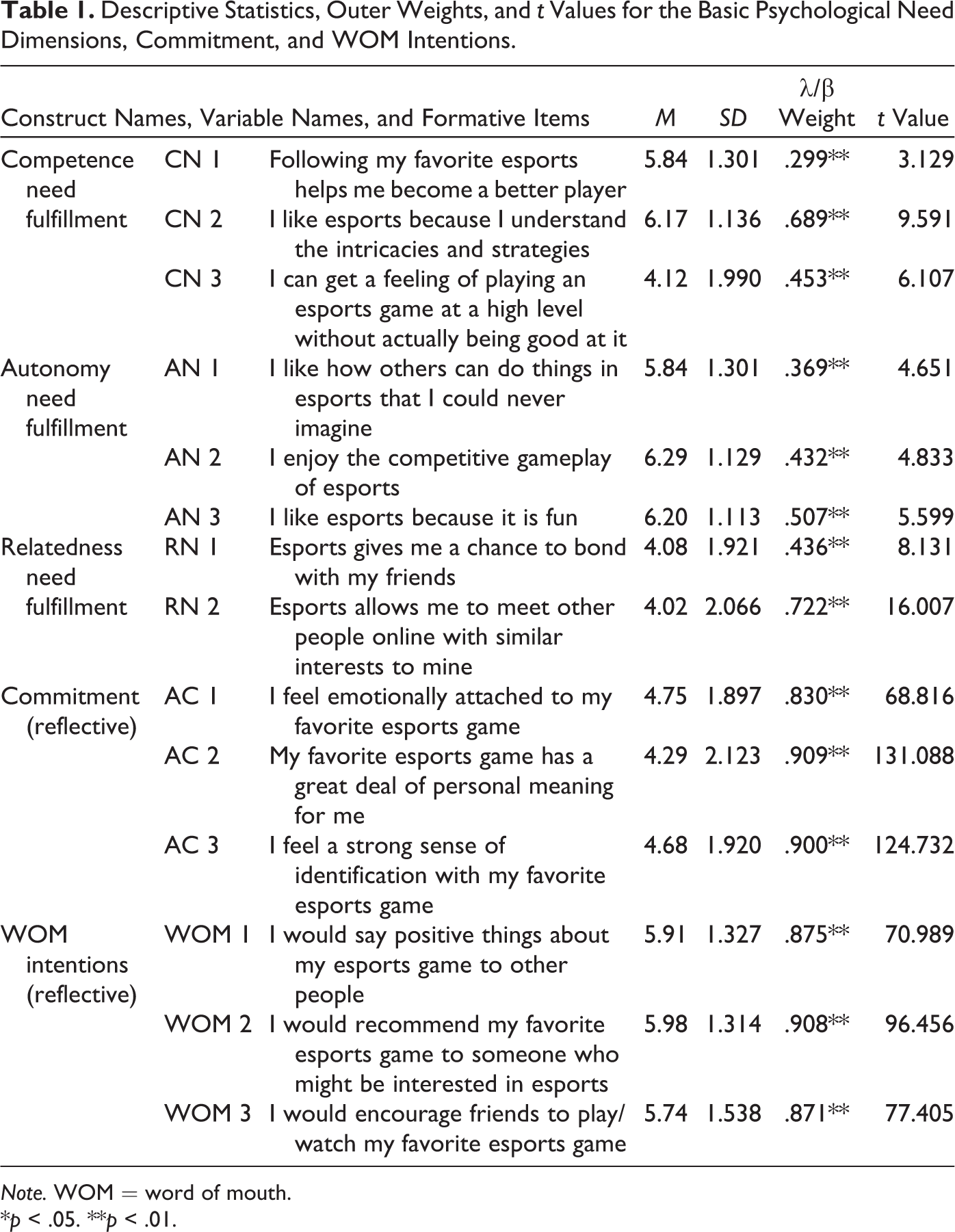
To ascertain the content validity of the 8-item, three-dimension formative model, the items were thoroughly scrutinized by an expert panel consisting of professors in sport media, sport management, and quantitative research methodology (Hulland et al., 2018). Based on the criteria of relevance, representativeness, and clarity, the expert panel members were asked to evaluate the items based on the definitions of the basic psychological needs. Following an 80% consensus among panelists, content validity was confirmed with 3 items measuring the competence need, 3 items measuring the autonomy need, and 2 items measuring the relatedness need. With respect to esports consumption outcome variables, items measuring esports game commitment (reflective) and WOM intentions (reflective) were directly adopted from Qian, Wang, et al.’s (2019) study (Table 1), while self-reported viewing hours (hours watched per week) and esports-related spending (annually in U.S. dollars) were assessed by 2 single items.
Descriptive Statistics, Outer Weights, and t Values for the Basic Psychological Need Dimensions, Commitment, and WOM Intentions.
Note. WOM = word of mouth.
*p < .05. **p < .01.
Data Collection and Analyses
The current study’s target population was esports fans who were over the age of 18 and watched esports at least once a month (Newzoo, 2017). A cross-sectional, nonexperimental design was employed. A convenience sample was collected via an online survey distributed on Reddit for 10 days (March 1 to March 11, 2018). Reddit is a popular online discussion forum characterized by high levels of interaction among members. Screening questions related specifically to esports were adopted to ensure that the participants understood the context and were qualified for the study. Of the 1,644 participants who entered the survey, 1,100 provided complete data.
We employed procedures in SPSS Version 25.0 to generate descriptive statistics. Procedures in SmartPLS Version 3.0 were executed to examine the partial least square (PLS) structural model and verify the proposed hypotheses. Our use of partial least squares-structural equation modeling (PLS-SEM) was considered appropriate as we attempted to (a) test a structural model with nonnormal data and formative measurement; (b) identify key driver constructs, that is, the basic psychological needs for competence, autonomy, and relatedness; and (c) predict key target constructs, that is, commitment, WOM intentions, and behavioral responses (Diamantopoulos et al., 2008; Diamantopoulos & Winklhofer, 2001; Hair et al., 2016; Jarvis et al., 2003; MacKenzie et al., 2005, 2011).
Because measures of internal consistency and reliability are not appropriate for assessing the psychometric properties of formative constructs (Jarvis et al., 2003), we evaluated the measurement properties of the formative constructs by following the three-step procedure suggested by Hair et al. (2016). First, we assessed the formative measurement model’s convergent validity via a redundancy analysis (Chin, 1998). A global item measuring the essence of each basic psychological need fulfillment was included in the survey. We calculated the path coefficients linking the formative constructs and the pertinent single item (global item) reflective constructs and determined whether the coefficients were beyond the threshold value of .70 (Hair et al., 2016). For example, “esports provides me a social outlet” measured on a 7-point Likert-type scale, from 1 (strongly disagree) to 7 (strongly agree), was developed to assess the convergent validity of the relatedness need fulfillment. Second, we evaluated the formative measurement model for collinearity issues. Variance inflation factor (VIF), whose value should be less than 5.0, was examined for all of the formative indicators (Hair et al., 2016). To assess discriminant validity of the formative constructs, we followed Lam et al.’s (2010, p. 138) approach and concluded that our basic psychological need constructs had satisfactory discriminant validity because (a) none of the indicators cross-loaded more heavily on their unintended constructs than on their own and (b) all the unattenuated construct intercorrelations were significantly less than 1.00. Third, we analyzed the significance and contributions of all formative indicators through nonparametric bootstrapping of 5,000 resamples (Hair et al., 2016). The significance (5%) of the formative indicators’ outer weights and loadings were investigated. Finally, we adopted the same 5% level of significance to examine critical t values of path coefficients (t values > 1.96) with the confidence intervals for bootstrapping needing to be significantly different from zero. PLS regression analyses were carried out to test the effects of the basic psychological needs on esports consumption variables.
Results
The general demographics of the sample were in line with the data provided by third-party analytics services (Deloitte, 2017; Newzoo, 2017). Of the participants, 89% (n = 979) were between 18 and 30 years, and 85.2% (n = 937) reported being single. About one half of the sample (n = 528, 48%) had an annual household income of more than US$40,000, and 73% (n = 803) of the participants were pursuing or held a college degree or an advanced degree. Additionally, a large majority of participants (n = 1,052, 95.6%) were male, which was consistent with esports fans described in previous empirical studies (Cruea & Park, 2012; Hamari & Sjöblom, 2017; Qian, Wang, et al., 2019; Qian, Zhang, et al., 2019).
Mean scores of the 8 items measuring basic psychological needs were all higher than 4.0, the midpoint of the 7-point rating scale, suggesting that the conceptualized conditions and situations were considered important by esports fans. The latent formative constructs showed good convergent validity. Path coefficients connecting the basic need fulfillment constructs and the global items were .78, .73, and .88 for the competence need, the autonomy need, and the relatedness need, respectively. An assessment of the formative model indicated that multicollinearity was not a concern as the VIF scores were between 1.01 and 2.84. Then, we executed a nonparametric bootstrapping of 5,000 resamples and investigated the significance and relevance of the formative indicators. Findings revealed that all of the outer weights and loadings of the formative indicators were statistically significant (p < .001), suggesting there were adequate relative and absolute contributions made by the indicators to their respective underlying constructs (Table 1). In addition, we assessed reliability, convergent validity, and discriminant validity of the reflective constructs (commitment and WOM intentions) by examining construct reliability (CR > .70), calculating average variance extracted values (AVE >.50), and comparing square root of AVE with the pairwise correlations. As a result, all the indices were beyond the threshold values, demonstrating good psychometric properties for the reflective constructs (Hair et al., 2010).
The findings of the SDT structural model analyses are presented in Figure 1. The model explained 30.8% variance in esports game commitment, 28.2% in consumers’ WOM intentions, 2.8% in viewing hours, and 3.8% in viewership-related spending. There was a significant, positive relationship between satisfying the three basic needs and commitment (competence: β = .083, p = .013; autonomy: β = .158, p < .001; and relatedness: β = .454, p < .001), supporting Hypotheses 1a, 1b, and 1c. The model also showed a significant, positive relationship between the fulfillment of the competence need and WOM intentions (β = .098, p = .021), and between the fulfillment of the autonomy need and WOM intentions (β = .189, p < .001), providing support for Hypotheses 2a and 2b. However, Hypothesis 2c was rejected since the fulfillment of the relatedness need did not exert a significant, positive effect on WOM intentions (β = −.042, p = .253). In terms of self-reported behavioral responses, only the relatedness need was found to be positively associated with esports-related spending (β = .109, p < .001). Interestingly, however, we found that the fulfillment of the competence need had a negative impact on esports-related spending (β = −.081, p = .036). Consequently, Hypotheses 3a, 3b, 3c, 4a, and 4b were rejected, while Hypothesis 4c was supported.
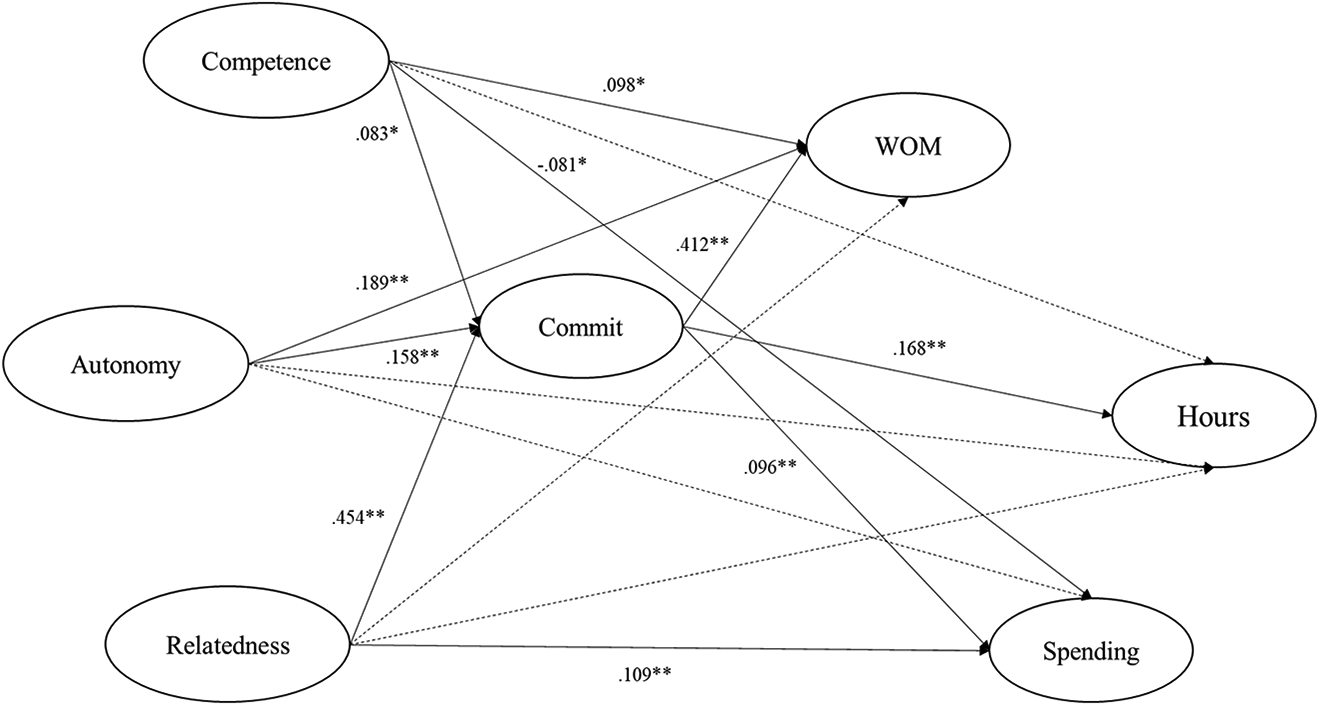
The resulted partial least squares-structural equation modeling (PLS-SEM) model depicting the relationships among the self-determination theory factors, commitment, and behavioral indicators.
It is necessary to note that commitment was found to be a crucial construct that mediated the relationship between the fulfillment of the basic psychological needs and outcome variables. Through the path of commitment, the fulfillment of the competence, autonomy, and relatedness needs was found to exert significant, positive indirect effects on WOM intentions, viewing hours, and esports-related spending, providing support for Hypotheses 5–7. Results of specific indirect effects of the basic need fulfillment on behavioral responses through the path of commitment are presented in Table 2.
Specific Indirect Effects of the Basic Psychological Need Dimensions on the Outcome Variables.

Note. WOM = word of mouth intentions; hours = viewing hours; spending = esports-related spending.
*p < .05. **p < .01.
Discussion
The current study represented an empirical application of the SDT (Ryan & Deci, 2000a, 2000b), a macro-theory of human motivation, to decipher esports fan motivation and related media consumption. Specifically, the SDT posits that the fulfillment of basic psychological needs is the underlying motivational mechanism that energizes and directs people’s behavior (Deci & Ryan, 2000). A few scholars have argued that content-specific motivational models could be enhanced by integrating the fundamental psychological dynamics (e.g., Funk et al., 2012; Van den Broeck et al., 2010). We echoed this proposition and utilized a large online esports fan panel to empirically test whether the SDT could offer a viable theoretical framework. Based on the assumption that people seek to satisfy the universal psychological needs for competence, autonomy, and relatedness, we conceptualized and operationalized the basic psychological need fulfillment in an esports context. In doing so, we expanded the research on the usefulness of the SDT in social media and video gaming to esports, an emerging form of participatory media (Jenkins, 2006; Peng et al., 2012; Tamborini et al., 2010, 2011), and explored the distinct effects of satisfying basic psychological needs on consuming esports media products and services. Our empirical findings supported the applicability of the SDT model and highlighted the importance of attending to differences in needs (competence vs. autonomy vs. relatedness) that exerted distinct influences on esports media consumption. It was further suggested that as a creative, quickly evolving, and widely variable practice, the broad appeal of esports is closely related to its ability to satisfy humans’ basic psychological needs and that the basic psychological needs are good predictors for esports consumption behaviors.
Overall, the fulfillment of the needs for competence, autonomy, and relatedness contributed to commitment, which was, in turn, translated into a higher level of WOM intentions and consumption outcomes. This finding added to the accumulating evidence on the positive mediating role of commitment in promoting people’s WOM intentions and behavioral outcomes (Biscaia et al., 2013; Brown et al., 2005; Inoue et al., 2017; Iwasaki & Havitz, 2004) and extends previous work by identifying the SDT antecedents to commitment in an esports context (Gagné & Deci, 2005; Sweeney et al., 2014).
We found that esports fans received a sense of effectiveness by developing esports-related skills, accumulating esports knowledge, and indulging themselves in immersive experiences through their engagement in esports. The enhanced feeling of competence then led to subsequent consumption activities (Csikszentmihlyi, 1975; Deci & Ryan, 2002). Our results were consistent with the SDT and suggested that due to this competence element, esports should be considered a highly participatory entertainment activity where fans are actively learning, developing, and improving their esports literacy. Interestingly, a negative direct effect of the fulfillment of the competence need on esports-related spending was found in this study. Although this finding was counterintuitive and seemed to contradict previous research, we posit that this finding is reasonable in an esports context as most of the current esports-related spending is irrelevant to the improvement of competence. For example, donations are made towards streamers/influencers for esports fans to show their appreciation and strengthen the fan-influencer connection; in contrast, microtransactions represent the sales of virtual items such as in-game cosmetics, skins, or decorations that primarily provide aesthetic value and do not affect players’ performances. Our findings thus documented a gap in esports product/service offering and opportunities in marketing strategy (Qian et al., in press; Qian, Wang, et al., 2019; Qian, Zhang, et al., 2019).
We also found that the fulfillment of the autonomy need was positively associated with commitment and WOM intentions. When people participate in activities that satisfy the autonomy need, they have an experience that they do not normally get in everyday life (Csikszentmihlyi, 1975). In our study, individuals engaged in esports consumption for the atmospheric conditions, emotional release, and pleasure of appreciating esports skills and movements. These benefits reflect the nature of esports consumption as an end in itself that is intrinsically rewarding.
The fulfillment of the relatedness need was found to have the most substantial influence (β = .454, p < .001) on commitment, highlighting that the social facets of esports are the most salient drivers of positive emotional attachment. More importantly, our findings showed that the relatedness need, supported by conditions or situations that boost the feeling of a sense of community and companionship, was positively associated with esports-related spending (β = .109, p < .001). Previous studies have highlighted the important role of chat and streamers in enhancing the relatedness need (Qian, Wang, et al., 2019; Qian, Zhang, et al., 2019). Martončik (2015) found that esports satisfy the need for belongingness by fostering relationships through membership in an esports online community. These findings were consistent with Qian, Zhang, et al.’s (2019) work that argued esports consumption originated from the love for the game but maintained through the social values and benefits associated with the experience, highlighting the importance of socialization in esports consumption. Esports fans’ interactions with content, streamers, and other viewers help build a live, shared, and interactive experience that could be considered a multiplayer entertainment that is created by the shared interactions of millions (Ford et al., 2017; Hamilton et al., 2014; Musabirov et al., 2018). While the need for competence and autonomy might attract people to consume esports in the first place, the social elements may have transcended the gaming practice itself. Most esports fans start following esports as they are also active players who simply enjoy the game; yet once the gaming component attenuates, the social identification and group membership associated with the game become their primary stimulant (Seo & Jung, 2016). Consequently, in line with CET, when conditions or situations that support perceived relatedness are present, subsequent need fulfilling activities (e.g., subscribing and tipping favorite streamers, buying products sponsoring esports events and players, purchasing virtual items and emotes that can be used in chat) are most likely to occur (Hilvert-Bruce et al., 2018).
Research Implications
Even though prior empirical work has delineated a number of discrete facets of motivation or motives among esports fans (e.g., Hamari & Sjöblom, 2017; Qian, Wang, et al., 2019), those studies have generally adopted an empirics-driven approach and failed to utilize a broader theoretical framework to understand motivation and subsequent behavior, resulting in limited efficiency (at least 20 items), complex model testing (7–12 constructs), and most critically, inconsistency in the conceptualization of motivational constructs as they vary from context to context. From a theoretical perspective, the current study helped fill a gap in esports literature by conceptually and empirically investigating esports fan motivation and consumption from the perspective of the basic psychological needs. By developing and testing an empirical model based on the SDT and its subtheories, CET and BPNT, we adopted a macro-theory approach to examine esports fans’ basic psychological needs and the resulted behavioral outcomes (Deci & Ryan, 2000; Przybylski et al., 2010; Ryan et al., 2006).
In this study, we applied the SDT to the esports context and conceptualized the universal psychological needs by using formative measurement to develop a more compendious understanding of esports fan motivation. The SDT model reduces the number of factors to explain esports fan motivation, enabling a more parsimonious examination of the constructs’ relationship to outcomes. The use of the SDT model also provides an opportunity for more consistent cross-study comparisons and contributes to a more unified development of consumer motivation scholarship as it represents the essential motivational facets that drive individuals to seek out esports experiences to satisfy their needs and receive benefits.
As noted, esports is a multifaceted and dynamic phenomenon with significant potentials associated with its exponential growth. Relevant stakeholders must understand the reasons behind people’s decision to consume esports. For example, a major gap in esports consumption is that much esports-related spending does not address people’s need for competence. To better accommodate esports fans’ need to improve their sense of competence, online stream platforms could team up with game publishers to provide deeper integration between fan experience and an esports competition, such as displaying real-time game statistics, enabling options to watch specific player cameras, or combining multiple views to create customized viewing experience (e.g., the launch of the Overwatch League All-Access Pass; Byrne, 2019). Likewise, given the strong influence exerted by the fulfillment of the relatedness need, it seems conducive to game publishers, streaming platforms, and streamers to increase the degree to which the fans experience communality and a sense of belonging. The growing popularity of individual streams is a signal showing how important it is for the content being personality-driven. The more content creators continue to build around communities of viewers, the more likely esports will keep seeing its growth. While the most popular games can come and go, the need for relatedness is persistent. With an increased number of high-profile influencers to facilitate high levels of interaction, maintain consistency to their content, and build brands around their personalities even if they might be changing up the games that they play occasionally, esports will likely continue to thrive and grow on these nurturing conditions. Essentially, this is what today’s fans crave: The ability to interact and even influence what they consume.
Limitations and Future Studies
Several methodological limitations are recognized in the current study. Given that we utilized a cross-sectional design, it is recommended that the use of longitudinal study could provide a more accurate evaluation of the SDT dimensions and effectively address issues such as common method bias and causality inference (Hair et al., 2010; Podsakoff, 2003). Future research may also consider adopting an experimental design to manipulate various conditions/situations to determine the strength of perceived competence, autonomy, and relatedness, particularly given that esports is a relatively new application of the SDT with a complex area of behavioral engagement in virtual contexts (Przybylski et al., 2010; Qian, Wang, et al., 2019; Ryan et al., 2006).
Limitations existed in the current study due to the nature of the data collected. Instead of obtaining actual behavior data, we relied on self-reported behavioral responses. Future research should examine the precision of self-reported behavioral outcomes and whether these results could actually be considered a cognitive misrepresentation. Relatedly, the explained variance of viewing hours and esports-related spending might not be as high as those of commitment and WOM intentions (i.e., attitudinal and cognate constructs). This was likely due to the fact that the data were self-reported and only measured by a single item. Even so, it should be noted that our study assessed participants’ behavioral engagement in esports fandom (although self-reported) as opposed to behavioral intention (cognate construct). Past research findings have shown that behavioral intention usually explains only 22%–29% of actual behavior variance (e.g., Armitage & Conner, 2001; Sheeran, 2002; Sheppard et al., 1988). As such, the variance could be considered acceptable in the current research setting. Optimally, future empirical studies should further refine the SDT instrument and employ a broader range of data collection methods, such as more differentiated samples and third-party data sources.
Finally, the current study did not examine the potential moderation effects of esports background factors such as fandom (e.g., differences between casual fans, moderate fans, and avid fans). Future research could look into such variables and provide more granular insights. Only intrinsic motivation and the fulfillment of the basic psychological needs were investigated in the current study as we did not examine a whole gamut of motivation, particularly four types of extrinsic motivation that are outlined in the organismic integration theory and amotivation within the SDT (Ryan & Deci, 2000a). We encourage future studies to deepen the line of investigation into how extrinsic motivation and associated regulatory styles may enhance or hinder esports consumption. Future research is advised to represent the full range of the self-determination spectrum and non-self-determined regulatory processes, so that the maximum variance can be explained.
Footnotes
Declaration of Conflicting Interests
The author(s) declared no potential conflicts of interest with respect to the research, authorship, and/or publication of this article.
Funding
The author(s) received no financial support for the research, authorship, and/or publication of this article.
