




Abstract
Wetlands are distinct ecological systems which provide numerous ecosystem services to human society and the environment. However, many of these important ecologically sensitive systems are threatened or are already lost, mainly due to anthropogenic pressures and land-use changes in their catchments. This article looks at the status of wetlands in India, discusses the existing legal and policy framework for wetland conservation, identifies the institutional vacuum leading to the loss of these freshwater ecosystems and assesses their implications for water management. The analysis indicates that it is difficult to estimate any sequential change in the overall wetland area by using estimates available from various wetland inventories since they all have used different methodologies and have considered different types of wetlands in their assessments. Further, deficient policy framework, poor implementation of existing policies and lack of interdisciplinary approach are the major institutional inadequacies in the approach to wetland conservation in India. As a result, various water management functions performed by wetlands, such as freshwater supplies, flood control, groundwater recharge and wastewater treatment, are under immense threat. Regulation of land-use changes in the catchment areas, pollution prevention and periodic assessment of water quality are suggested as major strategies to maintain the hydrological and ecological integrity of wetlands.
Keywords
Introduction
Wetlands are unique ecological features, which provide several benefits to human society and the environment (Bassi, Kumar, Sharma, & Pardha-Saradhi, 2014; Birol & Cox, 2007; Prasad et al., 2002; ten Brink, Badura, Farmer, & Russi, 2012). However, they are ecologically sensitive systems, and cautious efforts are required while formulating strategies for their sustainable management (Janssen et al., 2005; Ramachandra & Kumar, 2008; Turner et al., 2000). Once treated as transitional habitats, the wetlands are now considered as distinct ecosystems with specific ecological characteristics, functions and values.
Wetlands exhibit enormous diversity, based on their genesis, geographical location, water regime and chemistry, dominant plants and characteristics of their soil or sediment (Space Applications Centre, 2011). According to global assessments, wetland ecosystems cover an area ranging from 917 million hectares (mha) (Lehner & Döll, 2004) to more than 1,275 mha (Finlayson & Spiers, 1999). The global economic value of wetlands is estimated to be about US$ 15 trillion a year (Millennium Ecosystem Assessment, 2005).
Wetlands occupy about 5 per cent of India’s total geographical area and support nearly one-fifth of its known biodiversity (Space Applications Centre, 2011). These wetlands are distributed across different geographical regions, ranging from the Himalayas to the Deccan plateau. Ecosystem benefits provided by the wetlands are mainly classified into the following categories (TEEB, 2010): provisioning services (food, freshwater, non-timber forest products, medicinal resources), regulating services (air quality regulation, flood control, groundwater recharge, carbon sequestration, wastewater treatment, biological control), supporting services (habitats for species, biodiversity maintenance) and cultural services (recreation, tourism, spiritual experience). In terms of providing water management functions, they contribute to reduced water scarcity and improved livelihoods, especially for the poor and the marginalized. They also function as a storage facility for recharging groundwater and sustaining freshwater supplies, even during adverse climatic events (Bassi et al., 2014; Palanisami, Meinzen-Dick, & Giordano, 2010). Thus, even a small deterioration in wetland habitats can have a significant impact on human society due to the range of water management functions that they perform.
However, in spite of the fact that wetlands perform many potentially valuable functions, they continue to be ignored in the policy process (Turner et al., 2000). Many wetlands are threatened, whereas others are already degraded and lost. Urbanization, population growth, pollution and increased economic activities are major threats to freshwater wetland ecosystems (Bassi & Kumar, 2012; Bassi et al., 2014; Central Pollution Control Board, 2008; Institute for Resource Analysis and Policy, 2010). Several of these wetlands act as a ‘sink’ for untreated effluents discharged from urban centres and industries, which has adverse repercussions on the ecosystem services provided by them such as the availability of water, both in terms of quality and quantity.
In India, the problem of deteriorating water quality is particularly alarming in the case of lakes, tanks and ponds situated near urban areas. In the past, these water resources performed several economic, social and ecological functions. Despite all these benefits, many decision-makers and even ‘primary stakeholders’ think of them as ‘wastelands’. Everyone claims a stake in them but is rarely willing to pay for their extractive use (Verma, 2001).
Furthermore, the changes in land use in the catchments of wetlands are leading to changes in the quantum of inflows and deteriorating quality of the ‘runoff’. Encroachment of water-spread areas for urban development and excessive diversion of water for agriculture are other major problems (Verma, 2001). The lack of conformity among government policies regarding economics, environment, nature conservation and development planning is one of the major reasons for the absence of a regulatory regime to control such adverse developments, leading to the deteriorating conditions of the wetlands (Turner et al., 2000). Lack of good governance and poor management are also significant issues. Kumar et al. (2013) observed that a major reason for neglect of the local water bodies is the poor or total absence of any governance system. Even when such a system exists at the local level, there is a lack of clarity on the legitimate uses of these sources; the rights of owners; who should manage them; and the role of local community in their management. Furthermore, communities often do not realize the costs of using these water bodies for certain purposes.
Another aspect is the estimation of the real economic value of the wetlands. Often, there seems to be a confusion between the benefits of wetlands and the characteristics which are indicators of those benefits (Turner et al., 2000). Thus, the failure on the part of managers to clearly identify the wetland benefits and incorporate them in the decision-making process usually results in the framing of improper wetland conservation policies (Kumar et al., 2013). As a result, ecosystem services provided by the wetlands, including water management function, get affected.
In this context, this article analyzes the efforts on wetland conservation and its implications for water management in India. It is organized in seven sections. The first section presents the introduction, the second discusses the extent of wetlands, the third analyzes the threat to wetland ecosystem, the fourth discusses the existing legal and policy framework for wetland conservation, the fifth identifies the institutional vacuum leading to loss of wetland habitats, the sixth assesses implications of wetland deterioration on water management and the last section draws conclusion and provides policy inferences.
Extent of Wetlands in India
Between the 1980s and early 1990s, various researchers and scientific institutions attempted to prepare an inventory of wetlands in India. As per the country reports, namely A Directory of Asian Wetlands (Woistencroft, Hussain, & Varshney, 1989) and Directory of Indian Wetlands 1993 (World Wide Fund for Nature [WWF] & Asian Wetland Bureau [AWB], 1993), the spatial spread of wetlands in India was estimated to be around 58.3 mha. Almost 71 per cent of the estimated wetland area was under wet paddy cultivation. However, as per the Ministry of Environment and Forests (1990) estimates, wetlands occupied an area of about 4.1 mha, excluding the area under mangroves in the country. The first scientific mapping (1:250,000 scale) of wetlands of the country was carried out using the satellite data of 1992–93 by the Space Applications Centre (SAC), Ahmedabad. The exercise classified wetlands based on the Ramsar Convention definition of wetlands. This inventory put the wetlands’ extent (inland as well as coastal) at about 7.6 mha (Garg, Singh, & Murthy, 1998). The estimates do not included paddy fields, rivers, canals and irrigation channels. Thus, all the past assessments were flawed due to inadequate understanding of the definition and characteristics of a wetland.
The most recent inventory, that of the National Wetland Atlas 2011 (mapped on 1:50,000 scale), which is also considered to be the most comprehensive assessment, estimates that India has about 757,000 wetlands with a total wetland area 1 of 15.3 mha. Of this, the area under inland wetlands accounts for 69 per cent, coastal wetlands 27 per cent and other wetlands (smaller than 2.25 ha) 4 per cent (Space Applications Centre, 2011). In terms of average area under each wetland, natural coastal wetlands have the highest area, followed by man-made coastal wetlands, natural inland wetlands, man-made inland wetlands and other smaller wetlands. 2
The water-spread area 3 of wetlands varies greatly. Overall, inland wetlands have a water-spread area of 7.4 and 4.8 mha and coastal wetlands have an area of 1.2 and 1 mha in post- and pre-monsoon, respectively. Across all categories of wetlands, the water-spread area reduces significantly from post- to pre-monsoon season, indicating the uses and losses that the wetlands go through. This has major implications for the total water availability in these wetlands and its various functions in different seasons (Bassi et al., 2014).
Nevertheless, it is virtually impossible to estimate any sequential change in the overall wetland area of India using the estimates available from various wetland inventories, since they all have used different methodologies and have considered different types of wetlands in their respective assessments. However, from a management perspective, it is important to know the extent of change in wetland areas over the years.
To realize this, the available year-wise estimates for inland water resources of India were considered. These water bodies include reservoirs, tanks and ponds, flood plain lakes and derelict water bodies, and brackish water bodies. Between 1999–2000 and 2011–12, the total area under inland water bodies (excluding rivers and canals) has increased from 6.6 to 7.3 mha. However, much of this increase was due to building up of man-made water bodies such as reservoirs whose area increased from 2.04 mha in 1999–2000 to 2.91 mha in 2011–12. Conversely, the area under natural water bodies such as flood plain lakes decreased from 1 mha in 2002–03 to 0.80 mha in 2004–05 and remained the same till 2011–12. Similarly, the area under tanks and ponds decreased from 2.51 mha in 2002–03 to 2.41 mha in 2004–05 and stagnated thereon. Incidentally, the year of increase in area under reservoirs corresponds with a decrease in area under flood plain lakes and derelict water; tanks and ponds; and brackish water bodies.
State-wise comparison shows that between 2001–02 and 2011–12, the area under inland water bodies in the states of Andhra Pradesh, Gujarat and Kerala has declined, whereas it has increased in the states of Karnataka, Odisha and Tamil Nadu. In other states, no significant change was observed in the area covered by inland water resources (Figure 1). In Andhra Pradesh, Gujarat and Kerala, the area under brackish water bodies has decreased, whereas it has increased in Odisha. Also, in Karnataka and Tamil Nadu, the area under reservoirs has increased. Between 2001–02 and 2011–12, Gujarat reported the maximum decrease in area under inland water bodies (39.32%) and Kerala reported the minimum (0.55%). The maximum increase in area under inland water bodies was reported from Tamil Nadu (around 300%) and minimum from Odisha (1.34%).

Threat to Wetland System
Freshwater wetlands are among the most heavily used and exploited ecosystems by humans for their sustainability and well-being (Molur et al., 2011). In Asia alone, about 5,000 km2 of wetland area is lost annually to agriculture, dam construction and other uses (McAllister et al., 2001). The main causes of wetland loss are: population growth and urbanization, drainage to agricultural use, infrastructure and industrial development, pollution, global climate change and encroachment (Birol & Cox, 2007; Euliss Jr. et al., 2008; Millennium Ecosystem Assessment, 2005; Ministry of Environment and Forests, 2007; Prasad et al., 2002; ten Brink et al., 2012; Zedler & Kercher, 2005).
Urbanization significantly alters the structure and function of wetlands, mainly by modifying the hydrological and sedimentation regimes, and the dynamics of nutrients and chemical pollutants (Lee et al., 2006; Misra, 2011). Furthermore, human-induced land-use changes have greatly affected water bodies such as lakes (Zhao et al., 2006). For instance, about 34,000 ha of the water-spread area of the Kolleru lake (Andhra Pradesh) has been reclaimed for agriculture in recent years (Bassi et al., 2014). The impact of increase in population and urbanization is equally alarming on wetlands situated close to the cities and towns.
Khandekar (2011) found that out of 629 water bodies identified in the National Capital Territory of Delhi, as many as 232 cannot be revived on account of large-scale urbanization and encroachments. A report by Indian National Trust for Art and Cultural Heritage (1998) on Delhi’s dying water bodies highlighted that poor management of water bodies, lack of concrete conservation plans, rising pollution and the rapid increase in localized demands for water are the major reasons because of which these precious eco-balancers have been pushed to extinction. Similarly, between 1973 and 2007, intense urbanization and urban sprawl in the Greater Bengaluru Region led to a loss of 66 wetlands with a water-spread area of around 1,100 ha (Ramachandra & Kumar, 2008).
Changes in global climate are expected to become an important driver of loss and change in wetland ecosystem in the next 50 years (Millennium Ecosystem Assessment, 2005). Analysis on the impact of climate change on wetlands in India suggest that high-altitude wetlands and coastal wetlands (including mangroves and coral reefs) are some of the most sensitive classes that will be affected by changes in climate (Patel et al., 2009). For instance, climate-induced rising level of glacial-fed high-altitude lakes such as Tsomoriri in Ladakh have submerged important breeding islands near the lake where endangered migratory birds like the Black-necked Crane and Bar-headed Goose would breed (Chandan, Chatterjee, & Gautam, 2008). In the case of the coastal wetlands such as Indian part of Sundarbans mangrove, the rise in sea surface temperature and sea level owing to thermal expansion could affect the fish distribution and lead to the destruction of significant portion of mangrove ecosystem.
Institutional Strategies for Wetland Conservation
In the past, wetlands were seen in isolation and hardly figured in India’s water resources management and development plans. The primary responsibility for the management of these ecologically sensitive ecosystems is in the hands of the Ministry of Environment and Forests, Government of India (Ministry of Environment and Forests, 2007; Prasad et al., 2002). Though India is signatory to both Ramsar Convention on Wetlands and the Convention of Biological Diversity, there seem to be no exclusive regulatory framework for conservation of wetlands (Raju, 2012). However, the situation is gradually changing. Wetland conservation strategies including the legal framework and policy support for wetland conservation have been discussed in the following sections.
Legal Framework
There is no separate legal provision for wetland conservation in India. However, it is indirectly influenced by a number of other legal instruments. Important ones include: Water (Prevention and Control of Pollution) Act, 1974; Forest (Conservation) Act, 1980; Environmental (Protection) Act, 1986; Wildlife (Protection) Amendment Act, 1991; Biodiversity Act, 2002; and Scheduled Tribes and Other Traditional Forest Dwellers (Recognition of Forest Rights) Act, 2006 (Ministry of Environment and Forests, 2007; Prasad et al., 2002; Raju, 2012).
Provisions under these Acts range from protection of water quality and notification of ecologically sensitive areas to contributing towards conserving, maintaining and augmenting the floral, faunal and avifaunal biodiversity of the country’s aquatic bodies. However, the term wetland was not used specifically in any of these legal instruments.
Policy Support
Till the early 2000s, policy support for wetland conservation in India was virtually non-existent. The action on wetland management was primarily influenced by the international commitments made under Ramsar Convention and indirectly through an array of other policy measures, such as National Conservation Strategy and Policy Statement on Environment and Development, 1992; Coastal Zone Regulation Notification, 1991; National Policy and Macro level Action Strategy on Biodiversity, 1999; and National Water Policy, 2002 (Ministry of Environment and Forests, 2007; Prasad et al., 2002).
In 1981, the Government of India identified two sites, Chilika lake (Orissa) and Keoladeo National Park (Rajasthan), as Ramsar Wetlands of International Importance (Ministry of Environment and Forests, 2012). Thereafter, in 1985–86, National Wetland Conservation Programme (NWCP) was launched in close collaboration with the concerned state governments. Initially, only designated Ramsar Sites were identified for conservation and management under this programme (Ministry of Environment and Forests, 2007). Several steps were undertaken to halt further degradation and shrinkage of water bodies that had been degraded due to encroachment, siltation, weed infestation, catchment erosion, agricultural run-off carrying pesticides and fertilizers and wastewater discharge. Subsequently, in 1993, the National Lake Conservation Plan (NLCP) was formulated to focus on lakes, particularly those located in urban and peri-urban areas which are subjected to anthropogenic pressures. Initially, only 10 lakes were identified for conservation and management under this plan (Ministry of Environment and Forests, 2007). There is also a National River Conservation Plan (NRCP), operational since 1995, which aims to improve the water quality of the major Indian rivers through the implementation of pollution abatement works, to the level of designated best use.
The new National Water Policy, 2012, of India also recognizes the need for conservation of river corridors and water bodies (including wetlands) in a scientifically planned manner. Furthermore, the policy emphasizes that the environmental needs of aquatic ecosystem, wetlands and embanked flood plains should be recognized and taken into consideration while planning for water resources conservation (Ministry of Water Resources, 2012).
Over the years, the number of designated Ramsar Sites has increased to 26 (Ramsar Convention on Wetlands, 2012), the number of rivers under NRCP has increased to 39 and the number of wetlands covered by the NWCP and NLCP has increased to 115 and 61, respectively (Ministry of Environment and Forests, 2012). Together they represent only 0.4 per cent of the total number of natural wetlands in the country. Thus, these initiatives are too little considering the extent of ecologically sensitive wetland ecosystems in the country and the fact that only a selected few wetlands were taken up for conservation and management purpose (Bassi et al., 2014; Dandekar, Bhattacharya, & Thakkar, 2011).
The National Environmental Policy 2006 recognized the importance of wetlands in providing numerous ecological services (Ministry of Environment and Forests, 2006). The policy, for the first time, accepted that there is no formal system of wetland regulation in the country outside the international commitments made in respect of Ramsar sites and thus there is a need of legally enforceable regulatory mechanism for identified valuable wetlands, to prevent their degradation and enhance their conservation (Dandekar et al., 2011; Ministry of Environment and Forests, 2006). Furthermore, the policy advocated the development of National inventory of such wetlands (Ministry of Environment and Forests, 2006, 2007). A report by National Forest Commission (2006) among other suggestions also emphasized on: framing of a National Wetland Conservation Act and establishment of a National Wetland Inventory and Monitoring Programme in order to develop a sustained and serious programme for monitoring wetlands.
Wetland (Conservation and Management) Rules, 2010
Based on the directives of National Environment Policy, 2006, and recommendations made by National Forest Commission, the Central Government notified the Wetlands (Conservation and Management) Rules, 2010. As per the provision under Rule 5 of the wetlands rules, Central Wetlands Regulatory Authority (CWRA) has been constituted under the chairmanship of the Secretary, Environment and Forest. An Expert Group on Wetlands (EGOW) has also been constituted for examining management action plans of newly identified wetlands (Ministry of Environment and Forests, 2012). The rules have restricted activities such as reclamation, setting up industries in vicinity, solid waste dumping, manufacture or storage of hazardous substances, discharge of untreated effluents, any permanent construction, etc. within the wetlands. It also regulates activities (which will not be permitted without the consent of the state government) such as hydraulic alterations, unsustainable grazing, harvesting of resources, releasing treated effluents, aquaculture, agriculture, dredging, etc.
However, only some selected wetlands based on the significance of the functions performed by them for overall well-being of the people are being regulated under these rules. These include: (a) wetlands selected under Ramsar Convention; (b) wetlands in ecologically sensitive and important areas; (c) wetlands recognized as UNESCO World Heritage site; (d) high-altitude wetlands (at or above an elevation of 2,500 m with an area equal to or greater than 5 ha); (e) wetland complexes below an elevation of 2,500 m with an area equal to or greater than 500 ha; and (f) any other wetland identified by the Authority (GoI, 2010).
Regulation restrictions, especially on wetlands below 2,500 m, totally neglect the management and conservation of some of the crucial, smaller wetlands in urban and rural areas which perform important socio-ecological functions and are under severe threat by land-filling and reclamation. Furthermore, river channels (included as wetlands under Ramsar Convention definition) and irrigation tanks are excluded from protection status under the Wetland Rules (Dandekar et al., 2011). Thus, despite the recent national regulation on wetlands, a majority of them continue to be ignored in the policy process (Bassi et al., 2014).
However, it should be noted that the latest National Wetland Atlas, which is prepared by SAC, ISRO, with support from the Ministry of Environment and Forest, does include tanks in the wetland database. Hence, there seems to be a disagreement among the national agencies on the kind of water bodies that can be considered as a wetland type.
Also, various analyses have indicated that the wetland rules does not recognize the traditional rights over the wetlands for livelihoods even as it seeks to regulate such activities (ATREE, 2010; Bassi et al., 2014). Such regulation can, in effect, become prohibitive for livelihood activities. Also, the rules limit the involvement of community and local stakeholder groups in the management of the wetlands which goes against the recommendation 6.3 of Ramsar Convention (relating to encouraging active and informed participation of local and indigenous people at Ramsar listed sites and other wetlands and their catchments), made during the Sixth Conference of Parties in 1996 (ATREE, 2010).
Efforts at State Level
Most state governments have a lackadaisical response to conservation and management of wetlands. Apart from states such as Kerala, Rajasthan and Goa, where tourism around natural wetlands is a major economic activity and a source of revenue, no state has any concrete action plan for sustainable management of wetlands even though ‘water’ is listed as a state subject under the Indian constitution.
Kerala is the only state that has formulated Kerala Conservation of Paddy Land and Wetland Act, 2008. This Act prohibits the conversion or reclamation of existing paddy land and wetlands for other economic purposes. For its effective implementation, the Act also provides incentives to farmers who undertake paddy cultivation. Rajasthan too has shown its intent for the protection, conservation, restoration, regeneration and integrated development of lakes situated in urban and peri-urban areas through formation of a Lake Development Authority. However, the bill (formulated in 2012) for the purpose is yet to be passed by the state legislature.
Institutional Vacuum
It is clear from the above discussions that wetland conservation and management is not given exclusive attention in India. Though there are some stand-alone instances of wetland restoration works such as Ashtamudi, Chilika lake, Kolleru lake, Loktak lake, Sasthamkotta lake and Vembanad-Kol (Ministry of Environment and Forests, 2007), most of these efforts have only been on a few important wetlands and remained mostly in silos.
Apart from few states where wetlands offer tremendous tourism potential, they rarely figure in the state governments’ priority list. Furthermore, ineffective implementation of pollution control programmes has led to the discharge of untreated domestic wastewater and industrial effluent directly into the wetlands which affects their hydrological and ecological integrity. The policy governing land-use planning is also flawed. In many cases, wetland catchment area has been altered, leading to reduced or no water flows into the water bodies.
Still, there is no legal instrument which directly relates with wetlands. Even the policy support for wetland until 2010 was governed mainly by the programme initiated as per the international commitment. After 2010, though the rules pertaining to wetland conservation has been passed, they seem to have narrow objectives and completely ignore smaller wetlands such as tanks and ponds which play an important role in rural and peri-urban landscapes. This clearly shows the lack of interdisciplinary expertise and understanding in dealing with issues related to conservation of wetlands which are ecologically sensitive and fragile systems.
It appears that the overall policy recourse for wetland management in India followed an ‘Elite Model’ approach. Under such approach, a group of elite, such as public administrators and politicians, are assumed to possess all the knowledge required to frame and implement policies, and others have to follow it as they are not equipped to understand and know the same. For instance, India started its various wetland conservation and programmes as part of the international commitments which the ‘elite group’ considered to be important.
However, other than a few cases where non-governmental organizations have acted as catalysts for wetland restoration, such as ‘Peoples Group’ (Hyderabad), ‘Jheel Sanrakshan Samithi’ (Udaipur), ‘Society of Appeal for Vanishing Environments’ (Nainital), ‘Howrah Ganatantrik Nagarik Samiti’ (Howrah), ‘Green Kashmir’ (J&K), ‘Ecological Task Force’ (Harike), ‘User’s Committee’ (Pushkar) (Reddy & Char, 2006), scientific or civil society groups were rarely involved in the better understanding of the ground situation of the wetlands in the country.
Even the constitution of CWRA which was created under the Wetlands (Conservation and Management) Rules, 2010, is heavily biased towards the public administrators with some representation from the scientific institutions. Furthermore, the authority has no representation from the Department of Land Resources and Ministry of Urban Development. Thus, it remains to be seen whether the CWRA will be able to implement these rules effectively as well as regulate large-scale land-use changes in the catchment area of many of the wetlands.
Economic instruments such as payments for ecosystem services (PES), which can also be an important tool in wetlands’ catchment protection, have also not been given sufficient attention in the policy-making process. Though large-scale watershed programmes are undertaken in India, they do not assess the proper catchment hydrology and often result in upstream–downstream conflicts related to water sharing (Kumar, Patel, Ravindranath & Singh, 2008).
Implications for Water Management
Inappropriate wetland conservation policies coupled with growing threat to wetland ecosystem (urbanization, industrialization, discharge of untreated wastewater) has led to a loss in wetland habitat area, resulting in adverse impact on the key functions (including those related to water management) performed by them. For instance, excessive urbanization, industrialization and population growth in Ganges river basin has greatly modified the landscapes and carried out the major changes in the hydrological cycle such as large-scale removal of natural vegetation, drainage patterns, decrease in the natural depressions which store surface water, decrease in the rainfall-absorbing capacity of soil and large-scale formation of impervious areas (Misra, 2011). As a result, freshwater availability and groundwater recharge in such regions of the basin has been adversely affected.
Similarly, in the absence of proper pollution control mechanism, runoff from the arable lands and discharge of untreated wastewater directly into wetlands significantly alters their functions by altering its water quality. For instance, pollutants rich in nitrogen and phosphorus stimulate undesirable algal growth which may lead to eutrophication of the water body. This makes wetland water unfit for any ecological use.
Results from monitoring of Indian aquatic resources also show that water bodies such as rivers and lakes are becoming increasingly saprobic and eutrophicated due to the discharge of partly treated or untreated wastewater (Central Pollution Control Board, 2010). River Yamuna, which passes through six Indian states, receives about 1,789 million litres per day (MLD) of untreated wastewater from the capital city of Delhi alone (Baviskar, 2011). This is about 78 per cent of the total pollution load that flows into the river every day. As a result, the water quality and hydrological character in the Delhi segment of the river is the most polluted when compared to other stretches in terms of dissolved oxygen (DO) and biological oxygen demand (BOD). The DO level had decreased to 1.41 from 8.05 in the Himalayan segment and the BOD level has risen to 17.2 from 2.8. This is quite significant as National Capital Territory of Delhi extract about 2,500 million cubic metres of water per annum from river Yamuna for domestic, industrial and irrigation purposes.
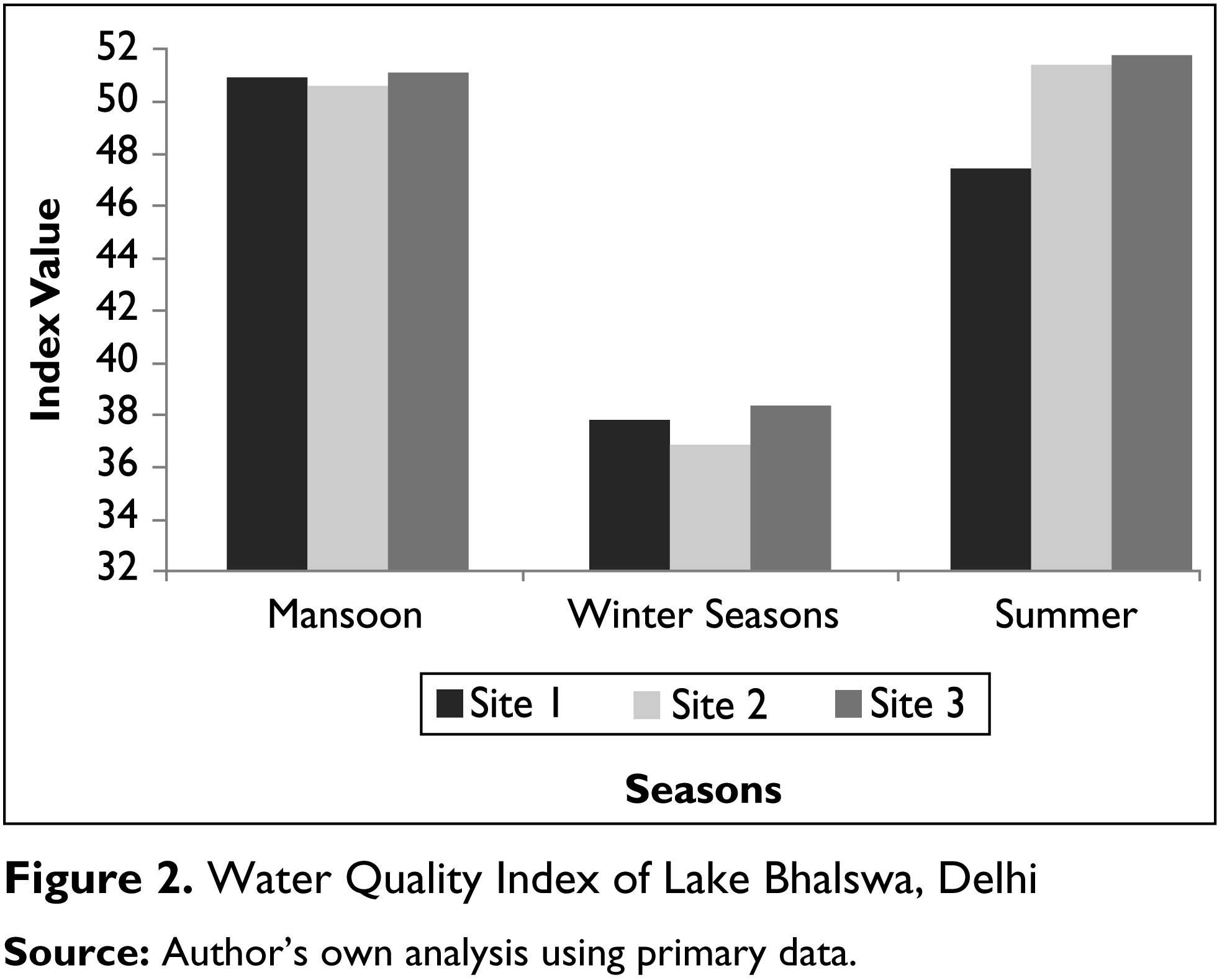
Similarly, lake Bhalswa, which is one of the three biggest and ecologically important lakes in Delhi, is getting polluted through runoff from the surrounding habitation and agricultural fields. The water quality (measured through water quality index 4 ) of the lake was mostly found to be bad at all the sampling locations and across different seasons, thus making its water unfit for consumption (Figure 2).
Furthermore, the destruction of coastal wetlands, such as Sundarbans mangroves, would diminish their critical role as natural buffers against tropical cyclones and floods and would result in loss of lives and livelihoods (Centre for Science and Environment, 2012; United Nations Educational, Scientific and Cultural Organization, 2007). Thus, any alteration in the structure of wetlands has a significant impact on the water management functions associated with them.
Conclusion
In India, wetland conservation and restoration programmes were started during the early 1980s. However, even after more than three decades of efforts and a recent national regulation on wetland conservation and management, a majority of wetlands continue to be ignored in the policy process. The main reason is that only a few wetlands have received significant attention by way of financial and technical assistance from the central government under the wetland conservation programmes. The remaining ones continue to exist in a neglected state.
Furthermore, the ‘Elite Model’ and lack of interdisciplinary expertise are other major institutional gaps in the approach to wetland management in India. There seems to be a disagreement among the national agencies as regards the kind of water bodies that can be considered as a wetland.
Given the growing threat to wetland ecosystems in India and the small proportion of the total number of wetlands taken up for conservation, it is essential that other ecologically important wetlands are identified and protected. Furthermore, it is important to regulate large-scale land-use changes in the catchment area of wetlands and prevent them from getting polluted in order to maintain their hydrological and ecological integrity. The development of catchment areas has to be undertaken with a proper management plan so that there are no major adverse impacts (in the form of reduced flows) in water bodies located downstream.
Moreover, water quality assessments are presently undertaken intermittently and that too only for a select number of major rivers and lakes. The assessments do not cover small wetlands which play an important role in the hydrological cycle. Therefore, an effective and proper water quality-monitoring strategy needs to be developed for all wetlands with significant ecological value and should be made part of all the existing wetland conservation programmes. The generation of reliable data on the present condition of wetlands in terms of their water quality status will help in devising and monitoring schemes for improvement in water quality management.