



Abstract
This article examines the impacts of Zimbabwe’s Command Agriculture (CA) program, a state-driven cereal production model implemented since 2016. In the context of the neglect of cereal crops by African states generally under the accumulation strategies of international and domestic capital, and in the face of persisting neoliberal strategies led by international agencies such as the World Bank, the Zimbabwe experience continues to provide insights into the problems and prospects of planning under neoliberalism. In the case of CA, the Government of Zimbabwe intervened to bolster maize production, which had remained underfunded. The study shows a distinct correlation between national food self-sufficiency and, to some extent, economic stability and growth under state intervention and planning. This suggests that the CA program, as well as other planning initiatives, can stimulate economic growth and development if well managed. It illuminates how farmers were recruited and mobilized under CA and attempts to identify the weaknesses and challenges of the program. We posit that state planning in cereal production poses a threat to neoliberalism and the hierarchical international food system, and is an important step toward attaining national sovereignty.
Introduction
In the aftermath of the Fast-Track Land Reform Program (FTLRP) in 2000–2003 (Moyo et al., 2009), the Government of Zimbabwe (GoZ) introduced several policies aiming to finance cereal production and reduce the nation’s food import bill within an evolving planning framework.1,2 In the 2016/2017 farming season, against a background of perennial food shortages, the GoZ introduced the Special Maize Import Substitution Program, commonly referred to as Command Agriculture (CA). This program has sought to increase domestic production and reduce food imports in a state-driven contract-farming scheme that enlists the peasantry and small-scale capitalist farms with funding support from domestic capital (Mazwi et al., 2019).
This article examines the impacts of state planning on agricultural development under contemporary neoliberal capitalism, with a focus on Zimbabwe’s CA program. Specifically, it examines a state-driven cereal production model, in the context of a growing neglect of cereal crops by international and domestic capital, as well as African states generally. It illuminates how farmers were recruited and mobilized under CA and attempts to identify the weaknesses and challenges of the program. It addresses four key questions: Has state intervention helped to revive cereal production in Zimbabwe? What are the strengths and challenges of CA? What are the implementation modalities and the contributions of the program to the agricultural sector and the economy as a whole? What are the broader implications of this program for neoliberal discourse?
Research and policy in Africa, as elsewhere, have focused on the growth of contract farming as a strategy to increase agricultural production (Jha et al., 2022). This has also been the case in Zimbabwe, where increased focus has been on private-led contract farming after agricultural production declined in 2000–2009, following the implementation of the FTLRP (Binswanger-Mkhize & Moyo, 2012; Chambati & Mazwi, 2022; Mazwi, 2022; Sachikonye, 2016; Sakata, 2016; Scoones, et al., 2016). African states under neoliberalism have generally neglected the financing and production of staple cereals (Binswanger-Mkhize & Moyo, 2012; Mazwi et al., 2019), which for most countries has led to the ballooning of food import bills and a reliance on grain imported from the United States and Brazil (Mazwi et al., 2019; Moyo, 2011). Such neglect of cereal crops has brought to the fore debates on food self-sufficiency, whose importance has grown further in the context of the war in Ukraine, which has rendered food insecure and vulnerable for many African countries dependent on food and fertilizer imports from Ukraine and Russia.
Zimbabwe has transitioned through various chapters of macro-economic management since 1980. State-led economic development in the first decade of independence gave way to a market-driven economic structural adjustment program (ESAP), followed by a return to state interventionist economic measures in 2000, in response to the effects of the FTLRP and Western sanctions (Moyo & Yeros, 2007). Soon after independence, the state offered cheap and subsidized loans to farmers through the state-owned Agricultural Finance Cooperation (AFC) (Moyo, 1995). These loans were confined to less than 10% of the black peasantry, with the rest of the peasantry receiving state support through subsidized inputs and output price support schemes financed via state marketing boards (Chimedza 2006; Moyo 1995). This support fell away from 1990 to 1997, when some state marketing boards were commercialized under neoliberal policies implemented at the behest of the International Monetary Fund (IMF) and the World Bank (Binswanger-Mkhize & Moyo, 2012). The FTLRP in 2000–2003 not only expanded the peasant base but also triggered capital flight (Binswanger-Mkhize & Moyo, 2012). Faced with limited options to stabilize the economy and support the resettled farmers, the state returned to interventionist mechanisms to finance the land reform as well as promote economic growth (Moyo & Yeros, 2007; Moyo & Nyoni, 2013).
Within an evolving planning framework for the agricultural sector, the GoZ implemented various interventionist policies to finance cereal production and reduce the nation’s food import bill (Mazwi et al., 2019; Moyo & Nyoni, 2013). Some of these policies included the Agricultural Sector Productivity and Enhancement Facility, Operation Maguta/Inala, and the Farm Mechanization Program (Moyo, 2013). The productivity and enhancement facility introduced in 2005 provided low-cost farming inputs for the newly resettled farmers (Moyo, 2013). Under Operation Maguta/Inala, the state distributed low-cost farming implements to a broad range of farming classes and revived irrigation schemes (Mazwi et al., 2019; Moyo, 2013). From 2007, the Farm Mechanization Program saw the state allocating irrigation equipment, combine harvesters, tractors, planters, scotch carts, and other farming implements to farmers through long-term loans (Moyo, 2013). While the interventions were limited in scale and reach, they reflected dirigiste policies in that the state actively supported farmers through financing operations involving the Central Bank.
The more recent experimentation with climate-proof agriculture, locally known as the Pfumvudza program, since 2020, has further reflected the broad nature of the GoZ policies to promote food sufficiency. Pfumvudza is a system of agriculture that prioritizes agro-ecological farming practices in response to climate vagaries and, furthermore, acknowledges the incapacity of the state and farmers to establish adequate irrigation infrastructure and dams due to the prevailing economic difficulties. The program provides seed for cereal grains, soybeans, sunflowers, groundnuts, cowpeas, sugar beans, vegetable combo, knapsack sprayers, and cotton, as well as fertilizers and chemicals. In addition to Pfumvudza, a separate Presidential Input Support Scheme benefited a total of 3.3 million rural households in the 2021/2022 agricultural season (Mazwi et al., 2022). The latter scheme differs from Pfumvudza and other input initiatives above in that it is a universal program reaching out to all peasant farmers (Mazwi et al., 2022).
In the 2016/2017 farming season, on the back of a continuing economic downturn, the GoZ additionally introduced the CA program, as a novel contract-farming model targeting maize production (Mazwi et al., 2022). It was a response to the underfinancing of the crop, and it attempted to reduce maize imports and address widespread hunger that had emerged after FTLRP (Mazwi et al., 2019). Zimbabwe had previously been self-sufficient in cereal production and only imported during years of droughts, but it began to continuously rely on imports of maize and on food aid in 2002 (Moyo & Nyoni, 2013). While most analysts attributed the decline in maize production to the FTLRP, a downward trend had been noticeable since the 1990s as a result of the liberalization of grain markets under ESAP (Moyo & Maguranyanga, 2014). Other factors contributed to the decline: consecutive droughts, the crisis of agrarian finance triggered by Western sanctions and international isolation, and a transitional slump in production that typically accompanies a major land reform program (Moyo & Nyoni, 2013; Scoones et al., 2010). Also, worth mentioning is the division that characterized the production of maize and other cereals prior to the FTLRP, whereby the black peasantry mainly produced the commodity while commercial farmers were engaged in the production of export crops. Population growth and the infertility of soils in communal areas where most black peasants were settled also played a contributory role in the decline of maize output after the FTLRP (Moyo, 2011a). The capital outflows that followed the introduction of the land reforms saw agricultural lending by commercial banks decline from USD 300 million in 2000 to an all-time low of USD 8 million by 2008 (Binswanger-Mkhize & Moyo, 2012). This, added to the fiscal constraints faced by the government, played a major role in fluctuations in maize production.
Some studies show that the state-led contract farming model improved maize yields at a national level after 2016, although they note that good rains also played a part (Mazwi et al., 2019; Shonhe & Scoones, 2022). Other studies, the media, and the Bretton Woods Institutions have generally focused on corruption and abuse occurring under the model (see IMF, 2022; Makuwerere-Dube, 2021; ZDI, 2020). The latter studies conclude that CA is a program driven by “neopatrimonialism” resulting from the government’s desire to consolidate power. The Zimbabwe Democracy Institute (ZDI, 2020) argues that:
CA is run through a ZANU PF/Securocrats patronage network that has made it very difficult to translate bumper harvests into food security and maize imports reduction. The proceeds… have been a very powerful means through which regime loyalists are financed, incentivized and rewarded from national to village levels.
While corruption is obviously a drag on development, it is unhelpful to dismiss outright a program intended to benefit farmers simply because some of its administrators are dishonest. Hitherto, CA has sought to provide a response to the question of addressing maize production in a context where private capital finances only export commodities. Analyses that describe CA in terms of sinister partisan power dynamics echo the narratives that condemned the fast-track land reforms as “political,” “neopatrimonial,” and “corrupt” in the early 2000s (Hammar et al., 2003; Richardson, 2005; Zamchiya, 2011), against empirical studies that showed that the overall balance of the FTLRP was broad-based, redistributive, and transformative (Chibwana, 2017; Moyo, 2013; Moyo et al., 2009; Scoones et al., 2010). There is clearly a need for an analysis of the implementation of CA that takes account of the inequities of an international food system that undermines food crop production in the Global South by financing export-led crops and promoting land-use patterns in favor of the latter (Moyo, 2011; Patnaik, 2011). An analysis of CA should go beyond the mono-economics that has dominated policy and intellectual debates for the past three decades since the adoption of neoliberal prescriptions. This is our entry point to such an analysis.
Other studies have also examined the implications of CA as a grain production model at the household and national level (Makuwerere-Dube, 2021; Mazwi et al., 2019; Shonhe & Scoones, 2022). Nonetheless, we still require a systematic review of the implementation modalities under the production model vis-à-vis the predominant economic development paradigms. 3 This justifies the four questions stated at the outset of this article, reiterated here: Has state intervention helped to revive cereal production in Zimbabwe? What are the strengths and challenges of CA? What are the implementation modalities and the contributions of the program to the agricultural sector and the economy as a whole? What are the broader implications of this program for neoliberal discourse?
In what follows, the second section discusses the conceptual framing underpinning the study and the methodological approach. The third section offers a brief discussion on maize in the political economy of Zimbabwe. The fourth section then presents the elements and challenges of the CA program, including farmer beneficiary selection procedures, implementation modalities, and outcomes in terms of maize production. The fifth section discusses the implications of state planning under a global neoliberal regime. A conclusion then summarizes the main findings.
The Importance of Economic Planning for Accumulation from Below
After independence, most African countries implemented dirigiste policies by which the state intervened in manufacturing, industry, agriculture, social services, and other enterprises to varying degrees of success (Amin, 2014; Mkandawire, 2001; Patnaik & Patnaik, 2021; Shivji, 2009). Economic growth increased along with food production and life expectancy in the 1960s and early 1970s (Patnaik, 2003). Industrialization through import-substitution strategies was attempted to drive economic development (Mkandawire, 2001). In the agricultural sector, intervention through the public sector and fiscal budgets took the form of input subsidies, price support, and the protection of local farmers from food imports (Patnaik, 2003). In the 1980s and 1990s, when national economies failed to sustain the interventions due to a number of internal and external factors (Mkandawire, 2001), African countries, despite their nationalist outlook and vision to promote inter-continental trade, were persuaded to adopt structural adjustment programs by the IMF and the World Bank (Moyo 2011; Patnaik 2003). This marked a radical departure from dirigsme to neoliberalism. The neoliberal policies entailed the privatization of the public sector, removal of state subsidies on inputs, and removal of tariff barriers, thus paving the way for a new assault by international capital against the economies of Africa and the South (Mkandawire, 2001; Moyo & Yeros, 2005; Patnaik, 2003). For the World Bank (1981, 2007), the only way for agriculture to thrive in Africa was through the privatization of the public sector.
The World Bank’s neoliberal policy regime resulted in income deflation for farmers (Patnaik, 2003). Commodity prices slumped with the removal of price support systems and the impact of food imports (Moyo, 2011; Patnaik & Patnaik, 2021). Other consequences consisted of widespread land alienation for the peasantry, a decline in the standard of living and rising levels of poverty, and the secular growth of labor reserves (Mazwi et al., 2022; Moyo et al., 2019; Patnaik & Patnaik, 2021; Yeros, 2023). As has been shown, neoliberalism has produced two major detrimental outcomes for agriculture: globalized food production by corporate monopolies mostly located in the North and parts of the South; and expulsions of peasants from their land in the form of land grabs and unfair contract farming arrangements (Amin 2012; Jha et al., 2022). Samir Amin posed an important question on the possible alternatives in order to save three billion farmers domiciled in the South from corporate agriculture (Amin, 2011): He proposed the preservation of peasant agriculture for the foreseeable future in the twenty-first century, and for the peasantry to embrace technology (Amin, 2011, 2012). This is an idea to which we fully subscribe, hence our focus in this article on financing cereal production by the peasantry.
For the preservation of peasant agriculture in the twenty-first century, and in the face of neoliberal regime, it is imperative for the state to support peasants and develop planning mechanisms. Zimbabwe’s CA was introduced as a unique contract farming model premised on heavy state intervention in agriculture in response to capital flight and inherent structural biases in financing crop commodities. As such, the potential of CA in filling the gap left by private capital and ensuring food self-sustenance should never be underestimated, and this applies to other developing countries that face agrarian crisis.
Other solutions proposed by Amin to address challenges faced by Third World agriculture include a reversion to protectionism, as was the case immediately after independence for most African countries, and adjusting food prices to acceptable levels (Amin, 2011, 2012). The social pressure for this solution is widespread; most recently, remarkable struggles by the peasantry in India, which led to nationwide protests in 2022, centered on the restoration of price support systems for farmers to guarantee steady incomes, which has been a long-standing policy (Roy, 2023; Thakur, 2023). Some studies show that CA offers credit support as well as improved maize prices for farmers (Chemura et al., 2017; Mazwi et al., 2019). While the IMF and critics of CA have revived their call for the state to withdraw support from agriculture by curtailing agricultural credit (IMF, 2022; ZDI, 2020), a dilemma arises: How to fund cereal production in the South in the face of competition from heavily subsidized agriculture in the North, so as to facilitate “accumulation from below” by the peasantry (Amin 2011; Neocosmos, 1993).
The present study was conducted from December 2021 to April 2022 and deployed a mixed-method approach to data collection and analysis. Quantitative data were collected from 112 farming households in the districts of Goromonzi and Zvimba. The qualitative research entailed in-depth interviews with stakeholders involved in CA: Agritex extension officers, traditional leaders, and officials in the loan departments of the banks, including the Commercial Bank of Zimbabwe (CBZ), which were enlisted in the program. The survey featured questions about the socioeconomic and demographic characteristics of the households, farmer recruitment and mobilization, incomes, power relations, and production and land use patterns. A snowball sampling technique was used with the assistance of the district Agritex officer to identify all the landowners. The questionnaire was administered for 83 A1 villagized households, 2 A1 self-contained households, 20 A2 farmers, and 1 large-scale commercial farmer (LSCF). The A1 settlement model has smaller land sizes and targets poor landless families, while A2 land holdings are larger and are intended for middle-scale black capitalist farmers. 4 The research also benefited from a review of annual budgets presented by the Ministry of Finance, particularly as they relate to spending on agriculture, and from reports of the World Bank.
Maize in the Political Economy of Zimbabwe
Since independence in 1980, agriculture has contributed to between 16% and 20% of Zimbabwe’s gross domestic product, while accounting for 60% of industrial activity (Moyo & Maguranyanga, 2014). The broadening of the peasant base as a result of the FTLRP increased the number of peasant households that are now self-employed and engage in maize production (Binswanger-Mkhize & Moyo, 2012; Chambati, 2011). The growing numbers of maize producers and the volumes produced are important indicators in rural economies since the producers are largely dependent on this crop (Binswanger-Mkhize & Moyo, 2012). Maize is the staple crop in Zimbabwe, and is vital for both household and national food security. Food self-sufficiency in Zimbabwe also curtails dependency on imported food, which makes the crop a key driver of local and national development (Mazwi et al., 2019).
As stated earlier, the GoZ intervened in the maize input and output markets by supporting various classes of farmers from 2002 to 2008 through a number of programs (see also Moyo, 2013; Murisa & Mujeyi, 2015). This was achieved through state-subsidized basic inputs (seeds, fertilizer, and chemicals) and affordable agricultural credit for mechanization (Binswanger-Mkhize & Moyo, 2012). It also provided cheap foreign currency to industries in the agricultural sector. In 2009, the country entered into a liberalization phase that was marked by the dollarization of the economy and the importation of cheap cereals from South Africa, Brazil, and Zambia, thus further constraining local production (Binswanger-Mkhize & Moyo, 2012). Maize shortages became rampant in Zimbabwe going into 2016. As a result of these factors and consecutive droughts, the state responded by introducing CA to increase maize production while also eliminating maize imports and dependency on donor agencies such as the World Food Program (Mazwi et al., 2019).
The major implementing actors of CA were the Ministry of Agriculture and Lands through Agritex (an agricultural extension services arm of the state), the Zimbabwe National Army (ZNA), the Grain Marketing Board (GMB), and Sakunda Holdings, a private company with close connections to the government and state officials (Mazwi et al., 2019; Shonhe & Scoones, 2022). The role of Agritex and the ZNA was to vet, monitor, and supervise CA applicants and beneficiaries. Agritex was also responsible for the mobilization and recruitment of farmers. Entry requirements were not stringent, requiring mainly land holdings of 5 hectares (ha) or more (Mazwi et al., 2019). The GMB, which is heavily subsidized by the government, was responsible for buying grain and paying farmers (Mazwi et al., 2019).
One impact of CA was that maize production increased substantially since 2016, also propelled by other factors such as Pfumvudza, the climate-proof agriculture program, as well as good rains, although it must be stated that climate-induced shocks have remained a challenge (see Table 1). Before CA, in the 2014/2015 season, 742,226 tons were produced, falling to 511,816 tons in 2015/2016. But in 2016/2017, under CA, there was a tripling of yield per hectare from 0.44 to 1.15 tons and a five-fold increase in production to 2,155,526 tons, the highest since the land reforms, which is attributed to CA (Mazwi et al., 2019). Since then, production has fluctuated as a result of drought, declining to 776,635 tons in 2018/2019, when yield per hectare fell to 0.48 tons (Mazwi et al., 2019). Maize production in the 2020/2021 season was the highest in Zimbabwe since 1982, reaching 2,717,171 million tons (see Table 1). The increase was attributed to favorable rains, state input programs (including CA and the Presidential Input Scheme), and climate-proof agriculture program introduced by the government in 2020 (Scoones, 2022).
Maize Production Trends from 2014/2015 to 2020/2021.

In most seasons, maize production has been below Zimbabwe’s annual maize demand of 2.25 million tons—1.8 million tons for human consumption and 450,000 tons for livestock. The failure to meet the demand is attributable to several factors already mentioned, including the macro-economic environment and the liberalization of trade, as well as population growth and the lower cost of maize production among regional neighbors that grow genetically modified varieties (Binswanger-Mkhize & Moyo, 2012; Moyo & Maguranyanga, 2014).
Elements and Challenges of Command Agriculture
Farmer Beneficiaries and Their Social Status
An analysis of the socioeconomic characteristics of farmers involved in the CA program offers vital information about their class character and potential accumulation trajectories, and responds to the allegation that the program is a tool for political mobilization by the ruling establishment. Of the households surveyed in Goromonzi and Zvimba, the CA contract farming beneficiaries were A1 (villagized 74.1%, self-contained 7.1%), A2 (19.9%), and remaining LSCF (0.9%) (see Table 2). Before being resettled, 53.8% of the farmers had been living in communal areas and 36.1% in towns and cities. Only 17.4% of the individuals surveyed were in formal employment.
Socio-economic Characteristics of Farmers Under Command Agriculture.

Most CA contract farmers had been to secondary school (57.4%), followed by those with only primary education (31.2%), tertiary education (4.1%), vocational training (1.6%), and non-formal education (5.7%) (see Table 2). Between 2000 and 2005, nine in every 10 households had settled on their plots, suggesting that their farming operations were well established at the time of the survey. A substantial majority of the farmers were men—a finding consistent with contract farming arrangements throughout Africa (Chambati et al., 2018; Mbilinyi, 1988; Torvikey et al., 2016), as patriarchal relations in agriculture tend to confine women to subordinate roles as laborers.
Most of the farmers under CA are A1 smallholders with no formal jobs and limited education who came to settle from Communal Areas, which dispels the notion that the program benefits the wealthy and the politically connected as alleged by critics (ZDI, 2020). The data on employment and areas of previous origin demonstrates that CA has connected with the most vulnerable farmers of society, with peasant farmers accessing inputs at a time of economic difficulty when Zimbabwe is under international isolation as a result of the land reform program. Further interviews, however, showed that some farmers who had failed the eligibility criteria set by the bank (CBZ) and the government under the policy were being smuggled into the program by the politically influential. Such practices have since led to the review of the program to give private commercial banks more influence and authority in the implementation of the program.
The following section features interviews with a broad range of actors involved in the program to show the implementation modalities of CA.
Farmer Mobilization and Recruitment
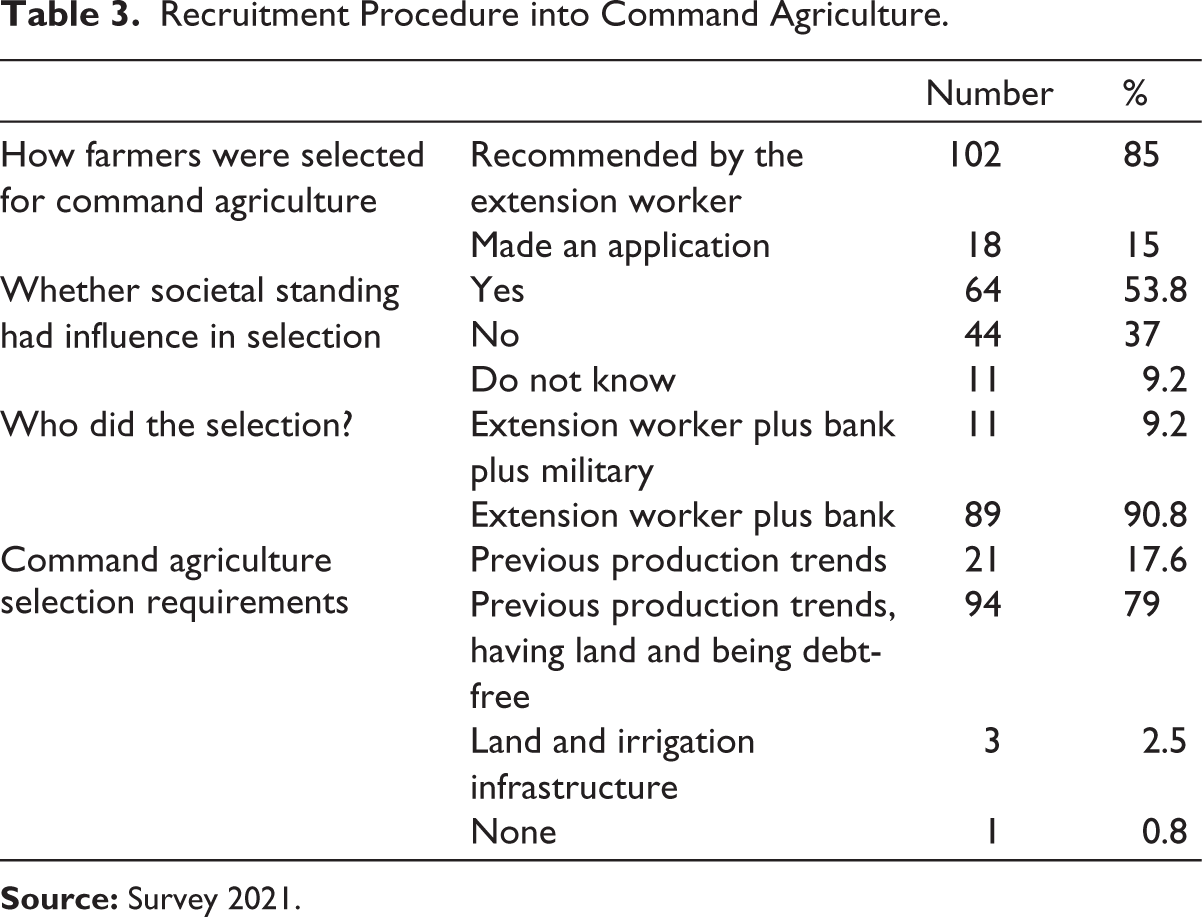
In response to how they were recruited into CA, 85% of the farmers interviewed from the survey stated that their participation and involvement had come through recommendations from extension workers (see Table 3). The rest said that they had submitted their applications to government offices on their own initiative. The researchers discreetly sought to establish whether social class or social standing had been a factor in the recruitment process. Almost 54% of the sampled farmers thought it had a bearing, 37% stated that it had no influence, and 9.2% did not know (see Table 3). The mixed reactions suggest that the program is open to farmers of different classes and from different social backgrounds.
Recruitment Procedure into Command Agriculture.
On implementation modalities, the study shows that CA is a multipartite model of contract farming that has the active involvement of various actors. The state is the principal player and the other actors are private commercial banks, namely the CBZ and AFC Holdings, and companies supplying inputs, such as Seed Co. Zimbabwe and the Zimbabwe Farmers’ Union (Interview, 22 December 2021, Goromonzi). The two banks involved in CA were selected by the state, probably because the latter has some shareholdings in the two banks involved. To be enlisted under the program, the farmer first fills out a verification form and submits it to Agritex. An agronomist is deployed to establish the GPS coordinates of the farmer’s land and assess the size and potential of the arable land to be used for the production of maize. The agronomist also examines the irrigation infrastructure and agricultural equipment before submitting a report to the bank involved. The vetting by agronomists and the strong influence of banks in the screening of applicants are new developments (Mazwi et al., 2019). The changes were introduced by the GoZ to reduce the rate of defaults in the repayment of loans (Ministry of Finance, 2018). The GMB, which is mandated to be the sole buyer of maize in the country, also has a key role in vetting farmers for contracts. A contracted farmer who fails to supply maize to the GMB can be disqualified from the program.
A notable challenge with the multipartite model is the bureaucratization of the application process. All the sampled farmers indicated that they had faced challenges in their applications to be considered for the program. Asked to specify the challenges, 81.7% of the farmers stated that the procedures were too cumbersome, time-consuming, and bureaucratic, and 32.2% cited excessive documentation as a major drawback. Almost 60% of the sampled households said they had experienced late distribution of inputs, and 57.6% noted that distances to the input collection centers were too long. As we show in the following sections, this has implications for the ability of farmers to repay agricultural credit on time, a challenge that must be seriously dealt with by policymakers.
Interviews with key informants also confirmed that for farmers, the process of steering applications through Agritex, the GMB, the bank, and private input suppliers is slow and often marked by inefficiency (Interview, 22 December 2021, Goromonzi). It therefore comes as no surprise to learn that the number of farmers contracted under CA has declined since the first year of the implementation of the program. An Agritex officer in Goromonzi stated (Interview, 28 December 2021):
The number of farmers under CA has been in decline in my district since 2016. Part of the reason is that communication between the banks and farmers has been very poor. You have a situation where an application to participate in CA is approved by the bank but the farmer does not receive such communication. This is what has frustrated many farmers.
Indeed, the banks and Agritex appear to be a major brake on the process. The government brought the banks on board to improve efficiency, but the results have sometimes proved less than adequate. The participating institutions in multipartite contract farming arrangements are assumed to complement one another in the production and marketing of a commodity. Such was the case with KTDA in Kenya and the Kakira Sugar Works in Uganda, for example, but bickering among the parties as well as bureaucracy has been a major drawback of the schemes (Martiniello, 2017; Ochieng, 2010).
This study found that banks and extension officers were, in most cases, overwhelmed by the demand for their services. The severely understaffed CBZ department working on CA is in Marondera, and its responsibility extends to the whole province of Mashonaland East. This slows down the processing of applications and turnaround times, and many farmers have exited the CA program as a result, according to key informants. The survey found that 60% of farmers failed to access inputs in time for the rains, forcing them to postpone maize farming to the following agricultural season at one point or another. Delays in the supply of inputs affect production, and as highlighted in the following section, most farmers fail to pay back the loans advanced under CA. Banking institutions, however, argue that the interference by military officials, particularly in the selection of beneficiaries, has been a major drawback for the program compromising its effectiveness.
Agritex is also overstretched because of an increase in the number of applicants. Almost 32% of the sampled households in both districts stated that extension officers were not easily available to receive applications and that the absence of professional agronomic services affected the quality of the crop.
Input Loans and Rates of Repayment
All the farmers under CA received input packages consisting of maize seed, fertilizer, and chemicals, along with technical advice from extension workers and fuel and tillage services during the 2019/2020 and 2020/2021 seasons. The inputs typically included 25 kg/ha of seed, 400 kg of ammonium nitrate/ha, herbicides, pesticides, and fuel. As late as December 2021, many farmers were yet to receive their inputs when they should have started their farming operations by late October or early November, depending on the onset of rains. Some farmers stated in interviews that they accepted the late deliveries because they would use the inputs in the next agricultural season. Since repayments are due within 3 years from the date of receipt of inputs, late deliveries do not leave farmers seriously indebted. In fact, extension officers have authorized staggered repayments in the event of droughts and other natural disasters.
CA beneficiaries enjoy relatively low rates of interest charged on inputs and relatively benign terms of repayment when compared to contract farming arrangements led by the private sector (Mazwi et al., 2019). Maize farmers are charged 10% interest compared to 12% and 20%, respectively, for tobacco and sugarcane contract growers (see also Mazwi, 2022). This compares favorably with the higher interest rates charged by private capital in contract farming and the high costs of inputs on open markets found in surveys conducted after the introduction of the land reforms (Moyo et al., 2009; Moyo et al., 2014). Therefore, CA can be viewed as an alternative arrangement that has the potential to facilitate accumulation from below based on interest rates and other favorable terms of repayment.
However, bank officials, extension officers, and the Minister of Finance and Economic Development have all expressed concern over late or non-payment of loans. Officials of one commercial bank stated that the default rate for CA farmers stood at 80% as of December 2021. While defaulting can be attributed to drought and the late supply of inputs in some seasons, it emerged that some farmers have fraudulently sold inputs in a highly inflationary environment. An extension officer in Goromonzi stated:
We had a case where a middle-scale commercial farmer misused inputs – such cases are rampant. The farmer took inputs that were provided to plant on 50 ha, but instead of doing that, he only grew maize on 5 ha and sold the rest of the inputs. This was discovered during our routine checks. We reported him to the police and he was taken to court which ruled that he could not be prosecuted since the contract agreement stated that his obligation is to sell his maize output to the Grain Marketing Board when the selling season starts. When the marketing season opened, the farmer simply went to Mazowe [a rich farming district] where he bought maize very cheaply at $3 a bucket. Through this, the farmer managed to repay all his credit (Interview, 28 December 2022, Goromonzi).
Late repayment of agricultural credit, diversion of inputs, and side marketing are some of the common challenges confronting CA, and are partly driven by the inflationary economic environment. Such practices are pervasive even under privately sponsored contract farming (Sachikonye, 2016; Sakata, 2016). Given these challenges, it becomes imperative to transfer less capable farmers, who are mainly peasant farmers, from targeted programs, such as CA to universal and all-inclusive input programs. CA ought to target middle- to large-scale capitalist farmers with a proven history in maize production so as to enhance national food self-sufficiency.
State Planning Under a Neoliberal Regime
Land areas for growing cereal crops declined significantly after the land reforms (Binswanger-Mkhize & Moyo, 2012; Moyo & Nyoni, 2013; Scoones et al., 2010), although maize production increased from 2017, partly as a result of CA (Mazwi et al., 2019). The IMF remains opposed to such interventions and has frequently recommended that the government should reduce its spending (IMF, 2022). It is easy to see why. The state spent USD105 million in 2016, USD439 million in 2017, and USD238 million in 2018 for returns of USD47 million and USD81 million in 2017 and 2018, respectively, resulting in an increase in public debt (World Bank, 2020). In 2021, the Minister of Finance told Parliament that the loan recovery rate under CA stood at 22%. Clearly, these underperforming markers should be addressed, as will be further argued below, without ignoring the positive impact of state intervention on maize output.
As the IMF stated in its report after the conclusion of Article IV consultations in Zimbabwe in March 2022, “real GDP rose by 6.3% in 2021 reflecting a bumper maize harvest, strong pickup in mining, and buoyant construction” (IMF, 2022). Viewed from another perspective, the Zimbabwean economy has experienced contraction in every year that the country has experienced deficits in food grains. An analysis of trends since 1980 shows a correlation between droughts and a regression in the economy (see Table 4). Years of drought and chronic food insecurity have been immediately followed by a contraction in GDP, except for 2010 and 2013 out of the years examined (see Table 4). Clearly, the role of the state in supporting the agricultural sector is crucial since it has multiplier effects on the general economy.
Timeline of Drought Events and GDP Growth Rates in Zimbabwe Since 1980.

There is need for the state to implement sustainable mechanisms in its continued support for agriculture while reducing the incidence of loan defaults and the financial deficits recorded under the CA program from 2017 to 2021. One analyst posits that CA costs can be reduced through efforts to complement the CA program with agricultural training, agricultural mechanization, and adaptability to climate change (Makuwerere-Dube, 2021).
The argument put here is that, given the targeted nature of CA and enlistment of banks in the selection of beneficiaries—which in itself is a progressive development given the enduring problems of financing agriculture—the CA program should be redirected to more capable farmers while also expanding the Presidential Input Scheme and climate-smart programs, as well as other redistributive programs, for those that cannot meet the requirements of the contract. The class and gender cleavages that operate around the CA, which is by nature a targeted policy for better-endowed farmers, must be addressed via the expansion of programs that are of a universal nature. The thorough screening of applicants in the 2021/2022 season already excluded many farmers who had defaulted in previous seasons. There is an added possible problem with capable maize farmers, which is that they are concentrated in a few Mashonaland provinces that receive favorable rains. Thus, one can even find some merit in the World Bank’s (2020) recommendation to improve beneficiary targeting to make CA more effective, but this should be done alongside the adoption of broad-based parallel measures for smaller farmers.
In this regard, there is also a need to promote cooperativism among those who cannot meet the requirements alone. Cooperativism must be incorporated systematically into the planning system for the promise it holds in mobilizing economic and social potential at a higher level. Moreover, this should be backed up by a transition scheme to other more resilient grains beyond maize, as has been happening in recent years. In addition, support for vulnerable and disadvantaged groups, notably the elderly, unemployed urban dwellers, and women who have been marginalized by the ascendancy of neoliberalism, requires that a social transformative policy framework becomes a pillar upon which an egalitarian society is built, and this can occur only where there is continuous and comprehensive state intervention in the economy for the redistribution of wealth.
State intervention through CA offers interesting lessons for agricultural development and presents challenges that need to be well managed. It can go far to block the influence of US and Brazilian agribusiness, which have traditionally exported grain to Zimbabwe during periods of drought under the World Food Program. Overall, state intervention in cereal production has the potential to disrupt the international food regime, whereby countries in the Third World are exporters of cash crops and perennial importers of food crops. State intervention and economic planning threaten the dominant international structure established during colonialism and reinforced under neoliberal structural adjustment programs (Moyo, 2011; Patnaik, 2011).
Conclusion
This article questions the reasoning of international agencies, the IMF, World Bank, and FAO, that farming production is best managed by the private sector, because private capital is primarily motivated by the accumulation of profits at the expense of genuine social transformation. We argue that a state-led multipartite model in financing cereal production makes better sense. This is the mechanism under which CA has been implemented. Major challenges noted under the program relate to its bureaucracy and targeted nature. In some instances, bureaucratic bottlenecks have delayed recruitment and distribution of inputs, impacting production at the farm level and debt repayments. The alarming default rate in the repayment of loans remains a drawback that can be addressed by improved targeting of program beneficiaries. The expanding role of commercial banks in recruitment has helped to screen out parasitic and speculative tendencies among applicants. If concerted efforts are made to solve these problems, state intervention in cereal production can be expected to enhance food self-sufficiency.
We also argue that there is a need to expand universal programs such as the Presidential Inputs program and the climate-proof program, which target vulnerable peasants in an effort to boost food security and national development. The task of CA, together with other universal programs, can go a long way to boost national and household food self-sufficiency and sustain national economic development and sovereignty. In this regard, it has also been shown that there is a distinct correlation between food self-sufficiency and economic growth during the period of state intervention. This suggests that state intervention can stimulate economic growth and development if well managed and can challenge the neoliberal model of the international food system as it currently operates.
Footnotes
Declaration of Conflicting Interests
The authors declared no potential conflicts of interest with respect to the research, authorship, and/or publication of this article.
Funding
The authors received no financial support for the research, authorship, and/or publication of this article.