



Abstract
The complexity of today’s world reflects on the professional lives of people as well. This complexity and its subsequent impact on work–life balance have necessitated organisations to thoughtfully consider the spiritual dimension of individuals at work, which has been neglected for years. The purpose of this study is to examine the interrelationships among workplace spirituality (WS), employee engagement and job involvement among Generation Y employees. Accordingly, a model is proposed which delineates the interactions among these constructs. Specifically, the mediating effect of employee engagement on the relationship between WS and job involvement is explored. The study uses two different forms of employee engagement, namely, job and organisational engagement. A questionnaire-based survey is adopted to test the aforementioned model, and data was collected from 353 professional consultants working in different sectors. The results of regression analyses support all the stated relationships, as well as provide evidence for the mediational effect of engagement. The findings of the study suggest the existence of significant relationships between spirituality and job and organisational engagement. Both forms of engagement partially mediate the relationship between WS and job involvement. The study illustrates that spirituality could be a significant predictor of employee engagement and job involvement among employees in the service sector. Based on the findings, it is reasonable to assume that spirituality could be a vital element in managing the work attitudes of Generation Y workers.
Keywords
Introduction
The concept of spirituality pervades all aspects of human life, whether we acknowledge it or not. What sets human beings apart is the presence of a higher self and the all-encompassing consciousness. In most of the cultures, work is considered to be sacred which provides meaning to lives. It is not surprising that people derive their identities, their notion of who they are, from the work they do. Most of us spend a considerable part of our lives engaging in some work. For this reason, it is interesting to know what role does the all-pervading spirituality plays in our work lives. Past two decades have witnessed a surge of research in the field of spirituality related to work (Ashmos & Duchon, 2000; Garcia-Zamor, 2003; Kolodinsky, Giacalone, & Jurkiewicz, 2008; Milliman, Czaplewski, & Ferguson, 2003; Mitroff & Denton, 1999; Pfeffer, 2003). Most of this research finds a nexus between the spiritual element of employees and their behaviour at the workplace. Although measuring spirituality is a challenging task and is questionable, the research in this arena is moving forward vigorously. Organisations functioning in the current business scenario constantly seek ways to outperform their rivals for which a superior workforce becomes an inevitable element. Tapping the spiritual quotient of employees, thus, becomes a practical option for the firms to explore by creating meaningful workplaces. Most of the studies on spirituality are conceptualised and explored in the Western context. Hence, there is a growing need to understand the phenomenon of spirituality in a non-Western context (Petchsawang & Duchon, 2009). By the same token, employee engagement also needs further exploration owing to vagueness in its theoretical establishment as a unique construct. Recent research in employee engagement emphasises on the distinctiveness of the concept (Hallberg & Schaufeli, 2006; Macey & Schneider, 2008; Saks & Gruman, 2014; Schaufeli, 2012; Shuck, 2011; Shuck, Ghosh, Zigarmi, & Nimon, 2013). With this background, this study intends to examine the impact of both constructs on job involvement, while contributing to the growing literature on spirituality and engagement. By considering the widely studied dimensions of spirituality, as well as the two forms of engagement, this article seeks to understand the relationship among spirituality, engagement and job involvement, while looking at the mediating role of engagement among a group of Generation Y workers. There is no widespread agreement on the age range for the Generation Y (Bolton et al., 2013). For this study, Generation Y starts from 1980 (Erickson, 2009) and is within the frame of the period, 1980–1990.
The next section of this article reviews the relevant literature, derives the objectives and rationale for the study and presents the proposed model. Subsequent sections deal with the methodology applied to obtain results, findings of the study and the discussion on the same. The final section outlines the implications, as well as the limitations, and concludes the study.
Review of Literature
This section briefly explains the construct of spirituality, employee engagement and job involvement in the context of this study.
Workplace Spirituality
Spirituality at work is a relatively new area in the field of management and organisational behaviour, and there is only limited development in its theoretical aspects owing to the subjective and abstract nature of the phenomenon itself (Dehler & Welsh, 2003; Fry, 2003). Numerous definitions of spirituality at workplace have been developed and used by several researchers in accordance with the context of their study. Mitroff and Denton (1999) following a meticulous study of the phenomenon defined spirituality as ‘the basic feeling of being connected with one’s complete self, others and the entire universe’ (p. 83). Giacalone and Jurkiewicz (2003) defined workplace spirituality (WS) in the context of organisational values and culture which promotes employees’ experience of transcendence and connectedness to one another. One of the widely accepted definitions of spirituality which is used in empirically testing the concept belongs to Ashmos and Duchon (2000). According to Ashmos and Duchon (2000), spirituality is defined as ‘the acknowledgement of the inner life of employees which nourishes and is nourished by meaningful work in the context of community’ (p.37). This definition was adopted for this study. Milliman et al. (2003) based on Ashmos and Duchon’s (2000) work represented WS at three levels—individual, group and organisational levels. Also, the community dimension and the organisational dimension were operationalised slightly different from Ashmos and Duchon’s (2000) conceptualisation. The study adopts the three-level framework for WS which has been consistently found in the literature (Neal & Bennet, 2000). Consequently, dimensions of meaningful work, as well as inner life, were considered from Ashmos and Duchon’s scale (2000), and they represent spirituality at the individual level. The community dimension, as well as the aspect of organisational purpose, has been adopted from Milliman et al. (2003) scale which was conceptualised as a sense of community and alignment with the organisational values, respectively. These dimensions of spirituality, namely, meaningful work, sense of community, personal–work values alignment and inner life, are also found to be critical dimensions of the Indian perspective of spirituality at work experience (Srirangarajan & Bhaskar, 2011).
The focal point of most of the research in this field was to define and develop the construct in an attempt to document and measure the phenomenon which was done through qualitative methods (Constantine, Miville, Warren, Gainor, & Lewis-Coles, 2006; Kinjerski & Skrypnek, 2004; Mitroff & Denton, 1999; Richards, Oman, Hedberg, Thoresen, & Bowden, 2006; Tischler, Biberman, & McKeage, 2002). Empirical research has also been carried out testing claims of spirituality benefitting employees and organisations (Daniel, 2015; Karakas, 2010; Milliman et al., 2003; Pawar, 2009; Rego & Cunha, 2008).
Workplace Spirituality and Employee Engagement
The WS and employee engagement are relatively new concepts of recent origin in management literature. Although different and unique in their own rights, WS and employee engagement share some commonalities in their characteristics (Saks, 2011). Both concepts bring in an idea about harnessing one’s complete self while performing his/her work. Kahn (1990) notes when people are engaged in their jobs, they experience more psychological meaningfulness and psychological safety and hence are more psychologically available in their jobs. This was further validated by May, Gilson, and Harter (2004) where the researchers found among the psychological conditions, meaningfulness to be the strongest predictor of engagement. Spirituality at work, as well as employee engagement, leads to numerous positive outcomes at the individual and organisational levels. Research suggests that spirituality strengthens organisational commitment, job satisfaction and employee well-being (Chawla & Guda, 2010; Crawford, Hubbard, Lonis-Shumate, & O’Neill, 2008; Milliman et al., 2003; Rego & Cunha, 2008) and is negatively related to turnover intentions and work stress (Daniel, 2015; Kumar & Kumar, 2014; Milliman et al., 2003). Similarly, employee engagement is also found to influence commitment and satisfaction levels positively, citizenship behaviours resulting in lower attrition rates among employees (Halbesleben, 2010; Rich, Lepine, & Crawford, 2010).
Workplace Spirituality and Job Involvement
There is evidence of meaningful relationship between spirituality at work and job involvement in literature. Although scanty, research suggests that WS has a positive influence on job involvement (Milliman et al., 2003; Pawar, 2009; Van der Walt & Swanepoel, 2015). Kolodinsky et al. (2008) found a direct link between organisational spirituality and job involvement, although evidence for a relationship between individual spirituality and work-related outcomes was lacking. Word (2012) notes that individual spirituality could manifest in some other ways rather than directly impacting job-related outcomes.
Employee Engagement
It was with Kahn’s (1990) seminal work on the topic of engagement the concept was formally introduced to the field of organisational behaviour. Kahn (1990) explained how people engage and disengage in their jobs. The author defined engagement as personal engagement where the members physically, cognitively and emotionally are present while performing their roles in the organisation. In Kahn’s definition, the physical aspect refers to the physical energies one employ in order to carry out his or her job, while cognitive aspect deals with the employee’s beliefs about the organisation including its leadership and working conditions. Emotional aspect relates to the employee’s feelings which lead either to a positive or to a negative attitude towards the job and the organisation. Although Kahn (1990) made a significant contribution to the field, a theoretical conceptualisation of the construct was lacking. Maslach and Leiter (1997) reintroduced the concept of engagement as the antithesis of burnout. The duo argued that engagement and burnout form two ends of the continuum, and if the employee is not engaged he is likely to experience a burnout. They define engagement as an energised state of being characterised by energy, involvement and efficacy. Schaufeli, Salanova, González-Romá, and Bakker (2002) also define engagement ‘as a positive, fulfilling, work-related state of mind that is characterized by vigour, dedication and absorption’ (p. 74). Based on Kahn’s definition of engagement and subsequent research Macey and Schneider (2008) argued that employee engagement is a multidimensional construct. Despite the numerous definitions and research to arrive at a common point for identifying the concept, the term resists a precise definition which is agreed upon unanimously. Robinson, Perryman, and Hayday (2004) note that most of the definitions lead to an overlapping of the construct with more established constructs in organisational behaviour such as organisational commitment and organisational citizenship behaviours (OCBs). Saks (2006) agreeing upon the multidimensionality of employee engagement distinguishes between job engagement and organisational engagement arguing that although there are shared similarities, they differ from one another. For this study, drawing from the popular definitions, we assume employee engagement to be a construct with physical, behavioural, emotional and cognitive components vital for the assigned tasks, as well as to be engaged in the organisation. Employee engagement is further operationalised according to Saks’ (2006) classification of engagement as job and organisational engagement.
Employee Engagement and Job Involvement
Employee engagement, due to ambiguity in its theoretical development, has been synonymously used with other attitudinal variables such as commitment, satisfaction and job involvement (Fleming, Coffman, & Harter, 2005; Harter, Schmidt, & Hayes, 2002). Hallberg and Schaufeli (2006) point out that both work engagement and job involvement refer to positive attachment to work and contain reciprocal and theoretical references to each other. Based on Harter et al. (2002) definition of engagement as a combined state of satisfaction and involvement, Macey and Schneider (2008) notice that job involvement shares a conceptual space with engagement. Job involvement refers to the psychological identification of the person with the job, and this aspect is included in some of the operationalisations of the construct of employee engagement (Cooper-Hakim & Viswesvaran, 2005). Research findings show that consequences of employee engagement include job satisfaction, organisational commitment and OCBs (Saks, 2006). Similarly, as indicated in previous research, job involvement could also be a significant outcome of employee engagement.
Job Involvement
Job involvement has been defined as a person’s psychological identification with his/her role in the workplace (Kanungo, 1982). Apart from identifying oneself with the job, it also involves active participation in it and affects his/her self-esteem (Lodahl & Kejnar, 1965; Saleh & Hosek, 1976). Mudrack (2004) notes when the job involvement is high, people consider their jobs to be crucially important which is linked to their identities, life goals and interests. High job involvement, in turn, enhances job satisfaction and commitment towards the organisation (Cohen, 1995). Chen and Chiu (2009) note that people with high involvement in their jobs display self-confidence and are independent with novel ways of performing their roles. Sarros, Cooper, and Santora (2011) also point out the positive relationship between job involvement and innovative behaviours.
Objectives of the Study
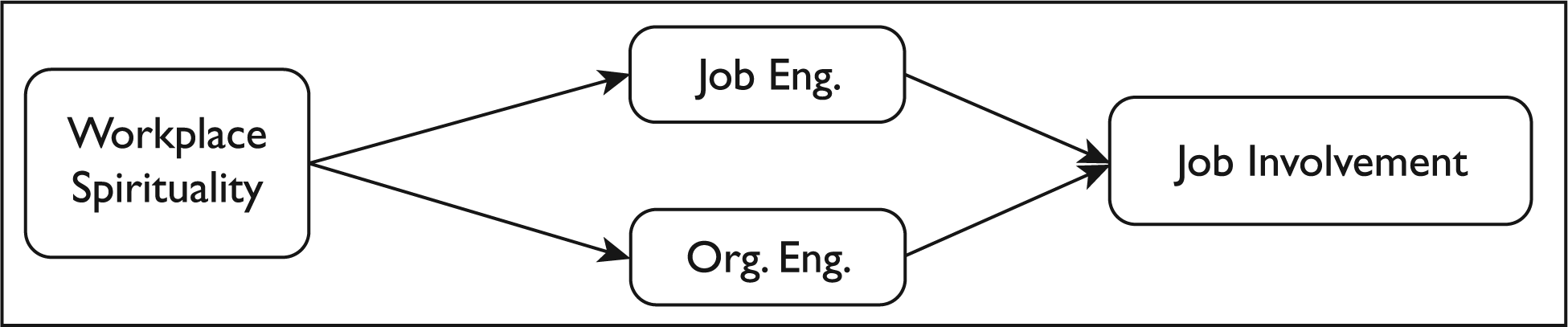
Based on the above literary discussions, the first objective of the study is to examine the relationship between WS and job and organisational engagement. Second, the study aims to explore the relationship between job and organisational engagement and job involvement. The last objective of the study is to assess the mediation effect of job and organisational engagement on WS–job involvement connection. The proposed model based on the study objectives is depicted in Figure 1.
Rationale for the Study
The outcome variable of the study is job involvement which is a very significant attitude variable like organisational commitment and job satisfaction. The studies on the antecedents of job involvement majorly centre around job and organisational characteristics and personality variables (Brown, 1996; Chen & Chiu, 2009; Lambert & Paoline, 2012; Rabinowitz, Hall, & Goodale, 1977). Brown and Leigh (1996) note the importance of studying psychological climate as a potential antecedent of job involvement. The psychological climate which is an individual attribute comprises the perceptions which are psychologically meaningful for employees. Spirituality in organisations helps in creating meaningful experiences for individuals which in turn influence their perceptions about their jobs. As already discussed, limited but valid research in the field points out the existence of a significant relationship between spirituality and job involvement. Likewise, May et al. (2004) note that engagement could be a predictor of job involvement as people who experience engagement at deeper levels might find it easy to identify with their jobs. General job involvement was found to increase work engagement (Kühnel, Sonnentag, & Westman, 2009). It is possible that this relationship could exist in the reverse direction also where engagement becomes a potential antecedent for job involvement.
It also has to be noted that the relationship between spirituality and engagement is under-explored. There are theoretical propositions about the relationship (Saks, 2011), but empirical evidence to support this relationship is lacking. Additionally, although there are several studies on employee engagement, studies which focus on engagement in different roles are considerably less. Again, although the mediating role of employee engagement was looked at, mediational effects of different forms were ignored. Moreover, the study is conducted among Generation Y employees. Also known as, millennials, this generational cohort is an interesting classification for both academicians and managers. They, in comparison with Generation X or baby boomers, are more open-minded, flexible, self-expressive and receptive to new ideas. Interestingly, a workplace research study notes that the Generation Y considers engaging workplace to be essential than the work being merely a support function (O’Neill, 2010).
Methodology
Sample Characteristics
The target population for this study was a group of professional service consultants working in different consultancy services including information technology (IT), public relations, management and strategy and law. The respondents were selected using a non-probabilistic sampling technique. The study employed a quantitative methodology to find out the association among the study variables. A total of 400 questionnaires were administered by the researchers both as emails and as hard copies, out of which 353 filled-up questionnaires were deemed fit for the study. The survey instrument contained items pertaining to the demographic information of respondents. Accordingly, 227 respondents were born between 1980 and 1985. Out of the sample, 77 per cent had a work experience between 7 and 13 years. In the sample, there were 208 (59%) male and 145 (41%) female respondents. Out of the total respondents, 34 per cent had a graduate degree in engineering, technology, commerce or arts, while 66 per cent are postgraduates. In the sample, 41 per cent worked in IT consultancies, 32 per cent in management and strategy firms, 14 per cent as legal consultants and the rest in public relations.
Measures
Workplace Spirituality
As discussed above, four dimensions of WS were selected for the study. Meaningful work, inner life and alignment of values were measured using items from Ashmos and Duchon’s (2000) scale; whereas, sense of community was measured using items developed by Milliman et al. (2003). Thus, the construct of spirituality was measured using 27 items, all of which was rated on a 7-point Likert scale where 1 indicated ‘strongly disagree’ and 7 represented ‘strongly agree’. Total score of WS is the summation of scores for the items of its four dimensions. The Cronbach’s alpha value of the scale is 0.82.
Employee Engagement
For employee engagement, both forms of engagement were chosen for this study. Job engagement was measured using five items; whereas, organisation engagement was evaluated using six items. Scales for both engagement forms were adopted from Saks’ (2006) scale. All items are measured on a 7-point Likert scale. The Cronbach’s alpha value was found to be 0.85 for this scale.
Job Involvement
The construct of job involvement was measured using 10 items from Kanungo’s (1982) job involvement scale. Out of the 10 items, 2 items were to be reverse coded. All the items were marked on a Likert scale, values of which ranges from one to seven, with one indicating strongly disagree and seven indicating strongly agree. After reverse coding, the Cronbach’s alpha value was 0.78 for the scale.
Results and Discussion
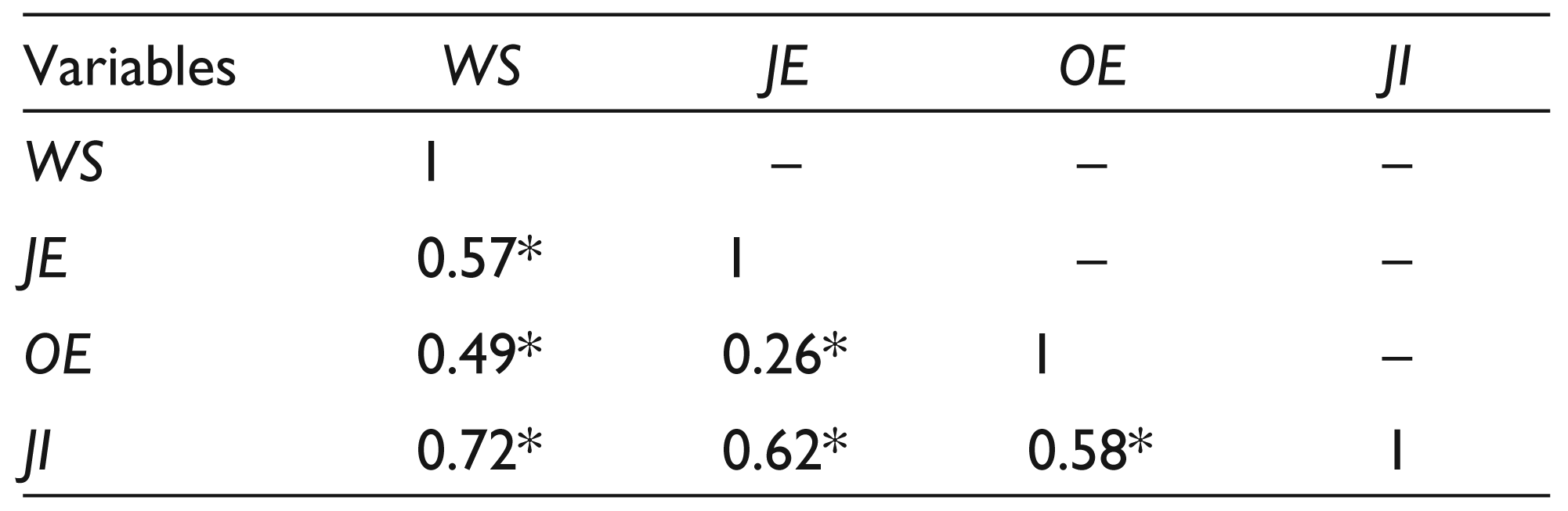
For data analysis, SPSS 20.0 statistical package was used. Results of Pearson’s correlation analysis are presented in Table 1. Correlation coefficients indicate that there exist significant relationships among the independent variable, mediators and the dependent variable. Before proceeding to test the predictor–criterion relationship, the confirmatory factor analysis was run to ensure that all variables in the study represent separate constructs. For the measurement model, the fit indices indicated that the measurement model provided a good fit to the data (X2/f = 1.4, p < 0.001, GFI = 0.92, NFI = 0.93, CFI = 0.93, RMR = 0.4)1. All the items had a factor loading equal to or above 0.5.
Pearson’s Correlations for All the Variables
Since the study includes testing the mediation effects, Baron and Kenny’s (1986) three-step procedure for assessing mediation was followed. This approach to mediation has been widely used to test mediation. The duo states three conditions to be tested in order to establish mediation. Accordingly, there should be a significant relationship between the independent variable and the mediating variable. Second, the independent variable should be related to the dependent variable, and third the mediating variable should be related to the dependent variable, when tested along with the independent variable.
In the first step, researchers regressed the mediators (job and organisational engagement) on the independent variable (WS). Meeting the first condition for mediation, the results showed that WS is significantly related to job and organisational engagement as shown in Table 2.
Job and Organisational Engagement Regressed on Workplace Spirituality
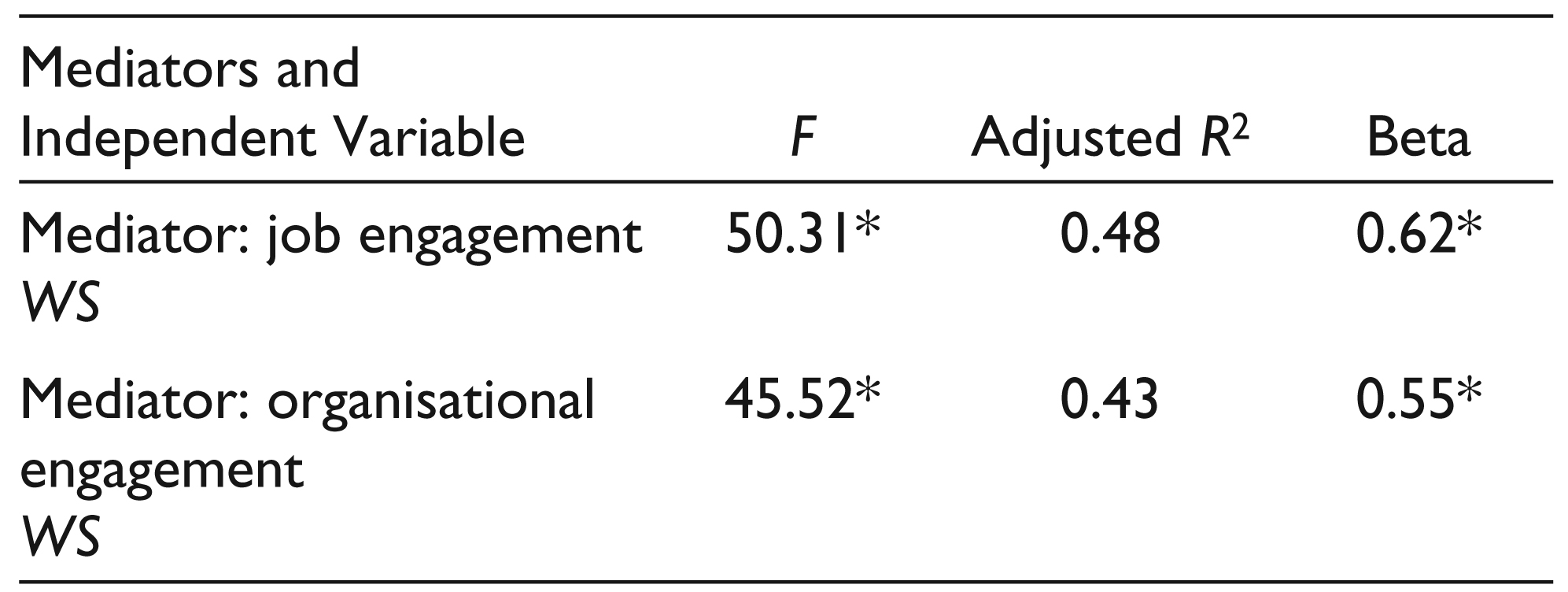
Beta values for WS are significant for both forms of engagement providing support for the first hypothesis. Next, the dependent variable (job involvement) was regressed on independent variable (Table 3). Beta values for WS are significant for job involvement, satisfying the second requirement for establishing mediation.
Job Involvement Regressed on Workplace Spirituality

The third step for mediation was conducted by regressing the dependent variable on the mediator variables, along with independent variables. In this step, if mediating variables and independent variables are found to be significant, one can conclude that a partial mediation is present. If the independent variable has a non-significant value, it is a case of complete mediation. Results of the third regression are presented in Table 4.
Job Involvement Regressed on Job and Organisational Engagement and Workplace Spirituality
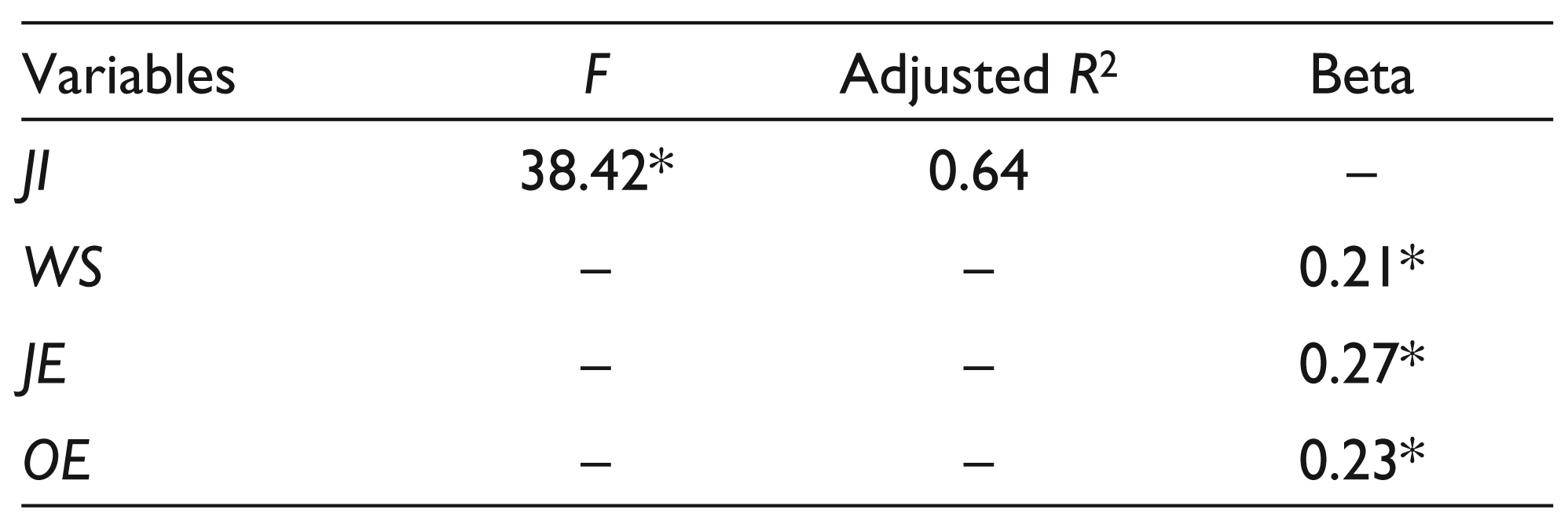
Examining the results of the final regression, the case of complete mediation is ruled out as WS as the independent variable is significant when tested along with the mediators. However, there is evidence of a partial mediation for both job and organisational engagement as regression coefficients for both forms of engagement are significant. Summarising the results, significant positive relationships existed among spirituality at work and both job and organisational engagement. Beta coefficients for both job and organisational engagement are significant for job involvement establishing a positive relationship among the variables. The final objective was to explore the mediation effect of engagement on spirituality–job involvement relationship. After introducing the mediators, the beta value for WS, although significant, has decreased (from 0.43 to 0.21) indicating a partial mediation of engagement.
Results of this study reinforce the findings of previous research on the impact of spirituality at work on individual job attitudes. As evident from the results presented above, spirituality affects engagement levels which in turn boost one’s involvement in work. In light of these studies and their findings, it is not wrong to presume that spirituality invariably affects every individual’s work-life at some point in time. These effects could be either very noticeable or subtle as the case may be. This can also be explained with the spillover theory (Wilensky, 1960) which postulates that since our needs, attitudes and roles in life are not strictly compartmentalised, effects in one area of life spillover to other areas as well. Originally applied in research in quality of life and work-life balance, spillover theory finds relevance in WS too (Kolodinsky et al., 2008). When work makes sense to the person, his/her belief of contributing to a mission is fortified which in turn motivates the person to be more involved in the job. Similarly, interpersonal relationships make the workplace lively and a conscious place to be in. Sincere relationships at work and feeling of being a part of the community positively influence one’s attitude towards work. In like manner, individuals recognising the existence of an inner life in them are more likely to make use of these hidden resources at work. Engagement which was once considered synonymous with job involvement proved to be a unique construct in its own right. The study also finds evidence for different forms of engagement, underlining the multidimensionality of the construct. Interestingly, spirituality enhances job involvement directly or indirectly through the mediating effect of job and organisational engagement. The study finds that both forms of engagement significantly mediate the relationship between WS and job involvement. The beta value of 0.43 was reduced to 0.21 when mediators were introduced. Positive relationships are found between spirituality and forms of engagement which is still an under-explored area in this field. Although the mediating role of engagement has been looked at in the past research, there are not many studies which use Saks’ (2006) classification of employee engagement in mediation. As Saks (2006) observes, a person engaged in his/her needs may not necessarily be engaged in his/her organisation. Hence, it becomes interesting to know when the topic of engagement is discussed, whether the engagement referred to is with respect to the job or the organisation.
Implications of the Study
Job involvement was found to be influencing a considerable number of employee outcomes (Kanungo, 1982). When the person is highly involved in his/her job, the job becomes very crucial for the individual’s self-esteem or self-image. A person with a high degree of job involvement is likely to expend more personal resources in performing a work role (Janssen, 2003). This emotional investment by the employees can always be a strong point for organisations. In this context, it is vital for organisations to find ways to promote job involvement in order to upgrade the overall performance. With the Generation Y seeking engaging work experience which can promote job involvement, spirituality can be of great help for organisations. Organisations should promote a culture which respects the wholeness of life and not merely its material aspects. Retention of talent becomes crucial for the Generation Y as they are more attached to their jobs than to organisations and have higher expectations to be met. Employees opting to stay with the organisation, to a large extent, depend on their engagement levels. Again, spirituality, as the findings reveal, could help in deepening the experience of individuals at the workplace thereby augmenting their engagement levels.
Limitations
Although this study provides an empirical evidence for the phenomenon of WS and mediating effects of employee engagement, it is not all-inclusive and therefore suffers from certain limitations. The first limitation is with respect to the sampling technique used which is a non-probabilistic sampling. As is the case with all non-probabilistic sampling methods, there is an inherent limitation about generalising the results of this study to other diverse groups of employees. Second, the study is cross-sectional in nature which prevents us from drawing robust conclusions regarding the causality of variables involved. Longitudinal research models help in verifying the direction of relationships and subsequent effects. Third, the study might be susceptible to common method variance as self-report measures were used to collect data from the participants. Also, the study uses a parsimonious model with the most widely studied dimensions of spirituality at work and has excluded several other dimensions. Also, the study has used Baron and Kenny’s (1986) approach to mediation which has a considerable number of limitations. Moreover, the study has not accounted for the variances due to control variables. Finally, there is a limitation to fully comprehend and quantify the experience of spirituality which applies to any other empirical study in this arena.
Conclusion
Although employee attitudes such as satisfaction and commitment were studied in relation to WS, there is a lack of research on the topic of job involvement which is equally significant like other behavioural constructs when it comes to employee productivity and wellness. The study provides to the literature on spirituality, job involvement and engagement. The study demonstrates that spirituality at work can be the significant antecedent for job involvement. Spirituality is personal in nature, and a personal resource can foster job involvement apart from work and organisational characteristics. The mediating role of engagement shows that people with high level of spirituality might be engaged in their roles as well as with their organisation. This engagement level motivates employees to be more attached to their jobs suggesting that engagement levels in an individual also could predict his/her involvement in the job. Spirituality at work is increasingly becoming a reality and not merely a trend, and the rise in empirical research enhances its acceptability in the field of business. There is a spiritual quest in every human being whether we acknowledge it or not or follow it or not. To live a life of meaning and purpose is our birthright, and most of our suffering spring from this feeling of meaninglessness in our existence. Workplaces are important in the sense that they can aid individuals in moulding a life of meaning. If organisations are able to acknowledge the spiritual life of an employee and can tap into their inner resources and develop their spiritual quotient like they do with intelligence and emotions, undoubtedly, immense possibilities await such organisations in the long run.
Declaration of Conflicting Interests
The authors declared no potential conflicts of interest with respect to the research, authorship and/or publication of this article.
Funding
The authors received no financial support for the research, authorship and/or publication of this article.