



Abstract
The impressive performance of the Bharatiya Janata Party in the 2014 Lok Sabha elections in West Bengal is seen as a turning point in state politics—a saffron surge and the red retreat. While trying to understand and explain the rise of the BJP, this article analyzes Hindutva politics in West Bengal in a historical perspective, highlighting the ideological and organizational legacies of the Hindu Mahasabha, the Bharatiya Jana Sangh and the Sangh Parivar. Hindutva’s political ambition always remained frustrated as the objective ideological and political milieu in a hostile Communist bastion had never been congenial to its brand of politics. Yet, the BJP continued to struggle for its existence, adopted pragmatic political strategies at the local and regional level, entered into smart political alliance with the Trinamool Congress at a crucial time, grabbed the opportunity to expand its base rapidly when the Left lost its credibility and political control and, finally, when Mamata started messing up with her support base. Buoyed by the BJP’s rise in the 2014 Lok Sabha elections, Hindutva forces have unleashed an ambitious and aggressive campaign to wrest West Bengal from Mamata’s Trinamool Congress in the 2016 assembly elections; thus, West Bengal is likely to witness a fierce political battle in the coming days!
Keywords
Hindu nationalism and communism represent two antithetical ideologies. While the second Rashtriya Swayamsevak Sangh (RSS) chief M.S. Golwalkar (Golwalkar, [1966] 1980) questioned the nationalist credentials of the Communists and identified them as one of the enemies of Hindu Rashtra, Communists always remained untiring and uncompromising critics of the ‘fascist’ Sangh Parivar (Yechuri, 1993). For Hindu nationalism, West Bengal, the citadel of Indian Communists, which experienced an uninterrupted rule of the Left Front for 34 years under the hegemony of the CPI(M), has always been an eye-sore; their long-cherished dream to unfurl saffron flag in this red bastion remained a frustrating exercise. However, the crushing defeat of the Left by Mamata Banerjee’s Trinamool Congress in the 2011 assembly elections, and subsequent political upheavals in the post-Communist Bengal, offer an immense opportunity to Hindu nationalists. In this context, the first section of this article deals with Hindutva’s Bengal connection, the entry of the Bharatiya Jana Sangh (BJS) into state politics, its inspiring electoral debut and subsequent decline. The second section shows how the new avatar of the BJS, the Bharatiya Janata Party (BJP), slowly entrenched in West Bengal by skilfully merging its national agenda with local politics, thus carving out a distinct space for itself, though the record of its electoral performance has, by and large, been unimpressive and unsteady. The third section, focusing on the 2014 Lok Sabha elections in West Bengal, analyzes the complex interplay of issues, campaign, leadership and social forces which contributed to the BJP’s surge in the state. The final section highlights how Hindutva forces, bolstered by this surge, have launched an ambitious and aggressive political campaign not only to snatch away the main opposition space from the Left but also to eventually overthrow the Mamata regime.
Hindutva’s Bengal Connection
Nineteenth-century Bengal produced the seed of Hindu nationalism, which germinated in Maharashtra giving birth to the RSS in 1925. In fact, everyday discourse and practice in the RSS would remain incomplete without invoking Bankim and Vivekananda. Bengal played an important role in the making of K.B. Hedgewar, the founder of the RSS, and his successor M.S. Golwalkar. While Hedgewar, as a medicine student in Calcutta, learnt lessons from Bengali radical nationalists, Golwalkar’s sojourn at Ramakrishna Math tempered his Hindu nationalism with the idea of renunciation and service (Kanungo, 2012). As Hindu Mahasabha was active in Bengal and was committed to protect Hindu interest and counter the Muslim League, the RSS neither had any urgency nor resources to enter Bengal.
Bengal was partitioned twice. While the first partition in 1905 was opposed by anti-colonial nationalism, the second in 1947 was welcomed by communal forces at the expense of Indian nationalism and Hindu–Muslim interrelations further deteriorated between the two partitions. Muslim League’s call for ‘Direct Action Day’ on 16 August 1946 was opposed by the Hindu Mahasabha, which mobilized Hindus not to join the hartal as it would legitimize the creation of Pakistan. The August call triggered the Great Calcutta Killings. Then came, as a sequel, the 1946 Noakhali–Tippera riots. The virus of communalism was widespread in the countryside. Killings, forcible conversions and abductions of women compelled Hindus to flee East Bengal in large numbers. By 1947, the Hindu Mahasabha was campaigning vociferously for partition of Bengal demanding the creation of a separate Hindu province within the Indian Union.
Shyama Prasad Mookerjee joined Hindu Mahasabha in 1939 under the advice of Hedgewar and Savarkar and became its president after Savarkar fell ill (Chatterji, 2010; Madhok, 2001). After the Great Calcutta Killings, speaking on the no-confidence motion in the Bengal Legislative Assembly, he blamed Chief Minister Surhawardy for the killing of Hindus and called him ‘the best goonda that is available not only in the province but throughout the world’ (Mookerjee, 2002, p. 16). He was inducted into the Nehru Cabinet as minister of industries and supplies in 1947. Mookerjee resigned from the Hindu Mahasabha in December 1948 as his proposal for opening the party to members of all communities was turned down. Subsequently, Mookerjee resigned also from the Nehru Cabinet opposing Nehru–Liaquat Agreement, which stipulated that neither India nor Pakistan would make ‘extraterritorial claims’ on behalf of the Hindus of East Bengal, many of whom forced to flee due to persecution by majority.
Mookerjee began his quest to form a political party to oppose Nehru’s policies. The RSS, during the ban after Gandhi’s murder, was also seriously debating over having its own political front. As both these missions converged, the BJS was launched in 1951 with Mookerjee as the president. An unprepared Jana Sangh fought the first general election in 1951–1952 and secured over 3 per cent of votes in Lok Sabha and 2.76 per cent in the state legislative elections. But Jana Sangh’s electoral performance in Mookerjee’s home state was much better than its national show (see Table 1).
Performance of the BJS in Lok Sabha and Assembly Elections in West Bengal
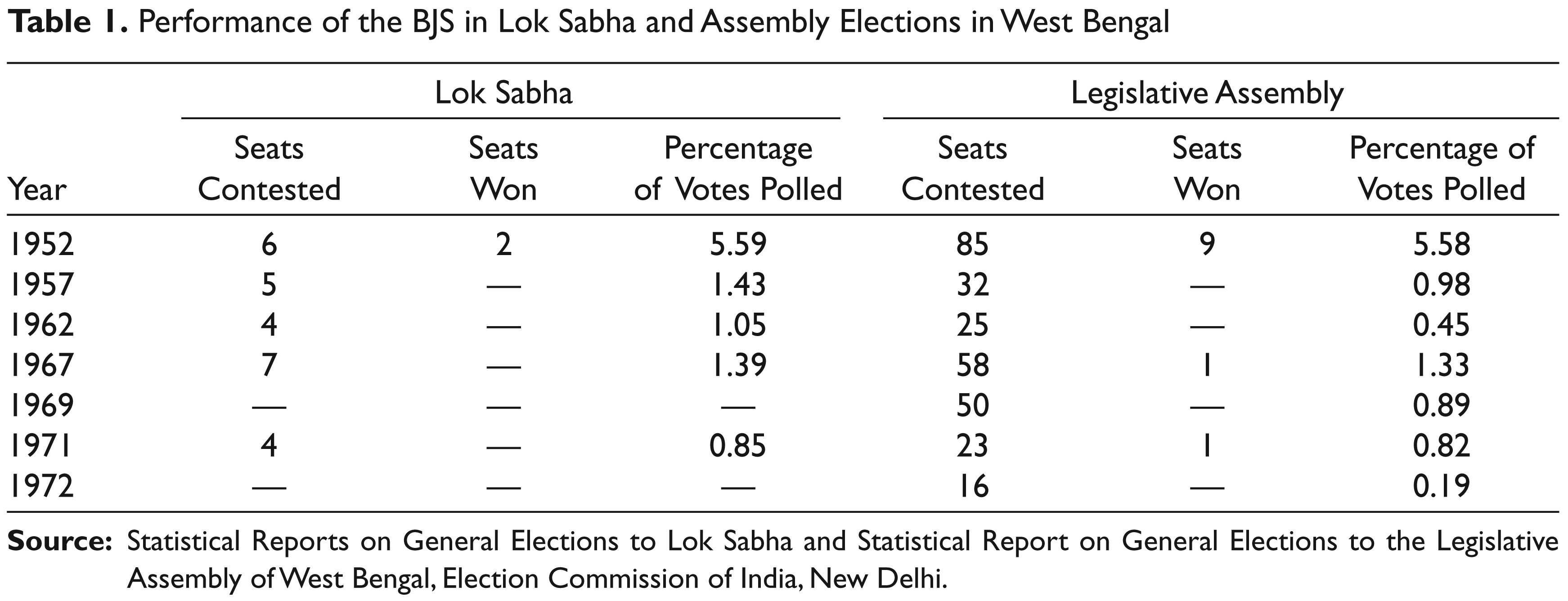
In the 1952 Lok Sabha elections, the BJS contested 6 out of 36 seats in West Bengal. The debut was impressive as it won 2 seats and secured 5.59 per cent of vote share. S.P. Mookerjee won from Calcutta south-east by securing 44.97 per cent of the votes, and Bandopadhyaya Durga Charan Das won from Midnapore Jhargram, securing 26.61 per cent of votes. N.C. Chatterjee of the Hindu Mahasabha won the Hoogly Lok Sabha seat, securing 36.19 per cent of votes.
In the Vidhan Sabha elections, the party contested 60 out of 238 seats and won 9 seats, securing 5.58 per cent of vote share; 8 were won in Midnapur and one in 24 Parganas. Some of the districts where the party performed well were Midnapur (12.68 per cent), 24 Parganas (9.17 per cent), Nadia (7.76 per cent), Hoogly (5.30 per cent), Burdwan (4.87 per cent) and Calcutta (3.47 per cent). This impressive performance was primarily due to Mookherjee’s leadership and the support he got from Hindu refugees. Hindu Mahasabha also won 4 out of the 33 assembly seats it contested and secured 2.37 per cent of vote share. Thus, both BJS and HMS could muster around 8 per cent of votes with the support of a Hindu vote bank.
The BJS and the Hindu Mahasabha joined hands to send Acharya Deva Prasad Ghosh to Rajya Sabha. Ghosh, a friend of Mookerjee and a Hindu Mahasabha activist in the late 1930s, was a mathematics professor in East Bengal who migrated in 1950 and joined the Jana Sangh. After Mookerjee’s death, Ghosh became vice-president and later the president of the BJS. Though Ghosh had the record of being the BJP president for more than four terms, the elderly Bengali ‘Bhadralok’ lacked the fire and standing of Mookerjee. Another Jana Sangh leader from Bengal, Haripada Bharati, was a member of the national working committee for six consecutive terms (1959–1965).
BJS’s support nosedived in Bengal after Mookerjee’s death. The Hindu refugee segment tilted towards the Congress and the Left as the party was not in a position to offer political patronage. It also lost the potential Bhadralok constituency in the absence of a powerful Bhadralok leader. Moreover, its partner, the Hindu Mahasabha, had become a spent force. Thus, the core components of a potential Hindutva constituency got dissipated. As a result, the BJS could not win a single seat in the subsequent 1957 and 1962 assembly elections, and even failed to secure 1 per cent of the vote share. However, in the 1967 assembly elections, BJS’s G.N. Mandal won Gosaba (24 Pargana district) seat and the party secured more than 1 per cent of the votes after a decade. Unlike other opposition parties, the BJS certainly could not capitalize on any anti-Congress sentiment. In 1969, the BJS again drew a blank in the assembly. While in the 1971 general elections Prafulla Kumar Sarkar won Jalangi (Murshidabad district) seat, the BJS was almost swept away by the Congress wave in the 1972 assembly elections.
BJP in West Bengal
The BJS joined the JP movement against Indira Gandhi’s Emergency and the Bengal unit collaborated with socialists, Gandhians and other anti-Indira forces. In the 1977 elections, the BJS fought as a constituent of the Janata Party, which won 29 seats in the West Bengal assembly. Prominent among the winners from the BJS component included Vishnu Kant Shastri (Jorasanko) and Haripada Bharati (Jorabagan). Both were academics. Shastri was professor in Hindi in Calcutta University and a writer, 2 and Bharati was the principal of Narasinha Dutta College, Howrah. After the break-up of the Janata Party, both these leaders joined the BJP. Shastri, moved to national politics by becoming a founding member of the BJP, later a member of the Rajya Sabha in 1992, and then governor of Himachal Pradesh and of Uttar Pradesh. Haripada Bharati became the first president of the Bengal unit of the BJP. Bharati’s death created a vacuum in the state leadership during the 1980s and it took the BJP almost a decade before it could have a popular leader like Tapan Sikdar, and other credible leaders like Satyabrata Mukherji, a high-profile corporate lawyer, as well as Tathgata Roy, a public sector CEO. Thus, BJP’s ‘Bhadralok’ oriented top leadership was not very different from the pattern followed in the CPI(M).
BJP’s Political Strategy: Blending the Local, the Regional and the National
The BJP started its activities in West Bengal in the early 1980s by entering into local politics at the panchayat level. This was a strategic move to enter into rural Bengal, which was turning into a serious political battleground. In the late 1980s and early 1990s, the party deployed Bengali Hindu/Hindutva icons such as Vivekananda and Bankim in various political campaigns, thus asserting the regional roots of Hindu nationalist politics. This was designed to strike a chord with the Bengali-speaking middle class/bhadralok in the state (Gillian, 2011). As the Ram Janmabhoomi mobilization picked up, the BJP in Bengal, while aggressively mobilizing Hindus on Ayodhya, simultaneously raised the issue of Bangladeshi infiltration more stridently. Thus, the local, regional and national strategies of campaign made an impact on the 1991 Lok Sabha elections, when the BJP, despite with its limited organizational base, secured 11.7 per cent of the total votes in the state. Though the BJP could not win a single seat, this performance established party’s credentials in the state and West Bengal saw the emergence of an incipient ‘third force’.
The party slowly made a steady growth in local politics by winning the gram panchayat elections. Its strength increased from a very modest 0.08 per cent vote share (34 seats) in 1983 to 3.89 per cent (2,372 seats) in 1993, and 7.78 per cent (3,830 seats) in 1998. More importantly, this gain was spread across regions: Cooch Bihar and Jalpaiguri in north, Nadia in central, North 24 Parganas in south and Purulia in west (Dasgupta, 2009). This indicated the party’s systematic inroads in local politics. For instance, a study of Janta village in Bankura district brings out how Tilis, the largest caste group of the village, changed their affiliation from the Left Front to the BJP (Tenhunen, 2003, pp. 495–518).
BJP’s Performance in the 1991 Assembly and Lok Sabha Elections
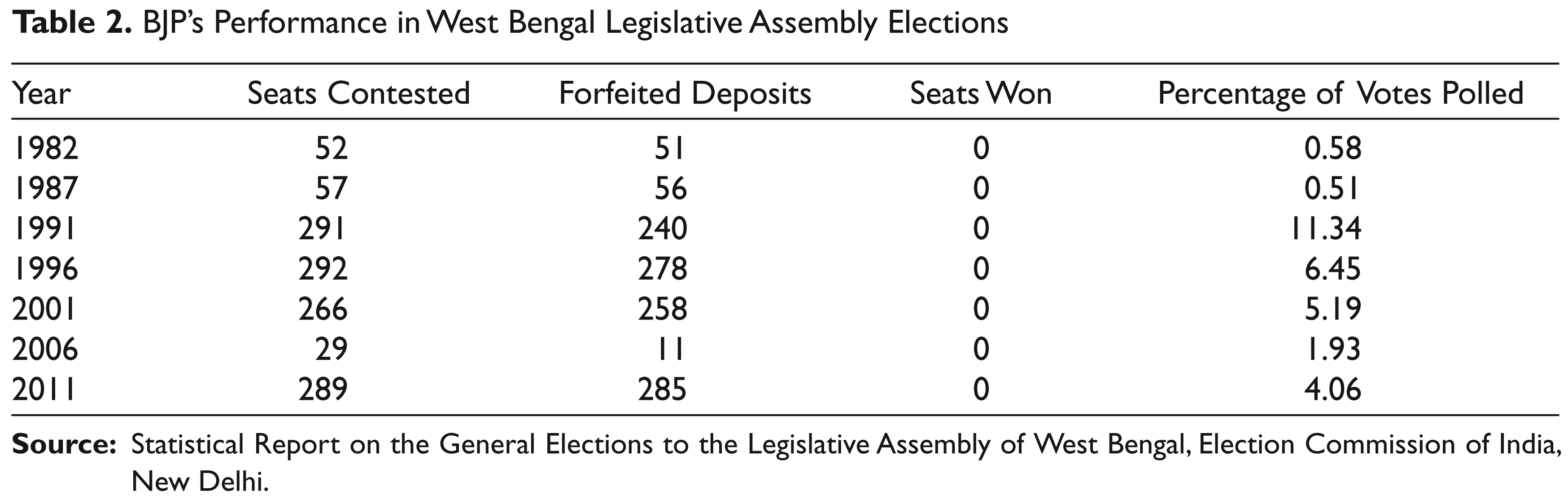
Table 2 and Table 3 clearly identify 1991 as the landmark year for the BJP. Though it did not win a single seat in any house, it secured 11.34 per cent of the votes in the assembly elections and 11.66 per cent in the Lok Sabha elections. Moreover, it saved deposits in 51 assembly constituencies and 8 Lok Sabha constituencies. Rajiv Gandhi’s assassination did not have any impact on West Bengal elections outcome as polls were held before the tragic incident. The Left Front, however, retained its supremacy by winning 37 out of 42 Lok Sabha seats and 244 out of 294 assembly seats.
The 1991 elections outcome indicated that the Ayodhya mobilization had brought new social groups into the party fold and engagement in local politics had enlarged its base in rural Bengal. Second, the BJP, polling over a lakh of votes in 15 parliamentary constituencies, signalled the erosion of the bipolar character of state politics. Left Front’s vote share declined from 51 per cent in 1989 to about 46 per cent in 1991, and the CPM’s from 38 per cent to 35 per cent. Third, though the BJP’s rise in vote share helped the Left Front to win more seats, it simultaneously signalled a danger for the Left. Finally, the rise of the BJP and the decline of the Left’s vote share further indicated that the BJP had not only got some Congress and anti-Left votes but had also established an active presence in the rural areas by mobilizing the forces which did not benefit from the land reforms. But the BJP could not sustain the momentum it got in 1991. Its vote share slipped sharply from 11.66 per cent to 6.88 per cent in the 1996 Lok Sabha elections, as this time anti-Left votes rallied behind the Congress.
BJP’s Performance in West Bengal Legislative Assembly Elections
BJP’s Performance in Lok Sabha Elections in West Bengal

The BJP–TMC Alliance
When Mamata Banerjee broke away from the Congress in 1997 to form the Trinamool Congress, the BJP quickly entered into an alliance with her new party. At this juncture, both needed each other (Gillian, 1998). For Mamata, having a partnership with the BJP, which was staunchly anti-Left and anti-Congress, would help her in taking on the two main political opponents more stridently. Second, she could push her Bengal agenda in the event the BJP came to power in Delhi. Third, the BJP’s organizational and financial resources would be handy in the election campaign and an alliance with a national party and standing would help expand her restricted electoral base. For the BJP, alliance with a secular regional ally like Trinamool was crucial to overcome ‘political untouchability’ and there was a possibility of Mamata’s emergence as a key partner in the future government formation at Delhi. While cementing this alliance, Trinamool was conscious enough not to alienate its Muslim support base. Hence, its election manifesto offered an unconditional apology for the ‘disgraceful’ Ayodhya incident and vowed to prevent any such incident in future. Banerjee took a calculated risk.
In the 1998 Lok Sabha elections, Trinamool and BJP contested 29 seats and 14 seats, respectively. Only in Midnapore both the parties fielded their own candidate; veteran CPI leader Indrajit Gupta was the Left Front candidate. The BJP increased its vote share from 6.9 per cent in 1996 to 9.76 per cent in 1998 and made its first ever victory in West Bengal, with its state unit president, Tapan Sikdar winning Dum Dum, the Left stronghold where the CPM had lost only once since 1952. The Trinamool–BJP combine secured a majority in 100 of the 294 assembly segments.
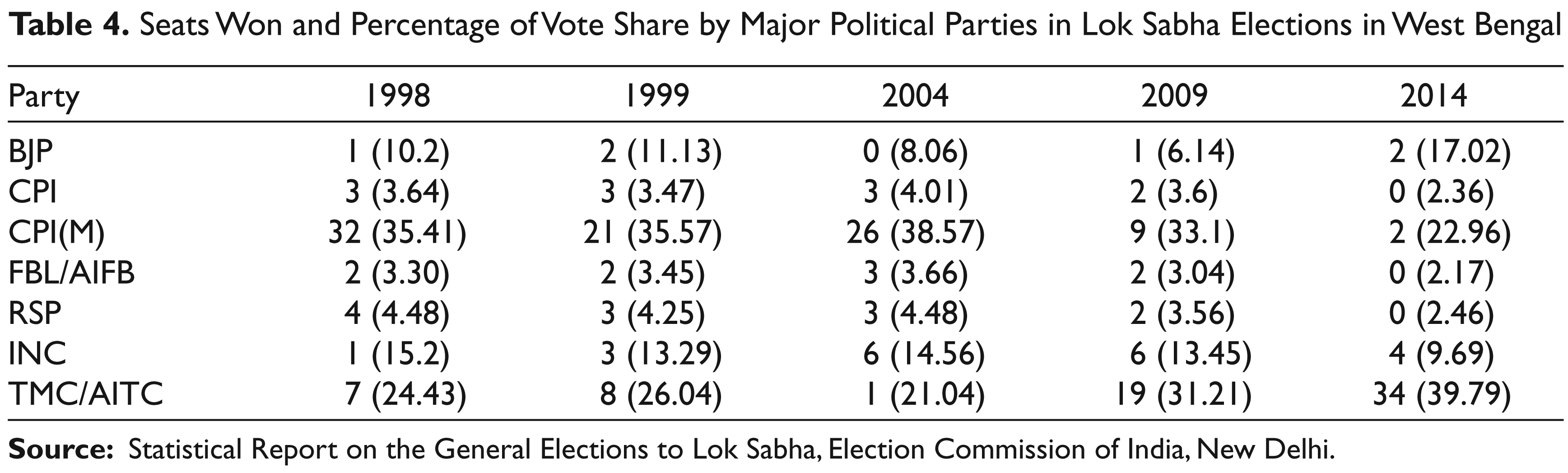
The BJP’s gain in 1998 was considerable as the party contested only 14 out of 42 seats. Though it won only one seat, it left behind the Congress as the nearest political rival to the Left Front in 10 other constituencies. Alliance with the Trinamool Congress certainly helped the BJP to increase its vote share significantly across all contested constituencies (Table 4). In 1999, the BJP made its debut in the state assembly with the support of the TMC when Badal Bhattacharya won a by-poll from Ashoknagar. As a lone BJP member Bhattacharya had to face CPM’s ridicule in the assembly; even Jyoti Basu sarcastically called him ‘Hanuman’.
Seats Won and Percentage of Vote Share by Major Political Parties in Lok Sabha Elections in West Bengal
While Mamata enabled the BJP to open account in Lok Sabha and assembly, the latter helped her new regional outfit to get national recognition. As a smart politician, Mamata was able to extract a number of concessions for the state. Problems started as Mamata kept her direct channel open with the BJP’s national leadership completely sidelining the state leadership. She reportedly blocked the entry of Tapan Sikdar, the lone BJP MP from the state, into Vajpayee’s cabinet. Her mercurial temperament as well as her irrational demand for the dismissal of the Left Front government became an irritant. The alliance continued, but both the parties fought the 1998 Panchayat elections separately. Mamata blamed the BJP for her poor performance in the Panchayat polls.
Despite such tensions both decided to fight the 1999 Lok Sabha elections as alliance partners. The BJP’s vote share rose to 11.14 per cent. Tapan Sikdar and Satyabrata Mukherjee won from Dum Dum and Krishnanagar, respectively, and both became ministers in the NDA government. Trinamool also joined the Vajpayee government and Mamata joined the cabinet. In 2001, before the state assembly elections, Mamata broke her alliance with the BJP, resigned from the government and entered into an alliance with the Congress. Thus, the BJP was compelled to fight the 2001 assembly elections alone. It could not win any seat and the vote share came down from 6.45 per cent in 1996 to 5.19 per cent in 2001.
Sangh Parivar Activism during the NDA Regime
Alliance with Mamata, electoral success and installation of the NDA government saw increased activism of the Sangh Parivar in West Bengal. The RSS always kept a skeletal presence in hostile West Bengal through regular shakhas, sammelans and shibirs. Its small but solid support base traditionally came from upper-caste Hindus, Hindu refugees, Marwari businessmen and Hindi-speaking non-Bengalis; Kolkota’s Lal Bazar area had been a traditional stronghold. The RSS disseminated Hindutva through its Bengali mouthpiece Swastika, a weekly, and other publications. It also maintained an excellent fraternal relationship with the Ramakrishna Mission since the days of Golwalkar. The Sangh Parivar has also had close ties with Bharat Sevashrama Sangha (BSS), which was founded by Acharya Pranavanada in 1917 in East Bengal. The BSS headquarters is in Kolkota but it has about 50 branches across the globe. Its four core commitments are reflected in its name: Bharat (India), Seva (service), Ashram (discipline/devotion) and Sangha (unity). The Sangha claims to be ‘dedicated to helping people in distress’. It undertakes social welfare activities which include ‘disaster relief, spreading education, providing healthcare facilities, vocational training and upliftment of the tribals’ (BSS website
The installation of the BJP-led government at the centre and the inclusion of two BJP Ministers from Bengal in the Vajpayee cabinet energized the Sangh Parivar to expand its network and activities. New Shakhas were opened and affiliates were mobilized. The VHP, which had already established its network in the state during the Ram Janmabhoomi agitation, campaigned against conversion in Bengal. In 1999, the VHP and the Akhil Bharatiya Sanatan Santhal Dal, a tribal affiliate of the Sangh Parivar reportedly organized the paraavartan yajna (reconversion ceremony) in Popra village, 20 km from Malda town on the Ram Navami day, reconverting 500 Adivasi Christians. Along with Ram and Sita, tribal gods like Tulsi were also worshipped and the ceremony was concluded with the shouting of slogans like ‘Gomataki Jai’ and ‘Jai Sri Ram’, ‘Jai Durga’ and ‘Jai Bharatmata’. However, the district administration denied any reconversion as it did not permit reconversion rituals like the agnipariksha and the shuddhikaran yajna. In Dinajpur, 50 Muslims families were also reconverted (Chanda, 1999).
While the Parivar activists were active with their assertive Hindutva agenda, the BJP was busy in the ‘India shining’ campaign. With Mamata breaking away, the BJP fought the 2004 Lok Sabha elections in West Bengal on its own. As a result, the party failed to win any Lok Sabha seat and its vote share plummeted to 8.06 per cent. This defeat was followed by a dismal and demoralizing performance in the 2006 assembly elections; the BJP contested only 29 seats and could secure only 1.93 per cent of vote share. In the 2009 Lok Sabha elections, party’s vote share went up to 6.14 per cent and veteran BJP leader Jaswant Singh won the Darjeeling Lok Sabha seat.
The 2011 assembly elections in West Bengal was historic. The Left citadel fell and Mamata Banerjee’s Trinamool Congress had an emphatic electoral victory. But the BJP could not really rejoice the defeat of the Left as its own fortune slipped again as it could not win a single seat and managed only 4.06 per cent of vote share. Series of defeats had demoralized the party and the leadership. Satyabrata Mukherji resigned from party presidentship after the 2009 debacle. Then intra-party rivalry pushed popular leaders like Tapan Sikdar to join Uma Bharti’s party. Sikdar returned to the party and contested from Dum Dum again in 2014, but lost. However, the BJP found a young dynamic party president, Rahul Sinha, to lead the state unit in the 2014 Lok Sabha elections.
The 2014 Lok Sabha Elections
Modi versus Mamata: The Changing Discourse
In the initial phase of the 16th Lok Sabha elections, the BJP’s Bengal strategy was ambivalent. Not sure of getting an absolute majority in the parliament on its own and realizing the party’s weakness in the state, the BJP preferred not to alienate Mamata Banerjee as her support might be crucial for government formation at the centre. As Bengal was not a crucial state in the BJP calculus and only a couple of seats were at stake, the strategy was to keep the channels open with Mamata for a future deal. Thus, in his first Kolkata outing, Modi attacked the Left and the Congress, sparing Trinamool and calling for ‘Didi in Bengal and BJP in Delhi’. Modi tried to sell the idea that West Bengal’s development would be ensured only if a friendly Modi government is installed at Delhi: ‘It will be a win-win situation for you with me at the Centre, Mamata Banerjee in the state and Pranab da to supervise us’ (rediff.com, 2014). Modi smartly echoed Mamata’s grievance that the Congress-led UPA government did not do much for Bengal’s development and promised that if West Bengal accepts the BJP he would fill up all the potholes created in the last 60 years. In his address to the Chambers of Commerce, he only attacked the Left for its 34-year misrule, thereby supplementing Mamata’s staple discourse.
Mamata was no less ambivalent in the beginning; she preferred to wait and watch quietly. But when the Left provoked her by attributing motive to her silence, she had to respond. She understood that Muslims, making nearly 30 per cent of Bengal’s electorate and constituting a large segment of her support base, were extremely sensitive about Modi, which she could ignore at her peril. Mamata also knew that her political future was tied with Kolkota, not with Delhi. Any covert or overt understanding with Modi would immediately swing this constituency towards the Left and the Congress. Hence, Mamata decided not only to reject Modi’s friendly gesture but went to the extreme by rebuking him as communal and blaming him for the Gujarat riots.
Modi took no time to understand Mamata’s compulsion; and hence, quickly changed his strategy by launching frontal attack on her. Modi accused that West Bengal had seen no real ‘parivartan’ or change since Mamata took over: ‘You have seen fake parivartan, now it’s time to see the real parivartan’; he sarcastically commented: ‘Parivartan Bangal mein aana tha, lekin parivartan Didi mein aa gaya [Change was supposed to come to Bengal, but Didi changed]’ (The Telegraph, 8 May 2014).
As Modi speeded up aggression, Mamata retorted with matching aggression: ‘No NaMo, NaMo. In the name of the Hindu–Muslim divide, some party is just trying to get a foothold here.’ Modi cautioned Mamata: ‘Mukyamantriji, aap jitne kichar uchaloge, utna jyada kamal khilega [Madam Chief Minister, the more you indulge in mudslinging, the more will the lotus bloom]’ and criticized the party over the Saradha chit-fund scam, thus questioning Mamata’s clean image. He appealed to the educated middle-class voters by invoking her failure on the development front, highhandedness in governance and confrontationist approach towards the credible institutions like the Election Commission.
As an intelligent campaigner, not getting stuck with Mamata, Modi cleverly linked unemployment to Bangaldeshi infiltration and Muslim appeasement: ‘while the people here don’t get jobs, those who infiltrate from Bangladesh are welcomed with red carpet’ (Deccan Chronicle, 2014). He also asked the people not to let the Congress open its account in Bengal this time and give the BJP a chance to transform the state with ‘real development’. In Darjeeling Modi said that tea and tourism could provide development to the region. The BJP also managed to put up high-profile candidates like musician Bappi Lahiri, singer Babul Supriyo, magician PC Sorcar, actor George Baker, journalist Chandan Mitra and tried to run down the Trinamool opponents like sitting Krishnangar MP, Tapas Paul, for non-performance; Krishnanagar was a key constituency for the BJP from where Satyabrata Mukherjee was contesting.
BJP’s 2014 Performance: Some Implications
The BJP not only bagged two seats, Darjeeling and Asansol, it also emerged second in three other seats—Kolkata South, Kolkata North and Maldaha Dakshin. Significantly, the party had finished third in 29 out of 42 parliamentary constituencies in the state. Above all, the party secured 17.02 per cent vote share raising its 2009 score of 6.14 per cent. This performance far exceeded its previous record of 1991, which occurred in the context of the Ayodhya movement. This time Modi made all the difference, revitalizing a weak organization whose fortunes kept fluctuating over the decades. In contrast, the CPM performed miserably as its vote share fell from 33 per cent in 2009 to 23 per cent in 2014, and the Left Front’s vote share declined from 43 per cent to 29 per cent.
There is a co-relation between the rise of the BJP and the decline of the Left. As the Left has been losing ground rapidly, anti-Mamata votes in the Left have got gravitated towards the BJP. This indicates a shift in the political equations in the state; the state is likely to witness a fight between Mamata and the BJP in the next round of poll battle.
Since the defeat of the Left in the 2011 assembly polls, the Sangh Parivar has been making steady inroads in rural areas. This has been reflected in the rising vote share of the BJP in various by-polls and municipal elections in the last three years. Modi–Mamata duel had a dual impact. While Mamata’s attack on Modi endeared her to Muslims, Modi’s attack on Mamata helped the BJP to consolidate pro-Modi and anti-Mamata votes in its favour.
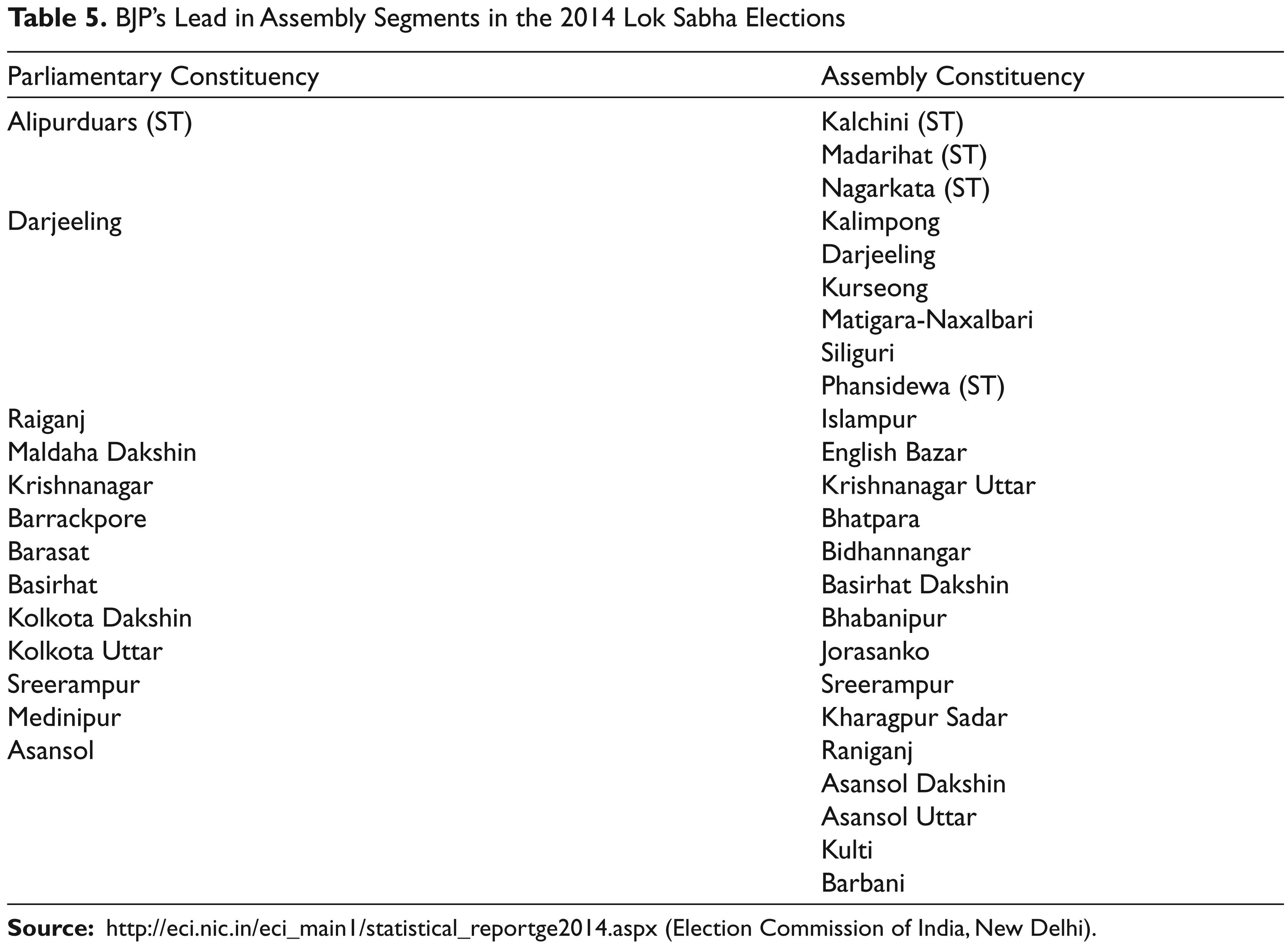
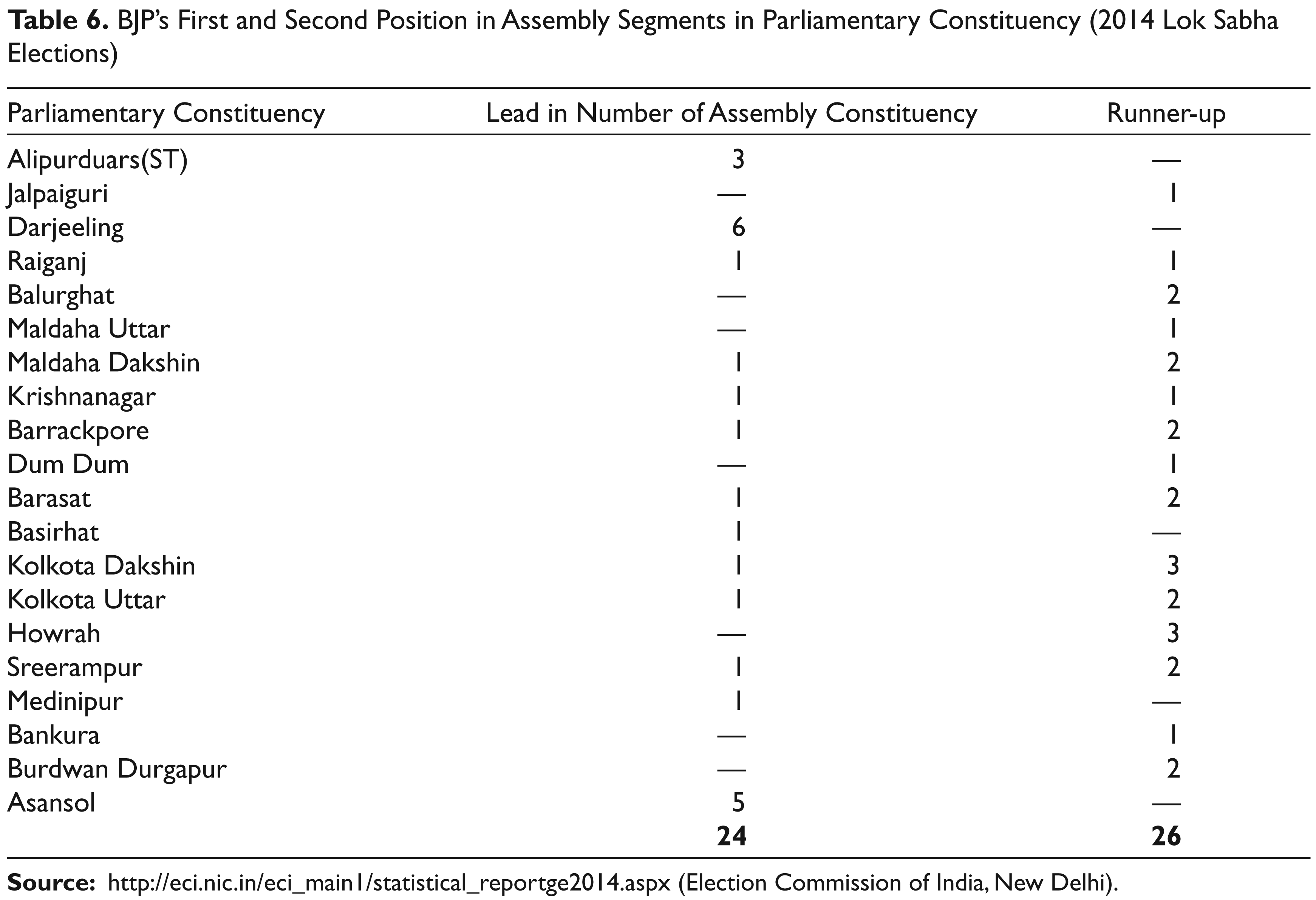
As a result of Modi–Mamata polarization, the BJP, which did not win a single assembly seat in the 2011 elections, has taken a lead in 24 assembly segments and emerged second in 26 others (Table 5 and Table 6). Mamata Banerjee must have got a shock when the BJP got a lead in the Bhowanipore assembly segment, which she represents in the assembly. If the BJP maintains this momentum, the Left does not prevent its erosion and the Trinamool continues to lose its credibility, then the BJP may emerge as a strong contender for power in the 2016 assembly elections.
BJP’s Lead in Assembly Segments in the 2014 Lok Sabha Elections
BJP’s First and Second Position in Assembly Segments in Parliamentary Constituency (2014 Lok Sabha Elections)
Who Voted for the BJP in Bengal?
What was the voting pattern in West Bengal in the 2014 Lok Sabha elections? The following tables (Table 7, 8, 9 and 10) would give an illustration.
As Table 7 shows, 42 per cent of female votes went to Trinamool, followed by 31 per cent to the Left. Though Trinamool has natural advantage of being led by a woman, Mamata has made extra effort by bringing in women to party organization and also nominating women candidates like actress Moon Moon Sen, trade unionist Dola Sen and Kakoli Ghosh Dastidar. 3 The BJP received only 12 per cent of female votes compared to 21 per cent of male votes. Thus, the BJP in Bengal is still a male-centric party and has not made any breakthrough to attract women voters, which may be a serious handicap in its quest for power.
Voting Pattern by Gender

Rural–Urban Voting Pattern

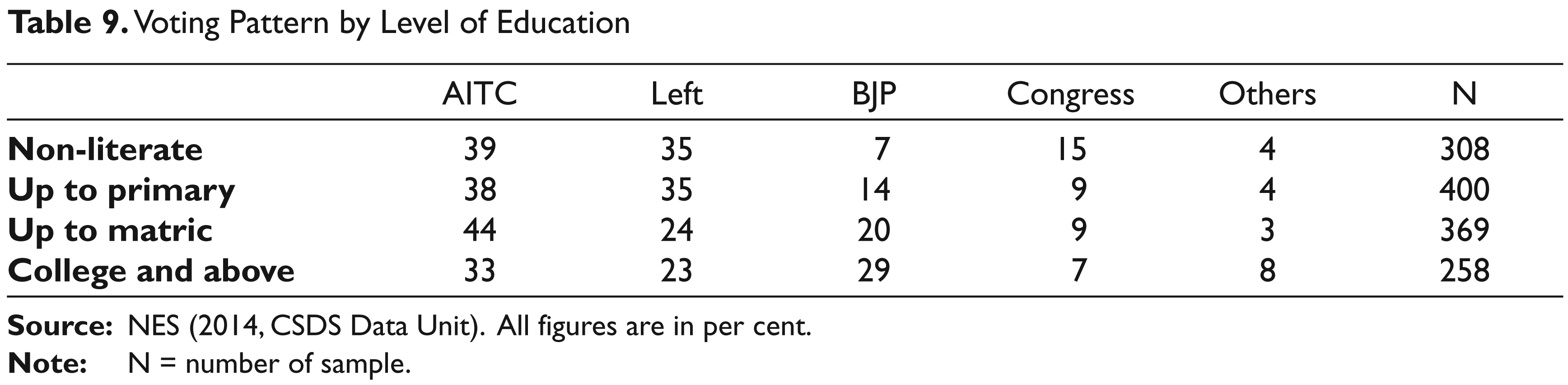
Voting Pattern by Level of Education
Religion-wise Voting Pattern in the 2014 Lok Sabha Elections

Rural Bengal has always been the key to power in state politics. Preference for BJP among the rural voters is a modest 13 per cent compared to Trinamool’s 41 per cent. Once its bastion, Left’s steady erosion of support in rural Bengal is quite alarming as Trinamool beats Left by a 9 per cent margin. In 2011, the Left lost its majority in the assembly because of a significant loss of support in the rural areas among its core support base—the landless and marginal landholders, Scheduled Castes and Scheduled Tribes (Bardhan et al, p. 54). Since then the erosion continues unabated. The BJP gets support from a quarter of the urban voters, marginally ahead of the Left. The BJP shows potential to close in with Trinamool in future by adopting a strategy for the urban electorate.
A large number of non-literate voters (39 per cent) have preferred the TMC, compared to only 7 per cent for the BJP. On the other hand, the BJP gets support at 29 per cent from the category of ‘college and above’, just behind the Trinamool by 4 per cent and ahead of the Left by 6 per cent. The BJP’s support among ‘up to Matric’ is about 20 per cent. Thus, the BJP has attracted an impressive number of educated voters; the Congress has completely lost its grip over this segment.
Interestingly, being a Hindu nationalist party, the BJP gets only 21 of Hindu votes compared to Trinamool’s 40 and Left’s 29. As far as Muslim votes are concerned, Trinamool gets 40 per cent, the Left 31 and the Congress 24; the BJP gets only 2 per cent. Hence, the BJP has not been able to get confidence of Muslims despite Narendra Modi’s call for ‘Sab ka Saath, Sab ka Vikas’. The Muslim preference is clear in the following order: Trinamool, Left and the Congress. Clearly, the Congress is not preferred by Hindu voters, having only 5 per cent Hindu votes.
The Muslim Factor in West Bengal Politics
After partition West Bengal did not offer enough space for community-centric politics. Muslim League faced a natural death as Muslims preferred to integrate with secular political parties rather than having their own political fronts. At the same time, community institutions and organizations survived and remained active in religious, social and educational spheres. As the Ram Janmabhoomi campaign progressed and created a sense of insecurity among Muslims, some Muslim groups and organizations in West Bengal started focussing on community mobilization. Certain radical Islamic groups, local, national and from across the border, who did not find any political space before, became active.
After the Mandal Commission report, the government included many backward castes and occupational groups in the OBC list of the state, but many backward class Muslims were left out. The Sachar Committee report pointed out that in terms of various socio-economic indicators Muslims in West Bengal were lagging behind and their presence in the public and private sector jobs had been dismal. Muslims perceived this as a major failure on part of the Left Front regime. Despite the Left’s commitment to secularism and security of the minorities, it certainly did not do enough for their economic betterment. This perception was the starting point of their alienation from the Left regime. The Left’s attempt at course correction was inadequate and unimaginative. For instance, it did not address the question of the political underrepresentation of Muslim women; out of the Left Front’s 26 women candidates who won 2006 assembly elections, only one was Muslim. This alienation further aggravated with Left’s high-handed land acquisition policy which affected Muslim small peasants.
As Muslim support was slipping, the Left tried to expose the BJP’s anti-Muslim character. During the 2006 assembly elections, CDs showing atrocities on Muslims in the Gujarat riots were distributed. This anti-Hindutva propaganda by the Left (and the Congress) further sharpened the communal divide and also encouraged ‘minority communalism’. In 2007, the All India Muslims Minority Forum (AIMMF) mobilized a large protest demanding cancellation of visa of Taslima Nasreen. In the same vein, 16 Muslim organizations came together in a rally on 30 March 2013 at Kolkata, in protest against the ongoing war crimes trial in Bangladesh, against the Shahbag sit-in and in support of the vice-president of the Jamaat-e-Islami Bangladesh, Delwar Hossain Sayeedi, one of the prime accused in the 1971 genocide in Bangladesh. The All Bengal Minority Council, the All Bengal Minority Youth Federation, the Madrassa Students Union, the Muslim Think Tank and the All Bengal Imam Muazzin Association took part in the rally. People even came from distant districts like Murshidabad and Nadia by bus; students of Madrassas and the new Aliah Madrassa University were also present. The Trinamool government remained silent.
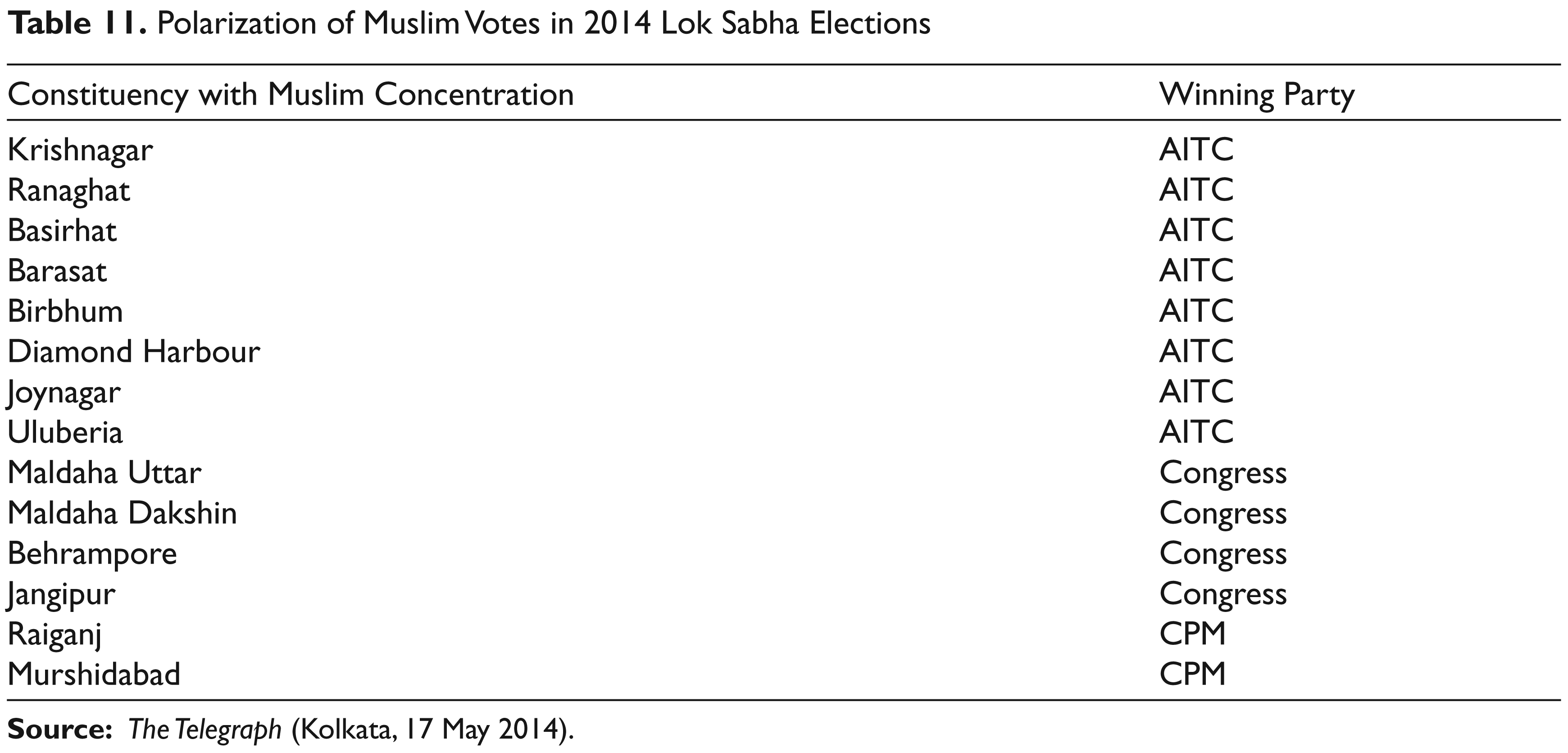
The Narendra Modi factor led to the swing of Muslim votes in the 14 constituencies with high Muslim concentration (Table 11). As Mamata made this election into a referendum on Modi, anti-Modi Muslim voters rallied around her. This strategy polarized Muslim votes in south Bengal and parts of north Bengal enabling her to win 8 of the 14 seats; while the Congress won in 4, the Left could get only 2. Trinamool wrested the Burdwan East, a traditional Left stronghold. These constituencies, which were traditional strongholds of the CPM, saw the shifting of Muslim votes towards Trinamool and the Congress. Muslims went for strategic voting solely on winnability criterion, overlooking ideology and party loyalty. For instance, Muslims supported the Congress in Malda North, Malda South, Behrampore and Jangipur. The Congress lost Raiganj and Murshidabad to CPM as TMC played spoilsport in both these constituencies. For the Congress, strong leadership factor became an additional advantage. Malda had a long legacy of A.B.A. Ghani Khan Choudhury and the Pranab Mukherjee factor swung votes in his son’s favour in Jangipur. Congress strongman Adhir Ranjan Choudhury won Behrampore by a margin of 356,567 votes, which is a record margin in the 2014 Lok Sabha elections in West Bengal. However, another strong leader Deepa Dasmunshi lost to CPM’s Md. Salim by a very narrow margin in Raiganj.
Polarization of Muslim Votes in 2014 Lok Sabha Elections
Besides exploiting the Modi factor, Mamata also ensured Muslim support by offering sops like allowance to Imams, employment and scholarships. The VHP opposed Mamata’s announcement of a monthly honorarium of ₹ 2,500 each for nearly 30,000 Imams. Pravin Togadia accused her of indulging in the politics of Muslim appeasement and warned that this would create communal divide in the state: ‘If the Imams can get the money, what sins have Hindu priests committed? They should also be paid.’ The VHP launched a signature campaign called ‘Amakeo ₹ 2500 Dao’ (‘Give Me ₹ 2,500 Too’) demanding monthly honorariums to Hindu priests and unemployed youth. It also criticized the previous Left Front government’s move to give reservation to Muslims under the OBC category (The Hindu, 2012). Competitive communal politics polarized the electorate further. While Mamata got the maximum advantage of this polarization, the Left became the major casualty, and the BJP definitely benefitted as pro-Hindutva, pro-Modi and anti-Mamata votes got consolidated behind the party.
Caste in the 2014 Bengal Elections
For long, caste discourse was either absent or suppressed in West Bengal under the hegemony of class-based discourses. Complete dominance of the political was the rule of the game. The Left Front rule, by introducing land reforms and democratic decentralization had changed rural West Bengal so significantly that ‘political parties in rural West Bengal largely transcend caste, religion and ethnicity based organizations which have some relevance in other parts of the country’ (Bhattacharya, 2009, p. 59). Partha Chatterjee observes that as a political consequence of the Partition of Bengal in 1947, the state experienced the continued and unchallenged dominance of upper-caste Hindus in virtually every public institution, whether political or cultural (Chatterjee, 2012, p. 69; Samadar, 2013). This pattern not only continued under the Left Front rule, it still continues under the present Trinamool regime. Interestingly, caste in the state was never polarized; both the Left and the Congress had representation of every major caste groups in their parties. While immigrant Hindu Scheduled Castes were more concerned with citizenship rights, a substantial section of Dalits started drifting towards the Left since the early 1980s. Whereas the post-Mandal era encouraged incipient backward caste politics, the post-Sachar period saw mobilization of backward-class Muslims.
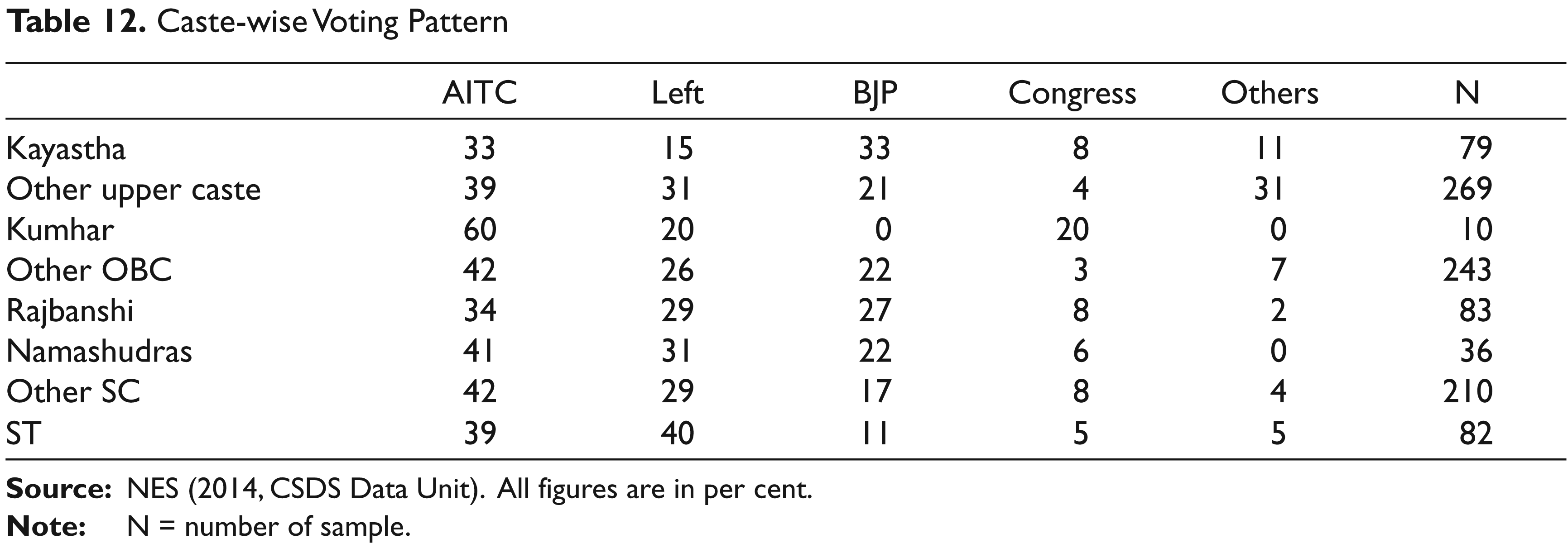
As Table 12 shows, the Trinamool and the BJP have got 33 per cent each from the upper-caste Kayasthas. Among ‘other upper castes’ category, the Trinamool’s vote share is 39 per cent compared to BJP’s 21 per cent. It is seen that the BJP has been closely competing with the Left for support from ‘other OBC’ and Rajabanshis. Significantly, the BJP has established a fair support base among the Rajabanshis and Namasudras, the two communities constituting more than 35 per cent of the SC population in West Bengal.
Caste-wise Voting Pattern
The BJP has been working among different castes and communities in rural and urban areas. One of such communities is the Namasudras (Bandyopadhyay, 1997), who migrated mainly from Bakarganj and Faridpur districts of East Bengal. The Matuas, a dominant sect of the Namasudras, under the leadership of P.R. Thakur, supported partition of Bengal. On the contrary, Jogendranath Mandal, another powerful Namasudra leader and a follower of Ambedkar, was an ally of the Muslim League and was opposed to partition. After partition a large number of Namasudras came to West Bengal as immigrants and were largely settled in Nadia and 24 Parganas. As the community was primarily engaged with the issues of rehabilitation and settlement, they primarily focused on their material prosperity. Though their political loyalty was divided between the Left and the Congress, their community organization strategically avoided any political affiliation.
Recognizing the community’s political importance, Mamata approached Baroma (P.R. Thakur’s wife), offered a party ticket to her son and made him a minister. On the other side, the BJP has made inroads into the Matua Mahasangha and made K.D. Biswas, its general secretary, as the party candidate from Bongaon constituency in the 2014 Lok Sabha elections (Sinharay, 2014). Modi, in his Krishnagar meeting, assured the Matuas that he would personally hear their problems regarding citizenship issues. Though there are clear signs of politicization of caste identities in West Bengal, they still remain under the dominance of the political.
What Happens to Class Politics?
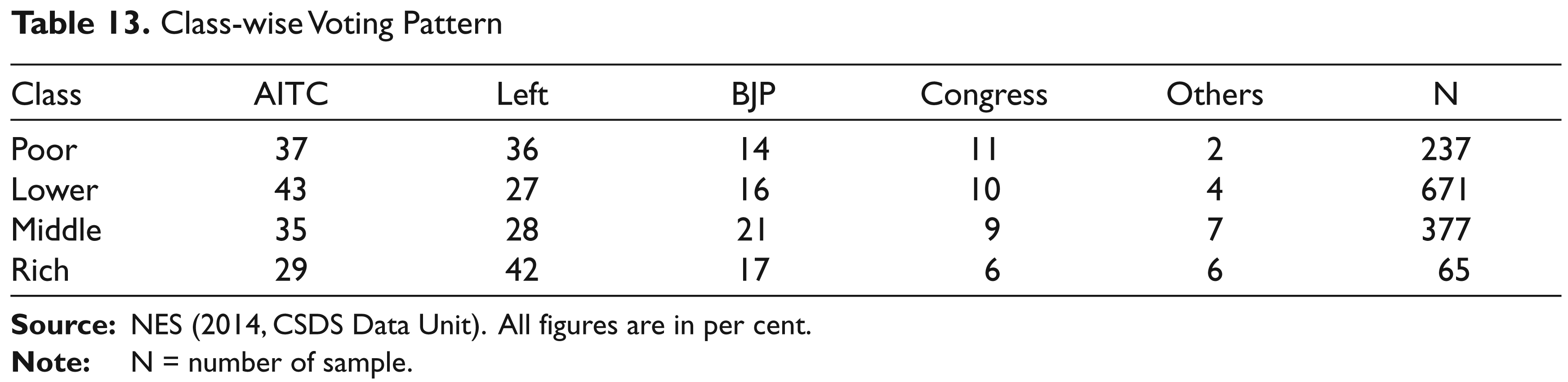
The Left ruled Bengal in the name of class for decades. What does the 2014 outcome suggest vis-à-vis class? Though BJP’s class-based support is more or less evenly spread among all categories, it has got less support from the poor and lower-class voters. As much as 36 per cent poor voted for Trinamool, 36 per cent for Left, and only 14 per cent for BJP. It is an irony that though the Left is perceived as pro-poor and the BJP pro-rich, 42 per cent rich voted for the Left, in contrast to only 17 per cent for the BJP. Trinamool has got a substantial support (43 per cent) from lower-class voters, and the Left and the BJP have received 26 per cent and 15 per cent, respectively. Clearly, while the Left has been losing its grip over its poor and lower-class support base, the TMC has consolidated its hold among those classes. Singur and Nandigram were ominous signals for the Left and since then a section of its support base among the poor and the lower class has started shifting its loyalty to the TMC. Table 13 shows that maximum middle-class respondents have voted for Trinamool (35 per cent); the Left and the BJP get 28 per cent and 21 per cent, respectively. This distribution suggests that the BJP has got a good middle-class support and the Left is struggling to retain its hold over this constituency.
Class-wise Voting Pattern
Left Becomes Vulnerable
The 2011 assembly elections ended the era of the Left rule in West Bengal after 34 years. Surprisingly, the fall was quick and catastrophic. From winning 233 out of 294 seats in the 2006, the CPM’s tally was reduced to a mere 62 seats in 2011. On the other hand, Trinamool had an unprecedented rise, from mere 31 seats in 2006 to 184 seats in 2011. Most of the Left stalwarts were defeated, including Chief Minister Buddhadev Bhattacharya, by a huge margin. Thus, the CPM, once an invincible party, became vulnerable. The 2014 Lok Sabha results shows no sign of recovery; the CPI(M) has lost 10 per cent of votes between the 2009 and the present Lok Sabha elections and its seats have been reduced from 9 to 2. Left Front’s class politics has taken a hard drubbing though new forms of class politics are evolving. The BJP, being traditionally inimical to class politics, has started reconfiguring its political agenda addressing class issues in the overall rubric of Hindutva.
The Post-Lok Sabha Bengal: Sangh Parivar’s Strategy
The unprecedented surge of the BJP in the 2014 Lok Sabha elections and the party’s huge leap in West Bengal has charged the Sangh Parivar to launch an ambitious and aggressive agenda to capture West Bengal. This is further buttressed by demoralization of the Left and its failure to counter Trinamool’s onslaught expediting exodus of thousands of its cadre to join the BJP perceiving it as their saviour.
On the day the Lok Sabha elections results were out, the RSS Chief Mohan Bhagwat arrived in Kolkata to address a 20-day camp focusing on the expansion of the Sangh activities. This obviously signalled how West Bengal is in the priority list of the RSS. There has been a rapid growth of the RSS in West Bengal in recent years. In areas where it was virtually nonexistent, ‘shakhas’ have started and the weekly ‘sammelans’ are organized. As reported, the number of shakhas in West Bengal has increased from 820 in March 2013 to 1,010 by March 2014 and some 100 ‘exposure’ camps have been organized to educate people about the Sangh (Bhattacharya, 2014).
Primarily focusing on OBCs, SCs and STs, the Sangh Parivar campaigns against the Left and the Trinamool, accusing them of pursuing minority appeasement policies that led to the plight of these communities. It also observes that Hindu OBCs are made to suffer due to the inclusion of 90 per cent Muslims within the OBC category; it finds the Bangladeshi influx as the root cause of socio-economic backwardness of SCs, STs and OBCs. The RSS expansion is very much visible in the SC, ST and OBC-dominated areas of South and North 24 Parganas, Nadia, Murshidabad, Bankura, West and East Midnapore and the rural Howrah. The RSS has also appointed competent swayamsevaks from these communities as important office-bearers of the Sangh. A large section of its local leadership now comes from the backward castes.
As the BJP has been emerging as the main opposition in the state, Trinamool’s violence now targets the Sangh Parivar. Post-election attacks on the Parivar compelled the RSS to take an unusual step. The RSS organized its first public meeting in West Bengal in ‘several decades’. The Baruipur meeting in South 24 Paraganas was attended by nearly 4,000 Sangh activists. The BJP also sent a fact-finding team from the centre. This show of strength makes clear that the Sangh Parivar, with its government at the centre, would not take such attacks lying down. The other objective was to assure the Left cadre that the Parivar will protect them if they join the BJP (The Hindu, 8 August 2014).
The VHP, which had established its presence during the Ayodhya Movement, has 65,000 members/well-wishers (hitachintaks); each pays an annual membership fee of 20 rupees and the membership is renewed every year. The VHP remains in regular touch with these members by organizing regular baithaks (meetings), chintan shibirs and other programmes. By the end of 2014, the VHP plans to achieve the target of 1 lakh hitachintaks by undertaking vigorous membership drive.
A ultra-Hindu group, the Hindu Sahmati, has emerged in West Bengal, talking of Hindu resistance and spreading hard-line anti-Muslim message. On 16 August, it celebrated the centenary year of Gopal Chandra Mukherjee, who ‘saved’ many Hindu families during the ‘Great Calcutta Killings’ of 1946. The day was symbolic and the figure was reportedly divisive. But for Sahmati, he was not ‘divisive’ but a ‘patriot and a nationalist’; ‘Mukherjee acted as a deterrent against the slaughter of Hindus on this day, 68 years ago’ (The Hindu, 18 August 2014). Hindu Sahmati renames Mamata Banerjee as Mumtaz Bano Arzee and accuses her of Trinamool’s connection with Jamaat-e-Islami Bangladesh. Hindu Sahmati organized a pro-Israel rally at Kolkota in August 2014.
The BJP, which was struggling hard to cross 1 lakh membership in 2010, increased its total membership to 3 lakh in 2011 to more than 7 lakh in 2013. Two lakh new members have enrolled in the last six months, which party leaders have attributed to Modi’s charisma. The ABVP, youth wing of the Parivar, too has witnessed a surge in its membership with the enrolment of 45,000 new activists in the last one year. Even the BJP’s minority and women’s wings too witnessed a surge in membership (The Times of India, 27 January 2014).
Curiously, the BJP claims that Muslim membership in the party has seen an unprecedented growth in the state. As of 20 June, 12.38 per cent (60,172 people) of new members of the party have been Muslims (The Hindu, 6 August 2014). It appears intriguing how the Parivar reconciles its anti-Muslim stance with the entry of a large number of Muslims into the BJP. As Muslims constitute roughly 42 per cent in 140 of the 341 development blocks in West Bengal and have 30 per cent of the vote share, the BJP certainly has to engage with them if it wants to rule Bengal. However, while opening the party for Muslims, the BJP assures its traditional constituency that it would never adopt ‘minority appeasement’ policy and would eventually build a ‘nationalist’ Muslim constituency.
The BJP’s Muslim policy is driven by pragmatism as Muslims and Hindus are leaving the Left Front in many districts to join the BJP as Left leaders fail to guarantee security. Hence, though it remains flexible in bringing Muslims to the party fold, at the same time it would like to be strict in monitoring and controlling their entry. The BJP is also taking advantage of the contradiction between the Urdu-speaking Muslims of Kolkota and the Bengali-speaking Muslims outside Kolkota. While the former is more aligned with Trinamool, the latter, being not favourably disposed towards the former, looks at the BJP as a potential political party that may give them political space and economic patronage.
Conclusion
The journey of the BJP in West Bengal since the Jana Sangh days has seen many ups and downs. But in 2014, the BJP crossed the threshold it was waiting for long; looking at the objective political situation in the state, it is very likely for the BJP to grow further. Many factors have enabled the BJP to reach this critical point: Hindutva’s regional legacy, partition of Bengal and communal riots, Sangh Parivar’s perseverance, Ayodhya campaign, plunge into local politics, smart political alliance with the TMC, erosion of Left, communal polarization, cross-border terrorism, the Modi magic and Mamata’s mistakes. The battle lines are drawn for a show of strength in the 2016 assembly elections, and may be even before, in the 2015 municipal elections. The trailer was the by-poll for the two assembly seats soon after the 2014 Lok Sabha elections; both Trinamool and the BJP won one each. Shamic Bhattacharya’s win from Basirhat (South) despite the Trinamool’s hard efforts became a big morale booster for the BJP. Bengal’s political battle has taken an interesting turn as an upbeat buoyant BJP, after winning Maharashtra and Jharkhand, has adopted an aggressive political strategy in West Bengal. Modi’s Man Friday Amit Shah stormed Calcutta in last December accusing Mamata Banerjee of ‘shielding the Saradha scamsters and harbouring terrorists’, and taking vow to uproot Trinamool from Bengal. Mamata is certainly at the back foot at the moment as New Delhi has initiated a systematic move to cage her. Modi has made a smart move by inducting the popular singer and young MP Babul Supriyo into his cabinet and he may rope in cricket star Saurav Ganguli to make an interesting ‘Didi’ versus ‘Dada’ battle in Bengal. Despite the fact that Modi has great penchant for pulling out surprises from his pack and has been using this tactic quite successfully so far, the BJP has to go long miles far beyond the rhetoric of ‘Bhag M Bhag’ and ‘Trinamool Mukt Bengal’ to win Bengal as Mamata is a grassroots leader and street fighter, and the Left is still alive!