



Abstract
This article explores different types of emotion a student experiences as she interns at a public defender’s office and proposes severalemotion rulesbased on her experience. After a literature review that locates emotions within the identity-construction process, the author analyzes data from reflective questionnaires to identify various emotions this student experienced that serve as a basis for inductively formulating the rules. Following a discussion of the rules, the article concludes with implications of this research for educators and newcomers to workplace communication environments.
Keywords
Identity development is a complex process, especially when transitioning from academic to workplace environments. Studying this transition process is especially important for business communication scholars and educators, since helping newcomers adjust and succeed in workplace communication fosters these newcomers and increases the likelihood of their success. While many studies have been very specific in their focus on newcomers’ developing identities in particular fields, the discipline of business and professional communication is unique in that it is multidisciplinary. Students majoring in this field and completing internships within it could be exposed to a variety of different workplaces, from nonprofit organizations, to the legal field, to marketing, to digital communication. As a result, students in business and professional communication begin internships with possibly more ambiguity about exactly who they are as communicators and as professionals.
Contributing to these feelings of ambiguity and uncertainty for these newcomers is the presence ofemotion ruleswithin organizations. While these are tacit and will not appear within any new employee handbook, newcomers can sense, intuit, and learn to imitate them, but this process takes time. Through the qualitative, case study approach, researchers can demystify the process of learning emotion rules and identify general patterns as well as specific stories that can help students in this interdisciplinary field transition to workplace communication environments with less ambiguity. Preparing students for this transition increases their awareness, discussion, and knowledge of emotion rules and ways they are connected to emotion in the workplace. As a result, students are better prepared to construct their own professional identities. This article focuses on the centrality of emotions and emotion rules to the identity-construction process of a student intern in a law office and provides implications for helping students transition to the emotional dimension of communicating at work.
After presenting a literature review on agency, emotion, and identity within organization studies, I outline research questions and methodology for a case study conducted in the summer of 2015, focusing on a student intern in a public defender’s office. Emotions play a key part in the intern’s identity-construction process, as revealed in her self-narratives and as detailed in the discussion of the case study, in which I identify several emotion rules this student learns. I conclude with implications this study has for workplace and academic audiences.
Literature Review
Because emotions are a key component of individual identity, I begin with a review of agency and emotions within the context of identity construction. Part of the process of developing personalized emotion rules within an organization is identifying and taking personal ownership of emotions. This is an active, rather than a passive, process that includes negotiating agency. Significantly, it is important to note that while newcomers’ identities are being socially constructed through various disciplinary workplace environments (Baehr, 2015;Hammond, Cross, & Moore, 2016;Hochschild, 2012;Noble et al., 2014;Pierce, 1995;Tracy, 2000), these disciplinary newcomers navigate agency as they simultaneously attempt to make meaning while developing newselves, as difficult as those are to define. The concept of agency is key within thepersonal meaning making, psychological strand of identity construction within organization studies (Dutton, Roberts, & Bednar, 2010;Hammond et al., 2016;Kira & Balkin, 2014;Martínez, 2012;Pratt, Rockmann, & Kaufmann, 2006); this view highlights the ways employees gain agency through making meaning using the discourses surrounding them at work. As a result of this agency, employees can participate in the development of their own identities, based on specific workplace experiences (Kira & Balkin, 2014). The personal meaning-making process allows participants to make decisions, including the consideration of the emotions surrounding those decisions. For example, in the case study that follows, the intern makes a personal decision to put aside emotions when she puts on her business suit and enters the courtroom. For the intern, the ability to manage and control her emotions is essential to her identity as a future lawyer. Being allowed to make such a decision contributes to the personal meaning-making process this intern constructs for herself as she creates her own identity as a professional, including the emotion rules that go along with it. This identity is one that she internalizes as personally meaningful for her, but it is also a very public identity that she uses to accomplish social action through her participation in the courtroom. Emotions and agency are essential to the identity-construction process, since experiencing emotions motivates employees to act. When employees do act based on emotions, their resulting agency mediates the social and cultural processes in place within the workplace environment (Martínez, 2012), facilitating employees’ identity-construction processes and participation within the culture surrounding them. Connecting emotions to agency as part of the process of mediating social action acknowledges the crucial, powerful role of emotions within the identity-construction process as an important motivating source of that action.
While emotions allow employees to acquire and negotiate agency, emotions are also socially constructed, influenced by the sociocultural environment of the workplace (Hargreaves, 2000;Martínez, 2012). A related concept isidentity work(Alvesson & Willmott, 1996,2002;Snow & Anderson, 1987), which Weigert said “entails both a cognitive and emotional dimension” (as cited inKivisto & La Vecchia-Mikkola, 2015, p. 91). Clarifying the nature of identity work,Kivisto and La Vecchia-Mikkola (2015)wrote that identity work and emotion management can become routine, almost invisible, when employees are performing workplace activities out of habit. But when preexisting identities are being challenged in some way, such as when newcomers unfamiliar with a workplace context enter it, the work becomes much more obvious (Kivisto & La Vecchia-Mikkola, 2015). Because interns enter workplaces often with no organization-specific identity or knowledge of that organization’s emotion rules, their identity development processes, including ways they navigate emotion management, are especially visible.
For new employees or those adjusting to new workplace roles, participating actively in developing or changing identity can also have a pronounced emotional impact, in addition to the emotions they may already be experiencing within a new environment. WithinChickering and Reisser’s (1993)seven vectors of development, the second vector is managing emotions. In a discussion of Chickering and Reisser’s work,Jones and Abes (2013)stated that tasks in earlier vectors must be accomplished and learned before addressing tasks in later vectors. Since the fifth vector isestablishing identity, employees, for example, must address emotions before fully being able to establish an identity (Jones & Abes, 2013). Managing emotion is a crucial part of this process. In fact, managing emotions is second only on Chickering and Reisser’s scale todeveloping competence(Jones & Abes, 2013). Jones and Abes focused on identity development in college students and acknowledged the social construction of identity, as well as the fact that different groups, such as women and those from different races or cultures, may experience this identity-construction process differently, including the ways emotions are managed. The process of managing emotions while constructing identity is a complicated, recursive process. Once novices develop skills, they move on to higher development vectors, only to return to more primary vectors to reconcile newly developed skills with the knowledge gained from earlier vectors.
This connection between emotion and identity change supports the complexity and importance of emotions to developing identities. At first, employees respond to workplace environments with whatKira and Balkin (2014)have calledpreferred identities, which include emotions and acts of agency. Over time, these identities can change to some degree or become more established, based on ways employees are navigating the discursive workplace environment and responding to it (Kira & Balkin, 2014). Indeed, emotions shape how employees view their entire workplace, by defining relationships with others, the workplace environment and all it contains, and even workplace activities (Langlotz & Locher, 2013). Because these emotions are socially constructed and affected by the relationships and activities around us, they are reflected in the language we use to refer to them and describe them. As such, looking at the actual language we use when discussing emotions reveals much about them; we develop emotion words that we use to identify our own feelings and reveal them through dialogue with others, feelings that are constantly changing, depending on the networks of people, places, and events with whom we are interacting (Langlotz & Locher, 2013). For example, a newcomer to a workplace might communicate feelings ofanxietywhen beginning a new job because he or she may not know the people within that workplace. Over time, anxiety may take on a different meaning; even though the newcomer has developed successful relationships overall, those relationship networks may hinder or contribute to progress in achieving workplace goals or tasks, producing another type of anxiety, as defined by this individual. While some argue that these interpersonal networks are a primary source for emotions (Langlotz & Locher, 2013), emotions are not only influenced by emotion words spoken or written by others; they also are revealed in important ways through participants’ own words, their narratives, as they present their identity-construction experiences. While such narratives are limited by the perspective of the participant and the timing (these narratives may not indicate a big picture view of experience), they do represent a snapshot of what the participant was thinking and feeling about certain events at a particular moment in time, even though we cannot take the presentation of emotions as a direct construction of reality (Bamberg, 1997).
One very specific way newcomers develop their identities within organizations and make sense of their emotions through words during this process is through learning emotion rules orfeeling rules(Hochschild, 2012;Tracy, 2000;Zembylas, 2005). Some scholars refer to similar concepts using other terms, such asemotional qualities(Cronin, 2014),emotional capital(Holt, Bowlby, & Lea, 2013; embodied social, emotional capital also relates to the concept ofhabitus[Bourdieu & Passeron, 1979]), as well as the concept ofculture-specific emotions, the idea that emotions are embedded in and specific to culture (Langlotz & Locher, 2013).Hochschild (2012)defined feeling rules as “what guide emotion work by establishing the sense of entitlement or obligation that governs emotional exchanges” (p. 56). We recognize these rules by paying attention to our own feelings, based on what we are experiencing, observing how other people respond to our acts related to emotions, and responding to the sanctions originating from ourselves and others regarding emotion acts. Related but somewhat opposed to the concept of emotion rules isemotional intelligence, a concept that emphasizes the individual’s learning and mastery of key emotional competencies (Boler, 1999;Goleman, 1995,1998;Hargreaves, 2000). While the concept of emotional intelligence has gained importance as a soft skill business communicators should have (Fall, Kelly, MacDonald, Primm, & Holmes, 2013;Sigmar, Hynes, & Hill, 2012), we also need to continue acknowledging that the ways emotions are expressed in the workplace are socially constructed and controlled, discursively managed by power structures (Zembylas, 2005), and historically and culturally influenced (Foucault, 1977).
This article helps mediate the dichotomy of emotional intelligence and emotion rules by exploring ways a participant uses her own agency and emotional intelligence to learn emotion rules in ways she finds not only personally gratifying but critical to her identity development as a professional. Even though the idea of emotional intelligence has become popular in business settings as employees learn how to interact better with others, the concept focuses primarily on the individual, rather than on the social constructive, sociocultural aspects of communication that necessarily involve others; hence, the development of emotion rules others must abide by in order to be successful communicators. Also, in many business fields and others, a focus ontechnical rationalism(O’Connor, 2008) exists, which causes participants to highlight the scientific and technical aspects of professional fields, sometimes to the detriment of learning emotional awareness, emotion management, and emotion rules that are also crucial for professional success. This work draws attention to the need for such knowledge that goes beyond the technical specificities of our disciplines. In addition, this work extends and affirmsTracy and Trethewey’s (2005)concept of the poststructuralist, crystallized self with its emphasis on continued growth and agency; because of the focus on the process of learning emotion rules, the individual is not merely growing in emotional intelligence but is instead interacting with the workplace environment and others. This case study and discussion also answerKira and Balkin’s (2014)call for managers and organizations to support employees by helping them find what they termpersonally meaningful work; such an environment is essential to grow and be successful, rather than stagnate.Kira and Balkin (2014)proposed that additional research could explore “how well-being is shaped in the tensions between social identity regulation and identity work” (p. 140). The concept of well-being includes the ability to learn, intuit, and apply emotion rules for the workplace. As this case study explores, a student uses her own agency to discover her own personal emotions at work and learn emotion rules during her internship, thereby contributing to a growing professional identity for herself as a participant within a law office.
Research Study
In order to learn more about this student intern’s personal meaning-making process of managing emotions within a law office, I chose two questions to research for the case study: one focused on the specific emotions the student experienced and the other sought to identify the emotion rules the student learned. The two questions, therefore, were somewhat related in that the identified emotions led to the development of the emotion rules.
Research questions for this study included the following:
Focusing the study on these questions yielded reflective responses that explore emotions as part of the identity-construction process and experience in business and professional communication. The internship experience provided an opportunity to examine the development of emotions and identity in a unique environment, since the intern studied was a traditional-aged college student who spent most of her time in school and had limited experience with full-time work in her chosen workplace, a law office. The internship environment allowed for exploration of the interface between the academic and workplace settings; this particular student had received academic training in business and professional communication that would prepare her for working in a law office (such as the need to address audience, purpose, ethics, design strategies, persuasion, and general effective team communication), yet she was totally inexperienced in actually applying what she had learned in practice.
Methodology and Case Study Participant
This study applies grounded theory and an interpretive approach to analyzing self-reflective narratives. The narrative strategy has proven useful for researchers studying students transitioning from academic to workplace environments; scholars such asNoble et al. (2014)stated that having students create narratives provides opportunities for reflection, which can help them as their new workplace identities form. Grounded theory (Glaser & Strauss, 1967;MacNealy, 1999;Strauss, 1987) and the interpretive approach (Heracleous & Barrett, 2001;Kuhn, 2006;Kvale, 1996) complement case study research, which is a standard research method in business and professional communication. Additionally,MacNealy (1999)indicated the prevalence and importance of case study research in the field of technical communication, since this type of research contributes information on the inner workings of workplace writing and communication. Three relevant examples within the field of business communication areAlvesson and Willmott’s (2002)“Identity Regulation as Organizational Control: Producing the Appropriate Individual”;Nguyen, Murphy, and Chang’s (2014)“The Construction of Social Identity in Newly Recruited Nuclear Engineering Staff: A Longitudinal Study”; andDulek’s (2015)“Instituting Cultural Change at a Major Organization: A Case Study”; as my research indicates as well, the case study approach provides an opportunity to study a rich amount of information and its context that might be limited by quantitative analysis alone.
The subject of this case study, referred to by the pseudonym Morgan, worked in a public defender’s office within the state of Tennessee for 180 hours in the summer of 2015. After Morgan consented to participate in the study, I emailed her three questionnaires at regular intervals throughout the summer and required that they be returned by certain dates so that I could study how her perceived emotions and identity were changing during her work. I started with very basic questions, and then I provided more in-depth questions that addressed developing themes from the previous questionnaire(s). To stay true to the grounded theory approach, I allowed “concepts derived from initial analysis [to] guide collection of subsequent data” (Corbin & Strauss, 2015, p. 15). For example, the first questionnaire contained questions and prompts such as “What types of communication are you participating in during the internship?” and “Please describe certain affective and emotional contexts that are associated with these various types of communication, based on your current knowledge.” Another general question I asked was “As an intern, what are some words you would use to describe yourself as a newcomer to this workplace?” Morgan would respond to these questions with specific words and experiences; the resulting data are based on her self-characterized identity in this environment, as well as the descriptions of emotional responses she narrated. Following the identification of emotions Morgan experienced, I inductively created the emotion rules, based on subcategories determined from the data.
Justification for the Research Approach
Specifically, the grounded theory, interpretive approach lent itself to analyzing the questionnaires by allowing me to do the following as a researcher:
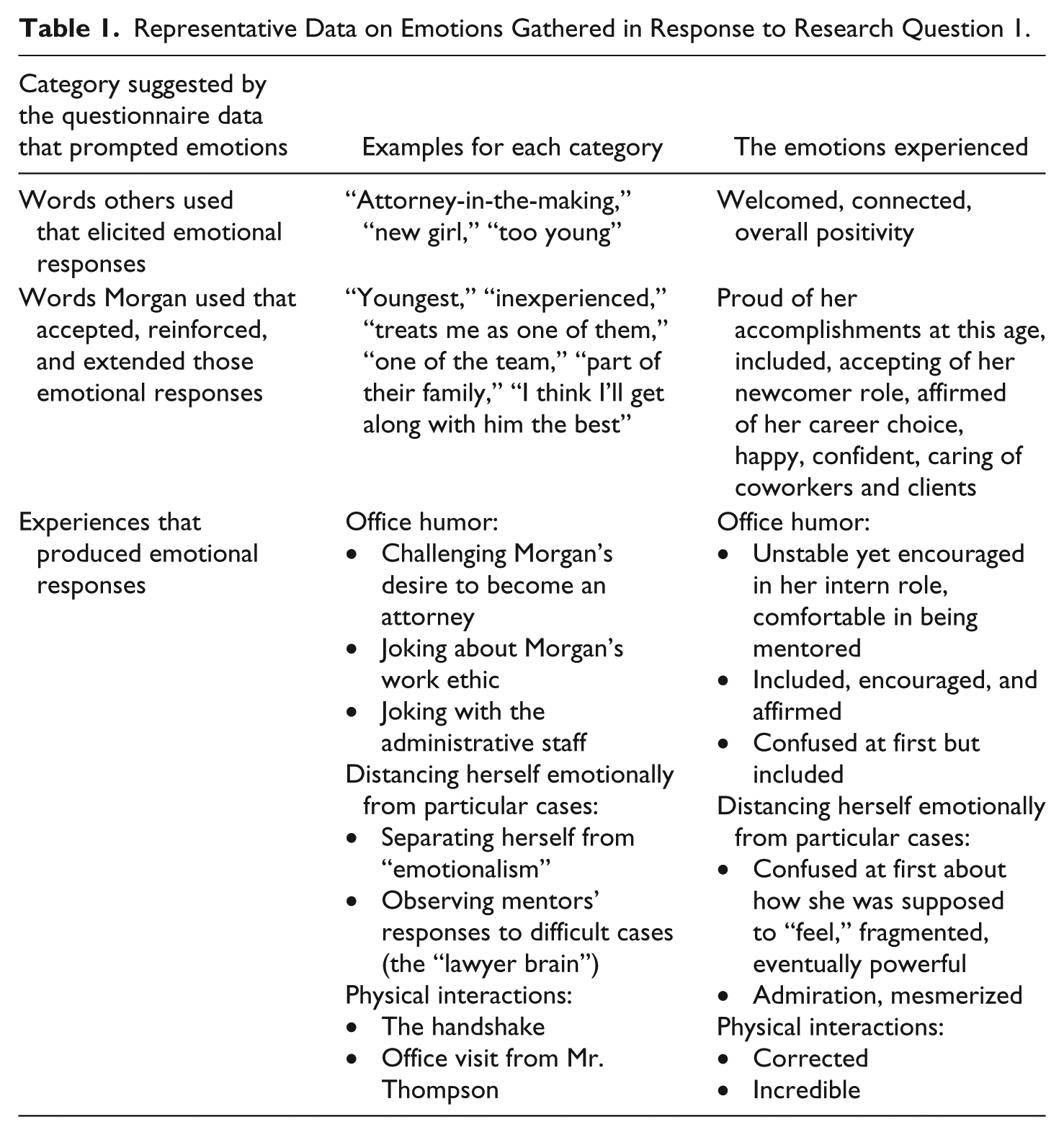
Discuss emotion that was grounded in the intern’s experiences and words (seeTable 1).
Provide a voice for the intern to discuss what she experienced, rather than have myself impose a framework on her experiences in advance.
Facilitate the development of categories, based on repetitive or significant topics identified or illustrated by the intern, to build on or request more information about in future questionnaires.
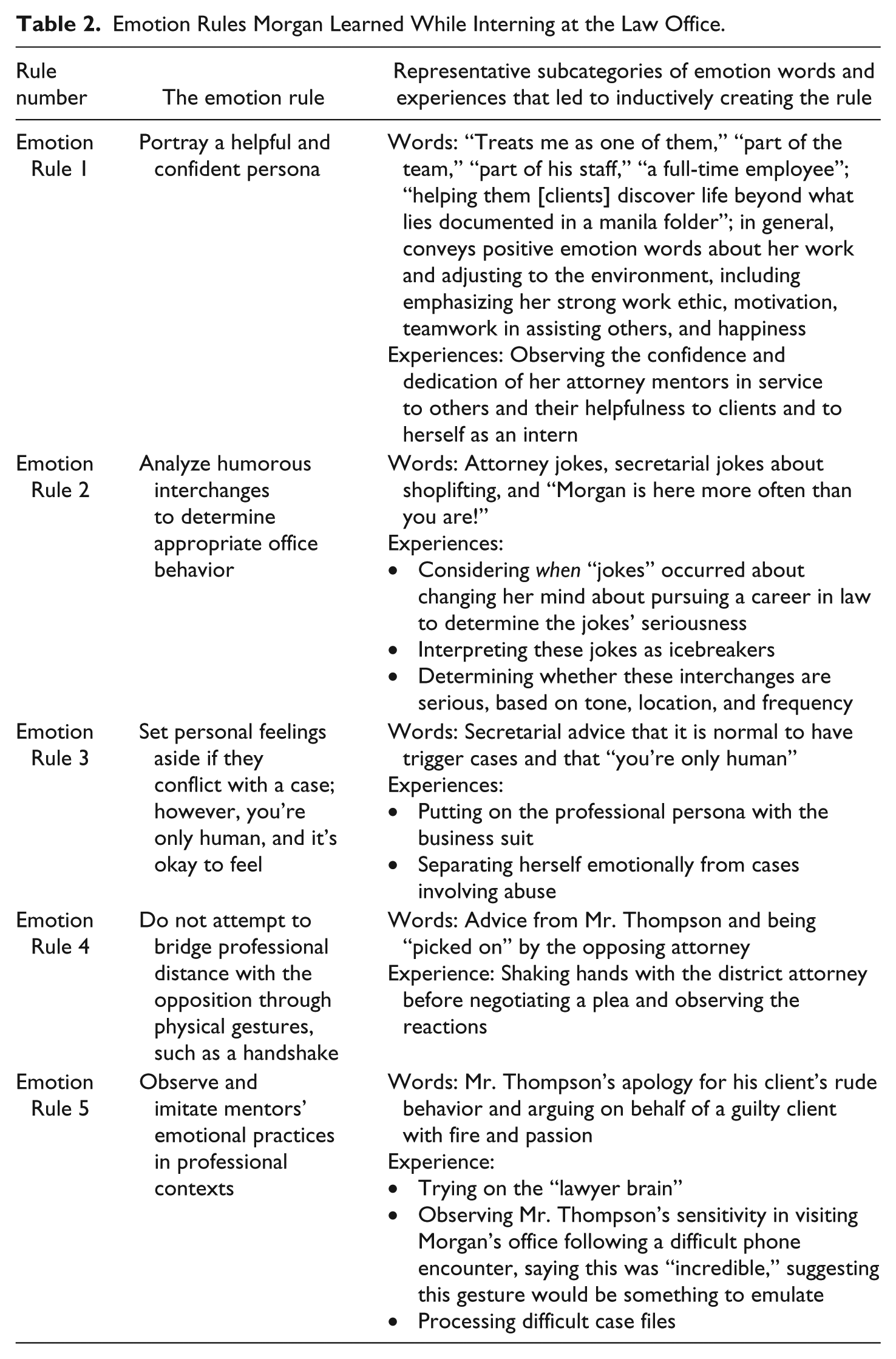
Transfer data gained from general questionnaire themes and categories and apply them to the development of additional subcategories that eventually led to the development of the emotion rules (seeTable 2).
Create connection points from the emotions Morgan identified (Research Question 1) to the rules that I inductively suggested (in response to Research Question 2).
Representative Data on Emotions Gathered in Response to Research Question 1.
Emotion Rules Morgan Learned While Interning at the Law Office.
Because the questionnaire responses contained specific emotion words and detailed experiences, based on my questions, I looked for ways the emotion words and experiences described similar emotions (such as words and experiences resulting in Morgan feeling included at the law office) and used those associations to build the categories (seeTable 1). As I analyzed the data, I associated common experiences with a broadly defined rule that could begin to help explain the strategies she used to navigate the emotional ambiguity she experienced at times, going back and forth between the data and emerging rule to determine what connections could be made. While the grounded theory approach provided the flexibility in identifying emotions Morgan described without any predetermined definitions, coaching, or expectations from me as the researcher, the interpretive approach allowed me to inductively identify these emotion rules that Morgan learned.
A complicating factor to this type of study involving a student intern is that students may not be able to adequately reflect on their own experiences during this process (Jones & Abes, 2013). While this type of contact zone between academic and workplace settings provides rich opportunities for research,Jones and Abes (2013)discussed that for traditional-aged college students, the process of making meaning is an external one, focusing on events, activities, and the general environment surrounding them. Drawing on the work ofBaxter Magolda (2001,2009),Jones and Abes (2013)clarified that when operating within this meaning-making structure, students at this stage are defining their identity based on external elements, such as “social norms and campus climate” (p. 100). These students’ internal belief systems are still developing, therefore, and the students (interns) may not be cognitively able to critique the external systems of belief around them using enough sophistication to develop their own internal meaning-making systems.
Through this case study, however, I wanted to hear the student’s voice during this reflection process, representing the student’s experienceat this time; I did not want to risk appropriating the student’s voice, especially because this process necessarily involved varying discourses of power and control. Another caution presented byCronin (2014)is that studying communication about emotions does not reveal their full complexity; the communication might be too far removed from the actual emotional experience. However, Cronin also stated that this talk reveals important information about the ways emotions function in relationships, since that type of communication is reflective. The reflective questionnaires, while limited in scope (Urzúa & Vásquez, 2008), can contribute useful insights about this intern’s perspectives in the moment. Another objection to this type of narrative and reflective case study research is that participants may not be able to reflect fully on tacit knowledge and may therefore not be able to articulate it; however, these reflections do provide employees with insight into their own experiences (Kira & Balkin, 2014) that they may not have recognized before, and they may become more productive and aware employees as a result.
Results and Discussion
The questionnaires yielded data that addressed both research questions. The research questions are discussed below, and the data are summarized inTables 1and2.
Research Question 1
Table 1presents an overview of the types of data gathered in response to the question “What are the emotions a student intern experiences when attempting to transition to an unfamiliar workplace environment?” The data are grouped into the categories of “words others used that elicited emotional responses,” “words Morgan used that accepted, reinforced, and extended those emotional responses,” and “experiences that produced emotional responses”; this last major category contains three subcategories of examples: office humor, distancing herself emotionally from particular cases, and physical interactions.
Words Others Used That Elicited Emotional Responses
At the beginning of her internship, Morgan indicated that the lawyers and staff in the office referred to her by several terms: “attorney-in-the-making,” “new girl,” and “too young.” She writes, “Only one day on the job, and I’ve been called ‘attorney-in-the-making’ and ‘new girl.’” She added, “The investigator actually commented ‘that I’m probably too young to be working for the government already’ before finding out I was an intern.” While the first term (attorney-in-the-making) sounds positive regarding Morgan’s developing identity as a future attorney, the other terms could be seen as condescending and could have negatively affected Morgan’s emotions as she adjusted to this new workplace environment. However, Morgan did not seem to interpret these terms that way, illustrating her own power and control in attempting to assimilate herself into this new field. She reflected on the “too young” comment by writing about the investigator who made the comment: “I think I’ll get along with him the best.” This statement implies that Morgan inferred some type of humor from the comment or maybe some sort of affectionate paternalism, both of which motivated her to feel she would like this staff member. Rather than take offense by this comment, she sought a way to make connections, to view this long-standing employee as an ally, even though at points in her narrative, she also described the law office environment and the field in general as being very “competitive.”
Words Morgan Used That Accepted, Reinforced, and Extended Those Emotional Responses
Morgan also adopted these terms others use to describe herself: “youngest,” “younger,” and “inexperienced.” She also added phrases and sentences like “treats me as one of them,” “part of the team,” and “they really seem to have confidence in me.” These characterizations reinforce her interpretations of others’ comments about her newcomer and intern role. For example, one of my questions asked, To the best of your ability, please compare and contrast ways clients and interns might be treated differently from each other at this particular workplace, based on your experience so far; as an intern, how do you find yourself feeling and responding to this difference and treatment, if there is one?
Morgan responded with I’ve noticed that the office treats me as one of them. Although I’m younger and inexperienced, they really welcome me as a part of the team. They do not treat me any differently than they treat one another. In fact, I’ve already been invited to go in on a court case hearing with my boss and the assistant attorneys tomorrow.
Perhaps Morgan adopted the characterizations other staff members made of her because some of these were simply stating a fact about her age. Even though she acknowledged her inexperience, though, she also felt like she was part of the team, and by the end of the internship, she stated, “I felt as if I had become a part of their family.” She also referred to herself as being “part of his staff” and “a full-time employee,” even though she was an intern just for the summer. Through these statements, she also recognized the opportunities she was awarded by being chosen as an intern at this stage in her college career, which is a competitive process. She accepted her role as somewhat powerless during the middle of her internship, when she wrote, “I never have any power in these matters [referring to situations when ‘prosecutors claim that they do not care what happens to a client’], so I just watch my bosses work the magic.” Despite these feelings of powerlessness (because she cares what happens to the clients), overall she felt the experience confirmed her future career choice: “I personally am so incredibly happy where I am [completing the internship], because I feel this is where I’ve always needed to be.” While Morgan could have interpreted some of these terms and references to herself negatively, her narrative responses were decidedly positive as she portrayed herself adjusting to this new environment. She was in the process emotionally of developing confidence and displaying it to others.
Experiences That Produced Emotional Responses
Morgan described several experiences that prompted emotional responses from her during the internship. Two of these examples relate to office humor, several distance herself emotionally from particular cases, and two relate to physical interactions.
Office humor
One example of office humor involved attorneys challenging Morgan’s desire to become a lawyer: “There is always a breakdown whenever I talk to an attorney who tries to change my mind about pursuing law. . . . However, I can never seem to forget the level of competitiveness in the field of law.” When I questioned Morgan about the motivation for these comments, she said they were not meant to discourage her. In contrast, she wrote, “In fact, one judge that met me commented that the field of law needs more ‘female competent attorneys, and I seem to have the fabric cut out for the job.’” She also mentioned that these comments tended to take place during casual moments, which to Morgan indicated that the comments might have been more humorous or less serious. She wrote, I mostly want to believe that it was for light jokes, and that they weren’t actually trying to change my career choice after I had worked so hard to get there. I presume this because it always happened at lunch or in a break room.
Again, rather than interpreting these comments as negative and responding with emotions of discouragement, Morgan reacted by expressing positive and affirming feelings. She viewed these staff reactions to her through a positive lens, exhibiting agency as she used these comments to further define herself in her new role at the law office. In addition, these humorous comments led to more mentoring conversations about the legal field between Morgan and the experienced attorneys, perhaps indicating another purpose for the humor, as an icebreaker for beginning to discuss Morgan’s preparation for her legal career.
Other comments involving humor that prompted emotional responses referred to Morgan being present more often than some of the other staff were: “One day, the secretaries remarked to one of the assistant attorneys that ‘[Morgan] is here more often than you are!’” Additionally, at the beginning of her internship, Morgan was surprised when she was included in a conversation with the secretaries: One of our clients was involved in a shoplifting scandal and was caught. Of course, she sought out my boss’s help. I heard one of our executive secretaries say, “[Michelle], why don’twego to Wal-Mart and load up our buggies and take what we can get. Think we’ll have better luck?” I was a little awe-struck by this, but I suppose it’s just office humor that I haven’t quite gotten adjusted to yet.
Throughout these humorous interactions, it appeared that Morgan was trying to ascertain, based on tone, location, and frequency, how serious these comments were, and she attributed them to humor, a type of humor which ultimately casted her in a positive light. At the same time, these comments challenged her identity as a future attorney or provided opportunities to discuss that identity, bring her into the secretarial group’s inside joking, and affirm her work ethic in the office.
Distancing herself emotionally from particular cases
As her narrative responses indicate, Morgan struggled to separate her own personal experience from the “emotionalism” of particular cases. In her first questionnaire, she wrote, I actually work in a law office, so I constantly must make a conscious effort to separate myself from this overwhelming sense of emotionalism. Today, I studied and purged case files that had very sensitive data. In fact, I thoroughly read into several class Felony A cases, charges, as well as all of the details. One particular defendant was charged with rape of a child, and it was incredibly hard for me to work past this. I actually took a break and brought it up with an executive secretary, and asked her if it was normal to have certain “trigger” cases. She said yes, that even she gets a little torn over assault and abuse cases, and that, at the end of the day—lawyer, citizen or criminal—you’re only human.
Morgan had to determine whether to let emotions interfere with the work being done, whether to dismiss or stifle them, or exactly how to manage them, and she asked a more experienced participant in this discourse community how to respond.
Morgan portrayed a multidimensional,crystallized self(Tracy & Trethewey, 2005) here because she, for the first time, added on to her academic identity as a prelaw student, complementing that academic development through workplace practice as an intern. Through her questionnaire responses, Morgan indicated some discomfort, some fragmentation, when she encountered cases that triggered certain emotions involving abuse. Within the academic environment, though, Morgan had not learned how tofeelas a lawyer. She wrote, I’ve studied law as a hobby for more than five years and as a forthcoming career for two years, and while I’ve had minimal experience—I’ve been trained to think, reason, and “bargain” like a lawyer thus far—I’ve found no book that can help youfeellike a lawyer.
Morgan developed these crystals through her internship, by seeking the advice of a secretary, and by observing other attorneys in the courtroom, even trying on this part of her growing identity when she worked with a client accused of abuse: Speaking of a client in particular, one was charged with a domestic abuse case, where a woman (his girlfriend) was the victim. He kept forcing incriminating evidence my way, saying things such as, “She said this, so I hit her, and she deserved it.” It was delightful to be able to tell him—from a legal standpoint, since he was also hurting his case—to just stop talking. It may also be worth mentioning that I’ve been the victim in an abusive relationship, so with the more he had to say, the more my emotions came into play. I think I handled it well, considering the circumstances, however.
This emotional struggle Morgan experienced provided her with power: “A space for agency lies in the ability to traverse, intersect, and hold in tension competing discourses and attendant ways of being” (Tracy & Trethewey, 2005, p. 188). I saw these “attendant ways of being” developing within Morgan’s self-narrative.
Throughout the internship, she continued to observe how the attorneys, as her role models, separated from and handled emotions, including ways those did or did not come through in the courtroom. She wrote, I remember in one instance, Mr. Thompson had to defend a man in a domestic abuse case. He was talking to me before the hearing, and he assured me that it’s a “hard case” [meaning he had a hard time personally defending this man, not that the case itself was hard]. I was so surprised when Mr. Thompson stepped up to the defense bar. It was fire and passion; it was as if he had known this man his entire life and saw no other way than out for him. He even made the victim second guess herself. It was mesmerizing.
Morgan commented several times about the “lawyer brain” that seems to be turned on in the courtroom, where emotions that might inhibit performance are left outside the door. When I asked Morgan if she at times felt as though she wereactingin this environment (regarding managing her emotions), she responded, No, it all felt incredibly natural. It was almost as if the second I put on my business suit, I also slid into my professional demeanor. I was given the same respect as an actual attorney would receive. I sat up front with the defenders and attorneys, ate lunch with them, and here and there would even send them a funny personal text. In ways, I feel as if I acted like an attorney. It didn’t feel like acting, though—it just feltrightfor me.
Morgan’s response may relate to the selfless nature she saw represented in the public defender’s office. She wrote of the lawyers there, [The] “lawyer brain” . . . seems to take over the second lawyers step into the courtroom, where who they are or what they do in their everyday lives no longer matters after walking through the doors. It’s almost as if they sacrifice a large part of their identity to act on the better benefit of their clients. It’s so incredibly selfless.
This admiration could have served as a motivation for observing this behavior as a type of emotion management template, as Morgan observed the practices of these lawyers in the hopes of imitating them in her own career.
Physical interactions
Two physical interactions prompted emotional responses, as well, addressing the first research question. First, Morgan discussed the concept of the handshake, that she was raised to use that physical gesture as a way of making contact with people she did not know, that it was a way to convey respect and collaboration, a way of making a connection, to some degree emotional, with someone unfamiliar. However, in the legal field, she discovered that shaking hands was sometimes inappropriate: I met with a district attorney and negotiated a plea. In between those two events, I shook his hand. He was confused by that and picked on me for it, and my boss later commented that I “probably shouldn’t shake everyone’s hand.” They soon realized that this was only a complex of my personality [the way she was raised], and that as soon as I’m put to work or placed in a professional setting, my disposition changes entirely. I have multiple personas that I mostly strung together on my own.
Morgan used a common physical gesture to try to make a collaborative connection with the opposition; however, through the advice and “being picked on,” Morgan understood that such a connection was not necessary in this case.
Another physical example involved an uncomfortable phone encounter, in which an irate client spoke very rudely with Morgan. Rather than acquiescing to her emotions and responding unkindly, Morgan contacted Mr. Thompson on the phone and let him know what was going on. The attorney reprimanded the client by phone for speaking to Morgan in that way and then later came over to Morgan’s office to apologize on behalf of the client. In this way, Mr. Thompson sensed the difficult position Morgan had been put in, anticipated what she must have been feeling, and then made an effort to communicate with her about the matter by physically visiting her office, rather than just calling her back on the phone. Morgan’s response was that this interaction was “incredible,” not only affirming her response to the situation as appropriate but also acknowledging her feelings about the situation, since she had been offended by the client’s treatment, although she disguised those offended feelings. She wrote, “Following this [the unpleasant conversation with the client], Mr. Thompson came to my office to apologize forhisclient’s actions. It was incredible, and I didn’t expect that at all.”
The words others used that elicited emotional responses, the words Morgan used that accepted, reinforced, and extended those emotional responses, and the experiences that produced emotional responses contributed to the development of the emotion rules suggested below in response to the second research question. It is important to note that Morgan did not indicate to me through her responses that she had learned these emotion rules during her internship. What follows is my attempt to state what she learned, which is tacit knowledge she gained through her own emotional responses and by observing her mentors at the law office.
Research Question 2
Based on the grounded theory, interpretive approach and the data gathered on specific emotions in response to Research Question 1, I inductively created emotion rules in response to Research Question 2, which was “What are the emotion rules the intern learns, based on her self-perception and reflection while experiencing these emotions?” Bysubcategories, listed inTable 2, I mean the words and experiences gathered from Research Question 1 that contributed to the emotion rules. The subcategories presented also do not fit “neatly” as either words or experiences at all times. Theexperiencessubcategory is based partly on specific words or conversations. While at times I list specific words inTable 2, at other times I summarize lengthy conversations.
The rules I created based on the questionnaire responses supported Morgan’s agency in this learning process; even though Morgan’s identity was being discursively constructed during this internship, she participated in the identity-construction process as an active participant by intuiting the rules.
Emotion Rule 1: Portray a Helpful and Confident Persona
Demonstrating agency, Morgan took ownership of the language used to describe her (she owned the descriptions of herself and portrayed herself in a positive light) and actively took control of her emotions. For example, in her first questionnaire, she wrote, “Although I’m younger and inexperienced, they really welcome me as a part of the team”; she called herself “attorney-in-the-making” and relished the term. She also wrote, “Part of my job is helping them [clients] discover life beyond what lies documented in a manila folder. Yes, that’s incredibly terrifying, but I know that I will enjoy it.” She observed her attorney mentors as they selflessly served their clients, and she expressed admiration of their efforts and a desire to imitate those same efforts. Even though she experienced fear, Morgan did not let that emotion keep her from actively participating in her work. She also portrayed a helpful and confident persona by her description of treating her clients as people and wanting to be part of the team at the law office, continually picking up on the positive language used to describe herself and interpreting others’ words through a positive lens.
Emotion Rule 2: Analyze Humorous Interchanges to Determine Appropriate Office Behavior
The humor Morgan experienced spanned different types of situations, but all examples seemed to have underlying goals. Attorneys’ comments challenged her identity as a future attorney; based on Morgan’s interpretations, these comments were “light jokes” meant to introduce casual mentoring conversations. Even though she referred to these conversations as “breakdowns,” she chose not to be offended by them, and after further reflection, she decided to interpret them as humorous ways to begin career discussions. The secretarial staff humor seemed to be a strategy of inclusion, to bring her into the group’s inside joking. Additional humorous comments from the office staff affirmed her work ethic in the office: “One day, the secretaries remarked to one of the assistant attorneys that ‘[Morgan] is here more often than you are!’” Another interpretation of this comment could have been that, based on observations of other attorneys in the office, Morgan was putting in more time than was required or expected. Instead of this interpretation, though, Morgan stated that she was proud of her hard work and the hours she was contributing: I work open until close almost every day here at the office. . . . When I’m at the office, I make sure to do so many files of discovery and purge so many boxes of cases that I could line them all up from the office to the courthouse. With this method, I can rest easy knowing that I’ll get to go to court that week.
This hard work ensured that Morgan could experience the reward of spending time in court, which was her favorite part of the internship, a benefit the attorneys experienced by default but that Morgan had to earn, hence the difference in presence that the secretarial staff noticed and joked about. Through her narrative responses, Morgan indicated that she was studying these interchanges to determine how she should behave. She interpreted the executive secretary’s comment as affirming her work ethic, so she continued to work hard so that she could go to court.
Emotion Rule 3: Set Personal Feelings Aside if They Conflict With a Case; However, You Are Only Human, and It Is Okay to Feel
Clearly, Morgan was encouraged by example not to let her emotions interfere with the legal work she was doing; it was also clear that she struggled with reconciling her feelings about the abuse cases she worked with and her own emotions stemming from abuse. While she was encouraged throughout that it is “okay to feel,” some of those emotions needed to be hidden when she put her business suit on and entered the courtroom. On the other hand, other emotions, such as passion for certain cases, seemed appropriate to experience. While some might call this processemotional labor(Hochschild, 2012), for Morgan, it seemed like a natural learning process that she enjoyed.Tracy (2000)remarked that in cases where emotions match with participants’ needs and desires through work, emotional labor may not be detrimental to the participant. Because Morgan enjoyed this type of work, including its emotional aspects and demands, it does not appear that she was receiving negative effects from this emotional labor. Emotional labor is a difficult process only when the process does not feel genuine or when employees, for example, might not agree with a workplace’s written or unwritten code of conduct (Rafaeli & Sutton, 1989;Tracy, 2000). The requirements for the job matched Morgan’s internal representation of what this job required.
Morgan also discussed the process of having to manage her emotions when she reviewed disturbing case details that related to her own experience, such as the child abuse case that prompted her to talk with the legal secretary as well as conversing with an alleged perpetrator of domestic violence about his case. During the process of determining how to handle these emotions, she learned from one of the secretaries that “you’re only human” and that “youcanfeel,” even though feeling, in this context, may need to take place outside of the courtroom or office. Throughout the internship, Morgan experienced situations that prompted strong, emotional reactions, yet through observing others and talking with her mentors, she learned how to manage these reactions so that they did not inhibit the professional persona she was trying to create, while still allowing herself to experience these emotions at appropriate times.
Emotion Rule 4: Do Not Attempt to Bridge Professional Distance With the Opposition Through Physical Gestures, Such as a Handshake
Together, the district attorney and Mr. Thompson let Morgan know that shaking hands was not appropriate when negotiating pleas. While the district attorney “picked on” Morgan for shaking his hand, Mr. Thompson later commented to Morgan that hand shaking was not appropriate in that case. Through this sanctioning behavior, Morgan learned the rule that even though this politeness strategy was “only a complex of [her] personality” and she was seeking to establish a collaborative connection, in some professional situations it is not appropriate.
Emotion Rule 5: Observe and Imitate Mentors’ Emotional Practices in Professional Contexts
Morgan tried to separate herself from certain emotions when she put on her business suit and entered the courtroom, as she observed Mr. Thompson doing when he mentioned it would be hard to defend a client yet argued passionately on his client’s behalf. She also controlled her emotions when interacting with disturbing case documents and details, following the example of one of the legal staff members who mentioned that she also had difficulty reviewing certain case details but still processed the files.
At the same time, Morgan observed Mr. Thompson making a special effort to encourage her when the client spoke rudely to her on the phone. Mr. Thompson reprimanded the client and then made a special effort to bridge the distance between attorney and intern by visiting Morgan’s office to apologize for the client’s offending behavior and encouraging Morgan, which resulted in a feeling she described as “incredible.” Observing the attorney in these various roles communicated to Morgan that, at times, such as in the courtroom, it is appropriate to argue on behalf of your client with passion, but in other contexts, such as on the phone, clients can be sanctioned and reprimanded for their inappropriate behavior, such as emotional outbursts. These emotional nuances would be hard to teach explicitly, but through mentor observations, Morgan learned the importance of client boundaries and the appropriate use of emotions among attorneys, clients, and office staff. By learning through observation, Morgan could imitate these behaviors in the future.
While it appears that Morgan successfully negotiated this new workplace environment and did just fine, it would be naïve to imply that Morgan did not also operate within various processes of identity regulation. In other words, the crystallizing process thatTracy and Trethewey (2005)referred to is not uniform and stable; it can be fragmented. For example, the emotional control Morgan experimented with could have worked during the time of her internship, but later she may have difficulty when emotions related to a particular case overflow into her life outside of work or vice versa.
Although Morgan accepted others defining terms for her, according toAlvesson and Willmott (2002), “Defining the person directly [is a way] of how identity is influenced, regulated and changed within work organizations” (p. 629); they discussed this process as a strategy for organizational control. This defining process could take place through specific terms used to define a person. While a person was simply stating a fact that Morgan was the youngest, how would such a definition influence her if she continued working at the firm? Would that fact become a rationale for paternalistic control? Responses to these questions might be studied through continuing work at the same law firm or a different one. Considering how this one term might change, depending on the role of the person it is used to describe, illustrates how tenuous, potentially fragmented, and unsteady language constructions and their referents are socially and how they are discursively constructed.
Morgan’s strong desire to be accepted in this environment could have motivated her to accept certain rules uncritically as well, and this uncritical acceptance could have contributed to identity regulation and emotional labor. In addition, Morgan may have felt pressure to portray an overly positive image of herself through the questionnaires for my benefit and the benefit of this audience. She also must have felt pressure to succeed in this competitive internship and may have overlooked some potentially negative aspects of it in her overzealousness. What we do see in the self-narrative is Morgan’s process of negotiating these different discourses—written, oral, and symbolic—during a short time frame. As such, her experiences suggest additional research and ways the academy might address some of these complexities. For example, research might be conducted on the possibility of performingautodressage, a term used to describe a process when “employees willingly engage in nonutilitarian work to ‘real-ize’ identities that are preferred as much by the self as for any audience or master; it is control and discipline for the sake of the self” (Tracy & Trethewey, 2005, p. 181). In this case, it would refer to a well-disciplined, emotional self who performed in this law office environment.
Implications and Conclusion
Hearing the internal, self-reflective voice of Morgan is complicated by her process of internal meaning making as a traditional-aged college student (Jones & Abes, 2013). However, listening to her internal voice through the questionnaires suggests several strategies that mentors can implement as they work with students or new employees, whether interns or not, as they address the complexities of learning emotion rules within workplace settings. Newcomers to workplace environments might use these recommendations as well to contribute to their own agency in the professional identity-construction process. My recommendations are as follows:
Mentors can make efforts to be transparent about stories of developing workplace identities, to the extent these stories are not built on tacit knowledge. In Morgan’s case, more explicit instruction might have taken place between Morgan and the lawyer who argued the case so passionately for the guilty client. How would he define the “lawyer brain” and the process of advocating so strongly for the client? What stories lie behind the process of developing different personae (one for meeting with clients vs. the courtroom persona)? Case studies such as this one can become the foundation for business communication scenarios to help preview ways different emotion rules are developed and ways specific emotions can be managed in professional environments. Newcomers can also be more reflective and self-aware of the stories they are participating in and observe the ways that these cases affect their own identity development.
Workplace participants can discuss growth and learning as a sometimes uncomfortable process. Morgan experienced perplexity when trying to understand humor in the law office and when she struggled to work with cases that mirrored her own personal experiences. Emphasizing that this discomfort during growth and adjustment is normal and natural can be reassuring to newcomers. Newcomers can also be transparent about the adjustment process, such as when Morgan asked one of the legal secretaries if it was “okay to feel.” Ideally, conversations would develop that would reveal the significance of balancing various identities within an individual as well as with other participants.
Mentors and participants, whether in the academy, in the workplace, or both, can promote the idea of actively taking control of emotions, separating from them when appropriate, and observing and imitating expert communicators, such as Morgan did when she viewed her mentor passionately arguing a case in court. Communicators in new contexts can accomplish this task by being aware of the ways language is used in business environments, dealing with emotions, and picking up on body language cues, such as the handshake and when it may or may not be appropriate. Because emotions are revealed in specific actions, more discussion could take place about what some of those actions are and ways to respond to them from acting and receiving points of view. These discussions could center on identifying what emotion rules might exist in various workplaces and even disciplines and how to identify them.
Future research could expand on the information gained through case studies such as this one by performing multiple case studies in various workplaces. The practical dynamics of the above implications might be evaluated in terms of jobs typically considered to be blue collar jobs and white collar jobs and various types of jobs in between. What are some of the similarities and differences involved in identifying emotion rules in these different socioeconomic contexts? How can employees and students take ownership as social actors within those settings? In addition, researchers can encourage all participants to be reflective about this learning process. A greater self-awareness, through narrative in particular, helps participants understand the dynamics of emotion rules in the workplace.
While the rules presented here are necessarily discipline and community specific, they can be used as starting points for exploring how workplace communicators in new environments learn to develop new identities by being aware of their own emotions and efforts to demonstrate emotional intelligence, as well as their efforts to learn from the feedback of others, through the form of emotion rules. While workplaces might not define or articulate specific emotion rules, talking about their existence with students and newcomers to any communication environment can help them alleviate some discomfort, ambiguity, and confusion when adjusting to new workplace environments, including their various sociocultural and emotional dynamics.
Footnotes
Acknowledgements
The author wishes to thank the anonymous reviewers for their insightful comments on drafts of this article.
Author’s Note
This study was approved as exempt by the Institutional Review Board of Tennessee Technological University. All identifying information has been removed, and pseudonyms have been used throughout the study. Participant comments are reproduced by permission. Parts of this article were presented at the 80th annual meeting of the Association for Business Communication, Seattle, WA, USA, October 2015.
Declaration of Conflicting Interests
The author declared no potential conflicts of interest with respect to the research, authorship, and/or publication of this article.
Funding
The author disclosed receipt of the following financial support for the research, authorship, and/or publication of this article: This research was supported by a noninstructional leave provided by Tennessee Technological University.
Author Biography