




Abstract
Executive Summary
Anti-immigrant rhetoric and constricting avenues for asylum in the United States, amid continuing high rates of poverty, environmental crisis, and violence in Guatemala, Honduras, and El Salvador, have led many migrants from these countries to remain in Mexico. Yet despite opportunities for humanitarian relief in Mexico, since the early 2000s the Mexican government, under growing pressure from the United States, has pursued enforcement-first initiatives to stem northward migration from Central America. In July 2014, Mexico introduced the Southern Border Program (SBP) with support from the United States. The SBP dramatically expanded Mexico’s immigration enforcement efforts, especially in its southern border states, leading to rising deportations. Far from reducing migration or migrant smuggling, these policies have trapped migrants for longer in Mexico, made them increasingly susceptible to crimes by a wide range of state and nonstate actors, and exacerbated risk along the entire migrant trail.
In recognition of rising crimes against migrants and heeding calls from civil society to protect migrant rights, Mexico’s 2011 revision to its Migration Law expanded legal avenues for granting humanitarian protection to migrants who are victims of crimes in Mexico, including the provision of a one-year humanitarian visa so that migrants can collaborate with the prosecutor’s office in the investigation of crimes committed against them.
The new humanitarian visa laws were a significant achievement and represent a victory by civil society keen on protecting migrants as they travel through Mexico. The wider atmosphere of impunity, however, alongside the Mexican government’s prioritization of detaining and deporting migrants, facilitates abuses, obscures transparent accounting of crimes, and limits access to justice. In practice, the laws are not achieving their intended outcomes. They also fail to recognize how Mexico’s securitized migration policies subject migrants to risk throughout their journeys, including at border checkpoints between Guatemala and Honduras, along critical transit corridors in Guatemala, and on the Guatemalan side of Mexico’s southern border.
In this article, we examine a novel set of data from migrant shelters — 16 qualitative interviews with migrants and nine with staff and advocates in the Mexico–Guatemala border region, as well as 118 complaints of abuses committed along migrants’ journeys — informally filed by migrants at a shelter on the Guatemalan side of the border, and an additional eight complaints filed at a shelter on the Mexican side of the border. We document and analyze the nature, location, and perpetrators of these alleged abuses, using a framework of “compassionate repression” (Fassin 2012) to examine the obstacles that migrants encounter in denouncing abuses and seeking protection. We contend that while humanitarian visas can provide necessary protection for abuses committed in Mexico, they are limited by their temporary nature, by being nested within a migration system that prioritizes migrant removal, and because they recognize only crimes that occur in Mexico. The paradox between humanitarian concerns and repressive migration governance in a context of high impunity shapes institutional and practical obstacles to reporting crimes, receiving visas, and accessing justice. In this context, a variety of actors recognize that they can exploit and profit from migrants’ lack of mobility, legal vulnerability, and uncertain access to protection, leading to a commodification of access to humanitarian protection along the route.
Introduction: “The Box Is a Mockery”
In the summer of 2017, as we waited to talk with a staff member at a shelter for migrants in Mexico’s southernmost state of Chiapas, we saw a beaten-up box affixed to the wall next to a map of Mexico. A group of migrants stood in front of the box and map, pointing to the places they intended to travel next. Across the top of the box was the word “DENUNCIA” (complaint) in large red capital letters, and underneath “Anónima” (anonymous) accompanied by a website for Mexican government units dedicated to investigating denuncias — the term used to refer to complaints of abuse committed against migrants (Figure 1). 1 There was a keyhole at the top of the box, but no slot into which one could deposit a complaint. It became clear that the box was not constructed to collect complaints. Indeed, it appeared locked, rusty, and abandoned.

Box in which migrants file complaints of abuse. Source: Photo by authors.
Since we were at the shelter to examine how migrants experience, and seek redress for, human rights abuses committed along the migratory journey, the box piqued our interest. As a staff member hurried us into her office, we asked about the box. She laughed it off, stating: That box is a fraud.…There is nothing in there nor has there ever been anything in there.…It is a mockery.…Do you think anyone has come to open it and see what’s there? No one has come in years. So, I think we will take it down because it is a mockery, right?
The box for collecting complaints was clearly not designed to yield results. Yet it opened a discussion into the broader obstacles migrants encounter in denouncing abuses and garnering humanitarian protection in Mexico. We discovered that migrants navigate a fraught, paradoxical space between relatively expansive humanitarian provisions on the books and opaque, restrictive realities in practice. To examine this paradox, we apply a framework of “compassionate repression” (Fassin 2012), in which limited humanitarian protections exist alongside, and in paradoxical tension with, policies that otherwise treat migration through aggressive policing. The prioritization of enforcement over protection amid widespread corruption and impunity means that humanitarian provisions are accessible to some, while the majority of migrants are governed by repressive migration policing that enhances their vulnerability to abuse and exploitation.
The article’s next section, Compassionate Repression at Mexico’s Southern Border, defines “compassionate repression” (Fassin 2012) and how it applies to Mexico’s migration governance. This section details legal provisions that provide limited forms of humanitarian protection in Mexico, including protections for migrants who are victims or witnesses of serious crimes committed in Mexico, as well as for individuals seeking refugee status. These humanitarian commitments are undermined, however, by a restrictive migration regime that invests substantially more resources in detention and deportation. The following sections apply the framework of “compassionate repression” to illustrate patterns of abuse against migrants throughout their migratory journey, as well as barriers to denouncing abuses and receiving protection for abuses that occur in Mexico. We then detail how uncertain access to Mexico’s humanitarian protection system alongside repressive migration policing enable a variety of actors to profit from migrant vulnerability in Mexico as well as throughout their entire northward journeys (Vogt 2018). We also note how migrants and advocates promote awareness of migrant rights and forge relations of solidarity to help mitigate risks en route (Brigden 2018; Vogt 2018). Even so, these efforts remain enveloped in suspicion because migrants are uncertain about who genuinely cares for their well-being. We conclude with a call for the Mexican government to legitimize freedom of mobility, engage in regional solutions to enhance protections for migrants who suffer abuses outside of Mexican territory, revise security-first migration policies, bolster humanitarian protections, and strengthen practical implementation of such protections.
Our analysis is informed by participant observation and qualitative interviews with 16 Central American migrants and nine shelter staff and migrant advocates conducted in the summer of 2017 at two shelters, one on each side of the Mexico–Guatemala border. 2 We also analyzed 118 complaints of abuse compiled and de-identified by a shelter on the Guatemalan side of the border between 2010 and 2015. 3 Unlike in Mexico, these complaints were submitted to the shelter’s human rights office for internal use, but staff often use the information in meetings with official bodies to advocate for enhanced migrant protection. 4 This sample of informal complaints therefore provides a critical source of information regarding migrant abuses not captured in official statistics. 5 An additional eight copies of complaints were gathered from and de-identified by the shelter in Mexico. They had been officially filed in 2016 and 2017. 6 We supplemented these data with insights from Galemba’s research at the Mexico–Guatemala border since 2006 and Dingeman’s work on deportation to Central America since 2008. To protect identities, we use pseudonyms and do not mention specific organizations or shelters.
Compassionate Repression at Mexico’s Southern Border
Anthropologist and sociologist Didier Fassin (2012, 2) defines “compassionate repression” as the invocation of moral sentiments of concern and empathy toward the disadvantaged while simultaneously advancing, and detracting attention from, policies that augment suffering and inequality. Fassin (2012, 111) points to trends in “Western societies…[that] assert generous principles of protection for victims of persecution while at the same time managing their recognition through the restrictive terms of immigration control.” His work demonstrates how “compassionate repression” operates in the governance of migration and asylum in France, where discourses of human rights and selective forms of humanitarian concern, particularly toward foreigners with serious medical ailments, coincide with policies aimed at restricting migrant rights and delegitimizing asylum seekers (Fassin 2012, 16, 83). In France, the “suffering body,” selectively recognized by the state, becomes grounds for temporary legal recognition and residence as the government otherwise seeks to discredit asylum seekers more broadly (Fassin 2012, 89). The humanitarian “exception” for ill migrants becomes severed and “hyperindividualized” from the repressive system of migration governance that constrains life chances and rights for migrants. Humanitarian justifications for individual protection supplant and preclude discussion of the political right to asylum (Fassin 2012, 127, 119, 157; see also Ticktin 2011).
In Mexico, we found that “compassionate repression” manifests through enhanced resources dedicated to detecting, deterring, and deporting migrants alongside growing humanitarian concern for both serious crimes committed against migrants and the plight of refugees. Heightened humanitarian concern is evidenced by amplified migrant protections in both the 2011 Migration Law and the 2011 Law on Refugees, Complementary Protection, and Political Asylum (Suárez et al. 2017; Doering-White 2018, 437). The following sections detail aspects of humanitarian compassion embedded in these laws and how they are constrained in practice by aggressive immigration enforcement, corruption, and impunity that sustain migrant insecurity and facilitate abuses. Meanwhile, extending limited humanitarian compassion for individualized forms of abuses, framed as exceptions, leaves unchecked the repression generated by the wider migration system.
Compassion: Mexico’s Humanitarian System and Its Limits
Outcries from Mexican civil society regarding abuses committed against migrants, including kidnappings, extortion, and forced disappearance, have mounted in recent years, especially after the 2010 kidnapping and brutal massacre of 72 migrants by the Zetas cartel in San Fernando, Tamaulipas. In response to humanitarian concerns, the Mexican government developed more protections for migrants. Beginning first at the state level in Chiapas in 2008, seven states now have special prosecutors’ offices dedicated to investigating crimes against migrants (Suárez et al. 2017). These initiatives were bolstered by the creation of a federal Unit for Investigation of Crimes against Migrants (UIDPM) in the Attorney General’s office in 2015, complemented by a Mechanism for Foreign Support, which allows victims of crimes and their family members to submit complaints and participate in investigations from abroad of crimes committed in Mexico.
Mexico’s 2011 revision of its Migration Law intended to provide a comprehensive approach to migration, enhance migrant rights, and decriminalize humanitarian assistance (Chávez-Suárez 2013). The law also included provisions for migrants who are victims or witnesses of serious crimes committed on Mexican territory to temporarily regularize their status through a humanitarian visa. 7 To receive this visa, migrants must denounce crimes to a state or federal prosecutor’s office, depending on the nature of the case. 8 They must then submit a copy of the complaint or alternate documentation to the National Institute of Migration (INM), which issues the visa (Suárez et al. 2017, 16). If granted, the visa enables recipients to reside and travel lawfully within Mexico and is valid for one year. The visa may be renewed if the investigation remains open, but this often proves impossible due to opaque procedures, demanding burdens of proof, and some prosecutors’ offices’ requirements that migrants continue to check in in person (Suárez et al. 2017, 17). Legally, authorization to work can be extended, but migrants are rarely provided the necessary documents, leaving them vulnerable to informal, poorly paid work and exploitation (Kerwin 2018; Vonk 2019).
The rationale behind the humanitarian visa is embedded in what Fassin (2012) calls “humanitarian reason”; it considers abuses against migrants to be individualized exceptions worthy of temporary protection. This, however, severs abuse from repressive migration objectives focused on deterrence, detention, and removal that place migrants at heightened risk of abuse. The visa is justified through a lens of victimhood, wherein only persons who suffered serious crimes are worthy of relief, and even so, may not receive protection. Specifically, the 2011 Migration Law and implementing regulations require qualifying crimes to be “grave,” granting authorities a wide degree of discretion into the claims they will consider and whether they will downplay or recognize abuses (Suárez et al. 2017, 16–17). The visa’s various institutional hurdles, including the requirement to fill out legal forms and access government offices, make it a difficult and intimidating process for many migrants. Protection is further constrained when abuses are considered exceptional and seen through a humanitarian lens, instead of as part of a broader pattern of rights violations. The visa offers temporary protection with no path to citizenship, placing migrants in a condition that Basok and Wiesner (2018, 1278; Sunderhaus 2007, 72) refer to as “precarious legality,” whereby they remain vulnerable to falling back into undocumented status and at risk for deportation and a range of abuse and exploitation.
Mexico’s 2011 Migration Law took a further progressive step by declaring shelters as sanctuary-like spaces where migrants could receive services and information, and pursue available forms of protection, without risk of arrest and deportation (Doering-White 2018). Shelters assist migrants by disseminating information regarding risks along the journey, providing resources on legal avenues for relief, assisting with filing complaints of abuse, and offering programs to develop skills and integrate locally. They widely advertise information regarding migrant rights and how to report abuses and access refugee protection (Isacson, Meyer, and Smith 2017). For instance, one shelter in Chiapas was adorned with posters from federal agencies and international organizations, including the INM and the Mexican Commission for Refugee Assistance (COMAR; Figure 2). One directly asks migrants, “Were you mistreated by authorities? Were you threatened, extorted, or humiliated? Did they abuse you because you don’t have documents?” Others read, “Amigo migrante, did you know you have rights…denounce!” and “To migrate is not a crime.” Such information sharing crosses borders, such that, in Guatemala, shelters collaborate with local radio programs to advertise avenues for protection in Mexico and provide resources to help migrants denounce abuses committed in Mexico. 9
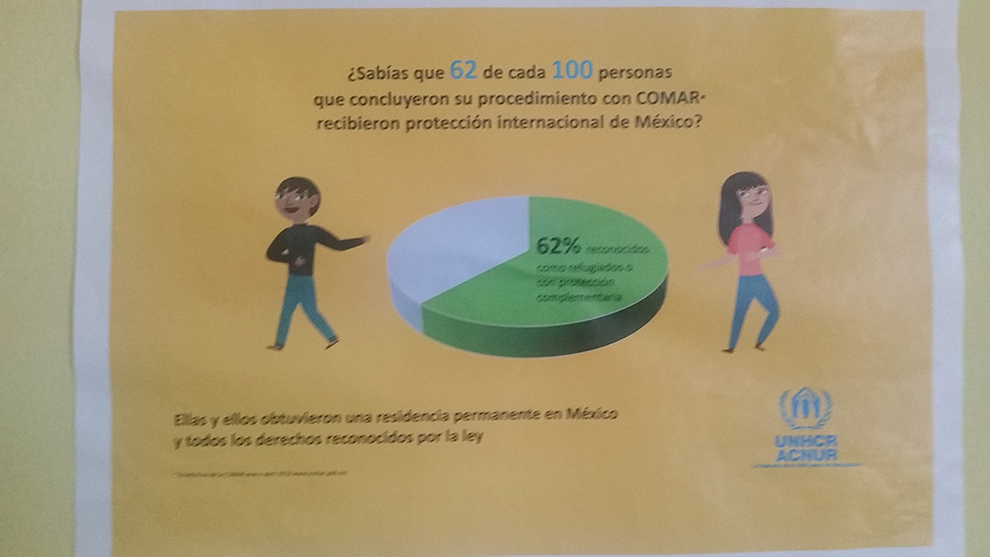
Poster in Tapachula shelter advertising humanitarian protection rates. Source: Photo by authors.
Increased awareness in southern Mexico and Guatemala about the benefits of the visa, led by shelters and through word of mouth, has increased their use. While few humanitarian visas were issued until 2014, they surged 575 percent between 2014 and 2016 (Suárez et al. 2017). The visa has become a life raft for many migrants as conditions in Central America prompt mass exit and aggressive migrant and asylum deterrence policies at the US–Mexico border foster a demand to lawfully traverse and to reside in Mexico. Increases in visa recipients, however, do not imply a humanitarian success. They are also indirect measures of skyrocketing abuses against migrants, especially since the implementation of Mexico’s Southern Border Program (SBP) in July 2014. Escalating abuses also reflect the intersection of migration securitization with the intensification of Mexico’s War on Drugs since 2006. During this time, drug cartels have fragmented and diversified into migrant kidnapping, extortion, and charging for access to territory, which has become more lucrative with increased policing of migration routes (Brigden 2018; Doering-White 2018).
Mexico’s paper commitments to humanitarian protections are also visible in its expanded Law on Refugees, Complementary Protection, and Political Asylum. The law, passed in 2011 and amended in 2014, widened the grounds for refugee recognition beyond the 1951 Refugee Convention to include those who suffer “generalized violence, foreign aggression, internal conflicts, massive violation of human rights, or other circumstances that have seriously affected public order” (SICREMI 2011). Mexico further recognized gender-based persecution; sexual, domestic, and family violence; and persecution by both state and nonstate actors as grounds for refugee status (ibid.). This expansive framework reflects the insecurity in Central America and has coincided with an exponential increase in asylum applications (Kerwin 2018, 300). Between 2013 and 2017, there was a 1027 percent increase in refugee petitioners in Mexico (Figure 3).

Refugee solicitants to the Commission for Refugee Aid (COMAR), Mexico, 2013–2017. Total and by states with the most solicitants. Source: Data courtesy of Stephanie Leutert, transparency request to COMAR.
Despite such advances, from January 2014 to the summer of 2016, Mexico accepted only 2,800 asylum petitions while it detained and deported more than 440,000 Central Americans, many of whom may have qualified for refugee status or asylum if they had been screened appropriately and granted information and legal aid (WOLA 2016; see Figure 4). In 2016, fewer than 6 percent of Central Americans migrants who were detained in Mexico requested asylum (Kerwin 2018, 292, drawing from SEGOB 2018). In practice, Mexico rarely applies the expanded provisions to Central Americans, whose cases are generally treated as “individually targeted” rather than the product of generalized violence (Kerwin 2018, 295). Many migrants in transit are dissuaded from applying due to a lack of information and access to the process, and due to corruption and insufficient resources and personnel. Mexico’s COMAR has only four offices 10 in the country, leaving many migrants without practical access to assistance. Practical application of the law has its challenges (Human Rights Watch 2016), but we join other scholars and advocates who contend that its humanitarian potential is most curtailed by “aggressive border enforcement that limits access to asylum,” especially under immense US pressure on Mexico to deter, intercept, and deport migrants to prevent them from reaching the United States (Kerwin 2018, 303; see also Menjívar 2014; Basok and Wiesner 2018).
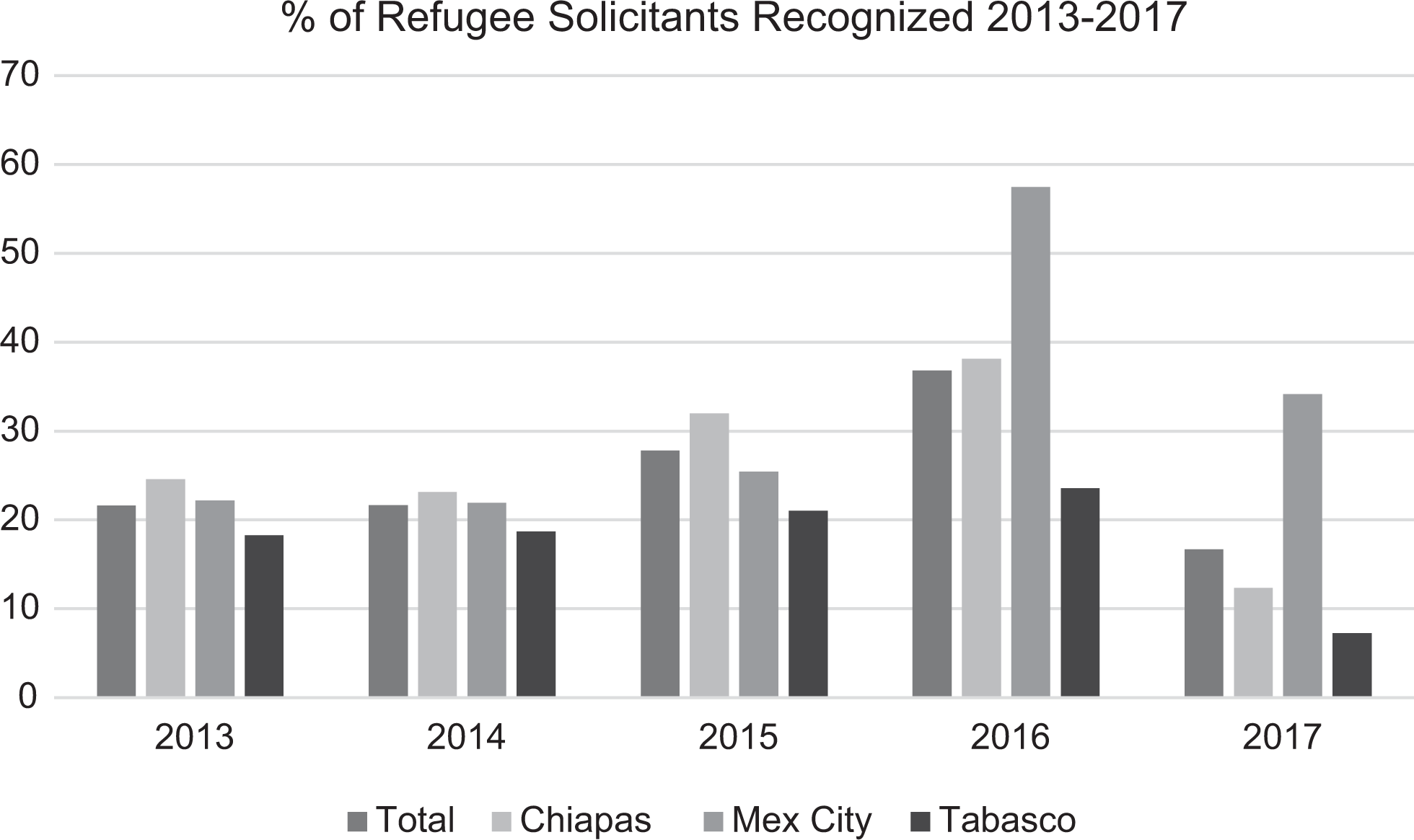
Percentage of refugee solicitants recognized by the Commission for Refugee Aid (COMAR), 2013–2017, total and by states with the most solicitants. Source: Data courtesy of Stephanie Leutert, transparency request to COMAR.
Repression: Mexico’s Prioritization of Enforcement
Mexico’s dedication of financial resources and willingness to protect survivors and prosecute crimes lag far behind, and are compromised by, its prioritization of detention and deportation (Suárez et al. 2017, 4; see also Basok and Wiesner 2018; Isacson, Meyer, and Smith 2017). In response to a “surge” in families and unaccompanied minors arriving at the US–Mexico border in 2014, Mexico launched its SBP in coordination with the United States. The program intended to provide more secure, orderly, and humane migration in the region, granting, as Mexico’s former secretary of the interior declared, “migration policies a dignified and human face…to promote well-being at the borders” (Animal Político 2014; Doering-White 2018, 439).
Despite compassionate rhetoric toward safeguarding migrants’ human rights, the program intensified immigration enforcement and surveillance, especially in Mexico’s southern border states and along central transit routes, leading migrants into increasingly nonlinear and riskier paths where they may be trapped for extended periods of time (Brigden 2018; Doering-White 2018; Vogt 2018). It also involved sending additional military, state, federal, and municipal police units and 300 members of the gendarmerie to Mexico’s border with Guatemala (Carlsen 2015), and installing more than 100 mobile checkpoints as well as enhanced infrastructure and technology to escalate detection, detention, and deportation 11 (Seelke 2016). Supplemental funding was funneled through the Mérida Initiative, a security collaboration established with the United States in 2008 to tackle drug trafficking, organized crime, and border security. The United States provided $100 million to support the securitization of Mexico’s southern border through the Mérida Initiative’s efforts to “create 21st century borders,” plus $88 million for information sharing and biometric data collection and $75 million to enhance technology and infrastructure (Isacson, Meyer, and Smith 2017, 4).
A 2016 investigation “found that — far from prioritizing the protection of migrants — migration policy in Mexico is oriented primarily towards the detection, detention, and deportation of migrants, without regard for their human rights or legal protections” (WOLA 2017; see also Consejo Ciudadano del Instituto Nacional de Migración 2017). Immigration raids pursued by Mexico’s INM in coordination with federal police, military, and other agencies more than doubled between 2014 and 2015, from 796 to 1,785 raids per month in southern border states (Leutert 2018). Under the SBP, Mexico’s apprehensions of Central Americans surged by 85 percent from 2014 to 2016. From 2013 to 2017, more than 83 percent of detained migrants were voluntarily or involuntary returned to their countries of origin, typically without access to legal information 12 (Consejo Ciudadano del Instituto Nacional de Migración 2017, 11).
Rather than assisting with migrant protection and dismantling smuggling, enhanced immigration policing is associated with increased abuses against migrants, particularly along the Mexico–Guatemala border. One report (Ureste 2017) found that crimes against migrants have risen 200 percent in border states since 2012, and scholars have documented an increased reliance on smugglers to avoid detection (Leutert and Yates 2017; Vogt 2018). Since the implementation of the SBP, abuses against migrants have been most pronounced in southern border states, especially in Chiapas. Using official data requested from the Mexican government through access to information requests, WOLA documented 2,566 instances of abuse from 2014 to 2016 in Chiapas, compared to 942 in Oaxaca, 573 in Tabasco, 996 in Sonora, 217 in Coahuila, and 530 from the federal unit (Suárez et al. 2017, 9). 13 Reflecting these patterns, in Chiapas, humanitarian visas extended to migrants who have suffered grave crimes increased exponentially, from 91 in 2014 to 218 in 2015, 449 in 2016, and 427 in 2017 (see Figure 5). 14

Humanitarian visas for victims of crimes: Chiapas, 2013–2017. Source: Data courtesy of Stephanie Leutert, transparency request to the National Institute of Migration (INM).
Migrant Abuses in Mexico and along the Route
Official data are likely vast undercounts. Official statistics from prosecutors’ offices regarding crimes against migrants can be inconsistent, lack specificity, and are difficult to compare among jurisdictions (Suárez et al. 2017). When WOLA submitted access to information requests to prosecutors’ offices, there was a lack of uniformity in how information was collected and presented. Some of the information requested was not provided, and some offices did not disaggregate data to enable a comparative analysis into the patterns, types, and perpetrators of abuses (Suárez et al. 2017, 10). WOLA’s more detailed field investigations, including interviews and access to information requests in collaboration with shelters, revealed greater detail. They found through further investigation that some prosecutors’ offices failed to receive complaints, others had insufficient staffing or will to document and investigate abuses, and some minimized crimes, leading official reports to undercount offenses (Suárez et al. 2017, 10).
Our examination of 126 complaints from two shelters along the Mexico–Guatemala border, and especially the 118 internal complaints filed with the Guatemalan shelter, highlights abuses that do not enter official statistics, demonstrating how fear, impunity, corruption, collusion, and migrants’ desperation to continue their journeys can preclude reporting. Although most of the complaints we analyzed were submitted informally by migrants to a shelter in Guatemala, this shelter has a unique vantage point. In addition to migrants headed north, deported people also come to this shelter for support as they debate whether to re-migrate, remain in the border region, or return home. The shelter is located near a deportation center where nearly all Guatemalans deported from Mexico are returned. At this shelter, returnees also informally report abuses to staff that span previous journeys north and experiences in Mexico and even in the United States. The internal complaints and our interviews revealed cases in which migrants were deported, or departed from Mexico to Guatemala or to their countries of origin, before they could file their complaints and file for regularization in Mexico.
In our examination of 118 internal complaints from the Guatemalan shelter, migrants reporting abuses ranged from 15 to 60 years of age, with a mean age of 30.8. Seventy-four percent of those who filed reports identified as men, and 26 percent as women. In terms of nationality, we found that 33 percent were of Honduran origin, 29 percent were Guatemalan, 26 percent were Salvadoran, and 7 percent were from other countries. Thirty-six percent of the complaints submitted to the Guatemalan shelter involved abuses that had occurred in Mexico; these individuals had been deported or returned before they could access protection or denounce abuses. These abuses underscore the lack of access to justice in Mexico.
This situation demonstrates how official corruption and collusion exacerbate migrant vulnerability and prevent migrants from denouncing abuses to Mexican authorities. Even though these abuses were revealed in Guatemala, there are avenues to receive protection in Mexico if the abuses were committed on Mexican territory. The Mechanism for Foreign Assistance enables migrants or their families to report crimes committed in Mexico and remain apprised of investigations from abroad (Suárez et al. 2017). For migrants who were victims of crimes in Mexico but are not currently in Mexico, however, obstacles pervade the process to collaborate with the investigation and receive a humanitarian visa in Mexico. For one, they must risk crossing the border to Mexico again without documentation. Guatemalan shelters can also use the internal complaints to inform the relevant authorities in Mexico and provide accompaniment for formal complaints. Yet, the fact that many complaints of abuse committed in Mexico were reported in Guatemala reveals that many migrants are too fearful of official complicity and corruption to report abuse in Mexico, and others are deported or convinced to depart before they can denounce the crime.
In terms of the location of abuses, they occurred throughout the migratory journey. Repressive migration policies in the United States and Mexico make migrants vulnerable to abuse throughout their migratory journeys as they attempt to travel northward, not just in Mexico. Fifty-one percent of abuses occurred in Guatemala, mostly near its borders with Mexico, Honduras, and El Salvador, as well as near Guatemala City. Of the 36 percent of crimes that occurred in Mexico, most occurred in Chiapas, although they were scattered along the migratory route through Mexico to the US southern border. The fact that the majority of abuses occurred in Guatemala reflects not only that our data were gathered from a Guatemalan shelter, but also how migrants are targeted before they reach Mexico. Mexico recognizes only abuses committed on Mexican soil as qualifying for a humanitarian visa. Enhanced difficulties of entering Mexico amid heightened border securitization, however, render migrants vulnerable to abuse, particularly near border-crossing points in Central America as well as along key transportation arteries in Guatemala. Figure 6 illustrates how abuses that occurred in Guatemala concentrated around immigration checkpoints and border regions, and were typically committed by immigration officials or the police. In fact, of the 25 instances of abuse committed in Guatemala by authorities, all but one (at a key highway juncture) were committed near border-crossing points at the Mexico–Guatemala or the Guatemala–Honduras border. Thus, only recognizing abuses committed on Mexican territory obscures migration-related abuses that prevent migrants from reaching Mexico. It also suggests that border securitization in southern Mexico places migrants at greater risk and targets those who are profiled as potential migrants, likely due to their appearance, belongings, accent, mode of transportation, and presence near borders or checkpoints (Andersson 2014; Brigden 2018).

Location of abuses: shelter denuncias. Source: Map prepared with eSpatial.
Despite the inherently transnational nature of international migration, recognition for abuses is constrained by the nation-state framework. It is precisely the difficulties of entering Mexico that lead migrants to be targeted before they reach Mexico. Even though Guatemala, El Salvador, Honduras, and Nicaragua signed a mobility agreement in 2006 recognizing freedom of mobility among their countries, corruption and the fact that many migrants do not carry documents make them vulnerable to extortion and abuse (Brigden 2018; Vogt 2018). Markers of migration target individuals for extortion since migrants are assumed to be carrying money or have kinship relations that can be exploited for financial gain. For example, complaints near the Guatemala–Honduras border entailed Guatemalan immigration authorities or police extorting bribes from Hondurans to continue their journeys. Many abuses occurring on the Guatemalan side of the Mexico–Guatemala border involved authorities extorting migrants to be able to pass and common criminals assaulting and robbing migrants on buses or near the river crossing to Mexico. In one complaint, an individual even posed as a pastor, promising a Salvadoran migrant he would help him cross into Mexico from Tecún Umán, Guatemala, for $2,000; the man then disappeared.
Such examples highlight how vulnerabilities triggered by securitized migration policies in Mexico ripple throughout the migration journey, making migrants vulnerable to abuses along the entire route (see Brigden 2018). Only counting, investigating, and recognizing abuses committed in Mexico to the exclusion of abuses endured throughout the journey paint an incomplete picture of the extent of abuses that migrants suffer as a result of the increasing securitization of migration in Mexico. This will become even more pressing as the border externalizes further south. In June 2019, the US Department of Homeland Security (DHS) began working to place DHS agents in Guatemala and to encourage Guatemala to revisit its freedom-of-mobility agreement (Sieff 2019).
According to the complaints, migrants transiting Mexico were also most likely to be physically assaulted, extorted, or robbed in border regions, at security checkpoints, and in secluded areas where migrants walk to evade inspection points. As the SBP installed more checkpoints in southern Mexican border states, as well as targeted La Bestia, the train on top of which some migrants attempt to traverse Mexico, migrants diversified their routes and increasingly took buses, microbuses, private cars, and trucks and trailers to travel north (Isacson, Meyer, and Smith 2017; Leutert and Yates 2017). As migrants approach checkpoints, they often disembark microbuses and run around hillsides, hoping to find transportation. If they are discovered aboard vehicles subject to inspection, they may face extortion or apprehension by officials. Because of increased checkpoints, they spend longer times walking through isolated and mountainous terrain, where they are vulnerable to assault and robbery.
Criminal actors and petty thieves explicitly target migrants in these hillsides and by remote train tracks, which migrants often traverse to avoid the risks or bribes required at checkpoints. In one complaint, a Nicaraguan woman reported paying a man $800 to get to Mexico City. She was traveling with two other people whom she had met along the journey. When they arrived in Ciudad Hidalgo just over the Mexican border with Guatemala, she took a microbus to Tapachula, Chiapas. She was told to wait in the central plaza for someone with a red truck, but that person never arrived. After staying two nights at a shelter in Tapachula, the three migrants attempted to continue their journey, accompanied by two additional migrants. They took a microbus to another town, disembarking the bus just before the checkpoint to circumvent it on foot. They then boarded another microbus destined for Huixtla, Chiapas, instructing the driver to let them off before the next checkpoint. They walked for half an hour when they encountered four men in the pathway, three with machetes and one with a firearm. Two of the migrants fled running, at which point one of the assailants fired a shot. Both fell to the ground. The men ordered the migrants to remove their clothing and turn over their belongings. The Nicaraguan woman was physically assaulted and groped; the men tore a hole in her bra and removed her cash. She eventually returned to the shelter and filed a complaint.
Consistent with this woman’s story, our findings indicate that abuses are highly gendered in terms of how victims are approached, where on their bodies they are assumed to be carrying money, and the manner in which they are humiliated. In the complaints and interviews, both men and women reported assaults in equal measure, but men’s narratives were more likely to report physical assault, while women reported and alluded to a variety of forms of sexual violence. This complaint also demonstrates how such abuses should not be considered particularly exceptional, but are produced and routinized by aggressive migration policing that diverts migrants to remote locations where they are vulnerable to assault (Doering-White 2018).
The complaints also provide insight into alleged perpetrators of abuses (Figures 7 and 8). Reported perpetrators for all data collected included government officials (37 percent); thieves/criminals (18 percent); gang members/cartels (11 percent); cab, bus, van, and moto-taxi drivers (12 percent); and unknown actors (18 percent). Aggressive migration policing and impunity for crimes encourage more routinized and institutionalized forms of abuse against migrants, while they also create opportunities for other vulnerable groups to profit by extorting migrants (Vogt 2018, 86). Some migrants, we learned, had been assaulted and robbed by petty “criminals,” “thieves,” or even “chicleros” (persons selling gum).
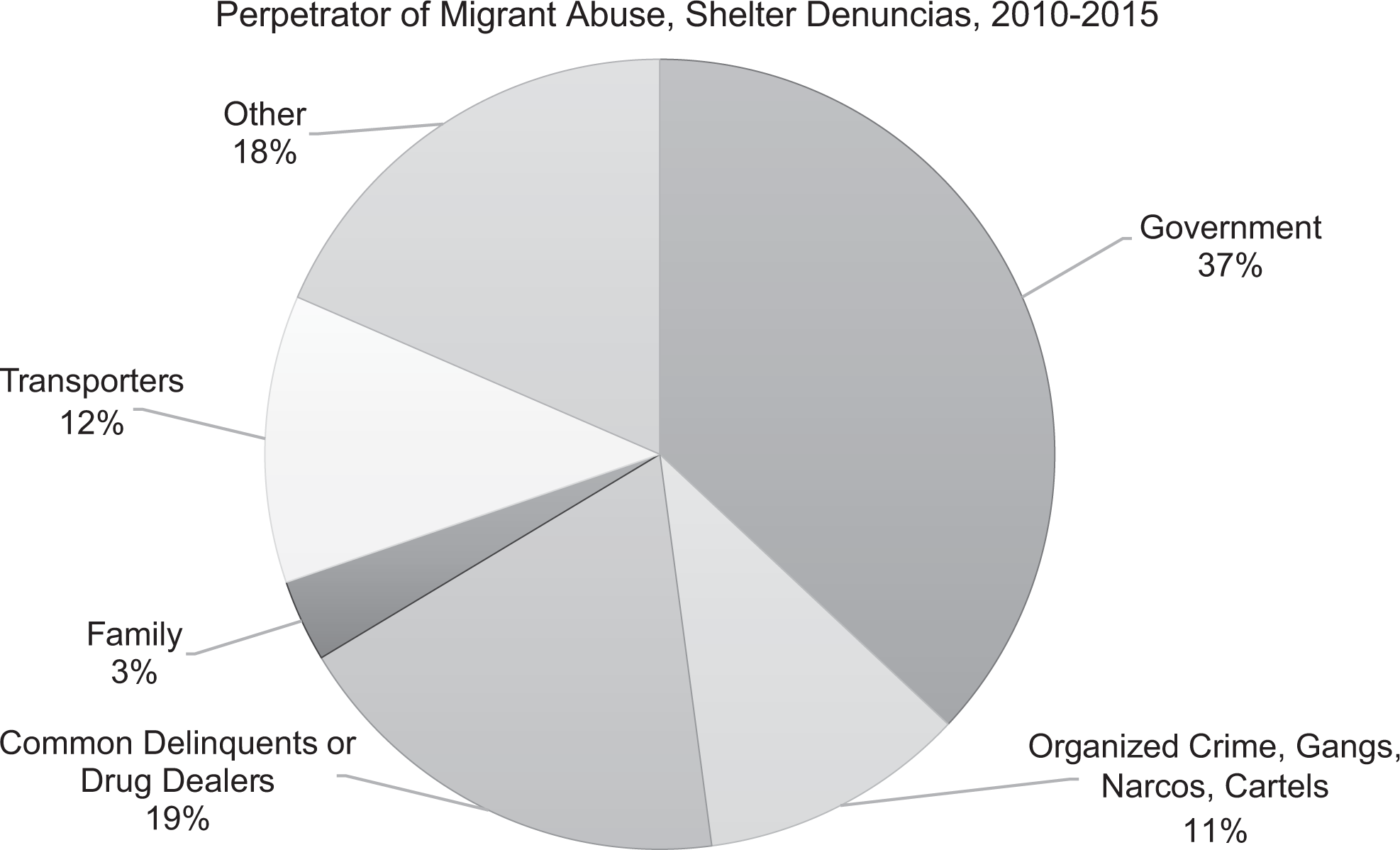
Perpetrator of migrant abuse, shelter denuncias, 2010–2015.
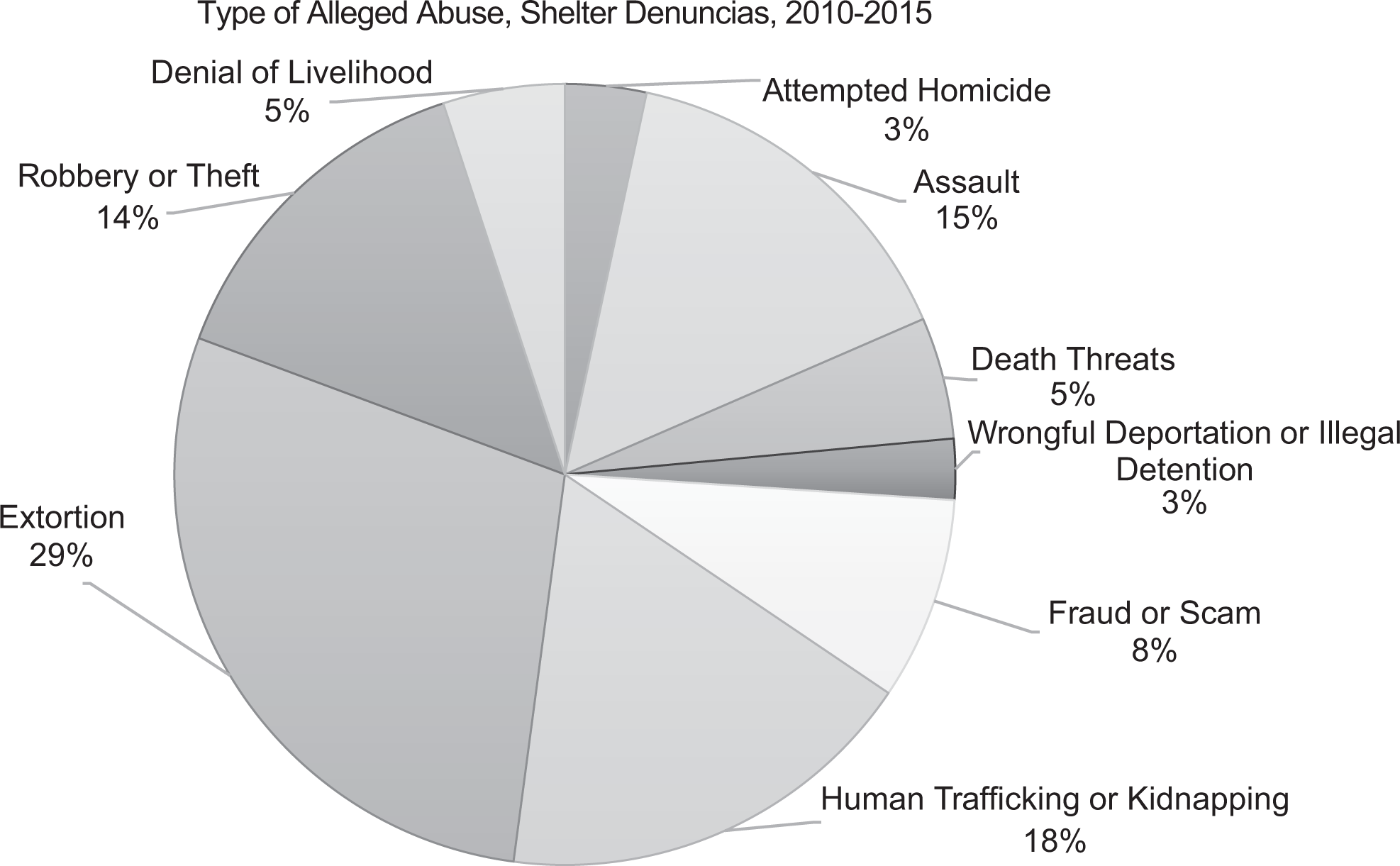
Type of alleged abuse, shelter denuncias, 2010–2015.
By far, the largest percentage of the reported crimes against migrants were committed by government officials, the majority of whom were federal and municipal police and immigration officers (see Isacson, Meyer, and Smith 2017). The complaints also revealed patterns of collusion between different authorities, transporters, organized crime groups, and other actors. For example, corrupt government agents use extortion tactics, such as demanding bribes in exchange for passage into and through Mexico, withholding vital services from migrants, selling false documents, demanding payment to cross the border to avoid imprisonment, and issuing threats of detention and deportation to prevent migrants from filing complaints. Migrants often reported that soon after crossing into Mexico, they were approached by immigration officials insisting on payment to avoid apprehension. In another complaint, even after paying an inflated fee, a microbus driver delivered the migrant directly to Mexican immigration authorities, where he was detained and deported (also Suárez et al. 2017, 12).
Our findings suggest that, consistent with existing research, migrant abuses correspond to, and shift in relation to, migrant securitization that crosses international borders. Protection avenues, however, account for only officially reported abuses that occur in Mexico. This neglects the wider array of abuses occurring along the migrant route, as well as how many offices in Mexico do not properly document and investigate crimes. Granting limited forms of humanitarian protection based on individualized, exceptional, and serious crimes can also detract attention from how intensified migration policing generates abuses that are patterned, systemic, and transnational. Border securitization throughout Mexico produces wider humanitarian impacts, including diverting migrants from paths with established shelters into areas where they are subject to higher risks and unable to access critical information regarding protection (Vogt 2018, 129).
Obstacles to Denouncing: “They All Cover for Each Other”
In addition to the abuses themselves, a context of “compassionate repression” creates barriers to submitting complaints, pursuing investigations, and receiving protection. Impunity and the complicity of authorities are major deterrents to reporting abuses and receiving protection in Mexico. WOLA found that of 5,824 documented crimes committed against migrants in Mexico from 2014 to 2016, there were only 49 sentences, or a remarkable impunity rate of 99 percent (Suárez et al. 2017, 30). Advocates and migrants report that substantial abuses are routinely committed by, in collusion with, or with full knowledge or negligence of state authorities. The INM is the engine executing Mexico’s deportation mandate, but it is also charged with receiving complaints and issuing the humanitarian visa. Migrants are hesitant to submit official complaints of abuse, especially when they doubt that investigations will yield results, they fear that authorities have been complicit in crimes, or they are concerned that they will be arrested, deported, or denied entry rather than receive protection (REDODEM 2015; Suárez et al. 2017; Kerwin 2018, 307).
In our interviews, advocates related that migrants are hesitant to denounce authorities in Mexico because “they are afraid of repression…out of fear. Because if I denounce [the authority] and later he grabs me [upon return to Mexico], it will be ugly for me.” An attorney explained how migrants are wary that “suddenly I am denouncing the person who is the friend of the one who did this to me.” One Guatemalan migrant, Héctor, who we met at a shelter in Chiapas, highlighted these dynamics of collusion, lack of faith in authorities, and how aggressive migration policing can lead to deportation before migrants can denounce and receive protection. One day, when he was selling pens in the street in Querétaro, Mexico, Héctor was approached by the municipal police. He explained, They asked: “What are you doing?”…And they said, “Come with us.” And because I don’t owe anyone anything, I went with them. They handcuffed me, and I still have the marks. When we got to the office, they started to beat me.” I asked them why they were beating me…that I would exert my rights. And they started to beat me more.…There were seven of them.…I told them I was going to denounce them.…They were afraid, and I think this is why they let me go. [Then] they brought me to migration…to deport me so I wouldn’t say anything.
Migrants also recount being given the “run-around” in Mexico by a series of authorities, who refuse to recognize complaints or claim that they lack jurisdiction or competency to investigate. Due to lack of faith in authorities, fear of reprisal, and the paucity of prosecutors’ offices in areas where migrants are prone to abuse, many migrants submit claims in Mexican states other than where they occurred (Suárez et al. 2017, 13). In Chiapas, an agreement guiding the Special Prosecutor’s Office for Crimes Against Migrants states in Article 5 that all prosecutors’ offices are required to receive complaints of abuses committed against migrants regardless of their competencies, territory, or sensitivity of the case, prior to referring the case to the Special Prosecutor’s Office for Crimes Committed Against Migrants (Despacho del C Procurador 2015). While abuses can be reported elsewhere, this practice leads some prosecutors’ offices to pause cases, to claim that they lack competency, and to advise migrants to report crimes and follow up on investigations in the state where they occurred (Suárez et al. 2017, 13, 24). Remaining in the state where an abuse has occurred, however, can endanger migrants by limiting their mobility and re-subjecting them to abuse, including by the perpetrators they denounced.
Poor communication between prosecutors’ offices, between state prosecutors’ offices and the federal UIDPM, lack of resources and training, and insufficient political will to pursue cases create challenges to transferring cases to the appropriate authorities, while it also enables authorities to deflect their own responsibility (Suárez et al. 2017, 23). In one case, a Chiapas attorney assisted two Honduran men who suffered a crime at the hands of Mexican migration officials. Migration officials warned the migrants not to denounce, but they did anyway and were locked up. The attorney accompanied the men to the special state prosecutor’s office for crimes committed against migrants in Tapachula, but this office directed them to a different office in Arriaga, Chiapas, since the abuse occurred there. The second office then denied competency and told them the case was federal, and thus fell under the Attorney General’s Office rather than the state prosecutor. This office also failed to entertain the case. Forms had to be brought to the appropriate authorities, but in this case, there was no one to receive them. The lawyer grasped this particular run-around: “I understood [those in charge] work with the same migration [officer who committed the abuse].…They all cover for one another.”
Advocates along the Mexico–Guatemala border play a key role in documenting abuses of migrants who are coming and going, and in providing accompaniment to support claims to humanitarian relief in Mexico if the abuses occurred within Mexican territory. Some migrants are successful in filing complaints on account of their abuse, especially when they are assisted by shelter staff, including attorneys and social workers, who work with government officials in the prosecutor’s office, consulates, and the INM to assist migrants and hold state actors accountable. Due to their fear of reprisal, lack of faith in the utility of the complaint process, and desire to continue their journeys, however, many migrants do not want to make formal complaints. According to a shelter staff member in Guatemala, “Sometimes they [migrants] say, I don’t want to. I don’t want to know anything.…I just want to say what happened to me, but please don’t use my name.” When migrants do not wish to make formal complaints, Guatemalan shelter staff encourage them to informally “leave their complaint here [at the shelter],” to help the shelter staff with their advocacy efforts. Staff assert that even submitting internal complaints can help “prevent others from suffering.” Guatemalan shelter staff draw on these internal complaints, like the ones we analyzed, when they participate in regular meetings with regional authorities. Even if migrants elect not to pursue their cases, advocates can use this information in Mexico and Guatemala to advocate for better security in areas where migrants experience crimes, enhance transparency and hold authorities accountable, provide information and accompaniment to migrants, and coordinate with consulates.
Advocates and migrants also recognize the potential risks of sending more authorities to improve security when abuses are often committed by, or with the full knowledge of, agents of these very units. As one advocate told us, “[We give these] details [from complaints] to the authorities so they can put more control at these points [where abuses occur]. Because it is a point of migratory passage.…But sometimes what happens is the opposite. If they send the police, but they are corrupt police…instead of helping [migrants], they are the ones assaulting them.”
Migrants also encounter hurdles when they must take copies of the complaints to the INM to receive the visa. Aware of corruption within the INM, many migrants are apprehensive to approach them. Migrant abuses reported to Mexico’s National Human Rights Commission levied against the INM rose 40 percent from 2014 to 2015 (Smyth 2015). We met one migrant, Francisco, who was beaten and robbed by migration agents, who then transported him to the Siglo XXI detention center in Tapachula. In the detention center, Francisco was informed of his right to denounce the abuse. According to Francisco, “One has the right to denounce…but sometimes you are deported when you are looking for the visa.…You don’t know who is on your side.” Even though he filed a complaint, Francisco was deported to Guatemala before he could be referred to the appropriate authorities to receive a humanitarian visa. When we met him in a shelter in Guatemala, he was contemplating how to safely return to Mexico without status.
Because of lack of oversight in detention facilities, migrants like Francisco may have few options but to submit complaints of abuse directly to INM agents (Carlsen 2015; Suárez et al. 2017). Without state prosecutors’ offices dedicated to investigating crimes against migrants in every state, Grupos Beta, the INM’s unit dedicated to defending migrant rights, is also charged with “providing rescue services, humanitarian assistance, and legal assistance” (Suárez et al. 2017, 15). But the reporting and referral of crimes to the corresponding authorities are inconsistent, and many migrants distrust Beta authorities due to their association with the INM (ibid.). Migrants may also denounce abuses to Mexico’s National Human Rights Commission (CNDH) during detention visitations, but the CNDH has issued few recommendations to the INM, especially considering the extent of violations levied against it (Suárez et al. 2017, 14, 28). WOLA investigations have found that INM agents not only fail to report abuses but tend to minimize them, or even intimidate migrants to deter complaints and encourage voluntary deportation (Suárez et al. 2017, 14). Lodging a complaint of abuse or expressing credible fear of return while detained presents a clear conflict of interest; INM officials, who are charged with detention and deportation, are then also responsible for identifying and referring migrants to appropriate bodies for protection (Kerwin 2018, 306).
Another obstacle to denouncing crimes and receiving protection is a general climate that criminalizes migrants and those who defend them (Suárez et al. 2017, 28). Racialized suspicions increasingly conflate migrants with gang members and generate a widespread stigmatization of Central American migrants. Advocates and officials at the Mexico–Guatemala border weigh bodily, linguistic, and other signs to differentiate those worthy of protection from suspected gang members, reinforcing a hierarchy of deservingness (see Doering-White [2018] on shelter practices to distinguish smugglers from migrants). For example, youth with tattoos, or even men from certain communities in El Salvador, are often assumed to be gang members, unworthy of relief or at least subjected to constrained versions of care. Two men we met at the Chiapas shelter, Adrian and Nacho, were traveling together from Soyapango, El Salvador, a town known for high rates of gang violence. The men explained how the stigma associated with their hometown and their tattoos made them vulnerable to mistrust and harassment by authorities along the migratory route and as they attempted to travel north and request refugee protection in Mexico. They were detained when trying to leave El Salvador and enter Guatemala. Adrian noted, “They didn’t want to let us through. For the simple fact that my ID says Soyapango.…Even being in my own country they didn’t want to let me pass through because my ID said Soyapango.”
Later in their journey, the men were stopped by Guatemalan police agents, who threatened to deport them and accused them of being gangsters. Their appearance and hometown generated further suspicion as they struggled to find advocates willing to assist them with filing refugee claims in Mexico. Profiling Central American young men as gang members and potential perpetrators casts them as subjects outside of humanitarian concern, justifying punitive deterrence and removal practices against not only them but migrants writ large. Meanwhile, racialized suspicions, restricted mobility, and the lack of access to protection enhanced their vulnerability to abuse.
Commoditized Protection and Solidarity En Route
The paradoxical space of “compassionate repression,” between ostensibly available humanitarian protections and aggressive migration policing, has led the migrant protection system to become increasingly commoditized into a protection industry, or what anthropologist Wendy Vogt (2018, 85) describes as part of the larger “cachuco 15 industry,” in which a variety of actors profit from Central American migrant (im)mobility. The intersection of intensified migration policing and drug war militarization increasingly commoditizes migrants, their paths, and their social networks (Brigden 2018; Vogt 2018). Drug groups have been able to fuel profits, control territory, and publicly demonstrate ruthlessness by violently manipulating migrants’ (im)mobility when they have limited avenues for protection and smugglers and migrants increasingly inhabit clandestine spaces governed by narco rules and norms (Slack and Campbell 2016; Sánchez 2017; Brigden 2018; Doering-White 2018). Migrant commodification is further enabled by transnational neoliberal capitalism that profits from migrants’ violent containment, illegalization, and racialization (Vogt 2018, 85–86). It converts migrants into valuable commodities as exploitable labor in wealthy countries, cargo to smuggle in transit, and social relations to extort while also casting vulnerable groups against one another in the struggle to survive (Vogt 2018, 86). We extend this argument to examine how “compassionate repression”, aided by impunity, has also commodified access to Mexico's humanitarian protection system.
Scholars have used the term “migration industry” to identify “the ensemble of entrepreneurs, firms and services which, chiefly motivated by financial gain, facilitate international mobility, settlement and adaptation, as well as communication and resource transfers of migrants and their families across borders” (Hernández-León 2013, 25; see also Andersson 2014; Vogt 2018). This industry refers to the ways migration enforcement and surveillance produce illegality that, combined with neoliberal capitalism, generates profits for a range of actors — including politicians, media, firms, military contractors and detention centers, NGOs, smugglers, recruiters, and lawyers — which coexist in a “complex web of economic ties” to facilitate and constrain migration (Golash-Boza 2009; Hernández-León 2013, 40; Andersson 2014; Vogt 2018, 85). While scholars have documented the ways the migration industry encapsulates humanitarian actors like shelters (Doering-White 2018; Vogt 2018), we extend this capitalization of migration to the actors who profit from migrants’ uncertain access to Mexico’s humanitarian protection apparatus.
The commodification of Mexico’s humanitarian protection industry is enabled by its securitization of migration, limited official avenues for protection and entry into Mexico, and widespread impunity that makes preying off migrants relatively profitable and low risk, with low barriers to entry (Sánchez and Zhang 2018). We found through our interviews and observations that migrants delicately navigate this climate of uncertainty and risk through social networks, relationships, trust, and sometimes crimes of livelihood or desperation themselves (Vogt 2018).
Commodification of protection is enabled by the fact that migrants can never be certain that officials will uniformly apply the law, whether to enforce deportation, to facilitate passage, or to process forms of protection and migration regularization (see Basok and Wiesner 2018). This uncertainty and level of corruption make Mexico’s protection system particularly susceptible to commodification, or, as one advocate stated, for migration to become “a business.” We observed numerous accounts in which passage past border checkpoints depended on migrants’ ability to pay. One advocate noted how corruption can pervade the protection process: “migration [agents] will make a [financial] agreement with people to give them a humanitarian visa, but only for six months, when the law says it should be for a year.…They see everything as a business.” We heard reports of migration agents charging migrants for forms that should be free, or even specializing in obtaining visas for particular populations for a fee. 16 An advocate noted that these practices will then “differ by official and by state,” heightening unpredictability for migrants as they improvise from a variety of strategies to access justice and relief (see Brigden 2018). Official corruption and uncertainty around official processes create space for other actors to engage in exploitative practices around migrants’ lack of access to protection and regularization measures. In one instance, an unknown man visited the Chiapas shelter offering migrants legal documents for a fee. He promised that the migrants would receive their documents more quickly than they could obtain papers through official regularization avenues. Despite warnings from staff that the offers being made were not legitimate, many migrants left with this man, paid him for his services, and never received their documents. “He took them and that was it,” related a staff member.
In Mexico’s securitized migration context that recognizes only individualized “serious” crimes and privileges deportation over adequate access to protection avenues, what count as “legitimate” stories of suffering are also commoditized. We found that certain narratives were viewed as “legitimate” forms of suffering that were more likely to be recognized by the humanitarian protection system, while others were seen as suspect. According to shelter staff, people preying on migrant vulnerability have learned that particular accounts of persecution are useful to present to Mexico’s Refugee Commission, COMAR, to acquire refugee status. According to one staff member, gang members, many of whom were following refugees from Central America, began selling stories of persecution in Central America to vulnerable asylum seekers, who were fearful that their actual suffering could be viewed as insufficient by the Mexican asylum system, to use in their government interviews with COMAR. Some migrants were convinced that paying for these ostensibly more compelling stories would more likely grant recognition from asylum officers. The gang members then began using variations of these stories to garner protection and residency in Mexico for themselves. A shelter staff member related how the process unfolds: “[Gang members] pretend to be refugees, and some get status and stay here by finding holes in the law.…People get status who should not while [COMAR] does not believe others.”
This may suggest that protection needs are made up, but the sheer volume of data on refugee-like conditions in Guatemala, Honduras, and El Salvador tells otherwise. Most migrants — some of whom are affiliated, or formerly affiliated, with gangs and are seeking protection — are legitimately fearful of returning home to dangerous, uninhabitable conditions. They are also aware of the limited availability of humanitarian provisions in Mexico in practice; their own vulnerability may lead them to then exploit the desperation of others to survive. Such suspicion positions migrants to seem deceitful rather than credible in the eyes of the state, which justifies the violent system of aggressive policing and removal and delegitimizes their right to protection.
In a system that privileges deportation over protection and in which COMAR’s resources are insufficient, stories of persecution are often mistrusted or trivialized by government agencies. Hierarchies and practices of deservingness delegitimize and criminalize the protection needs of people who are fleeing violence and retribution, but who are routinely denied access to refugee status, asylum, and other forms of humanitarian relief. The state’s lack of transparency and consistency in granting relief further undercuts the humanitarian system and enables state and nonstate actors to profit by facilitating or blocking access to protection.
In addition to opening opportunities for exploitation, however, precarious conditions can also invigorate emerging forms of solidarity and care among migrants, smugglers, shelter staff, human rights advocates, and other individuals encountered along the journey (Brigden 2018; Doering-White 2018; Sánchez and Zhang 2018; Vogt 2018). Shelters are spaces where support is provided to help migrants further their journeys and access legal aid. Staff and advocates establish relations of care with migrants, especially with families, by accompanying them to offices to make complaints, advocating on their behalf, and providing them with vital basic services and information. Shelters also become sites where relationships of care and solidarity among migrants form. At one shelter, we witnessed migrants bond together to collectively sell items, such as pencils and pens, bracelets, and other small handicrafts, to finance their journeys. Migrants also share information and help one another advocate for better treatment in official offices and within shelters, especially in one case when a family with young children had been mistreated by a security guard.
This production of care exists within, and cannot be disentangled from, a broader regime of migrant insecurity, which generates opportunities for profit when alternatives for survival are scant. Genuine acts of reciprocity coexist with suspicion and the potential for deceit (Brigden 2018; Vogt 2018). For example, when migrants at one shelter collaborated to sell bracelets, it became clear that one man was being extorted by another who sold him the thread. As another example, on the final day we visited the Chiapas shelter, we brought information cards we had gathered from a human rights office. Migrants crowded around us as they eyed the cards. A few of them were asking us, “How much?” Desperate for information on protection avenues, these individuals assumed that, like everything else, the cards carried a price. When we told them they were free, they were grateful and wary. In a journey where uncertainty, violence, and impunity incentivize commoditization of even humanitarian protection, relationships were fragile. As one migrant told us, “In this journey you cannot even trust your own shadow.”
Conclusion: Migrant Abuse and Humanitarian Exceptions in an Era of Removal
This article demonstrated how migrant abuses and obstacles to denouncing crimes and receiving protection are reflective of Mexico’s paradoxical balance between the securitization of migrant mobility and its humanitarian obligations. A framing of “compassionate repression” (Fassin 2012) demonstrates the ways in which the securitization of migration compromises the humanitarian agenda, produces abuses throughout the migratory route, and encourages commodification of the protection industry. Mexico’s 2011 Migration Law posits humanitarian visas as individualized exceptions to be garnered through serious crime victimization and collaboration with authorities, charging the very state agencies invested in the production and detection of migrant illegality with redressing its symptoms. Isolating abuses as exceptions or “grave crimes,” and limiting concern to abuses committed on Mexican territory, severs these crimes from the restrictive migration regime that facilitates them. Treating such abuses as exceptions to be remedied through limited forms of humanitarian recognition precludes a broader political discussion to address migrants’ fundamental lack of rights to mobility, work, and dignity throughout their transnational journeys (Ticktin 2011; Fassin 2012). Yet migrants have also exerted agency by assisting one another and banding together in recent caravans to traverse Mexico. In doing so, they draw attention to wider demands for migrant rights that disrupt the narrative of “exceptional” cases.
As Central American refugees’ claims are frequently discounted in Mexico and the United States, denouncing crimes and acquiring a humanitarian visa in Mexico are critical to safeguarding migrant rights and safety in transit. Yet this visa is also temporary and leaves migrants vulnerable to exploitation due to their “precarious legality” (Basok and Wiesner 2018), inability to work, and obstacles to renewing the visa and pursuing more permanent forms of regularization. It also neglects how, for many migrants, the United States remains their desired final destination. Even as the humanitarian visa can help migrants more safely travel north, some fear that any humanitarian protection garnered in Mexico could diminish their US asylum claim (see Vonk 2019).
Due to inadequate access to justice and the prioritization of deportation over alternative options for mobility, limited protection measures fall short in their ability to revalue the rights of migrants, hold authorities accountable, or alter a restrictive migration system that creates opportunities for abuses to be committed against migrants with impunity along the entire migratory trail (Isacson, Meyer, and Smith 2017; Suárez et al. 2017). Instead, the paradoxical tension between the criminalization of mobility and limited access to humanitarian protection generates a profitable market hinging on migrant vulnerability (Sánchez 2017). A proliferation of actors profit by facilitating migrant (im)mobility and the uncertain space between removal and humanitarian protection. In a context of economic insecurity, securitization, and violence, many of these actors are migrants, asylum seekers, or otherwise vulnerable populations who sometimes engage in violent or exploitative acts, like extortion and robbery, as means of survival.
Improvements can and should be made to Mexico’s humanitarian migration system and its criminal justice and policing infrastructure, as we outline in the Recommendations section below. The Mexican immigration system does not, however, exist in a vacuum. It is highly influenced by policy pressure and funding from the United States. Suggested reforms do not “justify the United States’ failure to receive and process asylum seekers” (Human Rights First 2017, 11), or the externalization of its border and its pressure on Mexico to aggressively police its border with Guatemala on its behalf (Menjívar 2014). It remains to be seen how Mexican President Andrés Manuel López Obrador will collaborate with the United States on migration management, but his early record has varied. Although he fast-tracked roughly 13,000 humanitarian visas with work permits for Central Americans arriving in Chiapas in January 2019, this approach ended shortly thereafter. His administration has since clamped down and conducted a large-scale raid on a Central American migrant caravan in Chiapas in April 2019, suggesting a repressive backslide.
Recommendations
As migration from Guatemala, Honduras, and El Salvador continues amid high levels of violence and insecurity, and as asylum and refugee avenues continue to contract in the United States, Mexico has an immense responsibility to ameliorate risk, enhance accountability, and better safeguard migrant rights in the region. The Mexican government should: Join Latin American and Caribbean calls for “freedom of movement”; uphold the free mobility agreement between El Salvador, Guatemala, Nicaragua, and Honduras to promote migrant rights in the region. Strengthen information campaigns to ensure migrants are informed of correct procedures and can access critical information about denouncing abuses, regularization opportunities, and avenues for pursuing refugee protection and other forms of humanitarian protection in Mexico. Increase funding, training, and political support of special prosecutors’ offices dedicated to investigating crimes against migrants. Improve communication among prosecutors’ offices, and facilitate processes for migrants to file complaints and to follow up with their cases at other branches with more rigor and consistency. Increase coordination between prosecutors’ offices at the state level, the federal unit, shelters, consulates, and human rights groups to facilitate complaints and investigations. Permit migrants to file complaints and be eligible for humanitarian visas in Mexico on account of crimes committed in countries of transit outside of Mexico. Increase regional collaboration to address migrants’ lack of access to protection and justice. Make procedures to renew humanitarian visas transparent and accessible, especially when migrants resettle elsewhere in Mexico. Facilitate work permits for visa recipients, and do not restrict them to southern border states where economic opportunities are few and migrants are often most vulnerable (as some proposals suggest; see Guthrie 2019). Revise the requirement for crimes to be considered “grave,” which can deter victims and incite arbitrary decision making and potential abuse by authorities (see Suárez et al. 2017). Provide clear and accessible paths for regularization. Create an independent agency, division, or office with independent oversight within the INM to approve and issue humanitarian visas, to avoid potential conflicts with the agency’s immigration enforcement mandates. Work toward the reduction of government corruption by increasing firings and prosecution of officials complicit in, and responsible for, crimes against migrants in Mexico.
Footnotes
Acknowledgments
We would like to acknowledge the research assistance of Eduardo Carreon, Jose Guevara, Diane Martinez, Rosemary Girón, and Yareli Pineda. We also thank Donald Kerwin, the Center for Migration Studies (CMS) and the Journal on Migration and Human Security staff, the anonymous reviewers, and especially our study participants for generously sharing their time and stories. The authors also appreciate data sharing and feedback on parts of the manuscript from Stephanie Leutert, and feedback from John Doering-White.
Declaration of Conflicting Interests
The authors declared no potential conflicts of interest with respect to the research, authorship, and/or publication of this article.
Funding
The authors disclosed receipt of the following financial support for the research, authorship, and/or publication of this article: This project was funded by a PROF grant at the University of Denver.