




Abstract
Abstract
A paradoxical element of Pakistan’s grand strategy exists in its approach to Afghanistan. Pakistan’s instrumentalisation of Islamist groups such as the Taliban has historically been the principal strategic method employed by the military to minimise Indian influence in Afghanistan. However, this strategy risks jeopardising Pakistan’s strategic partnership with China, which is another method used by Pakistan to counterbalance India. Beijing’s growing strategic interests in the region require stability in South Asia, whereas Pakistan’s strategic method in Afghanistan indicates a preference for instability. The destabilising effect of Pakistan’s support for Islamist groups, and China’s desire for political and economic stability in South Asia, indicate latent divergent interests in the Sino-Pakistan strategic partnership. Therefore, this study factors China as a looming constraint on Pakistan’s Afghanistan policy. This study also examines the psychological and strategic factors underpinning Pakistan’s support for Islamist groups in Afghanistan, and the strategic constraints on this policy. Advancing the notion of a ‘strategic culture’ in Pakistan’s military, this study canvasses the concept as an epiphenomenal explanatory factor of its Afghanistan policy, and more instructively, as a factor of strategic inflexibility.
Introduction
A growing tension between Pakistan’s support, on the one hand, for Islamist groups such as the Taliban and its desire, on the other, to deepen its strategic partnership with China presents a potential strategic dilemma in Afghanistan. In 2018, after enduring years of terrorism and instability, Afghanistan’s President Ashraf Ghani found it necessary to offer the Taliban a comprehensive peace offer and political recognition without preconditions. However, promoting the idea of ‘reconciliation’ with the Taliban in Afghanistan risks diverting attention from the region’s broader strategic challenge: Pakistan’s geostrategic pursuit of influence in Afghanistan through its instrumentalisation of Islamist groups such as the Taliban (see Barfield, 2012; Farrell, 2017; Maley, 2009; Rashid, 2000, 2002; Rubin, 1995; Saikal, 2004). Pakistan’s support for the Taliban insurgency is a fundamental obstacle to stability in Afghanistan and to the success of the United States’ counterinsurgency (COIN) campaign. However, Pakistan’s support for the Taliban insurgency in Afghanistan also creates a stability paradox for China and its interests in South Asia.
In a study of 30 COIN campaigns throughout history, the RAND Corporation found that all insurgencies with cross-border sanctuary or support were successful (Paul, Clarke, & Grill, 2010). Affirming the notion that COIN operations against forces with cross-border sanctuary typically fail, experts widely agree that so long as Pakistan provides support and sanctuary to the Taliban, peace will elude Afghanistan (Byman, 2007, 2011; Lieven, 2011; Nawaz, 2009). As a corollary implication for China, contestation in Afghanistan means stability in South Asia is threatened. If China’s economic interests in South Asia in theatres such as the China–Pakistan Economic Corridor (CPEC) are threatened, Pakistan faces a potential dilemma between its support for Islamist groups and its desire to deepen its relationship with China. This article explores the questions of what explains Pakistan’s support for Islamist groups in Afghanistan and what are the strategic constraints on this policy.
Pakistan has a long history of supporting the Taliban, albeit officially severing ties after the September 11 attacks. However, experts widely agree that after 9/11, Pakistan pursued a ‘dual track’ policy of ostensibly supporting the War on Terror (WoT) while simultaneously harbouring and supporting enemy combatants in Afghanistan (e.g., Gregory, 2007; Jones, 2007; Waldman, 2010; Weinbaum & Harder, 2008). Pakistan’s principal intelligence agency, the Inter-Services Intelligence (ISI) Directorate, continues to support Islamist groups in Afghanistan such as the Haqqani Network (HN) which has operated in various ways in Afghanistan since the Cold War. Existing explanations of why Pakistan supports these groups point to geostrategic competition with India, the pursuit of ‘strategic depth’ and geographic influence (Parkes, 2019). Beyond these, cultural and social forces such as pan-Islamism are arguably central aspects of the dynamics underpinning Pakistan’s Afghanistan policy. Some experts observe that a ‘strategic culture’ based on Islamism and hostility towards India exists within Pakistan’s military and explains its strategy towards Afghanistan (Fair, 2014; Haqqani, 2005).
This study expands on the ‘strategic culture’ notion, operationalising the concept as one factor that explains Pakistan’s clouded Afghanistan policy but also identifying it as a strategic constraint that prevents Pakistan from shifting its Afghanistan posture. In addition to examining strategic culture as a constraint on Pakistan–Afghanistan posture, this article posits that its strategic partnerships simultaneously constrain its policy flexibility. In terms of a case study to demonstrate this argument, this study examines an often-undervalued constraint in Pakistan’s Afghanistan policy, namely China, and the implications of divergent interests in Afghanistan.
While experts widely agree that so long as Pakistan provides support and sanctuary to the Taliban, peace will elude Afghanistan, the policy debate largely overlooks a key variable in the strategic constraints of Pakistan’s Afghanistan posture: its strategic partnership with China. Instead, the existing debate on testing the strategic constraints of Pakistan’s support for Islamist groups such as the Taliban in Afghanistan sees a realist approach, which involves applying stronger US pressure, challenged by a more liberal desire to achieve a ‘regional solution’ based on expanding interdependence and integrating the Taliban into Afghan political life (Curtis & Haqqani, 2017; Rubin, 2017). However, neither approach adequately addresses the complexities that surround Pakistan’s involvement in Afghanistan or the strategic variables shaping Pakistan’s Afghanistan policy. In contrast, this study analyses factors that explain Pakistan’s Afghanistan policy and factors that act as strategic constraints or choice inhibitors. By fostering an understanding of Pakistan’s strategic culture, this study highlights a strategic disjuncture in the Sino-Pakistan strategic partnership in Afghanistan.
Afghanistan and the Sino-Pakistan Relationship
If one accepts that a strategic culture exists in Pakistan’s military, a subsequent conclusion that flows is that strategic culture most likely reduces policy flexibility (Johnston, 1995a). Although Pakistan finds greater grand strategic utility in the China relationship than it does in supporting the Taliban in Afghanistan, its Taliban position remains unchanging, due to its strategic culture of supporting Islamist groups. Rubin argues that China’s influence over Pakistan is often overemphasised, but given the economic prospects of Pakistan’s inclusion in China’s ‘Belt and Road Initiative’ (BRI), this assumption requires revision (Rubin & Rashid, 2008). While China’s strategic priorities following the Cold War focused on the internal security of its Muslim majority regions such as Xinjiang, and territorial assertion to its east, its geostrategic ambitions in the 21st century appear to be focused westwards, at least in terms of economic liability and momentum. Valued at USD$62 billion, the CPEC locates China both as a great power ally of Pakistan and economic stakeholder in South Asia’s stability.
Historically, China has enabled Pakistan’s support for extreme Islamists by blocking the terrorist designation of Masood Azhar, leader of Pakistan-based Islamist group Jaish-e-Mohammed (JeM) at the United Nations (UN) (Kugelman, 2019). However, in May 2019, Beijing changed its position on Azhar and moved to support UN’s terrorist designation (Rej, 2019). Paradoxical to both pillars of Pakistan’s strategic culture, the move directly benefits India and impedes the impunity in which Pakistan instrumentalises Islamist groups. China’s pivot towards Pakistan’s support for Islamist groups in South Asia is a result of its shifting economic interests in the region, and the securitisation of the CPEC. In November 2018, the Balochistan Liberation Army (BLA) attacked the Chinese consulate in Karachi, killing four people. Less than a year later in May 2019, the BLA attacked the Gwadar Pearl Continental Hotel targeting Chinese investors and tourists, killing five people (Hashim, 2019). While the BLA and the Afghan Taliban are separate outfits, Pakistan’s strategic culture and its security-centric policies reinforce a norm of violent Islamist groups of all textures able to operate in South Asia. Both of these attacks were designed to stifle Chinese investment in Pakistan, particularly in attempts to sabotage the CPEC.
The CPEC Paradox
The CPEC is a multi-billion-dollar geostrategic infrastructure plan imperative to the success of China’s BRI. The CPEC also highlights a strategic disjuncture within the Sino-Pakistan partnership. Linking the ancient Chinese Silk Road city of Kashgar to Karachi, the CPEC includes various connected highways, railways, ports and a fibre optic network with prospects of drastically modernising Pakistan’s economy. In 2016, the CPEC had an estimated value of USD$62 billion. Hameed (2018, p. 7) argues that the Pakistan’s influence over the decision-making process of the CPEC is ‘further weakening civilian government’. Geostrategically, the CPEC links China to the Indian Ocean and the Arabian Sea through the Gwadar Port, located in Pakistan’s southwestern region of Baluchistan. The CPEC is a keystone project of the BRI and its success greatly depends on stability throughout South Asia. However, Pakistan’s support for Islamist groups in Afghanistan and South Asia more broadly presents a potential security risk for the CPEC, threatening China’s interests. Figure 1 illustrates the precarious balancing act Pakistan runs by seeking economic prosperity based on regional stability, while supporting Islamist groups in its neighbourhood. China and Pakistan are indispensable allies in competition with India and the CPEC strategically compliments this partnership. However, the CPEC is a specific locus of strategic tension between Pakistan’s support for Islamist groups and the potential security risk for China’s economic aspirations, and highlights a paradox in Pakistan’s grand strategy.
Should the CPEC succeed, it would present Pakistan with profound economic opportunities for increased wealth and prosperity. China’s interest in the Port of Gwadar has strategic implications for the maritime security architecture of South Asia (see Conrad, 2017). Some experts estimate that the corridor could create between two and three million jobs for Pakistan and raise its GDP by 2-3% (Shah, 2016). However, the CPEC is a gambit for Pakistan in strategy and infrastructure. Some experts doubt Pakistan’s abilities to fulfil the ambiguous terms of China’s total estimated loan of USD$50 billion by 2030 (Kugelman, 2018). With stronger normative ties with Beijing than with Washington, and the prospect of a China-led Asia, Pakistan partly fixes its growth to the continued rise of China. However, with the US ruling out the possibility of an International Monetary Fund (IMF) bailout should Pakistan default on loan repayments, China’s strategic constraints on Pakistan’s Afghanistan policy are likely to materialise.

If China comes to regard Pakistan’s policy as threatening to its own interests perhaps in a theatre such as the CPEC, then it is undoubtedly in a position to bring leverage to bear on Pakistan. In fact, China’s leverage could be sufficiently potent that it could shift Pakistan’s strategic culture. Since Pakistan’s strategic culture is largely founded on Islamism and Indian hostility, it would take significant strategic ballast to effect policy change in Afghanistan. However, even within a deeply-ingrained strategic culture, maintaining strong ties to China is itself part of Pakistan’s strategic culture, while this has likely never been the case for Pakistan’s relationship with the United States.
A realist foreign policy approach (FPA) in pursuit of grand strategic objectives might appear applicable to Pakistan’s Afghanistan policy. However, a powerful argument exists that its support for Islamist groups in Afghanistan has generally produced paradoxical effects, undermining realist grand strategic preferences. Pakistan’s ‘dual track’ approach to the WoT contributed to the creation of the autochthonous insurgent group known as the ‘Tehrik-i-Taliban Pakistan’ (TTP) also known as the ‘Pakistani Taliban’ based in Pakistan’s ‘Federally Administrated Tribal Areas’ (FATA) (see Siddique, 2010). Figure 2 maps these mostly self-governed regions that share an ethnic Pashtun identity with Afghan tribes residing along the Afghanistan–Pakistan border. To assist the WoT, in 2002 and with some reluctance Pakistan’s military entered the remote self-governed tribal regions, causing mass social discontent and violence. A tribal backlash, social conservativism and anti-US sentiment, collectively, provided fertile ground for an insurgency against the Pakistani state to materialise.

This study combines political psychology and strategic theories under an ontologically constructivist framework. This is based on the premise that culture impacts state behaviour. Moreover, psychological factors are useful in exploring the roots of Pakistan’s Afghanistan policy. This study distinguishes cultural and psychological factors in terms of ‘perpetual driving factors’ and ‘sporadic factors’. Perpetual driving factors are those which unavoidably occur in all areas of policy such as errors of judgement or gaps in information, resulting in the risk of miscalculation. By contrast, this article engages critically with sporadic factors such as misperception, cognitive biases and strategic culture. Collectively, these factors help explain seemingly irrational elements of Pakistan’s Afghanistan policy. Cognitive biases within Pakistan’s military elite actively cloud strategic decision-making. In addition to sporadic factors, it will be argued that several psychological factors offer rationales for Pakistan’s Afghanistan policy. Fusing the disciplines of strategic theory and political psychology accommodates a broader epistemological outlook for grand strategy that accounts for cultural context necessary with respect to Pakistan’s Afghanistan policy.
Strategic Culture
The concept of strategic culture observes how culture informs, influences and affects strategic decision-making. Multiple sophisticated definitions of strategic culture have been presented. Inglis and Geertz (2000) present an anthropological approach to strategic culture, privileging culture and norms. Similarly, Gray (1999) diverges from Johnston (1995a) in arguing against the separation of ideas and behaviour. To harmonise the discrepancy between Gray and Johnston regarding the relationship between strategic ideas and behavioural outputs, Booth (1990) adopts the moderate position that strategic culture influences rather than determines behaviour. Third-generation strategic culture theorists such as Lantis (2002) take a similar position. While no absolute consensus exists on the exact definition of strategic culture, Jack Snyder’s definition serves as a useful entry point for locating the concept, as it will be used in this article. Moreover, parallels exist between Snyder’s conception of Soviet strategic culture and its rendition in Pakistan’s military. Against the grain of Cold War nuclear assumptions founded on game-theoretic rationality, Snyder (1977) observed a distinctly Soviet strategic culture which conditions Soviet strategic thought and behaviour. Essentially emphasising the psychological and ideational factors of strategy, Snyder defines strategic culture as
The sum total of ideas, conditioned emotional responses, and patterns of habitual behaviour that members of a national strategic community have acquired through instruction or imitation and share with each other with regard to nuclear strategy (p. 8).
By analysing Soviet nuclear rhetoric and posture, Snyder saw ‘embedded patterns of strategic thought’ (p. 39), which deviated from rationalist assumptions of typical utility security maximisation.
Snyder’s observations of Soviet strategic culture can be adapted to shed light on Pakistan’s Afghanistan policy. Snyder (1977, p. 39) notes that these patterns are the organic outgrowth of more than two decades of strategic policymaking and have achieved a state of semi-permanence that puts them on the level of ‘culture’ rather than mere ‘policy’. Thus, when states diverge from rationalist cost-benefit policy postures, and their reasons for doing so include factors such as historical experience, cultural biases and ingrained decision-making, strategic culture is often at play. In contrast to political culture, strategic culture emphasises contextual factors and the centrality of elite groups, also in opposition to individualistic explanations for strategic outcomes.
Analysing shifts in policy is useful in understanding what causes change. However, in the case of Pakistan, the continuity of its policy towards Afghanistan is most illuminating. Pakistan’s support for the Taliban originated as a policy choice given the failure of other options, while its support for surrogate groups in Afghanistan as a way of minimising Indian influence is more deeply ingrained in its strategic culture. If a state persists in adhering to a strategic posture well beyond the point where that posture is serving its national interests, the prospect arises that the strategic culture might explain what national interest or a misperception of its perceived interests cannot.
Fair (2016) observes that Pakistan’s strategic culture is founded on four fundamental beliefs concerning the state’s threat environment. The first is that Pakistan is insecure and incomplete as a state. Second, and central to this study, is the belief that ‘Afghanistan is a source of instability often in collusion with India’. The third and fourth beliefs concern India and the perception that it is an existential threat to the state of Pakistan. This perception is conceivable, as Pakistan’s military instrumentalises militant Islam in Afghanistan on ideological grounds, simultaneously utilising its nuclear capability as a deterrent to pressure from India. In this sense, a constructivist approach is useful in highlighting the military’s imagery and ideological narrative as central elements of Pakistan’s Afghanistan policy.
Perception and Misperception
If one accepts that Pakistan’s instrumentalisation of Islamist groups in Afghanistan is not in the national interests of the state and that neither the organisational politics model nor the bureaucratic politics model convincingly explains this strategy, a miscalculation, perhaps due to a misperception, might explain such behaviour. Jervis (1968, 1976, 1988) presents a psychological interpretation of perception and misperception in international politics which notes the inherent nature of cognitive biases in the human psyche and how these relate to statecraft. Strategic perceptions serve as one of a broad range of factors with the potential to explain Pakistan’s Afghanistan policy. This study operationalises misperception through the constructivist school of IR thought. Pakistan’s self-conception, culture and identity feature heavily in the construction of its strategic perceptions. In this sense, the constructivist framework can usefully highlight how individuals manifest conceptions of the world and how these ideas permeate institutions. Jervis (2010) later links emotion with self-conception and identity, whereas Houghton (2007) presents a useful social constructivist theoretical framework for approaching FPA aspects of cognition and psychology.
Pivots in the Sino-Pakistan Relationship
The critical implication of this study is that Pakistan’s Afghanistan policy presents a strategic dilemma between its support for Islamist groups in Afghanistan and its desire to deepen its partnership with China. The existence of a strategic culture founded on animosity towards India places paramount importance on deepening and expanding the China relationship. Pakistan’s strategic disjuncture with China in Afghanistan raises the question of whether supporting Islamist groups is of greater strategic utility to Pakistan than the China relationship, especially when weighing grand strategic preferences. This highlights a misperception-based paradox within Pakistan’s grand strategy.
In conceptualising a framework that factors China in Pakistan’s strategic culture, Johnston’s ‘system of symbols’ framework is employed in examining threat perceptions and assumptions held by Pakistan’s military. Fair’s empirical employment of the ‘system of symbols’ framework is isolated and adapted with respect to Afghanistan, while also factoring China. The framework of this study adopts Johnston’s conception of strategic culture and adds nuance to Fair’s thorough investigation of Pakistan’s strategic culture in two ways. First, by identifying the link between Pakistan’s support for the Taliban and its strategic culture as correlated but not causal and second, by conceptualising how China factors into Pakistan’s strategic culture and thus acts as a strategic constraint. Ultimately, the key rudiments of strategic culture, including historical experience of social pervasion, justify the constructivist approach adopted in this study.
Pakistan’s Strategic Culture
Strategic culture is a key factor in explaining the continuity of Pakistan’s promotion of Islamism in Afghanistan. This section first discusses existing analyses of Pakistan’s strategic culture and then investigates how Fair’s research on Pakistan’s strategic culture sheds light on its Afghanistan policy and support for the Taliban. This section will then illustrate Fair’s study of Pakistan’s strategic culture as it relates to support for the Taliban. Beyond the Taliban and Pakistan’s strategic culture, the discussion will conclude with some implications of the normative internalisation of strategic culture.
Pakistan’s strategic culture is fundamentally based on a combination of promoting Islamism and hostility towards India, largely determined by historical experience. Such a combination is not uncommon in strategic cultures. For example, in his examination of Chinese grand strategy and strategic culture, Johnston (1995a) notes that almost all states have a particular ‘strategic style’. He terms this ‘cultural realism. In regards to the specific Afghanistan context, Fair’s (2014) Fighting to the End: Pakistan’s Way of War captures the essence of Pakistan’s culturally influenced style of strategy. As it relates to Pakistan’s Afghanistan policy, Fair’s (2014, 2016) explication of Pakistan’s strategic culture offers two insights into Pakistan’s perceptions of its strategic environment. Firstly, Afghanistan is a perpetual point of instability, susceptible to Indian influence (Fair, 2014). Secondly, the most effective means of countering Indian influence in Afghanistan is operationalising ‘strategic depth’ through supporting Islamist groups (Fair, 2014, p. 103). This means that the basic rudiments of Pakistan’s strategic preferences towards Afghanistan are based on hostility towards India and the promotion of Islamist groups rather than specific Taliban sympathy.
Strategic Culture and the Taliban
It is not controversial to observe that Pakistan has a special relationship with the Taliban. The opacity of Pakistan’s relationship with the Taliban was a major point of perplexity for policymakers in Washington, and deeply complicated the United States’ WoT efforts in Afghanistan. In late 2001, discussing the United States’ response to 9/11, Pakistan’s 10th President Pervez Musharraf told US Ambassador to Pakistan, Wendy Chamberlin, that it would ‘be best to focus on just taking out terrorist like Al Qaeda’ (Coll, 2018, p. 56). Here, Musharraf’s failure to mention the Taliban was telling. Pakistan’s support for the Taliban is correlated to its strategic culture, but is not a direct consequence of its strategic culture of supporting Islamism. Pakistan’s support for the Taliban originated as one element of its broader strategic policy preference to embolden Islamist groups in Afghanistan. Collectively, support for these groups is a consequence of the objectives and assumptions that underpin Pakistan’s strategic culture.
Isolating the link between Pakistan’s strategic culture and its support for the Taliban in Afghanistan, Figure 3 combines Johnston’s conceptual framework for strategic culture with Fair’s research on Pakistan’s military. The ‘system of symbols’ framework is predicated on two strategic variables. For Pakistan, the first variable of its strategic culture is how it perceives its strategic environment. Theoretically, Johnston (1995b) terms this as ‘basic assumptions on strategic environment’. As discussed, Pakistan’s support for the Taliban is symptomatic of its broader objective of support for Islamist groups. Opting to support the Taliban originated as a strategic policy preference for Pakistan immediately after the Cold War. However, since India provides the underlying impetus for Pakistan’s influence in Afghanistan, strategic culture does not necessarily denote immutable Taliban support. At the same time, Pakistan’s strategic culture highlights the basic assumptions held by the military regarding the ‘most efficient means’ in countering threats, includes Taliban support. Thus, Pakistan’s support for the Taliban bears a correlational link to its strategic culture. Pakistan’s military sees the most efficient means of countering Indian influence in Afghanistan as being the instrumentalisation of Islamist groups. Strategic culture usefully contextualises Pakistan’s broader strategic settings in Afghanistan and illuminates the basic assumptions the military holds concerning its strategic environment. Ultimately, the fundamental implication of Pakistan’s strategic culture is that the military will continue to promote Islamist causes in Afghanistan, beyond the Taliban so long as this method remains, as Johnston puts it, the ‘most efficient means to counter threat’.

Figure 3 isolates Fair’s research and illustrates Pakistan’s strategic culture as it relates to Afghanistan (see Fair, 2014, p. 23, 2016, p. 9)
Norm Internalisation and the Perpetuation of Strategic Culture
In 1971, Scott theorised the notion of normative internalisation. A constructivist approach to Pakistan’s strategic culture would suggest that within its military, Islamism and Indian hostility are perpetuated through the mechanism of internalisation. Discussing internalisation, Axelrod (1986, p. 1104) suggests that ‘violating an established norm is psychologically painful even if the direct material benefits are positive’. Axelrod’s definition applies to Pakistan’s strategic culture in two key ways. First, norm internalisation illuminates the extent of emotional belief-based psychological investment within Pakistan’s strategic culture, which is regarded as the established norm. Second, and more instructively, Axelrod stipulates that the human psyche feels greater agony by acting rationally and violating an established norm. The converse implication of this assumption is that norm internalisation accounts for some degree of irrationality. One ‘material’ instance of the internalisation of Islam within Pakistan’s strategic culture is its support for madrasas as a normative targeted instrument.
Pakistan’s promulgation of radical ideas through madrasas is a noteworthy instance of targeted norm internalisation to perceptible youths. As Axelrod (1986, p. 1104) notes, ‘families and societies work very hard to internalize a wide variety of norms, especially in the impressionable young’. In this sense, Pakistan’s madrasas act as conduits for the normative internalisation of conservative interpretations of Deobandi Islam. This buttresses conservative norms in society and Islamism in its military. Two important normative internalisations are observable in Pakistan’s self-conception. First, Islam binds the social fabric of the state. This is internalised both culturally and theologically through society. Second, the military’s strategic culture ensures the continuity of internalising strategic norms pertinent to its Afghanistan policy such as jihad, the promotion of Islamism, and projecting an intractable sense of Indian hostility. This projection of India as an intractable enemy can also be explained through the theory of ‘cascade availability’. Applying cascade availability to an analysis of George Orwell’s Animal Farm, Kuran (2007, p. 711) notes that ‘Information does not influence individual perceptions unless it becomes available in the public domain, so the availability heuristic necessarily interacts with all the other heuristics and biases’. Noteworthy in the context of Pakistan’s strategic culture, Opp (1979, p. 792) writes that if ‘internalization of norms means that conformity to norms is a motive of its own’, then the ‘higher the degree of internalisation is, the higher are the benefits of obeying norms, and the higher are the costs of deviating from them’. The norm of Islamism in Pakistan functions as a social expectation, and in the case of the military, a strategic guiding point of reference.
Ultimately, norm internalisation illuminates two central aspects of Pakistan’s Afghanistan policy: its strategic culture and the social norm of religious observance. While strategic culture is not the only applicable approach to analysing Pakistan’s Afghanistan policy, Pakistan’s politically-omnipresent military and the socially-engrained nature of strategic culture provides a unique analytical lens for understanding how culture informs strategic behaviour. The utility in studying Pakistan’s strategic culture lies in its duality. While the concept explains the continuity of Pakistan’s Afghanistan strategy, it also sheds light on the constraints of its support for the Taliban and other Islamist groups. Fair’s application of Johnston’s system of symbols usefully highlights Pakistan’s specific means of minimising Indian influence in Afghanistan, that is, strategic depth through the promotion of Islamist groups. Similarly, the psychological shadows that explain Pakistan’s Afghanistan policy also illuminate its cultural constraints.
The Constraints of Strategic Culture
Pakistan’s strategic culture is a key constraint on its Afghanistan policy. This is because strategic culture’s basic rudiments, including historical and cultural strategic references, limit policy flexibility (Johnston, 1995a). Although it is difficult conclusively to link culture to behavioural outputs, Elkins and Simeon (1979, p. 131) agree that while culture does not necessarily explain certain choices individuals make, its ‘explanatory power is primarily restricted to setting the agenda’. In this sense, a strategic culture within Pakistan’s military largely sets the agenda of its Afghanistan policy. Strategic culture offers insight into why the orientation of states might not change as rapidly as mere calculations of rationality would lead one to expect. For instance, Aldrich (2017, p.626) explains how the norms and beliefs derived from culture restrict policy flexibility. For this reason, there is significant utility in studying strategic culture as a constraint on Pakistan’s Afghanistan policy.
Discussing strategic culture’s bounded nature, Barnes (1986, p. 19) notes that ‘culture introduces biases in perception, limits vision and the range of choice’. Since shifting policies could undermine the narrative that legitimises Pakistan’s military, strategic policy settings are insulated. One example of this occurred in 2001—a notably low point in diplomatic relations between Pakistan and the United States. President of Pakistan Pervez Musharraf claimed that US Special Envoy to Afghanistan, Richard Armitage, made a threat that the US would ‘bomb Pakistan to the stone age’ if it did not comply with Washington’s demands following the 11 September 2001 terrorist attacks (Musharraf, 2006, p. 201). Yet despite these threats, Pakistan eventually resumed support for the Taliban. This suggests that Pakistan behaved out of an ingrained strategic culture rather than through a calculation of rational interest. This is not to say that strategic culture entirely explains Pakistan’s Afghanistan policy. Rather, strategic culture bounds Pakistan’s policy options. This is significant because the binding nature of strategic culture raises fundamental issues, especially given the organic flux in national interest all states experience. The Afghanistan case, however, highlights a growing tension within Pakistan’s strategic culture, that is, between using Islamist groups as a tool in its struggle against Indian influence and its desire to work as closely as possible with China. Ultimately, it is China’s rise that exposes the latent constraints of Pakistan’s strategic culture.
China: Risen and Restless
China’s rise and the relative decline of the United States carry tectonic implications for the security architecture of South Asia. This section explores the growing tension between Pakistan’s support for Islamist groups in Afghanistan and China’s desire for stability in South Asia. Pakistan’s support for Islamist groups in Afghanistan acts as a strategic constraint on its Afghanistan policy due to latent divergent interests in the Sino-Pakistan strategic partnership. The section first traces the largely unpredicted rate of China’s rise, and the normative history of the Sino-Pakistan strategic partnership, the strategic implications of the CPEC and China’s interest in a stable Afghanistan are then explored. From here, the study conceptualises how China factors in Pakistan’s strategic culture. This section applies the grand strategic assumptions of strategic culture to Pakistan’s strategic environment and its partnership with China, concluding that Pakistan sees greater grand strategic value in the China relationship than the Taliban relationship.
Balancing rapid growth with social and political stability has historically been both elusive to achieve and difficult to sustain. Due to this challenge, few predicted just how rapid and consistent the rate of China’s growth would be after the Cold War. It should be noted, however, that Kugler and Organski (1989) did foreshadow both China and India’s rise. Pessimists about China’s rise often cite the imperative of stable growth as a key predictor in the actualisation of China’s strategic potential. In discussing China’s power in 1997, former National Security Advisor to US President Jimmy Carter, Zbigniew Brzezinski, described Beijing as ‘not global but regional’ (p. 158). Brzezinski (1997) took a pessimistic view of China’s rise, stating ‘it is far from certain that China’s explosive growth rates can be sustained over the next two decades’ (p. 160). Brzezinski made a set of political and economic prescriptions China would require to sustain its growth, including an ‘unusually felicitous combination of effective national leadership, political tranquillity, domestic social discipline, high rates of savings, continued high inflow of foreign investment, and regional stability’ (p. 160). Yet, China has largely managed to fulfil Brzezinski’s prescriptions and exceed his predictions for its role in global affairs. China has consolidated territory in the South China Sea and made geostrategic inroads through the development of the BRI. Deborah Brautigam (2010) presents a highly insightful account of China’s geostrategic interest in Africa. Brzezinski noted, ‘To sum up: even by the year 2020, it is quite unlikely even under the best of circumstances that China could become truly competitive in key dimensions of global power’ (p. 164). This assessment requires revision in the light of China’s rise and the United States’ relative decline.
Brzezinski (1997) also highlighted significant geostrategic implications for China, Pakistan and India. Emphasising the strategic importance of geography, he noted that ‘Geography is also an important factor driving the Chinese interest in making an alliance with Pakistan’ (p. 165). Addressing the immutability of geography, Brzezinski argued that ‘Close military cooperation with Pakistan increases India’s security dilemmas and limits India’s ability to establish itself as the regional hegemon in South Asia as a geopolitical rival to China’ (p. 164). This grand strategic partnership is founded on two fundamental variables: geography and history. These are central points of strategic reference in Pakistan’s Afghanistan policy and its strategic culture.
China’s ‘Israel’
Pakistan’s normative partnership with China overshadows the generally transactional nature of US–Pakistan relations. Forged primarily out of shared animosity towards India, the Sino-Pakistan relationship is described by Chinese officials as ‘deeper than the deepest ocean’ (Small, 2015, p. 3). Demonstrating the close relationship between China and Pakistan, a Chinese general once noted that Pakistan is to China what Israel is to the United States (Small, 2015). This analogy is not overstated given the assistance China provided Pakistan during the Cold War to secure a nuclear capability (Gauhar, 1993). Throughout the Cold War, Pakistan’s secret nuclear programme was deeply dependent on Chinese technology and support. In discussing the depth of China’s support for Pakistan’s nuclear programme, Corera (2006, p. 45) noted ‘if you subtract China’s help, there wouldn’t be a Pakistani program’. Ultimately, the Sino-Pakistan strategic partnership is uniquely centred on military and defence ties rather than economic or diplomatic ties.
While China has never officially dedicated troops in support of Pakistan’s historical conflicts with India, Pakistan’s defence industry is heavily reliant on Chinese equipment and this relationship is historically deep-seated. To a large degree, the ancient Sanskrit proverb the ‘enemy of my enemy is my friend’ typifies the foundations of the Sino-Pakistan strategic partnership (Rangarajan, 1992). However, the extent to which China is comfortable for Pakistan to support Islamist militancy in South Asia in pursuit of its geostrategic ambitions is dubious, particularly in Afghanistan. Pakistan’s foreign policy objectives are heavily influenced by the military. By contrast, China’s objectives are all-encompassing geostrategic objectives that are strategic but require stability.
The normative nature of Pakistan’s relationship with China contrasts its transactional state of relations with the United States. The gap in Pakistan’s strategic culture is the space China occupies in its strategic preferences. Though strategic culture constrains Pakistan’s support for the Taliban, grand strategic preferences must be considered to conceptualise the constraints of Pakistan’s Afghanistan policy. As such, this section presents an outline of Pakistan’s strategic culture and the strategic disjuncture it faces with China. Drawing on Johnston’s ‘system of symbols’ for methodological framing and deriving empirics from Fair’s work on Pakistan’s military, China is conceptualised within Pakistan’s strategic culture as a key variable in its Afghanistan policy.
Conceptualising China in Pakistan’s Strategic Culture
The current lexicon that deals with Pakistan’s strategic culture suggests that its basic assumptions concerning its strategic environment are founded on ‘strategic depth’ through Islamism and Indian hostility (Fair, 2014, 2016; Rizvi, 2002; Parkes, 2019). This leaves little conceptual space for how China, despite its historical, strategic and geographic congruence with Pakistan, figures in its assumptions regarding its strategic environment. In seeking to bridge this gap, this section presents an overview of Pakistan’s strategic assumptions concerning Afghanistan, factoring China within Pakistan’s strategic culture.
This framework conceptualises how China factors within Pakistan’s strategic culture. China’s leverage is measured by the determinants of Pakistan’s specific strategic culture and through ‘symbols’ as they concern the Sino-Pakistan partnership. The key contribution offered is that this study factors China into Pakistan’s ‘system of symbols’ concerning and the strategic environment and this results in a credible strategic constraint. Figure 4 illustrates this study’s propositions concerning the Sino-Pakistan strategic paradigm and its interaction with the existing definition of Pakistan’s strategic culture. Figure 4 draws three key conclusions concerning Pakistan’s strategic culture and the constraints of its Afghanistan policy:
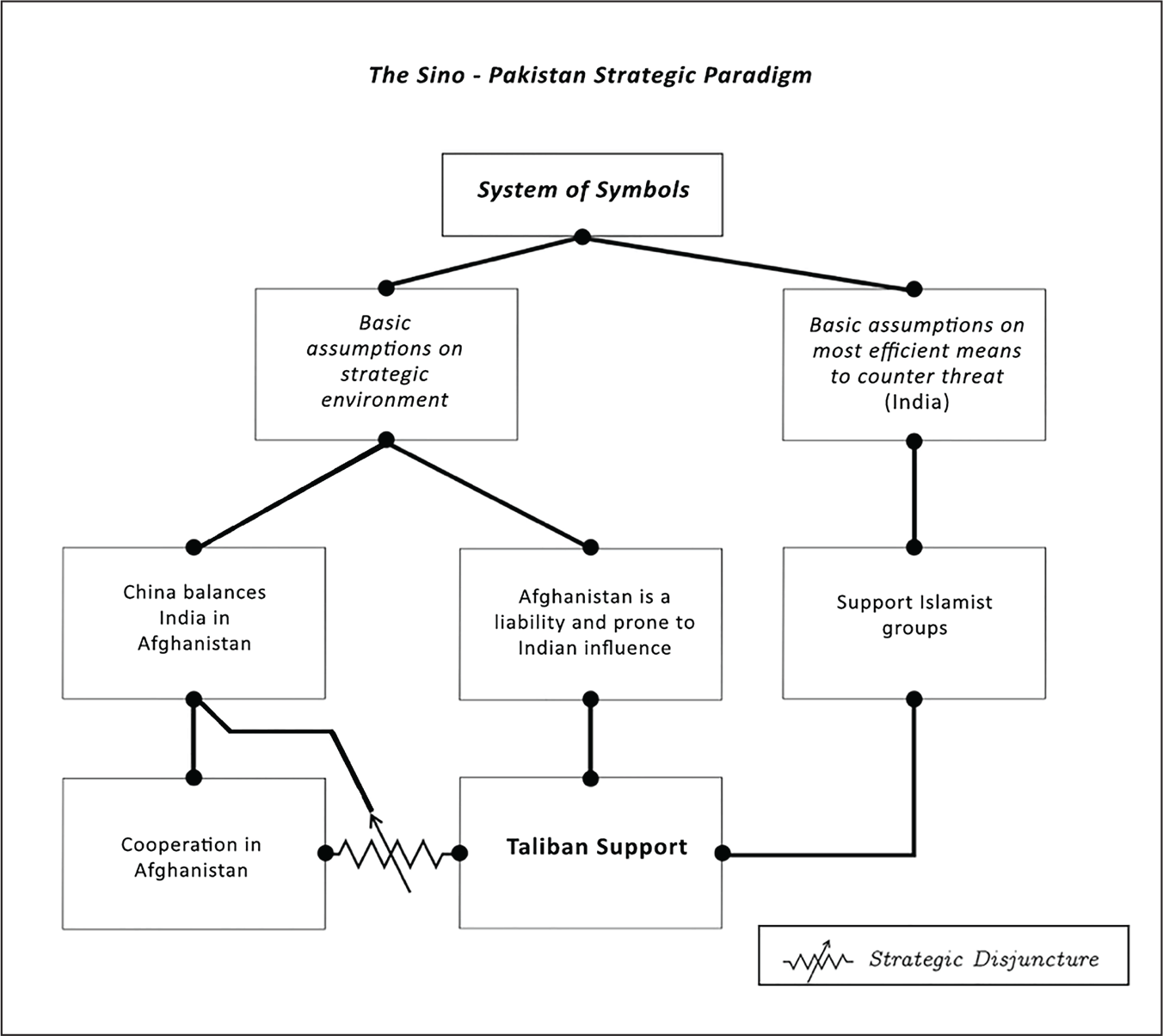
Pakistan’s strategic culture sees grand strategic utility in the Sino-Pakistan strategic partnership.
Pakistan’s support for the Taliban in Afghanistan forces a strategic disjuncture with China.
China cannot realise its economic and strategic objectives in Afghanistan without Pakistan reducing its support of Islamist groups.
Strategic culture explains some constraints on changes in Pakistan’s Afghanistan policy. However, the conceptualisation offered presents two mutually incongruous constraints to Pakistan’s Afghanistan policy. First, the ideational consistency that underpins Pakistan’s strategic culture prevents it from shifting its Islamist Afghanistan posture. Second, the strategic disjuncture illustrates how Pakistan’s regional strategy of ‘strategic depth’ through support for Islamist groups is incongruent with a deeper Sino-Pakistan strategic partnership (Figure 4). Hence, the strategic constraints of Pakistan’s Afghanistan policy are symptomatic of strategic culture but contain ideational and strategic elements.
In justifying this conclusion, strategic axioms point to geography and history with equal measure to ideation. This justification is drawn primarily upon the grand strategic nature of strategic culture and its regard for historical experience. Because Indian insecurity forms the basic premise of Pakistan’s strategic culture towards Afghanistan, strategically and indeed culturally through historical experience, China stands as a key determinant in defining Pakistan’s Afghanistan policy and arguably its strategic culture. This proposition rests on two strategic axioms.
First, China’s historical alliance as Pakistan’s greatest ally is typified by the most significant asset an ally can offer: a nuclear capability. Indeed, bestowing on an ally a nuclear capability is a salient example of grand strategic realism. Second, and with varying degrees of intractability, China and Pakistan both see India as a strategic rival. For Pakistan, Indian hostility is central to its own self-conception. For China, India poses a significant geostrategic challenge to Chinese regional hegemony. Hence, the Sino-Pakistan strategic partnership dwarfs Pakistan’s support for the Taliban because Pakistan’s strategic culture is founded on basic Indian insecurity rather than ideational affinity for the Taliban in Afghanistan.
Fair (2014) terms Indian ‘hegemony’ as a central determinant of Pakistan’s strategic preferences. The grand strategic element for Pakistan’s strategic culture is China’s fundamental geopolitical counterbalance to India; this is often analytically overlooked. Geostrategic considerations are inherent to strategic thinking. This conclusion sees Pakistan’s grand strategic preference locate China above the Afghan Taliban when measuring unit utility. That said, the ‘strategic’ aspect of Pakistan’s ‘strategic culture’ requires deeper examination to understand how China factors in Pakistan’s strategic culture and its impact on policy flexibility.
Johnston (1995b, p. 46) notes within the ‘system of symbols’ framework that assumptions concerning the strategic environment are derived from ‘deeply historical sources, not from the current environment’. Looking back invariably implicates Pakistan’s wars with India, border disputes and border skirmishes, but it also highlights China’s shared strategic enmity with India over issues of geography and protracted disputes, largely out of mutual misperceptions. 1
For a discussion on mutual misperceptions in conflict during the Cold War between India-China, see Ranganthan and Khanna (2000).
Conclusion
This article sought to highlight the growing tension that exists between Pakistan’s support for Islamist groups in Afghanistan and its relationship with China. If China comes to see Pakistan’s support for groups such as the Taliban as incongruent with its economic interest in South Asia, a strategic disjuncture emerges in Afghanistan. Thus, China acts as a strategic constraint on Pakistan’s Afghanistan policy. The gap within the literature on Pakistan’s strategic culture this article sought to remedy was locating China within Pakistan’s basic assumptions on its strategic environment. Because strategic culture deals directly with grand strategic thinking, China presents a legitimate strategic constraint to Pakistan’s Afghanistan policy, beyond the self-imposing nature of strategic limits on choice inherent to strategic culture. Concerning Afghanistan, the Taliban are a key preference for Pakistan. However, the source of strategic insecurity that predicates Pakistan’s strategic culture is India, not Taliban failure in Afghanistan. Ultimately, from a grand strategic perspective, China is a central variable in Pakistan’s strategic culture and a key constraint on its Afghanistan policy.
Three key scholarly implications can be drawn from this study. The first implication is the duality strategic culture offers in analysing Pakistan’s Afghanistan policy. Many experts point to strategic culture in explaining Pakistan’s behaviour, but for Afghanistan, the concept is more instructive in highlighting how policy flexibility is reduced. Viewing strategic culture principally as a constraint, and epiphenomenally, as an explanatory factor, the concept’s bounding nature is a key scholarly implication of this study. The second implication is that while Pakistan’s support for the Taliban is correlated to strategic culture within the military, its support for Islamist groups in Afghanistan is a direct consequence of strategic culture. Pakistan’s support for the Taliban originated as a policy preference, while its support for Islamist groups in Afghanistan is a causal consequence of strategic culture within the military. The third implication, which also points to further research, is conceptualising how China factors in Pakistan’s strategic culture given variables such as grand strategy, history and geography. The Sino-Pakistan strategic partnership is a locus of geopolitical power that is unlikely to pale in significance to strategic scholarship as China’s rise challenges global order and redefines post-Cold War security structures.
Footnotes
Declaration of Conflicting Interests
The author declared no potential conflicts of interest with respect to the research, authorship and/or publication of this article.
Funding
The author received no financial support for the research, authorship and/or publication of this article.