



Abstract
As demand increases for well-trained public health professionals, academic leaders of universities and colleges must tailor their curricula to prepare students to be ready for the public health workplace, while also providing critical thinking and awareness skills through a liberal arts course context. Temple University’s undergraduate public health program has created a capstone experience that bridges these two priorities. Using public health community-based program planning and evaluation as its content, this two-semester (32 weeks) writing-intensive course provides training for students in writing a grant proposal, including conducting a needs assessment, devising evaluable program goals and objectives, creating an intervention and planning its implementation and evaluation, and developing budgeting and marketing plans. Students also complete related assignments that help develop the critical thinking skills they need to understand the context of public health within the larger society. Utilizing the LEAP Essential Learning Outcomes, we infuse integrative, interdisciplinary, and applied knowledge with the concept of civic responsibility as pathways for ensuring learning, while still providing concrete skills related to public health practice. We discuss how the course is implemented and how public health practice and liberal arts learning objectives are emphasized to ensure an “educated citizenry.” Universities and colleges that offer an undergraduate degree in public health can use this framework to implement a capstone experience that bridges both public health and liberal arts skills.
The increase in undergraduate public health programs in the United States is a response to the national call for universal access to education in public health to foster the understanding of public health principles. This is noted as essential to creating an educated citizenry that contributes to the health of the public (Gebbie, Rosenstock, & Hernandez, 2003; Petersen & Plepys, 2011). Undergraduate programs in public health now exist in many 4-year and, recently, 2-year higher education programs, and public health is now one of five college majors on the rise in the United States; the number of public health bachelor’s degrees has doubled between 2003 and 2009 (Fischer & Glenn, 2009).
A challenge to undergraduate programs is building a curriculum that provides a liberal arts framework to increase overall understanding of public health in the context of critical thinking and problem solving, while still offering a practice-based framework that provides tangible skills for newly graduated students who plan to work in public health (Rozier & Scharff, 2013). According to the Association of American Colleges and Universities (AACU), liberal education refers to an overall undergraduate experience that combines both a general education in many areas and in-depth study in at least one area (AACU, 2002). College and universities have used this framework to identify principles and promote strategies for undergraduate learning. In the case of public health, this “educated citizenry” (Riegelman, Albertine, & Persily, 2007, p. 4) should be able to practice public health through the lens of critical thinking and be empowered by their broad knowledge and strong sense of values, ethics, and civic engagement (Albertine, 2008). It has been suggested that undergraduate programs should keep in mind the LEAP (Liberal Education and America’s Promise) Essential Learning Outcomes, which advocate for integrative, interdisciplinary and applied knowledge and practice with community outreach and civic responsibility as pathways for ensuring learning (AACU, 2007a; AACU, 2007b; Albertine, 2008; Riegelman, 2008; Riegelman & Albertine, 2011). Building on this initiative, the recently completed Undergraduate Learning Outcomes Model, developed by the Association of Schools and Programs of Public Health (ASPPH) and in collaboration with the AACU, the Association for Prevention Teaching and Research (APTR), and the Centers for Disease Control and Prevention (CDC), has both liberal arts and practice-based dimensions (ASPPH, 2011). This blending of frameworks is especially important when it is estimated that 250,000 more public health workers will be needed by 2020 to maintain capacity (Association of Schools of Public Health, 2008; Association of State and Territorial Health Officials, 2009).
Temple University, located in Philadelphia, PA, has responded to this need to offer undergraduate opportunities for public health training within a liberal arts framework that teaches knowledge of human cultures in the physical and national world, intellectual and practical skills, personal and social responsibility, and integrative and applied learning. Located in a College of Public Health within the Social and Behavioral Sciences Department, this program offers a BSPH, a public health minor, and a new 4 + 1 program to enable students who excel in their first few semesters to acquire a BS and MPH in 5 years. The undergraduate program has been named a national “Best Practice” by the Healthy People 2020 Curriculum Committee, the AACU, and APTR (Bass, 2012) and is fully accredited by the Council on Education in Public Health. The overarching philosophy of the undergraduate program is that undergraduate public health education can make a substantial contribution to building an educated citizenry as well as an entry-level work force that understands the role and value of public health (Gebbie et al., 2003; Petersen & Plepys, 2011).
To ensure the development of core LEAP Essential Learning Outcomes, public health students’ experiences are rooted in the community, and it is expected that graduates will understand the role public health has in fostering health within human cultures in the physical and national world. Majors learn to use critical thinking skills by analyzing interventions, gain experience in assessing the needs of target populations, clarifying program goals and objectives, and developing evidence-based strategies to motivate communities through educational interventions. To ensure that students are able to apply both intellectual and practical skills, majors must produce a capstone project. The capstone is completed in a two-semester, writing-intensive program planning and evaluation sequence that provides students an opportunity to put together the skills they have learned in other coursework (e.g., epidemiology, health behavior theory, disease prevention) to create and plan a community-based public health intervention. This is done through the integrative and applied learning mechanism of writing a grant proposal to a fictitious foundation, so students also learn budget skills, persuasive writing, and gain an understanding of how public health interventions are funded, while also critically evaluating literature, becoming engaged in the needs of their target community, and discussing ethics of developing culturally relevant interventions. While it is not expected that students will gain all skills needed to fulfill the LEAP Essential Learning Outcomes in this one course, we propose that their integration into the major’s capstone, along with their other public health and general education coursework, provide a framework for students to see public health through this liberal arts prism.
This article outlines the capstone course context, content, and delivery and highlights how curriculum planning has integrated both intellectual and practical learning outcomes. The skills of program planning and grant writing are essential to the public health arena, as are the broader skills of critical thinking, personal and social responsibility, and extrapolation to the larger picture. Thus, the purpose of this article is to describe how a capstone course can begin to provide these skills to undergraduate public health students within the larger context of their general education and public health curriculum.
Course Context
The capstone is a two-course sequence taken over two semesters (Introduction to Public Health Programs and Administration and Marketing of Public Health Programs) by public health majors, typically in the fall and spring of their junior year. The capstone is taken after the completion of the content-specific 1000 and 2000 lower level courses and concurrently with skill-based upper level courses such as theories of teaching and learning and a “professional seminar,” which provide concrete instruction on entry to the workplace. The course is meant to also provide practical skills prior to the student going out to complete two internships prior to graduation.
The Council on Linkages between Academia and Public Health Practice (2014) has identified eight core competencies for public health professionals. These two capstone courses touch on the skills in all eight of these competencies, and most specifically program planning and communication skills, as well as assessment, cultural competency, and financial management. The course is also grounded in LEAP Essential Learning Outcomes, with course curricula addressing the value of cultural approaches for meeting public health concerns, discussion of social justice and community capacity, the role of demographics and their effect on population health, and articulation of larger societal issues that affect personal health behavior (Albertine, 2008; Riegelman & Albertine, 2011). In addition, Temple University requires each major to offer at least two writing-intensive, field-specific courses, and these courses fulfill this general education prerequisite. Key requirements of the writing-intensive designation are that all students must engage in an iterative writing process with their instructor, the writing assignments that include required revision must count for at least 40% of the students’ final grade for the courses, and the ratio of students to instructors must not be greater than 20:1.
Because of the large number of public health students, and the limited class size, multiple sections are offered to accommodate students at this stage in their academic progress. Full-time faculty members, with community-based participatory research experience and knowledge about writing in the discipline, teach these sections. Students register for classes taught by the same faculty member for both semesters, allowing for consistency in exposure to course content, teaching style, and relevance of feedback as students develop their capstone project across the two semesters.
This capstone follows identified good practices in undergraduate education (Astin, 1993, 1999; Chickering & Gamson, 1991). Frequent student and faculty contact is encouraged through small seminar size, and the draft revision process provides prompt feedback (i.e., within 2 weeks of submission) with suggestions for improvement. The course also allows for the development of an active learning community through in-class exercises that build up to independently produced grant sections, emphasizing broader critical thinking, personal and social responsibility, and the integration of intellectual and practical skills. Finally, effective time management skills are emphasized through a paced two-semester development of the final grant.
Course Content
The course content is grounded in the PRECEDE–PROCEED planning framework (Green & Kreuter, 1999) and provides the student with an overview of program planning and evaluation concepts throughout the two semesters. This planning framework is an evaluation framework that can help program planners analyze situations and design efficient programs that directly relate to a community’s needs. It leads a planner through the process of identifying a health priority, understanding behavioral and environmental determinants in a specific community, identifying predisposing, enabling, and reinforcing factors that affect that community, and elucidating administrative and policy factors that might influence what is being implemented. It then allows for evaluation of an intervention once implemented (Crosby & Noar, 2011; de Jersey, Mallan, Callaway, Daniels, & Nicholson, 2016; Ghaffarifar, Ghofranipour, Ahmadi, & Khoshbaten, 2015; Green & Kreuter, 1999; Moshki, Dehnoalian, & Alami, 2016). It also allows for the integration of liberal arts learning outcomes and public health practice skill acquirement. Course content (see Table 1) is taught using a variety of pedagogical techniques, including lecture, discussion, multimedia, and in-class exercises. Content is infused with both LEAP and practice-based learning outcomes. For example, to discuss community assessment, classes engage in an exercise where volunteer students are given roles of community members and the rest of the class is charged with asking them questions about their needs as a way to understand how resources should be distributed in the community. The scenario is a fictitious health department hearing, and each volunteer represents a different person with unique characteristics (e.g., a teenage pregnant girl who smokes, an overweight adolescent). The rest of the class uses the class time to get to know the characters and understand what resources they may need to address their health issues. A nominal group process is then used to narrow down the key areas of intervention and discuss the types of resources that are required. This type of experiential exercise bridges both liberal arts and practice-based learning outcomes by teaching not only an understanding of demography, social justice, and analyzing information using critical thinking skills, but practice at a type of community-engagement technique (nominal group process).
Capstone Course Topics.

As an adjunct to the course material, applied and critical thinking skills are also gained through the writing of the grant proposal to a fictitious foundation. With this exercise, students learn practical budget skills and understanding of how public health interventions are funded, and also persuasive writing skills and the ability to describe how community partnerships promote population health. Classroom time is then spent not only on going over the above topics but also providing writing and research skills practice to ensure that students are able to adequately research and write their grant proposal. Internet searching, use of scholarly databases, use of CDC/NIH and local data sources, use of the U.S. Census website, and how different funders provide support for public health interventions are all discussed in class, as well as instruction on how to critically evaluate literature and apply it to community interventions. Both skill sets are thus essential to the experience and provide needed skills that can be applied not only in other classes but also in internships and employment after graduation.
Course Assignments and Integration of Liberal Arts and Practice-Based Learning Outcomes
Course assignments are directly mapped with the PRECEDE–PROCEED planning model phases (Green & Kreuter, 1999) and are designed to foster both intellectual and practical skill development, as well as provide multiple opportunities for individualized feedback on grant sections. The in-class skill-building assignments range from being academic (e.g., interpreting research articles) to being more practical (e.g., community visit, writing a press release). This range of activities is consistent with the course emphasis on community-based program planning and the goal of providing a learning experience that is both theoretical and experiential and bridges learning outcomes from both public health practice and liberal arts. All assignments are mapped to their corresponding practice-based and liberal arts learning outcomes to guide instructors in how to present material and establish benchmarks for success (see Table 2). A review of the skill-building assignments across the two semesters is provided in Appendix 1 (available online at php.sagepub.com/supplemental).
Course Assignments, Relationship to PRECEDE–PROCEED Phases, and Learning Outcomes.
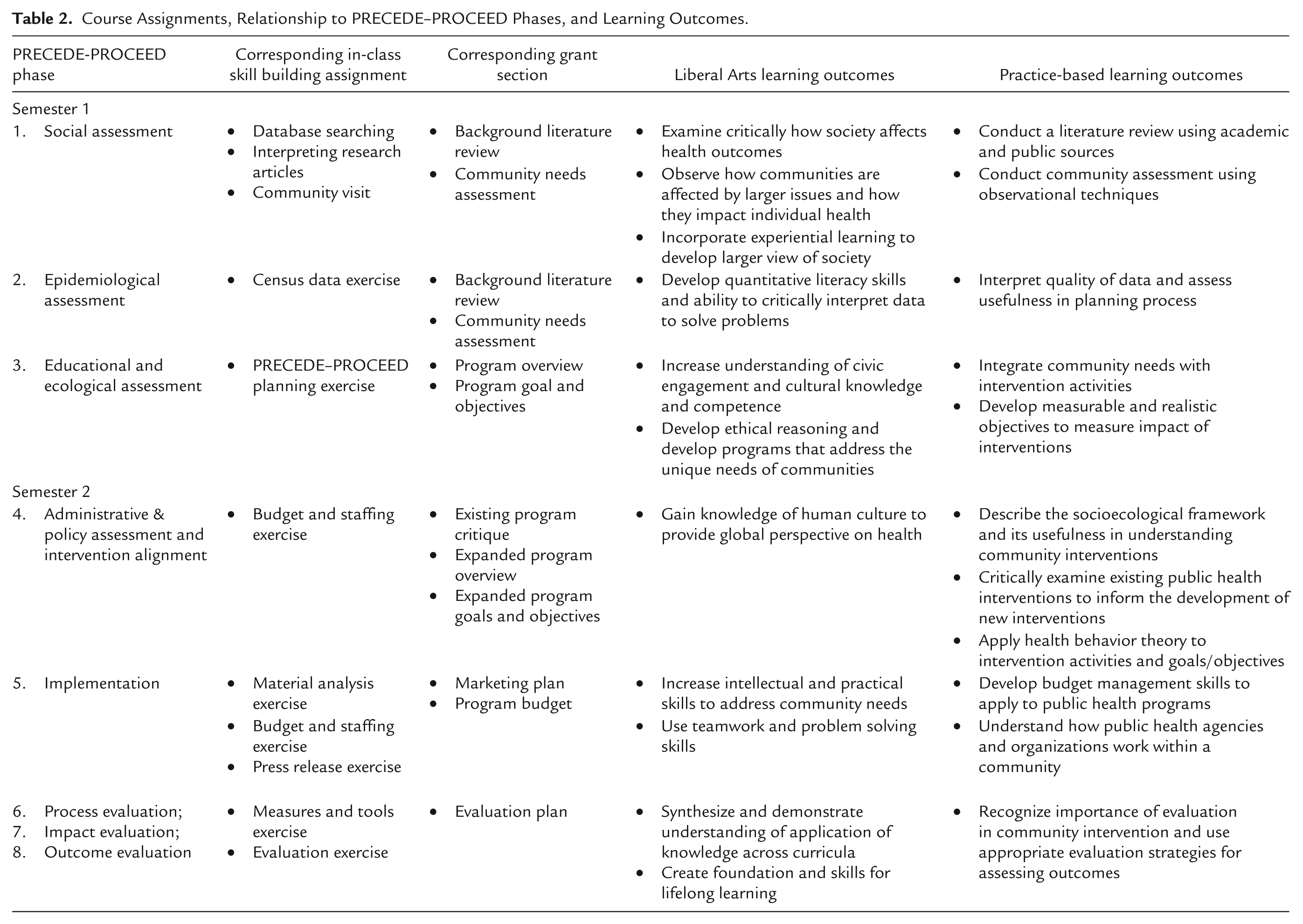
Graded skill-building assignments are typically returned to students 1 week prior to the deadline for the corresponding grant draft section. For example, a “measures and tool” exercise and an “evaluation” exercise are returned 1 week before the full evaluation plan is due. This timing allows students to process feedback and incorporate lessons learned as they prepare the corresponding grant section. It also allows students to use a variety of skills sets, which build throughout the two semesters. Across the two semesters, eight unique section drafts are submitted (Table 2). Instructors review the drafts and provide line-by-line edits in the first pages of a draft and more general feedback in latter pages. Submission of the section draft earns draft submission points; however, the quality of the draft is not scored. Instead, students are required to review feedback, revise the document, and compile with the other grant sections to make one, more polished, culminating document that is submitted at the end of each semester. At the end of the second semester, the final project submission also includes sections submitted in Semester 1, so a full grant submission is completed. (A review of the grant sections is provided in Appendix 2, available online at php.sagepub.com/supplemental.)
Thus, multiple opportunities for feedback are afforded to each student and they build on critical analysis skills throughout the two semesters. It is expected that by the end of the second semester, the student is able to grasp the practical process of writing a grant proposal and also exhibit the ability to process information, make cogent arguments about the need for intervention within a chosen community, argue for why a community has been chosen, and articulate the special needs of that community by developing a developmentally and culturally relevant intervention plan. This culminating product then blends intellectual and practice-based learning outcomes.
Challenges to Integrating Liberal Arts and Practice-Based Learning Outcomes
Integrating liberal arts learning outcomes in a practice-based course has challenges, especially in light of practical implications for teaching a multisection, writing-intensive course. The content of this course requires thorough and rigorous assignments and exams that need intensive feedback and grading. With some faculty teaching two sections of the course, with 40 students per semester, the amount of time required to simply grade this number of papers is challenging. In the context of ensuring that students develop critical thinking skills and the ability to analyze literature and apply it to communities, this can be a daunting task. One strategy to address this challenge is having faculty meet regularly to discuss issues, get feedback for how to best integrate critical thinking skills, and share strategies for engaging students. This constant communication also ensures the maintenance of teaching and grading fidelity, and being clear on all learning outcomes.
Temple University also attracts international students, where many come with limited English language skills and have not been educated in a system that emphasizes liberal arts learning outcomes. As such, students may not understand what is required of them to successfully fulfill intellectual or practical learning outcomes. These students require special support, whether in the mechanics of writing, an understanding of practical aspects of program planning and grant writing, or the more global critical thinking skills and understanding of cultural diversity, ethics, and politics of public health. While basic writing skills can be referred to the university’s Writing Center where staff can assist with grammar and proofreading, the bigger challenge is to infuse broader understanding of how public health can be seen in the context of human cultures and provide opportunities for them to explore their own cultural beliefs. These students must not only recognize the importance of social structure within the United States but also relate the experience here to their own. This is a significant challenge to infusing liberal arts ideas into this two-semester capstone course curriculum.
Although requiring a tremendous amount of faculty time and effort, most who have taught this course agree that it is a rewarding experience as it provides the capstone students with an opportunity for intellectual and applied growth in the field of public health, bridging the liberal arts and public health skill frameworks. Faculty members have the opportunity to mentor students and witness the growth of their skill sets. By ensuring both an understanding of public health and the broader context in which public health exists, the development of these skills position these students above other recent public health graduates in the workforce, giving them the edge they need to be gainfully employed.
Relevance for Undergraduate Public Health Education
Program planning and grant writing are integral skills for public health practitioners, as are critical thinking and the ability to analyze, problem solve, and extrapolate to larger societal issues. The blending of these skills is extremely important to helping students recognize the importance of culture, social structure, and politics of public health (Aelion, Gubrium, Aulino, Krause, & Leatherman, 2015), and understand the practice of public health in a broader sense. Other universities offering an undergraduate degree in public health can use the model presented in this article to bolster or create their own courses to ensure that both liberal arts and practice-based skills are integrated and complement each other with the goal of producing students with the ability to be “educated citizens” (Riegelman et al., 2007, p. 4). While this evolution cannot occur in one two-semester course, we would argue that infusing all public health criteria with these skills will complement other general education/liberal arts classes and provide public health students context for what they are learning. The challenge to public health undergraduate courses is to ensure the integration of LEAP Essential Learning Outcomes into the practice-based curricula, and their equal emphasis within the curricula.
The use of fictitious institutions (i.e., health department, foundation) enhances the feasibility of this approach, but is limited in the sense that a “real-world” context is not provided. Despite this drawback, feedback received from students on the course evaluations as well as anecdotal feedback received from recent graduates indicates that it is one of the most challenging courses they face in their undergraduate studies, and also one of the most valuable to their subsequent internships and careers. This is a good test of the worth of the capstone experience: that it is useful and stimulates intellectual growth.
Moving forward, this college will be faced with continuing assessment of course content as the program continues to experience considerable growth in the student body. One aspect of assessment concerns the use of LEAP-based rubrics: each LEAP Essential Learning Outcome has a corresponding rubric and the use of these rubrics within this capstone course is an important future direction, in which the rubrics could be integrated into existing rubrics for not only the capstone courses but also other public health curricula. A second aspect of assessment is the need to maintain quality assurance in course content and ensure that practice-based and liberal arts learning outcomes are achieved within the larger public health curriculum. The ability to provide this broad experience is essential to the public health undergraduate capstone experience and contributes to the development of an “educated citizenry” more ready to address the public health challenges of the 21st century.
Footnotes
Acknowledgements
The authors gratefully acknowledge the thousands of students who have completed and helped guide the content of this course.
Authors’ Note
Sheldon O. Watts is now at Drexel University, Philadelphia, PA, USA.
Declaration of Conflicting Interests
The authors declared no potential conflicts of interest with respect to the research, authorship, and/or publication of this article.
Funding
The authors received no financial support for the research, authorship, and/or publication of this article.
