



Abstract
The online Executive MPH (EMPH) Program at Emory University offers three majors, and prior to 2015, all integrated learning experiences (ILE) required theses. In 2015, the Program adjusted the ILE requirement based on each major’s intended career outcomes: Applied Epidemiology (Epidemiology: research thesis); Applied Public Health Informatics (Informatics: program-focused capstone courses instead of thesis); Prevention Science (Prevention: choice of research or program-focused thesis or program-focused capstone courses). Our goal was to describe major-specific curricular changes of the ILE requirement aimed to reduce time-to-graduation. We compared three cohort years before (2012–2014) and after (2015–2017) the 2015 curricular change using registrar data of time-to-graduation (339 students) and students’ self-reported satisfaction with their thesis experience (152 students). Informatics and Prevention majors had significantly more students (34%–35%) graduate on time in the 2015–2017, compared to the 2012–2015, cohorts. There was no significant difference by cohorts in perceived student thesis satisfaction in Informatics and Prevention majors and a decrease in satisfaction in Epidemiology majors. Before 2015, the main theme reported as a detractor to thesis satisfaction was lack of Program thesis support. After 2015, this detractor theme was not mentioned and instead a motivator theme was continuous thesis support. After 2015, the main detractor theme was difficulty with time management. Consistent motivator themes across 2012–2015 included thesis committee support and students’ self-fulfillment due to their thesis learning experience. The curricular strategies described can inform other online and residential programs that have a thesis requirement for the ILE.
Introduction
Globally, Master of Public Health (MPH) programs are offering new online curricula to offer flexibility in training the new public health workforce (Mukhtar et al., 2020; Taparia, 2020). For example, in 2022, the Association of Schools and Programs of Public Health (ASPPH) reported 94 online or online/on-campus hybrid MPH programs in diverse disciplines (Association of Schools and Programs of Public Health, 2022). These online MPH programs, like all accredited programs, are expected to train students in specific competencies through engagement with coursework, applied practice experiences, and an integrative learning experience (ILE) (Council on Education for Public Health, 2022). The ILE is meant to take place near or at the end of a student’s MPH training and is intended to “integrate” and apply knowledge and skills gleaned from coursework and academic experiences (e.g., workshops, seminars, applied practice experiences [practica]) gained through the MPH degree. The ILE may take many forms, including essay-based comprehensive exams, practice-based project, integrative seminar, capstone courses (courses at end of degree synthesizing past academic trainings) (Cox et al., 2021; Fifolt et al., 2022), and theses, among other options (Council on Education for Public Health, 2022).
Theses have traditionally been used toward the end of undergraduate and graduate programs to evaluate a student’s integration of past trainings (Cuschieri et al., 2018; Duke, 2018). Theses follow the “apprenticeship” model where individual students are paired with one or several faculty members (i.e., thesis committee) who can guide the student through an independent written deliverable (Bruce et al., 2008). Though beneficial for independent student learning, this model of student training may delay the student’s time to degree completion (Bruce et al., 2008; Coruth et al., 2019; Skeith et al., 2018). Challenges may include delays or difficulties identifying an original and feasible thesis topic, securing faculty that can support their theses, and completing their theses in the intended timeframe for degree completion. These challenges are magnified for students completing online degrees requiring a thesis. Online graduate students may be working professionals with multiple personal and work commitments (Davtyan et al., 2021). For this group of students, the independent and flexible format of a thesis may lead to its de-prioritization given other ongoing priorities (Hunt et al., 2022). Further, online students, compared to residential students, may also feel socially distant from faculty and other peers who could otherwise offer social support (Trinh, 2022) in advancing through a thesis process (Hunt et al., 2022). As many online programs consider whether to add or continue online curricula, including theses, it is important to improve the online student’s thesis experience and time-to-graduation.
The Executive MPH (EMPH) Program at Emory University, a hybrid-online MPH program for working professionals, was established in 1999, and annually enrolls an average of 58 MPH students divided into three majors: Applied Public Health Informatics (Informatics), Applied Epidemiology (Epidemiology), and Prevention Science (Prevention) (Emory University, 2020). Prior to 2015, all students (Informatics, Epidemiology, Prevention) were required to complete a research thesis for their MPH degree. Students were expected to identify a research thesis topic and a committee with limited support. Program leadership noticed a longer-than-expected time toward graduation among their students, identified that this lag was primarily due to completing a thesis requirement, and identified opportunities for ILE improvement through an internal student needs-assessment that informed recommendations for Program leadership. Thus, in 2015, the Program re-designed the ILE expectations (Figure 1) and support (Table 1) for its students based on their major’s intended post-MPH career trajectories. Specific student checkpoints were included in these activities to ensure students stayed on track toward on-time graduation and to identify those students needing additional advising support.
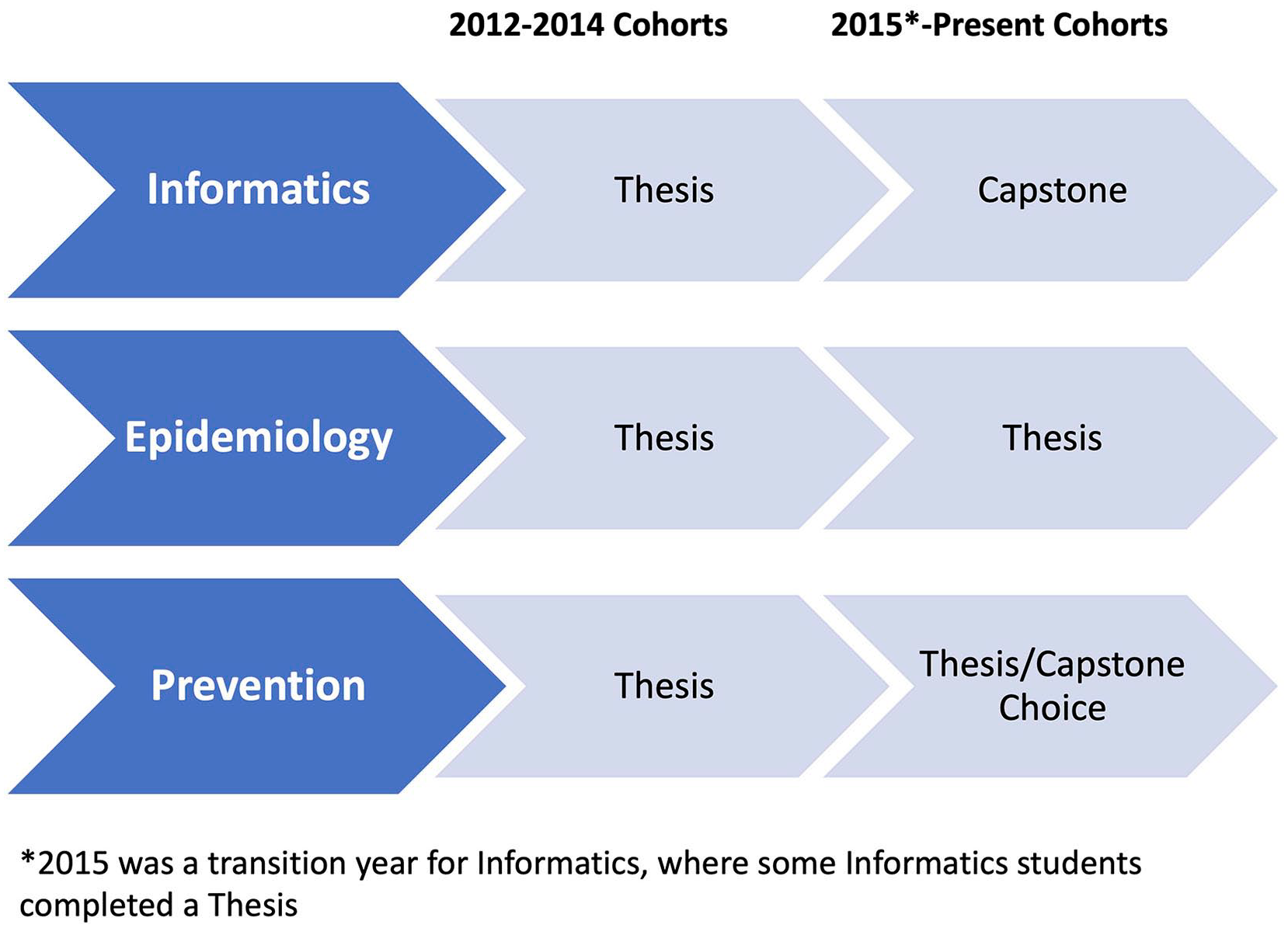
ILE requirements by Program major before (2012-2014 cohorts) and after (2015-Present) the 2015 Program curricular change.
Advising Integrative Learning Experience (ILE) activities supporting Program students after 2015 for six-semester graduating students (termed “full-time student”).

LMS: Student resources residing in learning management system (LMS).
Thesis students are Epidemiology and Prevention students who selected Thesis in Y1 Spring.
Self-paced class also includes two synchronous interactive workshops.
GIR: Graduate in Residence are students who have completed all their courses but need an Applied Practice Experience (i.e., practicum) or a Thesis to graduate.
ILE Improvements for the Epidemiology Majors: Dedicated Faculty ILE Thesis Advisor Support and Course on Thesis Expectations
Epidemiology students were expected to pursue research careers (e.g., clinical trials analyst, public health modeler) utilizing epidemiological skills. As such, their ILE should demonstrate the ability to analyze and interpret epidemiologic data. Thus, as an ILE for Epidemiology students, the Program decided to continue the ILE requirement of a research thesis analyzing a secondary dataset using epidemiologic methods acquired from Epidemiology coursework. Epidemiology students were introduced to this research thesis requirement, during orientation, and in more depth at the beginning of their second semester (Table 1).
To address the previously mentioned internal student needs-assessment result that highlighted a lack of thesis guidance and support, for Epidemiology students, the Program developed thesis guidance and support composed of two elements to improve time toward graduation. The first element was to assign all Epidemiology students a dedicated faculty member, named “ILE Thesis Advisor,” whose goal was to introduce the ILE expectations to students and assist them in identifying a thesis topic and a committee. The ILE Thesis Advisor remained available to troubleshoot concerns for the student and/or thesis committee while students were undertaking a thesis but ongoing thesis advising was the responsibility of the student’s thesis committee (composed of a thesis Chair and a second committee member named a “Field Advisor”). The second element was to require, prior to identifying a thesis topic and committee, completion of a self-paced thesis course (Table 1). The self-paced thesis course was led by the ILE Thesis Advisor, prepared students for their thesis experience using videos and interactive online activities and included thesis experience topics such as: identifying a thesis topic and a committee, developing a problem and purpose statement, researching the literature, and securing ethics approvals. To support the student in consolidating their thesis topic and timeline toward thesis completion, the end deliverable of the course was a two-page thesis concept description including a background summary, a thesis problem and purpose statement, a methods summary, and a detailed 1-year timeline to thesis completion. This deliverable was used by the ILE Thesis Advisor, post-class, to refine their thesis topic with the student and identify their thesis committee with the necessary experience to advise on the topic and provide mentorship based on the student’s needs.
ILE Improvements for the Informatics Majors: Capstone Courses as an ILE
Informatics students were expected to pursue programmatic careers (e.g., informatics project manager, health informaticist) utilizing public health informatics skills. As such, their ILE should demonstrate leadership and strategy skills in informatics combined with use of informatics for applied decision-making. Thus, as an ILE for Informatics students and to improve time to graduation, the Program decided to adjust the ILE requirement from a research thesis to a series of two capstone classes titled, “Public Health Informatics Leadership and Strategy” and “Advanced Data Science and Decision Support.” However, to meet graduation credit requirements during the curricular transition, some students in the 2015 cohort also completed a modified thesis in the form of a professional research portfolio. Informatics students were introduced to the capstone course requirements during orientation (Table 1).
ILE Improvements for the Prevention Majors: Option Between Thesis or Capstone Courses as an ILE, Dedicated Faculty ILE Thesis Advisor Support, Course on Thesis Expectations, and Expanded Thesis Options
Prevention students were expected to pursue either research or programmatic careers (e.g., surveillance analyst, nutrition program manager) using research and programmatic skills derived from their coursework. As such, their ILE should demonstrate either the ability to collect and/or analyze and interpret research data or the ability to contribute deliverables toward a public health program. Thus, as an ILE for Prevention students, the Program decided to offer Prevention students a choice between two options. One option was to take two capstone classes titled, “Public Health Advocacy” and “Program Planning.” The second option was a thesis focused on either research or programmatic outcomes. These options, compared to prior to 2015, were better defined and detailed in the students’ Thesis Manual and explicitly linked to career outcomes (research vs. programmatic careers). Prevention students were introduced to these two options during orientation and in more depth at the beginning of their second semester (Table 1).
For Prevention students, similar to Epidemiology students, the Program developed thesis guidance and support composed of two elements to improve time toward graduation. The first element was to assign all Prevention students a dedicated faculty, named “ILE Thesis Advisor,” whose first goal was to introduce the two ILE options to students and assist them in choosing, by the end of the second semester, either a two capstone classes option or a thesis option (Table 1). For Prevention students who chose a thesis option, the second element was to require, prior to identifying a thesis topic and committee, completion of the same self-paced thesis course required for Epidemiology students. The ILE Thesis Advisor was responsible for leading Prevention students through the self-paced class and helping advise students on their thesis research or programmatic options based on the students’ future research or programmatic career plans. As with Epidemiology students, the ILE Thesis Advisor helped Prevention students refine their thesis research or programmatic topic and identify their thesis committee that would support the student in their thesis.
Reduction of Program Curriculum Time
For the 2016 cohorts and beyond, the Program curriculum time was also reduced, for full-time students, from seven to six semesters, and for part-time students, from 11 to 9 semesters, for two reasons. One reason was to attract working professionals who preferred a shorter program. A second reason was to align all cohorts so that, when they began in the Fall semester, they would end in the Summer semester (full-time: six semesters later; part-time: nine semesters later). To meet the Council on Education for Public Health (CEPH) accreditation requirements, some courses were adjusted to include additional content and contact hours so all program competencies could be met in a shorter timeframe. Students who exceed the Program’s intended time-to-graduation goals to complete their graduation requirements will have additional financial responsibilities (i.e., tuition and fees). These students also increase the advising burden on Program staff and faculty. Lastly, Program students, staff, and faculty desire that Program students meet the intended Program’s intended time-to-graduation goals to avoid delays of students entering the public health workforce as productive and successful members.
For all these reasons, the objective of this report is to describe the curricular ILE revisions for each of the Program majors aimed to reduce time-to-graduation due to a thesis requirement. The results of this report can serve other online MPH, or non-MPH, programs seeking to strengthen their ILE requirements and reduce time-to-graduation especially as programs are reevaluating their students’ academic experiences.
Methods
Study Population
The population studied in this report consisted of degree-seeking students reported by the Registrar as being matriculated in the 2012–2017 cohorts (n = 339) of the Emory’s Executive MPH Program. This study received exempt status from the university IRB review committee because it was not considered human subjects research and was considered a program evaluation.
Registrar Data
To assess on-time graduation status, Registrar data were analyzed including date of matriculation and date of graduation. Because the curriculum re-design occurred with the 2015 cohort (see Introduction), we chose to compare three cohort years prior to 2015 (2012–2014: 174 students) and three cohort years including and after the 2015 curriculum re-design (2015–2017: 165 students).
Survey Responses
To assess student satisfaction with the integrative learning experience (ILE), Program alumni and current students were anonymously surveyed from existing program email lists. We focused our analyses on the same cohort years analyzed in the Registrar data (2012–2014, 2015–2017). A SurveyMonkey data gathering tool was used to disseminate four separate and identical emails, spaced 2 week apart, of an online survey between June-August 2019. The survey included a skip-logic approach to separately collect data from students pursuing a thesis versus capstone courses as an ILE experience (Figure 1). Survey data included: (1) satisfaction with faculty support; (2) ILE resource availability; (3) increased knowledge and skills; (4) communication from program and instructors; and (5) specific Y/N and open-ended questions on satisfaction with a thesis experience and capstone classes. No individually identifiable data were collected as part of the survey. A $50 Amazon gift card raffle was used to incentivize responses. For anonymity, at the end of the survey, respondents could access a new Google survey link, register their name and contact information, and participate in the raffle. There was no way to link the survey data to the Google raffle survey or the Registrar data. Of the 152 respondents, the percentage by cohort was: 2012 (43% [26/61]), 2013 (23% [15/65]), 2014 (38% [18/48]), 2015 (33% [20/61]), 2016 (57% [29/51]), 2017 (83% [44/53]).
Analyses
Descriptive statistics on sex, citizenship status, race/ethnicity, and age at matriculation were derived from the Registrar dataset. On-time graduation was calculated, using the Registrar dataset, among all students who had graduated by subtracting the number of semesters between graduation and matriculation and including any semesters where a leave of absence was taken. Some students took Program classes in a “special enrollment” status prior to matriculation and transferred in these class credits to their Program degree to reduce the required number of courses. “Special enrollment” students were included in the analyses on graduation rates. A separate analysis on graduation rates, excluding these “special enrollment” students, was also performed. Program students may elect to complete their degree full-time (three courses per semester) or part-time (two courses per semester). On-time graduation was defined, for cohorts 2015 and prior, as seven semesters (full-time students) and 11 semesters (part-time students) and, because of the new curriculum change (see Introduction), for cohorts 2016 and 2017, as six semesters (full-time students) and nine semesters (part-time students).
Thesis satisfaction was calculated from the survey question asking, “How satisfied are you with your overall thesis experience?” by dividing the number reporting “Satisfied” by the total number of respondents to that question stratified by cohort (2012–2014, 2015–2017). Themes of students’ perceptions with their thesis experience were categorized by exporting all the open-ended responses to “Describe why you were satisfied or not satisfied with your overall thesis experience” from each cohort (2012–2017) to a Microsoft Excel spreadsheet. Then, each individual response was read, the core idea(s) summarized into a theme(s), and all themes consolidated into a “theme” dictionary where each theme was assigned a definition and categorized into a thesis satisfaction motivator or detractor theme. 1 week later, using this “theme” dictionary, individual responses were re-read and assigned to a “theme” from the dictionary. In this second review, the theme dictionary was slightly refined by providing greater specificity to the theme definition. As a reliability check, responses were re-read 1 month later and re-categorized using the “theme” dictionary. Discrepancies were resolved through review by a second independent author. Thesis satisfaction motivator or detractor themes that appeared in more than three responses were presented as motivator or detractor themes for that specific cohort (2012–2014, 2015–2017).
All statistical analyses comparing the two cohorts were performed using logistic regression, Fisher’s exact test (two comparisons), chi-square tests (three comparisons), and p < .05 was considered significant. For adjusted logistic regression analyses, models were run for the on-time graduation odds between the two cohorts (2015–2017 vs. 2012–2014) of Informatics students, Epidemiology students, Prevention students, and only Prevention students who completed a thesis. All adjusted analyses included sex and age at matriculation. Because, in the Registrar dataset, only self-reported US citizens had self-reported race/ethnicity data, each model included two adjusted sub-analyses. One sub-analysis adjusted for US citizenship but not US race/ethnicity. The second sub-analysis restricted students to only US citizens, and within this subset of students, adjusted for US race/ethnicity (Asian, Black or African American, Hispanic or Latino, White). For model stability, the small numbers in the categories of “Mixed/Other” and “Unknown” were combined in a new category called “Other.” The cohort of Prevention students only had US citizens and thus their models were only adjusted for sex, age at matriculation, and US race/ethnicity. An evaluation of confounding (10% rule) was performed (Budtz-Jørgensen et al., 2007; Kleinbaum & Klein, 2010). Effect modification could not be performed on each Major’s adjusted models because of model instability.
Results
Overall, across the six analysis years (Table 2), the Program cohorts were predominantly female (77.6%), U.S. residents (97.3%), and of Black or African American (35.1%) followed by White (33.6%) race/ethnicity. At matriculation, the median age was 33 years old. Prevention students comprised the majority (51%) of the population described in the Registrar dataset, followed by Informatics (26%), and Epidemiology (24%) students.
Student Matriculation Demographics a .

Students must have a minimum of 3 years of full-time, post-baccalaureate work experience. However, on average, students have closer to 7 to 8 years of average work experience (depending on the cohort). Students may have another advanced degree, and many do, but it is not required. Students pay for the Program through a mix of scholarships, loans, self- and employer-based funding.
Numbers less than 5 have been redacted in accordance with FERPA guidelines on student privacy.
To compare the on-time graduation rates for each of the majors for the 2012–2014 cohorts versus the 2015–2017 cohorts, each student’s actual number of semesters-to-graduation was compared to the expected number of semesters for on-time graduation (see Analyses). The percentage of students graduating on-time among all graduates was compared across majors (Table 3). Comparing the 2015–2017 to 2012–2014 cohorts, the Informatics (34.9% higher) and Prevention (34.4% higher) students had a significantly higher likelihood of on-time graduation. The Epidemiology cohort exhibited no significant difference in on-time graduation rates. Because all Prevention students completed a thesis in the 2014 and prior cohorts, while only a subset of Prevention students chose to complete a thesis in 2015 and later cohorts, we also compared these two groups of Prevention students that completed a thesis (Prevention—Thesis Only). Prevention students who chose to complete a thesis in the 2015 and later cohorts had a significantly higher (28.8%) likelihood of graduating on time than the Prevention students who were required to complete a thesis in the 2014 and prior cohorts. We then excluded all “special enrollment” students (students who transferred in Program course credits) prior to Program matriculation (see Analyses). When we repeated these analyses, excluding “special enrollment students,” we found the same significant findings and similar magnitude of differences between the cohorts (data not shown) as in Table 3.
On-Time Graduation Rates Before and After the 2015 Curriculum Change, Among all Matriculated Students.
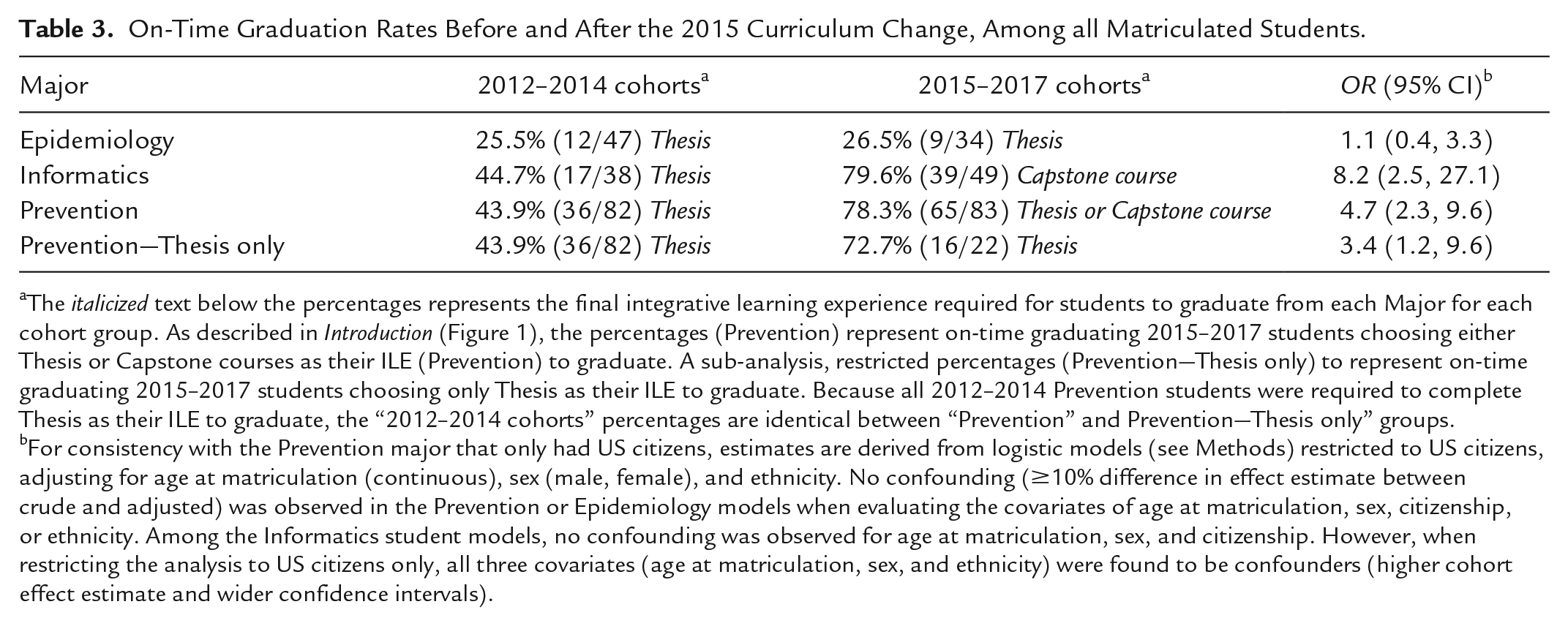
The italicized text below the percentages represents the final integrative learning experience required for students to graduate from each Major for each cohort group. As described in Introduction (Figure 1), the percentages (Prevention) represent on-time graduating 2015–2017 students choosing either Thesis or Capstone courses as their ILE (Prevention) to graduate. A sub-analysis, restricted percentages (Prevention—Thesis only) to represent on-time graduating 2015–2017 students choosing only Thesis as their ILE to graduate. Because all 2012–2014 Prevention students were required to complete Thesis as their ILE to graduate, the “2012–2014 cohorts” percentages are identical between “Prevention” and Prevention—Thesis only” groups.
For consistency with the Prevention major that only had US citizens, estimates are derived from logistic models (see Methods) restricted to US citizens, adjusting for age at matriculation (continuous), sex (male, female), and ethnicity. No confounding (≥10% difference in effect estimate between crude and adjusted) was observed in the Prevention or Epidemiology models when evaluating the covariates of age at matriculation, sex, citizenship, or ethnicity. Among the Informatics student models, no confounding was observed for age at matriculation, sex, and citizenship. However, when restricting the analysis to US citizens only, all three covariates (age at matriculation, sex, and ethnicity) were found to be confounders (higher cohort effect estimate and wider confidence intervals).
We were then interested in assessing whether the additional ILE training and advising support after 2015 resulted in increased satisfaction when comparing the 2012–2014 cohorts to the 2015–2017 cohorts. Based on the question in the survey, “How satisfied are you with your overall thesis experience?” we compared the responses for each of the majors for the 2012–2014 cohorts versus the 2015–2017 cohorts. We found that there was no significant percentage change in reported thesis satisfaction in the Prevention major (2012–2014 cohort [n = 32]: 69% satisfied, 25% neither, 6% dissatisfied; 2015–2017 cohort [n = 19]: 74% satisfied, 21% neither, 5% dissatisfied). With small number of respondents, we found significantly decreased percentage change in reported satisfaction in the Epidemiology major (2012–2014 cohort [n = 12]: 83% satisfied, 8% neither, 8% dissatisfied; 2015–2017 cohort [n = 10]: 20% satisfied, 50% neither, 30% dissatisfied). In response to the question, “Describe why you were satisfied or not satisfied with your overall thesis experience, in the 2012–2014, the one Epidemiology student who reported dissatisfaction reported this was due because the Chair left the program. In the 2015–2017 cohort, the three Epidemiology students who reported dissatisfaction reported this was due primarily to difficulty identifying a thesis idea and dataset (one) and balancing thesis with other academic and personal commitments (two). We found no significant percentage change in reported satisfaction in the Informatics major (2012–2014 cohort [n = 7]: 71% satisfied, 29% neither, 0% dissatisfied; 2015–2017 cohort [n = 2]: 50% satisfied, 50% neither, 0% dissatisfied). As a reminder (see Introduction), starting in the 2015 cohort, Informatics students were expected to complete capstone classes but some students during this curricular transition continued to complete a thesis to meet graduation credit requirements.
Students in the 2015−2017 cohorts, compared to students in the 2012–2014 cohorts, had more access to thesis advising support, including a Thesis class and dedicated ILE Thesis Advisors (Table 1). Students in the 2015–2017 cohort who reported taking the Thesis class stated finding it helpful (Overall 22/27 [81%], Epidemiology 5/9 [56%], Prevention 17/18 [94%]). A greater percentage of students in the 2015–2017 cohort (Epidemiology 7/10 [70%, p = .34], Prevention 18/19 [95%, p < .01]), compared to the 2012–2014 cohort (Epidemiology 6/12 [50%], Prevention: 18/32 [56%]), reported receiving formal guidance on thesis from the EMPH program. Students in the 2015–2017 cohort reported that their ILE Thesis Advisor was helpful with the thesis process (Epidemiology 7/10 [70%], Prevention 14/19 [74%]).
In the 2012–2014 cohorts, the overwhelming thesis satisfaction detractor theme that students reported was lack of program guidance and support on their thesis. An illustrative quote included, “The entire process can feel overwhelming because there seems to be many steps required. In order to navigate the process you need assistance and answers. . . But if you don’t know what to ask you may feel lost and there isn’t really anyone there to hand you the answers.” The main thesis satisfaction motivator theme that students reported included self-fulfillment due to their thesis learning experience and its application to their current role. An illustrative quote included “I was satisfied in that I learned how to use many new tools to incorporate into my practice setting and that I have become very successful using those tools.” A second thesis motivator theme was thesis committee support. An illustrative quote included “. . .my thesis chair was great in reminding me of areas that needed more explanation for non-experts while helping me to fulfill the program requirements. My thesis area field advisor was a wealth of knowledge and great at sending me into the literature.”
In the 2015–2017 cohorts, the main thesis satisfaction detractor theme that students reported was difficulty with time-management. An illustrative quote included, “It was difficult to balance full-time work with the coursework, as well as the thesis work.” The main thesis satisfaction motivator themes that students reported on their satisfaction included support from the Program, the ILE Thesis Advisors, and their thesis committee. Illustrative quotes included, “I was able to choose the topic I wanted to work on, I found a chair and an advisor who assisted me throughout the process, and I received guidance and assistance from [the ILE Thesis Advisor].,” “[the ILE Thesis Advisor] was there at every step, and offered great constructive feedback.,” “I have received continuous feedback that has helped me in my thesis.” Similar to the 2012−2014 motivator themes, a 2015−2017 thesis satisfaction motivator theme was also self-fulfillment due to their thesis learning experience. Illustrative quotes included, “Overall, the thesis experience helped me to apply things I learned during the EMPH program,” “I learned so much, and I’m very proud of my hard work.”
Discussion
The objective of this study was to describe major-specific curricular changes, in 2015 by the EMPH Program, of the ILE requirement aimed to reduce time-to-graduation due to a thesis requirement. Overall, we found that these ILE changes resulted in significant improvements in student’s time-to-graduation in two of three Program majors (Informatics, Prevention) with no significant change in student satisfaction. Before 2015, the main thesis satisfaction detractor theme was lack of Program support on their thesis. After 2015, students no longer reported this theme and instead highlighted that Program support was a thesis satisfaction motivator. Common motivators before and after 2015 included thesis committee support and self-fulfillment due to their thesis learning experience.
We found that the Informatics and Prevention 2015 cohorts and later, compared to earlier cohorts, had significantly increased percentage of students graduating on-time. The most likely explanation was the introduction of capstone classes to both Informatics and Prevention majors to replace their thesis requirements. Capstone classes, unlike a thesis requirement, had specific start and end dates for completion, and were instructor-driven (Cox et al., 2021). In comparison, a thesis experience is more personalized, flexible, and is student-driven (Cuschieri et al., 2018; Duke, 2018; Hardy & Ramjeet, 2005) which may lead to student delays in its completion. In support of this finding, Skeith et al. (2018) emphasized lack of effective time management and accountability as an important barrier in completing a thesis. In contrast to the Informatics and Prevention majors, the Epidemiology major did not add capstone classes for the 2015 and later cohorts, and this may have contributed to the same on-time graduation rates compared to the 2014 and earlier cohorts.
Interestingly, the Prevention students who chose to complete a thesis, in the 2015 and later cohorts compared to earlier cohorts, also had a significant increase in on-time graduation rates. This positive outcome occurred despite the Program’s decrease in their number of semesters to graduation in the 2016 and later cohorts (see Introduction). There are many reasons that could explain this increase. One reason may be that the act of choosing to complete a thesis may self-select individuals who are prepared to lead a self-directed experience like a thesis. A second reason may be that, since 2015, the added Program communication and trainings (Table 1) may have clarified expectations and provided resources that increased the likelihood of on-time graduation. Program support has been cited by many authors as important in helping students complete theses or publications derived from theses (Bruce et al., 2008; Heide et al., 2019; Viđak et al., 2017; Waheed et al., 2020). Further, many students in the 2015–2017 cohorts reported feeling supported by specific thesis support elements including: a helpful Thesis class, available tools, resources and formal guidance, and the ILE Advisors, who were helpful with the thesis process. In their open-ended responses, students supported this hypothesis as represented by main motivator theme of ongoing faculty support from the ILE Thesis Advisors. This one-on-one advising by an ILE Thesis Advisor, prior to engagement with a thesis committee, has been highlighted as a best practice by other reports (Bruce et al., 2008; Heide et al., 2019; Skeith et al., 2018). However, this additional program support introduced for Epidemiology thesis students, including a dedicated ILE Advisor, did not result in significant increases in on-time graduation rates for Epidemiology thesis students. Thus, this reason by itself may not be sufficient to explain Prevention thesis student’s increase in on-time graduation rates. A third reason may be the better structure and description, compared to prior of 2015, of additional Prevention thesis formats (grant proposal, systematic review, program evaluation) that lacked reliance on primary data collection and IRB approval of primary and secondary data analysis. Primary data collection and IRB approval are often reasons for delay. In contrast to the Prevention major, Epidemiology students continue their requirement of secondary data analyses. While this requirement is beneficial for applying their epidemiology training, this requirement may also introduce elements outside the control of the student (e.g., data use permissions, IRB approval) and delay on-time graduation. It is likely that a combination of these reasons contributed to Prevention students’ improved time-to-graduation.
Before and after the 2015 curricular change, students wrote about both detractors and motivators of thesis satisfaction. Prior to 2015, the main detractor theme was the lack of program guidance and support on their thesis. After 2015, no student mentioned lack of program guidance and support on their thesis but instead many students highlighted Program and ILE Thesis Advisor support on their thesis. Thus, these open-ended answers suggest that the programmatic addition of thesis support after 2015 reversed the 2012–2014 cohort’s feelings of lack of thesis guidance and support. For the 2015–2017 cohort, the main detractor theme was difficulty with time management, similar to other findings (Can et al., 2016). Because Program students are working professionals, balancing personal and work obligations with coursework and the independence of a thesis experience is challenging. Further, the Program’s decrease in their number of semesters to graduation in the 2016 and later cohorts (see Introduction) may have exacerbated feelings of difficulty with time management. A motivator theme that was repeated for both 2012–2014 and 2015–2017 cohorts were thesis committee support and self-fulfillment due to their thesis learning experience. These thesis motivator and detractor themes are similar to those from other studies (Skeith et al., 2018; Viđak et al., 2017; Waheed et al., 2020). While these themes are not unique to online programs, they may be exacerbated by the delivery of online and largely asynchronous curricular content. This delivery may increase the feelings of social isolation of students and decrease academic and social check-ins with faculty and peers that motivate accountability in meeting thesis milestones. As suggested by the Program’s curricular change and in other studies (Skeith et al., 2018; Viđak et al., 2017; Waheed et al., 2020), motivators for student accountability in meeting thesis milestone can be intentionally introduced in online programs through dedicated faculty and staff-led advising support. This support, in turn, may be hypothesized to reverse feelings of student isolation and improve academic and social check-ins. Evaluating this hypothesis may be an important future research direction.
This study had several strengths and limitations. Among the strengths, this study was able to describe three separate ILE curricular changes and focus on an objective outcome—time-to-graduation. A second strength was the focus on working professionals enrolled in graduate public health degrees—a population important to strengthening the public health workforce but often understudied. Among the limitations, there may have been recall bias on thesis satisfaction in the surveyed students as students were in varying stages of degree completion from just beginning their thesis experience to having graduated and completed their thesis 5 years prior. A second bias may be a social desirability bias from students who self-report answers they think would “please” the Program. This bias may play a larger role in current student, compared to alumni, populations. Another limitation was the absence of “control” group—a group of students after 2015 that continued with the same curriculum and limited Program thesis support, as before 2015. A “control” group could have strengthened the argument that the curricular changes caused increased on-time graduation percentages and were not caused by external societal factors (e.g., cohorts better able to time-manage and complete independent goals). In lieu of a “control group,” we adjusted our effect estimates for possible demographic confounders (age at matriculation, sex, citizenship, ethnicity) to minimize possible biases of these possible proxies of external societal factors. Lastly, a limitation was also the anonymous nature of the survey data on thesis satisfaction that could not be linked to the Registrar’s demographic data (could not describe student characteristics potentially connected to thesis satisfaction) or individual students (could not describe non-responder bias).
There are many implications to these findings. First, the investment in the 2015 Program curricular changes, supported by several studies (Coruth et al., 2019; Heide et al., 2019; Skeith et al., 2018; Viđak et al., 2017; Waheed et al., 2020), seemed to be associated with a reduced time-to-graduation for an increased percentage of students in 2015 and later cohorts, compared to prior cohorts. Because of the COVID-19 pandemic, MPH programs worldwide may be evaluating whether to add or strengthen their online trainings and may seek strategies to increase the likelihood of an on-time graduation for online students. These programs can consider many of the Program initiatives including: ˍ(1) offering capstone classes as an ILE option; (2) providing personalized student advising (appropriate topic, supportive committee) before beginning a thesis experience; (3) improving the diversity of thesis options that minimize external delays (e.g., primary data collection); and (4) including group trainings and thesis resources before beginning a thesis experience. Second, despite the increased number of on-time graduating students, the Program was not able to achieve 100% on-time graduation, even in the Informatics major where all students were required to complete capstone classes as an ILE. Given the ongoing personal and career commitments of working professionals (Coruth et al., 2019; Skeith et al., 2018) enrolled in the Program, it is unlikely that all matriculated students would graduate on time. However, additional improvements to the existing Program framework will likely result in improved on-time graduation gains.
In conclusion, these findings may benefit both online and residential MPH programs serving both working-professionals or full-time students and increase the likelihood that an ILE experience is both rewarding and contributes to on-time graduation. Our experience suggests that the following elements increases the likelihood that a student’s ILE experience is both rewarding and contributes to on-time graduation: (1) considering Capstone courses to fulfill ILE requirements for specific majors; (2) for those choosing a thesis, strengthening the robustness of their thesis advising support (e.g., a dedicated thesis class and thesis advisor, offering templates, examples, timelines, and guidelines of thesis expectations); (3) for those choosing a thesis, providing more flexibility in presentation (e.g., manuscript style, five chapter style) and thesis deliverables (e.g., grant proposals, systematic reviews) that minimize student delays (e.g., primary data collection, IRB approval).
Footnotes
Acknowledgements
Thank you to all the Program students who participated in the survey. Thank you also to Program Academic Advisors Leah Thompkins and Zelda Ray for support in understanding administrative program requirements and interpretation of registrar codes. We are also deeply grateful to the time and effort of the Emory University Office of Institutional Research and Decision Support, specifically Dr. Justin C. Shepherd and Ms. Rimma Rubin, who helped secure and prepare the registrar data for analysis.
Declaration of Conflicting Interests
The author(s) declared no potential conflicts of interest with respect to the research, authorship, and/or publication of this article.
Funding
The author(s) received no financial support for the research, authorship, and/or publication of this article.
Human Ethics
This study received exempt status from the Emory University IRB review committee because it was not considered human subjects research and was considered a program evaluation.
