



Abstract
The management of product development teams is a challenging task, especially when success hinges on the ability to guide technical and nontechnical personnel through an effective decision-making process. The “Tale of Two Rocks” exercise illustrates how differing motivations and beliefs about new technologies can affect the decisions developers and managers make in the product development process. In the exercise, the instructor provides a narrative about two very different new products: a novel, nontoxic cleaning solution and a simple rock with amusing packaging. When students complete a questionnaire about the market and profit potential of these new products, individuals with technical backgrounds prefer the high-tech solution, even when they sense that the market is more likely to accept the low-tech alternative. During the debriefing, students learn to both distinguish between a technical accomplishment and a business opportunity and better understand the mind-set of their colleagues.
Keywords
Despite the advent of improved models and tools for managing the new product development process, the majority (perhaps even 90%) of new products brought to market are outright failures (Christensen, Cook, & Hall, 2005). Failed products from high-profile firms (i.e., Amazon’s Fire Phone) are excoriated in the news media, while thousands of others fade away quietly each year—sometimes taking their companies with them. Some products may fall victim to factors such as inadequate promotion, but more often development teams simply made poor decisions. For example, in the case of Amazon’s Fire Phone, it was widely reported that most customers simply did not care for many of the built-in features of the product, not that they were unaware of it. In an effort to improve their success rate, a majority of firms have embraced the use of cross-functional interdisciplinary teams in the product development process over the past few decades (Cooper, Edgett, & Kleinschmidt, 2004). However, it has become clear that tightly integrating technical and nontechnical personnel in teams pursuing innovative products can present difficult management dilemmas (Visser, Faems, Visscher, & Weerd-Nederhof, 2014). Understanding these challenges is still an emerging area of study, but the importance of skilled and strong leaders to the success of such teams is evident (Sivasubramaniam, Liebowitz, & Lackman, 2012).
As the importance of technology-based innovative products continues to grow, the need for managers who can bridge the gap between the technical and business realms within an organization will become increasingly acute. This challenge is exacerbated by the fact that unconscious motivations and values with regard to technology and new products can drive critical management decisions during the product development process. Managers must understand that scientists and engineers often mistake a technical improvement for an improved product—effectively solving a problem that no one cared about (Slater & Narver, 1998). It is crucial that they see how implicit assumptions about what constitutes value in a product, which are rooted in intrinsic differences of mind set between developers and managers, can compromise the commercialization of new technologies.
In this article, I present a classroom exercise, the “Tale of Two Rocks,” which was developed to help students gain a better appreciation of how motivations and values with regard to technology can cause firms to misdirect resources toward creating products they assume are desired by the market, when in fact that is not the case.
This exercise aims to build a conceptual bridge between students trained in technical fields and those trained in management fields, helping each group of students appreciate the different values held by the other students. Exercises such as the “Tale of Two Rocks” contribute to the development of “T-shaped” individuals—that is, individuals with deep understanding of a technical discipline combined with a broader knowledge of the business world (Duckro, 2016)—as well as managers who can work more effectively with such individuals, helping them avoid common pitfalls in the product development process.
The Tale of Two Rocks Exercise
A Tale of Two Rocks is an easily communicated exercise with a long track record and nonintuitive results that ties to a number of important points covered in typical courses focused on managing innovation, entrepreneurship, and the development of new products. The “stickiness” of the exercise is evidenced by its frequency of unaided recall by students after they have completed their educational program.
The exercise presents students with a narrative about two very different new products associated with two very different rocks: (1) an enzyme-based stain remover that is used to remove black deposits (“Desert Varnish”) from sandstone rock (see the photo in Table 1) and (2) the Pet Rock®, made from a common river rock and intended as a novelty gift.
Tale of the Desert Varnish Rock.

Over the past decade of using this exercise in a specialized MBA program, I have found that students with technical backgrounds are clearly more “excited” about the Desert Varnish Cleaner, as compared to the Pet Rock, because of its novel technical capabilities. This excitement distracts them from the economic and market realities of the difficulties a company would face in commercializing such a product. In contrast, I find that students with more traditional management backgrounds intuitively understand that the simple novelty item, The Pet Rock, has a much more lucrative market and profit potential as compared to the Desert Varnish Cleaner. However, both types of students often fail to realize that their perspective is different from students with the other background. When teams tasked with new product development fail to recognize these differing perspectives, they can make decisions that lead to catastrophic failures.
Learning Objectives
After completing the exercise, students should be able to do the following
Recognize their own values in regard to new products and understand how these values will affect their decisions in the product development process.
Recognize that other individuals, particularly those with different education and work experience, may have significantly different value systems with respect to new product innovations.
Explain the dangerous role of irrelevant social trends and personal beliefs in influencing management decisions involving product development.
Distinguish between a business opportunity and a technical challenge to improve on an existing product, and be able to assist other team members in doing the same.
Harmonize the misaligned objectives of product development teams and direct their efforts.
Conducting The Exercise
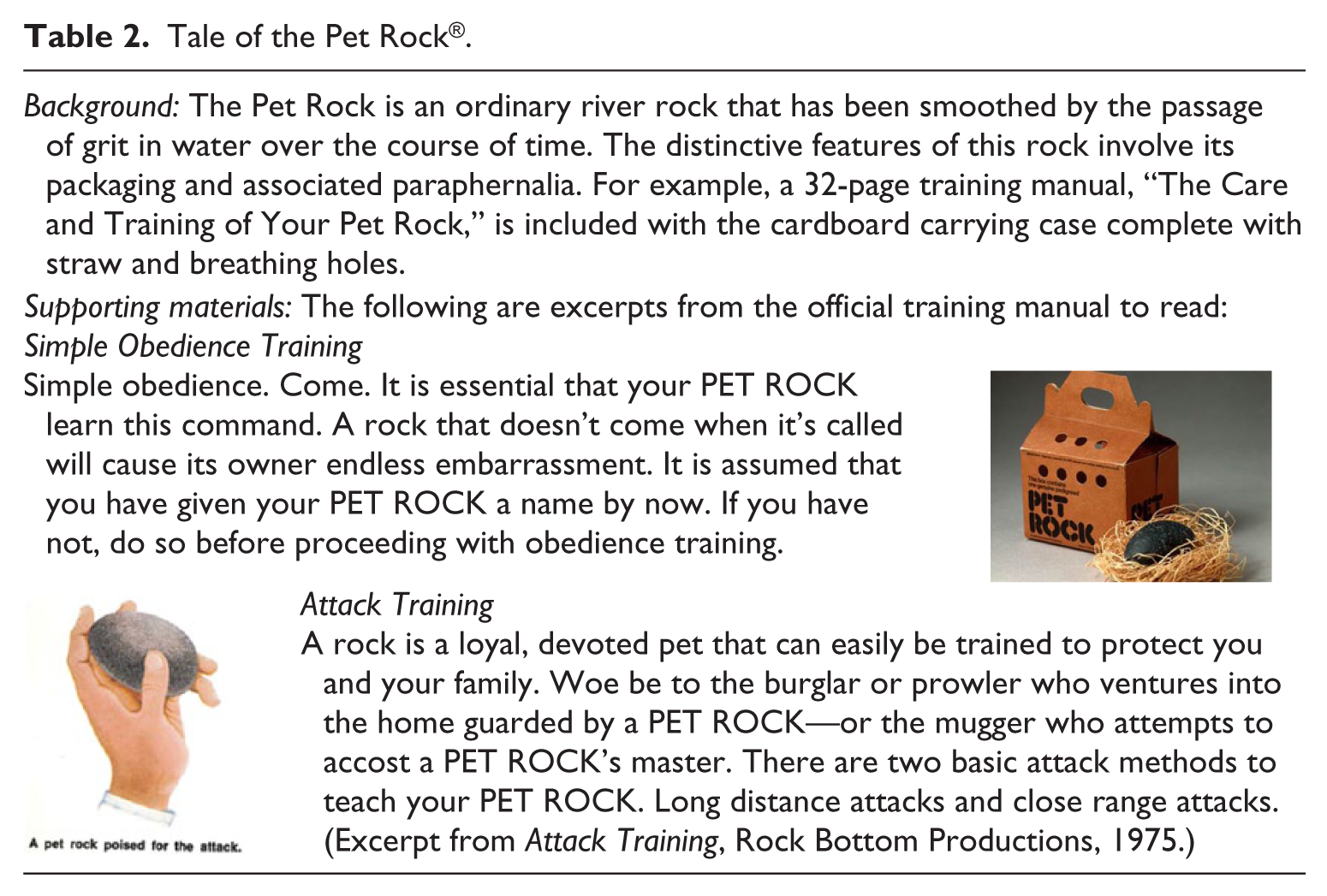
Begin by distributing the printed questionnaire (Figure 1), facedown, with the request that students not turn it over until asked to do so. Set a relaxed tone for the exercise and simply “tell” the class a story about the two rocks (see Tables 1 and 2 for summaries of each rock’s story and photos). For the first rock—the sandstone rock—it is important not to intimate that there is an expressed desire for change in the marketplace as one relays the information about the new enzyme-based cleaning solution to the students. For the second rock, either show illustrations of the Pet Rock or purchase one from an online retailer. Display the packaging and operating manual that is sold with the Pet Rock and read a few passages from the manual (e.g., “Simple Obedience” and “Attack Training” as reproduced in Table 2).
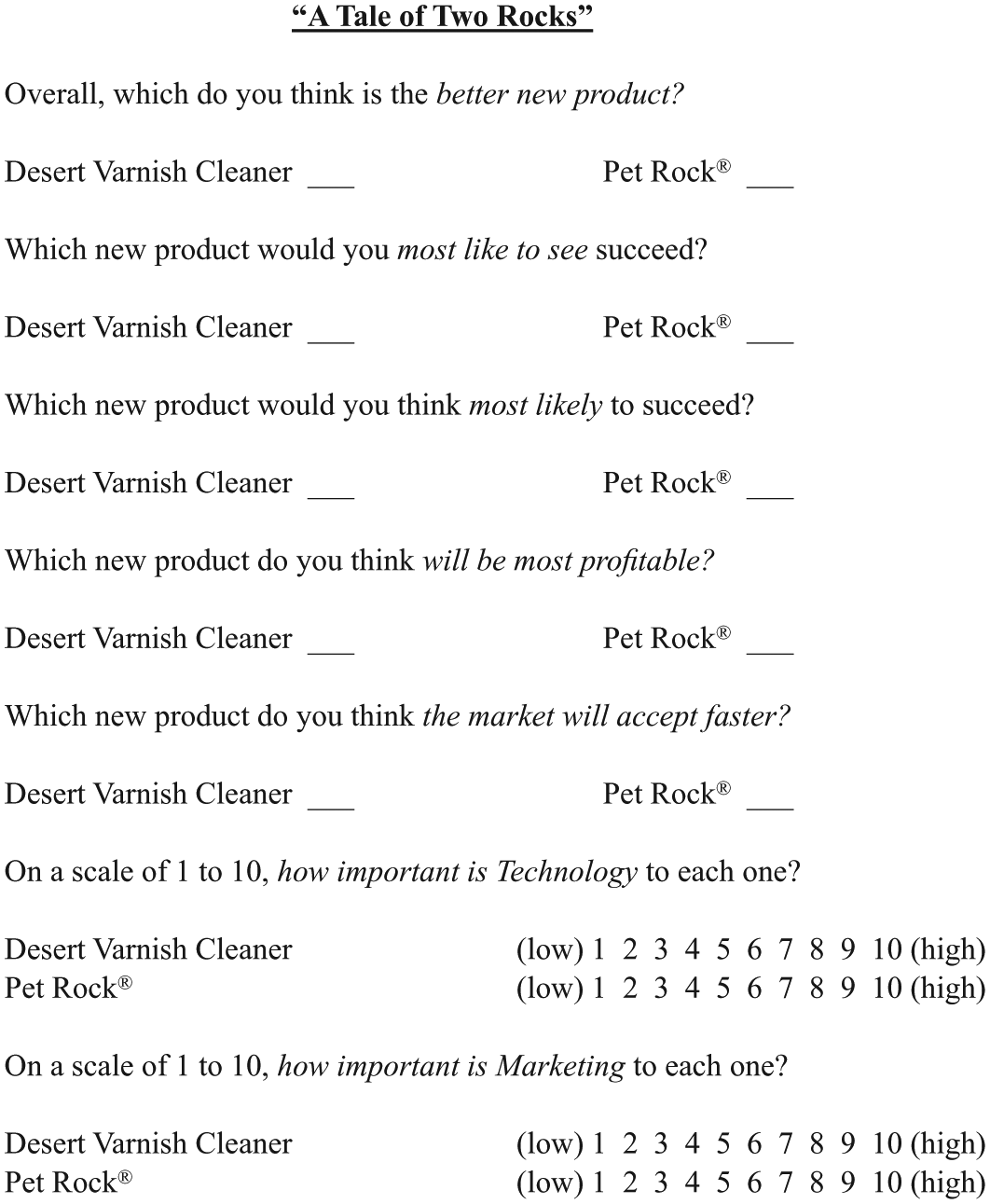
Student questionnaire.
Tale of the Pet Rock®.
After telling the stories of the two rocks, direct the students to complete the short questionnaire as shown in Figure 1. The questionnaire takes the students through a series of questions concerning their opinions on the merits of the two products, their probability of success in the marketplace, and so on. Instruct students to take no more than 1 minute to answer the 10 questions with a simple check mark or circle. Stress that this is not a test of any kind but only an anonymous exercise designed to stimulate discussion, and so students should go with their gut reactions rather than worrying about whether there are right and wrong answers.
Debrief of Exercise
Begin the debrief by asking students about their answers to the first question: “Overall, which do you think is the better new product?” (Figure 1). Students that identify the Desert Varnish Cleaner as the “better” new product are asked why they did so. Students preferring the Desert Varnish Cleaner typically argue that it is “better” because it solved a problem (in their perception), whereas the Pet Rock did not serve such a purpose. Secondary beliefs that may emerge from the discussion are that it is better because it accomplishes some good (by replacing acids with environmentally friendly and nontoxic compounds), and because it aligns with modern trends in those directions. See Table 3 for detailed guidance on debriefing each question.
Debriefing “A Tale of Two Rocks” Questionnaire.
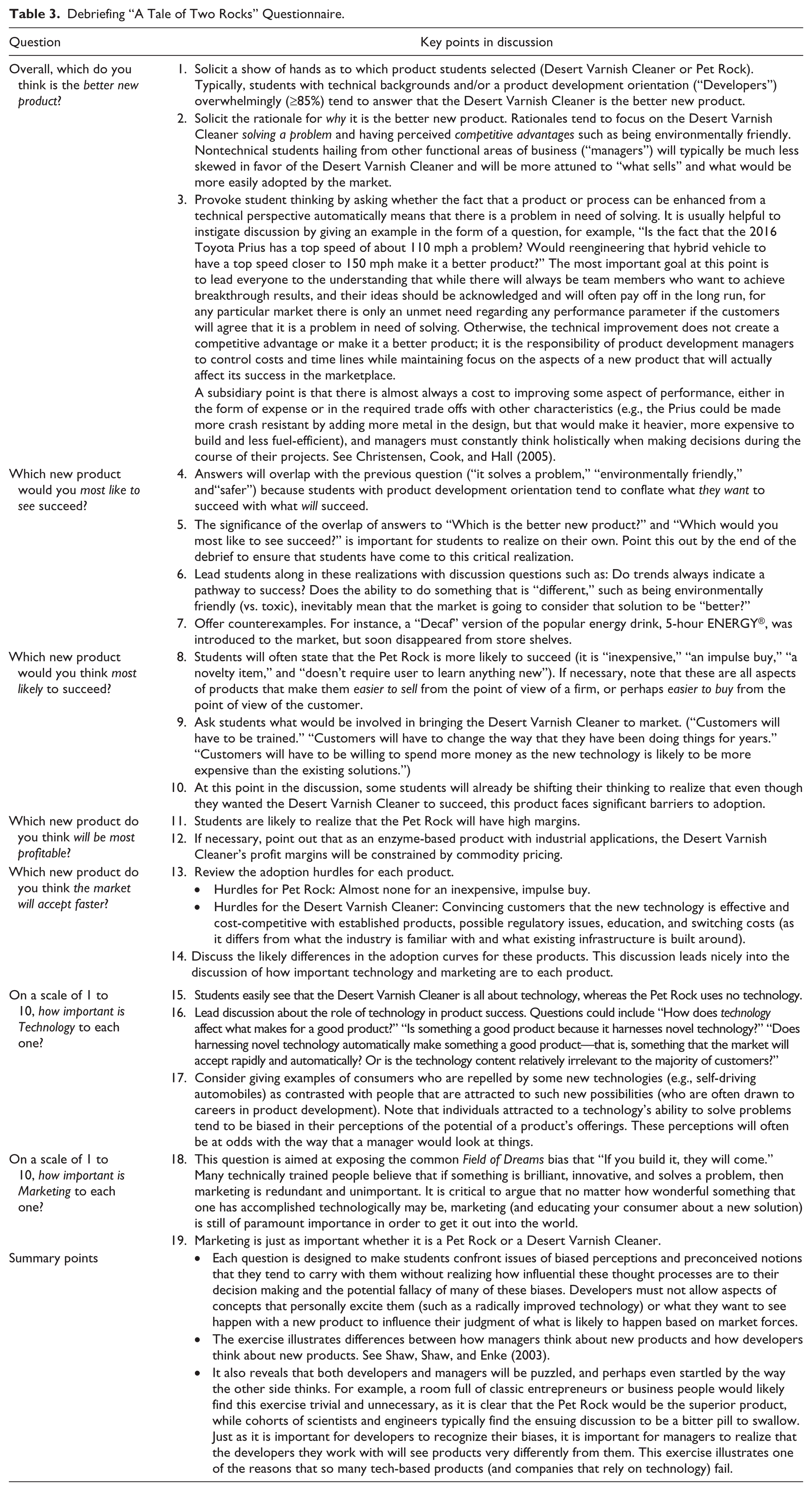
The goal of the debrief is not to “answer” the questions for the students, but rather to break down their thinking process and allow students to uncover their own biases. Do not “force” the discussion points, but rather let students discover insights at their own pace. By the end of the discussion of the questionnaire, however, make sure all students have learned the key points of the exercise.
The order of questions as presented in this exercise is purposeful and designed to elicit “gut” reactions and associated subconscious biases. If the series of questions were inverted when presented to students, the answer to which is the “better” new product would likely be influenced, because the later questions effectively prime the students to think differently about the definition of a better new product.
The typical total time for this exercise in a classroom setting with 20 to 30 students is about 40 minutes. In situations involving larger numbers of students, an instructor might try breaking the class into smaller groups who could discuss one of the questions, and then initiate the subsequent discussion of that question during the debriefing by offering their thoughts and conclusion.
After completing discussion of the questionnaire, reveal what actually happened with the two new products. The Pet Rock made millions for its creator as a fad gift, whereas the Desert Varnish Cleaner never made it out of the laboratory, since there appeared to be no significant market for it (see Table 4 for details).
Fate of the Desert Varnish Cleaner.
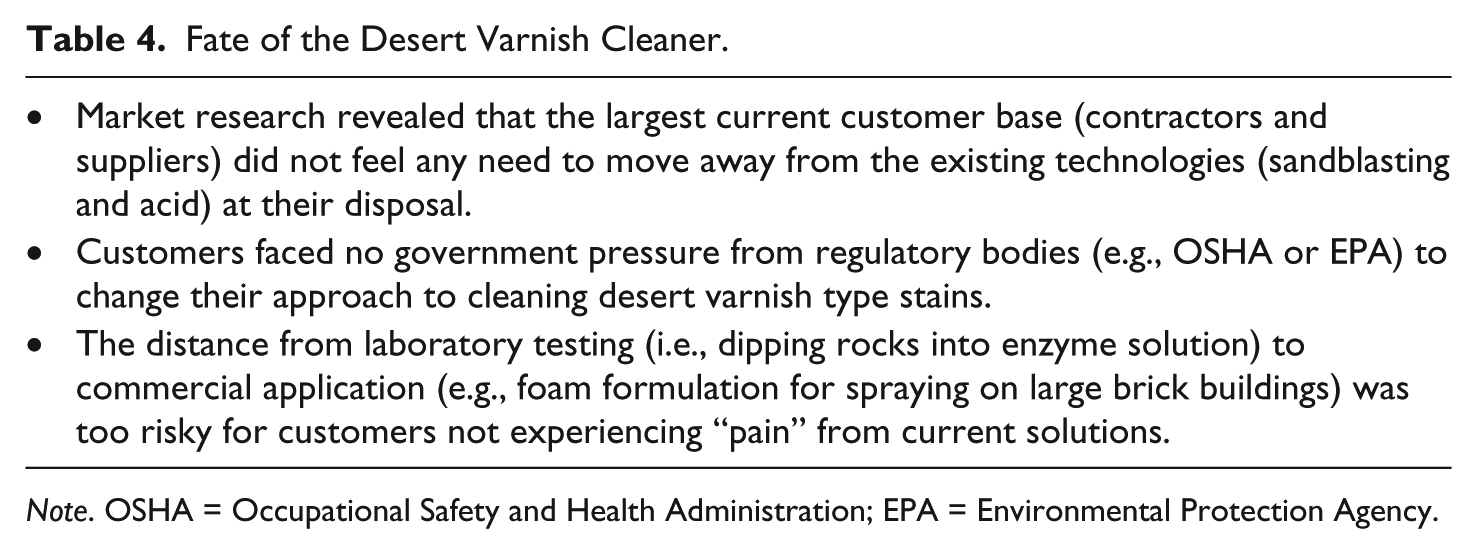
Note. OSHA = Occupational Safety and Health Administration; EPA = Environmental Protection Agency.
Subjects such as product development are often taught with little to no context regarding the roles of leadership and management, but this exercise offers strong connections to those subject areas. The statement that the Desert Varnish Cleaner was the brainchild of the company’s CTO and founder (see Table 2 for the complete story) is meant to plant the seed for a subsequent discussion concerning the management of creative staff. However, in practice this discussion almost always must be initiated by the instructor. When asked whether the company’s president was simply “done” with the issue after making the decision to abandon the project, very few students will identify the looming personnel problem without being prompted with a reminder that the product was directly attributable to the company’s key technical employee. Students commonly overlook the fact that many employees will take the cancellation of pet projects as personal attacks, with subsequent adverse impacts on company culture, relationships, and performance. The ensuing discussion can then segue into the techniques for handling adverse news without creating dissension and lowering morale, such as combining praise for creativity with reasoned discussion of markets and limited resources. I always point out that a key value of structured decision-making tools such as Stage-Gate® (Cooper & Edgett, 2008) is that they depersonalize tough decisions and thereby avoid personal animosity among team members. The importance of support from senior management and an atmosphere of trust in the decision-making system should also be emphasized.
Classroom Experience With the Exercise
Over the past decade, more than 85% of students have chosen the Desert Varnish Cleaner as the better new product despite the following facts: Only 28% of them thought it the most likely to succeed, only 20% thought that it would be the most profitable, and a mere 12% believed that the market would accept it faster than the Pet Rock! This disconnect is best explained by their responses to the question “Which new product would you most like to see succeed?” In this case, 89% checked the Desert Varnish Cleaner. Such technological bias can make it difficult for product developers to accept that a “silly” product such as the Pet Rock can do better in the marketplace than more sophisticated technologies. In practice, additional demonstrations (detailed in the appendix) have been presented during the same class period to reinforce the key lessons of this exercise, but they could also be used in a subsequent session. This exercise has been administered in a specialized MBA program designed for scientists and engineers, but it could easily be adapted for students with any level of education and experience.
The most dangerous assumptions are the ones that are never challenged, because they are rooted in socially constructed beliefs. That is why it is so easy for executives, team leaders, and developers to miss the fact that people involved in managing and performing the product development process often do not share key assumptions concerning the value of a product. During the 10 years that I have been using this exercise, my management, entrepreneurship, and marketing students have learned a valuable lesson by watching the potential scope and scale of this value misalignment play out in their own classroom.
Footnotes
Appendix
Declaration of Conflicting Interests
The author(s) declared no potential conflicts of interest with respect to the research, authorship, and/or publication of this article.
Funding
The author(s) received no financial support for the research, authorship, and/or publication of this article.
References
Supplementary Material
Please find the following supplemental material available below.
For Open Access articles published under a Creative Commons License, all supplemental material carries the same license as the article it is associated with.
For non-Open Access articles published, all supplemental material carries a non-exclusive license, and permission requests for re-use of supplemental material or any part of supplemental material shall be sent directly to the copyright owner as specified in the copyright notice associated with the article.
