



Abstract
Personnel selection is a key topic in Human Resource Management (HRM) courses. Many selection exercises focus on management situations that are unfamiliar to students who are taking introductory HRM courses. In contrast, this exercise introduces students to the pre-interview steps in the personnel selection process by asking them to determine the knowledge, skills, and abilities of potential adjunct instructors for a future offering of an HRM course. Groups of students act as management teams to determine the suitability of four applicants. Tasks include determining desirable qualifications, and then developing and ranking selection criteria based on the job posting. Subsequently, each group reviews the resumes of the four applicants and ranks them based on their selection criteria. A plenary discussion follows, during which students compare their choices and provide their rationale for their rankings. A discussion based on key questions concludes the activity. The exercise may be conducted in class or online.
Introductory Human Resource Management (HRM) courses typically include one lesson on employee selection, which provides an overview of its strategic significance and the steps in the selection process (Noe et al., 2019; Schwind et al., 2019). Although my undergraduate students understood the importance of the selection process, they generally lacked the work experience to appreciate the steps in the process. Consequently, they were not able to relate to the selection exercises in textbooks, which typically use work contexts with which they were not familiar.
I created this activity to help improve student comprehension and increase their engagement to learn about the selection process. This exercise provides undergraduate students enrolled in introductory HRM courses with a context to which they can relate: identifying key selection criteria and ranking applicants for the position of an adjunct instructor for a future offering of their HRM course. Because students are enrolled in this course, they can act as “consumer experts” to help identify what students find most important in choosing instructors. In addition, since the position requires using a learning management system and web conferencing, the activity solicits students’ perceived knowledge about these now commonly used pedagogical technologies. Overall, these conditions help augment the relevance of the activity and increase student engagement.
Theoretical Foundation
The personnel selection process generally includes five to eight steps, beginning with screening applicants and ending with the hiring decision (Schwind et al., 2019). Organizations usually begin the process by screening resumes, which is the focus of this exercise. The exercise utilizes fictitious resumes that were inspired from those submitted by actual applicants for similar positions, which augments the perceived authenticity of the activity and helps increase student engagement (North-Samardzic & de Witt, 2019).
Learning Objectives
At the end of this exercise, students will be able to
Identify and list job-relevant qualifications and attributes
Rank and weigh selection criteria according to their relative importance
Rank applicants by comparing the information provided in resumes with the selection criteria
Justify their choices, using evidence from course materials
Identify and discuss selection biases that could have influenced their choices
The Exercise
Overview
In this exercise, students identify relevant job qualifications in relation to a job posting for an adjunct instructor for a future offering of their introductory HRM course. After individually determining the selection criteria based on a job posting (Appendix A), students rank their selection criteria through group discussions (Appendix B). Subsequently, the groups review fictitious resumes (Appendix C) and rank the applicants (Appendix D). Appendices A to D are also available as online supplemental files. A plenary discussion follows, during which students provide their results and discuss the reasons for their decisions. Instructors lead a discussion on the outcomes of the activity using the questions suggested in the debriefing section.
Preparation
Make copies of the job posting (Appendix A), the selection criteria worksheet (Appendix B), the four resumes (Appendix C), and the scoring sheets (Appendix D). Prepare to present results to students by consulting the example provided in Appendix E.
Introduce the strategic significance of the selection function by underscoring the importance of aligning selection with organizational needs. Using their own institution and its instructors as an example of alignment helps students relate to the course material.
Inform students about organizational constraints, such as limited human and financial resources and realities of the labor market. For example, a tight job market might mean selecting from fewer applicants, and it might be more difficult to obtain ideal candidates, especially if financial resources are limited. An institution located in a rural area would not be able to rely on as many qualified candidates as urban institutions.
Briefly introduce the steps in the personnel selection process, which generally include screening applicants, interviews, employment tests, verifying references, the pre-offer, and the hiring decision.
Clarify that the exercise focuses on the initial screening of applicants for subsequent interviews. Point out why students are qualified to provide their rankings for future instructors. For example, their experience as students can help the institution emphasize attributes they find important in instructors. Because students generally consider themselves technologically competent, they can help identify instructors who will be likely to use technology to support teaching. Finally, some universities give students a voice in instructor selection, and this is an opportunity for them to express their preferences.
Procedure and Time Required
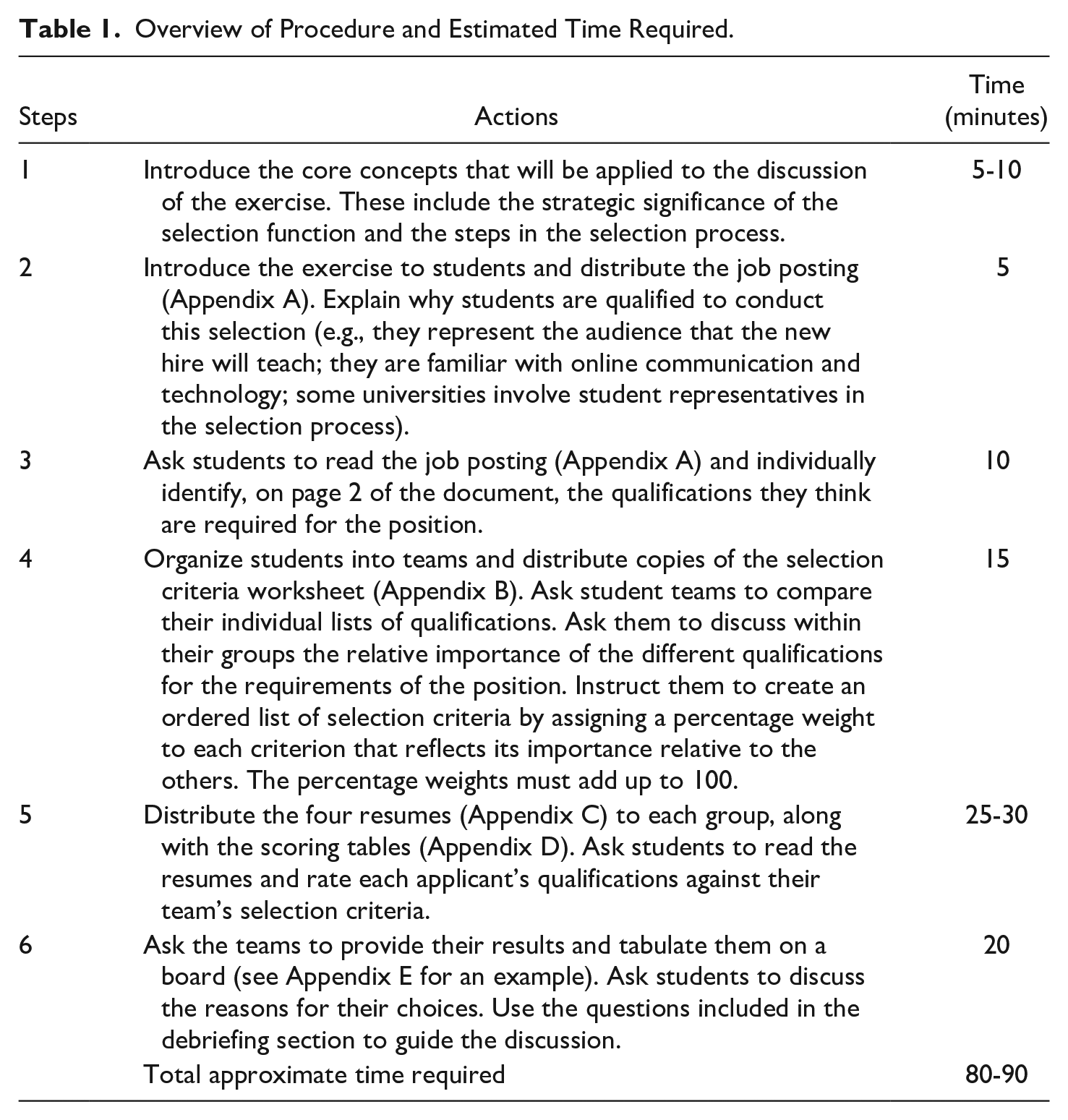
Table 1 outlines the actions and estimated amount of time needed to run this activity, which in total requires approximately 80 to 90 minutes.
Overview of Procedure and Estimated Time Required.
Variations
Shorter Class Sessions
Instructors can modify the presentation of the activity to accommodate sessions that are shorter than 90 minutes. For example, instructors can run the first three steps of the activity in one session (30 minutes) and complete the activity in the following session (60 minutes).
Emphasis on Age and Gender Biases
Some instructors might want to explore the effects of age and gender biases in selection. Thus, alternative resumes without names and dates are available in a supplemental file. This file makes it possible to conduct a split-class experiment by distributing different versions of the resumes to different groups of students. Alternatively, instructors could distribute the alternative resumes to all students and wait for the discussion to reveal gender and age information. Appendix F provides instructions for running the split class variation of the exercise and offers suggested discussion questions on gender and age bias.
Running the Exercise Online
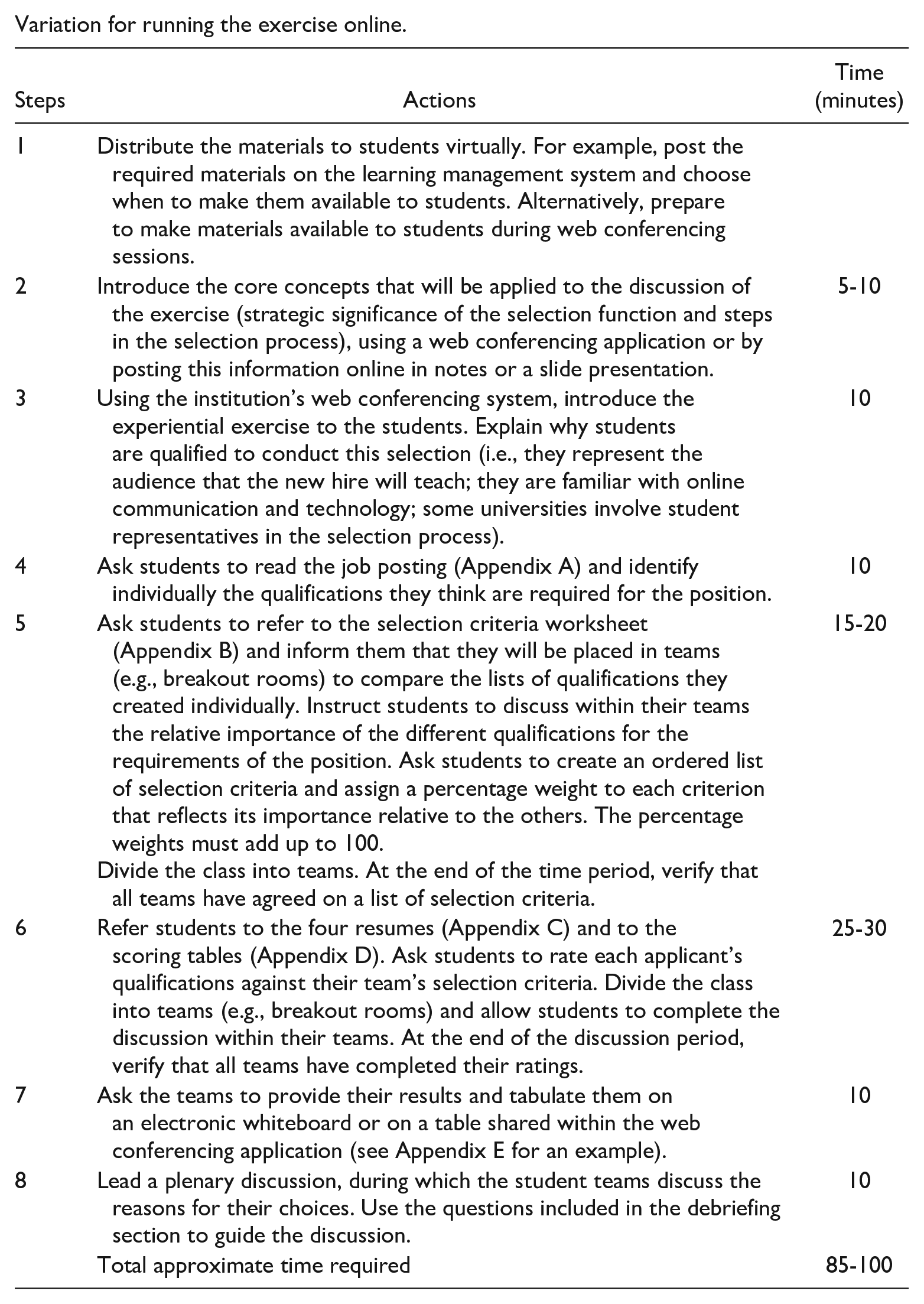
Instructors can run this exercise online (Appendix G), using the options available in learning management systems or web conferencing applications. It is possible to run the exercise both synchronously and asynchronously.
Students may find the synchronous mode more dynamic and engaging. To run a synchronous session, divide students into groups and ask them to rate the applicants within their groups, following the procedure outlined in Table 1.
Asynchronous sessions are advantageous when dealing with time zone and scheduling constraints. For asynchronous sessions, students meet in groups at their convenience and upload their results in slide presentations. They subsequently discuss possible differences in their ratings and answer discussion questions in online discussion forums.
Debriefing
During the debriefing, instructors invite students to discuss the reasons for their choices of selection criteria and ranking of applicants. The following discussion questions help organize the discussion.
Discussion Questions
Question 1. Which selection criteria did you find most important and why?
Although the number of criteria and their ranking will differ between groups, students commonly indicate educational level and type of degree, experience in HRM, and prior teaching experience. Students might also mention personal characteristics, such as self-motivation and organizational skills. In the discussion, students share why they chose their selection criteria. For this exercise, my students listed educational level and previous experience teaching HRM as their top choices. However, responses varied on the relative importance of the remaining criteria. Instructors should prompt students to discuss how they came to a consensus on the importance of their selection criteria. Some students will prefer candidates who seem to have more knowledge of technology since the job posting mentions using a learning management system and web conferencing. Others will argue that teaching experience is more important since an experienced instructor can learn to use the technology. Instructors should encourage students to articulate their choices in relation to the job posting.
Question 2. Provide your ranking of each applicant. Why do you feel your top choice is the better one, relative to the other three candidates?
Responses will vary. However, most groups of students in my courses preferred the applicants who had the highest level of experience in teaching (e.g., Applicants 1 and 4) and practical HRM experience (e.g., Applicants 2 and 4). Generally, students ranked Applicant 3 last because they felt he lacked specific experience in HRM, since his resume emphasizes marketing and international business.
The discussions around the preferred choices revealed that once students decided on their relevant criteria, some tended to focus on their chosen criteria and discard other information that might be useful. Although this was not the norm, instructors should encourage students to reflect diligently on their choices and to consider carefully all the information included in the resumes.
In all instances where I ran this exercise, the discussion portion was quite animated and revealed that certain biases emerged during the activity. This outcome opens the door for instructors to introduce various rater biases. For example, contrast effect is relevant since students tend to compare the resumes of the applicants against each other rather than against an objective standard. Other types of biases could also affect the ratings. For example, Zysberg and Nevo (2004) found that the fit of candidates for a managerial position tended to emphasize cognitive skills, suggesting that the appearance of intelligence, as signaled by the information on the resume, could create a halo effect. Limited information in the resumes could also have a disproportionate effect on the ranking of the candidates since students will make assumptions based on incomplete information. Furthermore, stereotypes can affect the rankings if students discriminate against a candidate belonging to a particular group. For example, some students thought that certain applicants were too old. Some students who preferred younger applicants engaged in reliance on central traits by presuming that a younger instructor would be more competent with technology and more dynamic.
Questions 3. What are the consequences of rating applicants in a context where qualified personnel might be limited?
This question emphasizes the problem of limited choices in personnel selection and gives rise to a number of questions. Would students consider their lowest ranked applicant, if the others were not available? What would be the repercussions of limited applicants in this context? Should the university cancel the course rather than consider hiring a less desirable applicant? What would happen if students needed the course to graduate?
In past discussions, students tended to prefer the option of not offering the course rather than hiring a less qualified applicant. They generally argued that given the number of institutions offering introductory HRM courses online, students who needed the course to graduate could take the course at a different institution. They argued that hiring a less desirable candidate would cause students to dislike the subject and could risk damaging the university’s reputation. These are examples of important overarching considerations that guide selection decisions.
Past Experiences With the Activity
I have used this experiential exercise on five occasions in undergraduate business courses. Students consistently engaged quickly, stayed focused, and enjoyed doing the activity. Students generally took the exercise seriously, and their comments indicated that their engagement increased because they knew that the resumes were inspired by those submitted by actual applicants. Students also appreciated that the job posting included the use of technological tools since this utilized their perceived competencies in online communications and technology. Later in the course, students referred to examples from this exercise to explain other HRM concepts, for example, linking selection with performance management, training, and career development. Therefore, participating in this exercise provided a memorable foundation upon which students could learn about different facets of HRM.
Conclusion
I developed this exercise to introduce undergraduate students to the screening stage of the personnel selection process in HRM courses. The discussion questions help students reflect on the process and on their decisions. Consequently, the exercise serves two major purposes. First, it gives students the opportunity to experience the challenges of the early screening process by identifying and ranking relevant selection criteria. Second, it demonstrates how other concepts presented within the course (e.g., labor force conditions, rater biases) relate to the screening process. Overall, this exercise provides an engaging way to introduce students to selection concepts that are relevant to their actual or future work lives.
Supplemental Material
Alternative_resumes_Supplemental_file – Supplemental material for Ranking Candidates: An Experiential Exercise in Personnel Selection
Supplemental material, Alternative_resumes_Supplemental_file for Ranking Candidates: An Experiential Exercise in Personnel Selection by Nicole Bérubé in Management Teaching Review
Supplemental Material
Appendix_A_Supplemental_file – Supplemental material for Ranking Candidates: An Experiential Exercise in Personnel Selection
Supplemental material, Appendix_A_Supplemental_file for Ranking Candidates: An Experiential Exercise in Personnel Selection by Nicole Bérubé in Management Teaching Review
Supplemental Material
Appendix_B_Supplemental_file – Supplemental material for Ranking Candidates: An Experiential Exercise in Personnel Selection
Supplemental material, Appendix_B_Supplemental_file for Ranking Candidates: An Experiential Exercise in Personnel Selection by Nicole Bérubé in Management Teaching Review
Supplemental Material
Appendix_C_Supplemental_file – Supplemental material for Ranking Candidates: An Experiential Exercise in Personnel Selection
Supplemental material, Appendix_C_Supplemental_file for Ranking Candidates: An Experiential Exercise in Personnel Selection by Nicole Bérubé in Management Teaching Review
Supplemental Material
Appendix_D_Supplemental_file – Supplemental material for Ranking Candidates: An Experiential Exercise in Personnel Selection
Supplemental material, Appendix_D_Supplemental_file for Ranking Candidates: An Experiential Exercise in Personnel Selection by Nicole Bérubé in Management Teaching Review
Footnotes
Appendix A
Appendix B
Appendix C
Appendix D
Appendix E
Appendix F
Appendix G
Variation for running the exercise online.
| Steps | Actions | Time (minutes) |
|---|---|---|
| 1 | Distribute the materials to students virtually. For example, post the required materials on the learning management system and choose when to make them available to students. Alternatively, prepare to make materials available to students during web conferencing sessions. | |
| 2 | Introduce the core concepts that will be applied to the discussion of the exercise (strategic significance of the selection function and steps in the selection process), using a web conferencing application or by posting this information online in notes or a slide presentation. | 5-10 |
| 3 | Using the institution’s web conferencing system, introduce the experiential exercise to the students. Explain why students are qualified to conduct this selection (i.e., they represent the audience that the new hire will teach; they are familiar with online communication and technology; some universities involve student representatives in the selection process). | 10 |
| 4 | Ask students to read the job posting (Appendix A) and identify individually the qualifications they think are required for the position. | 10 |
| 5 | Ask students to refer to the selection criteria worksheet (Appendix B) and inform them that they will be placed in teams (e.g., breakout rooms) to compare the lists of qualifications they created individually. Instruct students to discuss within their teams the relative importance of the different qualifications for the requirements of the position. Ask students to create an ordered list of selection criteria and assign a percentage weight to each criterion that reflects its importance relative to the others. The percentage weights must add up to 100. |
15-20 |
| 6 | Refer students to the four resumes (Appendix C) and to the scoring tables (Appendix D). Ask students to rate each applicant’s qualifications against their team’s selection criteria. Divide the class into teams (e.g., breakout rooms) and allow students to complete the discussion within their teams. At the end of the discussion period, verify that all teams have completed their ratings. | 25-30 |
| 7 | Ask the teams to provide their results and tabulate them on an electronic whiteboard or on a table shared within the web conferencing application (see Appendix E for an example). | 10 |
| 8 | Lead a plenary discussion, during which the student teams discuss the reasons for their choices. Use the questions included in the debriefing section to guide the discussion. | 10 |
| Total approximate time required | 85-100 |
Declaration of Conflicting Interests
The author declared no potential conflicts of interest with respect to the research, authorship, and/or publication of this article.
Funding
The author received no financial support for the research, authorship, and/or publication of this article.
Supplemental Material
The online supplemental Appendixes A to D and alternative resumes are available at 
Notes
References
Supplementary Material
Please find the following supplemental material available below.
For Open Access articles published under a Creative Commons License, all supplemental material carries the same license as the article it is associated with.
For non-Open Access articles published, all supplemental material carries a non-exclusive license, and permission requests for re-use of supplemental material or any part of supplemental material shall be sent directly to the copyright owner as specified in the copyright notice associated with the article.
