



Abstract
This paper aims to understand the multiple strategies developed by frontline workers to deal with situations of violence in vulnerable territories. We analyze the micro-dynamics within which workers operate to understand how the State deals with violence. Empirically, we analyzed data from interviews with 140 frontline workers implementing different policies not directly related to violence in neighborhoods located in the city of Sao Paulo, Brazil, known for their populations’ precariousness and vulnerability. The results expand the understanding of the different ways in which violence expresses itself in these places and show that the reactions developed by frontline workers are more complex than those suggested by the existing literature. The multiple violence to which these workers are exposed is used and manipulated by them in various ways during policy implementation. Frontline workers can ignore, negotiate with, or combat violence. They use their agency to develop different reactions based on how they and the policies are embedded or disconnected to the territories.
Introduction
This paper analyzes how frontline workers, as professionals responsible for implementing governmental policies, deal with daily violence in highly vulnerable territories. Here, we take into account that the State relates in multiple ways with social violence, understood as an interpersonal phenomenon (Blume, 1995; Reiss and Roth, 1993) with specific spatial dynamics (Wacquant et al., 2014).
The relationship between violence and the State is a traditional issue in the social sciences' classic literature (Bourdieu, 1980, 1988; Elias, 1939/2000; North, 2009; Weber, 1919). In dialogue with Weber (1919), almost all these authors argued that the modern State could never exercise a monopoly of violence. While the State is the prime holder of legitimate violence, some illegitimate violence always remains dispersed in society and would be used by social agents in different ways, and ascribed different meanings (Bourdieu, 1980; Elias, 1939/2000; North, 2009; Sundström, 2016).
Contemporary studies, inheriting the problem from classic sources, have been trying to understand how the State deals with the monitoring of its monopoly on legitimate violence (Johansen, 2019; Kyed, 2019; Morin, 2013; Pauschinger, 2019; Reid-Henry, 2015; Rivera and Ward, 2017) and with challenges in controlling social violence. This includes research on borders and their intersection with violence and conflict (Brambilla and Jones, 2019; Jones, 2015; Schindel, 2019; Weber, 2012), the relationship between institutions, violence, and crime (Barnes, 2017; Vigneswaran, 2014), narco-traffic (Ballvé, 2012; Warburg and Jensen, 2018), and terrorism (Ezcurra, 2017). Such literature usually analyzes violence as a general dynamic that affects the nation-state or society as a whole.
However, we also know that violence—and ways to deal with it—manifest differently across places and among social groups (Duru, 2019; Keenan, 2019; Kyed, 2019; Loftus, 2015; Mawani, 2012; Murphy et al., 2018; Pilo, 2019; Shaw, 2019; Vigneswaran, 2014). Violence, after all, is a social and interpersonal phenomenon (Blume, 1995; Reiss and Roth, 1993), which materializes in daily power relationships among actors operating within specific territorial dynamics, struggling over questions of resources distribution, conflicts of interest, and freedom of action (North, 2009). When manifestations of violence are only observed as one broad process, we are unable to understand why and how violence manifests in various ways among different people and territories. To advance the understanding of such situations, we should be able to observe the micro-dynamics of the relationship between State and violence that happen in specific local contexts.
This article aims to contribute to the literature by observing these micro-dynamics in one type of territory marked simultaneously by inequality, high levels of violence and exclusion. Previous studies have already highlighted the relationship between violence and excluded social groups (Reiss and Roth, 1993). As they act at the State’s borders and are the face of the State for citizens, frontline workers are daily exposed to multiple situations of violence in the places where they work (Sundström, 2016).
We consider that (1) the State is a set of heterogeneous actors and institutions, and not a monolithic power (Sharma and Gupta, 2009); (2) that it has to dispute its monopoly of violence with other actors (Elias, 1939/2000; North, 2009); and (3) that it does so within specific territories in which conflicts emerge (Pinto and Do Carmo, 2016; Wacquant et al., 2014; Zittoun, 2014). Applying these definitions to the frontline workers, while some of them are expected to deal directly with situations of violence, such as police officers (Epp et al., 2017; Nicholson-Croty et al., 2017) and those tackling issues such as violence against children or women (Frattaroli and Teret, 2006; Hong, 2016; Levenson and D’Amora, 2007; Morin, 2013; Pauschinger, 2019; Riccucci et al., 2014; Rivera and Ward, 2017). Other workers who implement policies not directly related to violence can be affected by it, having to deal with situations of criminality or violence.
Only a few studies have contributed to mapping these processes of everyday violence against frontline workers. When they do it, frontline workers are seen as victims or passive agents in the face of violence, whose usual strategy is to escape or avoid such situations. In this paper, we argue that the range of reactions observed among workers exposed to situations of violence is very complex. We demonstrate that their repertory cannot be reduced to passive behaviors: frontline workers can also use their agency to proactively deal with violence. Some of them do accept violence as part of their working context, maintaining silence about it or giving up on implementing policies, as shown in the existing literature; others try to adapt policies and negotiate with the dynamics of violence; and yet others do not take violence for granted and transform their policies into strategies against violence.
Thus, in this paper, we consider that a complete explanation of the relationship between violence and frontline workers should involve three aspects: an analysis of the various ways in which violence manifests itself; a typology of the professionals’ reactions in the face of violence; and an understanding of the reasons why agents subjected to these situations of violence adopt different positions and strategies.
Here, besides analyzing the diverse manifestations of social violence and agents’ reactions to it, we analyze how the territory plays a role in explaining different reactions. We demonstrate that workers’ ability to develop different reactions relies on the connections they and the policies have with places. When policies and agents are territorially embedded, they are able to react to violence both adapting to it or facing it. And when policies and agents are territorially blind, there are no institutional devices (under the policy’s angle) or social ties (under the agent's angle) that can be mobilized by them. Consequently, their reactions are about silence to violence. Territorial embeddedness means policies and actors are connected to territorial dynamics of power and mutual recognition, being able to dialogue with local needs; while territorial blindness refers to policies and actors disconnected to the local dynamics.
The empirical evidence is composed of cases in which frontline workers who do not work directly with criminality issues are regularly exposed to violence in their work. We gathered data from interviews of 140 frontline workers acting in different policy areas (community health workers, nurses, teachers, and social workers), who operate in very vulnerable and violent neighborhoods of Sao Paulo. The conclusions obtained are relevant to a variety of contexts because the cases analyzed reproduce conditions very similar to those found in several other developing countries and vulnerable territories in developed countries, also marked by high inequality, vulnerability, violence, and significant crime rates.
The paper is organized as follows. In the first section we present the literature about violence and the State, and the consequences for frontline workers. In the second section we comment on the context, data, and methods. In the third section we present the analysis of the multiple reactions against violence developed by frontline workers and a typology of strategies available to deal with violence. In the fourth section, we discuss the findings and propose a patterns of reaction taxonomy and their relationship to territories. The conclusion points out the main consequences of the research findings and future research agenda.
Violence and the state: Issues for frontline workers
Violence is a worldwide and multifaceted phenomenon. The fight against violence has always been one of the most important governments' agendas since the constitution of the first modern States (based on the idea of concentrating military power) until the present day. The specialized literature on violence has focused on studying this broad phenomenon of how States protect their territories and citizens, and fight crime (Brambilla and Jones, 2019; Bond and Gebo, 2014; Ezcurra, 2017; Marenin, 2014; Pinto and Do Carmo, 2016; Weber, 2012). Some studies have also analyzed specific policies against everyday violence, such as policing practices and social work initiatives to protect women, children, and vulnerable groups (Epp et al., 2017; Frattaroli, 2006; Johansen, 2019; Kyed, 2019; Levenson and D’Amora, 2007; Meier and Nicholson-Crotty, 2006; Nicholson-Croty et al., 2017; van Steden et al., 2015). Other researchers have studied violence as a broad social and political phenomenon (Cover, 1986; Fanon, 1963; Foucault, 1977), in which power takes on different meanings: some authors have introduced a distinction between power and violence (Arendt, 1970), while others have described an intrinsic relationship between these concepts, with violence assuming a role in the production and maintenance of power relations and oppression (Foucault, 1977) and even a cathartic or revolutionary character (Fanon, 1963).
In this article, inspired by WHO (2002) and Reiss and Roth (1993), we consider violence as the intentional use or threat of physical force or power by persons against persons that may be expressed in different ways, as injury, death, physical or psychological harm, maldevelopment, or deprivation. Although violence is an indispensable constitutive phenomenon of human nature and, therefore, of any social relationship, the uses of violence by the exercise of power can occur in different ways (Bourdieu, 2012; Elias, 1939/2000; Žižek, 2009). What determines these different ways of exercising violence can be aspects associated with the specificities of how the civilizing process takes place in each social configuration (Elias, 1939/2000), with the characteristics of the field or domain of reality that is taken into account (Bourdieu, 1980), among other factors.
Therefore, even if violence manifests itself as a widespread phenomenon, it occurs in very different ways in different places and is directed against different social groups (Keenan, 2019; Kyed, 2019; Murphy et al., 2018; Pilo, 2019; Pinto and Do Carmo, 2016; Vigneswaran, 2014). Studies have shown how some groups are more subject to situations of violence, mainly based on their race, gender, ethnicity, religion, or neighborhood (Epp et al., 2017; Mawani, 2012; Nicholson-Croty et al., 2017; Reiss and Roth, 1993; Wade-Olson, 2019). Research has also shown that cases of violence are more concentrated in some places than in others (Duru, 2019; Loftus, 2015; Shaw, 2019) and are more heavily clustered in extreme contexts, such as in poor or very unequal countries (OECD, 2019). This means that violence can be considered a social process caused by conflicts between actors operating within specific territorial dynamics.
To understand such dynamics, it is essential to recapture that territory is a polysemic concept, including various definitions in different theories and disciplinary traditions (Hasbaert, 2004). A territory can be defined by administrative or legal-political boundaries (Ratzel, 1990); cultural and identity aspects (García, 1976; Hall, 1986); or economic basis (Godelier, 1984). All definitions share a common substratum: the exercise of power in the dispute for control of material or symbolic resources between members of a territory, or between them and those outside (Raffestin, 1980). Although the key variable about territory is power, it can be operated from a structuralist perspective, according to which it is only important to recognize how power reproduces itself in this spatial unit. Or it can allow exploring the interdependencies between structure and agency, involving the structure and change of the local social orders; that is, recognizing the constraints that limit the freedom of agents and how they use this small margin of action that remains open to act on these structures. 1
North et al. (2009, 2012) establish a clear distinction between social orders in which the monopolistic concentration of legitimate violence in the hands of the State prevails and those in which the incomplete centralization of the use of force generates a dynamic marked by high levels of economic inequality, asymmetric power, and constant threat to the physical and social integrity of people and social groups. Although those authors associate social orders at the scale of nation-states, other authors apply similar explanatory logic to smaller-scale territories, such as rural places in Latin America (Berdegué et al., 2015; Favareto et al., 2015), neighborhoods on the outskirts of large cities and metropolises in the USA (Wacquant, 2007) or peripheral regions in Italy (Felice, 2013).
Other studies on vulnerable territories in cities in Latin America, Asia, and Africa offer similar findings, suggesting that, in these places, the frontiers between the world of the crime and the world of the State are quite blurred (Barnes, 2017; Feltran, 2008; Fontes, 2019; Sanjurjo and Feltran, 2015). In these territories, crime and State compose legitimate orders producing a specific device of urban organization due to their tensions and accommodations – a legitimation quite different from that suggested by the Weberian conception, but of concrete effectiveness for people who live in places where the State is absent or has a fragile and ambiguous presence. In this way, criminal organizations may develop collaborative and competitive arrangements with the State to determine acceptable levels of violence and stability (Barnes, 2017). These studies suggest that the micro-dynamics of the relationship between State and violence may create many types of reactions among frontline workers.
Considering that policies are influenced by the spaces in which they are materialized (Pollitt, 2013), we can presume that, in vulnerable territories with high levels of violence, the State and its agents are exposed to situations of violence even when implementing policies not designed to fight against violence. What remains unclear, then, is (1) how violence affects the State and its agents even concerning policies that are not supposed to face violence directly, and (2) how the State and its agents deal with these situations of violence in the territories in which they manifest.
The answers to these questions presuppose looking at the micro-dynamics of policy implementation in vulnerable territories. They also presuppose observing how workers at the frontline deal with such situations of violence and make decisions. The literature has already analyzed some of the effects of violent situations on frontline workers’ behavior. These studies show that some workers in certain professions are exposed to many different types of violence, such as verbal aggression, threats, and physical assault (Koritsas et al., 2010; McMahon et al., 2014; Robson et al., 2014; Sundström, 2016). Some studies term such instances as workplace violence (Koritsas et al., 2010), when the place in which workers implement policies is strongly associated with situations of violence from clients.
Most research, however, focuses on the violence provoked by clients and not on the territories in which violence is a part of the context. Such research usually concludes that the effects of violence in policy implementation involve frontline workers developing coping strategies, becoming subject to mental illness, or giving up service (Diamond, 1997; Koritsas et al., 2010; McMahon et al., 2014; Robson et al., 2014; Tummers et al., 2015; Zang, 2017). Some workers react passively, trying to avoid the violent situations, while others develop certain types of learning for dealing with violent situations (Robson et al., 2014). Overall, these studies usually view violence solely as an obstacle to policy implementation. This is because they usually consider that frontline workers are state agents trying to implement and legitimize the State’s interests. In this paper, however, we do not consider that frontline workers act only as implementing agents.
Frontline workers have agency, which is the ability to deal routinely with the real situations they meet (Maynard-Moody and Musheno, 2003), forming judgments and taking actions (Maynard-Moody and Musheno, 2012), and doing what they can do (Brodkin, 1997). Agency is shaped by their position and status in society and in the territory and by their authority (Giddens, 1979; Sewell, 1992). At the same time, the agency is expressed in interactions with and against citizens (Maynard-Moody and Musheno, 2012), which are always embedded in specific territories and social dynamics. Comprehending the connection between agents and the territories where they work is an important element to understand how they use their agency to interact with citizens (Siblot, 2006). Therefore, to understand how frontline workers deal with violence, we have to observe the multiple forms of reactions based on how they use their agency as actors with social positions in specific territories. In the subsequent pages, we contribute to the literature by proposing a taxonomy of possible frontline workers' reactions when dealing with multiple situations of violence during policy implementation, going beyond the behaviors usually identified.
Context, data and methods
We intend here to analyze the daily relationship between the State and violence, trying to understand how street-level workers deal with various situations of violence within vulnerable territories. To do so, we focus on frontline workers that implement social policies in vulnerable neighborhoods in the city of Sao Paulo in Brazil, one of the most unequal and violent countries in the world (Lima et al., 2016; UNDP, 2019). Only in 2018, Brazil had 57,341 homicides and 73,000 reported cases of violence against women (IPEA, 2019), just to cite some numbers.
Sao Paulo, the largest city in the country, has many vulnerable neighborhoods that witnessed a considerable increase in urban crime in the 1990s, reaching a peak of homicides at the end of the 1990s (Fontes, 2019; Manso, 2012). While homicide levels have fallen more recently, shoplifting and robbery rates have been increasing constantly (Fontes, 2019). The city has also seen high levels of violence against women and drug use disorder. Many of its vulnerable territories are dominated by paramilitary groups and drug dealers (Dias and Manso, 2019; Feltran, 2019). Thus, the case of frontline workers in Sao Paulo can be seen as an extreme case, which is a way to reach a “hard-to-get-at organizational phenomena” (Hällgren et al., 2017: 112).
The data collected for this paper are part of a broader study that aims to analyze the practices of frontline workers implementing universal policies in areas with high levels of violence, vulnerabilities, and inequalities. We selected the four neighborhoods with higher homicide rates, higher Gini indexes, and the lowest human development numbers in the city. For the larger project, we interviewed 173 frontline workers working in different policy areas in these neighborhoods: 93 community health workers, 20 nurses, 40 teachers, and 20 social workers. In this paper, we analyze the interviews of 140 respondents who voluntarily reported situations of violence when responding to certain questions in the interviews. The interviews consisted of three parts: 1) profile and trajectory, 2) perceptions about clients and policy implementation, and 3) stories of success and failure. The interviews were conducted between 2017 and 2019.
These workers implement different policies: nurses and community health workers implement the family health strategy, a primary health policy aimed at improving health conditions based on prevention practices. This policy is implemented by teams based in health clinics, which are responsible for one specific geographical area. The teams must follow up on health conditions through both house visits and services offered in the clinics. Teachers work in public schools at both the primary and high-school levels. In Brazil, children from lower-income families usually attend public schools, while middle- and upper-class families often study in private schools. Public schools in Brazil face many problems, including a lack of resources, low-paid and less educated teachers, and high levels of violence against teachers inside schools. Not surprisingly, then, Brazil still has one of the highest levels of inequality in education (PISA, 2019). The social workers interviewed work in centers that offer supplementary services for children and teenagers living in vulnerability. These centers conduct several activities during non-school hours. They help keep children off the street, take care of them while their parents are away at work, and help them strengthen their social and emotional skills.
All interviews were transcribed verbatim and analyzed using the N-Vivo qualitative data analysis software. Initially, each interview was coded separately (Nag and Gioia, 2012) two times by different authors. After that, we compared the coding, and when we found discrepancies, we reconciled them in the coding book. During this process, one of the codes that appeared recurrently was “violence”, which was coded in 140 of the interviews. Considering the centrality of this dimension, we decided to code the material again, only looking for descriptions of violence. In the next step of coding, we tried to find different types of reactions that appeared in the material. We did this procedure until attaining theoretical saturation of the material with first-order codes (Glaser and Strauss, 2017). We found eight first-order codes in this phase. After that, we grouped the first-order codes into second-order codes, which gave us three types of patterns for dealing with violence in policy implementation. At last, we observed how these patterns relate to territories.
The multiple reactions to violence
When implementing policies in highly vulnerable neighborhoods, frontline workers face a variety of everyday manifestations of violence. Issues such as drug use disorder, violence against women and children, drug trafficking, assault, and other types of violence present themselves to workers as conditions of the territory in which they work. As some of the interviewees reported, violence is a part of the context, and they are obligated to deal with it, even if the policy they are implementing is not designed to do so. When analyzing how frontline workers deal with these multiple manifestations of violence, we found eight basic types of reactions that represent the ways they use their agency, which are described below. Far beyond taking a passive posture towards violence or considering it a limitation of their work, we found that frontline workers develop various strategies and reactions when they face violence.
Silence
One of the reactions developed by frontline workers faced by violence is silence. As they fear or do not know how to react to violence, some of them decide not to do anything and simply pretend they do not see what is going on. Sundström (2016) found a similar reaction analyzing why bureaucrats in violent contexts accept bribe. As they are threatened and feel fear, they accept bribery as a reaction to protect themselves and silence when it comes to an illegal situation. In our case we found silence as a reaction when, for example, teachers or social workers have information about a situation of violence involving a child, or when a nurse recognizes a case of violence against a woman and decide not to report it. Similar reactions by frontline workers were found in the implementation of family violence policies by Lindhorst and Padgett (2005). In our case, other workers also decide to adopt a strategy of silence when this is viewed as necessary to gain access to the place and people’s trust and, therefore, be able to carry out their jobs. One example of this is when a community health worker knows about a situation of criminality but decides to maintain silence. The interviews excerpts below offer examples of this type of reaction:
There are plenty of people who do drugs in my area. But they know we don't get involved with this and that we see no point in reporting them, so they trust us. (…) And we also know that the drug dealers command this area. We just pretend we don’t know and it’s ok (NURSE 12).
We have to notify the appropriate authorities [in cases of domestic violence]. But due to the characteristics of the neighborhood in which we live and work, I just listen to the complaints and stay silent. This is because there are many women who just want to complain, but don’t want action to be taken for many reasons. We have to be careful with suggestions we give. Sometimes, when a woman is emotional, she tells you everything and if you give her a suggestion, she tells the husband, and this becomes a big mess. (CHW 54)
Giving up
When facing situations they do not know how to deal with or that make them feel powerless, some frontline workers simply give up, resign their jobs, or suffer from mental health conditions such as burn out. Most of the literature about frontline workers and violence has focused on analyzing these phenomena, reporting high levels of work abandonment and occupational diseases in violent circumstances (Diamond, 1997; Koritsas et al., 2010; McMahon et al., 2014; Robson et al., 2014; Zang, 2017). We also found evidence of this process among our interviewees in situations in which they felt that they were working at the edge of the system (Diamond, 1997) and did not face conditions conducive to implementing policies. This is when they tend to give up. In our interviews, this was not a very recurrent phenomenon. We found some teachers reporting cases of colleagues who had left the job, but very few of our interviewees reported having to leave the job themselves. The excerpts below are some examples:
There was a pregnant woman with whom I had a serious problem a few months ago, with her and her husband. I don't visit their house anymore (…). She wanted me to provide a [health exam] right away (but it takes time to conduct one). We had a horrendous discussion. She is crazy. She called me all sorts of names and insulted me. I tried hard to maintain my demeanor as a professional (…). After this episode I collapsed, I was away from work for two months. (CHW 5)
Respect for the teachers, in general, has diminished a lot. We see it on TV, young people assaulting teachers, throwing school desks… Even here, there are several teachers who have already been readapted
2
because the students cursed and insulted the teacher and threw things at her. (Teacher 8)
Denying the capacity of a policy
Another strategy to deal with situations in which the workers feel powerless is to deny the capacity of policy to be implemented or be effective. Strategies of denying, diverging, or even sabotaging policies during implementation have been reported before (Brehm and Gates, 1997; Gofen, 2014), but not in situations of violence. As some of the professionals think that the conditions of violence make their work almost impossible, they deny the effectiveness of the policy to protect themselves from the failures caused by situations of violence. Some teachers, for example, say that it is impossible to promote education in some very violent regions; some of them say they can only reach a minimum of students in such extreme situations . This type of reaction is a way for frontline workers to protect themselves against frustration or against being charged of failing to achieve results that they find impossible due to the conditions caused by violence.
There are students with problems that you can't handle (…) problems at home, violence, and other issues that you won't be able to solve as a teacher. No matter how close you get to the student, the pedagogical issue gets lost because he/she doesn't learn like a regular student… (Teacher 16).
(…) In the old days, we used to say that the school had become a place to deposit students. So, the students come here but not to learn. They come in order to receive the Bolsa Família,
3
because they are fed here, parents can get rid of them, and because they don't use drugs here (…). I feel that here we do everything but teach, and we are held accountable for everything but learning. (Teacher 22).
Excluding difficult cases
Another reaction is to exclude particular cases in which the violence is too strong or in which the frontline workers feel powerless. In these cases, rather than denying the effectiveness of the whole policy, as in the previous reaction, frontline workers deny services or treatments in specific cases in which violence is manifested. This means that situations of violence produce the exclusion of individuals subjected to them, as frontline workers are not able to deal with these cases. The idea that frontline workers exclude more difficult cases has been demonstrated before in the existing literature about street-level bureaucracies. Researchers have shown that, as these workers have to implement policies in difficult contexts involving a very high workload, they decide who gets what (Oorshot, 2008), prioritizing some cases that are easier to tackle, making them feel more motivated, or making them reach their goals faster (Lipsky, 2010; Tummers et al., 2015). In this way, they exclude the more difficult cases, which usually involve more vulnerable citizens (Nunes and Lotta, 2019; Pires, 2019). Based on our interviews, we add that, when some citizens are subject to conditions of violence, this factor may itself make their case more difficult, generating exclusion in a situation of vulnerability.
There was a 14-year-old girl who came from a totally broken home—her father was arrested because he beat her mother, her brother was arrested for drug trafficking, and she had two occurrence reports, she assaulted everyone. So, there is a course for teachers on mediation of violence, and there are pressures, the tests, they pressure us for disciplinary content. But what can I do in a case like this? (Teacher 32)
(…) about the issue of domestic violence. There are houses where we know the husband beats the wife. And she says: “I don't want to talk about it.” So, you won't be able to take it forward, because if you do, you will face a reaction. (…) Everything you do and say, you have to be very careful. (CHW 62)
Negotiating with violence
In some cases, frontline workers negotiate with actors involved in crimes or situations of violence to enable policy. Some of the interviewees reported situations in which they asked for help from drug dealers or paramilitary actors in order to act. They also negotiated with them on how to work in the areas, get into people’s houses, and on which activities to conduct. These cases demonstrate the blurred frontiers between crime and State and have been presented in earlier studies analyzing the everyday of crime in urban peripheries or favelas (Feltran, 2008, 2019). In these cases, the situations of violence are able to affect and transform frontline workers’ policies and actions. In our interviews, community health workers primarily reported situations in which they dialogue with actors involved in crime to enable their services:
There was a rumor that a professional had hurt a child. Then the drug dealer (…) looked at my face and said: “In this place people talk a lot of bullshit, and you have to be careful. Did you do anything that made anyone think that you hurt that kid?” I said, “No, I vaccinate the dogs in the area and usually I have a syringe with me. So, someone may have mistaken that. I would never do that.” The drug dealer then said: “I can see it in your eyes that you did not do this”. They have a way of identifying what is right and what is wrong. (CHW 35)
I had an old patient with a mental illness. She used to hoard garbage in her house (…). She lived on the top floor of the building and had already compromised the structure of the building by hoarding so many things inside the apartment. The apartment had a horrible smell and all the neighbors were asking for help. I didn’t know what to do anymore. She didn’t let us help her. Then I asked a guy (from the local paramilitary organization) to help us. They took 10 trucks full of dirty things out of the apartment. A drug dealer sponsored it all, painted the apartment, and threw all the garbage away…(CHW 41)
Adapting policy
Violence also affects policy when frontline workers adapt their actions to deal with different situations. Workers adapt their procedures, the work processes, the language, or even the content of policy in order to fit into situations made unpredictable by the presence of violence. Policy adaptation during implementation is part of the nature of frontline workers’ jobs (Lipksy, 2010), and has been extensively demonstrated in the literature (Hupe et al., 2015). What our case shows is that situations of violence also provoke this type of reaction. In these cases, the context of violence results in a change in policy and leads to the creation of new implementation strategies.
Violence, trafficking, theft, there is a lot of this in this territory. When the patient is a drug dealer and we have a lot of files to fill out, we have to write his profession. He won't say he's a drug dealer, and you get embarrassed to ask about his profession. But there are people who tell you, there are wives who say, “oh my husband is a drug dealer”, but we won't put that in the forms. We write “self-employed,” or we don't even ask for the profession and let it go. (CHW 5)
There was a pregnant mother who gave us extra work because she used drugs (…) She was so addicted and depressed, that the only thing that calmed her down was the drug. So, we arranged for her to take turns using drugs and breastfeeding. (Nurse 18)
Fighting against violence
Unlike what has been claimed in the existing literature, violence limits not only policies and frontline workers’ options of action. Actually, in some cases we found the opposite situation: workers using situations of violence faced by citizens to create new actions aimed at fighting against the violence. This occurs when these workers change the purpose of their action in order to create solutions. This means that violence becomes the focus of policy intervention, even in policies not designed to do so. These cases suggest a proactive reaction against violence, which becomes the enemy to be fought against.
We had a little boy here in the center. One day, he came with his hands burned. I asked him to tell me what happened, and he didn’t know what to say. Then I said, “I'm committed to you. I will not tell anyone. This only goes forward if you want to take it forward (…).” He said that he had found drugs at his house and thrown them away. (…) The father was a drug dealer and took both hands of the boy and burned them in the fire. So, when he got here, I managed to convince him; (…) we called his father and talked to him, asking him not to do this again. We did a good job. (Social Worker 3)
One student told me once “Oh, my uncle touched me,” I said, “You don't have to say anything anymore, I get it.” (…) Then I forwarded the case to the principal and she called the father. He lost custody of the girl and she ended up in a shelter. Then an aunt got her. She stayed out of school for a while and then she came back and thanked me (…) (Teacher 25).
Dealing with failure
The last reaction we found is when frontline workers try to deal with these situations, but come up against the limits of their actions. This is one of the reactions already reported in previous studies, in which workers keep doing their job, but develop a sense of impotence and powerlessness when dealing with some cases (Thomann et al., 2018). They do not give up, they still think they are important, but they think their power to bring about change is greatly limited by the situation.
What will you do when a teenager threatens you? I had nothing to do but try to change the strategies. We tried to do home visits, tried to talk to him, to talk to people from the municipality, and nothing worked. Unfortunately, afterwards, we heard that he had passed away. It was very sad because we tried so many alternatives. (…) [He] died at the age of 16. It’s a situation that the social assistance policy cannot handle … Because this family was not structured, so he already had a family problem. (…) (Social worker 10)
We have already approached her (a teenager) and she does not want school, does not want anything. She wants to be on the street stealing. She thinks it’s good for her. And the money she spends on drugs, alcohol. (…) We went to her house last week. We go weekly, but we cannot find her at home. She is already on the street. And she is not the first teenager with whom this has happened. There are many others who have the same problems. And they end up getting arrested. This is a characteristic of this territory. (CHW 59)
Discussion
The eight reactions described in the previous session show how frontline workers adopt multiple attitudes when dealing with violence. Far from being state agents that only implement policies, data show that these frontline workers develop their own reactions to deal with the situations they find in the specific territories where they work. In these territories, their responses to violence reflect their agency in dealing with these situations and making policy every day from the bottom up (Maynard-Moody and Musheno, 2003).
From the data collected, we were not able to associate individual reactions with particular professions or identify individual workers with one specific strategy. Notwithstanding, it is possible to observe that the reactions are associated with how the policies and the frontline workers are connected to the territory, understood not only as a given spatially determined area, but mainly as the place where power is disputed (Raffestin, 1980) in its material and symbolic dimensions. To observe this relationship, we aggregated the types of reactions to see the mechanisms frontline workers develop when dealing with situations of violence. We found three patterns.
The first involves accepting the situation and surrendering to it. This occurs when workers maintain silence about situations of violence, deny the effectiveness of a policy, or give up working on it. In our case, violence may indeed become an obstacle to policy and frontline workers. These are the kinds of situations that have been more extensively studied in the existing literature, showing how difficult situations make workers exit or neglect their role. They also reflect cases in which frontline workers feel powerless, resourceless or unable to deal with situations and, as a consequence, may cause the State to lose its power to implement policy in that area.
The second pattern involves accepting the violence but adapting policies and actions to get things done. This happens when frontline workers exclude specific cases, when they adapt their actions, or when they negotiate with criminal elements. In all these cases, workers are not fighting against violence; they accept it as part of the context. At the same time, they do not surrender, they try to enable policies in whatever ways they can. These are situations in which the violent conditions of a territory alter policy. Frontline workers adapt the original plans to real conditions, even when that means negotiating with illegality. This mechanism shows the blurred frontier between the State and crime already demonstrated in some studies that analyze violent contexts (Feltran, 2008).
The third pattern involves non-acceptance and confrontation of violence. This happens when frontline workers do not take the violence for granted and fight against the violence and its failures. They decide that the situation is not acceptable and try to intervene in it. In doing so, they change the policy's content and meaning, transforming it into a confrontation of violence. Sometimes they are able to do it; sometimes, they feel frustrated about it. However, in both situations, they assume that their main purpose is to face a violent situation and solve it. This mechanism makes frontline workers use their agency to reinforce the State's role in dealing with violence, even in situations not designed to do so. In this way, it reinforces their proactive role and, at the same time, reinforces the frontiers between the world of crime and the world of the State through a refusal to accept illegality and violence.
These patterns and the related reactions are described in Figure 1.
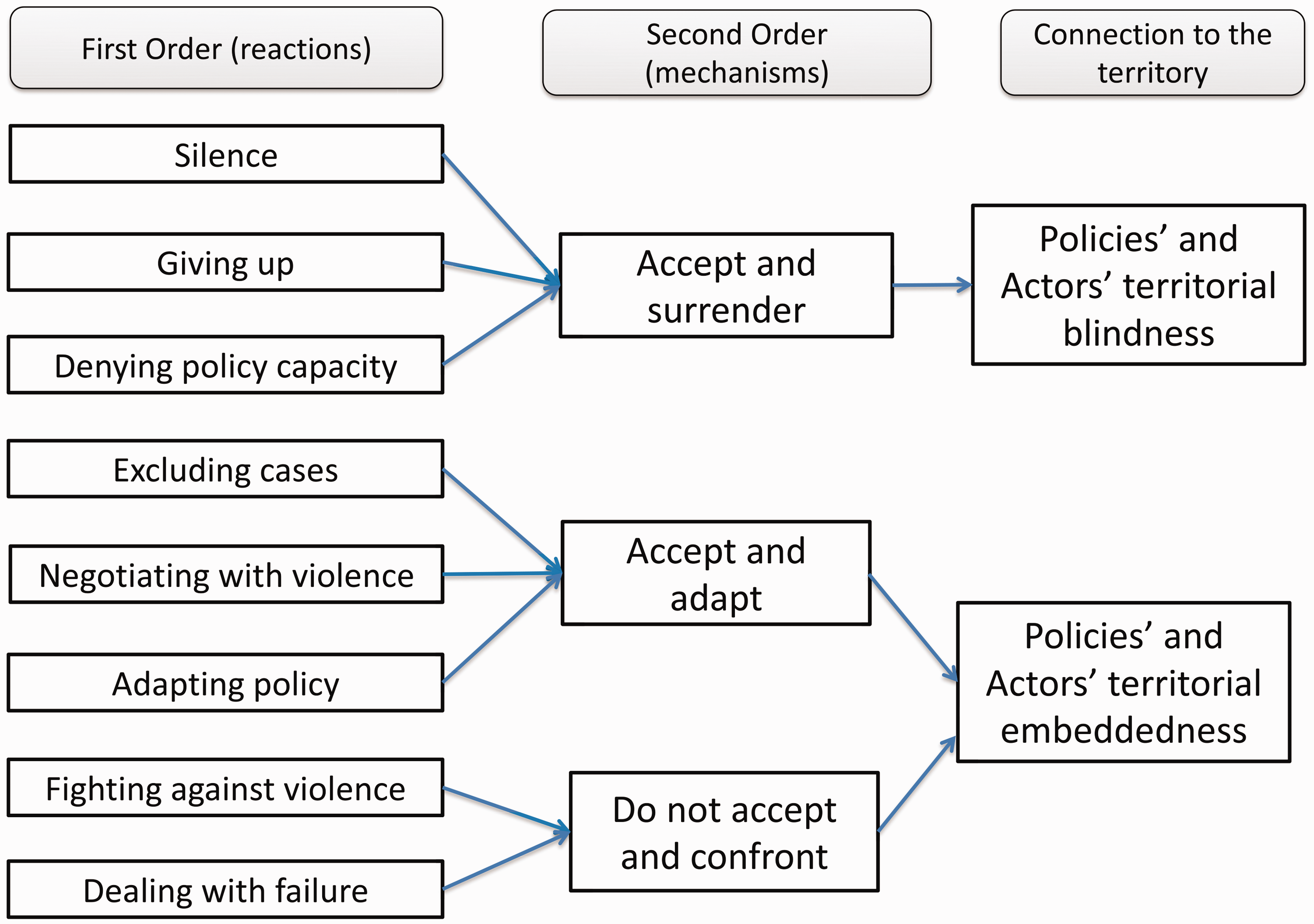
Reactions to and mechanisms against violence.
The question that remains is: how are these reactions and mechanisms connected to the territories? When policies and agents are not embedded in the territory, including their power relationships and disputes, their reaction is to accept and surrender. This is because they do not understand the local dynamics, they do not have the needed assets nor the embedded knowledge, resources or social network with local stakeholders to include, in their strategies, ways to face the violence. This is a phenomenon in which policies or agents are territorially blinded. The first case is when the policy is designed not to have a direct connection to the territory. This means the services are delivered there as they could be delivered anywhere else. It is the extreme case of schools when they do not have practices involving local communities or territorial adaptation of institutional components of pedagogical practices. The second case is when frontline workers are also disconnected from the territories. This may happen when the workers are new in the services and do not know the territory and the persons; or when they work in different places and do not connect themselves to them, as they stay only for short periods in each place. Consequently, they do not know local repertoires and disputes, the local language, or connections that could help them in their work.
On the other side, when policies and agents are embedded in the territories, their reactions may be adapting or confronting violence. In both cases, the ability to adapt or to confront depends on the connections between policies, agents, and territories. This is because these mechanisms rely on the capacity to activate local knowledge, resources and assets only available in situations of policy and agents’ embeddedness. We saw these mechanisms when policies are implemented incorporating local elements, as citizens’ social networks and dynamics. Or when frontline workers have a strong tie to the territory – they live there, they have local ties, and so on., which means that they can use their social connections into the policy, as previously shown in the case of health policies (Lotta and Marques, 2020). The different reactions to violence depend, after all, on the degree of policies and agents’ territorial blindness or embeddedness.
Final remarks
This paper aimed to understand the multiple strategies frontline workers develop to deal with violence in vulnerable territories, characterized by high levels of violence, inequality, social and economic vulnerabilities. We undertook an analysis of the micro-dynamics within which frontline workers operate to understand the broader process of how the State deals with violence. The results suggest that the repertory of reactions developed by frontline workers is much more complex than suggested by previous studies (Diamond, 1997; Koritsas et al., 2010; McMahon et al., 2014; Robson et al., 2014; Zang, 2017). We found that, besides passivity in the face of violence, frontline workers also take positive actions and use their agency in order to affirmatively deal with violence.
This study has made four contributions to the existing literature about the subject. First, it expanded the understanding of how violence expresses itself in different ways in the territories in which policies are implemented. Therefore, even admitting that violence is a widespread and important phenomenon, we could see how it is expressed differently in different situations and affect the State and its policies in variable ways. Second, we reframed the relationship between violence, policy implementation, and frontline workers, restoring to the latter an active role in dealing with violence in multiple ways (Sundström, 2016). Even if studies about specific professions have been analyzing the consequences of violence in work (McMahon et al., 2014; Robson et al., 2014; Zang, 2017), the literature has reserved a passive or victim role for these workers. As we show here, violence can help in explaining the practices developed by these workers. Therefore, it can be a variable to understand agency, discretion, behavior, divergence, and coping. The third contribution, finally, is about the types of reactions mapped in the paper. Here, we were able to propose a typology of reactions and mechanisms through which frontline workers deal with these variables, which can be tested and applied in future studies. We recognize that this diversity is important for designing more adherent strategies to improve policy performance in contexts of violence, so common in countries and territories with high levels of inequality and vulnerability. The fourth contribution refers to identifying mechanisms that allow us to understand why one type of reaction or another prevails. Among other possible causes, we show how the territorial blindness or inserted character of policies and professionals can make the difference in restricting or expanding frontline workers' ability to deal affirmatively with violence, instead of simply submitting and being victims of it.
The main limitation of this study is the capacity to generalize the findings. As it was a non-representative sample of bureaucrats and, at the same time, the original research did not aim at understanding violence deeply, we cannot suggest that these findings are representative. Simultaneously, even this limitation is relevant to show how violence is central to these workers and how it appears recurrently and comprehensively. Using an extreme case, the findings may be of interest to similar contexts of vulnerable territories both in developing and developed countries.
Considering these limitations, future studies should test this typology in different contexts and with different types of workers. It would be interesting to see if the same can be found in other types of territories, particularly those contexts of high violence but less vulnerabilities or inequalities.
Footnotes
Acknowledgments
Gabriela Lotta thanks the São Paulo State Research Support Foundation (FAPESP) for supporting the data collection (Process number 2019/13439–7, CEPID CEM).
Declaration of conflicting interests
The author(s) declared no potential conflicts of interest with respect to the research, authorship, and/or publication of this article.
Funding
The author(s) disclosed receipt of the following financial support for the research, authorship, and/or publication of this article: Lotta also thanks the Brazilian Council for Scientific Research (CNPq) for the Research Productivity Scholarship (Process 305180/2018–5). Fernanda Lima Silva thanks the São Paulo State Research Support Foundation (FAPESP) for the Postdoctoral Scholarship (project number 2019/06616–0). Arilson Favareto thanks the Brazilian Council for Scientific Research (CNPq) for the Research Productivity Scholarship (Project number 314020/2018–7).
