



Abstract
Research on street-level bureaucrats has examined the various ways in which these professionals have implemented public policies in areas such as healthcare, education, and security, often emphasizing the role played by discretion in the implementation process. Despite its importance, the concept of street-level bureaucracy has scarcely been approached by housing studies. This study focuses on the role of street-level workers in the delivery of public housing to the lower-income population. We affirm the value of complementing street-level discretion with the concept of proximity, a premise borrowed from the microfinance literature, to increase the understanding of the interactions and relationships established between street-level workers and policy recipients during the implementation process. Such complementarity may contribute to a more accurate understanding of the housing policy implementation dynamics on the street-level and the possible adjustments to meet local needs. To explore this issue, we used a theoretical lens inspired by Goffman’s frame analysis that points to the importance of relational mechanisms that characterize the interactions between street-level workers and beneficiaries. These lenses were applied to a collective case study of Minha Casa Minha Vida-Entidades, a Brazilian subprogram in which street-level workers linked to social housing movements assume a leading role in the planning and execution of interventions. The results indicate that the combination of proximity and discretion has a positive influence on the implementation of housing policies. Our analysis shows the existence of nonprofit-oriented arrangements that may present different features and nuances at the implementation (micro) level and contribute to the (macro) debate on housing policies.
Keywords
Introduction
In recent decades, the world has seen increased population concentrations in urban areas (UN Habitat, 2016). Latin America (LA) is one of the regions where this has been more intense, with over 80 percent of its population currently living in cities (Angotti, 2013). Urbanization rates in LA countries have grown more rapidly than the ability of governments and markets to respond to the housing demand (Murray and Clapham, 2015), resulting in high levels of informality, burgeoning slums, and a considerable housing deficit that affects more than 30% of the population, mainly the poor (Bouillon et al., 2012).
In this context, public housing delivery to the low-income population is a challenge, which has been analyzed through different approaches, such as land use (Murray and Clapham, 2015), construction management (Formoso et al., 2011), low quality of housing units (Bonduki, 2009), and the role of social organizations (McTarnaghan et al., 2016). Other studies have analyzed broader housing strategies focusing on the recent revival of state-led housing programs in the Global South, reigniting the discussion on enabling versus provider housing approaches (Sengupta et al., 2018). Enabling strategies, strongly advocated by the World Bank and UN-Habitat, have prospered in the context of a financial liberalization process that allegedly promotes mortgage finance as a market solution to housing shortage (Yap, 2016).
One criticism of enabling strategies is that they leave the urban poor behind (Rolnik, 2013), meaning the state must step in. However, rather than inaugurating a new era of the provider approach, current government actions in the Global South must be understood as one of the conceptual phases that enabling strategies have presented over 40 years, from the 1970s to the present day (Sengupta, 2019). The current phase of enabling strategies, initiated in 2000, is marked by state-led large-scale housing policies that include government support for mortgage markets expansion through subsidies so that the private sector is induced to remain engaged in policy implementation. In this sense, the current phase represents a “renewed commitment to the expansion of enabling principles where the state is an active agent” (Sengupta, 2019: 511).
In Minha Casa Minha Vida (hereafter MCMV), Brazil’s largest state-led housing program, enabling strategies are explicit since its main purpose is to boost the economy through allocating subsidies to projects led by private actors, often neglecting production quality and location issues (Sengupta, 2019). Despite the importance of discussing broad housing strategies, particularly the mutated versions of enabling principles, this study uses another analytical lens, focusing on implementation issues in a modality of MCMV known as Minha Casa Minha Vida Entidades (hereafter MCMV-E), based on arrangements that include local governments and housing movements. These arrangements are not profit-oriented and, as such, may present different features compared to predominant enabling approaches (Sengupta, 2019). In this sense, the empirical analysis of MCMV-E presents nuances at the implementation (micro) level that may contribute to the (macro) debate on housing policies.
The literature on public policy implementation can be used to understand these different features or nuances, particularly the street-level bureaucracy, a concept that housing studies have scarcely approached. Central to public policy implementation, street-level bureaucrats (SLB) are local–based agents, such as teachers and counselors, who interact with the beneficiaries, implement public policies, and are responsible for the dispensation of benefits and the allocation of public sanctions (Lipsky,1980). These frontline workers can be regular governmental bureaucrats or civil society and third sector employees, who develop direct work with service users (Verschuere et al., 2012). Therefore, we claim that local agents/actors linked to housing movements that engage in housing co-production alongside governments can be regarded as street-level workers (SLW). Although the terms SLB and SLW may be used interchangeably, this paper uses SLW to refer to any professional working with frontline public policies.
A distinguishing feature of SLW is discretion, i.e., the space of freedom at the frontline of services delivery that allows these professionals to influence what should be done in a particular situation, including resource allocation and decision-making (Lipsky, 1980). Despite its relevance, we argue that discretion alone is not enough. To improve the implementation of public housing policies targeting the lower-income population, a second concept should be combined with discretion – proximity – defined herein as a social and geographic closeness among actors. Geographic closeness helps increase interactions that lead to social closeness (Feigenberg et al., 2013). The resulting social ties can influence and shape social and economic relations within a territory (Granovetter, 1985). In the absence of proximity, the freedom granted by discretion may produce policy decisions that decouple or disconnect from the local reality of lower-income beneficiaries, jeopardizing the desired outcomes of the policy.
One of the sources of evidence that encourages us to put forward proximity as a potential construct comes from studies on microfinance, more specifically microcredit, whose implementation involves credit agents or frontline local-level actors who play the role of mediators between microfinance institutions (MFI) and borrowers. Accordingly, the research question guiding this investigation is: how can the implementation of public housing policies targeting low-income populations be improved through the combination of proximity and discretion strategies?
To explore this question, we use a frame analysis based on the relational mechanisms of SLW and beneficiaries (Goffman, 1974; Lotta, 2014) and a methodological design based on a collective case study (Stake, 1998). An in-depth investigation of two Brazilian public housing projects within MCMV-E was conducted. We collected empirical material through participant observation, 18 in-depth semi-structured interviews, and numerous documents. This study contributes to the debate on public housing delivery and to the street-level bureaucracy literature by identifying benefits derived from adding proximity to discretion.
This article is structured as follows: in the next section, we provide an overview of two bodies of literature, namely, street-level bureaucracy and housing public policy, and argue the value and complementarity of microfinance studies. We then discuss the conceptual framework and the methodological design of the study. Next, we present the results, followed by a discussion of the contributions and the main conclusions.
Literature background
Housing policies, street-level bureaucracy, and proximity
In many LA countries, recent state-led housing programs have hybrid forms and arrangements that include government at national and subnational levels, private developers, and financial markets. When discussing broad housing strategies, these programs may be viewed as adaptations of enabling principles and methodologies in place since the 1970s (Sengupta, 2019). State-led housing policies reemerged as an answer to an increasing consensus that the urban poor were not reached by the strategies then adopted. However, there was no radical disruption. The preservation of the ownership orientation and housing as an investment asset allowed traditional financial institutions to remain engaged (Rolnik, 2013), while different forms of partnerships attracted new market players, such as microfinance institutions (MFI) (Grubbauer, 2019).
Here lies an important conceptual link between microfinance and housing policies: MFI and other private sector actors were attracted by the potential profits of revived large-scale state-led housing programs that promoted mortgage finance through subsidies allocation. In this sense, microfinance represented a potential combination of investment opportunities and welfare production, emblematic of the new forms of enabling strategies (Sengupta, 2019). It is possible to link microfinance to housing public policies through another angle captured by three related arguments.
First, local conditions are crucial for shaping the needs of the lower-income population, enhancing the relevance of local-based actors for policy implementation in general (Gonzalez et al., 2015) and housing policies in particular (Laffin, 2013).
Second, credit agents in charge of implementing microcredit operations are examples of local-based actors who act similarly to SLW. Both are challenged to balance the formal aspects of standardizing public policy and its functional duties (efficiency) with discretion (Canales, 2014). SLW use discretionary spaces and powers to maneuver/negotiate between policy goals and service users’ needs, interpret and adapt policies to individual situations. They use their agency to respond to individuals and circumstances at the frontline instead of only responding to rules, procedures, and laws (Maynard-Moody and Musheno, 2000). Credit agents also use discretionary spaces to meet the local needs of micro-entrepreneurs (Ambrozio and Gonzalez, 2019). On the other hand, both SLW and credit agents may serve as gatekeepers in the access to scarce services and benefits, which is commonly associated with ‘negative discretion’ in the sense that it may adversely affect the expected policy outcomes (Alden, 2015).
Third, besides being local actors that resort to discretion, credit agents employ proximity, or “financial proximity,” as named in microfinance literature. Servet (1996) seems to have coined the term financial proximity, referring to transactions between agents belonging to the same geographic, ethnic, religious, or professional space. Proximity, be it spatial, cultural, social, or cognitive, ensures legitimacy and the effectiveness of MFI (Guérin and Servet, 2005). Within the boundaries of financial proximity, MFI must be geographically and socially close to the communities and must have an explicit purpose of meeting the needs of the community members and promoting social engagement at the local level.
Proximity is also related to the social network literature that investigates the role of physical spaces and the social returns on interactions. Solidarity and cooperation may be boosted by face-to-face interactions that form and strengthen social ties (Feigenberg et al., 2013). In addition, proximity enables the mobilization of local resources embedded in existent community relations (Junqueira and Abramovay, 2005), which may produce collaborative processes that generate better societal outcomes (Bartels, 2018). Within the implementation process of bottom-up housing policies, such as MCMV-E, proximity may enhance the ability to use local savoir faire to improve the delivery of adequate housing. SLW that combine discretion and proximity can maneuver to create bridges between housing policies and beneficiaries’ demands and translate to the latter the bureaucratic procedures/requirements and the rules to benefit from the policies.
Profit-maximization has been a common feature of the enabling strategies’ different phases in the last decades (Sengupta, 2019). However, the combination of discretion and proximity as part of state-led housing policies points to the possibility of implementing housing policies that are not mere adaptations of social welfare programs to private capital needs. In this sense, the cross-fertilization between these areas of study might shed light on shared issues that could improve broader housing strategies.
Recent housing policies in Brazil and the MCMV program
The Brazilian re-democratization process in the 1980s brought about the need to leverage low-income housing strategies due to the increasing housing deficit and the growing pressure of social movements. During this period, legal changes that underpinned these housing strategies emerged due to the advocacy by national movements related to urban reform (Bonduki, 2009), such as the institutionalization of the social function of property in the Federal Constitution of 1988. The 1980s also inaugurated interactive dynamics between popular movements and progressive local governments, such as the Workers’ Party (hereinafter PT), which reacted to popular pressure and started to negotiate solutions to housing problems (Blikstad, 2017). In 2003, after PT won the Brazilian presidential elections, the Ministry of Cities was created, followed by the Crédito Solidário program, the first national housing initiative to incorporate the self-management proposal, an old demand from the housing movements (Mineiro and Rodrigues, 2012). This program was the result of popular mobilization, even though it did not deliver the planned output due to operational difficulties faced by the housing movements when implementing the projects (Blikstad, 2017).
In 2009, the federal government launched MCMV, the largest ever mass housing program in Brazil, conceived as a countercyclical policy to reactivate the country’s economy through construction and real estate (Jesus, 2016). Initially aiming to build one million housing units for low-income Brazilians, MCMV was a milestone in Brazilian housing history by conceptualizing the return to the direct provision of social housing (Sengupta et al., 2018). However, the role played by the financial system and the private non-financial sector links the program to the current phase of enabling strategies (Sengupta, 2019). MCMV incorporates different sub-programs, with varied subsidies and norms, according to household income brackets. Faixa-1 is the cluster that includes families whose monthly income is less than two minimum wages (approximately US$550 in 2019). For this group, recipient families were supposed to pay between 5% and 10% of the house value (Ambrozio and Gonzalez, 2019).
Pressures from social housing movements led to the posterior creation of MCMV-E (Jesus, 2016; Stiphany and Ward, 2019). Both MCMV and MCMV-E work in Faixa-1, but with remarkable differences in the delivery mechanisms. The main distinction of MCMV-E is the direct involvement of social movements and NGOs in the implementation: the future residents are encouraged to engage throughout all the phases of the project, and the social organizations are responsible for the building process (NEPAC, 2015). While under MCMV, private companies have a leading role in the delivery process, including land selection, project development, and implementation; under MCMV-E, associations, cooperatives, and housing movements, all termed entities. take the lead. Entities must be certified by the Ministry of Cities and comply with predefined regulations to be eligible. As long as they abide by the regulations, the entities have relative autonomy to define their own criteria for screening and monitoring potential beneficiaries (Jesus, 2016). A scoring system – based on attending general meetings, street demonstrations, and occupations – is a common practice among housing movements for selecting families that will benefit from the housing units. For construction, the entities may opt for a self-management system with the support of technical assistants or for hiring private developers.
As of 2019, approximately 54,000 housing units were contracted under the MCMV-E. Although this number accounts for less than 5% of the housing units of Faixa-1, this subprogram had a paradigmatic political dimension, anchored in the tradition of self-managed housing policies and the involvement of the most representative social housing movements in the country (Rizek et al., 2014).
Despite the social housing movements’ agenda on rights, concrete material needs remain the main motivation for engaging potential beneficiaries of MCMV-E (Blikstad, 2017). Most citizens who entered the program heard about the movement through friends, neighbors, and family members and did not have previous experience of collective associations. Similarly, Stiphany and Ward (2019: 325) argue that MCMV-E beneficiaries do not “participate in community affairs beyond MCMV-E, which represents an opportunity for escaping poverty through homeownership.” In this scenario, housing movements’ representatives play a relevant role in mediating the relationship between the state and the future beneficiaries (Blikstad, 2017). These representatives try to reconcile producing housing units and forming a collective political awareness to foster social transformation (Stiphany and Ward, 2019).
Brazilian bottom-up housing policies, such as MCMV-E, have been studied with different focuses, such as their historical development (Mineiro and Rodrigues, 2012), the spatial segregation of self-managed housing units (Rizek et al., 2014; Stiphany and Ward, 2019), housing movements’ influence on public policies (Jesus, 2016), and the beneficiaries’ participation in policy implementation (NEPAC, 2015). Except for Viana (2017), who analyzes the action of federal government workers to minimize the resistance of local bureaucracy in the implementation of MCMV-E, and Santos (2016), who investigates specifically the political dimension of the technical assistance organization’s social work in the delivery of MCMV-E, we are not aware of studies that look into the work of those at the frontline of this bottom-up subprogram.
Conceptual framework
To answer our research question, we propose a framework based on two complementary studies: Goffman’s (1974) frame analysis and Lotta’s (2014) relational mechanisms associated with the SLW/beneficiaries’ relationship. The work of Goffman (1974) is well known in organizational studies and public administration areas due to its analytical power. The author proposes that interpretive schemes and frames of reference work as a medium for understanding and acting in the world, mediating the interaction among social actors and the reality they help to produce. These primary interpretive schemes and frames give meaning to events and relations that would otherwise be meaningless. Therefore, mental and action schemes cannot be separated from each other. The social actors – i.e., SLW and beneficiaries – interpret and structure the events and decisions in their daily lives based on these frames of reference.
Inspired by Goffman’s (1974) frame analysis, Lotta (2014) advances the understanding of bureaucrats as implementers. Through the deep investigation of the implementation styles adopted by community health workers, she presents a new analytical perspective on public policy implementation that incorporates new actors into the analysis, their frames of thinking, and their processes of interaction and mediation. Lotta’s theoretical path has similarities with Vijay and Kulkarni’s (2012) work on types of frames related to changes in social movements. Both tried to fill the gap identified in the growing body of research using frames as the theoretical anchor by paying attention to the social constructivist emergent qualities and discursive practices of framing processes.
Therefore, considering that during the interactions with the beneficiaries, SLW express their views on these relations and hence identify who they are, where they are, and where they want to go (White, 1995), Lotta (2014) systematized five relational mechanisms (Figure 1). The mechanisms help to clarify how these professionals act as mediators by building their practices and implementing public policies. The mechanisms identified are translation, frame-setting, frame-changing, identity, and reciprocity. They are described and illustrated below.
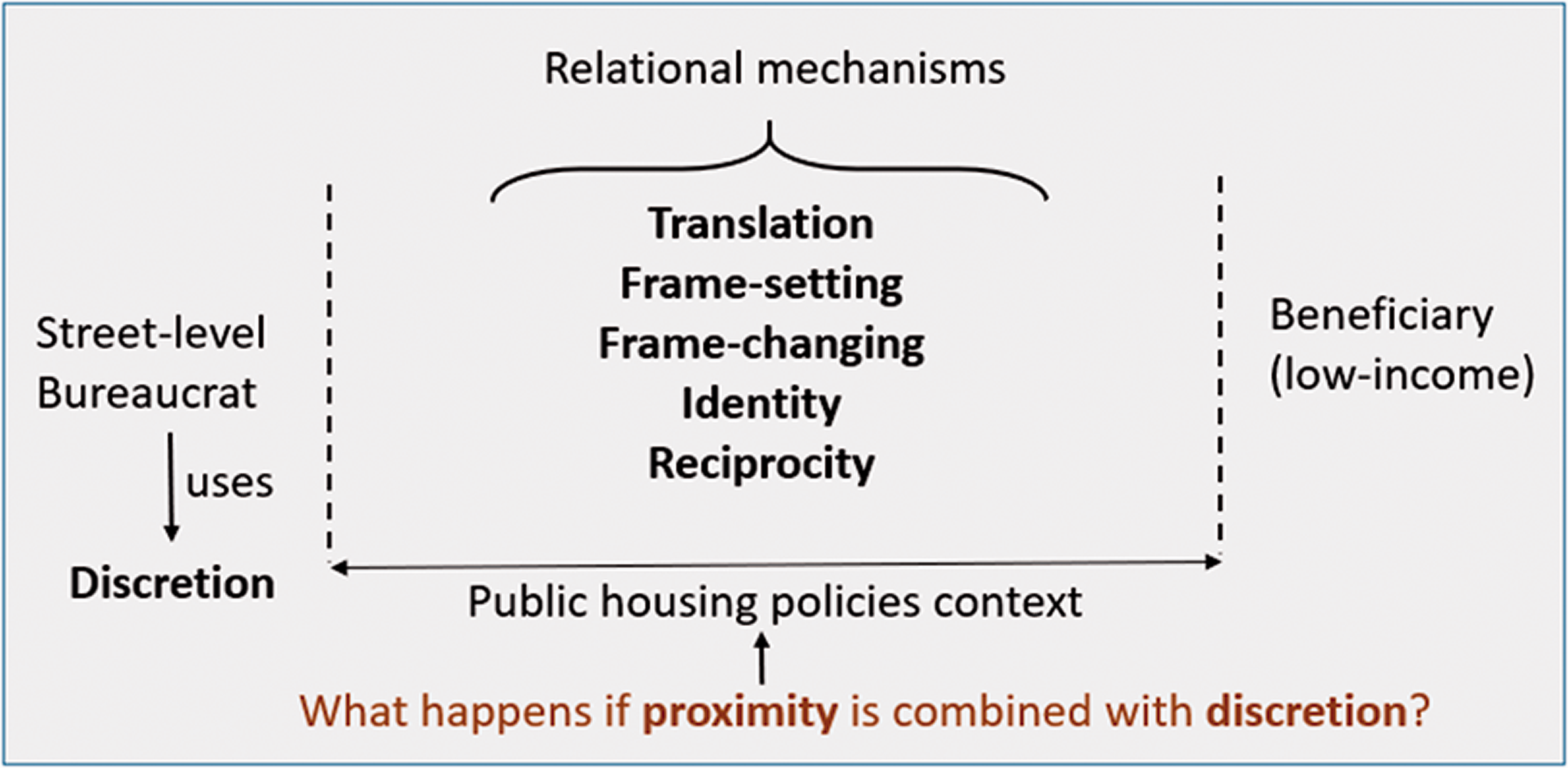
The initial conceptual framework.
While the identification of these mechanisms was based on discretion within the context of public health care policies (Lotta, 2014), our work analyzes the effect of proximity and its interconnectedness to discretion in the context of MCMV-E. Figure 1 represents our conceptual framework. The underlying assumption is that proximity influences the relational mechanisms positively, besides creating additional opportunities to improve the implementation of housing policies.
Methodological approach
The methodological approach embraces the concept of an instrumental and collective case study, as proposed by Stake (1998). Instrumental and collective cases are those chosen not for the intrinsic interest of the cases themselves but for their suitability for exploring a research question that transcends the case, thus bringing a broader understanding to similar cases. This understanding is a step towards the theoretical generalization of a few cases to many cases (Stake, 1998).
Within MCMV-E, we have selected two public housing projects: Case-1 and Case-2. They were selected because they share similar features: region, size, types of projects, and difficulties in the process of housing delivery within MCMV-E. In addition, we contend that proximity between future residents and frontline workers is an important element in both cases. These similarities help us mobilize analytical techniques that resemble the idea of literal replication, i.e., selecting cases that are similar in certain desirable aspects to see if similar patterns emerge and mutually corroborate.
However, these cases also present important differences, particularly related to the housing movements’ trajectory, proximity, and engagement strategies. Case-1 refers to the building of 120 apartments within MCMV-E, which was contracted in 2010 by a movement founded in the 1980s in the metropolitan region of São Paulo to deal initially with literacy issues. Local demands ended up pushing the movement toward housing issues. By the time of the interviews, Case-1 was significantly involved with MCMV-E in São Paulo. This movement does not follow the strategies of the main national housing movements, such as self-management, institutional engagement of potential beneficiaries, and political affiliation (Tatagiba et al., 2012). Moreover, Case-1 is not linked to left-wing parties, including the Workers’ Party.
Data from the interviews highlighted the strong role played by the founder and main leader of Case-1, who was described by some of the interviewees as the most important person in ensuring the achievement of the association’s outcomes. Case-1 directly manages all the housing policy implementation. Their work includes establishing a close relationship with the future owners of the houses, who commonly live near the association’s headquarter, are referred by local allied associations, and participate in meetings and assemblies where decisions regarding the housing projects are made. Their geographical proximity with the future residents results in constant interactions and social closeness (Feigenberg et al., 2013), which, in turn, support decision-making processes. Program beneficiaries from Case-1 were involved in the housing project from the outset.
Case-2 is led by a movement located in the municipality of São Paulo. The movement was also created in the 1980s and, since then, has been linked to struggles over the right to land and housing for low-income families. It is associated with local and national housing movements and adheres to their traditional repertoire of actions, such as self-management, which allows the housing initiatives’ participants to engage in decisions regarding land, architectural projects, and accountability (Tatagiba et al., 2012). The movement has the concrete purpose of promoting political debate and awareness among its members, including political engagement through political parties.
Case-2’s housing project comprises 396 apartments of 58 m2. The search for land began in 2008, and its acquisition took place in 2009. The project was approved within MCMV-E in the same year. Case 2 relies on the support of a technical assistance organization – a nonprofit engaged in the promotion of urban reform and self-management schemes, with evident political affinity with the movement leaders (Blikstad, 2017; Santos, 2016) – that responds to the movements’ demands and to local, thematic commissions formed by future residents. Future residents were also involved from the outset: first by participating in the search for land and later by scrutinizing, transforming, and approving the design of the apartments proposed by the technical assistance organization. The proximity between SLW and future residents is anchored on socioeconomic similarities and constant interactions during the meetings, works, and political formation activities, which aim to foster political awareness and transformations.
While in Case-1, SLW are comprised only by the representatives of the housing movement, in Case-2, there are two types of frontline workers: the members of the housing movement with previous experience in self-managed housing projects and workers from the technical assistance organization in charge of planning and managing the social and building processes.
It is important to point out that in both cases, there is interaction with Caixa Econômica Federal (hereafter Caixa), a federal government bank that accounts for most of the housing credit in Brazil. Although the Ministry of Cities was in charge of formulating the program, Caixa, due to its presence across the country, plays a major role in the implementation of MCMV-E, especially concerning project approval and funding operation, enforcing the set of rules and norms from the Ministry of Cities.
Data collection and analysis
Data collection was based on a triangulation counting on participant observation, documents, and semi-structured interviews. Several visits were conducted to interact with actors and collect documents. Participation in two important general meetings was crucial to understanding some of the interaction dynamics. In addition, 18 in-depth, semi-structured interviews were recorded and transcribed. We interviewed 6 SLW and 5 future residents (beneficiaries) from both cases, 3 governmental program coordinators, and 4 public agents from Caixa.
The data analysis was guided by the conceptual framework, following a deductive-inductive analytical procedure inspired by Miles and Huberman (1994). While the relational mechanisms suggested by the framework served as a starting point, we were nevertheless open to inductively identifying new mechanisms, paying special attention to the effects of proximity. We explored the effect of proximity on different relational mechanisms identified in the literature and the potential effect of such proximity on the input provided for housing policy decisions.
To facilitate the identification of sound patterns in the empirical data, we first carried out a within-case analysis for each of the two housing projects. We then conducted a comparative cross-case analysis to identify potential similarities and differences between the two embedded cases. Finally, we established criteria to validate the methodology based on Guba and Lincoln’s (1994) naturalistic approach to qualitative research (namely: confirmability, dependability, transferability, and credibility), and they were followed to ensure the credibility of the research procedures adopted.
Results
The use of the guiding conceptual framework allowed us to corroborate and enrich the existing literature. The initial list was composed of five mechanisms: translation, frame-setting, frame-changing, identity, and reciprocity. The data analysis led to the modification and addition of mechanisms. Accordingly, the final list is composed of eight mechanisms (Table 1). The mechanism of translation was divided into two sub-categories (word-based translation and action-based translation). Also, a new mechanism emerged, also divided into two sub-categories: internal and external mediation.
The influence of proximity in the identification of relational mechanisms.
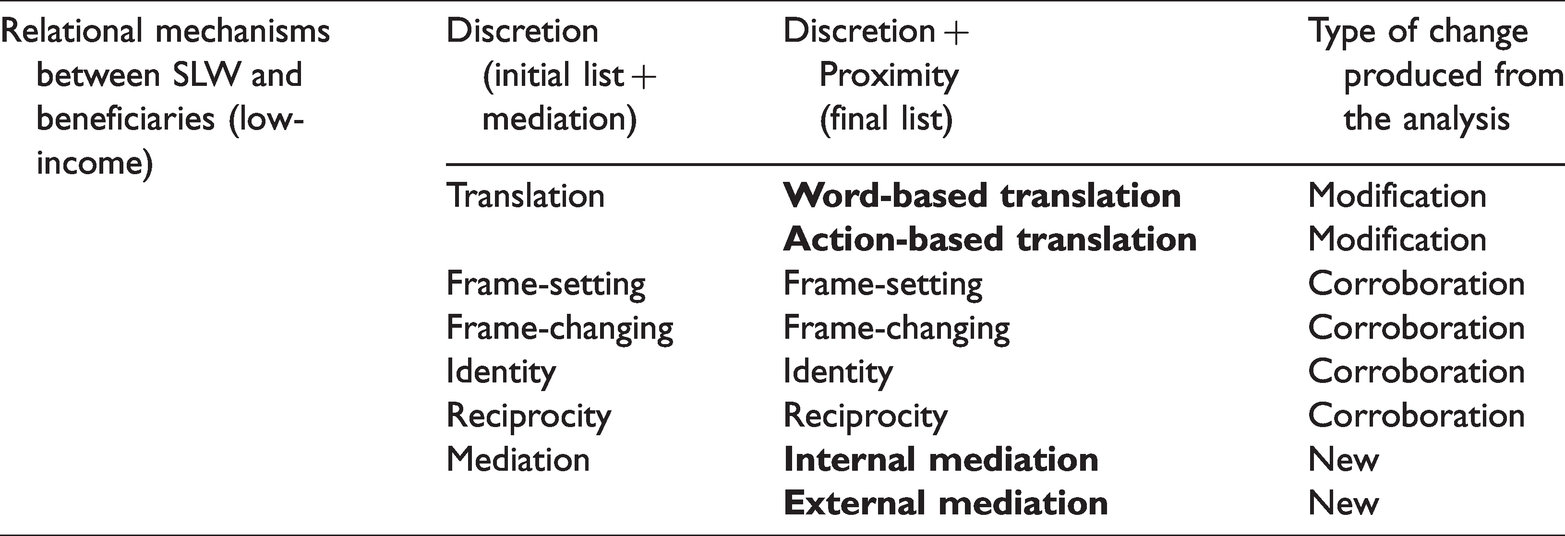
The following sections present the four existing mechanisms corroborated by our results and the four new mechanisms that represent a relevant contribution to the literature.
Corroborating existing relational mechanisms
The first mechanism that our results corroborated is frame-setting. It involves using a set of strategies to frame the relationship between the SLW and the beneficiaries on a continuum from a more technical-bureaucratic relationship to a more community-oriented relationship. We acknowledge the relevance of these frame-setting strategies, as illustrated by Quote 1, which exposes the framing of the relationship between an entity representative and the future residents. [Quote 1 – SLW/Case-2] In my opinion, I have much to contribute, I have a lot to say because I have had experiences that perhaps no one else here had. Everyone that was in the mutual self-help scheme is a member of the association because everything [the association and the scheme] belongs to them […]. I am not saying I am different. It is just a different way of seeing the process […].
The second confirmed mechanism is frame-changing. This occurs when the social actors reframe and change the existing frames to act towards achieving certain goals. This mechanism is, in fact, the capacity to manage and sometimes change expectations, for example, by switching subjects from short- to long-term, as illustrated by Quote 2. [Quote 2 – SLW/Case-2] […] we are always organizing something. First, it was the committees to start the construction, and now it is the completion of the building […] as for the [requirements from the] government, we have to understand what we need, the documents we will receive […] because we need them to complete the construction and start another stage in our lives. Our work is never-ending, and our struggle is continuous. […]
The third mechanism is identity, which refers to the ability to activate or deactivate the identities engaged in a specific interaction. This mechanism is mobilized by the use of local references and terms and common ways to interrelate. Unlike the previous mechanisms, identity was triggered differently in the case studies. Case-2 relied on promoting a traditional repertoire of housing movement actions, political awareness, and community links among its members (quote 3). Based on field observation, we realized that Case-1’s identity and proximity with its associates (and future beneficiaries) appeared to be more closely intertwined with the geographic location of the housing project and its closeness to the association headquarters. [Quote 3 – SLW/Case-2] We have other memories, and they [beneficiaries] also have other memories and references; there are many mutual self-help settlers here who are sons and daughters of people that were engaged in mutual self-help communities. Thus, they have good and bad memories related to our social movement and to self-help schemes […] and so do we.
The fourth mechanism is reciprocity. This refers to how the actors, during the interaction process, emphasize the development of reciprocity, which occurs on a continuum from asymmetrical, i.e., one of the parts assumes dominance over the other, to symmetrical, i.e., the parts assume equal positions regarding power relations. Again, all case studies employ this mechanism, but they occurred differently according to the movements’ working characteristics and principles. SLW from Case-2 have employed reciprocity, emphasizing relative equality and promoting the development of commitment and empowerment among the future residents. Case-1 has often used this mechanism to highlight the differences between the association and its beneficiaries. Quotes 4 and 5 illustrate the reciprocity mechanisms. [Quote 4 – SLW/Case-2] First of all, people tend to want bosses; that is the truth. They want someone to tell them how to do things, to give orders, to tell them if what they are doing is right or wrong. This is true not only during the construction, but during the entire process. […] We try to show that it is not like that; that we are partners and that the decisions have to be made collectively, for better or for worse. [Quote 5 – SLW/Case-1] We talk about equality, but we have different responsibilities. And they [future residents] know that. They even say, “the movement’s responsibility is much greater than ours in the project” […] But we try to show them that we are exactly the same; as a human being, I am not better or worse than them. We are equal, but we have different responsibilities.
Proposing new relational mechanisms
The first theoretical contribution of our results in terms of new categories is related to the mechanism of translation, a set of communicative strategies to create a common language and facilitate understanding between bureaucrats and beneficiaries. The definition proposed by Lotta (2014) focuses on the use of language and words, i.e., communication strategies. We found this word-based translation mechanism in several interviews (Quote 6), thereby corroborating its importance. [Quote 6 – SLW/Case-1] […] When you use technical language, you need to give examples of what you are saying. […] You need to say for example: this pipe here, which has this technical name, is popularly known as this other name. Because of this pipe, you cannot make holes in the wall.
However, a careful analysis of our data revealed a second type of translation. Specifically, we found translation mechanisms that are more than just communication strategies, i.e., more than just the use of words. Rather, the mechanisms were related to mobilizing concrete actions to achieve a common understanding. This means that the SLW use concrete examples to generate shared knowledge among the beneficiaries. Essentially, this mechanism involves taking the beneficiary by the hand, moving to different places, and demonstrating what is being explained (Quote 7). [Quote 7 – SLW/Case-2] Some time ago, I felt that I said things people were not able to visualize or understand. Therefore, we gathered a group of self-help mutual scheme coordinators, and we went to the construction site to show them [beneficiaries] what we were talking about: a power plug has to be made like this etc. […] In the construction sites, everything you talk about is there; if you take ten steps you can visualize and learn from what you are talking about.
These action-based translation mechanisms are possible due to the increased proximity, which means that people interact in the field and do not just talk to an officer, perhaps in their office or by phone, to establish a common understanding. During the process of building housing units, SLW may show beneficiaries how to perform certain tasks, going beyond the use of words to capture, for instance, technical concepts. Such action-based translation reinforces the value of physical proximity in the construction. By engaging through a hands-on strategy, the SLW can better manage the implementation process, especially given that unpredicted situations may occur at the local level.
Most of the mechanisms above facilitate communicating and establishing a relationship. However, we identified a second level of mechanisms that are much more political and collective. The SLW mobilize arguments and tactics by claiming, convincing, and compelling people to converge, exchange, and negotiate. These mechanisms informing and promoting convergence of interests and values refer to internal and external mediation.
An illustration of the internal mediation mechanism is when SLW facilitate dialogues among families to achieve consensus or address doubts. (Quotes 8 and 9). [Quote 8– SLW/Case-2] We gather a group of people who did not know each other but need to work together. Most of the time, they are not used to discussing without arguing, and they do not understand that dialogue is a process. At first, we helped in the meetings. We would tell them they had to talk, or that they were talking too much, or that they had to wait for the colleague to finish speaking […]. [Quote 9– SLW/Case-1] I participated from the beginning, when they [future residents] wanted a word from someone important in the entity, so they could trust that the work was trustworthy. When [the process] starts this way, they call me whenever they have a doubt. Every two months I have a meeting to talk to them about general things. Actually, to talk about everything that you can imagine […].
The SLW also employ external mediation, in line with Blikstad’s findings (2017), when they act as a mediator between the family and the external governmental agencies that have power over the family’s cause. For instance, they mediate the negotiations between the beneficiaries and the federal or municipal government or the bank (Caixa), as Quote 10 reveals. [Quote 10 – SLW/Case-2] This is very much what we do, defend, argue, and show. No matter how many adaptations we carry out to serve the families’ needs and comply with the law, the requirements keep coming from the bank [Caixa], things [requirements] we would never imagine [the bank would need].
Furthermore, the cases have provided evidence that the mediation role may be linked to political issues, although there are differences between the cases. For Case-2, the mediation was accompanied by attempts to foster citizens’ involvement with collective issues (quote 11) and create political awareness and active engagement for social change, mainly through self-management and closeness with progressive political parties. As for Case-1, the political dimension seems to be more abstract and less connected to specific groups or political parties (quote 12). [Quote 11 – SLW/Case-2] They [future residents] say, “wow, I came in here and I just wanted a house. Today I understand, I participate here, I participate there, I need to understand the city, what it takes to make changes” – That’s for sure. You transform yourself, there is no way one leaves here without being transformed, either a lot or a little bit, but the transformation happens. [Quote 12 – SLW/Case-1] And we continue working, but working alone. Here in [the municipality of] Santo André, for example, the local government has been, for a long time, the Workers’ Party, and we have a project here, at the end of this avenue, that is the result of a [program from the] federal government, which is also the Workers’ Party, and they [the local authorities] have never even come close to seeing the project.
Figure 2 visually summarizes the final conceptual framework, modified after our analysis, showing that when proximity is combined with discretion, a rich repertoire of relational mechanisms emerges in the relationship between the SLW and the beneficiaries. These mechanisms, as shown in the interviews, can improve housing delivery to the low-income population. They can encourage practices that consider the future residents’ necessities and provide adequate support to overcome the barriers to their participation in the policy, such as helping to produce the documents requested or to interpret bureaucratic rules.
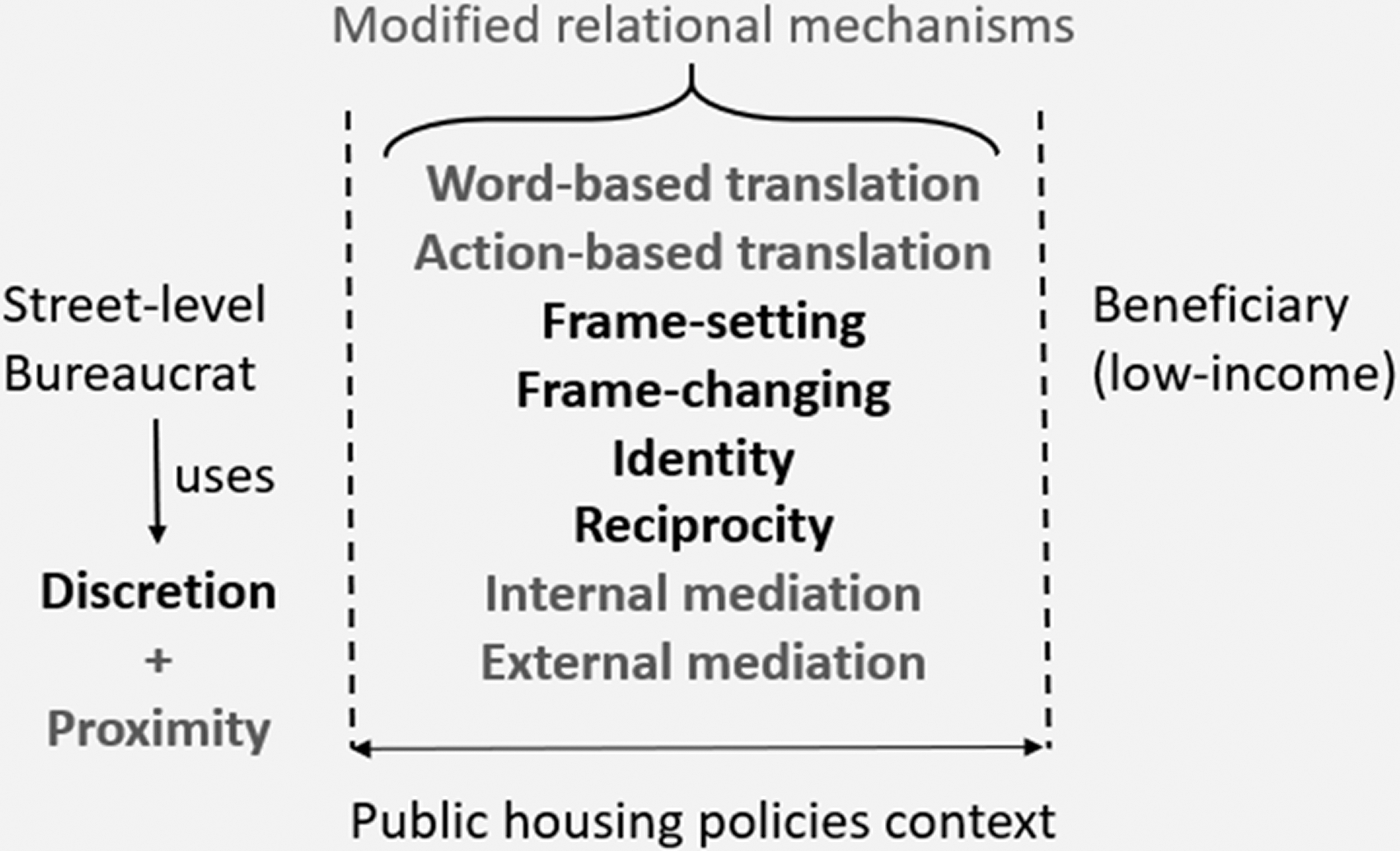
The final conceptual framework with new relational mechanisms.
Discussion
Since Lipsky’s (1980) seminal work, extensive academic literature emphasizing the role of SLW has corroborated the importance of discretion in implementing public policies. Our results may contribute to the discussion of new ways to boost discretion (Fuertes and Lindsay, 2016) and understand the interaction process between SLW and beneficiaries by considering the role played by proximity. In the context of MCMV-E, discretion seems to be better exerted when combined with proximity, creating room for housing policies that meet local demands and leverage the engagement of housing policies’ recipients.
The concept of proximity establishes a link between microfinance and housing policies’ implementation that differs from the analysis of broader housing strategies, particularly the current phase of enabling strategies (Sengupta, 2019), where the microfinance sector, together with other private actors, engages in state-led large-scale housing projects attracted by subsidies. Whereas in this case, housing microfinance actors are part of a macro analysis of the strategies and different approaches to social housing in the Global South, microfinance concepts may also contribute to the understanding of the dynamics and relationships established between citizens and SLW during housing delivery processes, which may contribute to policy adjustments to meet local needs.
Within the microfinance literature, the concept of proximity – or financial proximity – is fundamental to the legitimacy and effectiveness of MFI that reach out to local communities through credit agents who put the concept of proximity into practice (Guérin and Servet, 2005). Our study identified concrete situations in which SLW, similarly to credit agents, combined discretion and proximity in a way that improved the implementation of the MCMV-E program. For instance, as part of the eligibility criteria, the potential recipients must complete the forms from Caixa. However, some of the issues addressed by these forms may be wrongly interpreted by potential beneficiaries, and, as a result, inaccurate information regarding the socioeconomic characteristics may be provided. For instance, an SLW mentioned that beneficiaries were supposed to indicate the number of people living in the house to determine whether the number of persons per square foot was below a certain threshold. The problem was the understanding of who should be counted as living in the house. Many beneficiaries excluded relatives who were living under the same roof based on the premise that they were not “actually family.” However, the SLW were close enough to correct the information provided and include all eligible people. This example is similar to typical situations in which MFI credit agents help informal microentrepreneurs understand their own financial information (Canales, 2014).
We believe that in the MCMV-E there is additional room for SLW to act as policy entrepreneurs (Arnold, 2015), given that they will not change fundamental housing policy goals but may innovate in terms of the choice of policy instruments and the substance and norms of bureaucratic action. In line with Breit et al. (2016), we claim that housing policy improvements are dependent on the local institutional work of SLW in ways that support and enact the change processes rather than undermine them.
The interactions among the actors directly involved in the implementation of MCMV-E are mediated by interpretive schemes and frames of reference that shape the relationships in a way that is consistent with that proposed by Goffman (1974). Lotta (2014) extended this analysis to improve the understanding of the relationships involving street-level bureaucracy. Our work proposes a further step by identifying additional relational mechanisms that are taking part in the interactions that characterize the implementation of housing programs targeting low-income populations. Our results indicate the importance of proximity for the action-based translation. There is a two-way relationship between SLW and the MCMV-E beneficiaries. Specifically, a concrete, hands-on interaction is possible due to higher proximity, which, in turn, is enhanced by an action-based translation mechanism. Accordingly, discretion may create room for adaptation and the incorporation of local issues into the vocabulary. The discretion and proximity observed during the implementation of the MCMV-E enhance the quality of housing delivery since SLW can translate through actions, not only through words, a variety of concepts that range from financial education to construction issues. Hence, word-based and action-based translation (the latter favors proximity) may improve the identification and solution of many issues.
Mediation mechanisms are essential to promote alignment among the various actors and to mitigate collective action problems. The behavior of SLW linked to social housing movements is marked by maneuvering to engage housing policy recipients to reduce these problems. As put forward by Rolnik (2014), those who engage in housing movements are not only favored for participating in protests or invasions but also for actively engaging in a process that includes attending meetings, training, discussing, and participating in policy construction. The author points out that the very logic of MCMV-E is based on cooperative or self-managed housing construction, and those unwilling to engage (and that includes the political dimension of engagement) could resort to the MCMV instead of MCMV-E.
In our study, the type of proximity and the political views of the housing movements tend to play important roles in mediation. Case-1 is mostly driven by strong leadership presenting weak ties with national housing movements and political parties. Members of the association are socially and geographically close to the future residents and interact in their everyday lives. Their working dynamic has consolidated different roles and responsibilities, with the movement’s leader occupying a prominent space coordinating the activities and mediation efforts. Consequently, Case-1 uses the mediational and political mechanisms in a less institutionalized way, which seems to be compatible with the fact that the association leaders occupy a prominent role. For Case-2, a highly institutionalized and participative relationship was found between the future residents and the SLW, who engaged during the entire construction cycle, i.e., identifying land, project design, and building, seeking to maximize collective efforts for achieving the desired results. These efforts aimed to promote collective engagement and political awareness, usually associated with the agenda of national housing movements and progressive political parties. Their general meetings often included politicians, who were presented as supporters of Case-2 and housing movements in general. In that regard, the political dimension seems to have less relevance for Case-1 when compared to Case-2.
Another important component connected to political elements and the mediational dimension is the attempt to get external support activation (Blikstad, 2017; Viana, 2017). Once obstacles to implementation are identified, the entities must be able to mobilize governmental agents, including politicians aligned with the housing movements, to obtain support to overcome these challenges. Additional actions of housing movements to get support may include marches and occupations of public agencies. In all cases, the movements will have more leverage if beneficiaries are politically engaged (Blikstad, 2017), a fact corroborated by our empirical analysis, mainly for Case-2.
Conclusion
Our empirical investigation has emphasized the existence of relational mechanisms that emerge as part of the daily job requirements of local agents linked to housing movements and engaged in MCMV-E, a bottom-up subprogram of MCMV. We claimed that these local agents are SLW and that public housing delivery to low-income populations could learn from the extensive literature on street-level bureaucracy inspired by Lipsky’s (1980) seminal work. In addition, discretion could be combined with proximity so that the production of policy decisions would not be disconnected from low-income policy recipients’ local reality.
We put forward proximity based on microfinance studies, more specifically, the implementation of microcredit schemes through credit agents who play the role of mediators between MFI and borrowers. In this sense, we believe a relevant contribution of this article is to provide an additional conceptual link between microfinance and housing policies. In previous housing studies, microfinance was predominantly approached as complementary and/or alternative to traditional housing finance schemes that were not reaching the urban poor, mainly those working in the informal sector and living in informal settlements (Smets,2006). Microfinance was also approached in studies focusing on the revived large-scale state-led housing programs as a combination of investment opportunities and welfare that characterized new forms of enabling strategies (Sengupta, 2019).
Within the implementation process of bottom-up housing policies, such as MCMV-E, proximity may enhance the ability to use local savoir faire to improve the delivery of adequate housing. In addition, the combination of discretion and proximity in the context of enabling strategies points to the possibility of implementing housing policies that are not mere adaptations of social welfare programs to private capital needs
The study of two different housing projects showed that, during the implementation of MCMV-E, interaction mechanisms were commonly used, and geographic and social proximity between the housing movements and beneficiaries circumvented or mitigated obstacles to implement bottom-up housing policies. Therefore, our results point to the importance of expanding studies that focus on the relationship between SLW and future residents of public housing, which can promote a better understanding of local realities and needs, improving the process of housing delivery.
Our results highlight that although relational mechanisms are undoubtedly relevant, political issues are intertwined in the interaction between SLW and beneficiaries. Therefore, we claim that the political issues must be incorporated as a component of the relational mechanisms, particularly its mediational dimension. Although the results are related to the Brazilian context, and more particularly to the MCMV-E program, we consider them plausible for other similar contexts, i.e., they could be carefully applied to other housing and social programs co-produced by the government and civil movements. Furthermore, the analysis of MCMC-E points out implementation issues that create room for a more detailed and nuanced analysis of national state-led enabling housing programs since they may aggregate varied forms of policy provision.
Footnotes
Declaration of conflicting interests
The author(s) declared no potential conflicts of interest with respect to the research, authorship, and/or publication of this article.
Funding
The author(s) disclosed receipt of the following financial support for the research, authorship, and/or publication of this article: This work was financially supported by GV Pesquisa and by FGVcemif (Center for Microfinance and Financial Inclusion Studies) at FGV.
