



Abstract
As key sites of governance and poverty management, service hubs are conspicuous inner-city clusters of voluntary sector organizations that serve vulnerable urban populations, including people grappling with homelessness, substance abusers and mental illness. In this paper, we frame service hubs as potentially embodying capacious commons on the one hand, and meagre street-level bureaucracies on the other, reconstituting Lipsky’s individual focus to embrace the agency level. We use a comparative case study approach, focussing on two service hubs – Kamagasaki in Osaka and Overtown in Miami – to show how organizations in each combined, in various ways, the two logics in practice. The results suggest that service hubs acted more as ‘managed commons’, but with some tendencies towards street-level bureaucracy. This conversation between the commons and street-level bureaucracies, and its comparative application to the voluntary sector within service hubs, serve as our primary conceptual and empirical contributions, respectively. We conclude by considering how the two logics overlapped and created hybridized models of poverty management.
Introduction
Service hubs are conspicuous clusters of voluntary sector organizations that serve vulnerable urban populations, including those grappling with homelessness, substance abuse and mental illness (Dear et al., 1994). The voluntary sector is ‘distinguishable from the state by its independence; from the market by its emphasis on the non-profit principle, mutualism and altruism; and from the family/community by its formality’ (DeVerteuil, 2015: 41). It has become increasingly crucial in delivering basic needs to the urban public in the Global North (Lix et al., 2007; DeVerteuil et al., 2020). Service hubs do more, however, than just sustain the everyday needs of the vulnerable – they also constitute key sites of urban governance and poverty management, particularly for those at the urban margins. These are ‘groups forced to the economic, cultural and political edges of urban society, located there because of the inequalities of the urban world they live in, not because of their own actions’ (Lancione and McFarlane, 2016: 2405).
Service hubs provide potential sanctuary for those deemed non-productive, allowing them to exist and perhaps even thrive in contested urban space. This direct sustenance can allow some vulnerable populations to avoid participation in the (low paid) labour force and acts as a barrier to further capitalist accumulation within the city. At the same time, however, service hubs are highly convenient for the rest of the city, minimizing the spillover costs of extreme poverty by confining the vulnerable to devalued parts of the city (although some of these are now being re-valued). Containing vulnerable populations also potentially involves imposing conditions upon their behaviour that undercut pretences to openness and support. Going further, Willse (2015) argues that service-hub organizations ensure their continued existence by keeping vulnerable populations in abeyance, never truly enabling them to escape destitution.
In this paper, we theorize this dual framing of service hubs as both no-strings ‘safe spaces’ and as expedient holding pens by proposing, and relating, two longstanding logics. The first is the commons, which can be defined as the promise and practice of ‘life beyond marketization, privatization and commercialization’ (Jeffrey et al., 2012: 1249), creating space that is ‘both collective and non-commodified – off-limits to the logic of market exchange and market valuations’ (Harvey, 2012: 73). While there are many versions of the commons, most speak of it in terms of shared goods, mutual aid, of exceeding capitalism, and of being generous to those who cannot participate in a fully commodified version of everyday life, thereby undermining the process of accumulation itself (Hodkinson, 2012: 509). In the eyes of Gareth Hardin, this capaciousness and easy accessibility would lead to overuse and depletion, but many authors, notably Ostrom (1990), convincingly argued the opposite when commons are judiciously managed.
The commons are distinctly at odds with the second framing, street-level bureaucracies, which is about agency-level scarcity and constraints on everyday urban resources. In this respect, we depart somewhat from Lipsky’s (1980, 1984) influential notion of the street-level bureaucrat that framed how individuals working in frontline public agencies used their individual discretion and ingenuity to ration services when demand far outstrips supply. Rather than vehicles to transmit policies emanating from higher-tier governmental agencies, Lipsky saw these street-level bureaucrats as having autonomy to limit outlays in contexts of ‘chronically inadequate resources in circumstances where the demand [would] always increase to meet the supply of services’ (1980: 81). Unable to dismantle programmes outright, street-level bureaucrats adopted low-level strategies that kept budgets down while also streamlining operations in politically acceptable ways (see also Maynard-Moony and Musheno, 2000; DeVerteuil et al., 2002). These strategies ensured the overall goal of retrenchment while ensuring the continued survival of the outward program shell (Lipsky 1984: 6; see also Levine, 1979; Boyne, 2004). While the concept has framed a variety of publications in urban studies and urban geography around the street-level governance of local welfarism, substance abuse treatment, policing, local development and infrastructure provision (e.g. Alden, 2014; Benjamin, 2008; DeVerteuil et al., 2002; Fairbanks, 2009; Proudfoot and McCann, 2008), in this paper we are interested in reconstituting the concept towards the agencies themselves, which enables a focused understanding of the endemically constrained voluntary sector as street-level bureaucracies, as well as their common ethical focus on care (Alden, 2015).
This contradictory relationship within the governance of the service hub is at the heart of this paper – what is the relationship between a capacious commons on the one hand, and meagre street-level bureaucracies on the other? Does the latter limit the former, in terms of restricting access and inclusivity? Conversely, does the former prove generous enough to overcome the limited nature of the latter? We begin by fleshing out street-level bureaucracy and the commons in greater detail, bringing in the crucial role of the voluntary sector. We then propose a comparative case study approach, using two service hubs – Kamagasaki in Osaka and Overtown in Miami – to show how each combine, in various ways, the two concepts. The results suggest that the service hubs largely acted as ‘managed’ commons, counter-balanced by some distinct tendencies towards street-level bureaucracy. More specifically, there was (1) a high level of accessibility, suggesting a commons; (2) a mixed bottom-up and top-down governance, which splits across commons and street-level bureaucracy; and (3) low to medium levels of rationing, suggesting again a commons, but with the proviso that certain resource-heavy services – especially permanent supportive housing – were strictly rationed, especially in Miami. This conversation between the commons and street-level bureaucracy, and its comparative application to the voluntary sector within service hubs, serve as our primary conceptual and empirical contributions, respectively. In the conclusions, we compare the two service hubs and suggest future research that speak to the relations as a hybrid co-existence between the two framings, seeing the collectivity and solidarity of the service hub as a built-in restraint on the street-level bureaucracy tendencies among certain agencies. We also note conceptual limitations of using the agency scale, as well as the potential for a post-political reading of the service hub.
Street-level bureaucracy, the commons and the voluntary sector
Our discussion here goes beyond Lipsky’s street-level bureaucrat to embrace street-level bureaucracies at the agency level. We are inspired by Migdal (2001), who saw state actors working across four different levels – the trenches, dispersed field offices, central agency offices and the commanding highs. If Lipsky focused on ‘the trenches’, then we focus on the two middle levels, to show how constraints play out at the scale of the organization itself, and how this filters down to the client level. This is based in the insight that street-level bureaucrats always exercise their personal strategies as part of larger organizations. In effect, the bottom-up agency of the street-level bureaucrat and the top-down impositions of street-level bureaucracies co-constitute each other. We can argue that an organizational perspective necessarily involves a multilevel understanding of both the bureaucrat and the bureaucracy, of frontline workers and behind-the-scenes managers, as well as the constraints imposed by the broader political economy in which these organizations are embedded. This reconstituted agency perspective yields a wider view than a strict focus on the individual street-level bureaucrat. This is particularly true when dealing with sustained scarcity, which is endemic to the voluntary sector regardless of economic or fiscal cycles (Wolch, 1990; Alden, 2015; DeVerteuil et al., 2020). This is within a context where the voluntary sector has taken on an increasing role in terms of providing collective goods as a replacement for direct state intervention, including the health, education, training and welfare for a variety of vulnerable groups. But there is a second reason to look at the agency level: the existence of a common ethical drive within the voluntary sector to help people in need and care for them, which is not necessarily the case for more fragmented and potentially controlling state institutions such as education or the police.
An agency perspective is especially important because we are expressly focused on the organizational governance of scarcity of collective goods. Collective goods are those amenities that ‘improve the well-being of the community and would not be supplied by markets because their benefits are non-excludable, but similar to collective-implementation goods, they are supplied only through active forms of cooperation’ (Hall and Lamont, 2013: 19). For instance, Fairbanks (2009) offers an interesting case of the substance abuse treatment system, which in Philadelphia is almost entirely provided by voluntary-sector ‘recovery’ homes at the margins of the formal health care system. These recovery homes are arguably run by street-level bureaucrats, who carefully ration services to ensure institutional survival. As Fairbanks (2009: 69) states, ‘in many ways like early “mutual aid” fraternal societies during the Progressive era, recovery house operators networked effectively to combine outdoor relief subsidies with self-help recovery, affordable housing and an informal brand of risk pooling’. In this case, we can frame street-level bureaucracy as a certain approach to urban governance (McCann, 2017) that involves imposing micro-scale constraints on demand for collective goods such as housing.
Of course, the voluntary sector can be reliant on the state, and even act as an extension of the state (Wolch, 1990). Using Lipsky’s framework, DeVerteuil et al. (2002) shows how the voluntary sector and the local welfare state worked together, and sometimes against each other, to constrain demand for locally-funded GR (General Relief) in Los Angeles County. Since monetary costs could not be imposed on welfare benefits, other costs were devised, including temporal and psychological. In the 1980s, and faced with exploding demand, the local welfare state consolidated its service centres, thereby imposing greater inaccessibility and travel costs, effectively depressing demand ‘without formally changing anyone’s eligibility’ (Lipsky 1980: 102). Psychological costs involved procedures that unnecessarily overstepped client privacy, including inquiries into client behaviour and ‘persistent assumptions of fraud and dishonesty’ (Lipsky 1980: 93). Under these circumstances, the voluntary sector was expected to help clients who had been denied GR, or clients waiting for their GR to be reinstated after being sanctioned. Yet some organizations were vocal in criticizing the constraints upon GR, agitating for fundamental change to the welfare system. Similarly, Alden (2014) finds that the voluntary sector is largely designed to help clients, acting more as reluctant street-level bureaucracies and only during times of great scarcity. But given the diversity of the voluntary sector, there was no doubt that some organizations were more than willing to control and constrain clients, mirroring state-based welfare agencies. We will return to these dual tendencies in the analysis of our case studies.
Conversely, commons represent a certain generosity and capaciousness in the face of what has been deemed capitalist enclosure by Harvey (2012), as part of the longstanding accumulation by dispossession process. Enclosure is an ‘essential accomplice to neoliberal urbanism’ (Hodkinson, 2012: 506; DeVerteuil and Manley, 2017), involving the displacement and dispossession of commonly-held lands and their inevitable commodification. In response, Huron (2019: 70) argues that ‘the production…of non-commodified spaces in a ruthlessly commodifying world is surely a good thing’. Like street-level bureaucracy, the commons also deals with collective goods; however, the act of commoning places resources outside of the market, pushing back from capitalist encroachment, offering an alternative set of values based on the use-value of space (Eizenberg, 2012). The provision of collective goods is increasingly multiple and no longer monopolized by the state, which again allows the voluntary sector to participate more widely.
While there are many threads to the concept of the commons, we focus on its accessibility and generosity constituting a key site of governance in the provision of collective goods within cities. These foci are set within a sense that commons are relational and active: we characterize commoning as a relational process – or more often a struggle – of negotiating access, use, benefit, care, and responsibility. Commoning thus involves establishing rules or protocols of access and use, taking caring of and accepting responsibility for a resource, and distributing the benefits in ways that take into account the well-being of others. (Gibson-Graham et al., 2016: 195)
Along these lines, commons are inherently accessible to as many people as possible, but usually managed so that depletion of resources is avoided. Returning to the voluntary sector, Fairbanks (2009) argues that the network of recovery houses in Philadelphia constituted a commons for recovering addicts to keep them housed, as well as a source of collective, DIY and informal treatment that was indirectly abetted by the state in the form of monthly welfare payments to clients. Very little money exchanged hands in this system and there were relatively few strings attached, with benefits widely distributed. Collective goods are thus provided in a non-commodified manner (Ferreri, 2016), a sort of ‘pooling economy’ within a ‘sharing city’ (Foster and Iaione, 2016). Going further, Huron (2019: 58) sees commons as ‘a place largely of surplus…not of subsistence’, a location in direct opposition to the engineered scarcity of the street-level bureaucracy.
While eschewing the market, commons usually embody some overlap between the state and the voluntary sector, as well as informal community networks. This hints at the shared process and praxis of the commons, ‘… not a fixed entity but a political principle on the basis of which we must construct collective goods, defend them and extend them. The common is thus another name for the shared activity of co-responsibility, reciprocity, solidarity and democracy’ (Enright and Rossi, 2018: 38). commons promise a world of ‘social surplus’ (Amin, 2008) beyond the limits of capitalism, while street-level bureaucracy stymies efforts at redistribution in the name of (imposed) scarcity. As such, they differ in terms of the degree to which each is subject to the logics of scarcity (Latham and Layton, 2019).
Neither street-level bureaucracy nor the commons should be thought of in fixed terms, but rather are dynamically relational (Blomley, 2016). Both are also very much based in everyday and grounded practices, and can co-exist in the same organization and across service hubs in multiple and hybrid ways. The empirical focus here will be on service hubs in Osaka and Miami, using in-depth interviews with managers of service providers to gain insight into the constraints placed on daily practices at the agency level. In this respect, our study is also comparative, seeking similarities and difference across the Japanese and American contexts as they relate to larger structures that impact upon commons and street-level bureaucracy, especially in the form of the larger welfare state. Ultimately, we are interested in how these geographical contexts shape the seemingly contradictory relationship between a service hub based in a commons model versus a street-level bureaucracy model, or a mix of the two.
Context and methods
Beyond the fact that they are largely run by voluntary sector organizations, service hubs also offer collective goods to vulnerable populations with a varying degree of conditions, suggesting that they already embody a mix of street-level bureaucracy and commons (Blomely, 2008). Our first case study is Kamagasaki, located to the south of the elevated railway loop that encircles Central Osaka. Kamagasaki is a typical service hub, one that operates not only at the scale of Kyoto-Osaka-Kobe metropolitan region but at the scale of Japan itself. Kamagasaki has always been a socially marginal area that experienced large scale public interventions at an early stage (Kiener and Mizuuchi, 2018; Kiener et al., 2018). After its destruction during the Second World War, Kamagasaki emerged as a slum area and a haven for people who had lost their homes. Low-skill workers flocked to the area, drawn in by cheap rents and easy access to work in the booming post-war construction, manufacturing and shipping industries. Kamagasaki became a day-labour ghetto (yoseba), with pay-by-the day lodgings and informal open-air hiring markets absorbing dislocated rural male workers while providing disposable and cheap labour for an expanding industrial economy. At the same time, however, there was social unrest among day labourers, who were asking for better working conditions and less police harassment. What came out of this crucial period was a mix of DIY, voluntary sector and state interventions that shape the service hub to this day. In particular, the activities of day labourer unions and voluntary groups spurred a more comprehensive survival infrastructure in Kamagasaki, including soup kitchens and night patrols, thereby ensuring by the 1990s economic slump the emergence of a more formal voluntary sector response to the area’s problems. By the 2010s, more generous state welfare payments and expansion of supportive housing in response to homelessness, as well as the ageing of the clientele, had led to demographic stagnation in the area, itself mirrored in a larger decline of the yoseba districts across urban Japan (Marr, 2015).
Organizational sample – Kamagasaki

The interview instruments were translated from the original English text into Japanese, the language in which all the interviews in Kamagasaki were conducted. Transcripts were created from audio records, which were translated back into English, forming the base for the subsequent analyses.
To build and sustain an emerging Miami in the early 20th century, White American developers relied largely on African-American and Bahamian labour. Much of the black labour force could only find housing inside the Jim Crow ghetto called Overtown. This situation endured until Overtown was bisected by interstate highways in the 1960s. Subsequently, Overtown and neighbouring areas such as Wynwood, a Puerto Rican barrio, saw disinvestment and persistent decline. The downtown area experienced a concentration of homelessness in recent decades, given its proximity to poor, segregated inner-city neighbourhoods, key nodes of transportation and spaces used for everyday survival. A punitive response to homelessness led by police predominated in the 1980s and 1990s, until a civil rights suit (the Pottinger Agreement) and damage from Hurricane Andrew demanded a more compassionate response. When Downtown Miami was revived beginning in the 2000s, with high-end condos and a new basketball arena, some of the organizations re-located out of central downtown and into Overtown, often with pressure and financial support from government and private developers.
Organizational sample – Overtown Miami.

Analytically, the focus of the interview questions was the extent to which each organization could be considered acting as a street-level bureaucracy and/or commons. For the latter, questions focused on access; for the former, we were most interested in the organizational governance and strategies around rationing. This was done from a manager’s perspective, although some interviewees were also simultaneously engaged in frontline work, particularly the case in Kamagasaki where managers are expected to also work frontline jobs. We combined the two concepts into a set of relational characteristics: accessibility (low-high); governance (top-down vs bottom-up); and the provision of collective goods (rationed-generous). Low accessibility, top-down governance and rationed provision of collective goods would suggest that street-level bureaucracy is more dominant within that particular voluntary sector organization, while high accessibility, bottom-up governance and generous provision of collective goods would suggest the commons hold sway. These three characteristics were measured using questions about charging for services, the degree of non-excludability versus excludability, the governance model (self-governance and user-managed/owned model or more top-down), the degree of welfare state interference and co-optation (or withdrawal and absence), and the model of provisioning clients with social goods (rationed or open). The classification of each characteristic was done heuristically through the interview material, and coded to denote the tendency towards one model or the other. For the analytical purposes of this paper, we were open to a variety of relationships between the commons and street-level bureaucracy – strongly overlapping to muddled to disassociated.
Finally, we scaled up the organizational results to the scale of the service hub in order to compare them across the three characteristics. Our overall approach is guided by Nijman’s insights on balancing difference and similarity: ‘comparative urbanism … aims at developing knowledge, understanding, and generalization at a level between what is true of all cities and what is true of one city at a given point in time’ (2007: 1). Despite the fact that every city – or in this case service hub – is different and always unique, part of his emphasis was on why cities can also display crosscutting similarities but without the seeking of model urbanisms that had plagued urban studies for 25 years (see also Robinson, 2011). There is little analytical insight in saying that all service hubs are different and particular; rather, it is the additional seeking of similarities, regularities and synthesis that becomes analytically more interesting, alongside (but never ignoring) the inescapable differences.
Results and discussion
We begin with results around the relational characteristic of accessibility. Of the twelve Kamagasaki organizations, all but one deemed itself highly accessible to clients who needed help. For instance, as an emergency shelter, Organization 1 imposed no pre-conditions, no fees and very few limits on behaviour. In effect, this organization especially served those refused by the larger system. In the words of the director, ‘I’m often in contact with people who are spilled out of the system…in Japan there are a lot of different systems but there are also a lot of people who drop out’. The focus of Organization 3 was to address the needs of people beyond the market, which certainly suggests de-commodification: In the Japanese system the employment of handicapped people cannot be provided by the market. If [they] compete in the market…the company will face difficulties. In this sense, [we] become a mechanism to actively employ handicapped and homeless people.
As a day centre, Organization 4 took in over 300 homeless men, many of whom find it difficult to access welfare payments because of debt to predatory lenders, but also not wanting their families to know about their current condition. Underpinning this generosity is the livelihood protection (seikatsu hogo) system in Japan, which provides a housing subsidy, a monthly stipend and free medical care. It is awarded based on need within 14 days of application, but requires an inquiry to family members to verify that they cannot support the applicant. The no-strings attached approach was echoed by Organization 5, whose director said that when it comes to intake, ‘it is enough if someone is living here [in Kamagasaki], came to this area and sleeps here’. This organization was certain that market logics could not be applied to the employment of long-term homeless individuals. The same open approach pervaded Organization 7, whose director said that ‘there are no eligibility criteria. When the people move in we do an interview. When I say interview, it’s more like we talk for one hour, but we never reject someone’. Organization 8 also very much catered to clients of last resort: ‘those people we are catering to have been discriminated against and are in danger of being excluded by society. Who are they? We focus especially on elderly and handicapped people’. As a faith-based facility, the director of Organization 10 let us know that ‘we accept people who are declined from other places…we accept people with different kinds of issues that would not find a place somewhere else and care for them’. Only one organization was characterized as having low accessibility with high barriers. Organization 6, acting on behalf of the state that largely funds it, would not take clients unless they had done extensive counselling elsewhere. To those running the organization, the service hub once resisted state interventions but now very much operated as an extension of the state.
Drawing on the Overtown results, accessibility also ranked highly among the ten organizations, with only three imposing stringent eligibility rules on incoming clients, invariably due to very specific missions, funding streams and focus groups (e.g. families only). In effect, the aims of these three organizations were tightly circumscribed by their funding model, which imposed particular restrictions on who could be served. For instance, the ‘Housing First’ model imposed a variety of pre-conditions on clients (Organization 2, 6, 9), including limited income, disability and chronic homelessness, as well as being referred by gateway organizations. Organization 1 followed a ‘harm reduction’ model, in which the only condition was that new syringes could only be exchanged for old ones on a 1:1 basis. Testing for HIV and Hepatitis C was also done completely anonymously. Clients were only prohibited from injecting drugs in the facility itself. Other organizations (3, 10) had ‘one-stop’ approaches, with few barriers but a variety of services on site. Organization 3 even called itself ‘lenient’ when it came to providing health care, never excluding anyone: ‘if you walk in off the street, your mouth is hurting like crazy – there’s nothing, no ID, no birth certificate, nothing to identify you, we will still see you’. We can underline that while accessibility was high for everyday subsistence needs like food, health care and clothing, this was not the case for the provision permanent housing in Overtown. One needed a high vulnerability index score (i.e. major disability) and much patience – certainly Organization 2 rationed housing much more than its other services, given the enormous sunken costs and difficulties in siting affordable housing within Miami.
The inability to turn anyone away is actually mandated into some funding models. This extended into immigration status – none of the ten organizations policed status with regards to food and health care provision. Organization 7 deemed itself a ‘low-demand’ facility that admitted people who were still using drugs: ‘a low-demand transitional housing program combined with drop-in centre capacity. People could come, grab a meal, wash their clothes, get a shower, and leave. There was really very little commitment’. Similarly for Organization 8, access was purposefully high: ‘We’re what’s called a Housing First model. There’s no barrier to entry except you have to be homeless, you have to have a disability, and you can’t exceed the income’. In fact, the only limit on access usually revolved around lack of resources – a point which implicates the third characteristic on rationing. But legal structures also limited access – none of the Miami facilities could take in convicted sex offenders, as stipulated by Florida state law.
Second, in terms of the relational characteristic of governance, it was an even split for the Kamagasaki organizations, with six articulating a top-down, co-opted model that directly aligned with state policies, and the remaining six articulating a more bottom-up, client-oriented model. For example, Organization 8 was proud of its DIY ethos, eschewing any state support; the same could be said of Organization 12, which was openly critical of the strict nature of public assistance in Japan, as well as the tendency to hospitalize mentally unwell individuals in perpetuity. Several faith-based organizations made a point of not accepting state funding so as not to taint their religious mission. In this respect, they cannot be entirely deemed ‘bottom-up’, since they are in fact beholden to a strict religious ethos and larger religious structures. Other organizations felt there were filling the gaps of an absent state, but still had to follow state oversight. Stepping back, these organizations resonate with Benjamin’s (2008: 719) idea of occupancy urbanism, in which ‘poor groups, claiming public services and safeguarding territorial claims, open up political spaces that appropriate institutions and fuel an economy that builds complex alliances…while engaging the state, these locality politics remain autonomous of it’.
Despite these divisions, there was a remarkable amount of collaboration among ten of the twelve organizations in Kamagasaki, evidence by longstanding TIES. Moreover, none of the services were commodified, even when money came from state funding. That state funding came with strings attached is inevitable, and also introduced market logics through sub-contracting, mandatory services and imposed managerialism by the state. When dealing with people who are about to become homeless, the director of Organization 5 stated that ‘the state should do this [the program], but there is no way that the state does this as a public job support’. This same organization is 90% funded by the state and is very much part of the ‘shadow state’ of welfare services, extending state oversight into the commons.
For Overtown, these state-imposed pressures were equally familiar, but the organizations were more likely to be bottom-up. This split very much followed funding: if an organization had federal funding with many conditions (such as for Housing First initiatives), then the governance model was more likely to be top-down, given the complexities of applying for and spending the funds. Similarly, the larger the organization, the more likely they operated hierarchically. Organization 2 derived more than half of its operating budget from federal funding, and its everyday operations very much aligned with the funder: ‘the funder wants to accomplish a certain goal and they say, this is what we’re going to fund for. Provide this service in this way, so we can accomplish this goal’. The pressures to accomplish these goals – in this case around re-housing targets – and compete for external funding effectively changed the internal mechanisms of the organization to toe the (state-imposed) line. Organization 6’s policies were conditioned by regional and national headquarters, and its results had to be reported and approved by them. Conversely, the more an organization was self-funded through donations or private trusts, the more leeway they had in enabling a bottom-up, employee-run model of governance, with sometimes significant input from the clients themselves. Many employees were in fact former clients themselves, especially for substance abuse treatment programmes. Organization 4, a Christian-focused emergency shelter and treatment centre, refused any state funding in favour of donations and an employee-run, ‘tough love’ model that drew in former clients who had previously graduated from the programme. These bottom-up organizations also tended to be more reliant on volunteers rather than professional staff. For Organization 1, which followed the Harm Reduction model, all decisions were taken from employee-based meetings, although always within the relative confines of the private funders’ rules.
Third, was there evidence of rationing or a generosity of resource provision? In Kamagasaki, nine of the twelve organizations could be deemed ‘generous’ in this regard, and if they rationed it was indirectly applied. In the words of the director, Organization 7 acted as a substitute family for the clients, taking care of their money that in turn paid for the services. This relationship was very much limited by welfare benefits, but within that scope the outlays were never rationed; the same went for Organization 8, who was not allowed to reject clients nor limit its services, although clients did pay fees out of their welfare payments. Moreover, many services simply lacked the resources for the demand, but rather than ration services upfront, they adopted a ‘first come, first served’ model, which can be considered an indirect form of rationing. For instance, Organization 1 was limited to 35 beds every night on such a basis. Organization 10 shared whatever it had to clients until there was nothing left, at which point clients were told to return at a later date. Yet Organization 5 felt that offering everything for free was not always good, as it makes clients dependent. This connects to the remaining three organizations who were careful to ration services, not just to maintain supplies but also to discipline clients and avoid supposed dependency. Of course, some clients navigated around these artificial scarcities by cycling from one organization to another within the service hub, which is a key advantage of the service hub model in terms of client sustenance.
A few Kamagasaki organizations actually helped clients navigate the street-level bureaucracy embedded in larger state-supplied systems of welfare, health and public safety. As the admissions officer of Organization 11 stated: The first thing we do when they want to move in is an interview that is also done for the public assistance application. We ask them first what they will ask them as the ward office. We copy the questionnaire and being it to the ward office. The reason for doing this is that there are many people who have difficulties expressing themselves. People who cannot answer when they are suddenly asked at the ward office…In the past we could stand by their side during the interview, but today we cannot do this. The people of this area hate the ward office. I intervene between them...
The director goes on to say that they see themselves as a community safety net, and understand the service hub as a commons for the very poor, albeit one of last resort rather than first resort. The history of Kamagasaki bears this out: it was carved out of privately-held cheap housing for vulnerable populations, and thus represents a clawing back of urban space linked to capitalist accumulation, part of ‘collective resources wrestled from capital as part of previous rounds of social struggle and institutionalized’ (Shantz, 2013: 4).
For Overtown, the issue of rationing collective goods was influenced and sometimes compromised by two key limitations: a ‘fail first’ model for service provision, and the invariably limited nature of resources that compelled organizations to depend on the larger service hub, rather than necessarily compete with each other or necessarily ration services. Across the ten organizations, half placed relatively few constraints on their outlays to clients – these organizations were also among the most accessible. Organization 1, for instance, provided highly accessible yet controversial services to a severely stigmatized population (syringe exchange for drug injectors). It had never run out of syringes to exchange, helped in part by its private funders. As the director noted, ‘it’s really hard for a politician to criticize when you’re not spending any public money to do a public good’. Larger organizations such as Organization 2 could also afford to be generous with their services, adopting a ‘one-stop’ model whereby a full range of programmes were offered – drop-ins, emergency shelter, substance abuse and mental health treatment, Housing First and outreach. Across the board, however, clients had to arrive homeless, destitute, addicted, abused and so forth. In other words, the services were rarely preventive and sometimes demanded substantial personal change, including spiritual renewal (Organization 4). Of course, this ‘fail first’ model is also implicit in Kamagasaki, but was not presented in those terms by the interviewees. As such, access and rationing depends on the form of assistance, with permanent supportive housing by far the hardest to obtain, even via large institutions such as Organization 2. This was a function of a very tight supply of permanent supportive housing – especially for those without a disability – thereby ensuring that many clients cycle in and out of homelessness.
For the other five organizations, limits placed on resources for the voluntary sector were built-in to the very ethos of service delivery – the feeling that not everyone can be helped. As Organization 10 noted, Our services are limited by the amount of money, the tax money that we get in our budget. If we wanted to, say, create bridge-funding for homeless programs, then if we are allocated or appropriate money to do it, then we can do it, but we can’t have any unfunded mandates. We carry a lot of them, by the way, when we shouldn’t, and it kills us. We’re chronically understaffed. Public needs are chronically under-met because it’s based on really what we can afford to do.
These agency-level limits, however, were frequently transcended by turning to the service hub as a larger and mutualistic ‘commons’, in which they could piggy-back on other co-located Overtown organizations. Organization 3 boasted that its ‘lenient’ access could only work if it occasionally leaned on other nearby organizations in times of over-demand or specialized need. In the director’s words, ‘[the service hub] helps a lot because no one institution will be able to survive the demand of this uninsured population [for health care]. No one…so if we are picking up some of the volume from other health institutions, it makes the community as a whole a lot more healthy, as opposed to one institution that serves everybody and is heavily overloaded’. More specifically, the spatial proximity of the service hub enabled all ten organizations to spread responsibilities and clientele across more organizations, thus minimizing the risk of being overwhelmed.
Tendencies in the relationships across the two service hubs.
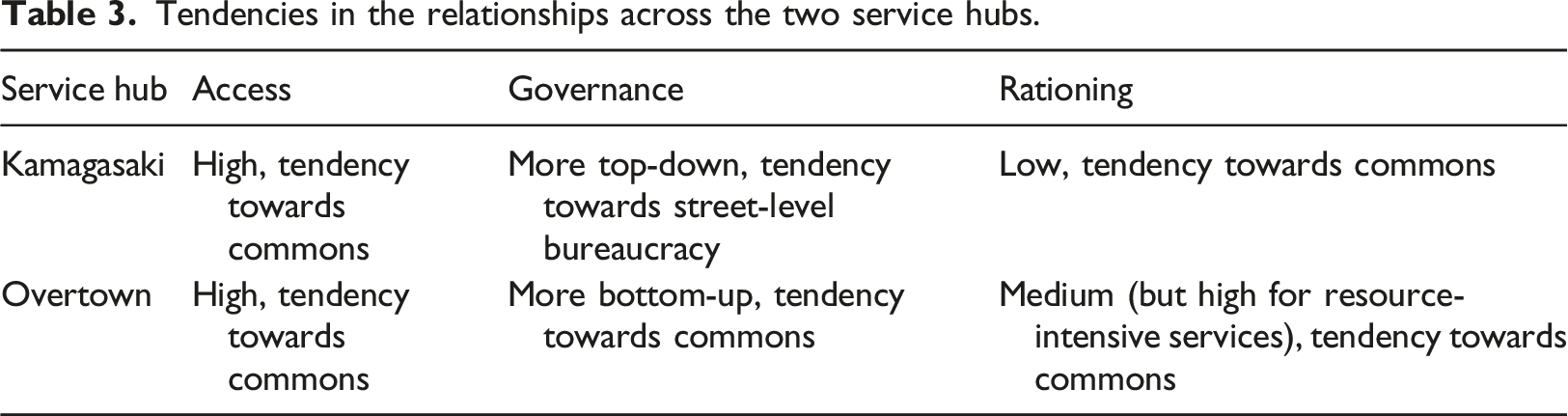
These tendencies, however, do obscure some overlaps as well, particularly with regards to ‘governance’ and ‘rationing’. There were grey areas whereby organizations were both top-down and bottom-up, and whereby organizations had to limit outlays without necessarily imposing harsh and humiliating conditions on clientele. As such, on-the-ground social and spatial practices of commoning in the service hub bumped up against the realities of patchy supply, chronic scarcity, tendencies towards client control, and an involuntary clientele who cannot access resources anywhere else, all of which are hallmarks of street-level bureaucracy.
Generally speaking, the greater the initial outlay involved in service provision – especially in the form of permanent supportive housing – the greater the potential for rationing, while the opposite was true for food, clothing, health care and temporary shelter. There was always the larger issue of accessibility tainted by the fact that clients usually had to first be excluded from the labour market, the housing market, family, informal community support and so forth; this can be combined with the indirect rationing of the ‘first come, first served’ model. While there was limited evidence of tight accessibility and rationing, there was more evidence around top-down, state-directed resource distribution and scarcity, which in turn promoted a pooling of resources across the service hub to overcome the limitations of any particular voluntary organization.
Conclusions: managed commons and hybrid co-existence
The analysis yielded an interesting set of empirical results that sometimes blurred the commons and street-level bureaucracy. This blurring is recognized by Huron (2019: 62), who said that ‘urban commoning is the messy, everyday, necessarily compromised work of trying to build networks of survival in the midst of the high-pressure centrality of the urban’. These same processes were detected in the geographies of both service hubs. They were highly accessible, largely characterized by mixed governance models and limited evidence of rationing. On these points, we can argue that the service hubs were more examples of ‘managed’ commons, in which resources were highly concentrated and accessible but whose outlays were overseen with a certain measure of care, than beachheads for an entrenched street-level bureaucracy that distances itself from clients at every possible juncture. Even when individual agencies under certain pressures behaved as street-level bureaucracies, the overall service hub would limit the worst of these tendencies, given their pooled resources and layers of solidarity.
There were some differences across the national contexts, especially in the lower socioeconomic inequality and strong welfare support as found in Japan. This meant fewer and less desperate clients, while higher racial inequality and meagre welfare support in the United States meant more clients and thus more pressure to ration services and limit accessibility resources. Both service hubs were similar in terms of access, but differed in terms of governance and rationing. For Kamagasaki, the governance model was more top-down – the product of sustained state interventions – and there was less obvious rationing, with rough equality between supply and demand. Unlike the US, Japan has durably reduced homelessness since the early 2000s – the nationally-provided and previously-mentioned Livelihood Protection benefits (seikatsu hogo) has made a difference. As Marr (2015) argues, the American welfare state is leaner than the Japanese one, and relies more on civil society, which means service hubs are under more pressure, but also more racialized, which prevents a truly no-strings welfare state.
Up to this point, we have showcased the logics of commons and street-level bureaucracy as they interacted within the characteristics of accessibility, governance and rationing. But the ‘managed’ commons also contains some interesting overlaps when we dynamically relate street-level bureaucracy to commons across both service hubs. This hybrid co-existence can be seen in at least three ways. First, the tendencies towards high accessibility for some resources – such as food, emergency shelter and basic health care – could be used to legitimize other exclusions and rationing, especially around permanent housing. This was especially the case in Overtown, set within a more constrained American welfare system. The second was that the commons can be eroded if organizations fear the absence of any kind of rationing, such that street-level bureaucracy acts as a necessary check on profligacy of the ‘unmanaged’ commons. Third, there is a certain seesaw across the two service hubs, in terms of which logic prevailed over time. Service hubs tend to start out more as (radical) commons than street-level bureaucracy, fiercely accessible and bottom-up with as few strings as possible. However, as voluntary sector organizations become more professionalized and thus more prone to ration and impose a top-down governance, the balance tips away from surplus and more towards stymied redistribution. So these three overlaps act as checks on the unfettered application of either logic, and end up creating something of a hybridized, co-existent model of poverty management.
Returning to our contributions, we have articulated a conceptual conversation between the commons and street-level bureaucracies, and its empirical and comparative application to the voluntary sector within service hubs. Further, we have reconstituted Lipsky’s original focus on frontline individuals to agencies, which enables a wider perspective overall, as well as a better understanding of the endemically constrained voluntary sector as potential street-level bureaucracies. This focus on agencies is also based in the existence of a common ethical drive within the voluntary sector to help people in need and care for them. However, an agency focus has several limitations. The first is that the focus on the frontlines and individual discretion is lost, subsumed into broader tendencies across multiple organizations. The second derives from the first limitation – that by concentrating at the agency level, the inherent fragmentation across and within organizations is smoothed out and lost.
While the joined-up street-level bureaucracy and commons perspective offered a relational way to grasp everyday operations and governance of the service hub, it misses some of the larger implications of service hubs as sites of (problematic) governance. Using a bio-political critique, Willse (2015) argues that voluntary organizations appear low-barrier and bottom-up yet are also altogether comfortable with just managing homelessness and poverty rather than eliminating them – which relates to the critique of the ‘fail first’ model. So rather than abandonment, the service hub enables containment and slow death (see also Marr, 2019). Such a critique would say that service hubs are just spatial manifestations of the homeless management industry. This industry is not designed to end homelessness, but to manage it with a sophisticated technical manner, in the end serving its own needs as an entrenched part of the (social) economy. A bio-political critiques of these ulterior motives somewhat chastens our revelations that the service hub is more commons than street-level bureaucracy. Of course, similar critiques can be levelled against the welfare state – while it decommodifies and undermines accumulation, it also stratifies, contains and disciplines the poor (DeVerteuil et al., 2002).
Along these lines, future research could recast the relationship between street-level bureaucracy and commons in service hubs – and beyond – using the construct of the post-political city (Penny, 2020; Swyngedouw, 2005). The post-political city features ‘a condition in which the collective political possibilities presented to people in cities by politicians and bureaucrats, through formal institutionalized decision-making channels, are narrowed in the name of economic exigency qua political necessity’ (Penny, 2020: 290). If one accepts this conceit, then the post-political city would invariably incorporate the practices of street-level bureaucracy, in terms of further distancing the state from the public it supposedly serves via the ‘no alternative’, business-as-usual, taken-for-granted work of civil servants and frontline workers. These workers are what Rancière would call ‘police order’, a cadre of unelected experts who obscure as a matter of course. However, such an approach would still need to heed a key lesson of this paper – the necessary incompleteness of street-level bureaucracy.
Footnotes
Acknowledgements
We acknowledge financial support from the British Academy, the Center for Global Support, and the Japan Foundation/Center for Global Partnership as well as the time given by the voluntary sector organizations in Miami and Osaka.
Declaration of conflicting interests
The author(s) declared no potential conflicts of interest with respect to the research, authorship, and/or publication of this article.
Funding
The author(s) disclosed receipt of the following financial support for the research, authorship, and/or publication of this article: This work was supported by the British Academy, the Center for Global Support, and the Japan Foundation/Center for Global Partnership as well as the time given by the voluntary sector organizations in Miami and Osaka
