



Abstract
As is often believed that the more centrally located a shop, the higher its sales volume, this paper analyzed relationships between the spatial clustering of retail stores, their respective transaction volumes, and the urban street networks to determine whether, and to what extent, the accessibility and density of a store’s location was correlated with its transaction volume. While this hypothesis is widely accepted, its veracity is underexplored and rarely validated using large-scale empirical datasets, possibly owing to the lack of access. Therefore, transaction datasets and accessibility indicators were first examined; a clear, positive correlation between density and revenue was found for specialty stores wherein people do “comparison shopping,” and for stores that complemented each other for activities such as “one-trip shopping,” the revenues were positively correlated when the stores were clustered. Generally, daily-use stores’ revenues were more sensitive to local access and those of non-daily-use stores were more sensitive to global access. In conclusion, these findings would not have been found using conventional methodology focused on the retail sector as a whole, because aggregate market mechanisms would have hidden the observed effects on specific store categories. Therefore, upon disaggregating the data, we found a distinct heterogeneity across the different store types for what concerns the relationship between revenue and location.
Introduction
City spatial configurations and the relationships with social behavior have been researched in fields ranging from urban planning to the social and economic sciences (Albert and Barabási, 2002; Barabási and Albert, 1999; Fujita and Thisse, 2013; Hillier, 1996; Hillier and Hanson, 1984; Jiang et al., 2014; March and Steadman, 1971; Martin and March, 1972; Porta et al., 2006b, 2009, 2012; Sevtsuk, 2014; Watts and Strogatz, 1998). Previous studies found cities as tending to have similar geometric patterns and features (Barthélemy and Flammini, 2008; Bohn et al., 2002; Lämmer et al., 2006; Masucci et al., 2014; Perna et al., 2011; Strano et al., 2013). Spatial graph primal representations (Porta et al., 2006b) are used to analyze accessibility and centrality in urban topologies, observing different distributions of centrality values between a self-organized, historical development city and predominantly planned city developments (Barthélemy et al., 2013; Cardillo et al., 2006; Crucitti et al., 2006; Lämmer et al., 2006; Porta et al., 2006b). While urban street networks through the primal approach cannot capture the underlying scaling property of streets because nodes and edges are embedded in the three-dimensional Euclidean space (Ma et al., 2019), spatial graph dual representations (Porta et al., 2006a) find the nontrivial small-world and scale-free topological properties that a relatively small number of streets tend to play dominant roles in city structures (Jiang, 2007; Jiang and Claramunt, 2004; Kang et al., 2016; Masucci et al., 2014). Spatial economics, however, examines the mechanisms and rules behind spatial agglomerations at the city, regional, national, and international levels (Fujita and Thisse, 2013), with the distribution of the economic activities and their spatial clustering considered a result of a trade-off between various forces (e.g. centripetal force and centrifugal force). For example, the physical proximity of economic entities facilitates communication and overcomes the information distance decay resulting in externalities (Lucas, 1988). However, excessive density in geographically limited areas decreases comfort and satisfaction, making the centrifugal forces stronger. Therefore, based on the self-organizing, bottom-up processes typical of complex systems, these mutual interactions would be expected to affect both the appearance and shape of cities (Fujita and Thisse, 2013; Krugman, 1996).
However, despite extensive research, few studies have combined spatial configurations and land use location choices at the neighborhood/street resolution level. For instance, retail location theory has rarely dealt with exogenous factors such as the geometric elements in the built environment, and architects and urban planners have seldom considered previous urban economic data (Sevtsuk, 2010: 12, 2014: 374). Unfortunately, most prominent models combining spatial and human behavioral dimensions have been based on strong but simplified assumptions (Alonso, 1964; Christaller and Baskin, 1966; DiPasquale and Wheaton, 1996; Huff, 1963; Lösch, 1954; Mills, 1967; Muth, 1969; Von Thünen, 1826). Overall, “it is rare to find an economics text in which space is studied as an important subject – if it is even mentioned” (Fujita and Thisse, 2013: 11).
To bridge the theoretical gap between configurational and human behavioral models and provide a more definite, quantitative understanding of how specific locational features may or may not influence citizen behavior, this paper analyzed the distribution of economic activities at a fine spatial resolution that considered the spatial configuration of the built environment. Both the spatial clustering of small-scale retail stores and their density at the neighborhood scale were considered along with the centrality metrics of the road network. Although few similar studies were conducted owing to the need for extensive observations of both spatial and human behavioral choices in the same urban configuration, there are now better opportunities for the acquisition and analysis of human and urban behavior data because of the emerging field of big data analysis (Yoshimura et al., 2018).
The specific question addressed in this study was related to retail location theory; namely, whether and to what extent a shop’s success, measured here as its sales volume, was related to its location in the city. Different location measures, such as local density, shop clustering, and a centrality metric, were considered in the analysis to gauge shop accessibility. As is customary in retail and urban planning studies (Porta et al., 2009), the hypothesis driving this study was that more centrally located shops and/or those spatially clustered with other shops are more successful than less accessible shops. While this hypothesis is the same as in past research (Hillier, 1996; Porta et al., 2009, 2012) that looked at the correlations between the centrality and retail and service densities, the exploration in this paper focuses on the correlations between store revenues, store clustering, and geolocations leveraging massive datasets of economic activities and street network from Barcelona, Spain.
Analytical framework
The analytical methodological framework had two main steps: the first step was to statistically test whether the store locations and revenues were clustered. To do this, the observed store locations were compared with the same number of randomly distributed stores (see section 2 in the supplementary material for detail). If the store proximities were closer than those perceived in the randomly distributed sample, it was assumed that the stores’ cluster pattern at the location was not formed by chance. As our driving hypothesis was that geographical advantage attracted many stores to cluster in specific locations in the city, which would possibly have higher revenues than those located on periphery, the second step was to explore the relationship between street network centrality and cluster locations using Porta et al.’s (2009) methodology. In other words, an estimated density centrality value computed the cell-by-cell correlations with the estimated retail activity density values. Therefore, this paper explored and accurately quantified the correlations between the clustered locations, the respective higher sales volumes, and the central locations through the analysis of large quantities of data.
Spatial scale distances
Definitions for the basic aggregation unit and other scale parameters are fundamental to spatial analysis as the spatial clusters and associated strengths could be significantly different depending on the geographical and spatial scale used (Fujita and Thisse, 2013). As the hypotheses were that retail store location choice depended on the (road) network distance and locational spatial accessibility, and that various retail stores had different network size preferences for their target customers, the following distances were defined as the spatial scale for the analysis



Global Moran’s I and Getis–Ord Gi*
The retail store spatial autocorrelation was examined as the first law of geography because “Everything is related to everything else but near things are more related than distant things” (Tobler, 1970: 236). Therefore, physically proximate stores were more likely to form clusters than stores further away from each other. The global Moran’s I index (Anselin, 1988) measures the positive or negative spatial correlation and its strength, comparing the observed economic activity distributions with the same number of hypothetically randomly distributed economic activities within the study area (see Figure S3). Moran’s I and associated methods are typically used to judge upon the existence of spatial clustering, but as they cannot quantify the clustering degree, the Getis–Ord Gi* (Getis and Ord, 1996; Ord and Getis, 1995) was used to measure the spatial clustering intensity in hotspot/coldspot locations (see Figure S4).
Centrality indicator
The betweenness centrality (Freeman, 1977) was computed to measure the local accessibility in the spatial networks, determined by examining the subset of nodes and edges in the network. Node i’s betweenness was determined using
The applied methodology utilized the “edge effect,” generated using artificially bounded networks (Okabe and Sugihara, 2012: 41–42; Porta et al., 2006a: 715–718), to estimate the adequate network distance from the specific retail store locations. The betweenness indicator is sensitive to network form; that is, the number of nodes, how they are linked, and the boundaries. Although many researchers have proposed potential solutions to soften these effects (Gil, 2017), the characteristics of the edge effect were used here to identify the location clusters that had similar accessibility patterns.
Figure 1 shows the different network distances d for node i. Changing d to compute the betweenness for node i results in different scores for node i (see Figure 1(b) and (c)); the changes in node i’s betweenness scores during changes in the function of d were explored. Figure 1 shows the betweenness scores for different network distance d values: (a) 300 m, (b) 2000 m, and (c) 5000 m. In the smaller-scale network, the locations with higher betweenness scores were located on local arteries that connected public spaces at the neighborhood scale. The more accessible locations gradually changed as the network size increased and became more coincident with the large-scale inter-district avenues for the largest value of d (Figure 1(c)).
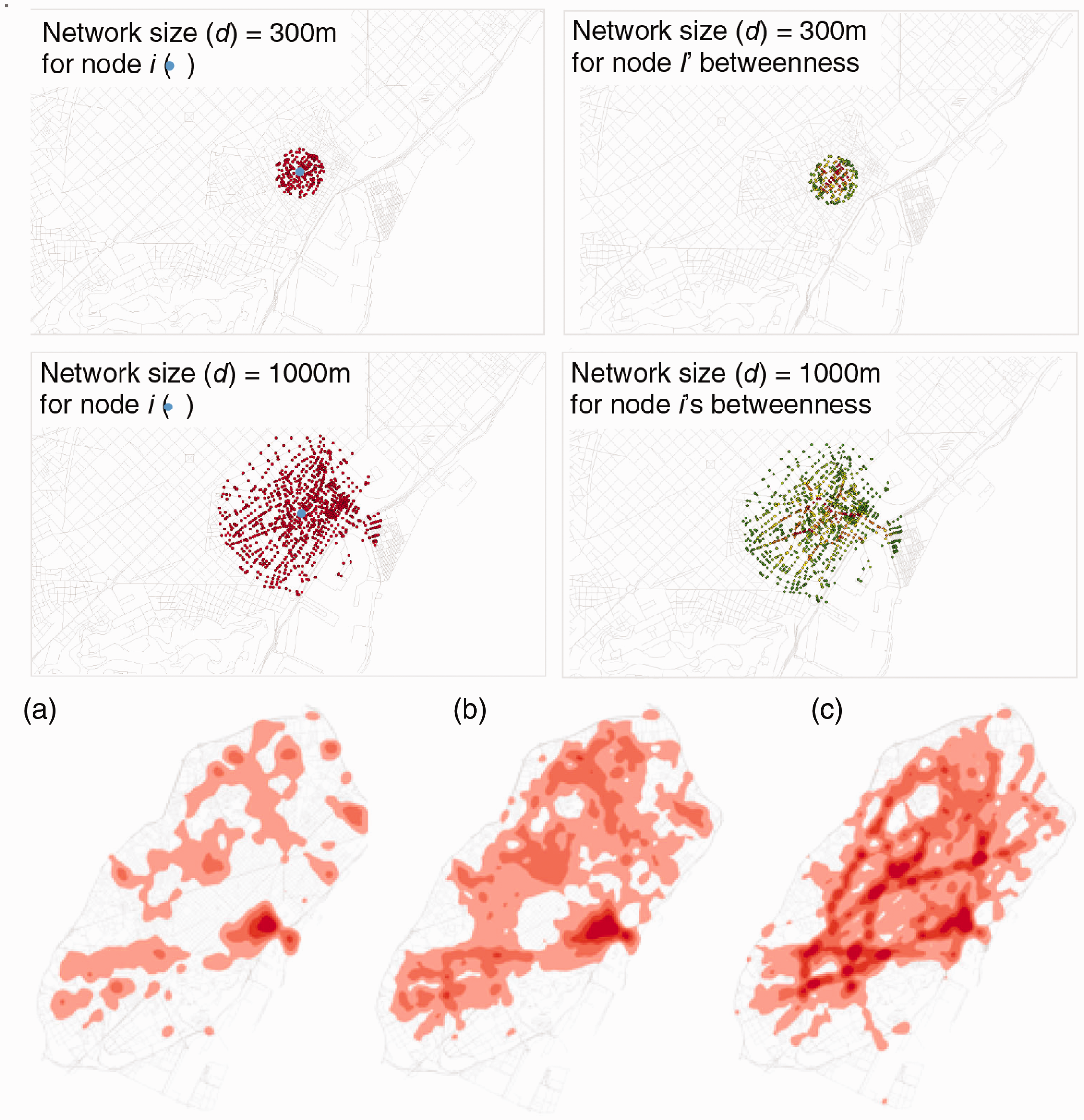
The different network sizes to be considered for node i and the difference in the results. The figure shows the betweenness scores for the different network distances d: (a) 300 m, (b) 2000 m, and (c) 5000 m, which respectively represent the neighborhood, district, and city scales. The darker red tones correspond to higher betweenness scores.
It was hypothesized that the smaller-scale network size (e.g. 300 m) would be useful for daily-use stores (e.g. butchers and supermarkets) because it suggests pedestrian access around the specific location at the neighborhood scale. The larger network size (e.g. 5000 m) may be more useful for non-daily-use stores (e.g. department stores) because it would be useful for vehicle-based access on a larger scale (e.g. district scale).
As different dependence patterns of betweenness as a function of d were found, to quantitatively identify the particular clusters, a silhouette test was first applied to determine the best number of clusters to use; then, the result was input to the k-means clustering algorithm. The silhouette test’s outcome indicated that the four k-means clusters were adequate (an average s-value = 0.51). The nodes in the first and second cluster were quite evenly distributed over the city, and the nodes in the third (locally important) and fourth clusters (important at city level) had clear spatial signatures (see Figure 2). The third cluster, which was the locally important nodes, was exclusively located in the historic center and corresponded to the arteries constructed at the beginning of the city formation. However, the nodes in the fourth cluster corresponded to the larger avenues that connected the different parts of the city.
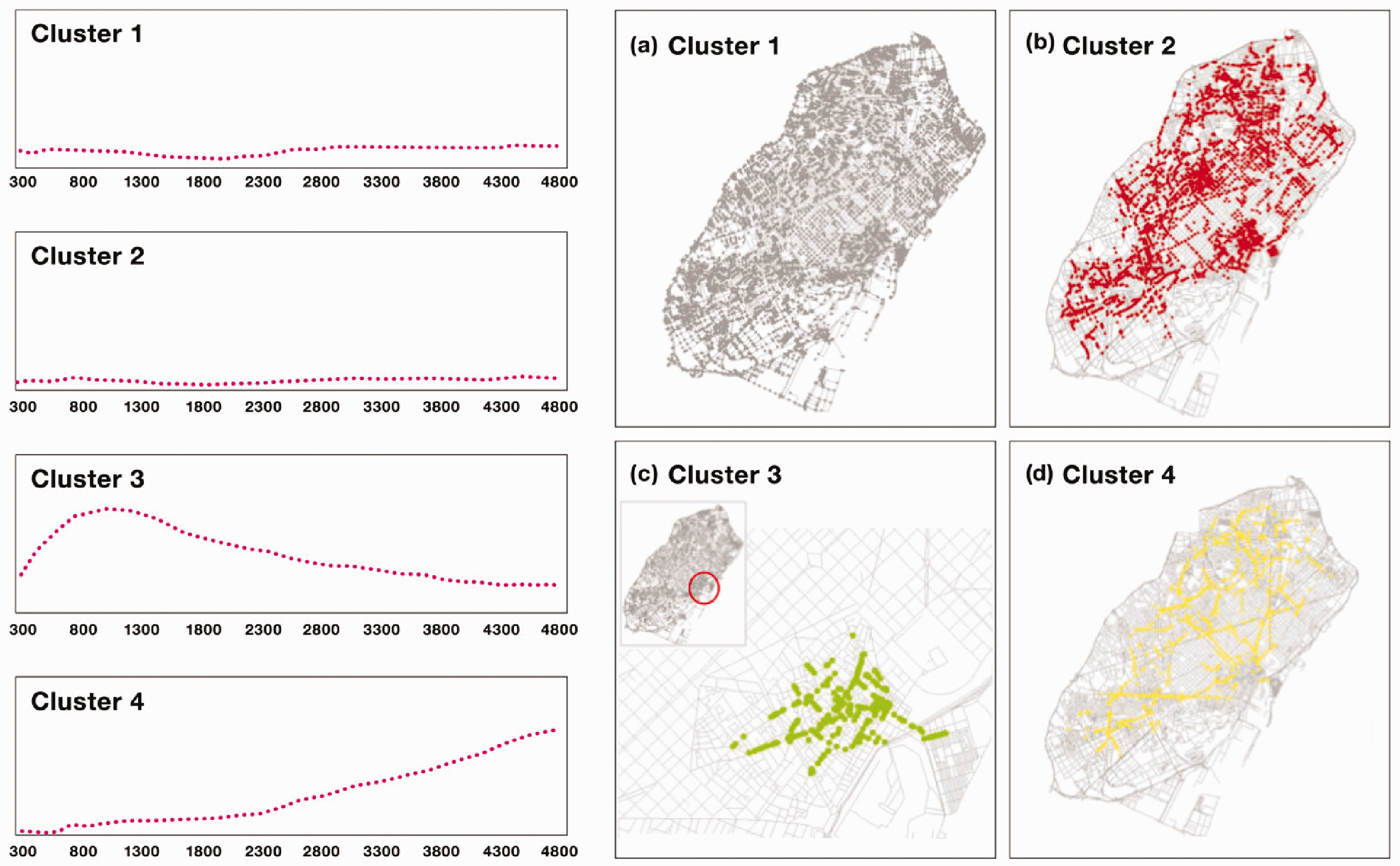
The representative distribution of nodes’ betweenness scores in the street network and its change by the network size, and their visualizations in the city (a–d).
The proposed clustering method effectively identified the nodes with different levels of importance in the city, and thus, the following analysis used these four clusters to study the possible correlations between economic activities and accessibility.
Kernel density estimation
KDE was applied to the correlation analysis. It enables the density of events (or objects) within a predefined radius to be computed as the average density around nearby locations, with the weights depending on the spatial distances. Figure S1 in the supplementary material shows a diagram of the KDE operations, wherein a kernel function is observed to determine the weights for each event as a function of the distances; the maximum value is at the center of the targeted grid square (point k in Figure S1 in the supplementary material) and becomes 0 at the end of the bandwidth (Fotheringham et al., 2000: 146–149), with the kernel density for point k in the grid being estimated as the sum of all weighted events within the bandwidth. The KDE results provide information about the density of events in a place based on the surrounding effects rather than on the individual store or entity because, as Porta et al. (2009) described, the focus is not the individual store; rather it is on what makes the environment special, which includes the nearby stores.
In this study, KDE was applied to the following variables
1

2

3

4

5

6

7

8

9

Data description
The dataset was composed of a large number of transaction records made available to the researchers by a major Spanish bank, which consisted of debit or credit card transactions from the bank’s direct customers and transactions from the bank’s point of sale terminals around the country. The provided information included the shop wherein the customer made the transaction, transaction’s timestamp, and amount of money spent, as well as a unique ID for each customer’s credit or debit card that was not associated with the real customer ID or bank card. The data were aggregated and hashed for anonymization in accordance with local privacy protection laws and regulations.
The shops were originally classified into 76 categories; however, based on previous research on economic activities in Barcelona (Porta et al., 2012), the shops were manually reclassified into seven general categories and 17 sub-categories depending on whether they were primary or secondary activities (see Table 1 in Yoshimura et al. 2018: 19 for all categories). Therefore, the differences in the relationships between the locations and the sales volumes and between the primary and secondary activities were analyzed. The analysis was focused on categories A and B, which corresponded to most small-scale retail shops and services. The category and sub-category definitions for A and B and the primary and secondary activity classifications and the basic properties are given in the supplementary material in Table S1 and shown in Figure S2. The store–store relationship analysis considered whether the shops were “imperfect substitutes (comparison shopping)” or “complementary goods (one-trip shopping).”
Results
Spatial clustering quantification
Retail store spatial clustering
Figure 3(a) shows the Moran’s I index for the individual categories, from which it can be seen that all obtained scores had a p-value < 0.05 and a z-score > 2.56, which indicated that the stores in all individual categories were spatially autocorrelated and the clustering was statistically significant. As the Moran’s I index systematically decreased when the considered distance increased, it was surmised that the clustering effect was weaker when the considered distance became larger. Category B2 (hotels, hostels, and B&Bs) had the highest Moran’s I index at all distances, with the clustering effect being much stronger than the general category B (hotels, B&Bs, hostels, restaurants, cafés, and pubs), which suggested that the higher number of stores in the combined categories did not always result in higher clustering. This was consistent with the results shown in Figure 3(b), which shows the Moran’s I index for all possible combinations between the individual categories for A (eight categories) and B (five categories). Interestingly, individual category B’s addition helped increase some of the individual category A Moran’s I indexes, but not all.
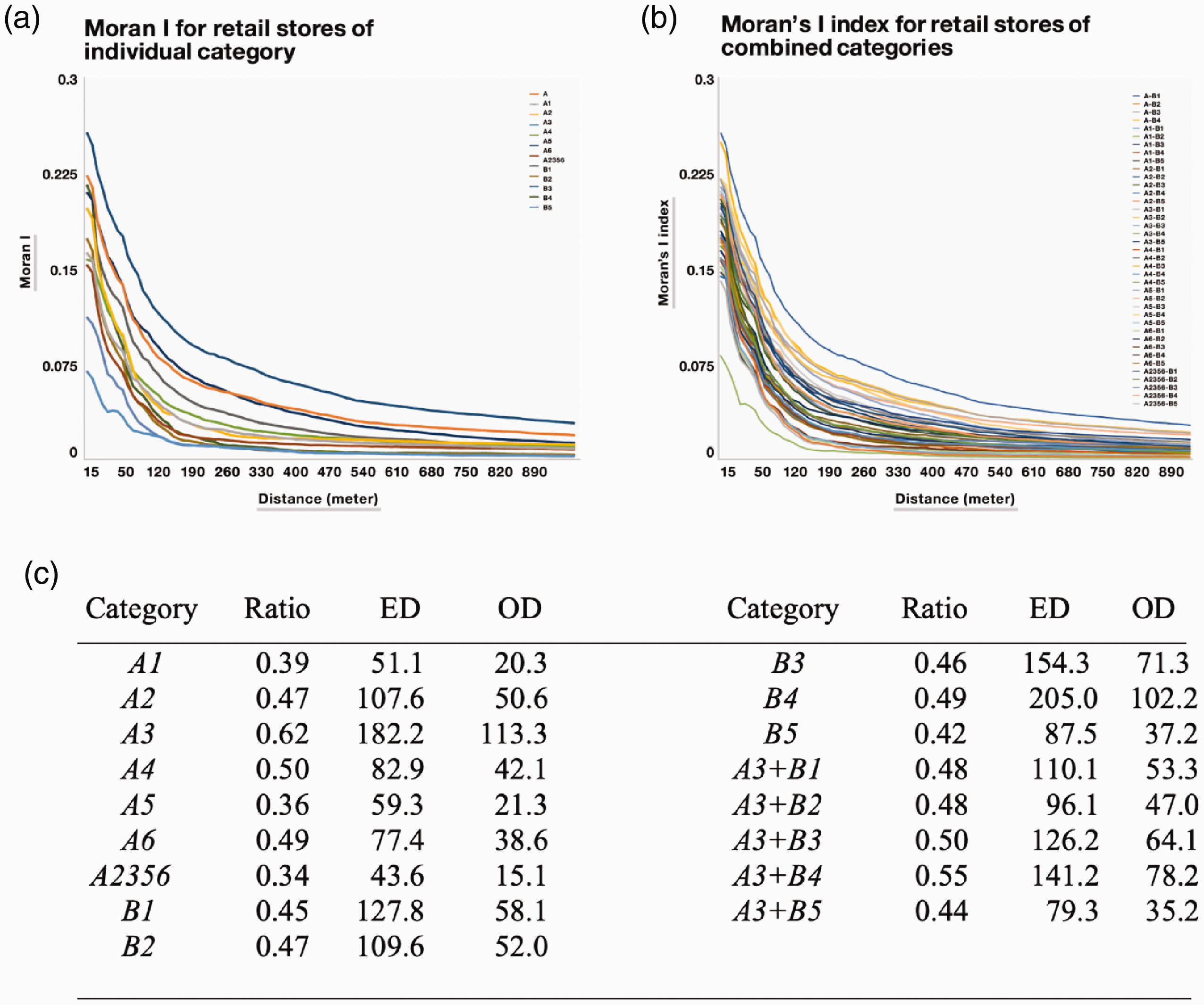
(a) Moran’s I index for individual categories and the change of values with the distance (moran_d). (b) Moran’s I index for the combined categories and the change of values with the distance (moran_d). (c) Table for the nearest neighbor analysis. ED: expected distance; OD: observed distance; OD/ED: ratio.
To examine the physical distance between each store in each category, a nearest neighbor analysis was performed (Mitchell, 2009), which compared the observed distance from the actual dataset and the expected distance if the same number of stores was iteratively and randomly distributed. Figure 3(c) shows that all nearest neighbor indexes were less than 1.0 (p < 0.05 and z-score < –2.56), indicating that all individual category retail stores were physically located much closer to each other than expected. The individual category, category A1 stores (grocery stores), were observed to be located the nearest to each other, and the observed distance for A3 was significantly improved when it was considered with an individual category B.
A hotspot and coldspot analysis was also conducted using Getis–Ord Gi*, which distinguished the locations based on clustering strength and indicated that it was possible to differentiate the densified areas from the locations wherein store agglomerations were statistically significant. The spatial clustering locations did not always coincide with the denser areas (see Figure S5 in the supplementary material as an example of category A1). Further, some hotspots did not correspond to the areas wherein the stores were highly agglomerated.
Figure S6 in the supplementary material shows the coefficient determinations (
These results, therefore, confirmed that the retail stores in each category were spatially clustered and such clustering was statistically significant. Moreover, the analysis showed that the spatial clustering locations were different from the high-store density areas. According to these results, an apparently denser area may not always indicate the most important clustering patterns in the city; thus, the proposed statistical spatial methodology revealed these important differences, which could be useful for retailers looking for the best locations.
Correlation analysis
Density of retail stores vs. sales volumes
Based on the spatial analyses in the previous section, the sales volumes in the higher-density areas and spatial clustering locations were further explored using the
1

2

3

4

Although all p-values were less than 0.05, the
However, when focusing on individual category as the factor for the
Figure S7(d) in the supplementary material also shows that the coefficient determination (
Correlations between locational density, spatial clustering, revenues, and centrality scores
The previous sections revealed that (1) the spatial clustering of retail stores was derived from their spatial autocorrelation (Spatial Clustering Quantification section) and (2) neither the highly densified store locations nor the highly clustered locations coincided with places producing higher sales volumes. However, the highly densified areas in categories B2 and A3 + B2 could explain the high density of their sales volumes, and the spatial clustering locations of A3, A3 + B4, and A3 + B3 could explain the spatial clustering of their higher sales volumes. Therefore, based on these findings, this section examined whether, and to what extent, the clustering locations were correlated with the central places based on the street network to determine whether better spatial accessibility could explain the spatial clustering of retailers and their higher sales volumes.
To analyze this correlation, the
The
Correlation between store revenues and bounded betweenness
Previous sections’ results indicated that none of the four considered factors (highly densified store areas, store spatial clustering locations, densified areas for store revenue, or spatial clustering of store revenue) were significantly correlated with the location accessibility as measured by the betweenness. Therefore, this section further analyzed the possible relationship between accessibility and revenue by examining whether the above-mentioned factors were correlated with bounded betweenness and the nodes, which were classified into four clusters (see the Centrality Indicator section).
Figure 4(a) shows the normalized revenue for stores located at a distance (x-axis) from the road network nodes belonging to cluster 3 (locally important nodes), from which it can be seen that the normalized store revenue pattern was higher for stores near the locally accessible nodes; however, there were exceptions. The shops in categories A, A3, B2, and B3 showed a slight linear, positive correlation with their distance from the locally accessible nodes. Therefore, the effect of local node accessibility on retail revenue was mixed, with positive correlations for some retail categories and slightly negative correlations for others.
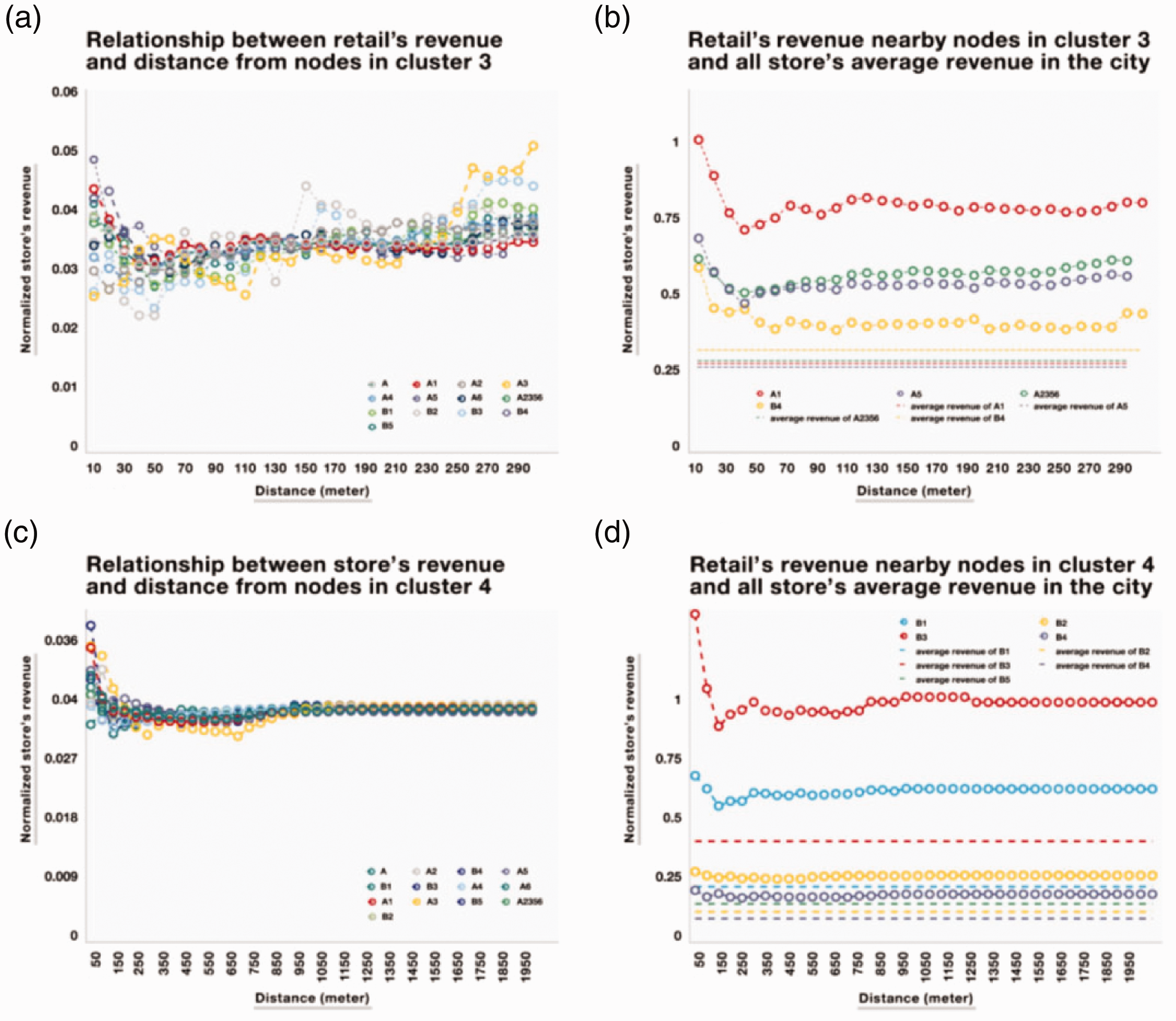
(a) The relationship between the retail store revenues in categories A and B and their distance from the nodes, which are classified into cluster 3. (b) The relationship between the retail store revenues located near nodes in cluster 3 and average store revenues in the same category (shown as flat dashed lines). (c) The relationship between the retail store revenues and their distance from the nodes, which are classified into cluster 4. (d) The relationship between the retail store revenues located near nodes in cluster 4 and the average store revenues in the same category (reported as flat dashed lines).
However, the positive effect of city-scale accessibility on retail revenue was apparent. As shown in Figure 4(c), all shop categories had a peak in normalized revenue for shorter distances to the city-scale accessible nodes; i.e. nodes belonging to cluster 4. It was also found that the revenue for the stores located near the accessible nodes at either the local (Figure 4(b)) or the city scale (Figure 4(d)) was much higher than average.
To summarize, the analysis revealed that nodes with relatively high city-scale accessibility contributed positively to store revenue; however, this effect for locally accessible nodes (cluster 3) was only observed in daily-use stores, which confirmed the intuition that these stores better capture passers-by than less locally accessible stores. Following this intuition, customers of daily-use stores (e.g. butchers and fishmongers) would be more likely to be drawn from nearby locations rather than from far away; that is, locally accessible shops are more likely to observe more customers. However, locally accessible nodes were not found to have the same effect for other categories (e.g. B2 and B3) because the customers tended to come from a much wider district or city-scale areas.
As the nodes in cluster 4 were found to increase store revenue independent of type, these nodes could be considered central places when considering larger network sizes, such as district or city scales as they more frequently captured passers-by from the whole city than other places. Therefore, these locations are advantageous for non-daily-use category stores (e.g. department stores) that derive their customers from a wider area than the local neighborhood. Although those nodes increased revenue across all categories, a further observation found that stores located at distances as far as 1 km from the nodes in cluster 4 had much higher revenues than the average revenue of all stores in the city. For example, the revenue in the category A1 stores located near the cluster 4 nodes was 3.7 times higher than the average revenue for the whole city. Surprisingly, the same tendency was found for cluster 3 nodes, where most of the environment was pedestrianized and the revenue was 3.5 times higher for category A1.
Discussion and conclusions
Based mainly on correlation analysis, this paper examined the relationships between the spatial clustering of retail stores, the transaction numbers, and the urban structure derived from the street networks in Barcelona, Spain.
Store clustering locations did not necessarily result in higher revenues, and that store density did not explain sales volume distributions, which was an intriguing result as it was not in line with the general belief that the more the retail stores in an area, the higher the expected sales volume. The exception was category A3 (personal equipment); although A3’s store density had lower
The analysis of the relationships between location and revenue found that (1) stores located close to city-scale accessible nodes had higher than average revenues and (2) some categories of stores located close to locally accessible nodes also had higher than average revenues. This finding was consistent with previous research, wherein betweenness centrality was correlated with the distribution of the retail and services densities on the ground floor (Porta et al., 2009) and on all floors (Porta et al., 2012). However, the current paper’s analysis went a step further. While previous research focused on assessing the presence of retail stores and their distribution and have therefore speculated about the respective sales volumes (e.g. may be higher), the analysis in this paper found the location and revenue relationships based on empirical datasets. Further, secondary activities were found to be located and concentrated not only in secondary streets but also in primary streets, in line with previous research (Porta et al., 2012). However, it was discovered that the stores located near the primary and secondary streets had higher than average revenues.
The obtained results can be interpreted as follows. As daily-use stores are largely oriented toward neighborhood customers rather than the whole district or city, they could optimize location choice by considering a five-minute walking distance, which would explain why only the daily-use store revenues were higher near the cluster 3 nodes, as shown in Figure 4(a) and (b). Daily-use stores might also tend to choose in-between locations that people pass by rather than being the origin or destination as these locations enable daily-use stores to capture customers from non-daily-use stores when the latter’s customers move from origin to destination, which may also be why daily-use store revenues were found to be higher near cluster 4 nodes, as shown in Figure 4(c) and (d). However, as the non-daily-use stores are more oriented toward attracting global customers from the city scale rather than the neighborhood scale, they focus on a wider-scale network; therefore, as presented in Figure 4(c) and (d), their revenues were higher near cluster 4 nodes but not near cluster 3 nodes (Figure 4(a) and (b)).
The results also reinforced previous studies’ findings, elucidating the possible causes for spatial retail clustering. Studies have hypothesized that when customer knowledge about items and prices in each store was incomplete, they tended to search for and compare similar products and prices between stores before making a final purchase. Therefore, if several similar stores were spatially clustered, customers could reduce their search costs and retailers could expect customer spillover from other stores, which would increase the probability of attracting more customers and receiving higher sales volumes. Adding to previous findings, this study provided a statistically sound quantification of the relation between the associated variables and found that this tendency was stronger for luxury personal equipment than for daily-use goods because customers are strategic and conservative when purchasing items in luxury stores. Therefore, our study suggests that customers would be relatively more likely to browse similar luxury stores in clusters than browsing similar daily-use stores.
Although this paper’s methodology and analysis provide clear value and novel perspectives on existing research in the field, certain limitations were noted. As our study focused on providing a solid correlation analysis between various spatial variables, its scope excludes the exploration of the possible causes of such observed correlations. Regarding the analysis of possible causal relationships, we acknowledge that several possible confounding factors were not considered in this paper. For instance, looking at spatial clustering of store location, it is not clear as to what extent the process of locating a store is influenced by local planning and retail policies. This might include incentives and/or disincentives to certain types of retail activities in a certain neighborhood. One way of accounting for this and extending this study is to enrich the models through, for example, the traditional data collection methods (e.g. interviews or questionnaires and research of present and past planning and incentive policies). This way, it would be possible to start exploring causal relationships between the observed variables. Our approach can then be considered as complementary to conventional study methods (Borgman, 2015).
This paper contributes to empirical data analysis and validates previously proposed human behavior theories related to economic activities. The observed datasets are different from experimental datasets as they register human activities as is rather than limiting the external factors because of the subsequent statistical analysis. As not all human economic activities are necessarily observable, unique analytical methodologies are required to uncover the mechanisms behind the observations. Therefore, the results of this study provide quantitative and empirical verification of Jacobs’ (1961) observations.
Supplemental Material
sj-pdf-1-epb-10.1177_2399808320954210 - Supplemental material for Spatial clustering: Influence of urban street networks on retail sales volumes
Supplemental material, sj-pdf-1-epb-10.1177_2399808320954210 for Spatial clustering: Influence of urban street networks on retail sales volumes by Yuji Yoshimura, Paolo Santi, Juan Murillo Arias, Siqi Zheng and Carlo Ratti in EPB: Urban Analytics and City Science
Footnotes
Acknowledgment
We would like to thank the Banco Bilbao Vizcaya Argentaria (BBVA) for providing the dataset for this study.
Declaration of conflicting interests
The author(s) declared no potential conflicts of interest with respect to the research, authorship, and/or publication of this article.
Funding
The author(s) received no financial support for the research, authorship, and/or publication of this article.

Supplemental material
Supplemental material for this article is available online.
References
Supplementary Material
Please find the following supplemental material available below.
For Open Access articles published under a Creative Commons License, all supplemental material carries the same license as the article it is associated with.
For non-Open Access articles published, all supplemental material carries a non-exclusive license, and permission requests for re-use of supplemental material or any part of supplemental material shall be sent directly to the copyright owner as specified in the copyright notice associated with the article.
