




Abstract
Abstract
This article evaluates the importance of climate-smart agriculture (CSA) in promoting sustainable agricultural development and ensuring food security and mitigating the negative impacts of climatic changes on agricultural productivity in India. A range of CSA technologies, practices and services have been initiated in climate-smart villages as adaptation strategies for coping with climate risks to ensure stability and sustainability in agricultural production. The farmers using CSA adaptation strategies were found to have achieved higher output, yield and return compared to those who did not. There are exciting opportunities for scaling out and immense potentials of these strategies for enhancing crop yields and farm incomes and reducing greenhouse gas emissions. Strengthening agricultural extension service and agricultural finance to achieve smart farming practices/technologies by linking climate finance to traditional agricultural finance could play a significant role in scaling out the CSA practices and technologies to make agriculture more sustainable and climate-resilient and a viable source of livelihood and food security for millions of farmers in the country. Zero budget natural farming as a climate-resilient farming system can enhance food and nutritional security, enabling farmers to improve soil fertility and yields through lower costs, risk and irrigation requirements, thus protecting the ecosystem by improving soil organic matter, water retention and biodiversity and reducing air and water pollution as well as greenhouse gas emissions.
Keywords
Introduction
The agricultural system in the world over has been facing tremendous pressure on the use of resources largely due to rising population, urbanisation, climate change and environmental stresses. The Food and Agriculture Organization (FAO) of the United Nations has estimated that food production will have to be increased by at least 60 per cent to meet the needs of the world’s expected population of 9 billion by 2050 (FAO, 2014). This is a great challenge for global agriculture under the condition that one in eight people currently face food insecurity, and agriculture is significantly influenced by climate change and variability. The Inter-Governmental Panel on Climate Change (IPCC), in its Fifth Assessment Report, has warned that global climate has been changing and it would continue to happen in the foreseeable future (IPCC, 2014). The global mean surface temperatures are predicted to increase by 1.4 to 5.8°C by the end of this century relative to 1990. There would also be changes in the variability of climate and in the frequency and intensity of some extreme climatic events, leading to uncertain onsets of monsoons and more frequent floods, droughts, cyclones and gradual recession of glaciers (IPCC, 2001). Climate change has been emerging as a major threat to agriculture, causing greater instability in food production and adversely affecting food security and livelihoods of millions of people in many countries. IPCC (2014) has noted that increasing temperature and increased frequency of extreme climatic events such as flood and drought will have direct and adverse effects on crops, fisheries, forestry and aquaculture productivity. Several studies (e.g., Aggarwal et al., 2009; Brida & Owiyo, 2013; Lobell, Sibley, & Ortiz-Monasterio, 2012; Mall, Gupta, Singh, & Rathore, 2006; Prasanna, 2014; Singh, Mishra, Singh, & Parmar, 2013) have argued that agricultural production could be adversely affected by increasing temperature, changing rainfall patterns and variations in frequency and intensity of extreme climatic events. Porter et al. (2014) reported that the estimated yield loss due to climate change can be up to 35 per cent for rice, 20 per cent for wheat, 50 per cent for sorghum, 13 per cent for barley and 60 per cent for maize depending on the location, future climate scenarios and projected years. Thus, climate change and climate variability are emerging as critical challenges for global food security, particularly in underdeveloped and developing economies. South Asia, as one of the most densely populated regions in the world, is among the most vulnerable to climate change and climate variability; this can have major consequences on food security, poverty and other developmental goals in the absence of adaptation and mitigation (IPCC, 2014).
India is particularly vulnerable to climate change due to widespread poverty, dependence of about 50 per cent of its population on agriculture for livelihood, heavy dependence of agriculture on natural resources and limited coping strategies. Even though the adoption of improved technologies, incorporating high-yielding varieties, fertilisers and irrigation in the mid-1960s was instrumental in achieving unprecedented growth in food grain production and ushering in an era of Green Revolution in Indian agriculture, there are growing concerns on the sustainability of such growth to feed the increasing population in the country. In spite of the success of the Green Revolution technologies in transforming Indian agriculture and making it self-sufficient in food grains, food insecurity, malnutrition, poverty and hunger have been persisting unchecked. Among the 119 countries, India ranked 100 and was classified in the ‘serious category’ with a score of 31.4 in the 2017 Global Hunger Index (International Food Policy Research Institute [IFPRI], 2017). As per FAO (2017) estimates, India had the largest number of undernourished people in the world—190.4 million in 2009–2011 and 190.7 million in 2014–2016, though the proportion of undernourished persons declined marginally from 15.8 to 14.5 per cent.
Moreover, continued intensive use of the same technologies and the consequent environmental problems, such as groundwater depletion with falling quality of water due to its overexploitation and deteriorating soil health, have been adversely affecting the agricultural sector. These are considered greatly responsible for slowing down of growth in crop production. The growth rate of food grain production decelerated from 2.85 per cent in the 1980s to 2.02 per cent in the 1990s and 2.12 per cent in the 2000s. Cereal production was affected greatly; its growth rate fell drastically from 3.03 per cent in the 1980s to −0.02 per cent in the 1990s, and then picked up to reach 2.01 per cent in the 2000s. The growth rate of rice declined from 3.62 to 2.02 per cent and further to 1.51 per cent; wheat output grew at the rate of 3.57 per cent in the 1980s and 1990s, but its growth declined to 2.16 per cent in the 2000s. The growth rate of all principal crops declined from 3.19 to 2.29 per cent and 2.5 per cent in the respective periods (Government of India, 2006, 2011).
The problem is further aggravated due to global climate change and increasing climatic variability. The surface air temperature in the South Asian region was predicted to rise by 0.5–1.2 °C by 2020, 0.88–3.16 °C by 2050 and 1.56–5.44 °C by 2080 depending on future development scenarios. Precipitation would also increase (IPCC, 2007). The Indian Meteorology Department and the Indian Institute of Tropical Meteorology (Pune) have projected a similar trend for temperature, heat waves, glaciers, droughts, floods and sea level rise. Such climate change and variability would adversely affect agriculture through their effects on crops, fisheries and livestock. These changes would further increase the pressure on agriculture, as it has to meet the increasing demand for food grains to be produced from the same or even shrinking cultivable land (Aggarwal, 2008).
The predicted increase in temperature and precipitation is likely to change land and water regimes that have significant implications for agricultural productivity and the food security and livelihoods of farming households. There is a probability of 10–40 per cent loss of crop production in India due to increase in temperature by 2080–2100 (Fischer, Shah, & Vehhnizen, 2002; IPCC, 2007; Parry, Rosenzweig, Iglesias, Livermore, & Fischer 2004; Rosenzweig & Parry, 1994). The Indian Council of Agricultural Research (ICAR) has indicated that food production could decline by 4.5–9.0 per cent in the medium term (2010–2039) under the impact of climate change (Venkateswarlu, 2017). The Indian Agricultural Research Institute has indicated the possibility of loss of 4–5 million tonnes in wheat production with every rise of 1°C temperature by 2020–2030 (Aggarwal, 2008). A similar trend of agricultural production loss in India has also been indicated in other studies (e.g., Aggarwal, 2003; Aggarwal & Mall, 2002; Aggarwal & Sinha, 1993; Mall & Aggarwal, 2002; Saseendran, Singh, Rathore, Singh, & Singh, 2000). Rao et al. (2013) argued that while climate change is likely to reduce yields of most crops in the long run, increased climatic variability could increase fluctuations in production in the short run. A moderate increase in temperature will have significant negative impact on rice, wheat and maize yields (Aggarwal & Rani, 2009; Aggarwal et al., 2009; Parry et al., 2004). Using district-level panel data on crop yields, rainfall and temperature for 200 districts across the country for the period from 1969 to 2005, Birthal, Khan, Negi, and Agarwal (2014) reported that while an increase in maximum temperature had an adverse effect on the yields of kharif and rabi crops, a similar increase in minimum temperature had a favourable effect on yields of most crops, but it was not sufficient to fully compensate the adverse effect of the rise in maximum temperature. Rainfall had a positive effect on most crops, but it was not enough to counterbalance the negative effect of temperature. The frequency, severity and spread of droughts are the major constraints to sustainable improvement of agricultural productivity in the rain-fed farming systems in India (Birthal, Negi, Khan, & Agarwal, 2015). The observed decline in drought-induced losses in rice yield is attributed to improvements in farmers’ adaptive capacity due to expansion of irrigation facilities and increased availability of improved varieties for the rain-fed production systems, along with other coping strategies.
The agricultural production system could be further worsened by climate change through increasing water scarcity, frequency and severity of floods and declining soil carbon (Geethalakshmi, Palanismy, Aggarwal, & Lakshmanan, 2009). The adverse impacts of frequent and severe droughts and floods on crop production in many parts of the country have been reported in several studies (e.g., Pandey, Bhandari & Hardy 2007; Singh & Pathak, 2014; Singh, Phadke & Patwardhan 2011). Thus, climate change and increasing climatic variability will lead to greater instability in food production and threaten the food security of millions of farmers and pose a serious challenge to poverty alleviation by exerting tremendous pressure on the agricultural system.
The agricultural production system will need to adapt to these changes in order to ensure food security and maintain economic activities and the livelihoods of farming communities in several countries, particularly in underdeveloped and developing ones. Efforts to achieve food security entail building resilience of rural households to climate shocks and strengthening their adaptive capacity to cope with increased climatic variability. Agricultural systems including crops, livestock, forestry and fisheries need to be transformed without degrading the natural resource base to ensure adequate quantity of quality food to the rising population and to promote economic growth and alleviate poverty. FAO has recognised that agriculture must be ‘climate-smart’ to achieve these goals. Climate-smart agriculture (CSA), proposed by FAO at the Hague Conference on Agriculture, Food Security and Climate Change in 2010, is an integrated approach that sustainably increases agricultural productivity and incomes, adapt and build resilience to climate change and reduce and/or remove greenhouse gas (GHG) emissions. Broadly, it focusses on developing the technical, policy and investment conditions to achieve sustainable agricultural development for food security under climate change (FAO, 2014).
This article evaluates the importance of CSA technologies, practices and services in fostering sustainable agricultural development and ensuring food security, mitigating the adverse effects of climate change and climatic variability on agricultural productivity in India. The rest of the article is organised as follows. The Climate-smart Agriculture section discusses the main features of CSA and climate-smart village (CSV) as approaches to sustainable agricultural development and food security; the Smart Practices and Technologies section reviews some of the success stories of smart farming practices and technologies in adapting and building resilience to climate change. Based on the evidence from field-level experiments in various regions of India, the Smart Farming, Productivity and Food Security section evaluates the impact of smart farming practices and technologies on agricultural productivity and food security; the Summary and Conclusion section provides the conclusion.
Climate-smart Agriculture
Recognising that climate change is a universal and critical challenge for global food security and the need for improving the existing way of management of agricultural systems and natural resources for effectively achieving food security, FAO (2014) advocates for the necessity of strengthening the adaptive capacity of rural communities to cope with climate changes and increasing climatic variability and building the resilience to climatic shocks. The agricultural sector has to be transformed in order to meet the demand for food of the growing global population. There is a need for changing the prevailing way of management of land, water, soil nutrients and genetic resources to ensure that these are used more efficiently and sustainably to make agriculture more productive and resilient. The agricultural production system requires adaptation to climate change and variability to ensure food and livelihood security to farming communities.
The CSA approach contributes towards achieving food and livelihood security and other developmental goals by (a) sustainably increasing agricultural productivity and incomes, (b) adapting and building resilience to climate change and (c) reducing and/or removing GHG emissions, where possible (FAO, 2010, 2013). Broadly, CSA integrates climate change into the planning and implementation of sustainable agricultural strategies and focusses on developing resilient food production systems that can lead to food and livelihood security of farming communities under climate change and variability (Lipperet al., 2014; Vermeulen, Campbell, & Ingram 2012). It identifies synergies and trade-offs among food security, adaptation and mitigation as a basis for reorienting policy in response to climate change (Lipper et al., 2014). It is designed to identify and operationalise sustainable agricultural development explicitly integrating climate change as a major parameter. Naturally, an integrated approach receptive to specific local conditions is required for CSA to become a reality (FAO, 2014). The CSA approach (a) addresses adaptation and builds resilience to climatic shocks, (b) considers climate change mitigation as a potential co-benefit, (c) is location-specific and knowledge-intensive, (d) identifies integrated options that create synergies and reduce trade-offs, (e) identifies barriers to adoption and provides appropriate solutions, (f) strengthens livelihoods by increasing access to services, knowledge and resources and (g) integrates climate financing with traditional sources of agricultural investment (FAO, 2014).
Branca, McCarthy, Lipper, and Jolejole (2011), Jat, Sapkota, Singh, Jat, Kumar, and Gupta (2014) and Sapkota, Jat, Aryal, Jat, and Khatri-Chhetri (2015) argue that agricultural technologies and practices such as minimum tillage, different methods of crop planting, irrigation and nutrient management and incorporation of crop residue can improve crop yields, water and nutrient-use efficiency and reduce GHG emissions from agricultural activities. Altieri and Nicholls (2013) and Mittal (2012) argued that use of improved seeds, ICT-based agro-advisories, crop/livestock insurances and rainwater harvesting can help farmers to reduce the negative impacts of climate change and variability on agricultural activities. Thus, CSA integrates location-specific traditional and innovative technologies, practices and services for adaptation of agriculture to climate change and variability (International Center for Tropical Agriculture [CIAT], 2014). A technology or practice is considered climate-smart if it is conducive to achieve at least one of the three objectives of CSA (Khatri-Chhetri, Aggarwal, Joshi & Vyas, 2017).
Climate-smart Village
The most challenging task for attaining sustainable agricultural development is to adopt appropriate strategies that enhance CSA. The Consultative Group on International Agricultural Research (CGIAR), in its Research Program on Climate Change, Agriculture and Food Security (CCAFS), has been working with rural communities in collaboration with national programmes to develop climate-smart villages (CSV) as models of local actions that ensure food security, promote adaptation and build resilience to climatic stresses. CSV is a community approach to sustainable agricultural development where farmers, researchers, local partners and policymakers collaborate to select the most appropriate technological and institutional interventions on the basis of global knowledge and local conditions to increase productivity and incomes, achieve climate resilience and enable climate mitigation. It integrates village developmental and adaptation plans along with local knowledge and institutions into the programme. The greatest strength of the CSV approach is its inclusiveness in bringing together farmers, policymakers, researchers and local organisations to work on a set of climate-smart technologies and practices with a view to adapt agriculture to climate change in order to ensure food and livelihood security of farmers in vulnerable regions (Aggarwal et al., 2013).
Building a CSV involves (1) selection of the location of CSV based on its climate risk profile, alternate land-use options and the willingness of farmers and local government to participate in the project, (2) working with existing community groups, consisting of farmers, researchers, rural agro-advisory service providers and village officials, (3) conducting a baseline study to capture the current socio-economic situation, resource availability, average production and income and risk management approaches of village households, (4) stakeholders’ discussion to prioritise the climate-smart technologies and practices best suited to their local conditions and to indicate the actions they would most willingly carry out, (5) capacity building by organising regular training sessions for farmers on good agricultural practices related to rain gauges, improved seed varieties, new livestock breeds, tree seedlings, simple machinery such as zero-till machines, subsidies on index-based insurance premiums and discounts on cell phone SIM cards, (6) monitoring and evaluating progress of the chosen farm activities of the participating farmers, and (7) disseminating the message of CSA, videos on success stories and testimonials from the pilot villages, screening them in nearby villages and publicising them widely through local, national and international media (Aggarwal et al., 2013).
As a comprehensive approach to sustainable agricultural development, CCAFS’ CSVs focus on climate change hotspots in Africa, Asia and Latin America with critical climate-smart interventions in key areas to encourage the CSVs to adopt (1) weather-smart activities (weather forecasts, ICT-based agro-advisories, index-based insurance, stress-tolerant crops and varieties and climate analogues), (2) water-smart practices (resilient water management practices, aquifer recharge, rainwater harvesting, community management of water, laser land levelling, water conservation, drip irrigation, raised bed planting, crop diversification, alternate wetting and drying in rice, direct-seeded rice and on-farm water management), (3) carbon-smart practices (agro-forestry, livestock and manure management, conservation tillage, diversified land-use systems and residue management enhancing carbon content in the soil), (4) nitrogen-smart practices (leaf-colour charts, hand-held crop sensors and nutrient decision-maker tools for site-specific nutrient management and precision fertiliser application using nutrient expert decision support tools, residue management and legume catch-cropping), (5) energy-smart technologies and practices (fuel-efficient agricultural machineries, residue management, biogas systems and minimum tillage conserving energy and reducing GHG emissions) and (6) knowledge-smart activities (cross-site visits of farmers, farmer-to-farmer learning, capacity enhancement on CSA, seed packets of adapted varieties, community seed and fodder banks and market and off-farm risk management system). These activities and practices would jointly work to build the resilience of a village community to climatic stresses and ensure food and livelihood security to farmers.
Smart Practices and Technologies
Considering that climate change and increasing climatic variability are most likely to aggravate the problem of food security by exerting environmental pressure on agricultural systems, building the resilience of Indian agriculture to cope with climate change and variability is crucial for the food and livelihood security of farmers in general and small and marginal farmers in particular in the country. CSA assumes special significance in view of the World Bank’s (2013) estimate that total crop production would increase by 60 per cent by 2050 without climate change, but the increase would be only 12 per cent in the event of climate change under a 2°C warming by the 2050s. Moreover, under climate change, the country will have to import twice the amount of food grains to meet per capita calorie demand when compared to a situation without climate change. Adapting to such climatic changes is critical for ensuring sustainability and stability in crop production in the country and food and livelihood security to farming communities.
The CSV approach was initiated first in Haryana and Bihar in 2011. Initially, 27 CSVs from Nilokheri, Indri, Gharaunda and Nissing blocks in Karnal district of Haryana were piloted. Among these villages, Taraori has emerged as a model CSV with progressive farmers, receptive of new technologies; 80 per cent of farmers in the village did zero-tillage and very few burned the residues. A tonne of rice and wheat residues, about 40 per cent of which is carbon, contains 5–8 kg of nitrogen, 1–2 kg of phosphorus and 11–13 kg of potassium. Zero-tillage improves water and nutrient retention and reduces diesel use by 80–85 per cent compared with conventional tilling. Zero-tillage with residue management and diversification of crops reduce the requirement of fertiliser by 20 per cent after three years. Direct-seeded rice reduces methane emissions by 40 per cent and water use by 25 per cent compared to the traditional transplanting method. Similarly, direct planting of maize and wheat at a level, raised from the soil, cuts water use by 30–35 per cent. The use of leaf-colour chart and Green Seeker helps farmer to fix the nitrogen requirement of crop and optimise fertiliser use. Farmers also use weather information and technology to measure soil moisture. Zero-tillage and line sowing of seeds improved rice and wheat yields by 10–15 per cent. The success of the trials in 27 CSVs in Karnal opened up exciting opportunities to scale out the CSV model and to mainstream CSA into development programmes and policies in a number of villages in several regions of the country experiencing environmental stresses (Aggarwal, Zougmoré, & Kinyangi, 2013). Haryana has decided to extend the model to 500 more villages; Bihar has also planned to scale it up. Trials under the CCAFS programme are currently being conducted in 70 villages in Punjab, Odisha and Karnataka, besides Haryana and Bihar.
With climate change and increasing variability of rainfall and temperature and greater risks from pests and diseases, the weather-index-based crop insurance scheme (WBCIS), introduced in the country in 2007 as an alternative to the existing yield-index-based National Agricultural Insurance Scheme, has been encouraging farmers to invest in their crops, raise agricultural productivity and mitigate climate change, thereby boosting the resilience of smallholder production systems and protecting the food security of farming families. The number of farmers insured under the scheme and the amount of pay-outs increased dramatically over the years; the number of farmers insured increased from 1,000 in 2003–2004 to about 12 million in 2011–2012. This insurance scheme has great potential to increase food production significantly by reducing farmers’ risk when investing in farm implements and inputs such as improved seeds and fertilisers (Neate, 2013). The Economic Survey 2017–2018 (Government of India, 2018) has emphasised the use of the crop insurance programme like Pradhan Mantri Fasal Bima Yojana to determine losses and compensate farmers within weeks.
Integrated Agro-meteorological Advisory Service (IAAS), introduced in 2007, has been helping farmers maximise income from crop production by assisting them to cope with current, short-term climate-induced risk. The meteorological services provide weather-related information including five-day forecasts and warning of impending severe weather. Specialists from ICAR, state departments of agriculture and agricultural universities translate the information into agricultural advisories to alert farmers to weather-related events and to advise on what actions they should take to protect their crops. The advisories are conveyed to farmers in local languages through various channels, such as SMS messages on mobile phones, local radio and newspapers, and face-to-face advisory and extension services. The advisories currently reach some 2.5 million smallholders across the country. Empirical studies show that farmers receiving IAAS advisories have obtained 10–15 per cent higher yields with 2–5 per cent lower costs relative to farmers not receiving the advisories (Neate, 2013).
International Crops Research Institute for the Semi-Arid Tropics (ICRISAT) has been working on five different approaches (viz. watershed management, futuristic multi-model, digital technologies, meteorological advisory and farm systems, climate and crop modelling) for building CSVs and helping farmers cope with climate change. It has developed climate-resilient dryland crops and a pool of climate-smart technologies that are used in all of its climate-smart project interventions. The approaches focus on equipping farmers to use climate-smart scientific interventions and innovations, use climate information for cropping decisions, diversify livelihoods, link to markets, make agriculture profitable, rehabilitate and restore their environment and influence policymakers. Under the climate and crop modelling approach, the farmers, who followed cropping advisories based on seasonal climate forecasts in the drought-prone Kurnool district of Andhra Pradesh, were able to earn 20 per cent more than those who did not follow them. Looking at this success, the project has been extended to other villages of Andhra Pradesh and neighbouring Karnataka (ICRISAT, 2016).
National Initiative on Climate-Resilient Agriculture
Recognising the challenges of climatic changes on Indian agriculture, the Indian Council of Agricultural Research (ICAR) launched a major scheme called National Initiative on Climate Resilient Agriculture (NICRA) in 2011. NICRA is a multi-institutional and multi-disciplinary project, primarily concerned with enhancing resilience of Indian agriculture to climate change and variability by evolving climate-resilient agricultural technologies and demonstrating climate-smart practices that can help farmers cope with the emerging problems associated with climatic changes. Participatory on-farm demonstration of site-specific technologies and practices is critically important for coping with the climatic changes and for ensuring adaptation gains and immediate benefits to farmers along with possible reduction in GHG emissions. Technology demonstrations under NICRA are being made in 100 vulnerable districts, identified on the basis of their exposure to recurrent climatic vulnerabilities such as drought, flood, cyclone, heat wave and cold wave. Demonstrations of resource conservation practices and technologies for natural resource management and efficient use of inputs and resources for improved crop, livestock and fisheries production are currently being made. Village climate-risk management committees have been constituted to prioritise the interventions, resource allocations and running of village level institutions such as custom hiring centres (CHCs) to facilitate better access to farm machinery and implements for wider adoption of climate-resilient practices and technologies by farmers. The goal is to scale out the successful interventions in all the vulnerable districts to make agriculture more resilient to climatic changes (Prasad et al., 2014). The scheme is currently going on in 151 villages across the country, and there is a plan to add another 100.
This section highlights some of the successfully implemented climate-resilient practices and technologies having potential for scaling out though various schemes under the National Action Plan for Climate Change, particularly under the National Mission on Sustainable Agriculture (see Prasad et al., 2014).
Land shaping through excavation of lowland fields and using the dugout pond for rainwater harvesting and dugout soil for raising the adjacent field area have offered a model for rainwater harvesting in kharif (monsoon), vegetable cultivation during rabi (winter) and fresh-water fish culture in the coastal region of South 24-Parganas (West Bengal), which is ecologically vulnerable to climatic variability such as cyclones and floods that play havoc with agriculture and livelihoods of farmers. The region, traditionally practising predominantly paddy-fallow cropping system, got converted into a region of diversified and integrated farm enterprises that helped enhancing productivity and reducing risk. This practice has the scope for scaling out in other coastal regions of the country. Staggered community paddy nursery as a local adaptation strategy to combat the problem faced by farmers during deficit rainfall seasons in lowlands was demonstrated in 565 hectares covering 1274 farmers in some NICRA villages from 11 states of the country. This farming practice was found to have yield advantage to the extent of 9.4–80.2 per cent and benefit–cost ratio of 1.4–5.1 compared to the traditional practice followed by farmers. Direct seeding rice as an alternative to transplanted rice has emerged as an efficient resource conservation technology. It became popular in the rain-fed rice growing states like Chhattisgarh and holds great promise in the Indo-Gangetic Plains and rain-fed rice growing areas in Odisha and Andhra Pradesh due to its advantages in terms of (a) reduced tillage, (b) saving in water up to 25 per cent, (c) saving in energy up to 27 per cent, (d) saving of 35 to 40 man days per hectare, (e) enhanced fertiliser-use efficiency due to placement of fertiliser in the root zone, (f) early maturity of crops by 7–10 days helping in timely sowing of succeeding crops, (g) reduction in methane emissions and global warming potential, (h) little disturbance to soil structure and (i) enhanced productivity. Drum seeding technique involving direct seeding of pre-germinated paddy seeds evenly in lines spaced at 20 cm apart in puddle and levelled fields has emerged as a smart farming technique due to its advantage in terms of (a) saving of seed, water and labour requirements, (b) reduced cost of cultivation as it does not require raising of paddy nursery and transplanting thereafter, (c) flexibility in timing of sowing a crop variety of suitable duration depending on the availability of irrigation or commencement of monsoon and (d) higher productivity due to line sowing and early maturity of crop by 7–10 days. Drum seeding of paddy, demonstrated in 194 hectares covering 367 farmers in some NICRA villages from five states, produced an average yield increase of 9–29 per cent and benefit–cost ratio of 1.9–2.9 compared to the existing practice of transplanting. Drought-tolerant paddy varieties, demonstrated in 185 hectares covering 463 farmers in some drought-prone areas under NICRA, provided an average yield increase ranging from 8.3 to 38.4 per cent with a benefit–cost ratio of 1.5 to 3.2 compared to the existing practice of growing long duration varieties. Similarly, experiments of flood-tolerant high-yielding rice varieties in 232 hectares covering 957 farmers in flood-prone areas from nine states produced substantial increase in yield ranging from 18.1 to 77.2 per cent with benefit–cost ratio of 1.6–3.3 compared to traditional practices. Crop diversification including intercropping has emerged as an important risk-minimising and drought-proofing strategy, providing livelihood security and resilience to climate variability in the scarce rainfall zones and paddy growing areas. This practice, implemented in 2,654 hectares covering 2,033 farmers in NICRA villages from 14 states, offered yield advantage ranging from 10.5 to 85.2 per cent and benefit–cost ratio of 1.3 to 4.2 compared to sole cropping practice. Similarly, several integrated farming systems combining small enterprises such as crop, livestock, poultry, piggery, fish and duck rearing, experimented in NICRA villages in the eastern, northern and north eastern states where mono-cropping was mostly practiced due to climatic constraints, have opened up the scope for building resilience to extreme weather events, earning year round income and improving farmers’ livelihoods. Custom hiring centres (CHCs) for farm machinery (such as rotavator, zero-till drill, drum seeder, multi-crop planter, power weedier and chaff cutter) established in 100 NICRA villages have helped mechanisation of small farms, enabling them to take up several climate-resilient practices and technologies. Over 1,000 demonstrations with energy efficient implements were successfully conducted in the NICRA villages covering 22,000 hectares and 30,000 farmers. Improved planting methods such as broad bed and furrow (BBF) and furrow irrigated raised bed (FIRB) are emerging as smart farming practices for enhancing water-use efficiency and crop productivity. The BBF system has many advantages including in situ conservation of rainwater in furrows, better drainage of excess water and proper aeration in the seedbed and root zone, higher water-use efficiency due to time saving in irrigation (25–30 per cent) and water saving (25–30 per cent), lower requirement of seed rate (20–25 per cent), better weed management—all leading to 5–10 per cent higher crop productivity. Similarly, FIRB planting has the advantage of simpler and more efficient irrigation water management, saving about 30 per cent irrigation water and 30 to 50 per cent wheat seed and improving crop yields by more than 20 per cent compared to flatbed planting method. Yield of rice transplanted on FIRB was comparable with traditional rice but could save as much as 25–50 per cent in irrigation water. BBF and FIRB planting, demonstrated in 412 hectares covering over 1,000 farmers in some NICRA villages from eight states, yielded 10–40 per cent increase in yield and benefit–cost ratio of 2.2–4.7 compared to farmers’ traditional practice. Zero-till sowing of wheat is gaining popularity in NICRA villages as the farmers are convinced about its performance and benefits. This technique not only saves tillage costs, irrigation water and energy, but also eliminates the need for seedbed preparation and lodging of crops at the time of maturity in case of heavy rains, and avoids the possibility of crust formation after rains and its adverse effect on germination. It is more efficient as the crop could be sown in large areas within a limited time of moisture availability; it improves crop yield, soil structure and fertility. Zero-till sowing of wheat, demonstrated in 851 hectares covering 1,227 farmers using the zero-till drill from CHCs, produced 16–64 per cent higher wheat yield on an average and benefit–cost ratio ranging between 2 to 3.2 compared to the traditional practice. Rotavator has been introduced in NICRA villages to change the farmers’ practice of burning crop residues, aggravating GHG emissions and air pollution besides depriving the land of biomass needed for precious soil organic carbon. Using rotavator, the harvested crop stalks/stubbles are chopped into small pieces and incorporated in situ into the soil which improves the physical properties and water retention capacity of soils, saves chemical fertilisers, energy, labour and time in tillage operation, helps in early seedbed preparation soon after harvesting of kharif crops for sowing of rabi crops. This process improves soil health and crop productivity. The process of in-situ incorporation of paddy, wheat and cotton residues and biomass of green manuring crops was demonstrated in 1,166 hectares covering 1,698 farmers in NICRA villages across several districts. Rainwater harvesting and utilisation through check dams, water catch ponds/pits (Jalkund), and individual/community tanks/ponds are increasingly being used in NICRA villages to cope up with climatic vulnerability due to unavailability of adequate water during dry season. Rainwater harvesting during heavy rainfall season and using it for winter and summer crops has opened up the scope for increasing agricultural production through multiple cropping.
The success stories of CSA interventions for a specific region would guide farmers to respond to the uncertainty and risk associated with climatic changes and their impacts on livelihoods and food security. CSA practices have been prioritised and included in the state agricultural plans for scaling out with the objective of increasing agricultural productivity and farmers’ income, while safeguarding the natural resource base and protecting biodiversity (International Maize and Wheat Improvement Centre [CIMMYT], 2014). These are crucially needed in view of the concern expressed in the Economic Survey 2017–2018 (Government of India, 2018) that climate change could reduce annual farm incomes by up to 15–18 per cent on average and 20–25 per cent for unirrigated areas in the medium term. The survey has recommended the need for improvement in irrigation, use of new technologies and better targeting of power and fertiliser subsidies to address the issues concerning agricultural stress and doubling farmers’ income by 2022.
Smart Farming, Productivity and Food Security
Food security is defined as ‘a situation that exists when all people, at all times, have physical, social and economic access to sufficient, safe and nutritious food that meets their dietary needs and food preferences for an active and healthy life’ (FAO, 2001, p.49). Hence, food security requires that (a) food must be available in sufficient quantities, taking into account domestic production, imports and national stocks; (b) household livelihoods must be adequate to provide people with access to food supplies and (c) the supplies available must satisfy the specific dietary and health needs of people (FAO, 2001). As the availability of food grains is essential for food security, the primary necessity is to improve food grain production. At the backdrop of declining growth rate of yield and output of food grains in India since the early 1990s, we evaluate the effectiveness of various climate-smart agricultural practices and technologies in ensuring food security by enhancing agricultural productivity and improving livelihoods and incomes of farm households in India. The small landholders with an average landholding size of less than two hectares constitute a key group needing special attention, in view of the fact that they represent more than 80 per cent of farmers and contribute more than 50 per cent of total agricultural output cultivating 44 per cent of agricultural land and support livelihood and food security of millions of people (Khatri-Chhetri, Aryal, Sapkota, & Khurana, 2016).
Impact of Zero-Tillage Practice on Wheat Yield in India
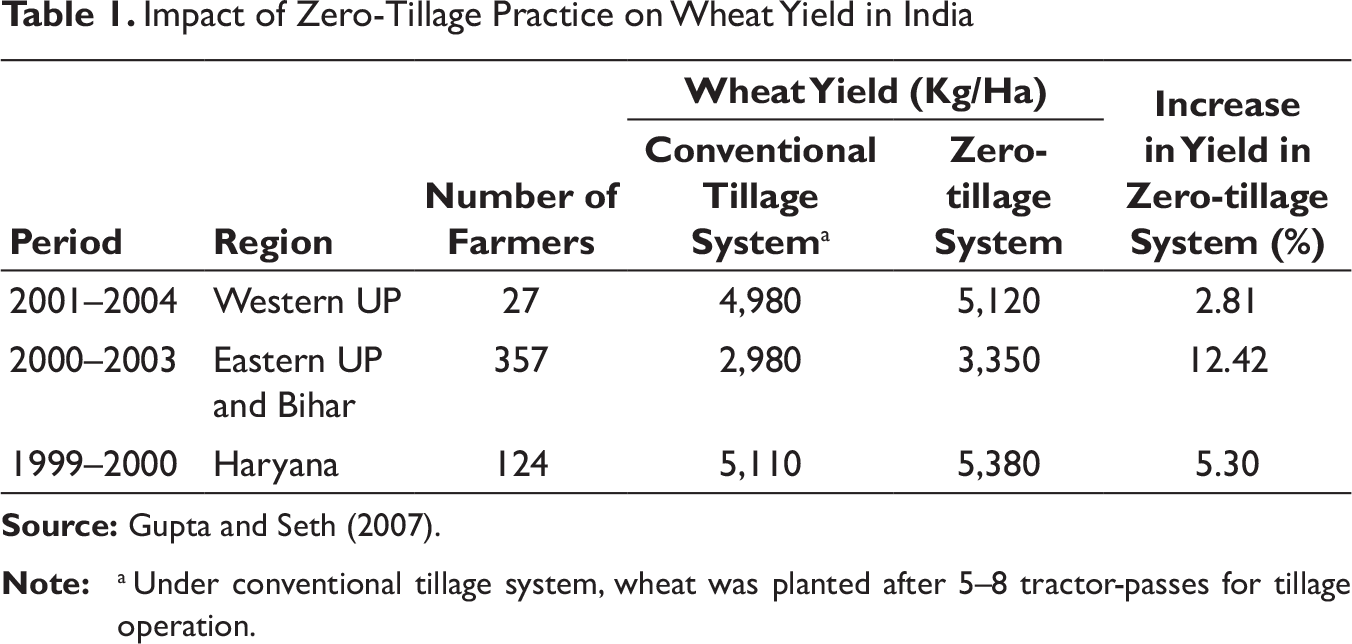
In order to minimise the negative effects of climate change and variability and to maximise economic benefits, small landholders have been implementing a range of CSA practices and technologies such as cropping system improvement (e.g. improved crop varieties, diversification, crop rotation and integration of legumes), integrated nutrient management (e.g. green manure, compost and site-specific nutrient management), resource conservation (e.g. minimum/zero tillage), precision water management (e.g. planting crops in bed, laser land levelling, mulching with crop residues) and agro-forestry as measures of adaptation to climate change and variability (Khatri-Chhetri et al., 2016). Several studies have reported that the application of these practices/technologies has enhanced crop yields, farm incomes and input-use efficiency (Aryal, Sapkota, Jat, & Bishnoi, 2015; Jat et al., 2009; Jat et al., 2014; Kumar et al., 2013; Sapkota et al., 2014).
Results from a more recent study by Khatri-Chhetri et al. (2016) based on a survey conducted with 625 households from the CSVs in Karnal (Haryana) and 641 households from the CSVs in Vaishali (Bihar) districts lend support to these findings. The selected sites with rice-wheat as the dominant cropping system are highly vulnerable to climate change and variability due to rapidly declining groundwater table and increasing soil salinity (Karnal) and occurrence of frequent flood and drought (Vaishali). Farmers in the CSVs are adapting to climate change and variability adopting CSA practices and technologies such as improved crop varieties, varieties suitable for drought/flood, laser land levelling, zero-tillage, residue retention, site-specific nutrient management, legume integration and crop diversification. About 60 per cent of the selected households implemented at least one CSA practice/technology. The CSA adopters prefer to use improved crop varieties (80 per cent), laser land levelling (42 per cent), crop rotations (23 per cent) and zero-tillage (11 per cent).
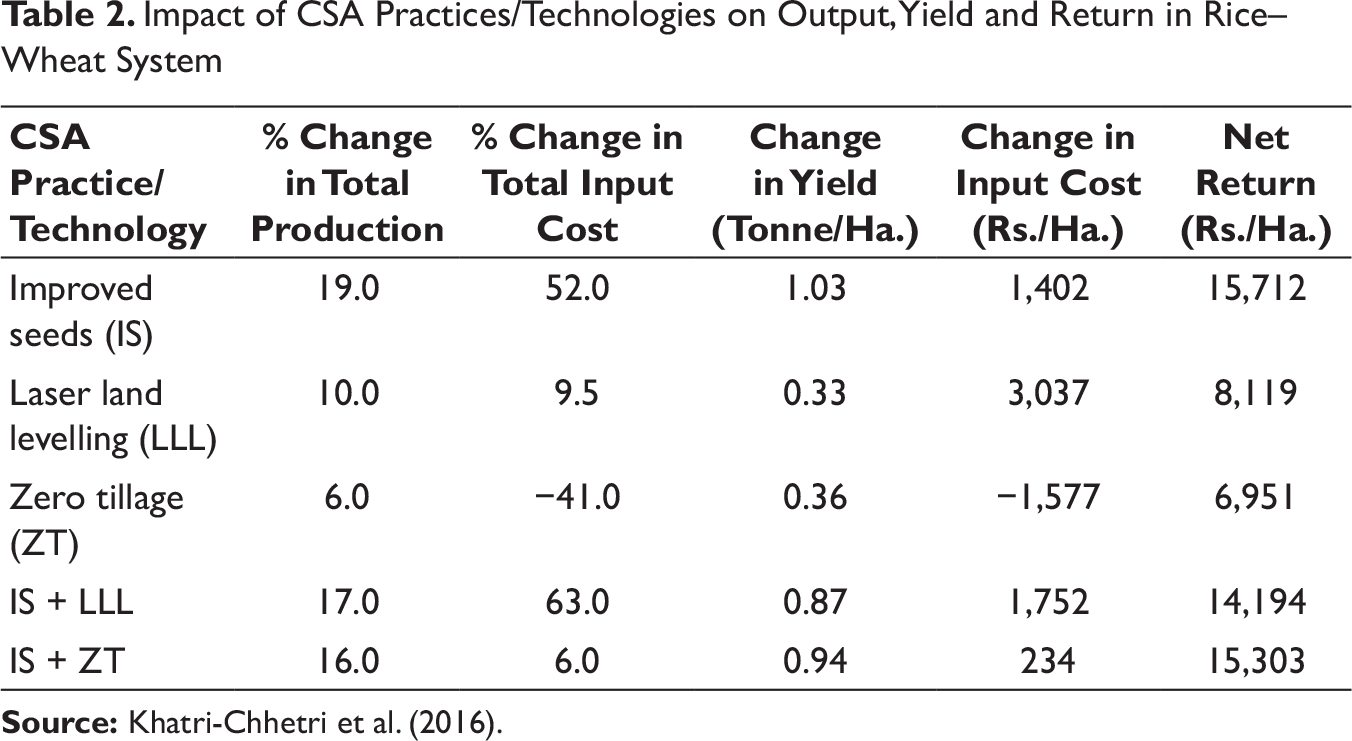
The results reported in Table 2 reveal that the farmers have achieved higher output, yield and return in rice-wheat cropping system after implementation of CSA practices and technologies individually or jointly in place of the conventional practices. Among the three CSA interventions, improved seed has the largest impact on production, yield and net return. Laser land levelling has the second highest increase in production and net return, followed by zero-tillage. And zero-tillage has the second highest increase in yield, followed by laser land levelling. A combination of improved seeds with laser land levelling/zero-tillage has helped achieve significantly higher yield and net returns than the levels achieved using laser land levelling or zero-tillage alone. Overall, the results indicate that CSA practices/technologies have helped small farmers in the Indo-Gangetic Plains of India achieve higher productivity and income than the levels they would have without these practices. This suggests that scaling out of such practices and technologies in other regions would provide economic benefits to farmers and help them reduce the adverse impacts of climate change and variability.
Impact of CSA Practices/Technologies on Output, Yield and Return in Rice–Wheat System
Zero Budget Natural Farming
Zero Budget Natural Farming (ZBNF), based on Fukuoka’s (1975) idea of natural farming, has been advocated (pioneered by Subhash Palekar) in recent years as a set of farming practices for sustainable agriculture and food and nutritional security in India. It has been spreading to various regions in the country, particularly in the southern states like Andhra Pradesh and Karnataka. ZBNF refers to farming with nature and without chemicals, credit and spending any money on purchased inputs. As a radical paradigm shift from water and chemical input-based agriculture, ZBNF controls the influence of photosynthesis to lock the carbon cycle and build soil health, crop resilience and nutrient density. It promotes poly cultures to keep the soil covered with biomass at all times and improves soil microbiome through indigenous cow dung and urine-based bio-inoculants. It enables farmers to improve soil fertility and yield with lower costs, risk and irrigation requirements. It also provides consumers with chemical-free, nutritious food and thus ensures food and nutritional security through continuously increasing soil organic matter, water-holding capacity and biodiversity.
ZBNF is based on four pillars. (a) Jivamrita (fermented microbial culture with indigenous cow dung and urine-based bio-inoculants, which provides nutrients, acts as a catalytic agent that promotes the activity of microorganisms in the soil and helps to prevent fungal and bacterial plant diseases), (b) Bijamrita (treatment used for seeds, seedlings or any planting material using cow dung and urine which is effective in protecting young roots from fungus as well as from soil-borne and seed-borne diseases that commonly affect plants after the monsoon period), (c) Acchadana/Mulching (the process of covering the top soil with crop and crop residue covers to ensure favourable microclimate in the soil) and (d) Whapasa/Moisture (the practice to ensure water vapour needed by the roots in the presence of both air molecules and water molecules in the soil) (FAO, 2016).
Andhra Pradesh has been working towards promoting ZBNF since 2015. At present, 160,000 farmers have been using this farming system, and 500,000 farmers are expected to adopt ZBNF by 2020. There are plans to transform all six million farmers in the state to ZBNF by 2024. Scaling-up ZBNF is founded on farmer-to-farmer knowledge dissemination by best-practitioner ZBNF farmers. Karnataka has also initiated ZBNF. Around 100,000 farmers were estimated to be using this farming practice (Khadse, Rosset, Morales, & Ferguson, 2018). Niti Aayog has suggested every state to initiate steps to adopt ZBNF, so that this farming practice may become systemic to Indian agriculture.
The farmers practising natural farming were found to have benefited immensely from it. Results from crop-cutting experiments and field surveys indicated that most of the farmers had obtained higher yields with reduced costs of cultivation. They also experienced improvements in soil conservation, seed diversity, quality of produce, household food autonomy, income and health. There are also immense ecosystem benefits through increased soil organic matter, water retention and biodiversity, with reduced air and water pollution as well as greenhouse gas emissions (FAO, 2016).
In spite of immense potential economic and environmental benefits, only a few states have been working towards promoting ZBNF. There are a very few official policies to help disseminate ZBNF to farmers in the states other than Andhra Pradesh. Official policies are also lacking to adequately address the challenges that the ZBNF farmers have been facing in marketing their natural produce. Concerted efforts and appropriate public policies are crucially needed to promote the Andhra Pradesh model of natural farming for adoption in all the states. Since ZBNF is promoted as a technologised natural farming programme, it may not be accessible to the resource-poor small and marginal farmers unless they are supported by the governments. There are also serious doubts about the feasibility of ZBNF to completely replace the water and chemical input-intensive farming practices and to produce enough to meet the requirements of the huge and growing population in the country. Success of the model in building climate-resilient food production system depends crucially on a holistic approach which takes into account interrelated policies, issues and concerns, especially those associated with environment, ecology, biodiversity, forests, water, seed sovereignty, among others.
Summary and Conclusion
This article has evaluated the importance of CSAs in promoting sustainable agricultural development and ensuring food security, mitigating the negative impacts of climatic changes on agricultural productivity in India. A range of CSA technologies and practices for cropping system improvement, integrated nutrient management, resource conservation, precision water management and agro-forestry have been initiated in CSVs in order to enable farmers to cope with climate risks and use natural resources efficiently to ensure sustainability and stability in agricultural production and food and livelihood security to farming communities. CSA technologies and practices used in various regions of India under the CGIAR’s CCAFS programme have helped farmers achieve higher crop yields, farm incomes and input-use efficiency with lower GHG emissions. The results from field-level experiments in various regions also reveal that the CSA adopters have achieved higher output, yield and return in rice-wheat cropping system. Alongside, demonstrations of smart farming practices and technologies under ICAR’s NICRA project have helped building resilience of rural households to climate shocks, strengthening their adaptive capacity to cope with increased climatic variability and to enhance crop yields. Farmers’ preferences for CSA interventions were found to vary according to their socio-economic characteristics, location and agro-climatic zones, besides potential benefits and cost of implementation of the technologies.
Smart farming services such as WBCIS have also been encouraging farmers to invest in their crops, raise agricultural productivity and mitigate climate change by reducing production risks. Similarly, the IAAS has been helping farmers maximise their return from crop production, enabling them to cope with current, short-term climate-induced risk. The farmers receiving IAAS advisories have obtained higher yields with lower costs compared to those not receiving the advisories. Again, the farmers, who followed cropping advisories based on seasonal climate forecasts in the drought-prone areas, were able to earn more than those who did not follow.
A number of factors, such as, farmers’ income and access to credit, landholding size and extension services, have influenced the adoption of CSA technologies and practices. In spite of huge potential benefits of the smart farming practices and technologies, their adoption rates are very low largely due to farmers’ resource and income constraints and lack of awareness. Implementation of a well-designed extension service and agricultural finance policy and strengthening national and local institutions to improve people’s adaptive capacity through enhancing their access to finance, assets and information could play a significant role in scaling out CSA technologies to several regions of the country. The experiments of CSA practices/technologies conducted in vulnerable areas under NICRA constitute an important part of this process. Provisioning climate finance through public sector financial institutions that can accelerate adoption of these practices and technologies for adaptation and mitigation could promote climate-resilient development in agriculture. A successful switch to smart farming will largely depend on adoption of the smart technologies and the availability of institutional credit (Dadhich, 2017). Increasing the targeting of financing to smart farming practices/technologies by linking climate finance to traditional agricultural finance could be an important step towards making agriculture more sustainable and a viable source of livelihood and food security for millions of farmers in the country. Appropriate polices may be adopted to promote ZBNF as a climate-resilient farming system, which can enhance food and nutritional security, enabling farmers to improve soil fertility and yield with lower costs, risk and water requirements and protecting the ecosystem by improving soil organic matter, water retention and biodiversity and reducing air and water pollution as well as greenhouse gas emissions.
Footnotes
Declaration of Conflicting Interests
The author declared no potential conflicts of interest with respect to the research, authorship, and/or publication of this article.
Funding
The author received no financial support for the research, authorship, and/or publication of this article.