




Abstract
Background
The associations between several metabolic factors, gut microbiota (GM), and cognitive performance have not been clearly identified. This study investigates their associations and GM's mediating effects.
Objective
This study aimed to investigate the causal effects of key metabolic factors on cognitive performance and to determine whether gut microbiota mediate these associations.
Methods
Genetic variants linked to four metabolic factors [body mass index (BMI), basal metabolic rate (BMR), systolic blood pressure (SBP), two-hour glucose], GM, and cognitive performance were selected from genome-wide association studies (GWAS). Univariable Mendelian randomization (MR) and mediation MR analyses were applied.
Results
We found a protective effect of body metabolic rate (β = 0.061; 95% CI: 0.029, 0.093; p = 0.0002) and risk effect of body mass index (BMI, β = −0.047; 95% CI: −0.074, −0.019; p = 0.0009), systolic blood pressure (β = −0.049; 95% CI: −0.084, −0.014; p = 0.0063), and two-hour glucose (β = −0.043; 95% CI: −0.070, −0.016; p = 0.0017) on cognitive performance. In addition, the 2-step MR analysis further showed that the BMI-effect on cognitive performance was partially mediated by Rikenellaceae family, with a mediated proportion of 14.03% (95% CI: 0.99%, 27.06%; p < 0.05).
Conclusions
Our findings suggest that several metabolic factors influence cognitive performance, with gut microbiota potentially mediating these effects. These results provide insights into potential targets and useful biomarkers for understanding the pathogenesis and developing interventions for cognitive health.
Keywords
Introduction
Cognitive performance includes attention, memory, language learning, executive function, and other cognitive processes. 1 It can be measured by assessing relevant cognitive domains and performing systematic tasks, which is the significant indicator of individual cognitive function. Cognitive functioning has implications for human physical and mental health, including educational attainment, lifestyle, and mortality, 2 the decline of which can subsequently lead to the potentially reversible mild cognitive impairment and irreversible dementia. 3 Globally, an estimated 57.4 million people were living with dementia in 2019, and this number is projected to nearly triple to 152.8 million by 2050. 4
Currently, 12 modifiable factors were identified as the related risk factors of cognitive impairment and dementia, including hypertension, obesity, diabetes and lifestyles. 5 Meanwhile, several relevant metabolic factors are also of equal concern, such as blood pressure, 6 glycemia, 7 body mass index (BMI), 8 and basal metabolic rate. 9 These metabolic abnormalities may contribute to cognitive decline through neuroinflammation, endothelial dysfunction, oxidative stress, and insulin resistance, leading to neuronal injury and protein aggregation.10–12 However, the specific mechanisms by which these factors affect cognitive performance remain unclear, hindering comprehensive prevention strategies.
Humans coexist with an estimated trillions of microorganisms, 13 including bacteria, viruses, fungi, etc. The gut microbiota (GM) is the largest reservoir of microorganisms in the human body, with common species including but not limited to Bacteroides, Firmicutes, Actinobacteria, and Proteobacteria. These microorganisms are responsible for a variety of physiological and pathological processes in the human body, with both pros and cons, such as regulating intestinal motility, defending against foreign pathogens, releasing neurotransmitters, and producing a wide range of metabolites. 14 Several studies have confirmed that a series of metabolic factors or metabolic diseases can influence the composition and function of the intestinal flora. 15 For example, compared to normal individuals, the GM in hypertensive patients has increased Firmicutes-to-Bacteroidetes ratio and decreased microbial diversity. 16 This relationship between hypertension and GM has also been replicated in animal models. 17 Moreover, numerous studies have indicated that GM may impact cognitive function through immune, metabolic, endocrine, and neuronal pathways. 18 For instance, Escherichia coli and Bacillus subtilis are associated with the production of amyloid fibers, which in turn can promote the accumulation of amyloid beta protein in the brain via the gut-brain axis, thereby increasing the incidence of Alzheimer's disease in the elderly. 14 Thus, we speculated that certain metabolic factors may contribute to the development of cognitive impairment by modulating the specific GM taxa. However, there was limited valid evidence to support the associations of GM, as animal studies are complex and costly to implement, and observational research generally depends on self-reported information which is subject to confounding and other bias.
Mendelian randomization (MR), utilizing genetic variants as instrumental variables (IVs), is a widely accepted epidemiological method for robust causal inferences. 19 As genetic variants are randomly allocated at conception and thus unrelated to postnatal factors (such as environmental factors and the development and progression of the disease), 19 there are strengths for MR in minimizing potential confounding and diminishing reverse causality.
Hence, in this study, we conducted an MR investigation to clarify the potential causal associations between certain metabolic factors (including BMI, systolic blood pressure, two-hour glucose, and basal metabolic rate) and cognitive performance. We further aimed to explore the potential mediating role of specific GM taxa in these associations. These findings could be valuable for the prevention, diagnosis, and treatment of cognitive impairments.
Methods
Study design
Overview and the critical assumptions of the MR study are shown in Figure 1. We conducted summary-level univariable MR (UVMR) and mediation MR analyses to investigate the effect of four metabolic factors (BMI, basal metabolic rate, systolic blood pressure, and two-hour glucose) on cognitive performance and the proportion of which mediated through GM. The analytic process was reported according to the STROBE-MR guidelines. 20
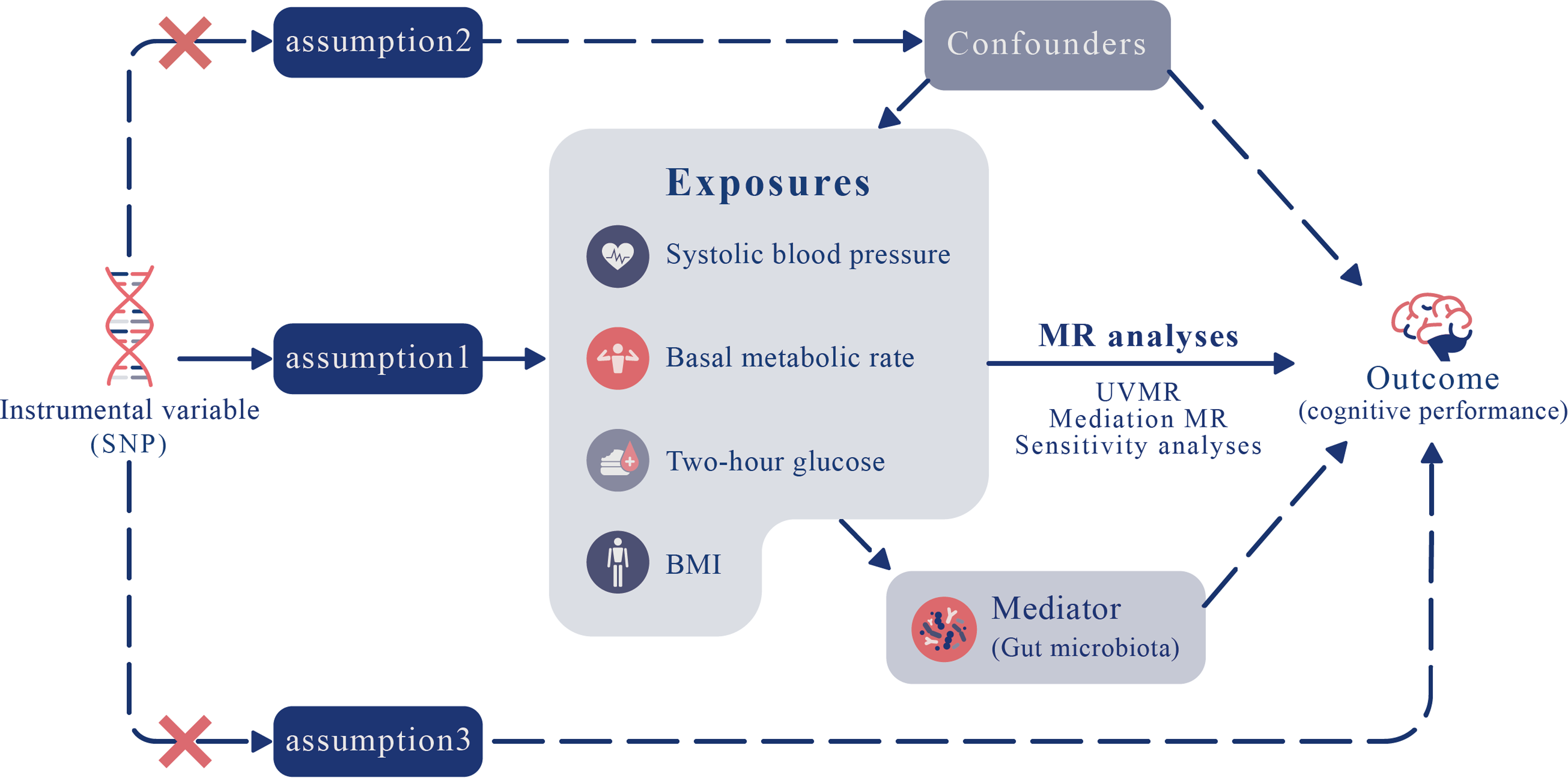
Study design overview. For the reliability of the results, SNPs used as IVs should meet three assumptions: (1) strongly associate with the exposures in univariable MR (UVMR) analyses; (2) be irrelevant with any confounder interfering with the associations between exposures and outcomes; and (3) only influence the outcomes via the exposures. BMI: body mass index; MR: Mendelian randomization; SNP: single-nucleotide polymorphism.
Data sources and ethical review
The summary-level data from publicly available genome-wide association studies (GWAS) of European ancestry was used to identify genetic instruments for metabolic factors, GM, and cognitive performance. Detailed information of corresponding data sources was shown in Table 1 and Supplemental Table 1.21–26 All GWAS datasets utilized in this study obtained relevant ethical approval and participant informed consent before implementation; thus, no additional ethical approval was required for this study.
Characteristics of used GWAS.

GWAS: genome-wide association studies; PMID: PubMed identifier; SD: standard deviation; GIANT: Genetic Investigation of ANthropometric Traits; NA: not available.
The summary-level data on BMI was sourced from a large-scale GWAS in the Genetic Investigation of ANthropometric Traits consortium (GIANT) including 681,275 European individuals. 21 The summary-level GWAS data on body metabolic rate was derived from a GWAS involving 534,045 individuals from the UK Biobank. 22 The summary-level GWAS data pertaining to systolic blood pressure and two-hour glucose was available from meta-analyses encompassing 810,865, 63,396 individuals of European ancestry respectively.23,24
Genetic instruments for GM were obtained from the GWAS summary datasets of the MiBioGen Consortium, a large-scale multi-ethnic GWAS meta-analysis including 18,340 individuals from 24 cohorts. 25 To ensure consistent genetic backgrounds and enhance the reliability and interpretability of the results, we exclusively utilized data from the European ancestry (18 cohorts, n = 14,306). The consortium presenting data on 211 taxonomic groups at 5 levels (genus, family, order, class, phylum), after removing 15 bacterial taxa without specific species names, 196 bacterial taxa remained for analyses. Genetic instruments for cognition performance were retrieved from a European ancestry GWAS meta-analysis conducted by the Social Science Genetic Association Consortium (SSGAC) (n = 257,841), with merging researches from the COGENT Consortium (n = 35,298) and UK Biobank (n = 222,543). 26
Genetic instrument selection
It is pivotal for IVs to fulfill the three assumptions mentioned in Figure 1. First, we screened for single nucleotide polymorphisms (SNPs) with conventional GWAS threshold (p < 5 × 10⁻⁸) for metabolic factors and the generally considered threshold (p < 1 × 10⁻⁵) for GM.25,27 Second, the linked unbalanced SNPs were clumped to a linkage disequilibrium threshold of r2 < 0. 001, distance = 10,000 kb at 1000 Genomes reference panel. 28 Third, as a higher F-statistics indicated a lower level of weak instrumental bias, SNPs with F-statistics >10 were remained. 29 Additionally, we excluded those with minor allele frequency (MAF) values less than 0.01 and no proxy IV was used when no shared SNPs were available between exposure and outcome. Moreover, all palindromic SNPs were removed during harmonization. Next, to avoid reverse causality, we performed the MR-Steiger test to filter SNPs, by calculating and comparing the variance explained by the exposures and outcomes. 30 Finally, after elimination of the outliers detected by Mendelian Randomization Pleiotropy Residual Sum and Outlier (MR-PRESSO), the remaining SNPs were utilized for further MR analysis. 31
Statistical analysis
UVMR analyses
The two-sample UVMR analysis was first conducted to assess the causal associations of genetically predicted four metabolic factors with cognitive performance. The multiplicative random-effects inverse-variance-weighted (IVW) method was utilized as the main statistical model, which meta-analyzed the Wald ratio estimates of each SNP into one causal estimate using the random-effects. 32
Mediation analyses
The two-step MR analyses were applied to explore whether GM could mediate the association between the four metabolic traits and cognitive performance. 33 The first step was to evaluate the causal effect of genetically determined four metabolic traits on 196 bacterial taxa (β1), and the second step was to estimate the causal effect of each potential mediator on cognitive performance (β2) after ensuring that there was no overlap between the IVs for the four metabolic factors and the IVs for mediators. Both steps using UVMR. With the total effect estimates of four metabolic traits on cognitive performance (β) obtained from the primary UVMR analyses, the proportion of each mediator was calculated by dividing the mediation effect (β1×β2, the product of coefficients method) by the total effect (β). 34 Notably, in instances where the indirect effect (β1×β2) and the total effect (β) had opposite directions, indicating a suppression effect, we calculated the absolute value of this ratio (|β1×β2/β|) to estimate the absolute contribution of the indirect pathway, which is presented as a reference for magnitude. The standard error and 95% confidence intervals (CI) of mediation effect were derived by the Delta method. 35
Sensitivity analyses
The MR-Egger, weighted median, MR.RAPS (robust adjusted profile score), maximum likelihood, and MR-PRESSO were further employed to validate the robustness of the IVW results in the UVMR analyses. 31 36–39 The MR-Egger and weighted median methods could provide unbiased estimates of the causal effect in the presence of invalid IVs but have limited precision.36,37 The estimator of MR. RAPS remains a robust inference in the existence of weak and pleiotropic IVs, especially when the phenotypes are complex. 38 The maximum likelihood method is similar to IVW with low standard error, and bias may occur because of a limited sample size, but which is so small that could be biologically negligible. 39 The MR-PRESSO method detects outlying SNP and produces estimates before and after the exclusion of significant pleiotropic outliers. 31
Then, we test for horizontal pleiotropy using the intercept of the MR-Egger, and the intercept estimator deviating from zero (p < 0.05) indicated the average pleiotropic effect across the genetic variants. 36 We also detect the heterogeneity using Cochrane's Q test, 40 and applied leave-one-out analyses to investigate the effect of SNP outliers.
Accounting for multiple testing, the Benjamini-Hochberg method for false discovery rate (FDR) correction was used to control for the type I error rate, with FDR q-value < 0.05 considered the statistical significance. 41 The bias from sample overlap and statistical power were further evaluated using online tools provided by Burgess et al. and Brion et al..42,43 All MR analyses were performed using the “Two Sample MR”, “mr. raps”, “MRPRESSO”, “forestploter” packages in R (version 4.3.3; R Foundation for Statistical Computing, Vienna, Austria).
Results
After satisfying the conditions of screening IVs as described above, 5938 SNPs were finally included in the analysis (Supplemental Table 2). The F-statistic of each IV was over 10, indicating the cogent strength of used IVs. The statistical power and overlap bias of the MR analyses was shown in Supplemental Table 3. The estimated bias from sample overlap between BMI, basal metabolic rate, systolic blood pressure and cognitive performance fluctuated from 0.001 to 0.014, suggesting less likelihood of weak IVs bias. The power was low in the association between systolic blood pressure and Dialister genus, but for the other study exposures were sufficient, greater than 80%.
Univariable analyses
In UVMR analyses, the IVW results demonstrated that genetically predicted increase of body metabolic rate was significantly associated with a protective influence on cognitive performance (β = 0.061; 95% CI: 0.029, 0.093; p = 0.0002), while genetically liability to the one unit increment of BMI (β = −0.047; 95% CI: −0.074, −0.019; p = 0.0009), systolic blood pressure (β = −0.049; 95% CI: −0.084, −0.014; p = 0.0063), and two-hour glucose (β = −0.043; 95% CI: −0.070, −0.016; p = 0.0017) were found to exhibit the potential detriment to cognitive performance. Consistent and stable results were obtained from several sensitivity analyses, with they all survived multiple testing corrections (Figure 2 and Supplemental Table 4). Genetic instrumental variables of BMI and body metabolic rate showed the presence of heterogeneity using Cochran's Q (Supplemental Table 5) and the intercept of MR-Egger indicated no evidence of pleiotropy with all four metabolic factors (Supplemental Table 6). The leave-one-out analyses did not find the significant effect of individual SNPs on the results (Supplemental Table 7).
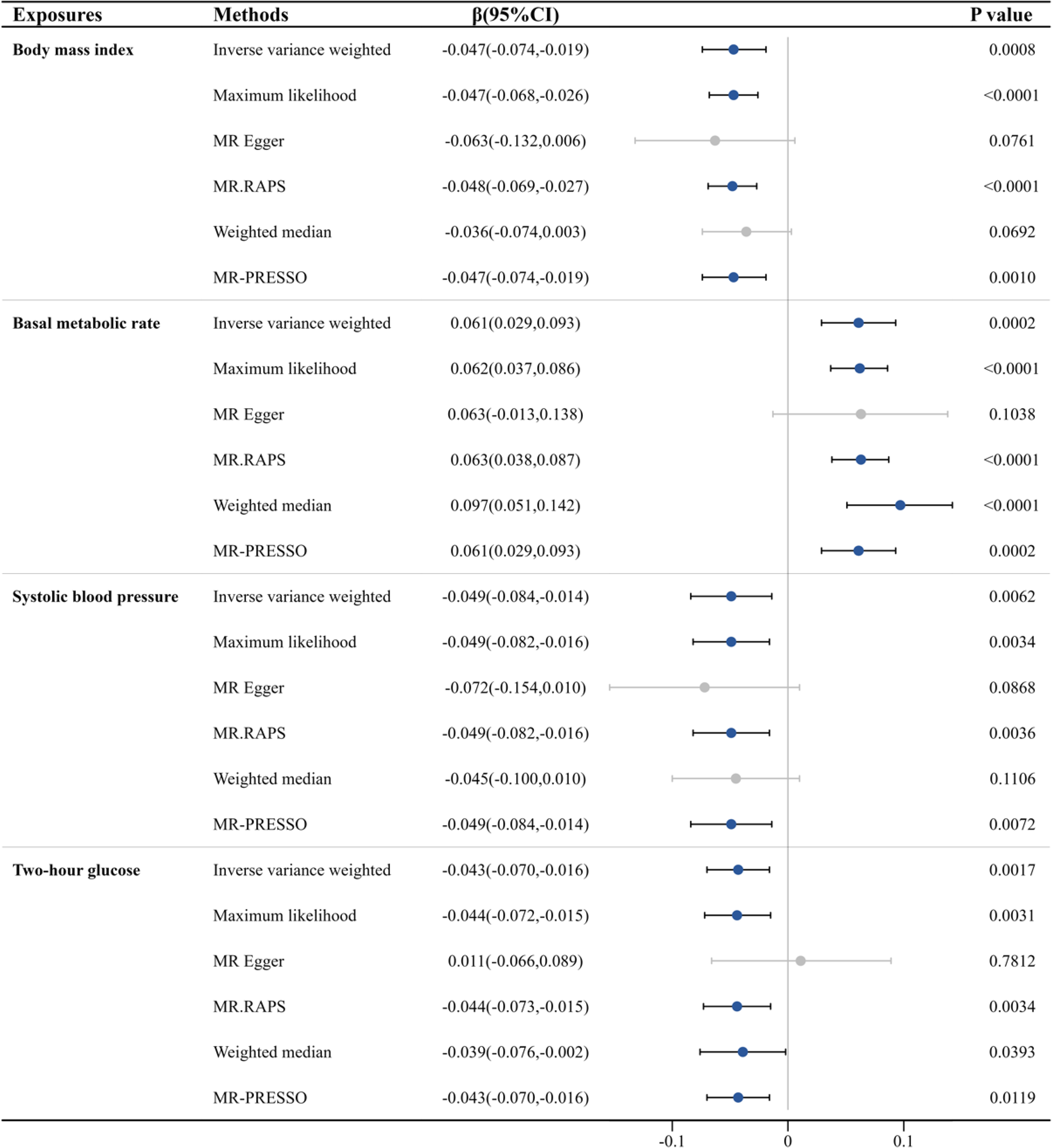
Associations of genetically predicted four metabolic factors with cognitive performance in UVMR. CI: confidence interval; UVMR: univariable Mendelian randomization; BMI: body mass index; MR.RAPS: Mendelian randomization robust adjusted profile score; MR-PRESSO: Mendelian randomization pleiotropy residual sum and outlier.
Mediation analyses
In analyses of GM, BMI was associated with 35 GM taxa (Supplemental Table 8), among which Deltaproteobacteria class, Rikenellaceae family, and Flavonifractor genus were estimated as potential mediators on the association between BMI and cognitive performance. The effect mediated by Rikenellaceae family accounted for 14.03% of the total effect (Figure 3). Deltaproteobacteria class and Flavonifractor genus counteracted the effect of BMI on cognition. For basal metabolic rate, associated with 28 candidate GM taxa (Supplemental Table 9), among which only Porphyromonadaceae family was associated with cognitive performance (Supplemental Table 9), whereas its mediating effect is not significant (Figure 3). Of 32 candidate GM taxa for systolic blood pressure, three GM taxa exerted consistent protective effects on cognitive performance (Supplemental Tables 8 and 9), but the main results only indicate the indirect protective effects of Ruminococcaceae UCG003 genus in association between systolic blood pressure and cognitive performance (Figure 3). Among the 25 GM taxa that were causally associated with two-hour glucose, only two demonstrated the negative correlation with cognitive performance, namely, Enterobacteriales order and Enterobacteriaceae family (Supplemental Tables 8 and 9). With similar biological origins, they were responsible for the same mediated effects of weakening the association between two-hour glucose and cognitive performance (Figure 3). All significant mediation pathways and their effect sizes are visually summarized in Figure 4. No horizontal pleiotropy was observed in the above two steps MR analyses, and only the genetic instrumental variables for Deltaproteobacteria class and Rikenellaceae family were detected the presence of heterogeneity in Cochran's Q test (p < 0.05) (Supplemental Tables 5 and 6).
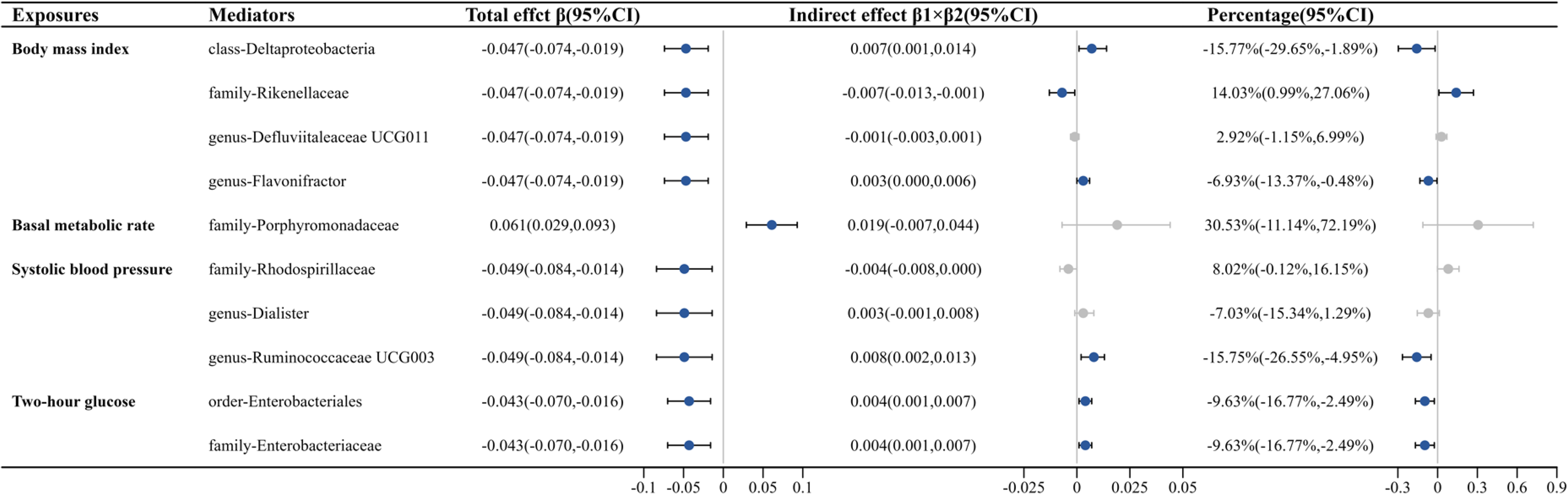
Mediation Mendelian randomization results of genetically predicted gut microbiota in associations between four metabolic factors and cognitive performance. Total effect(β): the effect of exposures on cognitive performance; Indirect effect (β1×β2): the effect of exposure on cognitive performance via corresponding mediator; β1 is the effect of exposure on mediator; β2 is the effect of mediator on cognitive performance. CI: confidence interval.
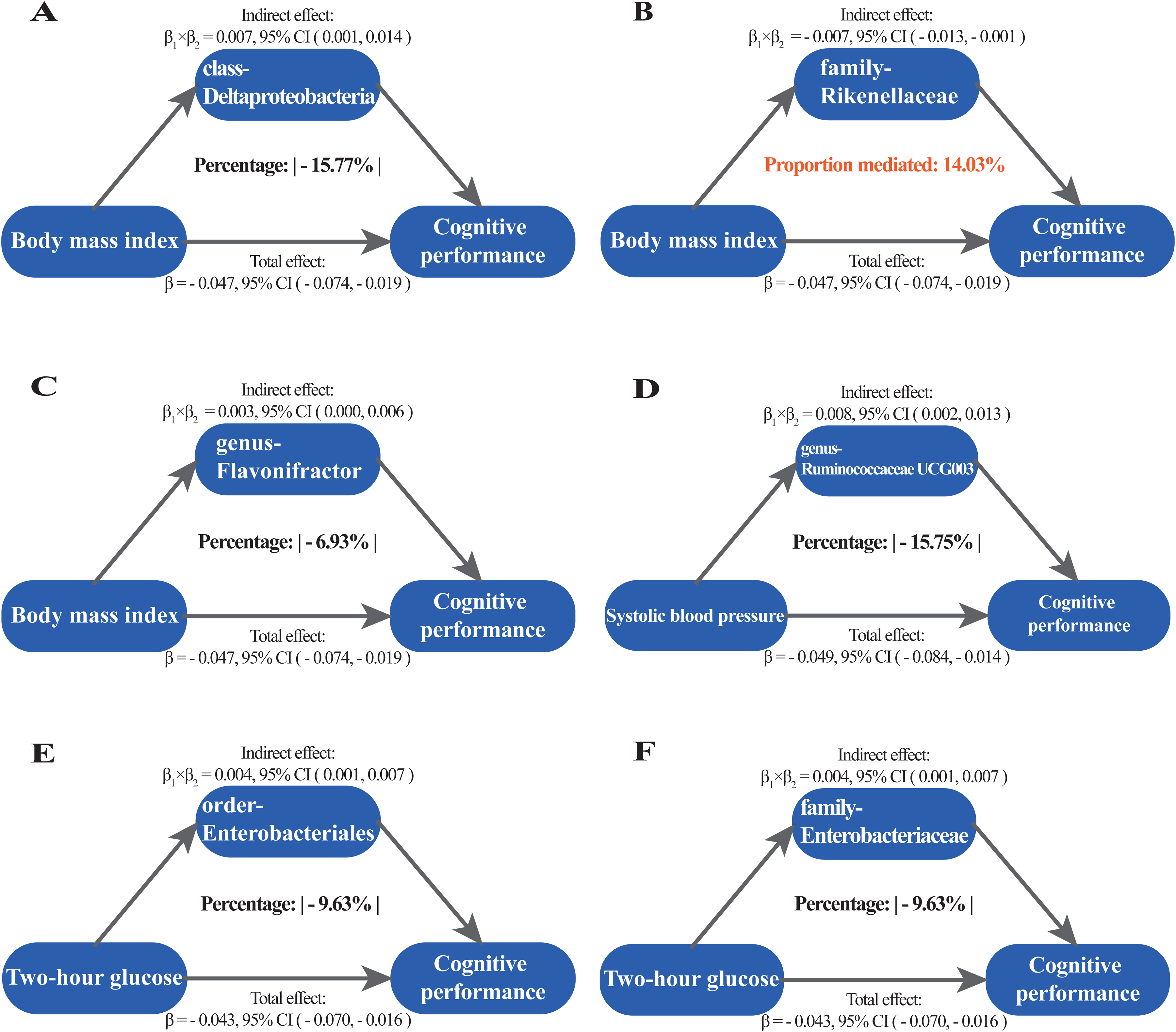
Mediation effect analysis of gut microbiota on the interaction between metabolic factors and cognitive performance. The figure displays the total effect (β), the indirect effect (β1×β2), and the estimated mediation percentage. This percentage represents the proportion mediated (calculated as (β1×β2/β)*100%) when the indirect and total effects share the same direction. In cases of suppression (where effects have opposite directions), the value represents the absolute contribution of the indirect pathway (calculated as |β1×β2/β|*100%) and is presented as a reference for magnitude. p-values <0.05 indicate a significant indirect (mediation) effect.
Discussion
This MR study demonstrated that genetic predisposition to elevated BMI, systolic blood pressure, and two-hour glucose were causally associated with poor cognitive performance, while higher body metabolic rate exerted the protective influence on cognitive performance. Concerning the possible underlying mechanism, it was the first time to uncover the mediating role played by six GM taxa in the causal associations of BMI, systolic blood pressure, and two-hour glucose with cognitive performance.
For the potential relationships between metabolic factors and cognitive performance, our investigation found that higher BMI was linked to poorer cognitive performance, as indicated by the results of UVMR. Previous conventional observational studies have indicated that there is a strong correlation between BMI throughout development and cognitive performance.44,45 BMI is generally regarded as a measure of obesity. Several previous MR analyses have found the effects of adiposity on cognitive function. 8 Consistent with our study, a longitudinal study has demonstrated that an accumulation of high systolic and diastolic blood pressure, as well as uncontrolled blood pressure, were linked to cognitive decline. 46 Furthermore, increased blood pressure can cause alterations in the structure of cognitive regions in the brain. 47 As for the two-hour glucose, a cross-sectional study suggested that the higher two-hour glucose level may be a risk factor for cognitive impairment, 48 which was similar to our findings. Meta-analysis and systematic review, summarizing current research, demonstrated obesity, hypertension and diabetes were the risk factors of dementia.5,49 Meanwhile, the basal metabolic rate, a quantitative assessment of the metabolic processes in the human body, was positively associated with cognitive function in this study. The direct evidence of the relationship between body metabolic rate and cognitive performance was limited, since the body metabolic rate was not commonly assessed in studies. To our knowledge, only one study, based on UK biobank, has demonstrated the higher level of body metabolic rate was associated with a decreased risk of Alzheimer's disease. 50 The role of maintaining body metabolic rate in the prevention of cognitive decline in older adults should be further investigated in future research.
To explore the mechanism of the associations between several metabolic factors and cognitive performance, we used the two-step MR to assess the mediating role of GM. Although, we found the causal relationship between body metabolic rate, Porphyromonadaceae family and cognitive performance respectively, but we failed to demonstrate the Porphyromonadaceae family mediated the effect of body metabolic rate on cognitive function, which suggested the pathway of the effect may not go through the GM and need to be explored further. Deltaproteobacteria class, Rikenellaceae family, Defluviitaleaceae UCG011genus and Flavonifractor genus were found to be causally associated with BMI and cognitive performance, as indicated by the two-step MR analysis. Some results have been confirmed by previous studies, 29 51–55 and some have yet to be sufficiently investigated such as the correlation between BMI and Deltaproteobacteria. With the exception of Defluviitaleaceae UCG011 genus, the other three GM taxa were statistically significant mediators, especially the Rikenellaceae family was manipulated by high BMI to the deterioration of cognitive performance. Future well-powered studies will be needed to verify our findings and further elaborate on underlying mechanisms. Of the three potential candidates, the GM taxa selected by the two steps MR, only Ruminococcaceae UCG003 genus reached the statistical threshold for the protective mediating effect on the pathway of systolic blood pressure with cognitive performance. To the best of our knowledge, few studies have investigated the relationship between systolic blood pressure and Ruminococcaceae UCG003 up to date. However, one previous MR study has reported the protective effect of Ruminococcaceae UCG003 on cognitive performance, 27 which is consistent with our results. Numerous epidemiological studies have revealed that the abundance of the Enterobacteriaceae-related GM taxa was negatively associated with cognitive performance and blood glucose.56,57 Our study also supports this supposition. Regarding the causal relationship between 2-h glucose after an oral glucose challenge and cognitive performance, the order Enterobacteriales and the family Enterobacteriaceae demonstrated the same statistically significant mediating effect in our study, which may be attributed to the resemblance of their biological origins. We suggest that high 2-h glucose level exerts the protective role against cognitive dysfunction by decreasing the abundance of the order Enterobacteriales and the family Enterobacteriaceae. Although numerous studies have uncovered the correlations of Enterobacteriales, blood glucose, and cognitive performance,56,58 no consistent findings has been yielded, additional studies with the larger sample size and with a comprehensive consideration of confounding, especially lifestyle-related factors, will be required to further elaborate on causality and underlying mechanisms. Metabolic factors are fundamental indicators of physiological state. Clarifying causality and identifying the mediated GM taxa could facilitate the thorough understanding of mechanisms and provide new perspectives for clinical prevention and treatment.
This study, to our knowledge, was the first two-step MR analysis to assess the mediating roles of GM in the association of metabolic factors with cognitive performance. The principal strength was the employment of the MR design, which yielded causal inference rather than correlation, largely reduced confounding and reverse causality, and compensated for the deficiency of traditional observation studies. 22 Furthermore, the rigorous selection of IVs, the small sample overlap bias, and the consistency of several sensitivity analyses ensured adherence to the three basic assumptions of MR and provided robustness to our findings. Additionally, the participants included were predominantly of European descent, thus effectively minimizing the population structure bias but may also limit the generalizability of the findings to other populations.
There are admittedly some limitations that should be considered when interpreting the results of this study. Pleiotropy is the major issue for MR analysis, which means the selected genetic instrument variables affect outcome not through exposure but other alternative routes, thus biasing the findings. However, no pleiotropy was detected by MR-Egger intercept test and MR-PRESSO analysis in this study, indicating less likelihood of potential biases. Furthermore, although the unavoidable sample overlap between exposure and outcome in this study may bias our causal estimates towards observational associations by inflating the weak instrument bias, 8 the IVs we selected were strongly associated with exposure, all estimated F statistics exceeded 10, and the estimated bias from sample overlap were small, suggesting the bias due to partial sample overlap should be minimal. Next, the MiBioGen Consortium's microbiome characterization is only available at genus-to-phylum resolution, so we are not equipped to investigate the GM at the species level. In addition, confined to the summary level genetic statistics, we can neither explore the nonlinear relationship or the relationship stratified by factors such as sex and age between metabolic factors and cognitive performance, nor assess the interactions with other environmental and genetic factors. Therefore, it is necessary to rigorously consider potential nonlinear effects, confounders, and interactions between exposures and outcomes in subsequent studies.
Conclusions
In conclusion, this comprehensive MR analyses corroborate the causal roles of BMI, basal metabolic rate, systolic blood pressure, and two-hour glucose in the modification of cognitive performance. The mediating effect of GM in the association between targeted metabolic factors and cognitive performance provides a better understanding of the underlying mechanisms and offers novel insights into interventions targeting metabolic factors and microbiome-based therapies for cognitive health.
Supplemental Material
sj-xlsx-1-alr-10.1177_25424823251405877 - Supplemental material for Metabolic factors, gut microbiota, and cognitive performance: Mendelian randomization analysis
Supplemental material, sj-xlsx-1-alr-10.1177_25424823251405877 for Metabolic factors, gut microbiota, and cognitive performance: Mendelian randomization analysis by Erhan Yu, Yi Zhang, Jiahui Chen, Bihao Peng and Jiawei Xin in Journal of Alzheimer's Disease Reports
Footnotes
Acknowledgements
The authors are grateful to the data source of the publicly available GWAS datasets of European ancestry.
Ethical considerations
All GWAS datasets utilized in this study obtained relevant ethical approval and participant informed consent before implementation; thus, no additional ethical approval was required for this study.
Author contribution(s)
Funding
The authors disclosed receipt of the following financial support for the research, authorship, and/or publication of this article: The study was supported by grants from Science and Technology Innovation 2030-Major Project (2022ZD0211603), National Natural Science Foundation of China (82371188), the Collaborative Innovation Platform Project for Fuzhou-Xiamen-Quanzhou National Independent Innovation Demonstration Zone (2022-P-028), Clinical Research Center for Precision Diagnosis and Treatment of Neurological Diseases of Fujian Province (2022Y2005).
Declaration of conflicting interests
The authors declared no potential conflicts of interest with respect to the research, authorship, and/or publication of this article.
Data availability statement
GWAS summary statistics used in this study are publicly available (see Table 1 and  for details). Analysis codes are available from the corresponding author (Jiawei Xin, xinjw@fjmu.edu.cn) upon reasonable request.
Supplemental material
Supplemental material for this article is available online.
References
Supplementary Material
Please find the following supplemental material available below.
For Open Access articles published under a Creative Commons License, all supplemental material carries the same license as the article it is associated with.
For non-Open Access articles published, all supplemental material carries a non-exclusive license, and permission requests for re-use of supplemental material or any part of supplemental material shall be sent directly to the copyright owner as specified in the copyright notice associated with the article.
