




Abstract
Despite growing recognition of the participation of autistic people as collaborators in research, this field continues to face several significant challenges. Key issues include a lack of guidance for researchers on how to implement participatory methods effectively and a shortage of evaluation tools to support best practice. Meaningful participation has the potential to redress power imbalances, reduce stigma, and ensure that research accurately reflects the lived experiences of autistic individuals, leading to more relevant and effective services and support. To address these challenges, researchers codeveloped and refined a standardized evaluative framework to promote meaningful autistic participation across all research stages and evaluate good practice in establishing a Participatory Action Research (PAR) Group while enhancing transparency regarding the extent of involvement. Draft tools were developed by a neurodivergent lead researcher, with the development and refinement process led by autistic researchers who facilitated consultation with participatory researchers, ensuring that the tools reflected diverse perspectives and lived experiences. The refined evaluation framework consists of the Evaluating Levels of Participation in Autism Research Tool which promotes participation of autistic people as collaborators across the stages of research and PAR group checklist which evaluates inclusive and accessible interactions with autistic collaborators. Both tools support researchers in addressing power dynamics, provide specific guidance on how to operationalize participatory approaches, and serve as frameworks for evaluating and enhancing the meaningful participation of autistic individuals in research. These tools can support equitable and impactful collaborations between researchers and the autistic community.
Community Brief
Why is this an important issue?
Autistic people have often been excluded from shaping autism research. Participatory research or coproduction involves working with autistic people, rather than just studying them. It aims to share power more equally in the research process by including autistic people as part of the research team (as we did in this project). While participatory research is growing, many researchers do not know how to involve autistic people effectively. There is also no standard way to measure meaningful participation, leading to research shaped mostly by nonautistic perspectives. This can reinforce stigma, misunderstandings, and services that do not meet autistic needs.
What was the purpose of this study?
This study aimed to codevelop and refine evaluation tools that support researchers in involving autistic people meaningfully as collaborators rather than as participants. The goal was to provide practical ways to ensure that autistic voices shape autism research and track their level of involvement across the different stages of the research process.
What did the researchers do?
The research team, led by autistic researchers and including a group of experienced participatory researchers, developed and refined two tools. The ELPART (Evaluating Levels of Participation in Autism Research Tool) assesses autistic involvement across five research stages: deciding the research topic, choosing research methods and tools, conducting research, analyzing research, and disseminating results. The Participatory Action Research (PAR) Group Checklist provides specific guidance in establishing a PAR group, creating accessible interactions, redressing power imbalances, and engaging in ongoing reflection and evaluation.
What were the results and conclusions?
The researchers found both tools effective in supporting meaningful autistic participation. Changes were made to improve clarity and usability, making them more practical for researchers.
The ELPART and the PAR Group Checklist provide a clear guide to measure and improve autistic involvement in research. When used properly, they can help shift autism research to adapt more ethical and inclusive practices.
What is new or controversial about these findings?
The ELPART and PAR group checklist are one of the first structured evaluation tools for measuring autistic participation. Many researchers claim to engage autistic people, but these tools provide a way to check if participation is meaningful. They also challenge traditional power dynamics, ensuring autistic people are decision-makers, not just consulted as an afterthought.
What are the potential weaknesses?
Independent testing is needed across different projects and with diverse autistic communities. Some autistic individuals face additional barriers to participation, such as those from global majority communities and nonspeaking individuals, and future research should ensure accessibility for all autistic voices.
How will these findings help autistic adults?
These tools can ensure that autism research is guided by autistic people, leading to more relevant studies, effective policies, improved support systems, and accountability, helping to shift research toward community priorities. By centering autistic voices, these tools promote a future where autism research is ethical, inclusive, and impactful.
Keywords
Introduction
In recent years, there has been increasing emphasis on the meaningful involvement of autistic people as collaborators in research, with participatory and co-produced approaches widely recognized as best practice.1,2 Despite growing numbers of projects being led predominantly, and in some cases exclusively, by autistic academics,3,4 they remain underrepresented. 5 Furthermore, participatory practices with autistic community researchers as collaborators are often embedded within neuronormative frameworks privileging neurotypical knowledge and ways of working. 6
Participatory research is a collaborative approach with researchers and participants working together to identify issues and generate knowledge, emphasizing shared decision-making and valuing lived experience. Participatory Action Research (PAR) extends this approach by emphasizing action and the principle that those with lived experience are best placed to shape solutions. 7 Participatory research continues to face structural, cultural, and practical barriers with the autistic community. Tan et al. 8 undertook a systematic evaluation of participation levels of autistic people in research using framework of den Houting et al. 9 Although autistic involvement in research has increased in recent years, they found that it was often distal and limited to consultation during the design stage, rather than embedded throughout the research process. Neurotypical researchers continued to hold decision-making power, and there was a lack of transparency and clarity around levels of involvement. In some fields particularly, such as autism genetic research, autistic involvement remains minimal. 10 Definitions of participation also vary, leading to inconsistent implementation,11,12 and participatory research is often understood superficially by academics. 9
Participatory research spans a spectrum of practices, from shaping research questions to redistributing decision-making power as equal partners and coauthors. 13 Navigating this spectrum is challenging; it is an iterative process requiring ongoing reflexivity and a willingness to address entrenched power dynamics. 5 Challenges vary and interact depending on a researcher’s neurotype, their relationship to the community being studied, and their position within the academic hierarchy. Early career researchers may face barriers such as limited institutional support or lack of understanding of meaningful participation from supervisors, whereas more established researchers may struggle to move away from hierarchical practices. 12 Neurotypical senior researchers may need to invest effort in building rapport and ensuring accessibility, whereas autistic early career researchers may lack the security or authority to challenge established norms.
Although enthusiasm for autistic involvement is growing, many researchers still lack the tools and support needed to implement participatory approaches effectively. 2
Background to Participatory Research with the Autistic Community
In critical neurodiversity studies, “business as usual” refers to neurotypical researchers dominating the field, which reproduce power imbalances, marginalize lived experience, and frame neurodivergence as a deficit to be studied “from outside.” 14 This is evident in autism research, where medical and psychiatric traditions have positioned autistic people as a problem to be solved15,16 reinforcing misconceptions that they cannot equally participate in the research process. 12 Historically, research centers neurotypical perspectives, with little accommodation for autistic participation. 17
Participatory research directly engages marginalized communities to redress power imbalances, whether through collaborative research teams, including community members with lived experience, or creative participatory methods such as photovoice.9,18 Inspired by Freire’s social justice work, which advocates for dialogic, participatory learning enabling oppressed people to develop critical awareness and act to change inequitable systems, participatory research promotes equity in knowledge production. 19 When implemented meaningfully, it moves beyond tokenistic inclusion to redistribute power and redefine whose knowledge counts.20,21
Over the last decade, autistic-led and mixed neurotype collaborations have begun to challenge neurotypical framings of autism research.4,22 These developments highlight that participatory approaches are not only about inviting autistic involvement into existing academic spaces but also recognizing the distinct knowledge, processing styles, communication preferences, and priorities that autistic researchers and communities bring.23,24 Even within all-autistic research teams, attention to diversity remains crucial to avoid privileging certain academic voices and ensure that outcomes represent the wider community. 4
Challenges of Participatory Autism Research
The current challenges of participatory autism research can be divided into the areas detailed below: Definitional ambiguity and shallow participation, misalignment between research and community priorities, inconsistencies in practice, and power and epistemic injustice.
Definitional Ambiguity and Shallow Participation
Researchers and autistic communities often differ in their understanding of what genuine participation entails. Pellicano, Dinsmore, and Charman 25 found that researchers frequently described their work as participatory, although autistic community members disagreed. Similarly, Masterson et al. 11 noted inconsistent uses of coproduction in health and social care, often without genuine involvement. den Houting et al. 9 observed that autistic participation was typically limited to advisory consultation, with professionals or carers more often engaged as partners. 11 Tan et al. 8 further highlighted ambiguity over who qualifies as a “community member,” with professionals sometimes included under this label. These findings highlight the need for clearer guidance to ensure meaningful and transparent participation.
Misalignment between Research and Community Priorities
Autism research often fails to align with autistic community priorities. Studies consistently identify a gap between research being conducted and what autistic people prioritize.12,25–27 For example, Kaljusto et al. 10 found that 87% of 149 articles in autism and genetics journals did not align with community priorities. Involvement of autistic individuals in research priority setting is needed to address this.
Inconsistencies in Practice
Although some projects demonstrate best practice, 22 participation is often concentrated at the design stage rather than embedded across all stages, from funding applications to dissemination.8,9 Pellicano et al.25,28 found limited opportunities for autistic involvement beyond design and dialogue. Similarly, Jivraj et al. 29 identified only two studies in which community members were consistently engaged throughout, although their strict inclusion criteria excluded more recent developments. Without deeper involvement, there is a risk of reverting to tokenistic practices.
Power and Epistemic Injustice
Superficial or tokenistic involvement reinforces what Bertilsdotter Rosqvist and Jackson-Perry 14 call neurotypical epistemic privilege, where neurotypical perspectives dominate what is considered valid knowledge. This can perpetuate epistemic injustice for autistic people, 5 leading to feelings of exploitation and exclusion. 30 Such practices foster mistrust in the autistic community and sustain deficit-based discourses in research.8,31 They also risk producing services and support misaligned to the diverse needs of autistic people.32,33
Existing Good Practice Guidelines Around Participatory Autism Research
One of the main obstacles to adopting participatory autism research is the lack of clear, practical guidance on how to implement them effectively.12,14
Arnstein’s ladder 34 has long been used to conceptualize levels of participation, from manipulation at the bottom to citizen power at the top. In autism research, participation is often tokenistic and sits in the lower levels. 2 den Houting et al. 9 adapted another model for the autistic community, reframing it as “doing to,” “doing for,” and “doing with.” While useful, critics argue that Arnstein’s ladder presents participation as linear and oversimplifies its complexities. 35 In autism research, power dynamics, accessibility needs, and communication preferences often shift across research stages, so participation is rarely linear.9,35 Power sharing is necessary but insufficient if neurodivergent researchers or participants cannot engage meaningfully due to systemic barriers. The ladder does not account for the adjustments, pacing, and communication support needed for equitable autistic participation.36,37 Furthermore, the ladder fails to capture the quality of participation and the reciprocity involved in participatory partnerships. For example, autistic individuals may be given formal roles (e.g., on advisory boards) without real influence or their contributions may be valued in some stages but dismissed in others.25,27 This broad framework does not specify how to implement participation throughout the research stages with autistic people.
Several frameworks have sought to provide more structured guidance on participation. The Guidance for Reporting Involvement of Patients and the Public (GRIPP2) framework 38 represents an important step toward improving transparency, consistency, and accountability in participatory work. While GRIPP2 offers a valuable foundation by encouraging researchers to document how involvement occurs, it was not designed specifically for autism research and focuses primarily on reporting rather than guiding practice. This highlights the need for autism-specific tools that support inclusive and equitable practices across research stages.
Valuable guidelines for meaningful participation specifically in autism research have been produced by Nicolaidis et al., 13 Gowen et al., 39 and Dark. 40 While some provide a broad framework for ethical and inclusive research practices, 40 they lack specific guidance on how to operationalize these principles in different research contexts. This makes it difficult for researchers, especially those unfamiliar with participatory approaches, to apply these principles meaningfully.
Building on the need for structured and actionable guidelines, the Cooperative Research Centre for Living with Autism (Autism CRC) 41 produced a range of Inclusive Research Practice Guides. These guidelines include a checklist for good practice in supporting participation in research for autistic individuals (Checklist 5), utilizing a 3-point scale to assess the involvement of autistic participants in research. This useful checklist provides a broad overview of participation, but lacks specific strategies for power sharing, accessibility, compensation, and reflective practice.
These examples highlight progress in articulating participatory principles, but also the need for a practical, autism-specific framework that supports researchers in applying them consistently and meaningfully. Without such tools, participatory approaches risk remaining underutilized or superficial.
25
With this in mind, the aim of this project was to codevelop and refine tools with the autistic community to:
Evaluate and identify different levels of community participation in autistic research—Evaluating Levels of Participation in Autism Research Tool (ELPART). Evaluate good practice in establishing a Participatory Action Research (PAR) Group with autistic people (PAR group checklist).
It is proposed that these tools will aid researchers, in both neurotypical and autistic led teams, adopting PAR approaches and in promoting best practice in autism research. Specifically, it is envisaged that these tools will:
Promote and provide specific guidance around the meaningful inclusion of autistic people throughout the research process, from conception of an idea through to dissemination of results (ELPART). Aid transparency in autistic involvement throughout the research process and in decision-making,
29
promoting the fair acknowledgment of autistic people’s views (ELPART and PAR group checklist). Aid reflection and learning at all stages of the research process (ELPART). Address power dynamics and disrupt “business as usual”
14
by promoting autistic people as coresearchers or coproducers with real decision-making power and centering lived experience as epistemically valid and necessary (ELPART and PAR group checklist).
Methods
Positionality
Our neurotypes shape how we know and produce knowledge. 14 Transparency and reflection were particularly important given the historical misrepresentation of autistic people in research and the resulting epistemic injustices. 5
The core research team comprised six autistic and ADHD people with intersecting experiential, researcher, and professional knowledge of neurodiversity and participatory approaches. The lead researcher identifies as an ADHD-er and as the mother of an autistic daughter, with career experience in participatory work as well as academic experience via university teaching and conducting doctoral research. Community researchers wore several hats; all brought experiential knowledge as autistic people, alongside academic and professional expertise as postgraduate students, with one having additional experience as an early-career academic.
Later, four additional mixed-neurotype (neurotypical and autistic) participatory researchers with relevant academic expertise were consulted. Perspectives were grounded in the neurodiversity paradigm 6 and the principle of “Nothing About Us Without Us.”
Participants and recruitment
Throughout this article, we distinguish between community researchers and participatory researchers. This distinction is important because the researchers with community-based knowledge led the process and held final decision-making abilities.
Community researchers were part of a PAR advisory group established for over 4 years by the lead researcher during earlier PhD work on autistic students’ mental health.33,42 All members of the group are autistic, with experience as students or recent graduates. Members were originally recruited through university networks, autism groups, and advertisements. As part of this ongoing work, the PAR group had already reflected on their participatory approach and developed creative strategies to promote meaningful involvement. This foundation provided a strong basis for tool development.
Following the award of Spotlight funding, four autistic PAR group members were recruited as community researchers to lead development and refinement over a 4-month period. To broaden perspectives, four additional mixed-neurotype participatory researchers were invited, including two established academics, a doctoral researcher, and a charity employee. They were known to the lead author through conferences, professional networks, and previous collaborations. Recruitment aimed to balance career stages and recognize power differences between early career and senior researchers. 43 All participants coauthored this article.
Development and refinement process
The lead author drafted initial tool versions, drawing on 30 years of participatory experience. These were shared with autistic community researchers, who led iterative refinement in partnership with the lead author. Feedback focused on clarity, accessibility, and relevance, ensuring that the tools resonated with lived experience. The process is described as codevelopment rather than full coproduction, as community researchers shaped but did not initiate the drafts and the lead author held overall responsibility. This may have created a power imbalance. Reflecting on sources of power, whether from positionality or structural roles, is essential for creating inclusive research environments.
Building relationships and reflexivity
Throughout the process, the lead researcher engaged in open discussions around her positionality. Her status as a mother of an autistic daughter and as an ADHD-er, positioned her as an “insider” within the neurodivergent community, conveying a common stigmatized identity that can build trust, deepen relationships, and minimize the risk of bias or inaccurate assumptions.24,44 Over time, effort was made to build trust, respect, and open and clear communication, leading to positive relationships, which are critical in participatory research.9,12 In his Double Empathy Problem theory, Milton 45 refers to the mutual misunderstanding that can occur between autistic and neurotypical people, suggesting that communication difficulties arise not from a deficit within autistic individuals but from differences in social experience and perspective on both sides. To avoid this, the lead researcher engaged in continuous self-reflection and evaluation to ensure that autistic communication or actions were not misinterpreted and to identify weaknesses and improve engagement strategies. 46
Accommodations and accessibility
In participatory research, it is essential to provide appropriate accommodations to enable full involvement. 37 Recognizing the diversity of autistic strengths, challenges, and needs, the project prioritized “bending towards the [community researchers’] skill set” 15 (p380) rather than expecting them to adapt to neurotypical norms. 47
The online platform Microsoft Teams was the most practical and accessible option for hosting meetings, allowing community researchers to manage their sensory environments. From the outset, individual adjustments were discussed and implemented, including allowing extra time for processing, enabling captions, and recording sessions. Community researchers could switch off cameras or microphones if preferred. Contributions could be made via chat during or after meetings, or by email, resisting the assumption that spoken word is the optimal mode of communication. 14
All requested adjustments were accommodated, as the short project built on years of prior collaboration and mutual understanding within the group.
The community researcher role was carved and customized to fit individual skills and capacities, rather than requiring conformity to a traditional research assistant role.
Initial meetings discussed preferred roles, which included chairing meetings, participating in tool review discussions, and conducting a literature review. Flexibility was provided in terms of hours worked.
Community researchers had existing postgraduate research experience so no immediate training was required, but ongoing support was provided through regular meetings with the lead researcher. These sessions identified support needs and provided additional information. For example, one community researcher who had taken a lead on research activities had to step down due to personal circumstances. Another member subsequently assumed the chairing role, supported by pre and debrief meetings with the lead researcher to discuss agendas and raise concerns. This flexibility ensured continuity of leadership and support.
As a mixed neurotype core team of ADHD and autistic researchers working collaboratively, we occasionally encountered challenges arising from our cognitive styles. For example, the lead author found it difficult to attend to and implement discussed changes to the tools due to attentional differences and challenges with organizational tasks. A reflective exercise with the core research team at the end of the wider PhD research project plans to explore how our mixed neurotypes influenced the research process and to identify strategies for supporting diverse ways of working in future collaborations.
Activities undertaken
The development and refinement process included multiple structured activities:
Outcomes
Through the development and refinement process, the tools underwent significant transformation (Tables 1 and 2), with changes shaped by autistic community and participatory researchers. Their leadership ensured that the final tools were not only theoretically grounded but also practical, accessible, applicable across a wide range of research contexts and reflective of autistic priorities and lived experience.
Development and Refinement Activity—Participatory Action Research Group Checklist
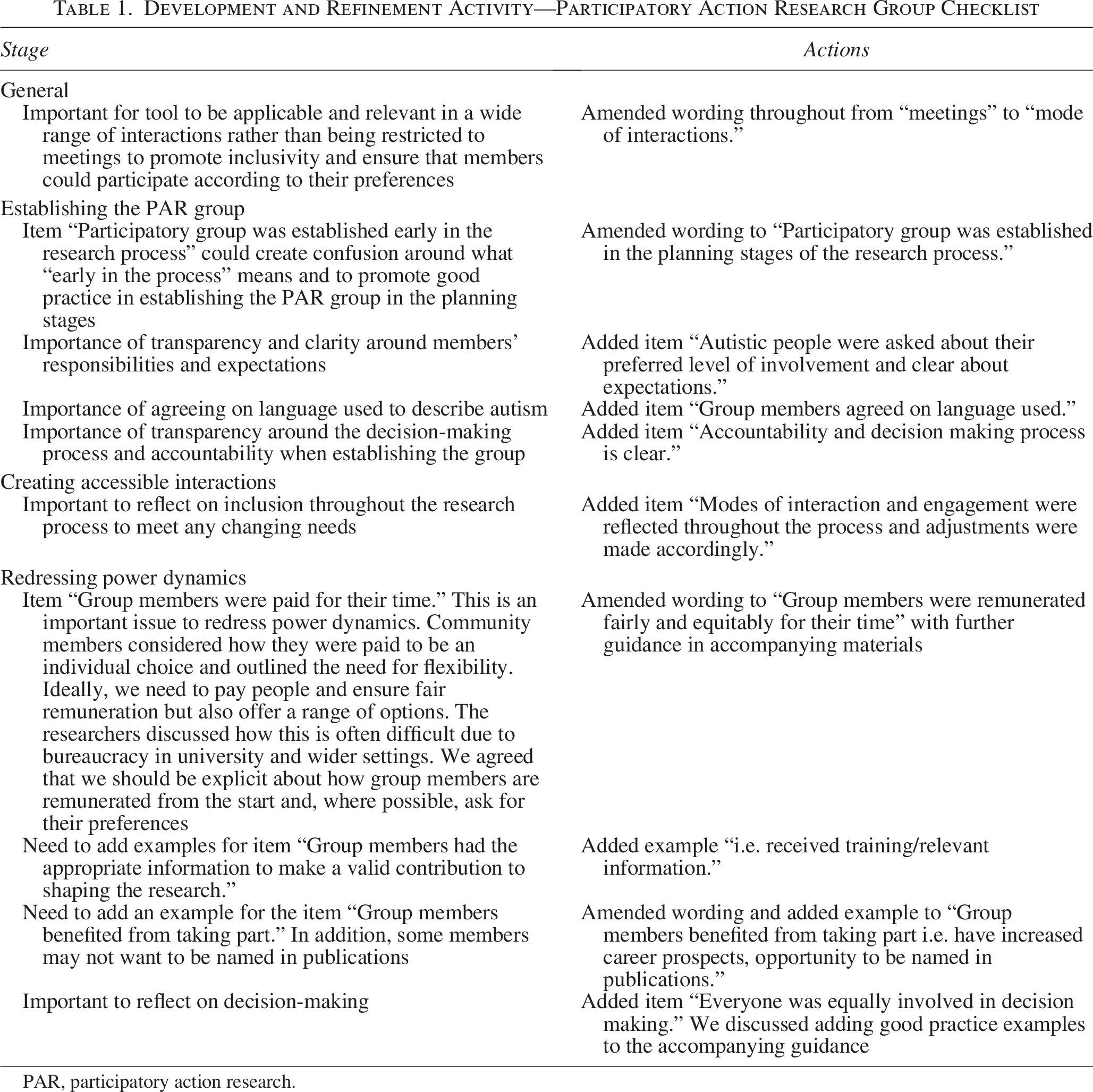
PAR, participatory action research.
Development and Refinement Activity—Evaluating Levels of Participation in Autism Research Tool
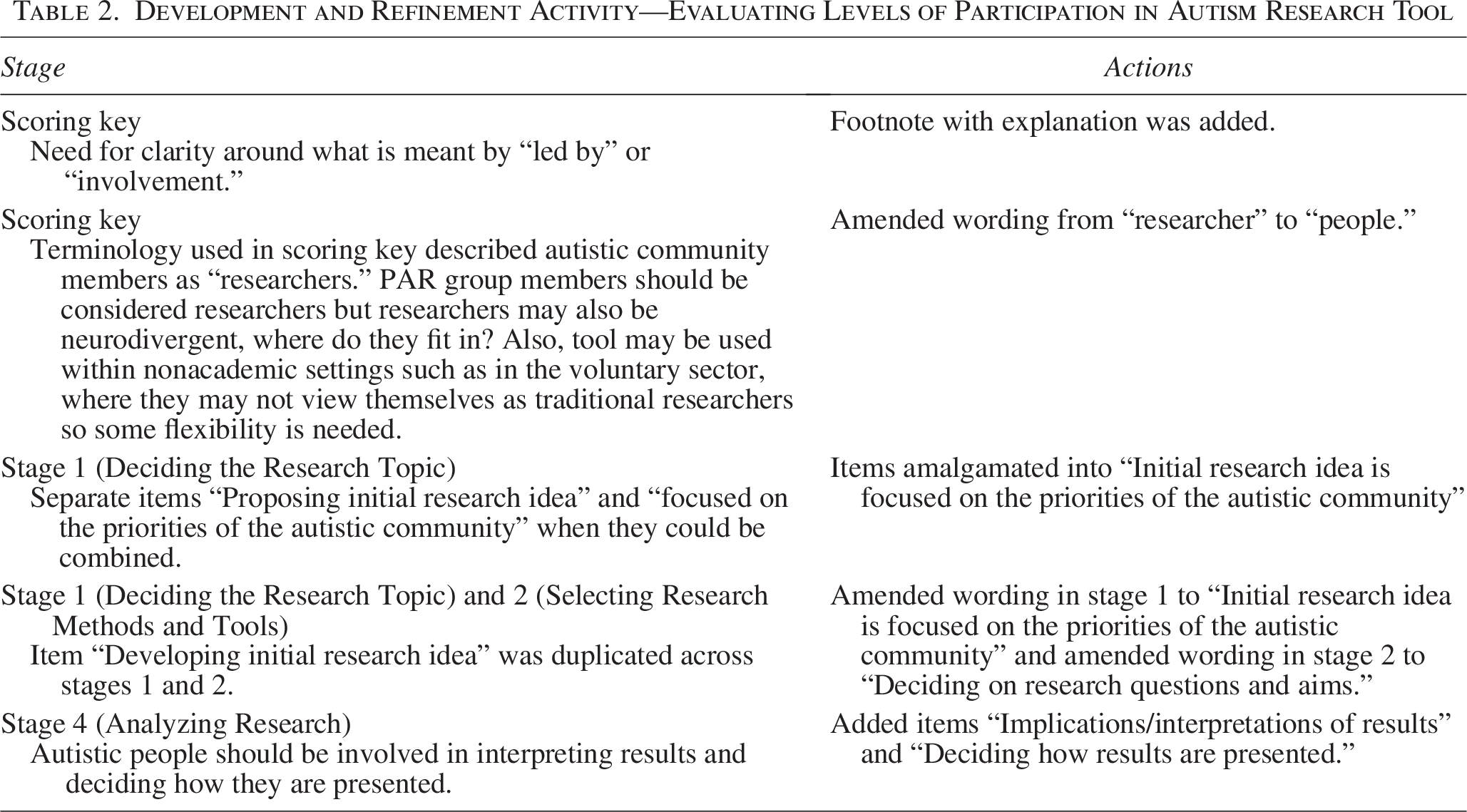
Key modifications included broadening scope so that items applied beyond questionnaires or interviews, for example, changing “disseminating questionnaires” to “promoting research” and “carrying out interviews/focus groups” to “collecting data.” Questions were also rephrased to acknowledge diverse methods such as clinical trials.
Addressing disagreements and power
With four autistic community researchers holding a majority status and decision-making power, the community researchers ensured that autistic voices were not overruled by neurotypical researchers which contributed to a power shift, disrupting “business as usual.” 5 Disagreements were openly discussed, with consensus reached collectively, with members discussing and debating issues and justifying their views. For example, a proposal to include an overall score on the ELPART was debated and replaced with stage-based scoring to avoid superficial assessments.
The lead researcher practiced deliberate self-disempowerment by stepping back where appropriate, resisting tokenism, and prioritizing autistic-led leadership. 5 For instance, she did not attend the first community meeting so members could freely critique draft tools, only joining later at their request.
Introducing the tools
The ELPART and PAR Group Checklist were designed to encourage more meaningful participatory research by providing structured frameworks that promote best practice and address power imbalances.9,12,36
PAR group checklist
The PAR Group Checklist (see Fig. 1) sets out good practice for establishing and supporting a PAR group with autistic people. A three-point traffic light scale (green = yes, amber = partly, red = no) was chosen for simplicity and actionability. 48 Items are organized across four domains: establishing the group, creating accessible interactions, redressing power dynamics, and reflective practice. A notes column provides space for researchers to record further actions.
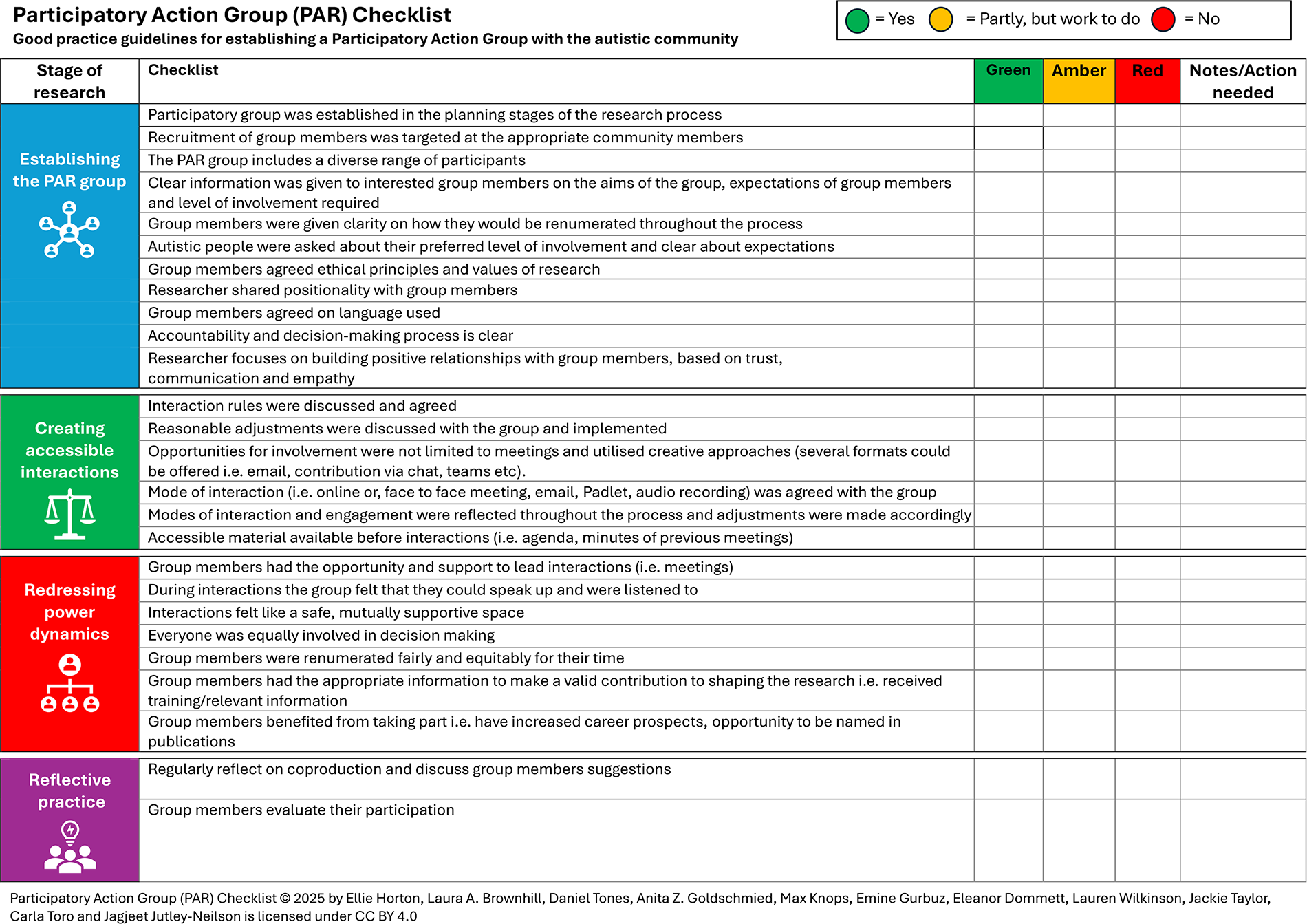
The PAR Group Checklist. A guide for developing and sustaining Participatory Action Research groups, structured around four domains: establishing the group, creating accessible interactions, and redressing power dynamics and reflective practice. PAR, participatory action research.
Establishing the PAR group
The first stage of the checklist focuses on establishing the PAR group. Ideally, this should occur during the planning stages of the research process to ensure meaningful engagement9,49 and early involvement, which is crucial in defining research aims and objectives aligned to autistic priorities.
Recruitment should be targeted to ensure group members possess relevant expertise and lived experience aligned with the research focus.12,13 For instance, in our research exploring autistic university student mental health, we recruited recent graduates or current students. 33 In circumstances where neurotypical input is also required, that is, in comparison studies, ensuring that autistic voices are not overruled by neurotypical researchers 5 and that inclusive and equitable practices enable full participation, address power imbalances, and integrate autistic and neurotypical perspectives is crucial. For example, providing clarity around the decision-making process from the outset and ensuring that neurotypical researchers practice deliberate self-disempowerment to redress power dynamics. 5
As we increasingly move toward autistic academic led research teams, in some cases exclusively made up of autistic people, it is important to acknowledge the power and privilege that autistic academics have compared with autistic people without research experience. Thom-Jones and Lowe highlight the importance of autistic researchers recognizing their own limitations in terms of knowledge and experience. 22 Gaining the views and experiences of a wider and diverse group of autistic people is therefore important.
Research often focuses on “easily researchable” autistic individuals, who are verbally fluent, sit still, and have moderate support needs, while excluding others with higher support needs or varied communication styles. 50 Research also highlights the underrepresentation of marginalized groups, including LGBTQ+ individuals and people from ethnically minoritized backgrounds.36,40,51 Utilizing methods that broaden representation and avoid exclusionary biases is therefore important, 50 along with ensuring that researchers are representative of marginalized communities 52 and develop trusting relationships. Pickard et al. suggest that partnering with relevant organizations, such as charities, supports inclusive recruitment efforts and ensures diverse autistic voices are heard. 12
Prospective group members should receive clear information about the group aims and their role in the research project. Autistic individuals should have autonomy over their level of engagement, with expectations made explicit from the outset. A lack of clarity in how autistic perspectives shape decision-making has previously resulted in exclusion and frustration. 29 Clarity is also needed around compensation and reimbursement. Transparency in accountability and decision-making is crucial to address historical power imbalances, particularly where autistic ways of knowing are resisted or marginalized by neurotypical individuals in influential roles. 5 This dynamic is illustrated in a first-person account by Michael (2021), who described how their contributions were acknowledged only when aligned with neurotypical perspectives, leading them to question the meaningfulness of future participatory research contributions. 53 Such lack of transparency is typical in participatory research 36 and undermines trust, leading to disengagement and dissatisfaction among group members. 13 Establishing clear expectations from the start can prevent these issues, even if involvement is restricted to specific aspects of the project.
Ethical principles should be agreed collaboratively ensuring that research aligns with the values and priorities of the autistic community. This includes researchers sharing their positionality, acknowledging their biases, and the inherent power dynamics in the research process. In neuro-mixed research teams, valuing experiential, professional, and scientific forms of knowledge is essential, while recognizing their relevance varies by context and that arguments should be judged on their merit rather than the source. 5 This transparency fosters more open and honest environments, allowing for authentic collaboration between autistic and neurotypical researchers.
The language used to describe autistic people remains a contested issue, often signaling power imbalances between researchers and the autistic community. Autistic individuals have historically been subjected to stigmatizing, deficit-based language imposed by others.15,31 In a review of articles in genetic and autism journals, Kaljusto et al. rated 80% of 116 articles as using stigmatizing or probably stigmatizing language. 10 Research shows that many autistic individuals prefer identity-first language (e.g., “autistic person” rather than “person with autism”). 54 However, perspectives on terminology vary, and no universally accepted definition of autism exists. 54 Group members should collectively establish preferred language guidelines to ensure that research terminology aligns with community preferences.13,40
Strong relationships between researchers and community members are critical in participatory research.9,12 These require time and effort to build, emphasizing trust, mutual respect, and clear communication. Effective strategies for collaboration include: encouraging open dialogue and active listening, providing opportunities for feedback and addressing concerns constructively, recognizing and celebrating contributions, and engaging in reflective practice to continuously improve research processes. 13
Honest communication is foundational to successful participatory research 55 and directly impacts relationships between researchers and group members. 56 To avoid the bidirectional misunderstandings between autistic and neurotypical people, as outlined in Milton’s Double Empathy Problem, 45 researchers must be mindful of their communication styles, ensuring that they are clear, concise, and adaptable to group members’ needs. They should respect the communication preferences of each group member and accommodate their needs/preferences throughout the research process.
Creating accessible interactions
The second stage of the checklist is about accessible interactions, which is key to promoting participation of autistic people in research.33,36,37 However, in a small sample of 15 autistic people, den Houting et al. found that reasonable adjustments in participatory research were reported by less than half of autistic participants. 9 Given the underrepresentation of nonspeaking autistic individuals, 36 adopting appropriate methods that support diverse participation needs is crucial. Considering the heterogeneous nature of the autistic community, research processes should be tailored to individual strengths, challenges, and preferences. 15 Key considerations include the following: Flexible modes of engagement (e.g., online meetings, email contributions, chat-based discussions), providing accessible materials in advance (e.g., agendas, meeting notes), and adapting communication formats to suit individual needs (e.g., written over spoken interactions). For example, in our PhD research PAR group, meetings were held online, but some participants preferred to engage via email or contribute through chat. Preferences were continually reassessed throughout the research process to accommodate changing needs.
Redressing power imbalances
To ensure equitable participation, group members should have the opportunity to lead interactions (e.g., facilitating meetings, shaping discussions) where appropriate. This may require additional support where there are many differing members’ needs to ensure implementation of reasonable adjustments. Flexible engagement allowed participants to adjust their involvement (e.g., choosing to contribute via written feedback rather than in meetings, taking breaks during discussions, or stepping back from activities temporarily without justification). During interactions, the group should crucially feel that they can speak up, are listened to, and that interactions feel safe and mutually supportive. 33 Neurotypical researchers should critically reflect on the power they hold as academics and neurotypical researchers, the power they hold as individuals working alongside community members. Actively examining power dynamics and practicing self-disempowerment are essential to equitable collaboration. As outlined above, everyone should be equally involved in decision-making. Strategies such as “Fist to Five” 57 where community researchers show their level of agreement via a hand signal ranging from a fist (strong objection) to five fingers (enthusiastic support) can support this. 57
Although compensation is a crucial factor in addressing power imbalances, 42% of den Houting et al.’s small sample of 15 community partners in autism research report not receiving payment. 9 Compensation should be equivalent to researcher or research assistant pay where possible, reinforcing the value of autistic contributions. Building costs into grant applications ensures that payment is fair and equitable. However, institutional restrictions and regulations governing how participants are paid and the rates permitted may still present challenges. In our case, the PhD researcher sought additional funding to employ autistic research assistants, ensuring fair compensation.
Beyond financial remuneration, involvement in participatory research should provide tangible benefits, such as capacity building, career development opportunities, and coauthorship on publications, should community researchers want to be included. 13 It should also be respected that not all community members will want to be named as authors on publications and the difficult position that this can place on autistic people as outlined by Fletcher Watson. 58 While some autistic individuals may not have an interest in academic careers, their participation offers an opportunity to develop transferable skills. 13
Ongoing reflection and evaluation
Participatory research should be viewed as an ongoing effort, rather than a fixed goal. As Milton et al. argue:
“Striving for participation and co-production can never be perceived as a given or a fully accomplished outcome” (p. 87). 59
The first item in this section relates to regular reflection and discussion of group members’ suggestions. Both neurotypical and neurodivergent researchers should engage in continuous self-reflection to ensure that they are not cherry picking the autistic contributions only aligned to their own 53 or misinterpreting autistic communication or actions. 45 Overcoming this challenge is essential to avoid epistemic injustices by asking how we can facilitate mutual understanding. 5 Self-reflection on positionality and continuous evaluation are essential for identifying weaknesses and improving engagement strategies. 46 Neurotypical researchers should be acutely aware of their neurotypical frame of analysis, a dominant norm in research. Researchers can use tools such as reflective journals to capture how autistic collaborators contributed to a project, what decisions they influenced, and how power was shared. The second item in this section relates to community members evaluating their participation to inform adjustments enhancing participatory experiences. 13 Building in regular feedback loops provides community members with opportunities to give feedback on inclusivity and barriers and enable team reflection.
By maintaining reflective, adaptable, and inclusive practices, the PAR Group Checklist ensures that participatory autism research is meaningful, ethical, and impactful.
ELPART
The ELPART tool (see Fig. 2) evaluates autistic participation across five stages of the research process: deciding the research topic, selecting methods and tools, conducting research, analyzing findings, and disseminating results.
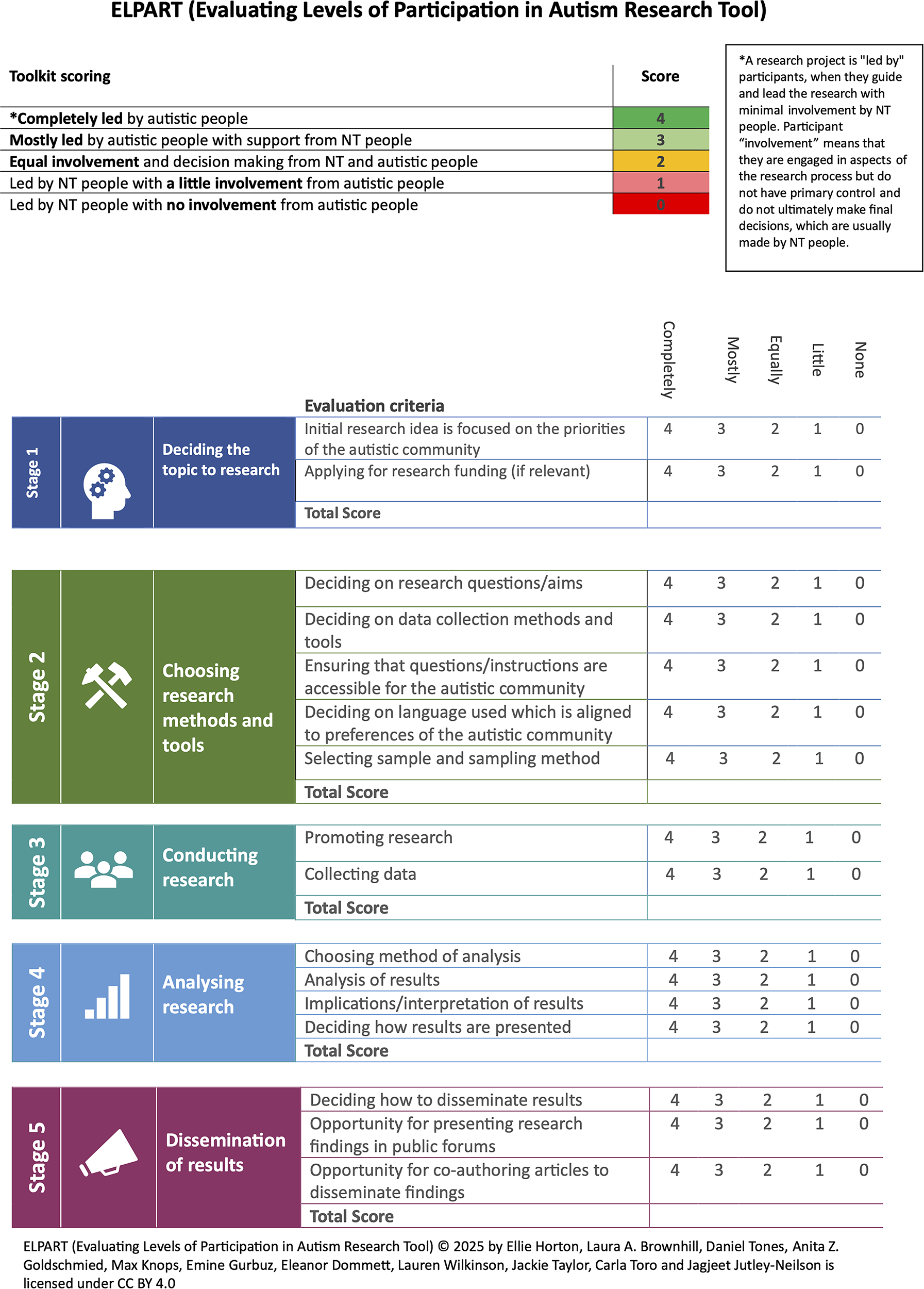
The ELPART Framework. A process-based tool for assessing autistic involvement in research, spanning five stages from topic selection to dissemination. ELPART, Evaluating Levels of Participation in Autism Research Tool.
Scale
Each research stage in ELPART is assessed using a five-point scale, allowing researchers to evaluate the extent of autistic involvement using the following criteria:
0 = No involvement 1 = Minimal involvement 2 = Equal involvement 3 = Mostly autistic-led 4 = Completely autistic-led
Community researchers recommended a five-point scale to better capture decision-making power, allowing for more nuanced responses than a binary (Yes/No). This is particularly helpful for the ELPART, where involvement exists on a continuum from consultation to coproduction to leadership. Scores can be mapped to existing participation levels outlined by Tan et al. 8 (Table 3). However, community researchers chose the terminology in the scoring system above to promote accessibility and clarity, particularly given the varying definitions of coproduction and participation11,12 and often superficial understanding of participatory research among academics. 9
Mapping Evaluating Levels of Participation in Autism Research Tool to Tan et al. 8 Participation Levels
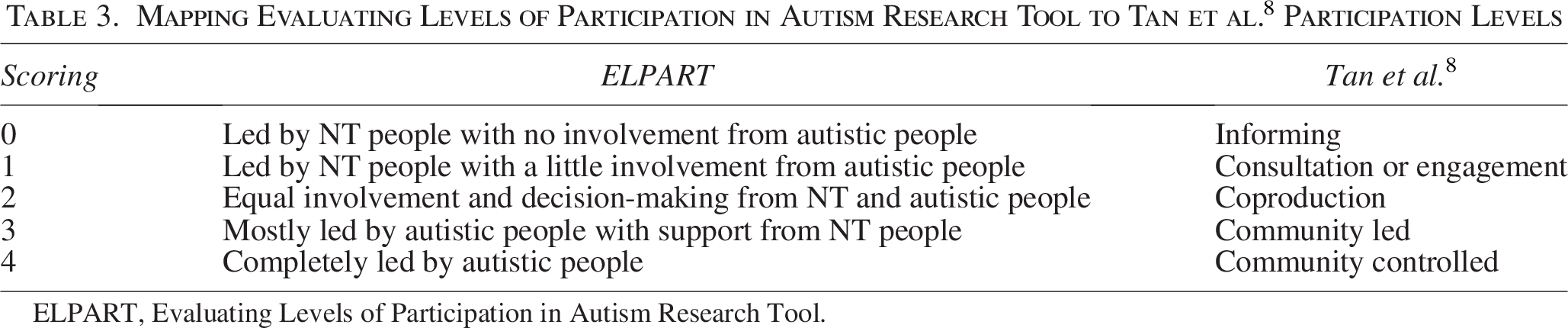
ELPART, Evaluating Levels of Participation in Autism Research Tool.
An overall score was avoided to prevent reducing participation to a checklist exercise. Moreover, ELPART is intended to support reflection on participation, and a single overall score would undermine that focus.
Stage 1: Deciding the research topic
Autistic people should be involved as early as possible, ideally in deciding the research focus. This stage includes two evaluation criteria:
Whether the initial research idea aligns with autistic community priorities. Whether autistic individuals are involved in applying for research funding.
This addresses a long-standing issue in autism research—the gap between research priorities identified by the autistic community and the research actually conducted.12,25,27 As Thom-Jones & Lowe state:
“research topics deemed worthy of investigation should and can only be identified by members of the autistic and autism communities” (pp. 164–165). 22
Autistic academics could be advantaged in providing their lived experience, 22 but for neurotypical researchers, gaps remain in involving autistic people in grant applications due to academic barriers. 36 For example, autistic contributors are often only compensated after a project is funded, meaning they are often invited to “endorse” prewritten proposals rather than being equitably involved in shaping proposals. To address this, researchers could engage with autistic communities through social media or look at previous community priority setting research (e.g., Roche et al. 60 ). One author described using social media polls to determine autistic community research priorities, demonstrating a practical engagement strategy. To promote the inclusion of people without social media access, researchers could develop links with community organizations and autism advocacy groups. 22
Stage 2: Selecting research methods and tools
Involving autistic people in methodological decisions improves research quality and inclusivity. 36 Methods should promote empowerment and social justice rather than reinforce barriers.61,62
At this stage, the ELPART emphasizes the importance of grounding decisions in collaborative and inclusive practices. Co-defining research questions and aims ensures that the work reflects autistic priorities rather than being shaped solely by academic interests. Carefully considering data collection methods helps minimize barriers to participation, promoting a wider range of autistic voices. Ensuring that questions and instructions are clear and understandable enables participants to share their perspectives fully and confidently. Using language aligned to autistic community preferences helps build trust and avoid reinforcing stigma. Finally, inclusive sampling methods capture diverse autistic experiences, minimizing narrow or stereotypical representations. Together, these practices demonstrate how open dialogue between autistic people and researchers can generate research strategies that are creative and genuinely coproduced.
Stages 3 and 4: Conducting and analyzing research
These stages ensure that research promotes inclusivity and that autistic insights shape data analysis. Evaluation criteria include:
Promoting research (including recruiting participants). Collecting data.
Including autistic people as collaborators during these stages ensures that research reaches underrepresented communities. Autistic involvement in data collection (e.g., conducting interviews) can increase research relevance and impact and enhance validity by ensuring accurate interpretations of autistic communication styles. 63 For example, autistic participants in Pellicano’s study reported that it was easier to tell their story when interviewed by autistic researchers and reported feeling heard, understood, and safe. 3 In some research contexts (such as wet laboratories or neuroscience studies), it may not be practical for community members to participate in data collection. However, involving them in the analysis phase ensures that interpretations are informed by lived experience. A collaborative, participatory approach to coding qualitative data can promote inclusion, lead to improved data analysis, and positively impact future data collection. 64
Stage 4 evaluation criteria include
Choosing method of analysis Analysis of results Implications/interpretations of results Deciding how results are presented.
Within this stage, autistic strengths such as hyperfocus, creativity, and monotropic attention can be advantageous in research, particularly in data coding and analysis, 65 and community members can advise on creative and accessible ways to present results.
Stage 5: Dissemination of results
Aligning to PAR principles, involving autistic individuals in dissemination maximizes community impact and drives change.19,33,42 The ELPART evaluates:
Deciding how to disseminate results. Opportunity to present research findings in public forums. Opportunity to coauthor research articles.
Offering autistic coauthorship promotes equitable recognition and skill development, enhancing employability and ensuring autistic people directly benefit from research participation. 13 Findings should be disseminated in ways that minimize stigma and align with community priorities 13 and community researchers could have creative ideas about disseminating results in nonacademic settings.
Discussion
The ELPART and PAR Group Checklist were codeveloped with autistic community researchers and participatory experts to provide practical frameworks for implementing participatory approaches in research. Both tools prioritize accessibility, usability, and reflection, enabling researchers to evaluate participation systematically and address the historical power imbalances shaping the field.9,13
These tools respond to consistent calls for clearer guidance in participatory autism research.12,36 Unlike broad models such as Arnstein’s ladder, 13 which conceptualize power but lack practical steps, the ELPART and PAR Group Checklist operationalize participatory principles into concrete, stage-specific actions.
The ELPART is the first known tool to systematically assess autistic involvement across all stages of the research process, using a five-point scale to capture the continuum from consultation to leadership. By explicitly reflecting on decision-making power, it provides transparency and accountability, which may assist funders and institutions in evaluating participatory quality.
The PAR Group Checklist complements this by outlining best practice for establishing and supporting participatory groups, with a simple traffic-light rating system making it easy to identify gaps and implement changes. Its emphasis on reflective practice encourages researchers to view participation as ongoing rather than a one-off achievement.
Both tools should be applied at the outset of a project and revisited throughout to support ongoing reflection, rather than treated as a checklist completed at the project’s end. The tools have the potential to strengthen participatory research by promoting autistic leadership, ensuring accessibility, and embedding continuous reflection. Their adaptability means that they can be applied across different methodologies and career stages, supporting researchers, including autistic-led teams, who are new to participatory work and experienced teams seeking greater accountability.
Limitations
Institutional change is needed alongside the ELPART and the PAR Group Checklist to address systemic barriers to participatory research such as limited time, resources, and institutional structures that undervalue autistic involvement.12,36 These tools can highlight gaps and prompt funders and universities to embed participatory standards, but cultural and attitudinal shifts remain essential. 55
Not all projects will achieve full participation across all stages. Context, resources, and project scope shape what is possible, and even partial involvement can provide a starting point for reflection and deeper engagement in future work. 66 However, transparency about the extent and nature of autistic involvement is crucial, 67 and these tools support researchers in assessing and reporting this.
The researchers codeveloping these tools were primarily from psychology and education backgrounds, so requirements in other disciplines may differ. Community researchers were mostly White, female, and academically experienced, meaning that perspectives of autistic people from ethnically diverse groups, those with higher support needs, intellectual disabilities, or nonspeaking individuals were underrepresented.
Next Steps
Recent efforts were to disseminate the tools, with community researchers and the lead researcher presenting the tools at paid guest lectures and at a webinar paid in vouchers. A website, hosting the tools, will be updated on an ongoing basis.
We acknowledge the tools as being at an early stage of development, with further community led validation needed. Rigorous external validation across diverse autistic communities (including nonspeaking individuals and those with intellectual disabilities) and within diverse research contexts is needed to ensure that these tools capture the full spectrum of autistic experiences.
Conclusion
This study addressed gaps in participatory autism research by developing and refining two tools as follows: the ELPART and the PAR Group Checklist. Both were cocreated with autistic researchers and participatory experts to provide structured, practical guidance for embedding autistic voices across all stages of research.
The tools aim to promote transparency, accountability, and equity, helping researchers reflect on their practices, avoid tokenism, and recognize autistic expertise as epistemically valid. By operationalizing participatory principles, they move beyond broad frameworks to offer actionable steps that can be adapted across research contexts.
We hope that these tools will support researchers at all career stages in centering autistic perspectives and advancing meaningful participatory research.
Footnotes
Acknowledgments
The authors would like to thank the additional members of the participatory group who took part in discussions leading up to this research.
Authorship Confirmation Statement
E.H.: Conceptualization, data curation, formal analysis, funding acquisition, investigation, methodology, project administration, resources, supervision, visualization, writing—original draft preparation, and writing—review and editing. L.A.B.: Conceptualization, data curation, investigation, methodology, project administration, supervision, and writing—review and editing. D.T.: Conceptualization, data curation, investigation, methodology, project administration, supervision, and writing—review and editing. A.G.: Conceptualization, data curation, investigation, methodology, and writing—review and editing. M.K.: Conceptualization, data curation, investigation, methodology, and writing—review and editing. E.G.: Methodology and writing—review and editing. E.D.: Methodology and writing—review and editing. L.W.: Methodology and writing—review and editing. J.T.: Methodology. C.T.: Conceptualization, methodology, resources, supervision, and writing—review and editing. J.J.-N.: Conceptualization, data curation, formal analysis, funding acquisition, investigation, methodology, project administration, resources, supervision, visualization, and writing—review and editing. The article has been submitted solely to Autism in Adulthood.
Author Disclosure Statement
No competing financial interests exist.
Funding Information
Part of this work was supported by University of Warwick through an internal research grant (Spotlight fund).