




Abstract
Background:
Positive sibling relationships have important implications for the well-being of autistic adults. Yet past research finds that individuals with autistic siblings report lower levels of sibling relationship quality. The research in this area, however, relies on the perspective of non-autistic family members and focuses on families where one sibling has a clinical autism spectrum disorder (ASD) diagnosis. The current study addressed these limitations by assessing whether autistic young adults also report poorer sibling relationship quality than non-autistic young adults and whether patterns differ by what it means to be autistic.
Methods:
Participants included a total of 964 18- to 29-year-olds (Mage = 24.61, SD = 2.90; 45% female; 58% White) from across the United States who completed an online survey. Participants were assigned to one of four groups: those diagnosed with autism or in the process (n = 97), those who identify as autistic but have not been diagnosed and are not seeking diagnosis (n = 80), those high in autistic traits but do not identify as autistic and have not been diagnosed (n = 67), and the non-autistic (n = 720).
Results:
Results show that young adults in the three autism groups reported poorer relationship quality than the non-autistic group in terms of closeness, conflict, ill-wishes, and parent-mediated relationships. Furthermore, autistic young adults reported greater heterogeneity in sibling relationship quality experiences (except for parent-mediated relationships) than non-autistic young adults. There were no mean or heterogeneity differences among the three autism groups on any relationship quality dimension.
Conclusions:
The findings suggested that autistic young adults report poorer sibling relationship quality than non-autistic young adults and that it does not matter if an individual has been clinically diagnosed with ASD; autistic traits are likely the driver of social experiences, not a diagnosis.
Community Brief
Why is this an important issue?
Siblings can play an important role in supporting young adults through many life transitions, including those experienced by autistic young adults. Because of this, it is important to understand what factors are linked to better or poorer sibling relationship quality. Some studies suggest that sibling relationships are lower in quality when one sibling is autistic. However, these studies have relied only on the perspectives of non-autistic family members and have only included families where the autistic individual has been clinically diagnosed with autism.
What was the purpose of this study?
There were two purposes. First, to examine young adults’ perspectives on their sibling relationship based on whether they were autistic or not. Second, to compare the sibling relationship experiences of autistic adults based on whether they had been clinically diagnosed with autism spectrum disorder (ASD) or are currently seeking a diagnosis, identify as autistic but have not been diagnosed, or have high levels of autistic traits but have not been diagnosed and do not identify as autistic.
What did the researchers do?
A total of 964 young adults from the United States completed an online survey about their sibling relationship quality. Participants came from nearly every state. Just under half were female, and just over half were White.
What were the results and conclusions of the study?
Autistic young adults typically reported poorer relationship quality compared with those who are not autistic. This pattern especially emerged in terms of how emotionally close they felt to their sibling, how much conflict they had, how often they wanted their sibling to fail, and how much their parents helped them stay connected.
There were no differences among autistic adults. Meaning, those clinically diagnosed with ASD, those who identify as autistic, and those high in autistic traits all have similar sibling relationship experiences.
What is new or controversial about these findings?
These findings suggest that, in understanding the social experiences of autistic adults, we should value the perspectives of those who identify as autistic even if they have not been formally diagnosed, just as much as those who have.
What are potential weaknesses in the study?
We did not have information about the participants’ siblings, specifically, whether their siblings were autistic. Future studies should include this information to determine if patterns differ when both siblings are autistic.
How will these findings help autistic adults now or in the future?
Our findings affirm and validate the experiences of all autistic adults, whether diagnosed or not. This recognition can help promote understanding and solidarity within the autism community.
Background
Sibling relationships are important for healthy development across the life course, including young adulthood1,2 and for autistic young adults. Past work notes that in the context of autism, siblings provide support to one another3,4 and that for some, a non-autistic sibling may become a primary source of support for an autistic adult as parents age.5,6 Some studies suggest, however, that when one sibling is autistic that relationship quality is lower.7,8 Studies in this area are largely based on reports from non-autistic family members and do not use reports from autistic individuals themselves. In addition, research in this area is typically on families where the autistic sibling has been clinically diagnosed.4,9 The current study aimed to address these limitations in two ways. First, we compared young adults’ perceptions of their sibling relationships based on whether they were autistic or not. Second, we examined if sibling relationship experiences of autistic young adults differed across three different autism groups: individuals who have received or are currently pursuing a formal autism spectrum disorder (ASD) diagnosis, individuals who self-identify as autistic without a diagnosis and are not seeking one, and individuals who score high in autistic traits but neither identify as autistic nor have a diagnosis.
Sibling relationships in young adulthood
In childhood and adolescence, siblings often live with one another due to family structures outside their influence.10,11 At those younger ages, sibling relationships are defined by the core relationship quality processes of emotional closeness (i.e., being important to one another, going to each other for advice or support) and conflict (i.e., arguing or being annoyed with one another).10,11 Moving into young adulthood, however, individuals often seek independence marked by employment, education, and long-term romantic relationships. 12 These pursuits bring changes to the sibling dynamics of young adults. The most visible change is that far fewer young adult siblings live with one another compared with younger ages. 13 Beyond coresidence, levels of core relationship quality processes also change; many young adult siblings increase in closeness14,15 and decrease in conflict. 16 Beyond longitudinal changes in closeness and conflict, scholars have asked if the nature of sibling relationship quality broadens in young adulthood.17,18 The life stage changes experienced by many young adults (i.e., independence, education, employment, etc.) 12 and their advanced cognitive development compared with children and adolescents 19 allow new relationship processes to emerge or become more salient.17,18 Based on those notions, a recent study found that closeness and conflict remain central relationship processes for young adult siblings, but other factors are important in defining the sibling relationships of young adults. The additional factors identified in that study are as follows: ill-wishes, upward comparisons, and parent-mediated relationships. 17 Ill-wishes is more than conflict with a sibling; it is the active wishing for misfortune or failure upon a sibling. Upward comparison is defined as viewing a sibling as more capable, valuable, and competent than one’s self. Parent-mediated relationships are defined by parents helping siblings maintain a relationship and keeping siblings aware of one another’s lives.
It is important to understand the sibling relationship quality of young adults because of the potential impact siblings can have on well-being and adjustment.1,2 Our position is that good quality relationship processes are those that promote positive and healthy development. Poor relationship quality does the opposite. As with younger ages, young adults’ close and positive sibling relationships promote higher life satisfaction, 1 positive mental health, 2 and greater empathy. 20 Conversely, negative and conflictual relationships have been linked to riskier behavior 21 and lower quality of life. 22 Higher levels of ill-wishes mark poor relationship quality because higher levels of ill-wishes are associated with less life satisfaction and more depressive symptoms. 17 Greater levels of upward comparison are considered poor relationship quality because they have been linked to less life satisfaction and more depressive symptoms.17,23 Finally, higher levels of parent-mediated relationships are considered a marker of good relationship quality because the construct is linked to greater life satisfaction and less sibling rivalry. 17
We note that several studies of child and adolescent sibling pairs in which neither sibling is autistic underscore the value of examining typologies based on combinations of different sibling relationship processes.24–26 Specifically, these studies find that some sibling relationships are marked by high levels of closeness and conflict, some by low levels of each, and others by a mix. One study has examined similar patterns in pre-adolescent siblings in the context of autism. In that study, parents reported that their children were more likely to be less close and have less conflict if one child was autistic. 27 Despite these patterns in the literature, we focused on each dimension of sibling relationship quality individually for one main reason. The typologies suggested in these studies are based on closeness and conflict only. In this study, we conceptualized sibling relationship quality based on recent work that suggests dimensions of young adults’ sibling relationship quality are broader than those of adolescents and children. Once future studies have established and replicated typologies based on these broader constructs, it will be important to examine their links within the context of autism.
Regardless of focus on broader typologies or individual dimensions, it is important to understand the nature of sibling relationships in young adulthood in the context of autism. Young adults with autistic siblings report relationships that are less close and more conflictual compared with those with non-autistic siblings 28 and those whose siblings have other types of disabilities such as intellectual disability8,9 or Down syndrome. 7 These studies, however, use reports solely from non-autistic family members. The perspectives of autistic individuals are needed in addition to the perspectives of non-autistic. Thus, our first goal was to compare young adults’ perceptions of their sibling relationships based on whether they were autistic (all those in our three autism groups described in the next section) or not. Given these past studies on sibling relationships with autistic young adults, we anticipated that autistic young adults would report poorer relationship quality with their siblings than non-autistic young adults. In addition to testing mean differences, we also examined heterogeneity/variation in sibling relationship dimensions based on being autistic or not. However, we offered no hypotheses about differences in variation.
ASD, autistic identity, and autistic traits
After comparing autistic young adults’ perceptions of their sibling relationships to those of non-autistic young adults, we considered if sibling relationship differences would emerge based on what it means to be autistic. Recent years have seen an increase in debate on who decides whether an individual is autistic or not.29–31 Historically, autism was based on the medical model and clinical diagnosis by medical professionals. 32 Researchers have reinforced this perspective by placing a premium on the validity of the findings for the autism community, often ensuring that participants have been clinically diagnosed with ASD.33,34 Increased autism awareness and the growth of the neurodiversity movement, however, have brought an increase in self-diagnosis and adults identifying as autistic without a clinical diagnosis.30,31,35 Although for some, self-diagnosis and autistic identity are steps toward clinical diagnosis, for many, they are not.30,31 The potential implication is that clinical diagnoses, based on the medical model, may not be needed. Yet there is debate about the utility and validity of self-diagnosis.31,35 A critical question is whether those diagnosed with ASD have different social experiences from those who self-identify as autistic but have not been diagnosed.
In addition to comparing those with formal diagnoses (or seeking one) with those who self-identify as autistic, we also compared differences with those who are high in autistic traits but have not been diagnosed with ASD nor self-identify as autistic. In recent years, some scholars who examine the social experiences of autistic individuals have argued that autistic traits drive social experiences and not the diagnosis or identity.36,37 As a result, autistic traits can be examined in the general population in ways that allow researchers to collect larger samples but find patterns applicable to the lives of all autistic adults.37–39 In other words, there is value in examining links between autistic traits in the general population, even among those not diagnosed with ASD or those who do not identify as autistic, because the traits may be the real driver of social experiences.
All three autism groups were combined together to test our first goal of the study: to compare autistic young adults’ perceptions of their sibling relationships to those of non-autistic young adults. The second goal of the study was to examine if the three autism groups differed in their perceptions of sibling relationship qualities. Within this goal, we had two competing hypotheses. First, based on the notion that autistic traits drive the social experiences of young adults more than a diagnosis or selected identity,36,39 we anticipated that it was possible that all three autism groups would report similar levels of sibling relationship quality with their siblings (whether the siblings were autistic or not).
The second notion on how the three autism groups may or may not differ was based on research on the impact of diagnosis and identity on social relationships. Specifically, multiple studies, including a large meta-synthesis, conclude that the experience of being diagnosed with ASD brings clarity and understanding that promotes well-being40,41 and, for many, increased social support. 42 In contrast, an emerging body of literature on psychosocial processes surrounding self-diagnosis suggest different effects. Those who self-diagnose and identify as autistic often report higher levels of self-doubt30,35 and possibly relational difficulties. Thus, those who self-identify as autistic but have not been formally diagnosed may report poorer sibling relationship quality than those formally diagnosed. Our third group, those who are high in autistic traits without diagnosis or self-identity, may also report poorer relationship quality than those clinically diagnosed with ASD. This effect may emerge because this group does not have the clarity and understanding that some experience with diagnosis, but they still have many traits that may drive social experiences.36,37 As with our first question, we also tested whether there were different levels of variation in sibling relationship qualities among the three autism groups, but we offered no formal hypotheses.
The current study
Siblings can play important roles in supporting autistic adults,3,4 yet past work notes that sibling relationship quality may be lower for those with an autistic sibling.8,9 The current study built on existing literature to address two questions. First, do autistic young adults report lower relationship quality than non-autistic young adults? Second, are there differences in sibling relationship qualities among our three autism groups (those who have been clinically diagnosed with ASD or are in the process of being diagnosed; those who self-identify as autistic without a diagnosis and not seeking diagnosis; and those high in autistic traits without diagnosis, not seeking diagnosis, and do not identify as autistic). Based on past research and theory, we hypothesized the following: Autistic young adults (all those in the three autism groups) would report poorer sibling relationship quality than non-autistic young adults. There would be no differences in sibling relationship quality among the three autism groups. Among the three autism groups, those diagnosed with autism or are in the process would report the best sibling relationship quality.
Method
Participants
Participants for the current study were drawn from a sample of 1001 18- to 29-year-olds living in the United States (3.84% of participants were born outside the United States). All participants had at least one living sibling and were from every state except Alaska and Wyoming. Participants were excluded from the analysis if they missed any attention-checking questions. Thus, the final analytic sample included 964 young adults who were broken down into four groups: those diagnosed with ASD or in the process of being diagnosed (n = 97), those who self-identified as autistic (n = 80), those high in autistic traits (n = 67), and the non-autistic (n = 720). Additional demographic details are found in Table 1.
Descriptive Statistics (Means and Standard Deviations, or Proportions) for Participants’ Demographic Information

Procedure
Participants were recruited via Prolific in July 2023. Prolific is an online platform of potential research participants. Unlike other online pools of potential participants, Prolific is built specifically for research. As such, Prolific takes rigorous steps to ensure data fidelity that removes bots and duplicate participants before researchers recruit from their panels. Every account on Prolific undergoes a vetting process that includes verification of physical identification documentation, examination of IP address and VPN usage, and a story writing task to ensure they are human. 43 We added two additional data quality measures. First, only those with a 95% or higher approval rating on Prolific were eligible. Second, the survey included three attention-checking questions (e.g., I do not like change. Select slightly agree if paying attention). The survey sections and items within each section were completely randomized for each participant, so that attention-checking questions were randomly dispersed throughout the survey. Randomization of sections and items within sections makes it harder for inattentive participants to watch for such items and answer them accurately. Beyond their approval rating, participants were eligible for our study if they lived in the United States, were between the ages of 18 and 29, and had at least one living sibling. On average, the survey took 8.90 minutes to complete (SD = 8.80). There were no missing data. Participants were given a $2.50 honorarium even if they missed attention-checking questions. All procedures were reviewed and approved by the Institutional Review Board of Brigham Young University (number IRB2023-203).
Measures
Sibling relationship quality
Sibling relationship quality with participants’ closest aged sibling was assessed with a version of the 36-item Emerging Adults’ Relationships with Siblings Scale (EARSS 17 ). The measure included five subscales: closeness (11 items; M = 3.14, SD = 0.89, Cronbach’s α = 0.93), conflict (8 items; M = 2.06, SD = 0.75, Cronbach’s α = 0.87), ill-wishes (4 items; M = 1.42, SD = 0.59, Cronbach’s α = 0.74), parent-mediated relationships (6 items; M = 2.88, SD = 0.88, Cronbach’s α = 0.68), and upward comparison (6 items; M = 2.59, SD = 0.72, Cronbach’s α = 0.84). The original version of the EARSS has 12 closeness items, but one item was unintentionally omitted from the data collection (“I am excited when I tell my sibling good news”). All items were on a 5-point scale (1 = never, 2 = rarely, 3 = sometimes, 4 = often, 5 = always). See Supplementary Table S1 for the wording of all items.
Autism diagnosis and autistic identity
Participants were asked, “Have you received a formal clinical diagnosis of ASD, made by a psychiatrist, psychologist, or other qualified medical specialist? This includes Asperger’s syndrome, Autism Disorder, High Functioning Autism or Pervasive Developmental Disorder.” The response options were: 1 = yes, as a child (n = 37); 2 = yes, as an adult (n = 42); 3 = I am in the process of receiving a diagnosis (n = 18); 4 = no, but I identify as being on the autism spectrum (n = 80); 5 = no (n = 769), 6 = don’t know/rather not say (n = 18). Those who responded to categories 1, 2, or 3 were coded as diagnosed with ASD or in the process (n = 97). Participants in the process of diagnosis were combined with those already diagnosed because both groups are or were engaged with formal clinical assessment compared with self-identified or high-trait individuals without diagnosis experience. Those who responded to category 4 were coded as identifying as autistic (n = 80). Those who responded to categories 5 and 6 were initially coded into the non-autistic group (n = 787).
Autistic traits
Autistic traits were assessed via the Autism Quotient (AQ 44 ). Items were coded, so that they received 0 (not connected to an autistic trait) or 1 (connected to an autistic trait). All items were summed, so that total scores could potentially range from 0 to 50, with higher scores reflecting more autistic traits. Past work shows that among nonclinical samples, the average AQ score was 16.94, and among those diagnosed with ASD, the average score was 35.10. 45 In the current sample, the average AQ score was 23.35 (SD = 7.48; Cronbach’s α = 0.83). Baron-Cohen et al. 44 recommended that individuals who score 32 or higher consider seeking an autism diagnosis. Thus, those who reported that they were not autistic but scored 32 or higher on the AQ were coded as high in autistic traits (n = 67).
Results
Analytic strategy
We first examined whether autistic traits differed among those diagnosed with ASD or in the process, those who identify as autistic, and those who identify as non-autistic. This test established differences or similarities in autistic traits among these groups. We excluded the group of those who were high in autistic traits but did not identify as autistic and had not been diagnosed with ASD, since that group was inherently defined by their high level of autistic traits. The residuals of an initial analysis of variance model were not normally distributed, so we used the Kruskal–Wallis test 46 to instead look at median differences. Post hoc group differences were examined via a Bonferroni adjustment.
To test Hypothesis 1, we examined mean differences on the five sibling relationship factors from the EARSS between the autism groups (combined) and the non-autistic group. Models were tested separately for each dependent variable, but in an identical fashion. We tested two hierarchical analysis of covariance (ANCOVA) models for each dependent variable. In Model 1, we included the group (0 = autism groups; 1 = non-autistic group) and controlled for sex (1 = male; 0 = female), age, parental status (1 = has 1+ child; 0 = does not have children), number of siblings, relationship status (1 = married, engaged, or in a civil union; 0 = not in those types of relationships), employment status (1 = employed full or part time; 0 = not employed), ethnicity (1 = ethnic minority; 0 = not ethnic minority), and education (1 = bachelor’s degree or higher; 0 = less than bachelor’s degree). We included these covariates because past research and theory suggest that each can shape and influence sibling relationship dynamics in young adulthood.47–49 In Model 2, we added autistic traits. The addition of autistic traits into Model 2 provided an examination if any differences are due to traits or identity/diagnosis. In Models 1 and 2, significant effects for group and autistic traits were followed up with post hoc tests using a Tukey adjustment. After testing Models 1 and 2, we extracted the residuals from Model 1 and conducted Levene’s test to examine if the variation in each dependent variable was similar between the autism groups and the non-autistic group.
To test Hypotheses 2a and 2b, we conducted another series of ANCOVA models. Models were run separately for each dependent variable, but in an identical fashion. In these models, we removed the non-autistic group, so we could compare the three autism groups to one another. The main independent variable was the autism groups variable (1 = diagnosed with ASD or in the process; 2 = identifies as autistic; 3 = high in autistic traits). These models controlled for the same set of control variables included in the models for Hypothesis 1. The code for all analyses is available upon request.
Autistic traits
Findings showed that median autistic traits differed among the three groups (χ2 = 183.3, df = 2, p < 0.001). Post hoc tests (see Fig. 1) revealed that the median autistic traits for the non-autistic group (median = 21) were lower than those diagnosed with ASD or in the process (median = 29) and those who identify as autistic (median = 31). Those diagnosed with ASD or in the process and those who identify as autistic did not differ from one another.
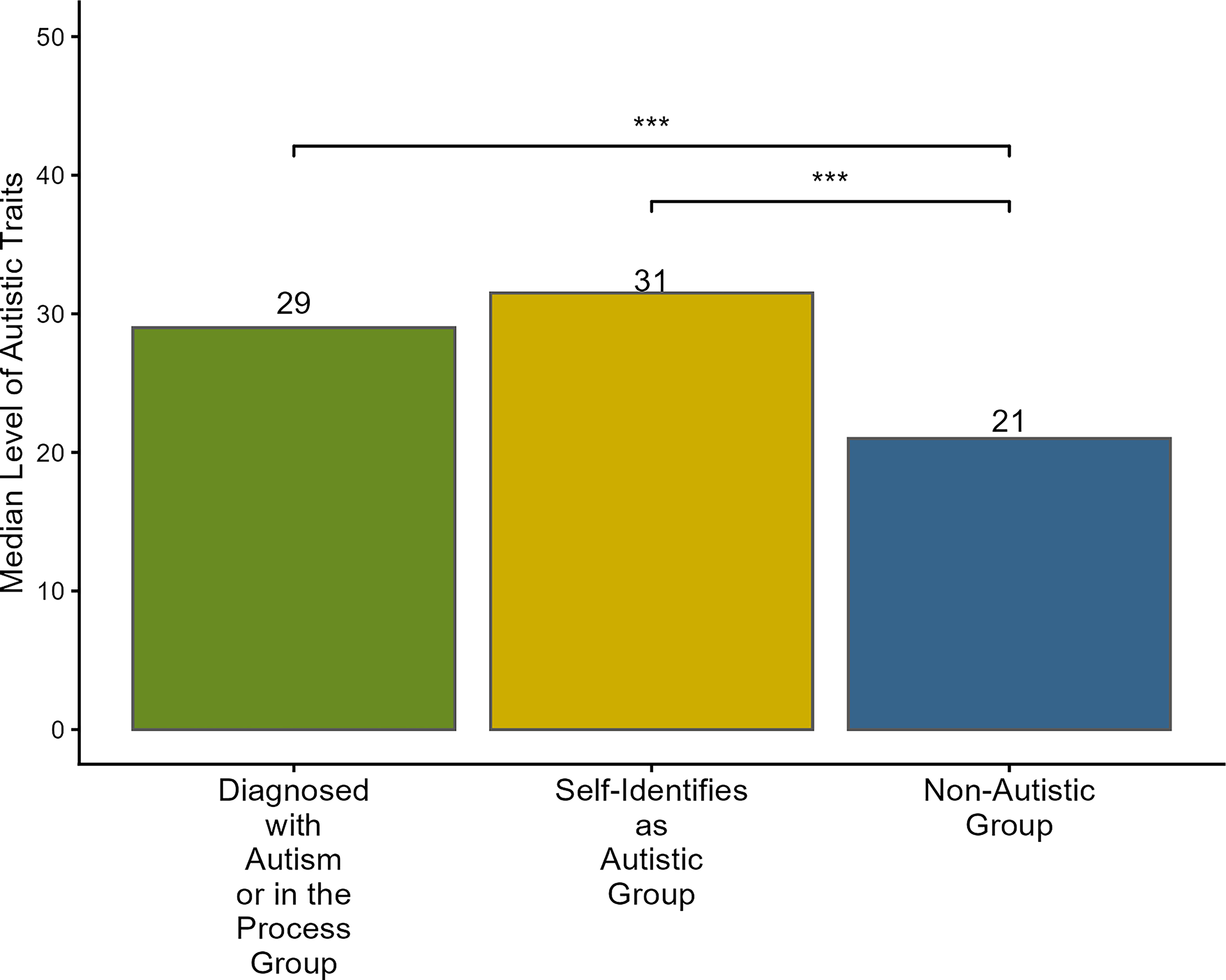
Median differences among groups on autistic traits. Notation indicates significantly different medians at ***p < 0.001. Bars without connecting notation do not differ.
Hypothesis 1
Closeness
Results for closeness are presented in Supplementary Table S2. In Model 1, group was significant (F = 25.68, df = 1, p < 0.001, η2p = 0.03). In support of Hypothesis 1, post hoc tests (see Fig. 2 Panel A) showed that the autism groups (M = 2.90, SD = 0.94) reported significantly less sibling closeness than the non-autistic group (M = 3.22, SD = 0.85, p < 0.001, d = 0.33). In Model 2, with the additional covariate of autistic traits, group was no longer significant. Autistic traits, however, were significant (F = 13.91, df = 1, p < 0.001, η2p = 0.01). Levene’s test results showed that the autism groups had significantly greater heterogeneity in closeness than the non-autistic group (F = 7.38, df = 1, p < 0.01).
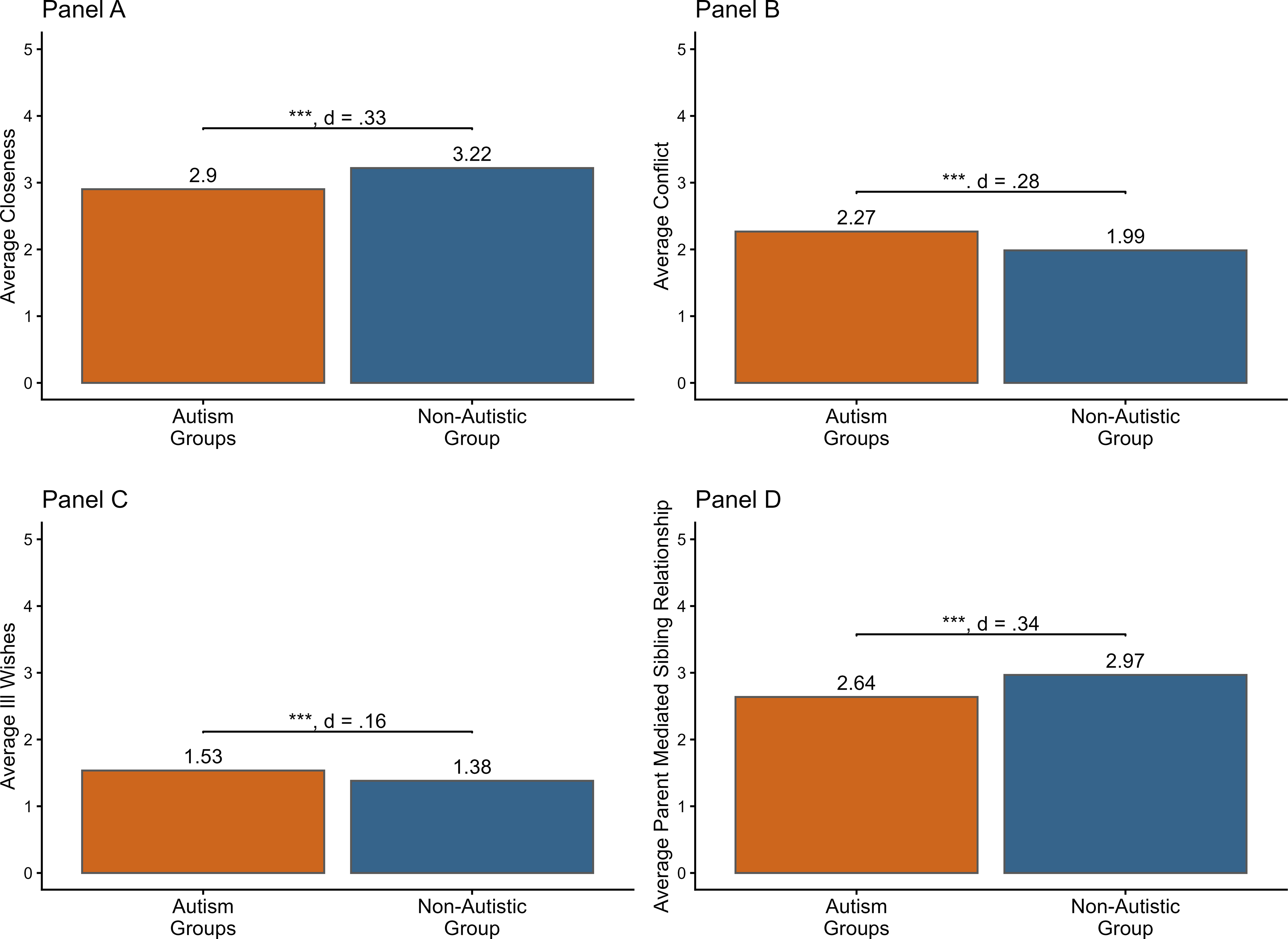
Differences between autism groups and the non-autistic group on sibling relationship qualities. Notation indicates significantly different means at ***p < 0.001. d, Cohen’s d.
Conflict
Results for conflict are presented in Supplementary Table S2. In Model 1, group was significant (F = 24.73, df = 1, p < 0.001, η2p = 0.03). In support of Hypothesis 1, post hoc tests (see Fig. 2 Panel B) showed that the autism groups (M = 2.27, SD = 0.91) reported significantly more sibling conflict than the non-autistic group (M = 1.98, SD = 0.68, p < 0.001, d = 0.28). In Model 2, with the additional covariate of autistic traits, the group was no longer significant. Autistic traits, however, were significant (F = 15.09, df = 1, p < 0.001, η2p = 0.02). Levene’s test results showed that the autism groups had significantly greater heterogeneity in conflict than the non-autistic group (F = 28.49, df = 1, p < 0.001).
Ill-wishes
Results for ill-wishes are presented in Supplementary Table S2. In Model 1, group was significant (F = 13.71, df = 1, p < 0.001, η2p = 0.01). In support of Hypothesis 1, post hoc tests (see Fig. 2 Panel C) showed that the autism groups (M = 1.53, SD = 0.72) reported significantly more ill-wishes toward their sibling than the non-autistic group (M = 1.38, SD = 0.53, p < 0.001, d = 0.16). In Model 2, with the additional covariate of autistic traits, the group was no longer significant. Autistic traits, however, were significant (F = 19.20, df = 1, p < 0.001, η2p = 0.02). Levene’s test results showed that the autism groups had significantly greater heterogeneity in ill-wishes than the non-autistic group (F = 11.27, df = 1, p < 0.001).
Parent-mediated relationships
Results for parent-mediated relationships are presented in Supplementary Table S2. In Model 1, group was significant (F = 28.10, df = 1, p < 0.001, η2p = 0.03). In support of Hypothesis 1, post hoc tests (see Fig. 2 Panel D) showed that the autism groups (M = 2.61, SD = 0.88) reported significantly lower parent-mediated relationships than the non-autistic group (M = 2.98, SD = 0.86, p < 0.001, d = 0.34). In Model 2, the effect of group was still significant (F = 5.93, df = 1, p < 0.05, η2p = 0.01), but so was the effect of autistic traits (F = 9.19, df = 1, p < 0.01, η2p = 0.01). Levene’s test results showed that the autism groups had similar variation in parent-mediated relationships to the non-autistic group (F = 0.56, df = 1, p > 0.05).
Upward comparison
Results for upward comparisons are presented in Supplementary Table S2. Group was not significant in Models 1 or 2 (see Supplementary Fig. S1). Autistic traits were significant in Model 2 (F = 4.63, df = 1, p < 0.05, η2p = 0.00). Levene’s test results showed that the autism groups (SD = 1.04) had significantly greater heterogeneity in upward comparisons than the non-autistic group (SD = 0.87; F = 6.64, df = 1, p < 0.01).
Hypotheses 2a and 2b
Results for all dependent variables are presented in Supplementary Table S3. Consistent with Hypothesis 2a and contrary to Hypothesis 2b, there were no differences in any of the sibling relationship qualities among the three autism groups. In addition, all three autism groups had similar levels of variation on each dependent variable.
Sensitivity analyses
First, we compared those diagnosed with ASD (n = 79) to those in the process of receiving a diagnosis (n = 18) on all demographic, independent, control, and dependent variables. The two groups did not differ on any variable, except one. Those diagnosed with ASD were more likely to have children than those in the process of receiving a diagnosis. Next, we retested each analytic model for all hypotheses. The first set omitted 18 participants who were in the process of receiving an autism diagnosis, but had not been diagnosed yet. The second set omitted 18 participants who, in reference to the autism diagnosis question, responded that they did not know or did not want to answer. In every single sensitivity analysis, p-values were consistent with the original analyses (meaning significant or not) and for all significant effects, the direction of the effect was in the same direction.
Discussion
Siblings can serve as healthy sources of support for autistic young adults.4,8,9 Thus, it is important to understand the quality of relationships that autistic young adults have with their siblings. To date, however, the majority of studies in this area have focused on the perspective of non-autistic individuals in families where the autistic sibling has been clinically diagnosed with ASD.4,9 We asked two questions to address these limitations. First, do autistic young adults report different levels of sibling relationship quality than non-autistic young adults? Second, are there differences in sibling relationship quality among three autism groups: those diagnosed or in the process, those who identify as autistic but not seeking diagnosis, and those high in autistic traits but not diagnosed and do not identify as autistic?
Comparison of young adults autistic and not
Our first hypothesis was that autistic young adults (from all three autism groups) would report poorer relationship quality with their siblings than non-autistic young adults. Past work notes that sibling relationship quality is lower when one sibling is autistic,7,8 but that body of literature is based on the perceptions of non-autistic siblings. Our results were mostly consistent with Hypothesis 1. Specifically, autistic young adults reported poorer relationship quality in terms of closeness, conflict, ill-wishes, and parent-mediated relationships, but not upward social comparison. Past work notes that young adult sibling relationships are marked by affect, behavior, and cognition. 18 Closeness, conflict, and parent-mediated relationships are concentrated on affective and behavioral components. Importantly, the behavioral components of these relationship dimensions are based on real interactions between family members (e.g., “I have deep conversations with my sibling”; see Supplementary Table S1 for wording of all items). It may be that family members, autistic and not, may struggle with interactions when one family member is autistic because autism is defined in part by challenges in social communication. 50 Indeed, higher levels of stereotypical autistic behavior among autistic individuals are linked to decreased sibling communication and connection.51–53 This conclusion is consistent with the idea that autistic traits are a main driver of social experiences.36,37 Our findings support this claim. In our analysis, autistic young adults had significantly higher autistic traits than non-autistic adults, and when we controlled for autistic traits, the effect of being autistic or not was ameliorated.
Also consistent with Hypothesis 1, our findings suggested that autistic individuals reported higher levels of ill-wishes. In contrast to closeness, conflict, and parent-mediated relationships, the factor of ill-wishes is largely affective in nature and not behavioral (e.g., “I am happy when my sibling messes up”). Historically, autistic individuals have been stereotyped as unfeeling, but data are clear that autistic individuals feel emotions just as much but may express them differently.54,55 The challenges autistic individuals face in sibling closeness, conflict, and parent-mediated relationships may be part of more holistic relational struggles in the family that may feed into a greater propensity in wanting their sibling to fail or experience misfortune. It is important to note that although levels of ill-wishes were higher for autistic individuals, on average, they reported feeling ill-wishes toward their siblings less than rarely on the measurement scale. In other words, relatively higher levels do not mean high levels.
What about upward comparison? We found no differences between autistic and non-autistic individuals in their level of upward comparisons. The items forming upward comparison are focused on cognitive appraisals (e.g., “I think of my sibling as smarter than me”) that may require some level of perspective taking. Perspective taking is an essential component of forming upward social comparisons. 56 Past work suggests that autistic individuals may not engage in perspective taking at the same level as non-autistic individuals.57,58 In that regard, we might expect lower levels of upward comparison among the autistic. We found, however, that autistic young adults engaged in similar levels of upward comparison as non-autistic young adults. Most siblings grow up together and spend a lot of time together throughout childhood and adolescence. It is possible that the unique nature of sibling relationships makes it easier for autistic adults to cognitively engage with a sibling and make comparisons than with strangers. Our results as a whole, but particularly findings regarding upward comparison, highlight the importance of including the perspectives of autistic adults. Future studies should explore more broadly if perspective taking and empathy between autistic adults and their siblings show different patterns than in other contexts.
Comparisons among the autism groups
Regarding the roles of clinical diagnosis, self-identity, and autistic traits in the question of what it means to be autistic,29–31 we offered two competing hypotheses. First, there would be no sibling relationship quality differences among the three autism groups (Hypothesis 2a). Second, those diagnosed with ASD or in the process would report better sibling relationship quality than those who identify as autistic or are high in autistic traits (Hypothesis 2b). Our findings unequivocally support Hypothesis 2a. The three autism groups did not differ in autistic traits or in any relationship-quality outcome, and all three groups reported similar levels of heterogeneity on sibling relationships measures. Our results contribute to a broader discussion in the autism community regarding the real-life tensions between the medical model and neurodiversity approaches.59,60 This debate raises the questions, are the distinctions among these groups necessary? Is a clinical diagnosis needed? Is self-diagnosis valid? The implication is that whether diagnosed, self-identifying, or high in autistic traits, the social relationship experiences of these groups are possibly more similar to one another, on average, than they are to non-autistic individuals. This pattern supports a more inclusive approach to autistic identity, one that treats self-identification and autistic traits as meaningful indicators of lived experience (especially given barriers to diagnosis). Indeed, this conclusion is consistent with research that shows those diagnosed with ASD and those who identify as autistic experience similar levels of stigma, self-esteem, and quality of life. 61
Our results also have implications for research. Rather than always needing a sample of those clinically diagnosed with ASD, studies can likely include measures of autistic traits or let participants self-report on whether they are autistic. This will allow researchers to collect larger samples that will provide more replicable findings. This assertion, however, comes with a major caveat. The broader use of self-identification and autistic traits may only be applicable to the study of social experiences of adults. There are many instances where a clinical diagnosis for included participants is essential. For example, studies examining the prevalence or causes of autism may require clinically diagnosed participants. Likewise, in situations where autistic traits may not be the primary driver of autistic individuals’ experiences, a clinical diagnosis may be important for research fidelity. In addition, it may be important to use clinical diagnosis as an inclusion criterion when studying younger populations, particularly children. Although identity development is a lifelong process, 62 the self-awareness needed for a fully formed autistic identity may not be evident in children in the same way it is in adults.
Heterogeneity in sibling relationships
Beyond mean differences, we also explored differences in relational variation. With the exception of parent-mediated relationships, autistic young adults reported greater variation in their sibling relationship quality than the non-autistic. Furthermore, all three autism groups reported similar levels of variation on each measure. Autism is heterogeneous with wide-ranging experiences and outcomes.63–65 Indeed, autistic individuals as a group may experience greater variation in their social experiences than non-autistic. 66 Despite these past findings, the source of greater variation in autistic young adults’ sibling relationship experiences is likely not due solely to being autistic but may also be founded in the goodness of fit with the family environment. Recent developments on the double empathy problem posit that social communication challenges are in part driven by a mismatch between social partners’ neurotypes.67–69 Some autistic young adults will have siblings who are also autistic, or high in autistic traits, and others will have non-autistic siblings, or are particularly low in autistic traits. It is possible that autistic young adults would report better sibling relationship quality with an autistic sibling than with a non-autistic sibling. This idea highlights a major limitation of the current study. We did not have information on the diagnosis, identity, or autistic traits of the participants’ siblings. Future studies must include that information, so that moderation analyses can be conducted to determine if mean level and heterogeneous differences exist when both siblings are autistic or similar in autistic traits.
Limitations and conclusions
Despite the rigor of our methods and analysis, this study is not without limitations. First, as discussed in the previous section, we did not have information on the autistic traits, diagnosis, or identities of the participants’ siblings. Next, although the overall sample was large, the specific groups of those diagnosed with ASD or in the process, those who identify as autistic, and those who were high in autistic traits were smaller (<100). The smaller size of these three groups may have potentially masked differences among groups. Future work will need to focus on recruiting samples based on the sizes of each group and not just the overall sample size. The current study was also limited by using only the AQ. 44 Although the AQ has been validated and is also widely used, other measures may provide different perspectives. Our findings regarding the role of autistic traits will especially need to be replicated with additional measures. Last, our sample did not measure participants’ intellectual abilities. Given the online nature of the data collection through Prolific, it is unlikely that many of our participants had lower intellectual abilities. A sizeable portion of autistic individuals, however, have some level of intellectual impairment.70,71 Because of the heterogeneity in the lived experiences of autistic individuals,63–65 it is likely that autistic adults who have intellectual impairment may have different sibling relationship experiences than autistic adults without intellectual impairment. Future research can examine the perspective of non-autistic adults who have an autistic sibling with intellectual impairment. Qualitative studies can also be conducted. But relying on the perspectives of non-autistic family members and smaller scale qualitative studies is ultimately insufficient. Large-scale quantitative studies can provide more generalizable findings, and the perspectives of autistic adults are not just good, they are essential. Thus, scholars need to develop novel methods that allow for survey participation from a wider range of autistic participants, especially those with intellectual impairment.
On the whole, the results of this study support the notion that it is important to include the perspectives of autistic individuals. Although our findings were consistent with past work where non-autistic young adults reported poorer relationship quality with an autistic sibling,7,8 we cannot assume that autistic adults will always share that perspective. Furthermore, we conclude that, in the context of social relationships, what it means to be autistic is less about a clinical diagnosis or even identity without a diagnosis, and more likely about autistic traits. Clinicians, scholars, and family members should consider the experiences of those diagnosed with ASD, those who identify as autistic, and those who are high in autistic traits to be equally valid.
Footnotes
Authorship Confirmation Statement
A.C.J.: Conceptualization, methodology, formal analysis, investigation, drafting, and editing. M.B.: Conceptualization, investigation, drafting, and editing. M.D., M.S., and M.H.: Conceptualization, investigation, and editing.
Ethical Considerations
All protocols were approved by the Institutional Review Board of Brigham Young University (number IRB2023-203).
Consent to Participate
All participants provided digital consent before participation.
Data Availability
Due to privacy and consent agreements, the data are not publicly available or available to share. The analysis code is available from the corresponding author upon request.
Author Disclosure Statement
The authors have no conflicts of interest to report.
Funding Information
The authors have no funding to report.
Supplemental Material
References
Supplementary Material
Please find the following supplemental material available below.
For Open Access articles published under a Creative Commons License, all supplemental material carries the same license as the article it is associated with.
For non-Open Access articles published, all supplemental material carries a non-exclusive license, and permission requests for re-use of supplemental material or any part of supplemental material shall be sent directly to the copyright owner as specified in the copyright notice associated with the article.
