




Abstract
General music class is a space for students to engage in honest dialogue and reflection about the societal, cultural, and historical contexts of music, even when the subject matter is difficult. General music teachers can support students by opening “courageous conversations” about race, culture, and complex histories as they intersect with meaningful repertoire. The purpose of this article is to provide music educators with repertoire ideas and resources to assist in the process. Selections from Rhiannon Giddens’ album Freedom Highway are explored as a point of entry for dialogue about race, culture, courage, and justice in the secondary general music classroom. Songs about the Civil War, the Civil Rights era, and the Black Lives Matter movement are linked to inquiry-based strategies and the national music standards.
Keywords
March 2020 ushered in a tumultuous time for educators and students across the globe. The ensuing years have manifested upheaval, trauma, anxiety, disruptions, and existential inquiry within the field of education. Beyond the worldwide health crisis, part of the shared trauma of 2020 emerged from witnessing the brutal and public murder of George Floyd at the hands of police in Minneapolis, MN. Communities across the country, and the world, responded through protests, discourse, and music to challenge police brutality and amplify the message that Black Lives Matter. 1 Many educators today wonder how they can continue to respond and support productive conversations about race and social justice that lead to more inclusive, safer, and equitable spaces. The opportunity for rich and diverse musical engagement in the secondary general music classroom is one path to spark dialogue, provoke action, promote healing, and create openings to facilitate meaningful change in schools and communities.
Because music is a human activity, “musical sounds are always inherently multi-dimensional, social, cultural, political, gendered, and economic constructions” (Elliott, 2012, p. 23). The expansive nature of repertoire and curriculum in the general music classroom provides teachers and students with a range of musical sounds to explore along with “multiple viewpoints and perspectives on the world and music” (Abril, 2013, p. 8). General music educators contextualize these musical meanings, illuminate how music is informed by individual and collective understandings, and reveal the ways that musical sounds are used/valued in the world. That includes a wide-ranging history of music linked with activism. Meaningful lessons can be learned from the singers for freedom in the Civil Rights movement (Carawan & Carawan, 2007); the Candlelight March mourners who sang to remember Harvey Milk 2 (Hayes, 2016); the musicians who protested corporate greed and economic inequality during Occupy Wall Street (Norton, 2011); and the musicians who performed to heal communities reeling from the tragic loss of innocent Black lives (Stevens, 2021). In each setting, we have seen adolescents and children marching with adults, raising voices together for equity and change. The general music classroom is a space to examine and honor these aspects of students’ lived experiences. This article will place musical selections from Rhiannon Giddens’ album, Freedom Highway, within this narrative of music used to advance social justice. The songs “Julie,” “Freedom Highway,” and “Better Get it Right the First Time” provide a point of entry for dialogue about race, culture, courage, and justice in the secondary general music classroom.
Rhiannon Giddens
Rhiannon Giddens is a nationally celebrated singer, songwriter, multi-instrumentalist, historian, and co-founder of the Black string band, the Carolina Chocolate Drops (rhiannongiddens.com). She first gained notoriety performing folk and fiddle music with a contemporary twist on the Chocolate Drops’ 2011 Grammy-winning album, Genuine Negro Jig. Since then, Giddens has become a unique voice in American music performance and scholarship. Her expertise spans folk, classical, bluegrass, and gospel genres as she utilizes music to educate audiences about stories at the intersections of history, culture, race, equity, and the arts. Giddens’ accomplishments are extensive. She received a MacArthur “Genius” Fellowship in 2017, was named Artistic Director of the Silk Road Ensemble in 2020, has released multiple albums, curated diverse composer concerts with the Boston Pops Orchestra, and composed for the opera Omar, and the ballet Lucy Negro Redux, both receiving premiers in 2022. Her commitment to education, equity, and music as/for artistic citizenship (Elliott, 2012) make her work compelling content for the general music classroom.
Freedom Highway
Rhiannon Giddens was recently honored for “reclaiming African American contributions to folk and country music and bringing to light new connections between music from the past and the present” (Martin, 2018). Her album Freedom Highway, released in 2017, is an example of that work, rooted in historical content, using the power of music to amplify the voices of people who have been silenced and marginalized. The theme of Giddens’ album is freedom: yearning for freedom, being denied freedom, having freedom stolen with a last breath. In speaking about the song content of Freedom Highway, Giddens (2017) advises:
Know thy history. Let it horrify you; let it inspire you. Let it show you how the future can look, for nothing in this world has not come around before. These songs are based on slave narratives from the 1800s, African American experiences of the last century, and the Civil Rights movement of the 1960s and headlines from streets of Ferguson and Baltimore today. Voices demanding to be heard, to impart the hard-earned wisdom of a tangled, difficult, complicated history; we just try to open the door and let them through.
Since “music can help us examine the past and imagine the future” (Robison & Culp, 2021, p. 4), Giddens urges all of us to remember the stories of our ancestors and to let those stories educate us to do better today.
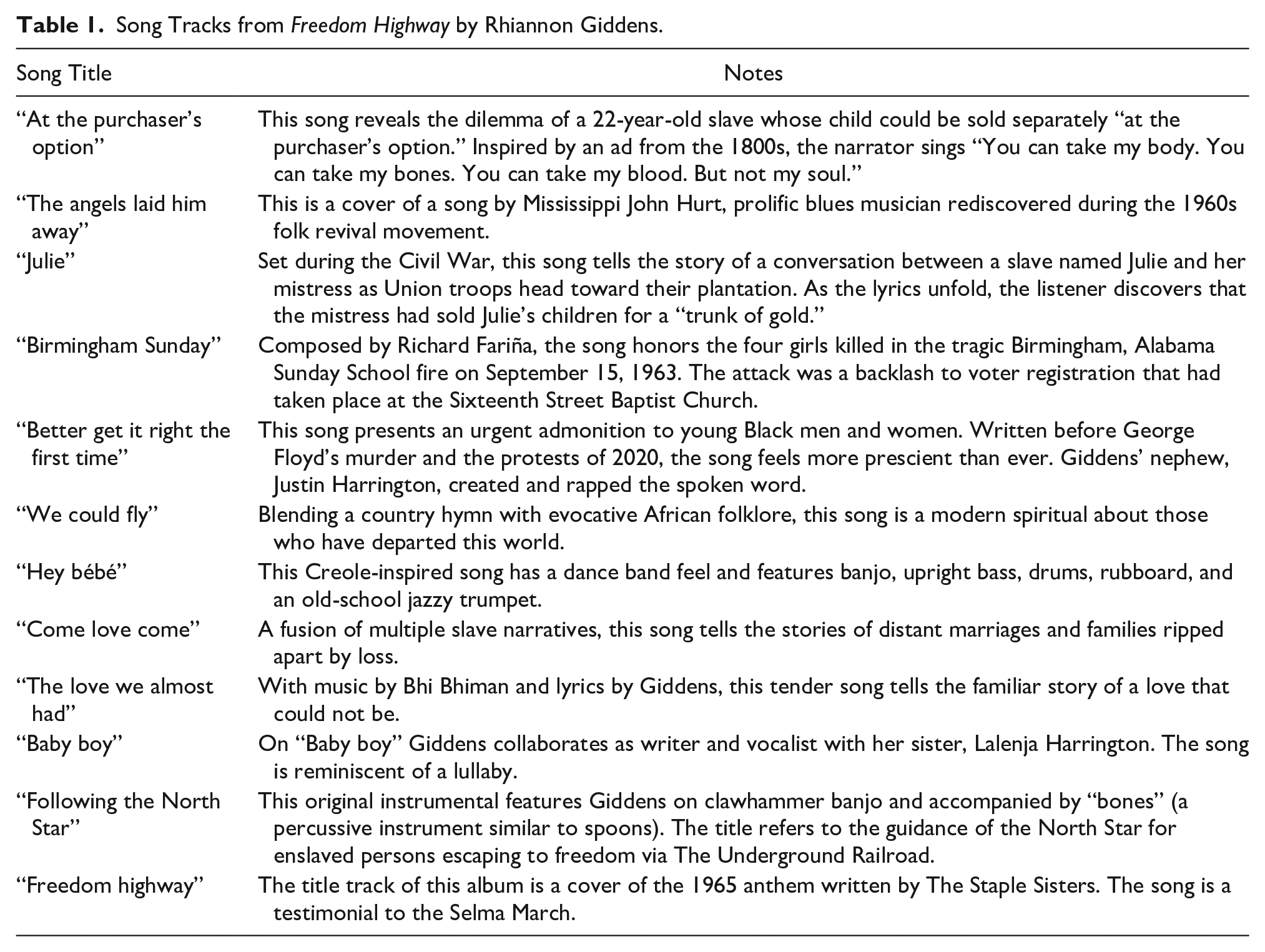
The album Freedom Highway includes nine original songs composed by Giddens (some in collaboration with others), as well as three notable covers. A title and a summary of each song appears in Table 1. The songs are inspired by books, artifacts, and significant moments in history, along with everyday occurrences. One thing that Giddens explains about her album is that she wanted to amplify the voices of people who have been marginalized, ignored, and even killed. The stories come from slave narratives, The Civil War, and the Civil Rights era. Although some of the content is disturbing and complicated,
3
Rhiannon Giddens is a truthteller, a storyteller, and a historian. This album provides an opportunity for general music educators to reflect together with their students on personal experiences of the present, as framed by Giddens’ narratives of the past. The tracks on the album easily link to the National Core Arts Standards (nationalartsstandards.org), especially the artistic process of connecting:
MU:Cn11: Relate artistic ideas and works with societal, cultural, and historical context to deepen understanding.
Enduring understanding: Understanding connections to varied contexts and daily life enhances musicians’ creating, performing, and responding.
Utilizing the rich musical content of Freedom Highway, teachers can help students contextualize their socio-cultural and historical understandings of the Civil War, the Civil Rights Era, and the Black Lives Matter movement.
Song Tracks from Freedom Highway by Rhiannon Giddens.
Getting Started With “Courageous Conversations”
Silverman (2015) notes that before we can expect meaningful dialogue and responses from our students, we must “prepare students for the multiple layers inherent in any piece of music” (p. 165). Those layers often go beyond the Western European elements of music (e.g., melody, harmony, form, etc.). While educators feel comfortable discussing musical elements, layers that involve race, culture, and difficult histories are often overlooked (Singleton & Hays, 2008). Facilitating conversations about race and racial inequity may seem daunting, particularly to White educators who make up most of the teaching workforce (nces.ed.gov; Hess, 2021). The resulting dialogue may be uncomfortable and even provocative. However, the reality of life in the United States in the 21st Century is that race matters (West, 2017), and racial matters intersect with our lives daily. Many of the songs and musics we explore in the general music classroom have contexts and histories tied to racial matters. “We Shall Overcome” was a hymn that became a Civil Rights Era anthem. “This Land is Your Land” was written as a response to “God Bless America” to expose the economic inequities across the country. 4 If we sing these melodies with our students, but neglect to have honest conversations about race, slavery, colonialism, and immigration, we are missing salient meanings in the repertoire and more urgently, we may be in danger of appropriation or the whitewashing of our country’s complicated history.
Dialogue about race, culture, and justice requires educators to acknowledge the lens with which they perceive and understand these matters (Jagoo, 2020). For example, I acknowledge that this article is written through my lens as a White, cisgender woman and music educator who has enjoyed multiple manifestations of privilege. I work with an incredibly diverse, talented, and insightful population of students in Queens, NY, who have challenged me to reflect on my assumptions, personal bias, whiteness, and privilege in the world. As I have grappled with my role as an educator in a position of power, I have seen the urgent need to self-reflect, actively listen to the students, and disrupt Eurocentric bibliographies and curricula (Hess, 2021). This work is incomplete and ongoing. And I am grateful for the ways members of my community have opened my mind to varied perspectives. I continue to strive daily to be an ally in the effort toward creating safe spaces for students to explore and discuss repertoire and curriculum.
Conversations about complex curriculum matters related to race, justice, and equity require courage. As music educators work with their students to engage in such conversations that challenge racism and resist social injustice (Hess, 2021), they can utilize Glenn Singleton’s field guide, Courageous Conversations About Race. Singleton offers language choices, reflection questions, and practical exercises to guide educators “to engage, sustain, and deepen interracial dialogue about race to examine schooling and improve student achievement” (Singleton, 2022, p. 30). His hands-on text encourages participants to explore their levels of awareness regarding race and to acknowledge personal truths and mindsets that cultivate productive dialogue. Singleton reminds us that students are already aware of the inequities in their communities. Helping them to participate in honest discussions will support their ability to begin to work toward change (Singleton, 2022). The work is not easy. Unlike other lessons, teaching music connected to race and racial matters is not resolved in one class session. As educators, we can reassure students that a lack of closure is acceptable and normal. We can explain that “the classroom cannot provide closure for a topic that is not closed in the real world” and “participants should accept that their courageous conversations will be ongoing” (Singleton & Hays, 2008, p. 21). It also helps to explicitly frame expectations. Remind students that different cultures experience and discuss race in different ways. As Singleton notes, “Many White Americans have been culturally conditioned to not talk about race” (p. 81). Educators should prepare students to expect multiple points of view, some discomfort, and sometimes silence. This will help to normalize the experience of talking about difficult subject matter. Through active and empathic listening (Silverman, 2015), coupled with “courageous conversations” language prompts (Singleton & Hays, 2008), students can begin to deepen their understanding of important artistic creations as they find their own voices in resonance within meaningful musics. What follows are recommendations for specific ways educators might explore three of the songs from Freedom Highway as a part of this journey: “Julie,” “Freedom Highway,” and “Better Get it Right the First Time.” Some of the questions suggested are related to song content, but others are informed by Singleton’s work. Educators might wish to consult the Courageous Conversations text for support when they see a question specifically framed by race or justice.
While reading Andrew Ward’s 2009 book The Slaves’ War, Giddens was struck by one slave narrative: a dialogue between two slaves called Mill and Jule and their female mistress (slaveowner). The story takes place during the Civil War, and the Union troops are coming to the plantation. Mill and Jule will finally gain their freedom, and their mistress is appealing to Mill, in tears, requesting that Mill should claim the silver plates and valuables. The mistress is trying to retain her own wealth by using Mill and Jule, yet again. The power of the narrative comes when Mill defies the mistress saying, “I can’t lie over that. You bought that silver plate when you sold my three children” (Ward, 2009, p. 47). Giddens brings this story to life via her song, “Julie,” performing on a banjo replica of one from 1858. The banjo might sound something like the banjo shown in Figure 1. This picture, from the Library of Congress, shows an African American child with a banjo dated 1865. The inscription behind this Black musician from Philadelphia, including a treble clef, notes “de jubelo,” a phrase associated with freedom from slavery. Educators can highlight commonalities between the modern-day song “Julie,” based on a slave narrative, and the possible lived experience of the young Black banjo player featured in Figure 1, including talking about the banjo as a folk instrument, its origins in Africa and uses today, as well as the socio-cultural context of life in the 1860s (Martin, 2018).
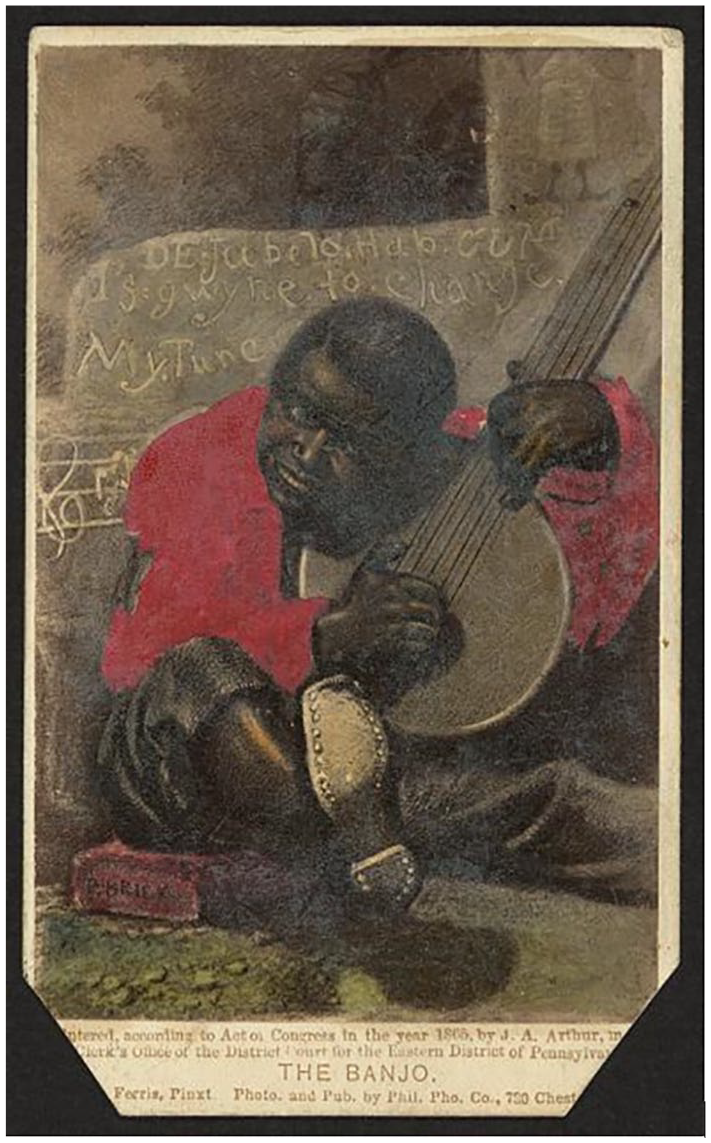
African American Child With Banjo, From the Library of Congress (https://www.loc.gov/item/2010647934/).
In considering both narratives (that of Julie and the young banjo player), there is an opportunity to build an interdisciplinary lesson for secondary general music students. Typically, the 7th- and 8th-grade social studies curriculum involves studying causes and outcomes of the Civil War. The Common Core standards (corestandards.org) recommend that students view historical documents and analyze an author’s intent, tone and meaning in connection with events and context. The NCAS Intermediate connecting standards encourage secondary students to consider the “cultural, social, and political uses of music” (nationalartsstandards.org). Students can be encouraged to listen to “Julie,” analyze the lyrics for intent and meaning, and connect the narrative to what they have learned about Civil War history and early American music.
Potential questions for discussion:
What kinds of music were people listening to during the Civil War?
What were the social, cultural, and political uses of music in the 1860s?
What are the social, cultural, and political uses of music today?
How did race shape Julie’s experience and/or the experiences of her children?
What does Julie mean when she says, “the price of staying here is too high?”
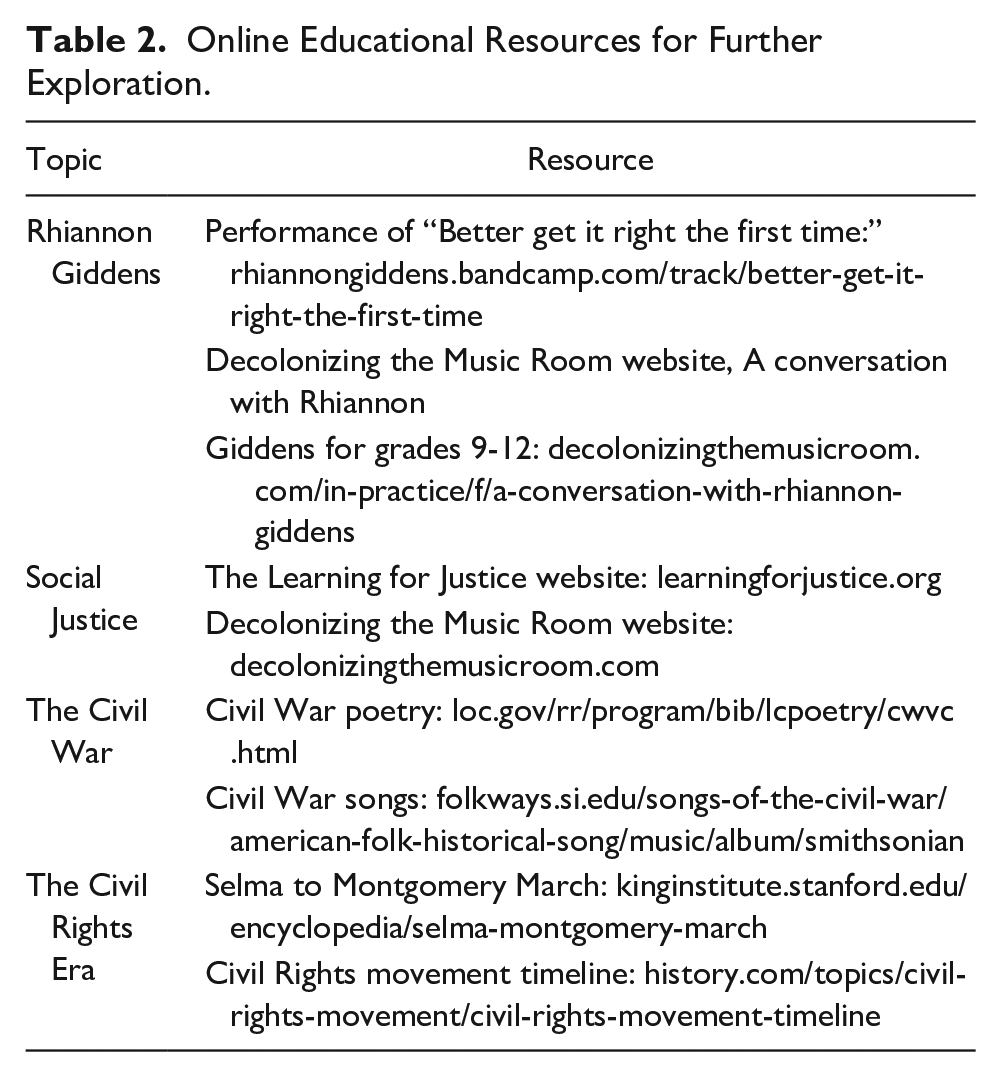
Further student inquiry could include (a) listening to excerpts of an interview with Rhiannon Giddens about the creative process behind “Julie” (seizingfreedom.vpm.org/interview-rhiannon-giddens/); (b) curating Civil War poetry as inspiration for students to compose their own songs (www.loc.gov/rr/program/bib/lcpoetry/cwvc.html); or (c) analyzing and performing the Civil War song, the “Battle Hymn of the Republic,” with lyrics by poet Julia Ward Howe (www.britannica.com/biography/Julia-Ward-Howe). As part of a centers-based approach (Burton, 2012), educators might set up four classroom learning stations, each focused on connecting with “Julie” via a different standard: creating (e.g., students compose a refrain based on a Civil War poem), performing (e.g., students perform drum beats to accompany Civil War songs), responding (e.g., students create a listening map for “Julie”) and connecting (e.g., students research the political uses of music in the 1860s). Students could select the station and activity that interests them or rotate through each center for a holistic experience. Additional educational resources for exploration are provided in Table 2.
Online Educational Resources for Further Exploration.
The final track on Giddens’ album Freedom Highway is a cover of the 1965 song “Freedom Highway” by The Staple Singers, written in response to the Selma to Montgomery march for voting rights. Although the Civil Rights Act of 1964 had been passed, Black citizens in many places were still being denied the right to register to vote. As a result, protests took on more urgency in 1965, and under the leadership of Martin Luther King, Jr., thousands of activists marched 54-miles from Selma to Montgomery, AL, to fight for Black voting rights (Currie, 2020). 5 This march was interrupted multiple times because of violent confrontations, including with members of law enforcement. On March 7, 1965, later known as “Bloody Sunday,” peaceful protestors were brutally attacked as they attempted to march across the Edmund Pettus Bridge. This event was documented by reporters and broadcast that night for the world to witness. The public was shocked and distressed by the violence.
According to Pervis Staples, his whole family was watching the violence unfold in Selma and their father, Pop Staples, became impassioned to compose the song “Freedom Highway.” His lyrics reveal the frustration many felt over continued inequity and voter suppression: “There is just one thing I can’t understand my friend; why some folk think freedom was not designed for all men” (Giddens, 2017, p. 9). The Staple Singers performed and recorded this song live at New Nazareth Church in Chicago, April 1965 (Kot, 2014), and it appeared on their album, Freedom Highway. That album included iconic songs from the Civil Rights movement: “We Shall Overcome” and “When the Saints Go Marching In.” In 2017, Giddens reinterpreted the song “Freedom Highway” as a contemporary anthem and commentary on the work that continues today toward freedom, equity, and justice (Carawan & Carawan, 2007).
High school curricula delve into the Civil Rights Era as part of American History. General music educators can connect to that curriculum and highlight the important role of music in shaping the Civil Rights movement. Songs were sung in jail and at picket lines. “Music was not only used as a tool to strengthen those in the struggle, it also became a vehicle to inform others about the black freedom struggle” (Combs, 2013, p. 96). Women often learned the songs in church and taught them to the children. Spirituals were sometimes altered and took on new meanings, as in the case of Bernice Johnson Reagon changing the words from “over my head, I see trouble in the air” to “over my head, I see freedom in the air.” A unit on Civil Rights and protest songs could connect this rich history with the song “Freedom Highway.” Students would compare The Staple Singers’ version of “Freedom Highway” with Rhiannon Giddens’ version: (a) Staple Singers: https://www.youtube.com/watch?v=f7_b_jyRVRc&t=162s and (b) Rhiannon Giddens: https://www.youtube.com/watch?v=5eFtU57vme4.
Students could then critically listen for musical elements related to instrumentation and orchestration. They could analyze the lyrics and consider ways the text is a commentary on social, cultural, and political contexts of the 1960s, as well as the context today.
Potential questions for discussion:
How does music help us understand the lives of people of different times and places?
What are the similarities/differences between both versions of “Freedom Highway?”
In speaking about Freedom Highway in the 2014 book, I’ll Take You There, Mavis Staples says, “We marched, we marched, and we marched, and it ain’t over yet” (Kot, 2014, p. 9). What does she mean by that statement?
How did the role of music shape the Selma march and the Civil Rights movement?
Who are the people fighting for freedom in the world today?
Further student inquiry might include (a) listening to and/or performing other songs from the Civil Rights Era, including “We Shall Overcome”; (b) studying the album Freedom Songs: Selma, Alabama as a historical record of the music underscoring the Selma march (https://folkways-media.si.edu/liner_notes/folkways/FW05594.pdf); or (c) planning a justice-oriented concert or event designed to meet a need in the school or community.
“Better Get it Right the First Time” is a modern-day protest song about police brutality and systemic racism in policing. Giddens collaborated on this song with her nephew, Justin, a young Black 17-year-old, who wrote the rap lyrics. Appearing on npr’s Fresh Air podcast, Giddens explained that this song is one story of too many similar narratives. Written in 2017, before the death of George Floyd, before the national racial reckoning with Black Lives Matter and the protests of the summer of 2020, the lyrics resonate louder than ever today:
Young man was a good man Always went to school Young man was a good man Never played the fool Young man was a good man Never had no drama Young man was a good man Always took care of his mama . . . Young man was a good man Baby, they shot you anyway Better get it right the first time (Giddens, 2017, pp. 3–4)
Giddens’ song exposes the internalized anxiety many young Black men and women experience related to encounters with law enforcement. The narrator tells the story of a young Black man who did all the right things: earned good grades, acted responsibly, took care of his mother, and yet, he was still killed. Through the lyrics, “we know enough to be cautious, but honestly, it’s not simple,” the case is made that even if you “get it right,” it may not be enough. The message in Giddens’ song could be about Elijah McClain, or Allan Feliz, or Alteria Woods, or any Black man or woman (https://sayevery.name/) who “paid the price” (Giddens, 2017, pp. 3–4).
The song also reminds us about the need for courageous conversations about race. Black families are more likely to engage in dialogue about race, “frequently having ‘the talk’ with their children, seeking to prepare them to experience and combat the biases that could one day kill them” (Sullivan et al., 2021, p. 1). Raising consciousness through a song like “Better Get it Right” is a way to harness the expressive power of music to help students consider their own lived experiences alongside those of others unlike them. In exploring this song, students can be asked to identify the parts of the song that are hard to talk about, to brainstorm words that represent how the song makes them feel or write their inner thoughts in a private reflection for the teacher. These activities can be useful in fostering follow-up conversations that honor and validate students’ multiple and diverse experiences, building intercultural and interracial understandings.
Potential questions for discussion:
How does the text of “Better Get it Right the First Time” connect with current events?
What do the lyrics “Better Get it Right the First Time” mean?
Should it matter whether the “young man was a good man?”
How does race shape our individual experiences with this song?
What effect does the gospel choir have on the song’s message?
As an extension of this song activity, students could (a) write their own spoken word verses to connect with the text; (b) read books that highlight black excellence, like Little Legends: Exceptional Men in Black History (Harrison, 2019) and Little Leaders: Bold Women in Black History (Harrison, 2017), reflecting on the value and contributions of Black musicians and leaders; and (c) research Black composers and musicians to add to a classroom wall of honor.
Lingering Thoughts
While most traditional album releases are celebrated with a party and lighthearted entertainment, Giddens and her band launched Freedom Highway by spending the day performing for and making music with incarcerated persons at Sing Sing Prison, as part of the Carnegie Hall Musical Connections Program. Giddens called the day’s setting “perfect for what this album is about and the sort of social consciousness and activism that surrounds this record” (Rubin, 2017). Teachers and students can all learn from Giddens’ example of leveraging music for action on the path toward social justice. Freedom Highway’s lyrical text and artistic interpretations of history create a space for critical listening, analyzing, connecting, and responding to the music in a way that naturally intersects with discussions about race, social justice, and activism. If we can help our students participate in courageous conversations about these topics, perhaps we can help them begin to “understand and empathize with and for each other” (Silverman, 2015, p. 158) leading them on a path toward activating courage and justice in their communities.
Footnotes
Declaration of Conflicting Interests
The author(s) declared no potential conflicts of interest with respect to the research, authorship, and/or publication of this article.
Funding
The author(s) received no financial support for the research, authorship, and/or publication of this article.
