



Abstract
This paper presents a non-iterative deep learning approach to compressive sensing (CS) image reconstruction using a convolutional autoencoder and a residual learning network. An efficient measurement design is proposed in order to enable training of the compressive sensing models on normalized and mean-centred measurements, along with a practical network initialization method based on principal component analysis (PCA). Finally, perceptual residual learning is proposed in order to obtain semantically informative image reconstructions along with high pixel-wise reconstruction accuracy at low measurement rates.
Keywords
Introduction
Compressive sensing (CS) is a signal processing technique that enables accurate signal recovery from an incomplete set of measurements (Candes and Tao, 2006; Baraniuk, 2007; Duarte and Eldar, 2011; Duarte and Baraniuk, 2012):
The CS reconstruction process can be observed as a linear inverse problem that occurs in numerous image processing tasks such as inpainting (Bertalmio et al., 2000; Bugeau et al., 2010), super-resolution (Yang et al., 2010; Dong et al., 2016), and denoising (Elad and Aharon, 2006). In order to reconstruct the signal
After being successfully applied to numerous previously mentioned image processing tasks, machine learning methods started to gain more interest in the area of CS (Mousavi et al., 2015; Mousavi and Baraniuk, 2017; Mousavi et al., 2017; Kulkarni et al., 2016; Hantao et al., 2019; Lohit et al., 2018). Novel CS reconstruction algorithms based on deep neural networks have recently been proposed, and they represent a non-iterative, fast and efficient alternative to the traditional CS reconstruction algorithms.
A deep learning framework based on the stacked denoising autoencoder (SDA) has been proposed in Mousavi et al. (2015) and it represents pioneer work in the area of CS reconstruction using the learning-based approach. The main drawback of the SDA approach is that the network consists of fully-connected layers, which means that all units in two consecutive layers are connected to each other. Thus, as the signal size increases, so does the computational complexity of the neural network. Authors present an extension of their previous work in Mousavi and Baraniuk (2017) and Mousavi et al. (2017). The DeepInverse network proposed in Mousavi and Baraniuk (2017) solves the image dimensionality problem by using the adjoint operator
In this paper, we propose an efficient deep learning model for CS acquisition and reconstruction. Our model is based on a fully convolutional autoencoder with a residual network. Fully convolutional architecture alleviates the signal dimensionality problems that occur in the full-connected network design (Mousavi et al., 2015). Disadvantage of using the fully convolutional architecture is that it is not directly applicable to certain imaging modalities where the measurements correspond to the whole signal, and one cannot perform measurements in a blockwise manner. In contrast to Mousavi et al. (2017) where the authors propose to learn a non-linear measurement operator in their DeepCodec network, we use a linear encoding part while the non-linearities are introduced only into the residual learning network. Motivation for this is to ensure that the learned measurement operator is implementable in the real-world CS measurement systems which are mostly linear. The residual network improves the initial image reconstruction and removes eventual reconstruction artifacts.
Although it is well known that normalization of the training data significantly speeds up the training procedure (Ioffe and Szegedy, 2015), applying the measurement normalization in the learning-based CS is not straightforward. In order to normalize and mean-centre the CS measurements, measurement process has to be redesigned. Mean values of the observed image blocks have to be known in order to perform mean-centring and normalization. Therefore, we dedicate a single measurement vector to measure the mean value of the observed image block. The rest of the measurement matrix is optimized in the training process. Input to the decoding part of the proposed model are mean-centred measurements, and the decoding process results in mean-centred image reconstruction. Mean value for the observed block is then added to the initial image estimate to obtain the final image reconstruction. Without the proposed modifications of the measurement process, performing reconstruction on normalized measurements would not be feasible. As expected, we show that the measurement normalization process speeds up the convergence of the network significantly.
Furthermore, we discuss the connection between the linear autoencoder network and principal component analysis (PCA). Based on our observations, an efficient method for initialization of the network weights is proposed. The proposed method serves as a bootstraping step in the network training procedure. Instead of initializing the model using random weights, we propose to use an educated guess for the initial weights by using the PCA initialization method.
Finally, we introduce perceptual loss in the residual network training in order to improve the reconstructions at extremely low measurement rates. Experimental results obtained using the proposed model show improvements in terms of the reconstruction quality.
The paper is organized as follows: in Section 3.1, convolutional autoencoder for CS image reconstruction is proposed. Section 3.2 and Section 3.4 offer a discussion on the measurement matrix optimality and efficient network initialization. Section 3.3 introduces the normalized measurement process. Finally, perceptual residual learning is introduced in Section 3.5 in order to improve the image reconstructions obtained by the autoencoder. Section 4 presents the main results with discussion, while Section 6 offers the conclusion.
Proposed Architecture for the CS Model
Convolutional Autoencoder
The encoding part of the proposed shallow autoencoder network performs the CS measurement process on an input image, while the decoding part models the CS reconstruction process and reconstructs the input image from the low-dimensional measurement space (Fig. 1).

Proposed design of the CS image reconstruction model. The convolutional autoencoder learns the end-to-end CS mapping. The encoder performs synthetic measurements on the input image, transforming it into the low-dimensional measurement space. The decoding part learns the optimal inverse mapping from the low-dimensional measurements into the intermediate image reconstruction. The residual network additionally improves the initial image reconstruction.
In the traditional CS measurement process, an image is vectorized to form a one-dimensional vector
In this paper, a linear convolutional layer performs decimated convolution, as in Eq. (5), in order to obtain the measurements. Convolution can be used as an extension of the inner product in which the inner product is computed repeatedly over the image space.
The CS reconstruction process is modelled using a transposed convolution (Dumoulin and Visin, 2016), and the decoding part of the autoencoder is trained to learn the optimal pseudo-inverse linear mapping operator
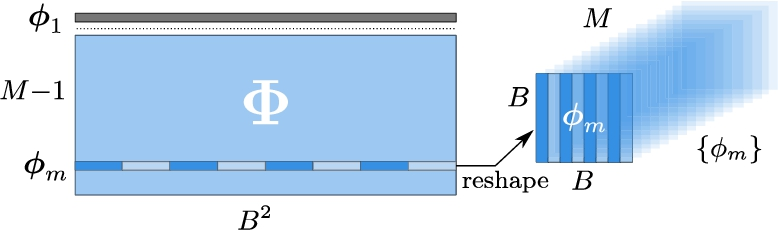
Creating a set of measurement filters from the measurement matrix. Row vector
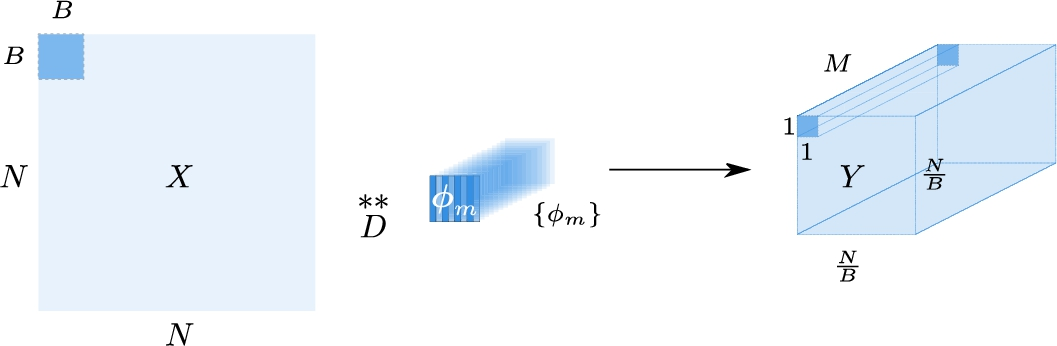
Visualization of the measurement process using decimated 2D convolution. Block x of size
There are two basic approaches for the measurement matrix design. An arbitrary measurement matrix
Alternatively, the optimal measurement matrix can be inferred from the training data. Such a matrix better adapts to the dataset and preserves more information in the measurements, resulting in better reconstruction results. In our proposal, we optimize the encoding part of the autoencoder to learn the optimal linear measurement matrix
Network Training Using Normalized Measurements
Training neural networks on normalized, mean-centred data became standard in all areas of machine learning (Ioffe and Szegedy, 2015). It is well known that such practice significantly reduces the training time, but the application to the learning based CS is not straightforward. The measurement process needs to be redesigned in order to obtain normalized and mean-centred measurements, since the mean value of the observed signal has to be measured during the CS acquisition process. In this section, we present an efficient measurement process which enables the direct application of data normalization techniques, which is in contrast with the previous work in this area.
In order to measure the mean value
Training the neural network on non-mean-centred data has undesirable consequences. If the data coming into a neuron is always positive (e.q.

Training loss function. Normalized mean-centred measurements vs. original measurements. Notice the zig-zagging in the loss function when using non-centred measurement data. Loss functions are visualized on the log scale.
In Lohit et al. (2018) and Du et al. (2019), the authors optimize the linear encoder in order to infer the optimal measurement matrix for each measurement rate r. In Baldi and Hornik (1989), it has been shown that the linear autoencoder with the mean squared error (MSE) loss converges to a unique minimum corresponding to the projection onto the subspace generated by the first principal component vectors of the covariance matrix obtained using the principal component analysis (PCA). Thus, it is sub-optimal to retrain the model for each measurement rate r.
Instead, we propose an efficient initialization method for the deep learning CS models based on the observation from Baldi and Hornik (1989). Principal component analysis (PCA) is an analytic method that has a widespread use in dimensionality reduction. The PCA is performed on the covariance matrix of the data vector
Thus, we propose to use the reduced eigenvector matrix
Furthermore, we propose to initialize the reconstruction part of the network using the PCA as well. The eigenvector matrix
The proposed initialization method for the network weights has several advantages. While a neural network has to be retrained in order to obtain the measurement matrix
As previously mentioned, the first part of the proposed network consists of a linear autoencoder. Non-linearities can be easily introduced into the measurement and reconstruction part of the network to further improve the initial reconstruction obtained by the autoencoder. In our proposal, non-linearities are only introduced into the decoding part of the network. Although there are some methods that learn a non-linear measurement operator from the data (Mousavi et al., 2017), linearity is an important property of measurement systems and we want our CS model to be realizable in real physical measurement setups like Takhar et al. (2006) and Ralašić et al. (2018).

Contrast-adjusted visualization of the learned residual for several test images and for the measurement ratio
The output of the proposed convolutional autoencoder represents a preliminary reconstruction of the input image from its low-dimensional measurements. We feed the preliminary reconstruction to a residual network (He et al., 2015) that induces non-linearity and reduces potential reconstruction and blocking artifacts, and eliminates the need for an off-the-shelf denoiser such as BM3D (Dabov et al., 2009) used in the competitive methods. Figure 5 shows several examples of the estimated residual. Residual learning compensates for some of the high-frequency loss and improves the initial image reconstruction.
Figure 6 shows the architecture of the residual learning block used in our proposal. The residual network consists of two residual learning blocks and each residual learning block has three layers. The first layer consists of 16 convolutional filters of size
Reconstructing the high-frequency content in the original image (i.e. edges, texture) is problematic for the linear autoencoder, and the residual network helps to alleviate this problem. Problems occur partly due to the fact that the lower frequency content is dominant in natural images and the learned measurement filters have a low-pass character, and partly due to the choice of the loss function used for training the network. It is known that the MSE loss function yields blurry images (Kristiadi, 2019). Thus, some papers suggest using a different loss function for the network training. As an example, Lohit et al. (2018) uses the adversarial loss function in addition to Euclidean loss to obtain better and sharper reconstructions. Furthermore, Du et al. (2018) uses perceptual loss in order to achieve better reconstruction results. The authors train their model using the Euclidean loss in the latent space of the
In this paper, we fuse the per-pixel reconstruction loss in the autoencoder with the perceptual loss in latent space in the residual network. This is in contrast with Du et al. (2018), where the authors optimize the whole network using the Euclidean loss in the latent space. As a consequence, their method results in semantically informative reconstructions, but with low per-pixel accuracy. By using a combination of Euclidean and perceptual loss, we obtain semantically informative reconstructions that have high accuracy of per-pixel reconstruction resulting in higher PSNR compared to Du et al. (2018).

Residual learning block. The residual learning block consists of 3 convolutional layers.
Pixel-wise Euclidean loss function for the autoencoder is defined as:
The residual part of the proposed network is trained separately from the autoencoder part using perceptual loss function
Network Training
In this section, we discuss the details of our network training procedure. We use tensorflow (Abadi et al., 2015) deep learning framework for training and testing purposes. The training dataset is formed using uncalibrated JPEG images from the publicly available Barcelona Calibrated Images Database (Párraga et al., 2010). Our training dataset is created by extracting 1676 image patches of size
Adam optimizer (Kingma and Ba, 2015) (
We perform series of experiments to corroborate previous discussions and observations. In order to achieve a fair comparison framework, a set of 11 images (Monarch, Fingerprint, Flintstones, House, Parrot, Barbara, Boats, Cameraman, Foreman, Lena, Peppers – see TestDataset), which were used in the evaluation of the competitive methods are used for testing purposes with four different measurement sub-rates
Measurement Matrix
In Section 3, we have discussed the connection between the measurement matrix learned by the linear encoder and the one obtained by performing the PCA analysis. In addition, we proposed an efficient initialization method for the network weights. In this section, we perform an experiment to show that the performance of the trained linear autoencoder is limited by the performance of the PCA method network in terms of image reconstruction quality.
Comparison of linear autoencoder and PCA in terms of reconstruction PSNR [dB].
Comparison of linear autoencoder and PCA in terms of reconstruction PSNR [dB].
Table 1 shows the mean reconstruction results in terms of PSNR for the standard test images. Notice that the reconstruction results are comparable. The slightly lower reconstruction performance of the linear encoder is due to the network not fully converging to the global minimum. Reconstruction results obtained by using the PCA method represent an upper boundary for the performance of the linear autoencoder network for CS image reconstruction.
In Fig. 7, reconstruction results obtained using random Gaussian and adaptive measurement matrix for Parrot test image are shown. The reconstructions are presented for measurement rates

Reconstruction results obtained using linear autoencoder for “Parrot” test image (1) and for two measurement ratios
In this section, we compare the proposed CS model to other state-of-the-art learning-based CS methods. To provide a fair comparison, we compare our method only to similar methods which use an adaptive linear encoding part.
We compare our method to the ImpReconNet (Lohit et al., 2018), Adp-Rec (Xie et al., 2017), FCMN (Du et al., 2019) and two variants of PCS (Du et al., 2018), namely
Reconstruction results obtained using the learned measurement matrix. Table contains mean PSNR reconstruction results for the standard test images at different measurement rates r. Although, FCMN achieves better results in terms of PSNR, it is clearly visible from Fig. 8 that it does not preserve structural information. This is due to the fact that PSNR measures image quality on per pixel basis, which is not a relevant measure for the preservation of high-level image features.
Reconstruction results obtained using the learned measurement matrix. Table contains mean PSNR reconstruction results for the standard test images at different measurement rates r. Although, FCMN achieves better results in terms of PSNR, it is clearly visible from Fig. 8 that it does not preserve structural information. This is due to the fact that PSNR measures image quality on per pixel basis, which is not a relevant measure for the preservation of high-level image features.
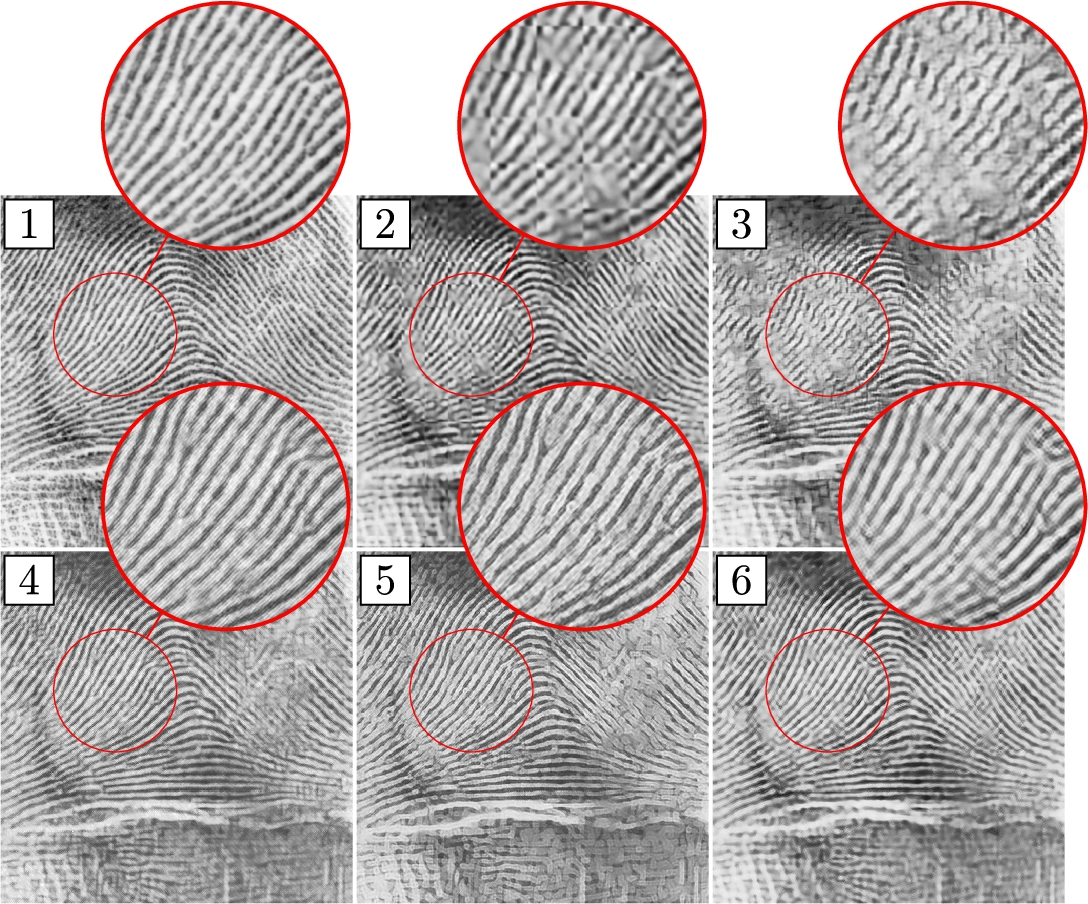
Reconstruction results for “Fingerprint” test image and for measurement rate
On one hand, FCMN and ImpReconNet yield similar results in terms of PSNR compared to our method (see Table 2), while on the other hand the aforementioned methods do not preserve structural and high level semantic information. The two PCS methods preserve structural information, but yield images that contain significant amount of noise when observed on pixel-wise level. Our method benefits from the combination of pixel-wise Euclidean loss in image space and the Euclidean loss in the latent space of the

Reconstruction results for “Monarch” test image and for measurement rate
Iterative nature and high computational complexity present the main drawbacks of the traditional CS reconstruction algorithms. Learning based methods for the CS image reconstruction present an efficient alternative to the traditional approach. Average per-image reconstruction time for a set of images with size
Better performance of the learning based methods in the reconstruction phase comes at an increased cost in the training phase. In order to learn the optimal measurement and reconstruction operators, learning based methods require an offline training procedure with a relatively large training dataset. Since learning based methods are data driven, they are also data dependent. Thus, if the statistical distribution of the training dataset significantly differs from the testing data, the performance of the learning based methods will be influenced. Finally, convolutional block image processing is not applicable in imaging modalities where the measurements correspond to the whole signal, and one cannot divide the signal into smaller blocks.
Conclusion
In this paper, we proposed a convolutional autoencoder architecture for the image compressive sensing reconstruction, which represents a non-iterative and extremely fast alternative to the traditional sparse optimization algorithms. In contrast with other learning based methods, we designed a measurement process which enables the model to be trained on normalized, mean-centred measurements which results in a significant speedup of the neural network convergence. Moreover, we proposed an efficient initialization method for the autoencoder network weights based on the connection between the learning-based CS approach and the principal component analysis. The residual learning network was used to further improve the initial reconstruction obtained by the autoencoder.
A combination of a pixel-wise Euclidean loss function for the autoencoder network training along with a Euclidean loss function in the latent space of the