



Abstract
Trans-informed administrative guidance introduces concepts from trans studies to educational leaders, but researchers have relatively ignored these policy implementation tools. This content analysis describes the design of administrative guidance using a representative sample of 112 Illinois districts: the who, what, how, and why of supporting transgender students. The results substantiated evidence of trans-informed guidance that introduced complex gender “definitions” and legitimized students’ identity. Many of these same texts also included barriers to supporting students with administrative gatekeeping, definitions reinforcing the gender binary, and mandates to involve parents in access decisions. All but one district (96%) highlighted existing state and local policies to motivate administrative actions around 13 issues. A minority of the texts provided specific directions to guide decision-making and reform efforts. This paper includes areas of concern and suggestions as policymakers initiate gender reforms.
Keywords
Introduction
In the past 15 years, state governments have passed legislation intended to prevent discrimination and harassment of transgender students in schools. Starting with the Minnesota Human Rights Act in 1993, several state discrimination laws banned discrimination based on gender identity in PK–12 educational institutions. However, local school boards and administrators do not always adopt or understand these state education laws in the same way. While some leaders have resisted enacting protective laws and policies (Payne & Smith, 2018; Woolley, 2019), other leaders have sought out resources from their local school district and external sources (Mangin, 2019). Historically, federal and state governments in the United States have motivated local educational reforms by mobilizing formal resources (e.g., curriculum frameworks, content standards), social resources (e.g., training teachers), and accountability systems (e.g., testing regimes, lawsuits; Cohen & Spillane, 1992; Peurach, Cohen, Yurkofsky, & Spillane, 2019). Many of these tools are missing in the implementation of gender policy reforms. Yet these policies require extensive resources to implement because gender-based reforms often necessitate changes in deeply held and culturally anchored biases. Administrative guidance documents are one of the few existing district-level tools designed for gender-based policy implementation. Superintendents, principals, school boards, and other local leaders use guidance texts to translate broad policy messages into specific implementation practices, but these tools remain relatively unexamined in the existing literature.
Despite the established academic literature suggesting transgender and other gender-expansive or nonconforming youth, overall, experience educational, safety, and health inequities compared to cisgender youth (Centers for Disease Control, 2017), a growing literature points to the role of inclusive laws, local school structures, and family supports in buffering or eliminating these inequities (Greytak, Kosciw, & Boesen, 2013; Kosciw, Clark, Truong, & Zongrone, 2020; Olson, Durwood, DeMeules, & McLaughlin, 2016; Pollitt, Ioverno, Russell, Li, & Grossman, 2021). For instance, Kosciw et al. (2020) found that lesbian, gay, bisexual, transgender, queer, and other gender-expansive (LGBTQ+) students reporting protective policies also reported less bullying, more school belonging, and more school safety compared to students without inclusive policy protections. Several qualitative studies describe how transgender students who are supported are not only surviving, many are thriving and leading in educational spaces (Frohard-Dourlent, 2018; Luecke, 2011; Nicolazzo, 2016a). This more nuanced body of work stresses the importance of creating and revising practical tools to disrupt gendered school structures. Because leaders have so few resources readily accessible, administrative guidance documents can play an outsized role when leaders seek out information to guide their work with transgender, nonbinary, and other gender-expansive youth.
Analyzing the content of existing administrative guidance documents provides a roadmap for discussions around the design of new, and the revision of existing, administrative guidance concerning transgender students. By incorporating lessons from across psychology, organizational studies, and trans studies in this analysis, I highlight elements of guidance documents that are more likely to motivate individual administrators into action as well as resources that could facilitate systemic reforms for school systems. The cognitive psychology framework highlights individual-level processing of PK–12 administrators and educators. More specifically, the cognitive psychology literature on bias helps explain why inclusive policy reforms with general or no implementation guidance provoke hot cognition, a strong emotional and physiological response contributing to PK–12 leaders’ decision-making and resistance to reforms (Spillane, Reiser, & Reimer, 2002a). The cognitive approach provides insight into the amount of information and specificity needed to change an individual’s existing gender beliefs and combat bias. The organizational history and current context also influences how individual administrators understand reforms (Spillane et al., 2002a; Turner, 2015). So it important to consider a systems-level approach to reveal how organizational factors motivate, or hinder, meaningful educational reform and the role of PK–12 administrators in making institutional changes. These factors include the availability of resources for administrators to learn about gender concepts and existing legal protections. Applying concepts from trans studies provides more specific direction around the educative content needed to transform gendered processes and practices. This includes drawing from trans studies scholarship to inform PK–12 administrators about gender concepts as well as centering the knowledge of transgender students when co-designing procedural changes in the local context. As federal, state, and local policy reforms concerning transgender students occur, an interdisciplinary framework is imperative to creating improved administrative guidance concerning transgender students. Guidance should create to space for PK–12 administrators to learn more about gender and promote structural gender-based reforms in the local context.
In this paper, I first discuss how administrative guidance concerning transgender students motivates and shapes the policy implementation process through individual and organizational processes. This section includes an introduction to the ways individual cognitive processes, sensemaking and hot cognition, fit into the broader policy implementation literature concerning organizational resources. Then, I introduce a trans-informed approach to administrative guidance and consider aspects of the policy implementation and trans studies literature that can be used to evaluate whether guidance is likely to facilitate changes in administrators’ beliefs about gender and related educational reforms. This review of the policy implementation problem highlights commonalities and differences across the disciplines of cognitive psychology, organizational studies, and trans studies in weighing the pros and cons of specific versus flexible implementation guidance. I then focus on an empirical case study by using data from a mixed-methods content analysis of Illinois local district guidance documents (e.g., administrative procedures, guidelines, and policy concerning transgender students) to consider how guidance texts in a representative sample of school districts detail (1) who “counts” as transgender, (2) what issues administrators should discuss (i.e., accommodations) with students and how leaders should approach these conversations, and (3) how policy references motivate why administrators should reform gendered district processes and practices. Threaded throughout this discussion, I highlight the need for more specific, trans-informed guidance by providing examples of trans-informed definitions and directions as well as guidance falling short of this ideal. In doing so, I incorporate themes of gatekeeping, gender legitimacy, agency, and visibility (Blackburn, Clark, & Martino, 2016; Enke, 2012; Martino & Ingrey, 2020; Stryker, 2007).
Conceptual Framework: Administrators’ Sensemaking and Hot Cognition
Administrative Guidance as a Guide for Administrators’ Sensemaking
All educational policies require administrators to interpret, or make sense of, policy texts (Ball, 1993; Hill, 2001). School board professional associations, state departments of education, local school boards, and districtwide student services administrators write guidance documents to help leaders understand policy reforms and the appropriate administrative response to a host of matters (e.g., field trip guidelines, disciplinary procedures). Administrative guidance documents concerning transgender students explain why and how administrators should reform educational procedures and practices to create a better learning environment for transgender students. This work includes meeting with students and guardians to understand impediments to student well-being in school, initiating changes in administrative forms (e.g., official documents containing gender markers and names), incorporating inclusive-curricular reforms, selecting the appropriate leadership teams and professional development to engage teachers and staff in reforming gendered practices.
Statewide administrative organizations, local district school boards, and school administrators shape the sense-making process through implementation tools like administrative guidance texts. State and local leaders in these organizations often clarify the intent of PK–12 educational laws and policies, establish shared definitions, and provide the administrative options available to district leaders—all key components to the implementation of any policy (Ball, 1993; Spillane et al., 2002a; Stone, 1997). Administrative guidance concerning transgender students similarly gives administrators a guide to make sense of gender reforms. While it is unlikely the guidance documents alone will lead to widespread, comprehensive reform of gendered practices in schools, I describe how these tools can be one of several tools used to lay the foundation for more meaningful changes in administrators’ practices.
Hot Cognition, Gender-Diversity Policies, and Resistance
Spillane et al. (2002a) have described educational leaders’ struggle to maintain existing beliefs and rationalize their decisions when confronted with new educational policy reforms, even when faced with incongruent information, in a process called “motivated reasoning.” All humans engage in motivated reasoning when they make decisions based on existing (often emotional) beliefs and deny evidence that contradicts the existing belief. When motivated reasoners receive too little information, they may become even more resistant to changing beliefs. In the current American educational system, PK–12 leaders generally receive little training on the gendered nature of PK–12 systems and other gender concepts in teacher education (Greytak, Kosciw, Villenas, & Giga, 2016; Sherwin & Jennings, 2006) or educational leadership programs (O’Malley & Capper, 2015). This lack of resources shapes how leaders make sense of policy reforms concerning transgender students.
Without an opportunity to challenge existing ideas about gender or to learn about the complexity and nuance of what it means to be “transgender” (Glasser & Smith, 2008; Stryker, 2007; Stryker, Currah, & Moore, 2008), many leaders struggle to make deep structural reforms to disrupt the gender binary in PK–12 schools. Beliefs about gender connect to personal identities and gender norms socialized since childhood. These beliefs often elicit strong emotional responses and can be especially difficult to change (Ferree & Merrill, 2000; Lodge & Taber, 2005). Because beliefs about gender connect to leaders’ own identities and worldview, administrative decisions related to gender fall into a category psychologists call “hot cognition.” In other words, thinking that is affected by an emotional state. “Automatic,” less rational, and low-quality decision-making can arise from these emotionally charged gender beliefs (Lodge & Taber, 2005). The hot cognition response contributes to biased, immediate responses that can impede the policy implementation process (Spillane et al., 2002b). In contrast, logical decision-making involves weighing the evidence and using other higher order executive functioning, such as cognitive flexibility, when considering possible administrative options (Kunda, 1990).
Researchers describing gender-inclusivity professional development (Airton & Koecher, 2019; Meyer, Tilland-Stafford, & Airton, 2016) have widely described the strong emotional responses elicited from educators struggling to reconcile ideas about gender with their own identity and existing gender ideologies. Payne and Smith (2018) report administrators believed gender and sexuality reforms were irrelevant to their student population, despite evidence to the contrary from teachers in their district. School leaders also largely disconnected gender and sexuality reforms from their schools’ equity missions. In explaining teachers’ fears and justifications for not fully implementing a California PK–12 education bill concerning gender identity and sexuality, the FAIR Act, Leonardi (2017) effectively describes a motivated reasoning response to gender reforms. Teachers initially justified their hesitation to include gender and sexual diversity topics in their curriculum by questioning the appropriateness of the content and citing parental pushback. Teachers also indicated that they did not have enough information or tools to effectively implement the curricular reforms.
The lack of institutional resources needed to effectively learn about policies concerning gender helps explain why leaders have resisted implementing policy mandates concerning transgender students in New York (Payne & Smith, 2018; Woolley, 2019) and California (Leonardi, 2017), while other leaders have been primed with a trans-informed approach through their experiences with transgender students (Mangin, 2019), transgender educators, or gender-inclusivity professional development (Smith & Payne, 2016; Staley & Leonardi, 2020). Researchers examining motivated reasoners and bias suggest most individuals have an affective tipping point (Redlawsk, Civettini, & Emmerson, 2010). Humans reach this tipping point, which may differ across individuals, when presented with enough specific evidence that contradicts existing beliefs and alternative methods to solve social problems. How much additional information administrators and teachers will need to make sense of policy reforms depends on a variety of factors, which include the local political context, existing organizational norms, the administrators’ self-image, and life paths (Spillane, 2004; Spillane et al., 2002b). Scholars’ descriptions of leaders who do adapt their beliefs about gender and change practices often cite access to resources and an understanding of cisnormative systems (Greytak et al., 2013; Hernandez, Alston, & Fraynd, 2020; Mangin, 2020). For example, in a study of supportive principals, Mangin (2020) described the willingness to learn more about gender, usually by modifying personal beliefs, and access to resources, as crucial characteristics of gender-affirming educators. Guidance documents aid this process by providing an introduction to the foundational knowledge about gender required to make student-centered, trans-informed decisions. They also connect a trans-informed frame-work to leaders’ professional obligation to implement protective educational laws.
Evaluating Administrative Guidance Language From a Policy Implementation and Administrative Practice Perspective
Administrative guidance texts target the beliefs and behaviors of local educational leaders and are thus valuable data in understanding reform efforts for transgender youth. Broadly speaking, policy implementation occurs through institutionalizing ideas by changing rules, roles, and norms (Coburn, 2016; Honig, 2006). “Coupling” policy reforms with changes in leaders’ technical work is one way to institutionalize these ideas. This is why administrative procedures should address questions about for whom, what, how, and why of policy protections and reforms. The goal is to couple policies with the technical work of administration by describing how leaders could change organizational processes, documents, and practices (Meyer & Rowan, 1977; Spillane, Parise, & Sherer, 2010). Among administrators’ core responsibilities is ensuring that school staff comply with policies, so the authors of guidance documents often focus on delineating the legal scaffolding for reforms (Halverson & Kelley, 2017; Spillane, 2012). By targeting leaders’ understanding of policy reforms, the guidance documents have the potential to influence superintendents’, principals’, and other district-level student services administrators’ decisions about resource allocation, curricular alignment, professional development, instructional practices, and school goals (McQuillan, 2021).
How do guidance documents ideally reflect and encourage the connection? As a first step, leaders need to know about the legal landscape and gender concepts. Scholars have noted that educational institutions often use policies as symbolic or ritualistic responses to signal compliance with educational reforms while preserving the existing practices within schools (Meyer & Rowan, 1977; Spillane, 1998; Turner, 2015). In other words, school leaders use policies as a shield to prevent reform efforts and decouple the policy from the technical practices of administrators. Tying discrimination, accessibility, and bullying policy protections to administrative practices can be especially powerful motivators toward administrative reform because of the legal ramifications of administrative actions in these areas. For instance, discrimination and accessibility legislation, such as Title IX and IDEA, have relatively clear enforcement measures to hold administrators accountable. These laws can also be useful in bringing administrators’ attention to the legal impetus for gender reforms, especially when administrators have limited resources and must meet the needs of multiple stakeholders. Finally, the ability to defer to higher legislative authorities may set the stage for administrators’ openness to working with grassroots activists and give leaders the leverage needed to change organizational practices (Meyer & Rowan, 1977; Spillane et al., 2019).
Finding a Balance Between Flexible and Specific Guidance
As a second step, guidance documents should align policies with the practices of administrators, teachers, staff, and students (Coburn, Hill, & Spillane, 2016). Only adopting policy protections without building the capacity for change results in the continuation of the same problematic behaviors and beliefs (Meyer & Rowan, 1977; Spillane, 2004). Similarly, trans studies scholars, most notably Spade (2008, 2015), have written extensively about the perils of relying too heavily on discrimination and hate crime reforms to resolve the broader, systematic injustices of gendered societal systems. Spade (2015) suggests legislation that “tinkers with systems to make them look more inclusive while leaving their most violent operations intact” only perpetuates harm (p. 91).
Guidance documents concerning transgender students often tie policies to practices by including a description of for whom, what, how, when, where, and why administrative actions should align with the state discrimination and bullying mandates. Importantly, texts should include enough specificity in the guidance to challenge existing gender beliefs, norms, and practices. Co-designing administrative guidance involves deferring to students’ experiences, allowing students’ a major role in the decision-making process concerning accommodations/reforms, and including transgender advocacy groups and activists in reforming gendered school structures. This process mirrors the co-design approach advocated by antiracist leadership scholars (Garces & Cruz, 2017; Ishimaru & Takahashi, 2017; Penuel, 2019; Welton, Owens, & Zamani-Gallaher, 2018). This process can disrupt what Ishimaru and Galloway (2014) refer to as the institutional scripts underlying administrators’ practices. The institutional scripts consist of “taken-for-granted norms, expectations, and assumptions that constrain marginalized families and educators in exercising collective agency to disrupt educational inequities.” This bottom-up policymaking draws on the knowledge of trans advocacy groups and students about the structural obstacles the students face in the local context. A co-design process also draws from the professional knowledge of PK–12 administrators about the organizational context, existing policies, and administrative processes. Collaborative strategies can encourage innovation between administrators, students, and families in an effort to deepen and expand gender reforms in school.
Embedding a Trans-Informed Approach
In guiding administrators towards a co-design approach, guidance instructions can steer administrators towards building solidarity and may lead to new “ways of being” in schools (Spade, 2020). Trans-informed texts start by reframing the policy problem as the structural institutionalization of gender categories in schools rather than defining trans students as the policy problem (Spade, 2020). But as Martino, Kassen, and Omercajic (2020) note, “trans-informed understandings of gender identity and gender expression cannot be reduced to a sustained critical project of eliminating gender stereotypes starting at childbirth, and it is in this sense that the necessity of addressing the whole question of cisgender privilege and cisnormativity is eschewed” (p. 14). Spade proposes building community members’ skills for participation, cooperation, and, eventually, enhanced decision-making. Rather than relying on the charity of those in power, Spade suggests building solidarity for reforms by engaging in collective political action and providing material supports (Spade, 2020). Part of this process includes educating school community members about cisnormativity, privilege, and interlocking systems of oppression in order to start conversations about reforming administrative systems (Martino et al., 2020; Spade, 2015). While guidance documents will not achieve this goal on their own, they do provide an institutionalized guide to take a step forward in this process.
Expansive definitions can help create the necessary bridges between leaders and trans community members by attempting to explain gender concepts that convey the complexity of gender identities (Stryker et al., 2008). However, in one of the only American document analyses of policy documents concerning transgender students, Meyer and Keenan (2018) found guidance texts in California did not interrogate gender categories. In doing so, the texts reinforced binary assumptions about gender and further reified gender identities. Rather than guiding administrators toward structural reforms, the California guidance isolated students as the policy problem. This disconnect does not simply weaken the guidance but can also nullify the policy’s original intent.
Without imposing too many artificial gender categories or assumptions about individual students, administrative guidance must also have enough specificity in its practical directions to change administrative processes and behaviors. For instance, administrative guidance texts can introduce concepts that challenge a gatekeeping approach to implementing policy mandates when outlining the legal scaffolding and role of administrators as policy implementers. Administrators gatekeep in two main ways: first, by making decisions about the legitimacy of students’ gender identities, and second, by controlling access to school facilities, records, and other school resources. Trans-informed administrative guidance texts center the student as the arbiter of their identity and student agency as the primary decision-maker in how the student should move through educational spaces (Blackburn et al., 2016; Enke, 2012; Martino & Ingrey, 2020; Stryker, 2007). A trans-informed text would question whether school or medical authorities can determine the legitimacy of students’ gender identity. Additionally, administrators need to know how to “accommodate” transgender students because binary school processes, procedures, and practices erase them. Yet guidance documents stressing that it is transgender students who need to have accommodations highlight the “hypervisibility” of transgender students (Enke, 2012). While the “ideal” guidance will vary depending upon the local context and student body, trans-informed guidance centers some of these core trans studies concepts.
Policy adoption and the initial implementation process is only the start of an iterative process of continuous reflection and improvement needed to disrupt gender norms. Indeed, most educational reforms are more likely to be successful when they are paired with multiple tools for implementation and enforcement (Cohen & Mehta, 2017). Guidance could help leaders struggling to adjust to gender-based reforms by broadening their understanding of gender and gender oppression within their institutions. This study expands upon a limited guidance literature to explore the content, use, and effectiveness of the guidance documents used by PK–12 district administrators in one Midwestern state and how far guidance texts have to go to integrate a more trans-informed approach.
Methods
The Current Study
This sequential, mixed-methods study (Creswell & Creswell, 2017) used a representative sample of 112 districts across Illinois. Figure 1 outlines the sampling, document collection, and mixed-method analytic strategies. Illinois was an ideal location to study variation in local districts’ responses, or nonresponses, to policy protections for transgender students. Illinois was demographically, politically, and economically representative of the United States population (Bureau of Labor Statistics [BLS], 2018; McQuillan, 2021; U.S. Census Bureau, 2017). The state had protective legislation for transgender students (e.g., LGBTQ-inclusive bullying law, Human Rights Act) and did not have laws that restricted educators from discussing LGBTQ issues (e.g., “Don’t Say Gay” laws). Additionally, Illinois did not have the most progressive state legislation for students compared to states like California and Massachusetts (e.g., lacked LGBTQ-inclusive curriculum mandates) in 2017, so it represented a legislative middle ground.

Mixed-methods data collection, coding, and analysis outline.
Sample
I used stratified random sampling based on enrollment size to obtain a representative sample of 112 districts across the state, about one-fourth of districts, and 46% of the high school student population. Enrollment data came from the Directory of Educational Entities (Illinois State Board of Education, 2016). I oversampled larger districts to obtain data concerning a larger portion of the state’s students and weighted estimated frequencies in the analysis.
Data
The data for this study came from a larger document analysis (Figure 1). In that collection process, the research team collected up to 13 documents from each district in the sample by downloading documents from district websites (if available) and contacting district offices directly to verify the completeness of the documents (McQuillan, 2021). The researchers also asked each district to send additional documents concerning LGBTQ+ students used by the districts, such as administrative procedures or guidance, if they were not posted online. This analysis included only institutionalized policies, administrative procedures, or guidelines for transgender students, such as administrative procedure documents in school board policy manuals or uniform guidelines posted on district website pages concerning LGBTQ+ students. I did not include informal documents because leaders might not have access to these documents, like superintendents’ emails describing informal processes or ad hoc gender support plans. I also did not include school-level statements in handbooks that did not apply to the entire district.
Analysis
The results from this study came from four rounds of coding: (1) ongoing, inductive open-coding, which revealed conceptual themes for the (2) conceptual coding scheme used in the descriptive quantitative analysis. The focused, relational coding consisted of (3) evaluating elements of specificity and flexibility in gender definitions, administrative choices, and interpretations of the law drawing from the cognitive policy implementation literature, and (4) examining aspects of gatekeeping, gender legitimacy, hypervisibility, and rigid binary categorizations drawn from trans studies literature.
To identify initial themes used in the quantitative conceptual content analysis, I open-coded the first 20 districts in the sample (Figure 1; Charmaz, 2014; Corbin & Strauss, 2008) and added additional coding themes that emerged inductively. These themes included for whom, what, how, and why administrators could use accommodations in their work with transgender students. For example, through open-coding, 13 issues or supports emerged in guidance texts: discrimination, bullying, records, privacy, use of name and pronouns, curriculum and instruction, bathroom use, locker room use, off-campus trips, overnight trips, athletic participation, dress codes, and professional development. As new approaches arose inductively to these issues, the research team added codes to the scheme. The author and two research assistants conducted the conceptual analysis displayed in Tables 1–3, double-coding 22% of the documents with a high degree of reliability (κ = .92). I used Stata (StataCorp, 2017) and Microsoft Excel to conduct the descriptive quantitative analysis.
Proportion of Districts and Documents Describing Who “Counts” as Transgender and Adding Barriers to Access (N = 112)

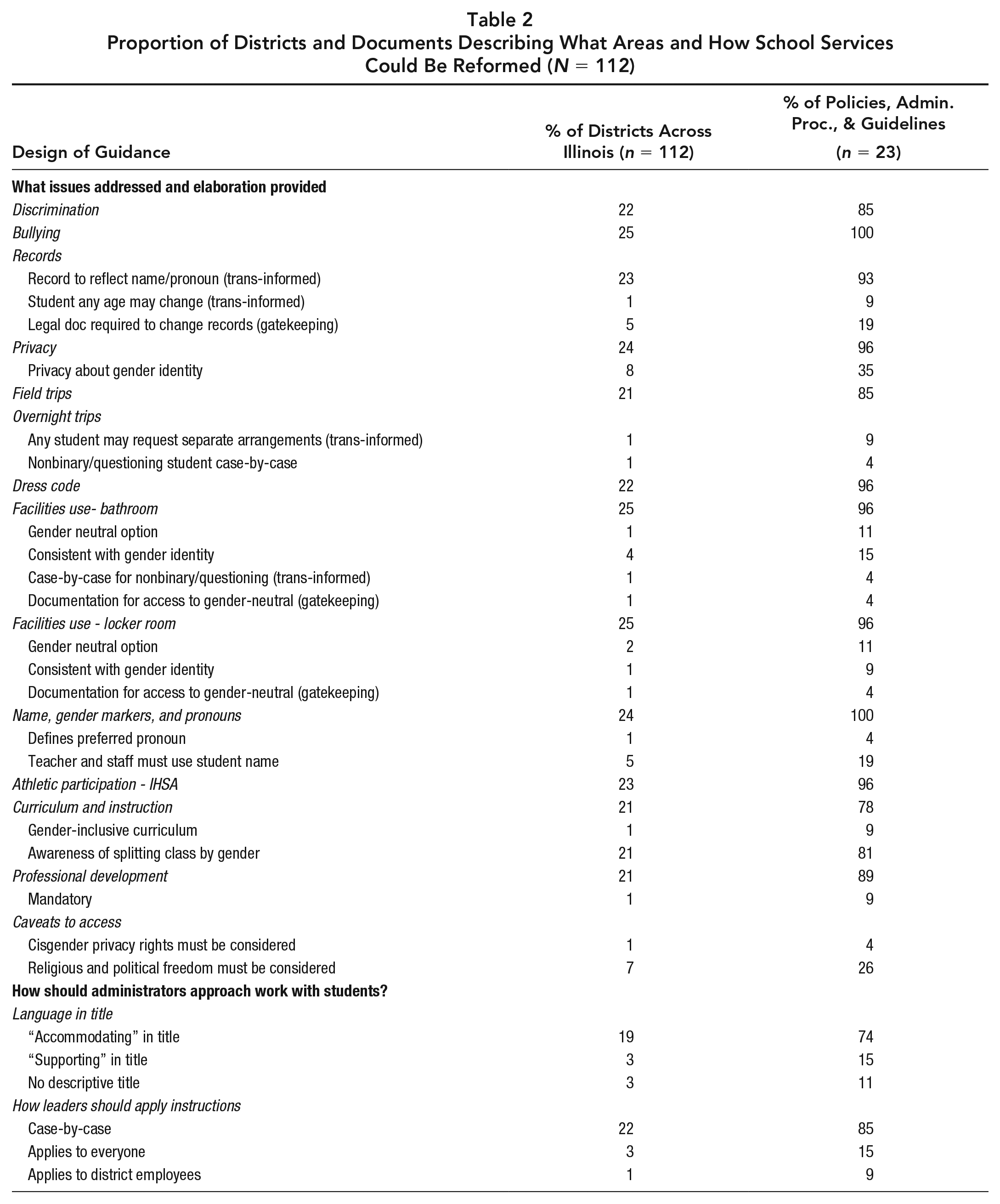
Proportion of Districts and Documents Describing What Areas and How School Services Could Be Reformed (N = 112)
Proportion of Districts and Documents Describing the Legal Foundation for the Guidance (N = 112)

The author and a research assistant followed the conceptual analysis with qualitative relational comparisons of definitions (e.g., “transgender” and “transitioning”), accommodations instructions (e.g., students should go to locker room corresponding with their gender), and interpretations of U.S. or Illinois legislation (Neuendorf, 2016). I coded the instructions on a continuum of specific to vague. The critical discourse and relational analysis (Fairclough, 2010) drew on themes from trans studies and organizational studies that emerged as themes through ongoing coding. This stage of coding focused on whether definitions and instructions allowed for gender complexity, student agency in access decisions, the legitimization of students’ identity, and hypervisibility. Finally, I created additional codes for explicit interpretations of existing Federal and state laws or local board policies.
Findings
None of the guidance texts in this study consistently incorporated specific instructions, clear policy interpretations, or a trans-informed approach. However, I do find examples of specific interpretations of existing policies and trans-informed instructions in the guidance texts. This section will describe how guidance outlined who “counts” as transgender followed by differences in how guidance instructs leaders to approach their work with transgender students. I find an overall absence of specific instructions that would help administrators understand what school structures should be reformed and how to engage transgender students. Finally, I review evidence of legal references across all documents and policymakers’ attempts to interpret existing laws for leaders.
Who “Counts” as Transgender and Has Access to Supports?
All of the documents outlined who should have access to supports, or accommodations, by providing (1) definitions of key terms, (2) whether and which documents were required to “prove” transgender identities, and (3) whether districts mandated parental involvement (quantitative results shown in Table 1).
Changing Existing Beliefs Without Reifying Gender
A majority of guidance texts (88%) stated the intent of definitions within guidance text was to educate readers about gender concepts. A template used by the majority of districts was created by the Illinois Association of School Boards and explicitly clarified the goal of definitions by explaining, “Definitions are not intended to label students, but rather to assist with understanding.” All the documents included definitions, signaling the belief that administrators needed additional scaffolding on basic terms at the core of policy protections. Table 1 illustrates the frequency of the 10 most common terms defined in the guidance documents, such as “transgender” (100%), “sex” (96%), “gender identity” (93%), “gender expression” (93%), “nonconforming student” (89%), and “sexual orientation” (81%).
Within these definitions, trans-informed guidance urged leaders to consider nonbinary and flexible gender labels. One example of a definition resisting simple categorizations defines “gender identity” as: A person’s deeply held sense or psychological knowledge of their own gender, which can include being female, male, another gender, or no gender. A person’s gender identity can be the same or different than their sex assigned at birth. The responsibility for determining an individual’s gender identity rests with the individual. Unlike gender expression, gender identity is not visible to others.
This definition instructs administrators about identities outside the male-female binary and counters the conflation of gender identity with gender expression. Importantly, this definition affirms student agency to determine their own identity, not an administrative gatekeeper. Similarly, another definition states gender identity as: The deeply held sense or psychological knowledge that individuals have of their gender, regardless of the biological sex they were assigned at birth. Everyone has a gender identity. Common examples include male/ man/boy, female/woman/girl, trans/transgender, gender variant, gender nonconforming, agender, or any combination of these terms.
By stating “common examples include,” the authors provided examples of identities without restricting the realm of possible identities. The school board association’s template, used by 88% of districts with guidance, took additional steps to disrupt assumptions about gender binaries and the role of medical transitions. The guidance stated, “An individual can express or assert a transgender gender identity in a variety of ways, which may but do not always include specific medical treatments or procedures. Medical treatments or procedures are not considered a prerequisite for one’s recognition as transgender.” This specific, trans-informed definition conveyed there is not just one way to “be transgender” and asserts students’ legitimacy in determining one’s identity.
Reinforcing the Gender Binary and One-Dimensional Identities
While I found examples of trans-informed concepts embedded in definitions, all districts had at least some language reinforcing the gender binary. This included being either a “male or female,” “boys or girls,” and “masculinity or femininity.” One policy described gender identity as “a person’s deeply felt internal sense of being male or female.” These definitions reified gender and excluded identities between and outside of these categories, such as nonbinary, genderqueer, and agender.
Despite the heavy influence of culture on the construction of gender (Butler, 2004), only one district recognized gender as being culturally based and included “nonbinary” in the gender identity description. This district also noted that gender changes over time, drawing in the concept of fluidity. None of the guidance addressed how multiple, marginalized identities would influence students’ needs or experiences, nor did they include terms that may be culturally relevant to student bodies, such as two-spirited.
Required Gatekeeping: Additional Documents Needed to Prove Identity and Parental Involvement
A minority of guidance stated that documentation of identity from external gatekeepers was not necessary to access accommodations. In 15% of guidance documents, the text advised administrators to respect students’ authority in determining their identity, and that a student’s request for accommodations should be sufficient to access resources. These documents supported a trans-informed approach with specific instructions tied to administrative actions.
Conversely, a smaller percent of texts put the onus on students to advocate for and prove their identity. These instructions placed school administrators in a gatekeeping role. Nine percent of districts required additional documentation to “verify” students’ gender (Table 1) but only if students identified as transgender. Administrators could request affidavits from parents/guardians (9%), new birth certificates (9%), and physician’s affidavits (4%) to legitimize students’ identities and expressions. Requiring additional documents to prove identity undermines leaders’ ability to take a trans-informed approach. Additionally, none of the texts directed administrators to verify cisgender students’ identities in these same districts, creating a double-standard for transgender students.
Requiring parents’ or guardians’ involvement created a similar dual-system for students who have supportive parents/guardians and those who do not in the same district. A majority of texts indicated parents/guardians could be involved in the process (89%), while 19% mandated involvement. Additionally, guidance instructions for parents or guardians conflicted with district records and privacy policies. Privacy and records policies uniformly allowed parents/guardians to access records until students turned 18 years old; however, 35% of guidance advised students’ identity should be private. These conflicting policy documents leave administrators without clear guidance if unsupportive parents or guardians request school records about their children.
The What and How of Reforms
In addition to determining who should be included in policy reforms, administrative guidance outlines possible administrative actions around key issues. State gender reforms frequently filtered through intermediate agencies, the Illinois Association of School Boards (IASB) or the Illinois State Board of Education (ISBE), as districts implemented state legislative reforms (McQuillan, 2021). IASB provided templates and other policy consulting services to aid district compliance efforts. The policy templates stated that school boards should adapt the documents to the local context, but I did not find extensive evidence of local policymakers modifying the template. Only six districts developed completely unique guidance for the local context, and four of the five came from highly resourced ($15,765–27,980 per-pupil expenditures), suburban/urban districts.
13 Areas of Support
Across all document types, open coding revealed the text referenced 13 main areas of support. Table 2 shows the proportion of districts addressing each of the 13 areas. Of note, all guidance documents discussed bullying, pronouns, names, and most referenced facilities use (96%). Under each of the 13 areas, few texts provided specific options to help further scaffold administrative decision-making (Table 2). Again, most of the guidance (88%) came from the same IASB template with few modifications. My analysis revealed few texts provided a sufficient framework to counter existing beliefs or help leaders take student-centered, trans-informed administrative actions even in districts that designed their own guidance documents.
A Lack of Overall Specificity to Educate Leaders
When guidance authors provided specificity, I found both trans-informed attempts to educate administrators as well as mandates that further problematize attempts to reform cisnormative systems. To visualize this pattern that I found across the subcodes under the 13 areas of support in Table 2, Figure 2 illustrates the percent of documents with references to bathrooms (96%). Almost all texts referenced bathrooms, but few texts elaborated on how administrators could approach facilities use with students or broader structural reforms. Fifteen percent of texts indicated students should access bathrooms consistent with their gender. These instructions allowed for students of all identities to access the appropriate facilities but administrators who did not have a broader understanding of gender may understand these instructions in binary terms. Four percent suggested administrators should discuss options with nonbinary students, drawing attention to the idea that administrators should consider more than one approach to facilities and consult students in the process.
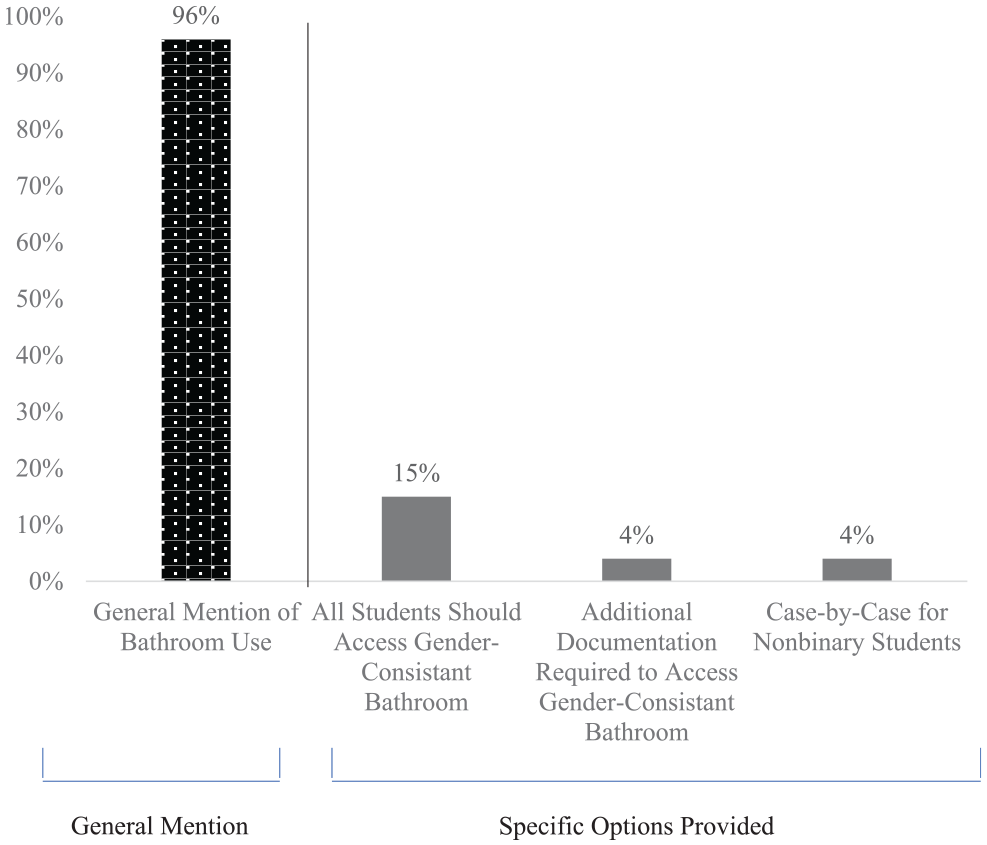
Percent of guidance addressing bathroom supports for transgender and nonbinary students and options provided (N = 27).
Evidence of Specific, Trans-Informed Instructions
A minority of texts included trans-informed instructions for administrators to allow any students, regardless of gender, to request separate overnight arrangements (9%), gender-inclusive curriculum (9%), and students of any age to request name and gender marker changes (9%; Table 2). A minority of texts also indicated all students and employees had access to accommodations, which also relieves the administrator from a gatekeeping role. Fifteen percent of guidance documents stated administrators should open access to supports/accommodations to any student requesting them (Table 2). Taking a step further, 9% of districts indicated administrators should address employee requests. These texts introduced a trans-informed approach by providing more specific administrative options without forcing administrators to take a “one-size-fits-all” approach to policy implementation.
Evidence of Specific, Problematic Instructions
In contrast to trans-informed instructions, I found evidence of potentially harmful administrative guidance. One district required documentation only when students requested access to bathroom facilities consistent with students’ genders (4%; Figure 1). I found evidence of similar gatekeeping mandates for changes to school records and locker room access (Table 2). In addition, all the document titles centered on transgender students as the policy problem. Seventy-four percent of titles framed the reforms as “accommodations” for transgender and nonbinary students, while a minority (15%) of texts used “supporting” students (Table 2). Eighty-five percent of guidance texts left the decision to discuss accommodations/supports to administrators to decide on a case-by-case basis, indicating no mandate to engage or provide any support to transgender students. The analysis also revealed two additional caveats of note. The phrasing “religious and political freedom must be considered” appeared in 7% of districts, and one district stated, “Cisgender privacy rights must be considered.” None of the documents elaborated on how either of these caveats would change administrative behavior, again leaving the administrator with little direction.
Why Should Administrators Reform District Structures and Practices?
Referencing specific laws and policies to the practices outlined above underscores leaders’ responsibility to implement reforms. Almost all the guidance texts cited federal (93%; e.g., Title IX; Table 3), state (96%; e.g., Illinois Human Rights Act), and local district policies (100%; e.g., bullying policy) to connect the legal obligations to transgender students and the 13 areas of reform.
Limited Interpretation of Federal Legislation
Similar to instructions guiding the who, what, and how of reforms, texts provided limited interpretations of policies to explain why leaders should initiate reforms. The texts that used an IASB template stated federal laws “prohibit exclusion and discrimination on the basis of sex . . . the U.S. Department of Education’s Office for Civil Rights (OCR) and the U.S. Department of Justice, Title IX protects lesbian, gay, bisexual, and transgender students, from gender discrimination.” The remaining documents merely cited Title IX without explanation.
Limited Interpretation of State Legislation
Texts also explained state gender-based discrimination interpretations by clarifying, “under Illinois state law, sex discrimination extends to claims of discrimination based on sexual orientation and gender identity.” The interpretation of existing Illinois legal protections clarified that discrimination protections extend to transgender people in schools. The IASB template authors further explained that: Gender-based discrimination is a form of sex discrimination and refers to differential treatment or harassment of a student based on the student’s sex, including gender identity, gender expression, and non-conformity with gender stereotypes, that results in the denial or limitation of education services, benefits, or opportunities. Conduct may constitute gender-based discrimination regardless of the actual or perceived sex, gender identity, or sexual orientation of the person experiencing or engaging in the conduct.
In addition to clarifying protections for transgender students and workers, the statement extended protections to gender expression and the perceived identity of the target of discrimination. Yet another text stated: The Illinois Human Rights Act defines sexual orientation as the actual or perceived heterosexuality, homosexuality, bisexuality, or gender-related identity, whether or not traditionally associated with the person’s designated sex at birth. . . . The Act permits schools to maintain single-sex facilities that are distinctly private in nature, e.g., restrooms and locker rooms.
These descriptions outlined broad discriminatory actions—the denial or limitation of education services, benefits, or opportunities—and clarified the perpetrators’ actions constituted discrimination, not the victim’s identity.
Except for facilities use, I did not find extensive interpretations of the law that would help leaders identify examples of discrimination or definitions of what “limiting services, benefits, and opportunities on the basis of gender” looks like in PK–12 schools. The legal interpretations found in this study also stopped short of bridging the law to trans-informed administrative practices.
Discussion
Between the state legislature passing protective discrimination policies and the students’ daily routine, there is a complex set of institutional and human mechanisms that determine how inclusive policies translate into school climates for students who do not conform to gender norms. While we know guidance can address leaders’ existing beliefs and the different organizational contexts that heavily influence how administrators make sense of policy reforms (Cohen & Spillane, 1992; Spillane et al., 2002b), little is known about how guidance texts influence district organizational norms and community members’ beliefs about gender. Because educational reforms that diverge dramatically from commonly accepted practices or beliefs require more guidance for implementation than reforms mandating smaller changes (Coburn et al., 2016; Cohen & Mehta, 2017), initiating deep, structural gender reforms requires educating leaders about gender concepts and more specific instructions about possible strategies to implement protective policies. While an evaluation of whether the guidance documents actually did shift administrators’ behaviors was outside of the scope of this content analysis, the interdisciplinary framework drawing from cognitive psychology, organizational studies, and trans studies speaks to why some instructions failed to initiate change, while other texts have a greater potential to educate and motivate leaders.
PK–12 district administrators first need to have a better understanding of gender in order to adapt their administrative practices to a student body that increasingly identifies as transgender and nonbinary (Rider, McMorris, Gower, Coleman, & Eisenberg, 2018). As McKinney de Royston, Lee, Nasir, and Pea (2020) have noted about teachers’ work, school administrative work is “not as a set of scripted ‘best practices’ and instrumentalist approaches, but as a work that is both principled (based on specific methods) and improvisational, requiring them to know how to adapt their instruction [or administrative actions] to the students before them.” Most texts in this study explicitly stated the intent to educate administrators about gender concepts and introduced ideas that may challenge administrators’ existing beliefs. This foundation gives leaders an initial framing to adapt processes and practices. Similar to Airton, Kirkup, and colleagues’ (Airton, Kirkup, McMillan, & DesRochers, 2019; Kirkup, Airton, McMillan, & DesRochers, 2020) analysis of guidance documents in Ontario, guidance documents in this study provided expansive definitions of gender. These definitions signaled more sophisticated approaches to gender and challenging stereotypical ideas about what it means to be transgender than in Meyer and Keenan’s (2018) analysis of 10 California districts collected the same year.
Lowering the barriers to who “counts” as transgender and who can make decisions about gendered practices and spaces may open the dialogue among educational stakeholders. This dialogue is critical to build more nuanced administrative responses. This study provides examples of texts embracing the complexity of gender in their definitions and directing administrators away from the “nexus of power among medical, legal, and other social institutions that confirm or deny people’s right” to occupy educational spaces (Enke, 2012, p. 75). Rather than forcing transgender students and staff to “come out” to initiate a conversation, several texts suggested accommodations for transgender students should be available to everyone. These instructions reframe the administrators’ role away from gatekeeping, but the lack of specificity also serves to preserve the status quo by leaving leaders without possible options for making deeper structural reforms. This lack of specificity may contribute to the same motivated reasoning and resistance to reforms documented by educational scholars (Leonardi, 2017; Payne & Smith, 2018; Woolley, 2019).
In a like manner, instructions to take a case-by-case approach maintains structural cisgenderism by “accommodating” individual students and only those students with the power advocate (Martino et al., 2020). The case-by-case approach also encourages gatekeeping. The administrator determines who should have access and compels students to lobby for support. Making administrators and other adults the primary gatekeepers takes away students’ agency in their identity development and unnecessarily restricts how students move through educational institutions (Keenan, 2017; Wilson, 1996). Conversely, 15% of texts legitimized students’ identity claims and stated students would not have to “prove” their identity through medical, legal, or parental gatekeepers. These same texts also acknowledged students’ agency to make decisions about access to all-gender or binary facilities and other school spaces.
While the policy implementation and hot cognition literature justifies greater specificity, not all scaffolding attempted to improve conditions for transgender and nonbinary students. Mandates to involve parents/guardians in student access decisions bar some students from support and could force administrators to disclose students’ identities to parents/guardians. Mandating involvement leads to additional harm for students from unsupportive families and prevents students from accessing supports (Katz-Wise, Ehrensaft, Vetters, Forcier, & Austin, 2018). Parental/guardian mandates create a two-tiered system for transgender students in the same district depending upon if they have supportive adults at home. In the absence of family support, gender-affirming school climates may be essential to safeguarding student engagement (Ullman, 2017), achievement (Fenaughty, Lucassen, Clark, & Denny, 2019), and mental health (Russell, Pollitt, Li, & Grossman, 2018). Additionally, requiring documentation and involvement increases the visibility, time, and financial burden on students. These demands further exclude students who cannot access or afford legal and medical documents (Spade, 2015). For example, until 2017, acquiring an amended birth certificate would have been especially problematic for youth in Illinois until 2017. Before 2017, Illinois law only allowed changes in birth certificate sex designation if individuals had gender-affirming surgery. However, as noted in some definitions of gender identity, identifying as transgender is not linked to medical interventions or any other bodily transitions. Because many transgender youth may not want or be too young to access gender-affirming surgery, if administrators complied with this stipulation prior to 2017, few, if any, students could discuss school reforms and supports with administrators in these districts.
Notably, all texts presented a reductive construction of identity without stipulations that students with nonbinary or multiple, intersecting minoritized identities may require different resources (Beemyn, 2015; Nicolazzo, 2016b). Even within the same Illinois documents with trans-informed definitions, I found definitions that used gender labels and other categorizations that overly simplified gender identities and expressions, similar to the California guidance (Meyer & Keenan, 2018). This finding aligns with previous critiques of organizational strategies brought forth by trans and education scholars (Butler, 2004; Enke, 2012; Stryker, 2007; Stryker et al., 2008). The results also shed light on the complexity involved in designing guidance documents that will meet the needs of administrators who are coming to the work with vastly different experiences of gender in a range of institutional environments.
Instead of taking a “one-size-fits-all” approach to policy implementation, specific trans-informed guidance takes small steps to educate leaders about the how and why of reforming school structures. For instance, pointing out nonbinary students should be included in facility access decisions and that their needs may be different than transgender students with more binary identities is an example of a more specific yet trans-informed approach to guidance. Like the calls from trans studies scholars to center trans voices in policymaking (Frohard-Dourlent, 2018; Nicolazzo, 2021; Meyer, this issue, pp. 315&323), a host of organizational scholars examining equity concerns point to co-designing policies, procedures, and other interventions as a hallmark of meaningful equity reforms (Garces & Cruz, 2017; Ishimaru & Takahashi, 2017; Penuel, 2019; Welton et al., 2018). Co-designing guidance documents could be one strategy leading towards deeper structural reforms, but I found only a few examples of instructions that pointed leaders away from gatekeeping and towards collaborative decision-making (e.g., including nonbinary students in access decisions). The lack of overall specificity in administrative guidance provides an explanation for why leaders’ understanding of policies differs across districts. The absence of scaffolding around what and how to implement gender reforms may also contribute to whether administrators make the jump from the complexity introduced in gender definitions to enacting trans-informed structural and social reforms.
To slow the decision-making process and educate leaders on the range of possibilities, trans-informed guidance would provide a more detailed and nuanced approach to leaders’ understanding of the 13 issues that emerged from my textual analysis. Using less specific language left administrators without practical, meaningful guidance as they engaged with students, even in common scenarios. Leaders may also need more detailed, nuanced interpretations of policy protections to counter the entrenched beliefs about gender that many administrators hold (Ferree & Merrill, 2000; Spillane et al., 2002b). Guidance texts in this study provided legal framing to ground administrators’ sense-making of gender-based reforms. Rather than drawing from personal experiences and identity (i.e., “hot” cognition), couching gender reforms as an obligation of their professional role encouraged administrators to use a more rational, evidence-based decision-making process (i.e., logical cognition). Meyer and Quantz’s (2018) findings support the need for additional interpretation of the law in their interview study of local, K–12 Title IX coordinators. Few Title IX coordinators believed the equitable treatment of transgender students fell under their responsibilities. While few legal interpretations incorporated trans-informed concepts, the lawyers, administrators, and school board members writing the guidance documents in the current study did clarify federal and state discrimination laws, including Title IX, extended to transgender students.
Similarly, caveats about cisgender privacy and religious freedom contribute to a lack of clarity about the intent of policy protections. Including language about cisgender privacy and religious freedom implies the rights of other students could be compromised in reforming gendered school processes. This argument undermines the extension of discrimination protections to transgender populations when federal law does not explicitly protect gender identity. For instance, when the Supreme Court ruled U.S. employment discrimination laws extended to discrimination based on gender identity in Bostock v. Clayton Co (2020), Justices Kavanaugh’s and Alito’s dissents expressed similar concerns about religious freedoms and cisgender privacy. Because Illinois law did explicitly protect employees and students from discrimination based on gender identity, these caveats muddied the goals of the state discrimination laws and could lead to further confusion among administrators.
Additionally, using the language of “accommodations” in school settings communicates the legal responsibility of districts rooted in the Individuals with Disabilities Education Act (IDEA) and the Education for All Handicapped Children Act before that. The titles of the documents in this study suggest familiar legal frames for special education services, but both “accommodating” and “supporting” place students as “outside of” the normative school structures of access (Enke, 2012; Slater, Jones, & Procter, 2018). Yet critical trans and disability theorists have proposed these frames contribute to the “hypervisibility” of students who access accommodations and the exclusion of students with nonnormative labels (Adair, 2015; Enke, 2012).
Like other administrative documents providing procedural guidance for school leaders, administrative guidance concerning transgender and nonbinary students can be instructive, shaping beliefs and practices (Cohen & Ball, 1999; Gioia & Chittipeddi, 1991; Sabatier, 1988). Policymakers face a challenge in designing guidance that provides clear, specific directions but is not overly prescriptive. Embedding a trans-informed approach could enable leaders to adapt to the individual needs of the diverse group of students who identify as transgender.
Conclusion
The existing tools to implement reforms concerning transgender students have been inadequate to produce widespread structural changes. Administrative guidance is one tool that reaches several layers of educational stakeholders—school boards, administrators, teachers, and staff—needed to influence structural changes, but these documents alone are not enough. They should be used in conjunction with multiple other strategies. Initially, administrative guidance documents lay the legal scaffolding for structural reforms by explaining how existing state laws, local board policies, and court rulings apply to transgender students. While trans scholars have contested the effectiveness of this approach (Spade, 2015), the legal context is important to superintendents and principals responsible for administering and enforcing school policies. For local districts to implement educational reforms, the knowledge about the reform—Why is it necessary? What are the goals? How can leaders achieve those goals?—must shift from higher authorities, such as the state legislature, to educators in local districts (Coburn, 2003). The hot cognition framework contextualized why and how gender-based policies trigger the emotional responses from administrators documented in the literature (Meyer & Leonardi, 2018; Payne & Smith, 2018; Woolley, 2019). When only provided general information about policy protections, anxiety and discomfort about new gender concepts contribute to resistance and the inability to change. The decision-making process does not need to be emotionless. However, understanding cognitive processing sheds light on the type of support leaders may need to effectively make sense of policy implementation and why some leaders may need more specific information and coaching about who, what, and how they should proceed with gender reforms.
Policies and multiple implementation tools can lead to incremental changes in school practices (Spillane et al., 2002a, 2002b). While more than a quarter of districts across the state (27%) provided guidance documents concerning transgender students (McQuillan, 2021), many existing guidance texts in this study failed to effectively bridge a trans-informed approach with existing legislation at the level of specificity needed to educate administrators who have not received formal education on gender issues. In other words, there has not been an effective alignment in educating teachers and administrators with statewide legal mandates. The superficial reforms described in the existing policy research concerning transgender students reflects a pattern in the broader policy implementation literature, which policy implementation scholars attribute to piecemeal and inconsistent administrative guidance (Coburn et al., 2016; Spillane et al., 2002a). McQuillan and Leininger (2021) found many Illinois educators want more guidance and training on how to provide more inclusive school environments. This broader understanding of gender and consistent institutional resources allows leaders to be more flexible and fluid as they work with students (Mangin, 2020). A strategy of providing institutional resources informed by trans studies may also help administrators see the problem of gendered school structures and practices as a collective, not just individual problem (Spade, 2020). Importantly, this introduction to trans studies concepts and theories within guidance texts could lead to mobilization and harnessing support for broader structural reforms.
Policymakers should consider using lessons from both trans studies and organizational studies to craft the language of guidance texts. In future iterations of these documents, local school boards and district leaders could consider collaborating with trans studies scholars, trans activists, and students when writing guidance documents. This collaboration and co-designing structural reforms depend upon consensus-building, skill-building, and an anti-authoritarian approach firmly rooted in the evidence from organizational studies, trans studies, and cognitive psychology. Finally, the guidance documents should not be considered the end-goal of reform initiatives but one of several tools prompting a cycle of inquiry among school community members to reveal and reform organizational processes.
