



Abstract
States and institutions increasingly rely on articulation agreements to streamline vertical transfer, although the effectiveness of those policies on transfer student outcomes remains unclear. To better understand this effectiveness, we explored a partnership between the College of Engineering at a mid-Atlantic research university and two community colleges located within the same state. We interviewed engineering faculty and academic advisors (i.e., the street-level bureaucrats who implement policy) to explore how an articulation agreement influences processes and policies related to coursework transfer. Our results revealed complexities in the implementation of the articulation policy as it collides with an enrollment management university policy that differs in purpose. Their collision has challenging implications for transfer students and for the faculty and advisors responsible for interfacing with those students.
Keywords
Introduction
Four-year postsecondary institutions in the United States must manage a wealth of competing interests and priorities, particularly in science, technology, engineering, and math (STEM). A complex, often-opposing set of forces is meeting national calls to broaden access for underserved, low-income, and first-generation students while simultaneously enhancing financial stability, institutional rank and prestige in an increasingly competitive higher education marketplace. Community college transfer pathways offer one potential lever for institutions to increase access for underserved populations and are often bolstered through articulation agreements (LaSota & Zumeta, 2016). Simultaneously, 4-year institutions rely on comprehensive enrollment management (EM) practices to maintain financial stability and rank, despite the challenges they pose for equity and access (Hossler, 2004). In this article, we explore how an institution balances competing priorities, as enacted through implementation of articulation and EM policies, and describe how the collision of policies poses challenges for students and individuals who are responsible for implementing each policy.
Several concurrent movements compel postsecondary institutions to expand access. First, calls persist for the postsecondary education system to prepare a sufficient and diverse STEM workforce in the United States (Tsui, 2007). Second, the exponential rise in tuition and fees—and subsequent student loan debts encumbered by students and families to attain a postsecondary credential—has resulted in public outcry for reform in the postsecondary education system to be more financially accessible (Heller, 2001). Third, a societal focus on equity and inclusion, coupled with recent admission scandals at elite universities (Jaschik, 2019), has called attention to postsecondary institutions’ efforts (or lack thereof) to diversify and make campuses more inclusive. This challenge is particularly notable in areas such as STEM, where enrollments of minoritized students fall well behind those of White and Asian students (Digest of Education Statistics, 2018, 2019). The community college transfer pathway is one policy mechanism that 4-year institutions use to increase access. Community colleges have long served as a low-cost pathway for students and families and enroll a disproportionately high percentage of underrepresented minorities (URM; using a term from the National Science Foundation), low-income, and first-generation students in the U.S. higher education system (Roksa & Keith, 2008), particularly within engineering (Terenzini et al., 2014).
Community college transfer pathways are increasingly formalized through articulation agreements at the state, system, and institutional levels (Hodara et al., 2017). However, the efficacy of these policies in increasing transfer is inconclusive and varies across states and institutions (Anderson et al., 2006; Eaton, 1994; Giani, 2019; Kopko & Crosta, 2016; Roksa, 2006, 2009). The effectiveness of articulation agreements in STEM contexts is particularly constrained by rigidity in how credits transfer between institutions, highly sequenced coursework, disagreement among faculty members about the content of foundational STEM courses, and perceptual concerns over “rigor” of prerequisite coursework, particularly in math courses. These factors collectively lead to credit loss, ambiguous advising support structures, and credit creep (Dowd, 2012; Hodara et al., 2017; Ignash & Townsend, 2001; LaSota & Zumeta, 2016; Moore et al., 2009; Morris, 2016). This challenge is most prevalent for students who seek transfer to highly selective institutions (Hoffman et al., 2010). We know little about how these policies intersect and/or interact with other competing policies at 4-year institutions with different aims, like EM.
Four-year universities and colleges have institutionalized EM policies and practices that enable recruitment, retention, and graduation of students who best fit the mission and goals of the institution, and thus increase financial stability, institutional prestige, and rank (Humphrey, 2006; Natale & Doran, 2012; Snowden, 2010). Competitive admissions into academic programs are one of the most common forms of EM (Hossler, 1984; Hossler & Bontrager, 2014; Natale & Doran, 2012). Among the key metrics for increasing institutional rank in postsecondary ranking systems, such as in the U.S. News and World Report, is the admission rate of new undergraduate students. Although some institutions focus on this metric institution-wide, others highlight specific academic programs with highly competitive entry to increase the program’s, and simultaneously the institution’s, academic social identity and rank among its peers. The arms race for academic program prestige is particularly pronounced in STEM disciplines. EM policies and practices, like those of competitive admissions, are counterintuitive to policies and practices that increase access, like articulation agreements. Implemented in concert, the result is a collision of policy efforts: As an institution seeks progress in one area, it may actually be detrimental to progress made for another, despite astute care during design and implementation of each policy independently.
In this article, we examine what happens when articulation agreements and EM policies collide for transfer students through the lenses of specific advisors, administrators, and faculty who hold the responsibility for advising students on academic matters. Serving as institutions’ “street-level bureaucrat” (Lipsky, 2010; Meyers & Vorsanger, 2007; Prottas, 1978; Taylor, 2007), these particular institutional actors must play a substantial role as implementers of policies. These actors understand the system in which the policies operate, having supported hundreds of transfer students who have navigated and experienced the policies directly. Although street-level bureaucrats may not have a hand in crafting policies, these stakeholders must help enact them and interface with students affected by them, which can become challenging when colliding policies work against one another in objectives. The guiding questions for this inquiry are as follows:
How do academic advisors, administrators, and faculty describe having to implement colliding policies?
How do colliding policies influence the coursework transfer process for vertical transfer in engineering?
Employing a case study methodology, we engaged faculty and advisors who are responsible for advising engineering transfer students on academic matters in semi-structured interviews at a university and two partner community colleges to understand how they navigate the implementation of contrasting policies as well as the implications of policy collision on transfer students in engineering. We complement findings from interviews with analysis of policy documents and quantitative analysis of transfer students’ course-taking post-transfer.
Literature Review and Theoretical Underpinning
To understand the transfer of coursework process, we first summarize literature regarding articulation agreement policies and their impacts on community college and university transfer partnerships. Next, we detail previous scholarship on university EM policies and practices. Finally, we discuss the role of street-level bureaucrats in policy implementation.
Articulation Agreements
Although articulation agreements between institutions have existed since the early 1900s (O’Meara et al., 2007), state involvement has grown substantially during the past 30 years to streamline transfer of coursework processes through the implementation of statewide agreements (Kisker et al., 2011; LaSota & Zumeta, 2016; Montague, 2012; O’Meara et al., 2007; Zinser & Hanssen, 2006). Research on articulation policy has focused primarily on their design, implementation, intended outcomes, and efficacy (Montague, 2012; O’Meara et al., 2007). The majority of articulation policies and policy elements aim not to increase prevalence of transfer but to preserve credits for students who do transfer (Roksa & Keith, 2008). Articulation policies range from tightly coupled 2 + 2 arrangements (system-wide), which “specify all lower division courses for nearly all majors so that course credits are applied to programs of study consistently across the system” (p. 338), to loosely coupled arrangements between institutions for specific programs (institution-driven Hodara et al., 2017). Commonly included policy elements within articulation agreements include (a) common general education package, (b) common lower-division pre-major and early-major pathways, (c) credit applicability, (d) students granted junior status upon transfer, (e) guaranteed and/or priority university admission, (f) associate/bachelor’s degree credit limits, and (g) acceptance policy for upper-division courses (Kisker et al., 2011).
Research on the efficacy of articulation policies has found mixed results, with some studies indicating transfer students perform on par with first-time-in-college (FTIC) students in terms of grade point average (GPA; Garcia Falconetti, 2009), have better graduation outcomes if they transfer through an articulation agreement (Kopko & Crosta, 2016), and are more likely to transfer vertically if they live in a state with a blanket articulation policy across all public institutions (LaSota & Zumeta, 2016). Other research has shown that articulation agreements had no effect on increasing the prevalence of transfer (Roksa & Keith, 2008) or successful completion of bachelor’s degrees after transfer (Garcia Falconetti, 2009; Huffman, 2012). There is some evidence that system-wide policies provide the clearest transfer pathways to credit equivalency and timely degree progress, whereas institution-level arrangements are cumbersome, lack clarity, and are less effective at supporting transfer (Hodara et al., 2017). Considered collectively, the effectiveness of articulation policies seems to depend substantially on state, institutional, and policy contexts.
There are a number of challenges working against creating effective articulation agreements (Dougherty et al., 2017; Hodara et al., 2017; Montague, 2012; Wang, 2020). For example, students’ uncertainty of major and limited advising capacity, particularly at the community college, negatively influenced policy outcomes (Hodara et al., 2017). This finding suggests that a lack of on-the-ground resources may inhibit the effectiveness of articulation policy, regardless of its purpose and design. The multipurpose nature of community college courses (e.g., transfer prerequisite, core requirement for a terminal degree, certificate course) can pose challenges for constructing and assessing transferability (Cohen et al., 2014; Montague, 2012). Broad-stroke articulation policies can also fall short because of tensions or prejudices between 2-year and 4-year faculty (Bailey et al., 2015; Bailey & Morest, 2006; Dougherty et al., 2017; Montague, 2012; Wang, 2020). Articulation policy may fall short of bolstering transfer student outcomes because it may become derailed by other institutional actors, structures, and policies that exert influence during implementation. The nature of this derailment needs to be better understood.
Accordingly, we notice a few notable gaps in articulation policy literature. First, we know little about how articulation policies are interpreted and implemented. Second, without a focused street-level perspective within a specific policy implementation context, we do not know how 4-year institutions balance implementation of articulation policy alongside other institutional interests that may act as a conflict, such as EM. The addition of a focused approach within a single context is needed to complement prior large-scale studies of articulation agreements and to provide unique, more nuanced understanding of policy implementation.
EM
An emerging finding in our exploration of articulation agreements is their interaction with EM policies. The emergence of a competitive academic marketplace had led to institutions adopting strategic EM practices and policies to maintain financial stability and academic rank. Snowden (2010) finds that EM practices and policies have become institutionalized and professionalized within 4-year institutional structures and are powerful influencers on organizational decision making and spending priorities. The main goal of EM is to develop a unique identity and brand through student enrollment and marketing (Hossler & Bontrager, 2014), and EM practices exist across many parts of an institution, including recruitment, admissions, financial aid, selective enrollment, marketing, and branding (Natale & Doran, 2012). Humphrey (2006) found that EM is not just critical for maintaining financial stability, but it also bolsters institutions’ ability to grow endowments, enhance academic reputation, and increase in academic rank.
The most prevalent EM efforts discussed in the literature include tuition discounting, spending on recruitment and marketing, and selective enrollment (Hossler & Bontrager, 2014). Tuition discounting involves a shift to merit-based aid practices whereby institutions offer attractive aid packages to the students with the most competitive admission application package (Hossler, 2004; Natale & Doran, 2012). Institutions may also increase spending on recruitment of highly qualified students, marketing, and branding (Natale & Doran, 2012). The impacts of increased spending on EM have negative implications for equitable access for underserved students and have been explored by several scholars (Hossler & Bontrager, 2014; Natale & Doran, 2012). Finally, institutions can increase prestige and academic social rank through increased selectivity of enrollment, both into the institution and into specific academic programs (Frank, 2004; Hossler, 2004; Natale & Doran, 2012). Some elite universities have low acceptance rates institution-wide, whereas other 4-year institutions instead only have certain academic programs or colleges that are highly ranked or wield prestige in the professional marketplace for their graduates. In this latter case, colleges within a university may use EM policies to restrict enrollment flow into specific degree programs. This scenario is the case in our study, as the College of Engineering (COE) utilizes an EM policy to restrict enrollments into degree-granting engineering majors based on academic performance.
Although EM supports institutions’ efforts to enhance their brand and academic identity, other scholars have highlighted the subsequent detriment to college access (Hossler, 2004). Tuition discounting, for example, involves a shift away from need-based aid packaging to merit-based aid funding, thereby supporting students who already have the means to afford college (Hossler, 2004). Investments in recruiting high-scoring students siphon money from efforts to increase diversity of enrollments on campus (Natale & Doran, 2012). And increasing selectivity of academic programs, much like systems to distribute merit-based aid, typically rely on students’ performance on standardized tests, course performance, and completion of certain courses to determine eligibility. Underserved, low-income, and first-generation students are more likely to underperform on these entry metrics compared with high- and middle-income White students, thereby perpetuating inequities in the postsecondary education system (Carnevale & Strohl, 2013). This prior research has focused on best practices for marketing, recruiting, and increasing yield of transfer students. There is a dearth of literature considering the influence of EM on college access through transfer pathways; prior research has focused on best practices for marketing, recruiting, and increasing yield of transfer students (e.g., Hope, 2016, 2018; Sutton, 2018). We know very little about how community college transfer students are affected by EM, a notable contribution of this study.
In thinking across seemingly contrasting policies, an institution will be forced to decide how to balance investments between EM practices and its efforts for supporting equitable access through policies like articulation agreements. Because street-level bureaucrats serve on the front lines as policy implementers, they play a critical role in representing the institution to students in how it chooses to balance competing needs and policy interests. In cases where policies intersect or overlap, as is the case in our study with articulation and EM policies, frontline faculty and advisors are forced to make on-the-ground decisions about how to apply each policy.
Policy Implementation and Street-Level Bureaucracy
Individuals involved in the first three phases of policymaking (i.e., agenda setting, policy formulation, and policy adoption) rarely are involved directly in implementation, a job often carried out by administrators on the ground (Dunn, 2015, p. 43). We consider this fourth phase of the policymaking process in our study, particularly with respect to articulation policies coming into conflict with EM policies at the implementation phase. To describe the role that frontline administrators have in carrying out policies and procedures, Lipsky (1969) coined the term “street-level bureaucrat,” which is the theoretical lens that grounds our analysis. Prottas (1978) further explored the unique positioning of street-level bureaucrats as boundary actors between an organization and its clients, suggesting that they accrue power and control as the only member with simultaneous access to information of the organization and client. Hudson (1989) suggested that street-level bureaucracy has been underutilized as a theory to explain policy implementation and how street-level bureaucrats make decisions during implementation.
In one of a few examples, Loyens and Maesschalck (2010) linked the theory of street-level bureaucracy with ethical decision making. They found that street-level bureaucrats often face role strain during policy implementation, where they must balance their role as employee of the organization and also act in support of the client. Despite developing routines for decision making based on client characteristics, Loyens and Maesschalck (2010) found that street-level bureaucrats were often left with inescapable dilemmas of competing needs that were impossible to reconcile and, as a result, were coerced to act with discretion.
In examining the behaviors of street-level bureaucrats, several authors have found that the implemented policy often deviates from prescribed or intended policy, a phenomenon coined as street-level divergence (Brodkin, 2003; Lipsky, 1980; Maynard-Moody & Musheno, 2000). For example, caseworkers in Chicago welfare offices distorted implementation of a federal caseworker policy by adjusting the content of casework meetings. Brodkin (2003) describes how doing so allowed caseworkers to meet federal quotas to continue receiving funding. Although perverse external accountability demands are one cause for street-level divergence, it can also result from policy ambiguity, changes in organizational practice, or decisions about implementation being complex and impacting multiple stakeholders (Brodkin, 2003; Gofen, 2013; Hill, 2005; Lipsky, 1980). The complexity of meeting divergent stakeholder demands plays a significant role in the emergence of street-level divergence during policy implementation.
Gofen (2013) expanded prior work on street-level divergence by exploring how it occurs and in what forms. He found that, in examining policy implementation within the contexts of teachers, nurses, and social workers, divergence could be categorized in three ways: (a) transparent versus concealed divergence, (b) self-serving versus other-serving divergence, and (c) individual versus collective divergence. In the first category, street-level bureaucrats either chose to explicitly label their divergence from stated policy or to forgo disclosing their adjustments. In the second category, street-level bureaucrats either adjusted policy in their self-interest to make it easier to operate in support of competing stakeholder needs or adjusted policy to best suit the needs of their clients. Finally, Gofen (2013) found that divergence either could occur on the individual level with certain street-level bureaucrats shifting policy at implementation or could occur across a collection of colleagues working to enact adjustments together. These findings provide a framework to examine how street-level divergence occurs within organizations and how that divergence influences policy implementation.
In our study, we extend prior research on policy implementation by examining how street-level bureaucrats manage implementation of two converging policies. Prior research points to the complexities street-level bureaucrats encounter in trying to meet the needs of multiple competing stakeholders. However, there is little research on the influence of managing multiple policies that are dissonant in purpose but impact the same clients, a notable contribution of this study. Another contribution of this study is that, to our knowledge, street-level bureaucracy and divergence have not been examined within the postsecondary education context. We seek to understand how street-level bureaucracy can be used to explore actions of academic faculty and advisors who implement policies on the ground for postsecondary institutions.
Data and Method
We explore the collision of policies through semi-structured interviews with faculty and academic advisors in a case study of a partnership between the COE at a mid-Atlantic research university and two community colleges located within the same state. A case study approach can answer “how” and “why” questions, and is useful when context is relevant to and challenging to discern from the phenomenon under study (Baxter & Jack, 2008). We conducted an in-depth analysis of how institutional actors enact and implement policies within a specific articulation agreement context. Interview participants included faculty and advisors responsible for engaging with engineering transfer students in a professional advising capacity. In effort to triangulate our findings from interviews with participants, we also collected data from policy documents, institutional web pages that contained information about each policy, and institutional course-taking data for transfer students. We describe each of these research processes in the following sections. In-depth descriptions of the institutional and college contexts as well as the policy contexts follow the “Data and Method” section.
Data Collection and Participants
We engaged faculty and advisors in semi-structured interviews to explore their experiences managing implementation of colliding policies in engineering. We complement interview data by analyzing documents that detail the articulation agreement and EM policies and analyzing university course-taking data of transfer students.
Interview Data
All COE faculty and academic advisors who engage with transfer students in an advising capacity at the 4-year university were invited to participate. This population included professional advisors who advised transfer students, administrative professional faculty who advised transfer students, administrators who coordinated transfer within the COE, and community college faculty responsible for advising transfer students. We conducted a total of 26 interviews, 21 with university academic advisors and administrators across 12 of the 14 (86%) university engineering departments and five with community college faculty responsible for advising engineering transfer students at two community colleges. Each of the participants at the university was within academic affairs in the COE. The professional role and title of department advisors at the university varied, with some classified as administrative, others as administrative/professional faculty, and others as faculty who had specific responsibilities around student advising (separate from teaching responsibilities). We use the following methodology to distinguish the professional roles of participants throughout the article: Community college engineering faculty who also advise students are listed as “faculty”; staff within the COE are labeled as “administrators,” except for the transitional advisor; the transitional advisor within the COE and all other participants serving as advisors within engineering disciplines are labeled as “advisors.” We use “participants” when referring to the entire participant pool. More details about the professional roles of participants and the organizational structure of the university are provided in the institutional and college contexts.
Although indirectly involved in implementation of colliding policies at the university, incorporating the perspectives of community college faculty was critical for understanding the implications of the collision on the outcomes of the articulation agreement between the university and the community college partners. We acknowledge that the community college perspective is underrepresented relative to the numbers of university perspectives in the participant pool. The participating community colleges had far fewer faculty who worked with prospective engineering transfer students; the participants included in this study account for most of the faculty advisors in engineering across the two community colleges. Based on interviews with these faculty, we determined that advising generalists at the community college would not have sufficient understanding of engineering pathways to merit inclusion in our sample.
The interview protocol was approved through the Institutional Review Board, and all participants provided informed consent. Interview questions were adapted from a previous study on transfer students (Ogilvie & Knight, 2019, 2020) and customized by a team with relevant professional experience and research expertise with transfer students, community colleges, and transfer of coursework processes. Interviews explored five primary areas of the transfer of coursework process: (a) how students receive information on transfer of coursework prior to transfer, (b) the role of academic faculty/advisors in the course transfer process, (c) the application of transfer articulation agreements in practice, (d) perceptions of academic preparedness of incoming transfer students, and (e) how transfer of courses and variation across academic programs influence transfer student success. The full interview protocol is provided in Supplementary Appendix, available in the online version of the journal. The use of semi-structured interviews provided consistency through a prescribed set of questions addressed to all participants while also allowing flexibility to engage in robust discussion (Corbin et al., 2014). Interviews lasted 45 to 60 minutes and were audio-recorded and transcribed for coding and analysis. All interviews were conducted in person with one interviewer and one participant.
Policy Documents and Institutional Data
A characteristic of case studies is the use of multiple data sources to gain a more comprehensive understanding of the context under study (Stake, 2013; Yin, 2009). We complemented interview data with analyses of policy documents. Collecting and analyzing the articulation agreement and EM policy information corroborated findings from interviews about the purpose or intentions of each policy. The articulation policy document was a four-page PDF document that detailed the purpose of establishing the agreement, a list of participating institutions, as well as the requirements and benefits for community college students who choose to transfer via the formalized agreement. The articulation policy was accessible via university and community college web pages. The EM policy was less formal than the articulation policy, with its purpose and requirements provided on a web page within the COE website.
Finally, to corroborate interview and document data, we analyzed institutional data on student course-taking post-transfer. In doing so, we were able to understand what courses students took at the university post-transfer and understand, tangentially, how each policy and their collision may influence students’ course-taking patterns. A data access agreement was established with the university’s data steward to access student-level course-taking data at the institution. This quantitative data set included records of all courses taken by engineering transfer students between Fall 2009 and Fall 2016 semesters at the university (n = 2,208 students). By using multiple types of data, we were able to triangulate findings from interviews on how these policies influenced students’ course-taking immediately following transfer.
Data Analysis and Quality
Data analysis was conducted in three phases and was largely inductive. First, we used thematic analysis (Corbin et al., 2014) of transcribed interviews to explore how faculty and advisors implement colliding policies and how that management process influences the transfer of coursework process. The first round of thematic analysis involved descriptive coding (Saldaña, 2015) by a member of the research team using NVivo coding software. To validate the quality of the initial codes generated through thematic analysis, a second research team member selected a random subset of transcribed interviews and generated descriptive codes, which were then used to refine the initial codes generated by the first research team member. The research team then engaged in peer auditing, looking across themes to identify codes relevant to the research questions addressed in this study.
Three descriptive codes were most salient and were selected for a secondary round of focused coding: Articulation Agreements, EM Policy, and general discussion of Other Policy. Seeking a more nuanced understanding of these codes, the research team engaged in a second cycle of coding which included a blend of focused and evaluation coding (Saldaña, 2015). The combination of focused and evaluation coding enabled us to capture a more detailed understanding of participants’ on-the-ground experiences with each policy, including their perceptions of the effectiveness and impacts of the policies on the transfer process. The theoretical lens of street-level bureaucracy played a role in this secondary coding process, which remained inductive in nature, but helped us to narrow our focus on understanding how these policy actors engaged in policy implementation for both policies. Table 1 provides a summary of frequency counts of the occurrence of the focused codes with a count of sources (i.e., participants) for each code. Finally, the research team consolidated findings from descriptive, focused, and evaluative codes and identified themes related to each policy and their intersection.
Frequency Counts of Focused Code Mentions and Sources
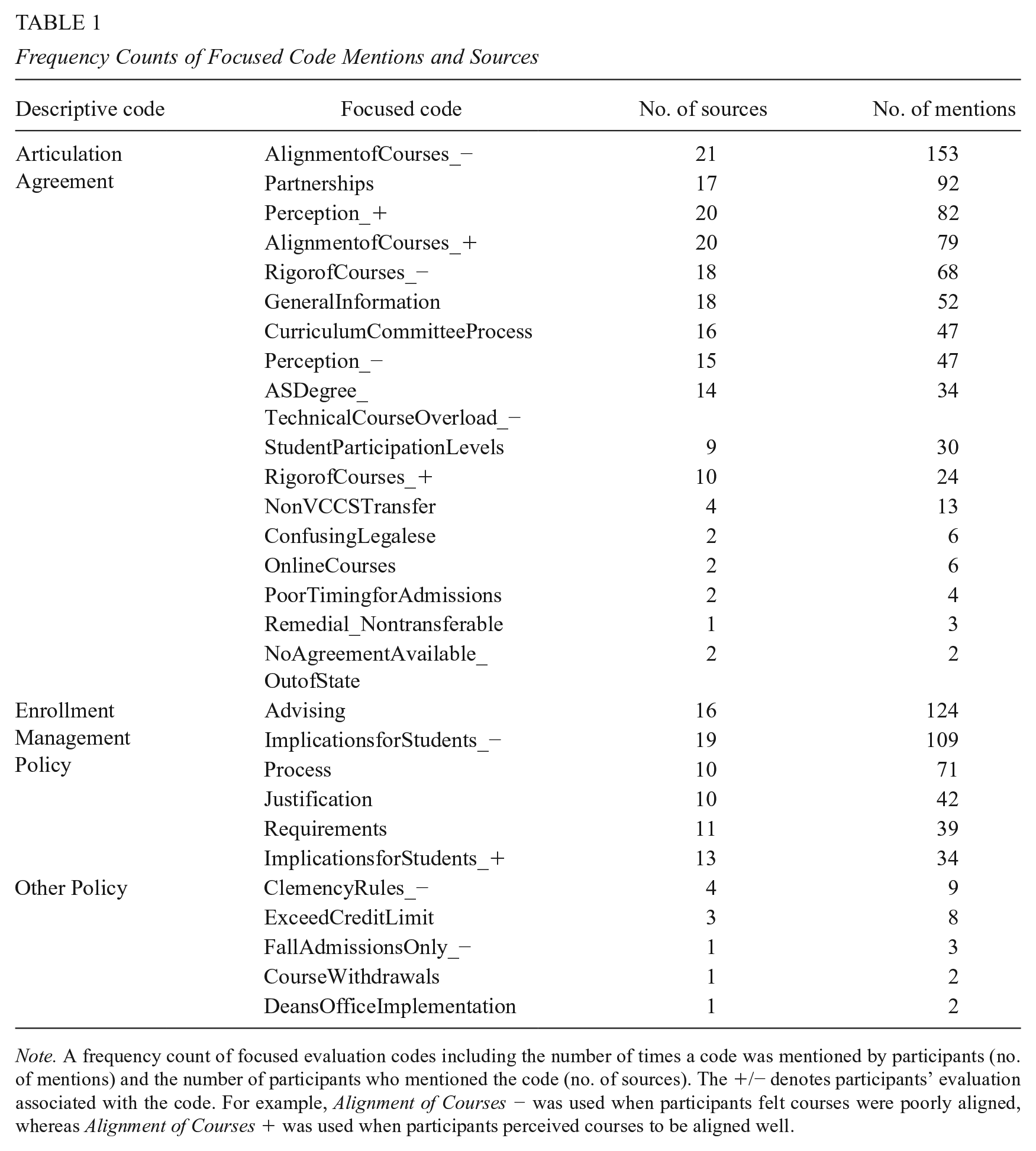
Note. A frequency count of focused evaluation codes including the number of times a code was mentioned by participants (no. of mentions) and the number of participants who mentioned the code (no. of sources). The +/− denotes participants’ evaluation associated with the code. For example, Alignment of Courses − was used when participants felt courses were poorly aligned, whereas Alignment of Courses + was used when participants perceived courses to be aligned well.
To illustrate the analytic process from initial codes to identifying themes, we provide the following example. In the initial phase of coding, we parceled out participants’ discussion related to implementation of the articulation agreement and of the EM policy. Then, knowing that street-level bureaucrats grapple with balancing the needs of the organization and its clients, we used focused and evaluation coding and found that participants described a series of negative implications for students that resulted from the implementation of the EM policy (e.g., coded Implications for Students −). Next, during the theme generation process, we discovered that many of those negative implications also linked to focused and evaluation codes from the implementation of the articulation agreement such as students becoming overloaded with technical courses in their first semester post-transfer (e.g., ASDegree_TechnicalCourseOverload). This largely inductive process, informed by street-level bureaucracy, led us to the discovery of policy collision, the prominent finding of this study.
To triangulate descriptions from the participant interviews, we generated a protocol to conduct a document analysis of the articulation agreement and EM policy. The protocol involved a systematic and iterative review of each policy examining the following elements: (a) purpose, (b) requirements, and (c) benefits and/or intended outcomes. Finally, we conducted a descriptive analysis of entering transfer students in engineering including student demographics. We also examined the types of courses in which transfer students enrolled during their first two semesters post-transfer. All courses taken by a transfer student in their first two semesters post-transfer were collated into three groups: (a) elective courses, (b) foundational preengineering non-major courses, and (c) discipline in-major courses. We then compared percentages of enrollment by transfer students in each group during their first two semesters post-transfer, which helped us to triangulate the impacts of colliding policies on transfer students’ course enrollments. We also examined transfer students’ performance (i.e., GPA) in courses during their first semester post-transfer to understand the scope of students impacted by the collision of policies.
Institutional and College Contexts
We bound this case study within the institutional and college contexts of this research. By Carnegie classification, the university of focus in our study is a “more selective, very high research activity,” land grant institution. Classified as a “lower transfer-in” university, around 17% of all new enrollments annually are transfer students, with a lower percentage (14%) of transfer students entering engineering. Engineering is the most prestigious college at the institution and houses the largest percentage of undergraduate enrollments. However, entry into many of the engineering disciplines is competitive. The institution has 14 engineering departments that enroll around 8,000 total undergraduate students annually. The college admits around 300 transfer students annually, the majority of whom come from the state’s community college system. For the Fall 2019 entering class of new engineering transfer students (n = 344), 16% were from minoritized race/ethnicity backgrounds (excluding Asian—30%), 15% were women, 2% were veterans, and 27% were first-generation.
We focus this article on the COE for three reasons. First, national calls persist to increase the number and diversity of graduates in engineering, which subsequently led the institution to invest substantial amounts of money toward the efforts of these colleges. Second, engineering is historically difficult for students to navigate as a transfer pathway because of sequential and credit-heavy nature of the curriculum, and so the field serves as a useful case study that has known barriers to transfer success. Third, the grant that supported this research sought to bolster this engineering transfer pathway, and this policy analysis is a way to improve that system.
The advising structure students encounter during the transfer process is multilayered with several hand-offs between departments at both the community colleges and the university. By design, new students at the community college are first assigned a generalist advisor out of a centralized advising office at each community college. Upon declaring a major, students are then assigned a faculty advisor within the engineering department at each community college. This faculty member interacts with students by teaching courses in the discipline and also serves as students’ academic advisor through the transfer process—all five community college participants in this study fit this description and are referred to as “faculty” throughout this paper. As students begin their transitions to the university, they interact with a staff member in the administrative office of the COE. Among other roles, this person serves as the recruiter for community college transfer students from the state system—this and other COE staff participating in our study are labeled as “administrators.” Once students are admitted to the institution and pay their matriculation fee, they are assigned to a professional transitional advisor housed within the administrative office of the COE or to a professional academic advisor within the general engineering program. These advisors also advise FTIC students during their first year at the university. Once students fulfill the requirements set forth by the EM policy, students are then handed off to an academic advisor within a degree-granting discipline based on their major. At the 4-year institution, the professional academic advisors hold the titles administrative/professional faculty or Professor of Practice. We use the term “advisors” in this article to refer to this final collection of participants because the institution considers advising responsibilities as separate from teaching.
Policy Context
The establishment of articulation agreements between the university and its state community college partners is linked with negotiations between the university and the state around a range of issues related to autonomy. To garner increased fiscal autonomy from the state, the university was compelled to create articulated pathways across the institution including for engineering (Leslie & Berdahl, 2008). The articulation agreement in this study was built by the COE in collaboration with the state’s community college system. The historical context around crafting the articulation policy at the university is not formally documented. Based on current practices at the institution regarding formalization of policy, creation of the articulation agreement may not have involved all departments within the COE and may have involved a voting process by members on a committee. Currently, administrators in the COE central office represent the university in formal negotiation of the transfer articulation agreement with the state community college system (SCCS). The articulation agreement between the COE and the SCCS outlines a prescribed set of courses, minimum GPA (i.e., 3.2), and denotes that students’ complete an Associate of Science (AS) degree for guaranteed admission into the university’s COE. The policy aims to facilitate a seamless transition for students from the community college to the university, a goal outlined in the official document detailing the agreement: The University’s COE and SCCS, recognizing the need to facilitate the transfer of students from the community college to [University] resolve to adopt a Guaranteed Admissions Agreement (GAA). [University] provides special opportunities to help [community college] students experience a smooth transition.
By meeting the requirements set forth in the agreement, the primary benefits for students are guaranteed admission into the COE at the university, access to a community college and university contact who can direct students to departmental faculty and advisors who can help students understand requirements for various majors at the university, completion of the university’s general education course requirements, and access to scholarships specifically for GAA and SCCS students. This articulation agreement is best characterized as an institution-level (institution-driven) agreement (Hodara et al., 2017); a detailed description of these types of articulation agreements is provided in the literature review.
After gaining admission to the university through the agreement, students are admitted into general engineering, a non-degree-granting program. To enter a degree-granting major within the COE (e.g., mechanical engineering or civil engineering), students must meet the requirements of the EM policy. The EM policy was formalized between 2010 and 2012, a period of growth for the university, and is believed to have served as a mechanism for “equitable” distribution of incoming students into engineering programs. The EM policy is best characterized as a policy that restricts enrollment flows into disciplines (Hossler & Bontrager, 2014). Based on findings from interviews, the process of creating and institutionalizing the policy was informal and driven by an ad hoc committee. Thus, like the articulation agreement, the process of formalizing the EM policy is not formally documented. The EM policy was created more than a decade after the articulation agreement and thus may have involved a largely different group of actors, offices, and departments in its creation. Currently, formal decision-making authority for the EM policy is shared across degree-granting engineering disciplines and is enforced by the general engineering department. The decision makers for the EM policy are not necessarily the same institutional actors that manage the articulation agreement in the COE.
The EM policy requires that transfer students complete 12 GPA-bearing credits at the university at a minimum GPA (3.0) to gain admission into the degree-granting major of their choice. Students need to meet a minimum GPA of 2.0 for eligibility for any degree-granting program. Unlike the articulation agreement, the official document outlining the EM policy does not include language explicitly specifying the purpose or intentions of the policy. The web page containing the admission process for the COE includes the following language: Once accepted to the College of Engineering, first-year and transfer students are admitted to the general engineering major, housed in the [General Engineering Department], where a major focus is allowing students the opportunity to explore the 14 degree-granting majors available at [University].
Understood in isolation, each policy serves a purpose. The articulation agreement explicitly expands access into engineering programs for transfer students through the community college path. The agreement outlines a set of requirements that, if met, result in students’ guaranteed admission, completion of the general education course requirements, and access to scholarship opportunities specifically allocated for transfer students. The EM policy, instead, funnels all new students, including transfer students, into a general engineering department to allow students to explore major options and to require students to take university courses and meet a GPA requirement before applying for a degree-granting major. Although less explicit in purpose and function than the articulation agreement, the EM policy acts to control enrollment flows into disciplines.
Results
Exploring the collision of an articulation agreement and an EM policy sheds light on the systematic complexities that occur for faculty and advisors responsible for implementing and enforcing both policies, as well as the implications on students who confront those colliding policies. We find that the articulation agreement functions as a sending policy designed to support transfer students as they transition to a university in engineering, whereas the EM policy functions as a receiving policy to coordinate enrollment flows into disciplines. Although both policies are distinct in purpose and are not designed to intersect, these policies collide for transfer students. The following sections detail several themes that emerge from the experiences of stakeholders operating as street-level bureaucrats at this policy collision (Figure 1).
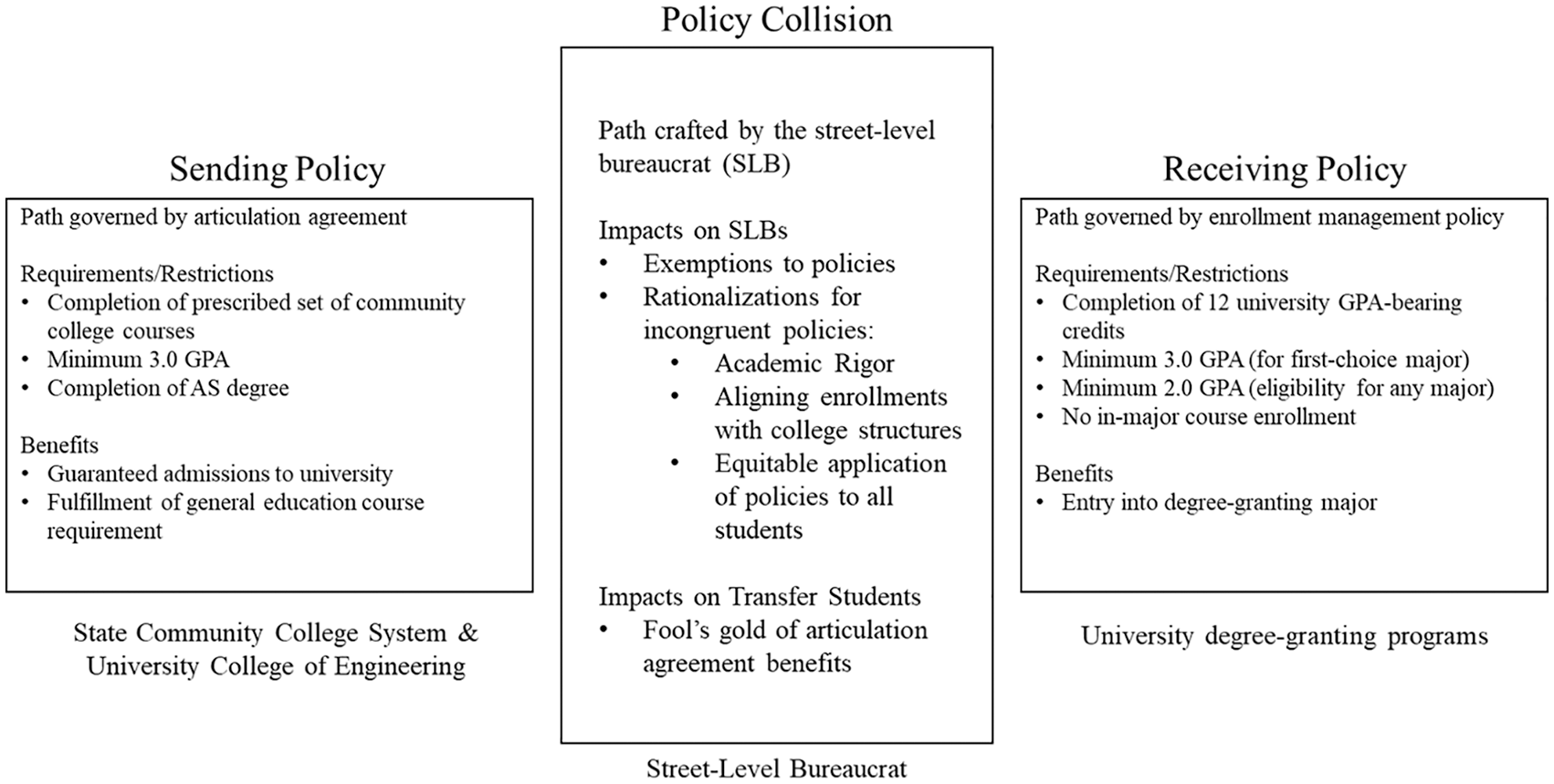
The collision of sending and receiving policies causes a policy collision that is managed by street-level bureaucrats.
Managing Policies as They Collide
Our analysis of interviews with street-level bureaucrats identified multiple themes. First, faculty and advisors modify parts of policies so that they work in better alignment during implementation. Next, we discuss rationalization processes that emerge as advisors, faculty, and administrators grapple with dissonance caused by the policy collision. Finally, we detail how the collision of policies negates some of the benefits included in the design of the articulation policy.
Exemptions: Street-Level Divergence in Response to Dissonant Policies
To manage the policy collision, the majority of university advisors and administrators interviewed (16 of 21; 76%) described making modifications to parts of the EM policy, often referred to by participants as “exemptions.” Specifically, university advisors and administrators enact small modifications to the policy during implementation so that it comes into better alignment with the articulation agreement. By design, transfer students who complete their associate’s degree in engineering before transfer often have completed most or all of their foundational core coursework (e.g., math, physics, chemistry). Thus, when students arrive to the university via the articulation policy, they should be positioned to take courses within a degree-granting department because they have completed prerequisite courses. However, the EM policy restricts any student from taking a course within a degree-granting major or discipline during their first semester. University advisors and administrators, acting as street-level bureaucrats, are left to make decisions about how to enforce the EM policy while simultaneously upholding the benefits of the articulation agreement policy.
In response, advisors and administrators have enacted exemptions to the course-taking restriction portion of the EM policy for transfer students. This type of exception is not made for FTIC students who also must abide by the EM policy during their first year at the university. One advisor details the exemption made exclusively for transfer students: That’s a policy that we do have internally that no one knows about except for transfer students and advisors who work with transfer students in our college . . . we do not allow a first year student to take discipline-specific courses that are major restricted until they’re in the major, but we do allow new transfers to take discipline-specific courses before being officially admitted.
Without this unofficial exemption, an advisor often is challenged to find courses for students to take in their first semester after transfer, which can hinder students’ timely progress to degree. An advisor highlights how the exemption has removed a barrier for transfer students: “I think because of the work we’ve done with the departments to gain access into the major level classes, I really don’t think it’s a hindrance to most students.” The adjustment of the policy is temporary and is reinstituted for transfer students immediately after their first semester: If you don’t get into [specific engineering major] at the end of fall, then you can’t take that [engineering major] spring class because you’re not in the major. That’s part of our enrollment management . . . we are busting at the seams. We cannot continue to allow non-majors in our classes, but we do make that flexible for our first time enrolled transfer student.
The collision of the benefits outlined for students who transfer using the articulation agreement is not well aligned with the EM policy restriction that precludes students from taking upper-level courses prior to being admitted into a degree-granting major. As participants grapple with competing policies, they exhibit agency and engage in street-level divergence (Lipsky, 1980) by modifying the EM policy to align with the benefits of the articulation agreement.
The override process is quite common; in examining students’ course-taking data during their first semester at the university (Fall 2009–Fall 2016), we find that 42% of courses (n = 12,663 courses) taken by transfer students in their first semester at the university are within a degree-granting engineering major department that would have required an exemption by an advisor. By design, transfer students are no longer exempt from the major restriction portion of the EM policy after their first semester when it is perceived by faculty and advisors that the policies no longer interfere with one another. There is some evidence, however, that the exemption may be extended beyond the first semester for some transfer students who do not meet the minimum GPA or credit completion requirements set in the EM policy to matriculate to a degree-granting major. Thirty-two percent of courses taken by students who remained in General Engineering into their second term (34% of transfer students) were enrolled in major courses that would require an extension of the exemption to the policy. These findings do not align with findings from interviews; advisors made no mention of extending the exemption that allows in-major course-taking for transfer students who remained in General Engineering beyond their first semester.
Policy Justifications: Making Sense When Policies Do Not Make Sense
To reconcile dissonance between and communicate the purposes for the articulation agreement and EM policies to students, participants engaged in a rationalization process, generating varied policy justifications that may or may not mirror the original intents. We discuss three frequently used justifications generated by participants in this rationalization process: (a) academic rigor of university engineering, (b) distribution of enrollment flows into disciplines, and (c) equitable policy implementation for all students.
Academic rigor of university engineering
Several university advisors and administrators pointed to “academic rigor” as the policy justification. This rationale was pervasive, emerging in conversations with 16 of the 21 (76%) university participants across nine departments. Despite the articulation policy guaranteeing university admission for transfer students, students must also meet the separate GPA requirement (3.0) in their first semester at the university for guaranteed entry into a degree-granting major of their choice. When asked by students why there are two separate GPA requirements, university advisors and administrators often attribute the requirement to the desire to ensure students are prepared to withstand the university’s academic rigor: The committee on enrollment management made a decision . . . that indicated that they wanted an actual university GPA before they would allow a student to go into a major. My assumption it’s to show proof that a student can withstand the university rigor when they transfer.
Another advisor suggested that the policy helps the university mitigate concerns about how community college coursework prepares students to be successful at the university: Then the 12 hours came about because we really thought these transfer students, they have a 3.5 at their institution, but we don’t know how their institution rigor compares really to [University]. We want them to have a solid number of hours here. That’s what we’ll make our evaluation on if they’re competitive for their major they’re wanting to go into.
One advisor felt the justification of rigor for EM policy was a university-wide theme, although most stringent in engineering: You have to prove to us that you can do [University] work. Right or wrong, that’s kind of the direction that we’ve gone. I don’t know that that’s engineering specifically. I think that is across the university. However, we have the most stringent enrollment management plan.
Although widely prevalent, justifying the EM policy based on the argument of rigor was not a unanimous belief. One advisor held a contrasting view, expressing concern for the potential implications that using “rigor” as a justification may have for incoming transfer students: I’ve heard colleagues say things like, “Yeah, you have to take 12 credits to prove to us that you can be successful in engineering.” I think that is what is concerning because I can see how [students] perceived that way and then if we have folks actually saying those words, then that’s trouble too.
Although not explicitly stated in its purpose, advisors and administrators at the university commonly expressed their belief that academic rigor was the primary function of the EM policy. Other participants have expressed concern with how making sense of policies in this way and communicating that justification to students can influence transfer students’ perceptions of their transition experiences to the university in terms of entering an unwelcoming environment.
Controlling enrollment flows into disciplines
Another justification that emerged from participants’ rationalization process was the need for the college to control enrollment flows into departments. This justification was less prevalent than the rigor rationale, but still emerged in interviews with seven (33%) university participants across six departments. One advisor explains, What the college was seeing was there were certain majors . . . at that time, it was [Department A] and [Department B], that the demand for those was just overwhelming. At that time, there weren’t really any restrictions on the number of students that could go in. Let’s say [Department C], not a lot of students really knew about that. They didn’t have a lot of applications, and everyone was going into these two or three. It was really causing a resource burden. When it comes around time to ask for faculty, [Department A] and [Department B] are saying we have more students, we need more faculty.
Based on this perspective, the policy intended to shift enrollment flows to align better with college resources, structures, and efficiency as opposed to responding to student demand: [Large departments] continued to get more, and then the smaller departments that don’t have as many students are continuing to get less. In essence, we’re hurting those departments while we’re just continuing to feed these other ones. We’re not using our resources strategically at that point. We’re just putting them in where we have demand.
This justification was pervasive across several disciplines within the college. One administrator cited the strategic push by the college to encourage students to enroll in smaller departments: “the College having so many of the university’s students. How to manage that number. How to allow . . . not unbounded growth in the college and have departments have the number of students that they can reasonably teach.” Another advisor similarly highlighted the criticality of the policy to help smaller, less sought-after departments increase their enrollment demand: We’re big, we have a big faculty, so we can teach a lot of students. [Department] is not as big they can’t teach as many students and plus, who wants to go to [Department]? Not very many people. I mean that’s just the reality of it. Or [Department] is another one for example. It’s a smaller unit than we are. I think that the GPA, and the credit issue is a big picture enrollment management process. And the college, I suspect, is still trying to figure that out.
How institutions grapple with meeting student demand and efficient allocation of resources is an important conversation and emerges as a different justification when these policies collide.
Equitable policy: Universal application to all students
A final policy justification that emerged from the rationalization process of university advisors and administrators was the need to apply policies equitably to transfer students and FTIC students. This justification was least frequent of the three rationales, emerging in interviews with six participants at the university (23%) across two departments. An advisor shares a perspective on why transfer students should also abide by EM policy guidelines: When that went into place, it meant that all students did come into [general engineering], because if we direct admitted transfer students, then we had a harder time controlling the number of students that went into each discipline. We had to put them into the enrollment management plan as well.
In this case, controlling enrollment flows for FTIC students into engineering disciplines also meant that the policy should be applied equally across all incoming students. A few other advisors surmised that admitting transfer students directly into major could lead to frustration and complaining from FTIC students and their parents, feeling as though FTIC students were not being treated equally for competitive entry into disciplines. One advisor elaborates on this perspective: When we went to this enrollment management plan in engineering about three or four years ago and stakes were so much higher for getting into the major that you wanted . . . [transfer students] still have to get in like a freshman would have to get in.
Under the assumptions of this rationale, excluding transfer students from the EM policy is seen as an unfair application of the policy, providing transfer students advantages not afforded to FTIC students who must abide by the requirements of the policy.
Including transfer students in EM processes is not without consequence, as one university advisor noted: “Most transfer students I feel like know what they want to do right when they come. Or they wouldn’t have spent two years at community college trying to figure it out.” Another important consideration for the inclusion of transfer students in EM policies is how it is perceived by community college faculty and the students they are supporting through the transfer process. As one community college faculty reflects on their experience informing students about the impending collision of policies, When I advise students and I tell them that they’re going to go and they’re going to get in to general engineering, it is a disappointment . . . the student feels like they did all this work, and they graduated, and they have a 4.0, but they’re not going to get into their discipline. I think that’s tough. I think it’s a perceived negative for them because I don’t think it actually, if they’re a great student, really impacts them there. But it’s perceived that way.
The use of justifications to explain incongruent policies, particularly when communicated with transfer students, may influence their experience during transfer.
Impacts of Colliding Policies on Students
To address our second research question, we sought to understand how colliding policies influenced the transfer of coursework process. An important theme that emerged in conversations with 14 of the 26 (54%) study participants was the unintended consequences of technical course overload for transfer students in their first semester after transfer. By transferring to the university through the articulation agreement, one of the primary benefits for students is satisfying the general education course requirement at the university. When examining the articulation agreement in isolation, this arrangement seems to be a desirable and enticing benefit for transfer students and guarantees the transfer of a portion of credits required for completion of a bachelor’s degree. However, faculty and advisors discussed how this benefit can actually end up harming students, particularly in their first semester after transfer, as students’ schedules are overloaded with technical, upper-level major courses. An advisor details how an engineering program’s curriculum (i.e., check sheet) is designed to help students balance difficult technical courses with nonprogram elective courses each semester and the implications for transfer students who lose access to the balanced curriculum by design: I worry a little bit about the burnout . . . the reason we have the check sheet the way it is is because it’s very balanced . . . you have the [Gen Ed Required Courses] littered throughout. . . . You have a balance of [program] classes and non-[program] classes. . . . But if you’re coming in and you’ve eliminated everything but the [program] classes that first year when you just start, it can be just kind of a killer. Just a motivational killer sort of thing.
Designed as an incentive for community college students to transfer via an articulation policy, students who have completed the general education course requirement are left with “nothing to take except for really, really hard classes that they’re just not quite ready for.” Table 2 shows the distribution of general education courses and compares courses allotted in the first 2 years of a program versus the latter 2 years; in aggregate, program plans are designed to have more general education courses in the latter 2 years as a way to balance the academic course load.
Distribution of General Education Courses in Academic Plans by Discipline
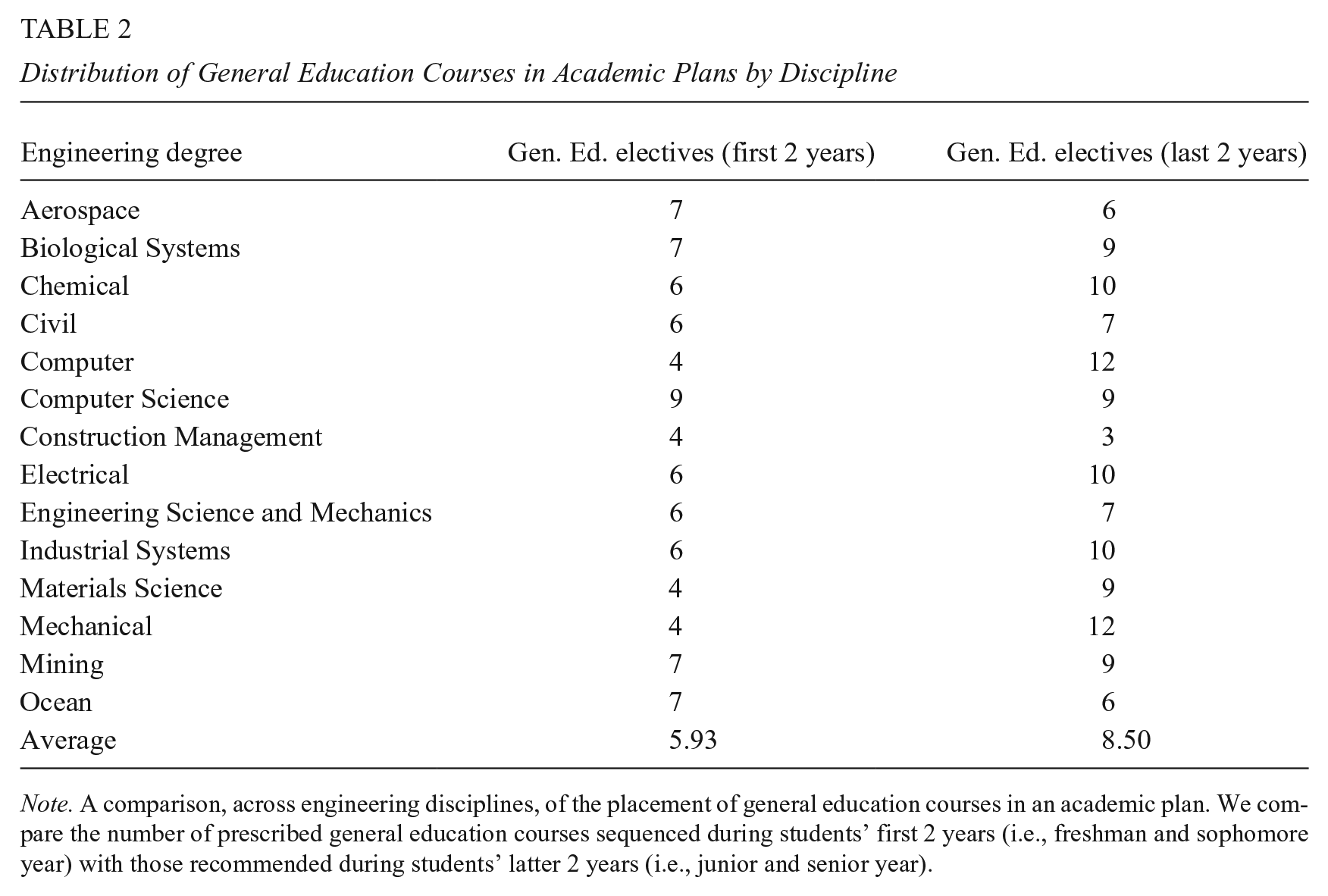
Note. A comparison, across engineering disciplines, of the placement of general education courses in an academic plan. We compare the number of prescribed general education courses sequenced during students’ first 2 years (i.e., freshman and sophomore year) with those recommended during students’ latter 2 years (i.e., junior and senior year).
On average across disciplines, academic plans include three credits more of general education in the latter 2 years than the first 2 years. This design helps students balance their workload in the junior and senior years as they contend with challenging upper-level major courses as well as a senior design project. Thus, although the intent of the articulation policy general education requirement waiver is to benefit transfer students, it conflicts with how classes are sequenced in academic plans across engineering disciplines for FTIC students.
The check sheets do not account for courses that transfer students actually take after transferring to the university. Consequently, we examined the classes in which transfer students actually enrolled their first semester after transfer and compared them with courses taken by FTIC students in their fifth semester, the semester most closely aligned with vertical transfer students who transfer via the articulation agreement. Transfer students enrolled in more major courses and fewer elective courses than FTIC students (Table 3).
Comparison of First Semester Transfer and First Year FTIC Enrollments by Course Type
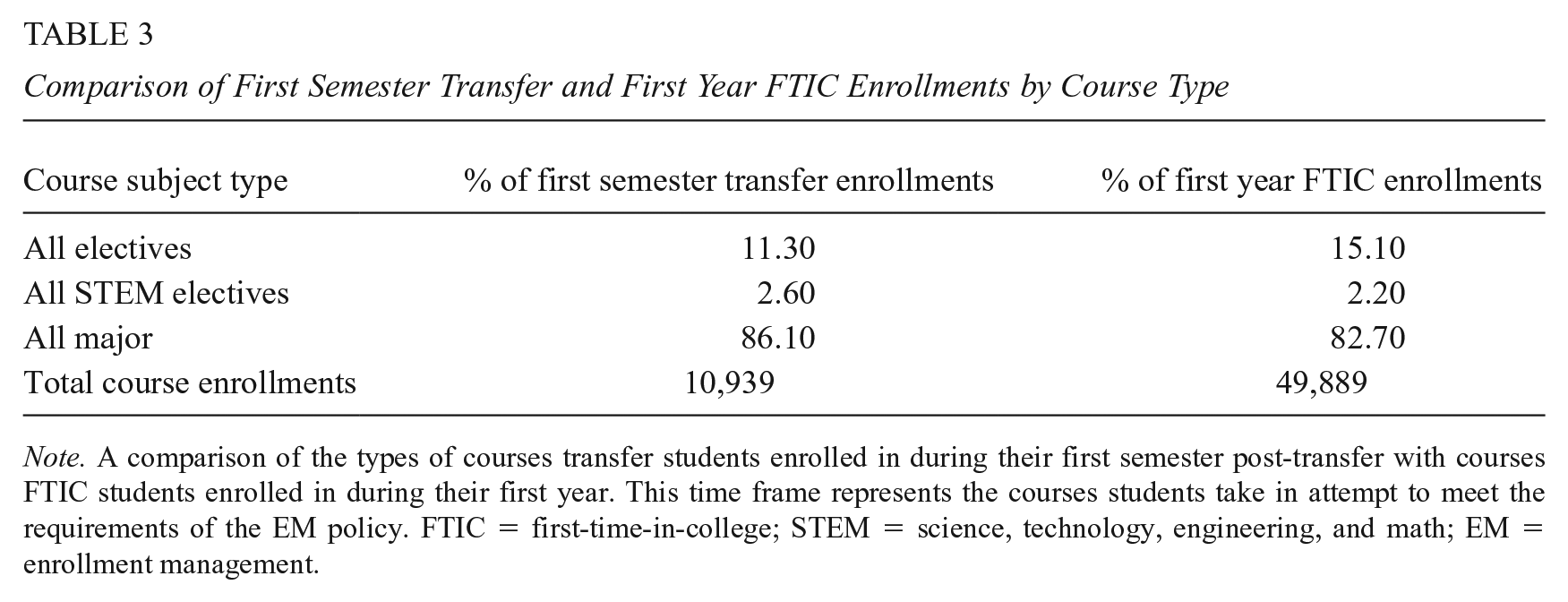
Note. A comparison of the types of courses transfer students enrolled in during their first semester post-transfer with courses FTIC students enrolled in during their first year. This time frame represents the courses students take in attempt to meet the requirements of the EM policy. FTIC = first-time-in-college; STEM = science, technology, engineering, and math; EM = enrollment management.
Further complicating the issue for transfer students is that in their first semester, along with enrolling in a higher number of difficult technical courses, on average, transfer students also had to meet the GPA (3.0) and credit completion (12) requirements of the EM policy to gain entry to a degree-granting major. Only 63% of transfer students in our data set met the minimum GPA requirement in their first semester for entry into their first choice major, with a median GPA of 3.19. An advisor reflects on frustration expressed by transfer students who feel the classes they are taking in their first semester after transfer are harder when compared with FTIC students who must meet the requirement of the EM policy after their first year of courses at the university: [Transfer students] say things like they don’t get any “frou-frou” classes, or whatever, which I get. That’s absolutely a challenge that I see. And we try and acknowledge that without adding fuel to their fire. We try and acknowledge that at orientation by emphasizing the importance of having a balanced schedule. So you don’t need to take 18 credits of junior level whatever engineering major. Let’s balance out other degree requirements, that might help.
This expressed concern of transfer students may be warranted, as the average weighted GPA of FTIC students in their first year courses is 3.12, which includes some general education courses. However, when examining the academic performance of FTIC students in the same set of courses that transfer students take during their first semester, transfer students (3.01 average) actually outperform FTIC students (2.97 average) in those same courses. Thus, institutional data support the perception that the EM policy implicates FTIC and transfer students in different ways.
Knowing students must complete 12 credits at a 3.0 GPA to enter into a degree-granting program, another advisor modified their recommended courses for students, particularly in the first semester after transfer, to help students successfully transition to the university. The advisor describes that although students could take a set of courses to advance more quickly toward degree completion after transfer and not enroll in general education courses, it may not be a best practice for their success: Sometimes, we also have to be careful about the number of discipline-specific courses that we’re recommending to transfers because we also don’t want to overwhelm them even though they can do something; it’s a matter of should they be doing something. But I also think we have to be careful about the types of courses that we’re putting our transfer students in right out of the gate. I think that we do need to take those things into consideration as advisors in our college and not throw them in all 4000 level classes in a specific discipline and allow them that semester of transition.
Another advisor shares a contrasting perspective and suggests that students advised to take courses to meet the requirements of the EM policy “get penalized for that because they’re not being advised to take classes that count towards their progression. It’s going to take them longer and longer to graduate.”
Although there is variation in how faculty and advisors choose to manage students’ technical course loads in their first semester, the impact of colliding policies is evident. One advisor expresses pessimism about the design of the articulation agreement for transfer students and expresses concern over how its current design hinders students’ ability to be successful in coursework after they transfer: That’s where it comes into a question of the associate’s degree is great to have on their record, and I know that the community colleges want it for graduation statistics, but it actually in a lot of times hurts the students if they come in with a full associate’s, because there’s just not anything here for them to take, whereas if you only do one year there, we can actually insert some classes into your first year here.
It seems that, particularly within this engineering context, the potential consequences of granting students’ fulfillment of general education coursework as part of an articulation agreement in combination with EM policy requirements may place students in challenging situations.
Discussion
We organize the discussion around four themes that emerged from our results. First, we compare and contrast our main finding, the collision of policies, with other education policy literature, focusing specifically on policy (in)coherence in the K–12 sector. Second, we contextualize how street-level bureaucrats manage the policy implementation process, focusing particularly on instances when implementation diverges from policy design. Third, we seek to understand the emergence of participants’ rationalizations for policy by connecting our findings to prior literature on EM policies and practices. Finally, we connect our results to prior research on transfer shock and design of articulation policies.
The primary finding of this study is that advisors, administrators, and faculty, acting as street-level bureaucrats, faced challenges in implementing two policies that collide for transfer students. Prior research in K–12 education policy points to similar challenges faced by frontline workers in public schools who, in managing multiple competing external demands, encounter policy incoherence or a lack of alignment of coordinated policies to meet educational goals (Fuhrman, 1993; Hatch, 2002; Honig, 2006; Knapp et al., 1998). Policy incoherence has been linked with school mismanagement, strained coordination and productivity, teacher turnover, and overall poor performance of schools (Fuhrman, 1999; Honig & Hatch, 2004). Ideally, K–12 schools, in collaboration with school district central offices, would “work together to craft or continually negotiate the fit between external demands and schools’ own goals and strategies” (Honig & Hatch, 2004, p. 16) to achieve policy coherence, a coordination of policies that support achievement of educational goals.
Policy coherence, in some ways, informs our findings of policy collision. First, policy coherence positions external demands as distinct from a school’s internal goals and strategies. In our case, to achieve more fiscal autonomy from state control (Leslie & Berdahl, 2008), the university was compelled by the state to formalize articulation policy, even if transfer was not a priority for the institution. In this way, establishing and managing the articulation agreement pathway for transfer students became an external demand that the institution was forced to manage in conjunction with EM practices and policies. Honig and Hatch (2004) conceptualize “crafting coherence” as a dynamic process of managing external and internal demands through policy and suggest that schools use goals and strategies to either bridge or buffer external demands. Bridging activities strategically engage external demands to advance internal goals, whereas buffering activities selectively limit the influence and incorporation of external demands (Honig & Hatch, 2004). If we adopt the perspective that the articulation agreement for transfer students moved forward because of external demands from the state, inclusion of transfer students in the EM policy could have been a buffering activity by the university, thereby limiting the influence of the external demand on internal enrollment goals. However, drawing these conclusions could also overstate transfer and articulation as purely an external demand for the university.
Policy collision also differs from policy coherence in several ways. First, policy coherence in the literature is primarily concerned with the relationship between schools and school district central offices, which often act as the centralized governing body for a collection of schools. In our case, articulation policies are formalized agreements between 4-year institutions and 2-year institutions that are distinct and have limited or no shared governing structure, at least within the state context of this study. Consequently, transfer articulation in this context is not a mandate and is not imposed, regulated, or enforced. In addition, the establishment of transfer articulation also may be an internal priority for the institution or for the college. In this way, policy collision would be a result of two competing internal goals of the institution, dissimilar from policy coherence, which is a result of conflicting external and internal priorities. Prior research on policy coherence also suggests that schools’ adaptation to multiple competing demands may improve performance, usually a result of additional resources (Hatch, 2002; Honig & Hatch, 2004). In our analysis of policy collision, the aims of each competing policy seem to be in direct conflict, however, where advancement of one policy does not advance the other. Finally, policy collision is a result of granular analysis of how two policies are implemented, as experienced by street-level bureaucrats. Policy coherence, in contrast, speaks more generally to policy design and alignment to institutional goals (Fuhrman, 1993; Honig & Hatch, 2004); it tends not to refer to the ways in which administrators, teachers, and principals navigate policies or programs that may conflict with one another during the implementation phase.
In response to colliding policies for transfer students, advisors, administrators, and faculty are compelled to implement the policies differently than they were designed. Street-level divergence, or a policy’s deviation from its original design as it is implemented (Lipsky, 1980), helps explain the process of exempting transfer students from policies. Many scholars have found street-level divergence to be an inevitable part of policy implementation, although the reasons for its occurrence are varied (Hill, 2005; Lipsky, 1980; Majone & Wildavsky, 1978/1984). One explanation is that street-level bureaucrats accrue and wield power within the organization by acting as boundary actors for the organization with its environment (Prottas, 1978). In our study, we find similar evidence of street-level bureaucrats wielding power as boundary actors for the organization (Prottas, 1978) with university advisors and administrators wielding power and acting with discretion as they operate as intermediaries between university policymakers and transfer students.
Loyens and Maesschalck (2010) shifted the focus away from accrual of power and control and instead found that street-level bureaucrats face inevitable complexity of work along with scarcity of resources that necessitate discretion in policy implementation. Furthermore, with scarce resources, street-level bureaucrats would develop routines for decision-making to avoid having to make individual decisions on policy enforcement for each individual client. Faculty and advisors talked extensively about the complexities of dealing with transfer student course plans and making decisions about what courses to recommend, particularly when students were not allowed to take upper-level major courses. As a result, an exemption was used as a mechanism by which to routinize the decision-making process for advising students with respect to course-taking, allowing faculty and advisors more options and less complexity in recommending courses. Gofen (2013) distinguishes between individual and collective street-level divergence, where the former is divergence executed by individual street-level bureaucrats based on individual client needs, and the latter is a divergence in policy executed collectively by an entire group of street-level bureaucrats. In our case, we find collective divergence as faculty and advisors have standardized the modification to the course-taking restriction portion of the EM policy for incoming community college engineering transfer students. Although findings of individual divergence for this policy did not emerge in interviews, it is possible that faculty and advisors are exempting students from the policy on a case-by-case basis, indicative of concealed divergence of the policy for second-term transfer students who had not yet transitioned into a degree-granting major.
Although other studies have focused on power and complexity as reasons to explain street-level divergence (e.g., Loyens & Maesschalck, 2010; Scott, 1997), we find that street-level bureaucrats are forced to engage in street-level divergence because of the collision of two disparate policies. In our case, although both policies serve relevant parts of the enrollment process for the university, the articulation agreement and EM policies were designed with different purposes by different groups of stakeholders. As a result, as students flow between the community college and university, they experience misalignment under the auspices of both policies, which is not experienced by other student populations. Faculty and advisors, then, as policy implementers for both, respond by having to adjust one policy or the other to bring them into better alignment.
Often policymakers and policy analysts consider policy spillover effects and externalities when designing a specific policy (Dunn, 2015). However, less frequently considered is how a policy will interact with other policies. This phenomenon is a particularly novel finding in the context of higher education transfer as most literature on articulation agreement efficacy does not consider interactions with other university policies. A consideration of this exemption is how advisors may end up making curricular decisions for students or at least may override structural and curricular sequence decisions enacted by curriculum committees; that overriding decision authority rests outside of the traditional governance processes of academic disciplines.
Confronted with colliding policies with disparate aims, we found that participants were compelled to a rationalization process, generating policy justifications that may or may not reflect those intended in the design of policies, particularly EM. EM policies often are designed and implemented at colleges and universities for the expressed purpose of funneling student enrollments to fit department structures and academic program resources (Hossler & Bontrager, 2014). Thus, it is not surprising to see participants deriving the enrollment funnel rationale for the policy. Although a wealth of literature exists on EM practices employed by universities to control enrollment flows for FTIC students (Hossler & Bontrager, 2014; Humphrey, 2006; Snowden, 2010), there is a dearth of literature on EM policies for transfer students. Our findings highlight a need to understand how EM policies are applied, or should be applied, to transfer students, particularly in contexts where institutions have articulation agreements for vertical transfer.
Rigor was the most prevalent justification and may stem from the fact that EM practices often target recruitment and selection of the most competitive student academically (Cheslock, 2005; Hossler, 2004; Hossler & Bontrager, 2014). The use of EM for increasing the academic profile and rank of a program is particularly prevalent in STEM disciplines (Nicholls et al., 2007; Phelan, 2000). Alternatively, the emergence of rigor as the most prominent justification could be related to the institutional and college contexts. As a prestigious and selective college within a more selective, lower transfer-in institution, institutional actors in this case study placed particular emphasis on rigor. This justification may not be as common for street-level bureaucrats at less selective institutions or within colleges with less competitive admissions. Regardless, there is emerging scholarship linking the use of rigor-based rationales to maintaining systematic privileges for those in power (Riley, 2017). Other scholarship has linked the use of rigor to perpetuate transfer stigma or the belief that community college transfer students are ill-prepared for the academic rigor of university coursework (Thompson, 2019). The prominent emergence of this rationale in our study may have important implications for transfer stigma that warrants attention in future scholarship.
Interestingly, in contrast with our first finding of street-level divergence, where advisors and faculty make exceptions to policies for transfer students, there was little evidence of faculty and advisors considering preclusion of transfer students from the EM policy altogether. Instead, equal application of the policy to all students was a commonly derived rationale for inclusion of transfer students in the policy. How policies should be enforced, and for whom, are considerations for policymakers throughout the process of creating and enacting a policy (Dunn, 2015). The decision to include students in application of a policy with workarounds or adjustments to it, rather than excluding them from the policy altogether, is a compelling finding that deserves more attention in future studies. The process of deciding between modifying policy to fit subgroup needs or excluding subgroups from its application is not something frequently explored in scholarship, particularly in the context of higher education and vertical transfer.
“Transfer shock,” or a temporary dip in GPA during transfer students’ first semester after transfer, has received considerable attention from transfer scholars and practitioners (Cejda, 1997; Hills, 1965; Ishitani, 2008). Transfer students face multiple challenges as they adjust to the university academically and socially, and we find that those adjustments may be compounded by the collision of articulation and EM policies. While designed as a benefit for transfer students in the articulation agreement, fulfillment of a general education coursework requirement may not be advantageous, at least as it intersects with the EM policy requirements in students’ first semester after transfer. We find that not only are students left with a difficult course load post-transfer, they also immediately encounter a high-stakes condition imposed by the EM policy to guarantee entry into their major. This collision may also be perpetuating inequities for community college transfer students who, to succeed in meeting admission criteria while completing a technically overloaded course load, may miss out on participation in cocurricular activities, forming peer relationships, and engaging in professional development opportunities that may be critical to future professional opportunities in engineering. The difficult circumstances that students encounter as they transfer influence and are indicative of how transfer receptive a 4-year institution is of the community college transfer pathway (Jain et al., 2011).
We are not recommending that future articulation agreements remove the general education incentive, nor are we recommending that universities preclude students from program entry requirements through EM policies. Instead, we suggest that policymakers at universities, at community colleges, and at state levels consider the collision of converging policies and the implications of their collision on students and how those students may be incentivized to behave in ways that extend their long-term degree progression to meet a short-term policy requirement.
Implications
Our findings have several implications for transfer students and for the scholars, practitioners, and policymakers who support them. We first discuss implications for faculty, advisors, and administrators serving as street-level bureaucrats during policy implementation. Next, we discuss implications for policymakers charged with designing policies for transfer students. We finish with some implications for research and policy analysis.
Implications for Street-Level Bureaucrats
An important implication from this study for advisors, administrators, and faculty, serving as street-level bureaucrats, is how they reconcile and rationalize implementation of disparate policies that collide for transfer students. Organizational pressures can lead street-level bureaucrats to adopt reductive and pathological moral dispositions, including indifference, enforcement, or caregiving when acting with discretion in policy implementation (Zacka, 2017). We found that participants generated varying justifications for the existence of policies, such as rigor and equal application of policies, that are then communicated to students. We suggest that it is important for street-level bureaucrats to understand the roots of why they generate these justifications. For example, the reliance on rigor to justify the tension between these policies may be emblematic of a larger power imbalance between the university and its partner community colleges, the latter of whom are supposed to be partners in adoption of the articulation agreement, but may not actually be considered equals by the former. Transfer partnerships have little chance for success if 4-year institutions and the institutional actors enacting them do not trust the education provided by community colleges.
Advisors, faculty, and administrators also should consider how these justifications for policy collision may be interpreted when they are communicated to marginalized students. Street-level bureaucrats may be the first institutional agents—practitioners at 4-year institutions in a position of authority (Dowd et al., 2013)—to engage with transfer students and, as a result, have significant influence on those students’ first experiences post-transfer. Institutional agents play a critical role in affirming transfer students’ transfer aspirations and collegiate identity, particularly for marginalized students (Dowd et al., 2013). Relying on academic rigor to justify the existence of colliding policies that negatively impact transfer students may fall short in affirming those students’ aspirations and collegiate identities and instead perpetuate students’ experiences of transfer stigma and self-doubt as they transition to the university.
Another finding pertinent to institutional actors serving as street-level bureaucrats is street-level divergence or the adjustment of policies to fit different contexts or needs. As street-level bureaucrats at universities grapple with colliding policies that affect students differently, how should they decide when to adjust policies to better fit the needs of a subgroup of students? In our case, faculty and advisors chose to engage in concealed divergence (Gofen, 2013), informing only transfer students about their exemption from upper-level coursework registration restrictions of the EM policy. Simultaneously, universal application of the policy to all students emerged as a justification for including transfer students in the policy. As universities balance EM practices and articulation agreements with community colleges, they will often face these kinds of predicaments when choosing who will be affected by policies and how exemptions or exceptions will be made and communicated to stakeholders. Street-level bureaucrats should be mindful of how, why, and in what instances they engage in street-level divergence and understand how those decisions impact students.
Implications for Transfer Students and Policymakers
Among the most prominent implications of this study is that transfer students are caught between a policy that expands access and another that constrains their progression. Policy collisions may influence subpopulations differently, especially when a policy designed for a different target population negatively influences a particularly vulnerable subpopulation. Concerted efforts to improve access through community college pathways may be largely undermined by other policy efforts like managing enrollment through selective admission policies. Transfer students who rely on the articulation agreement for transfer may also perceive the EM policy as another unnecessary barrier as they progress toward their degree and may be dissuaded from persisting. Policymakers who seek to establish equity-minded policies (Bensimon et al., 2016; Wang, 2020) and who are authentically interested in improving vertical transfer should consider ways to design articulation and EM policies that work together instead of relying upon street-level bureaucrats to make difficult decisions about which parts of policy to prioritize over others when there is conflict. This consideration is particularly important in the context of vertical transfer pathways, where students are already marginalized by the higher education system structure (Cohen et al., 2014).
University policymakers should also consider the explicit versus implicit nature of their policies. In our case, because the purposes of the EM policy were not stated explicitly, policy implementers were left to generate their own justifications for why transfer students were subject to the EM policy, particularly as students experienced dissonance with the tenants of the articulation agreement. Having multiple justifications for policies across street-level bureaucrats can create ambiguity among transfer students as they work with peers to transition to their new institutional environment.
Another implication of unwritten policies is that, for transfer students and the community college faculty and advisors supporting them, the planning process for coursework begins well before transfer. We found that community college faculty and staff were aware of the EM policy rule and communicated its existence to students in advance of transfer. However, because the policy, and particularly the exemption, was not explicit and public knowledge, students and community college faculty may not be aware of workarounds to coursework issues that emerge from colliding policies. Thus, students with lower amounts of transfer student capital, or the knowledge, skills, and abilities needed to navigate the transfer process (Laanan, 2004; Laanan et al., 2010; Santos Laanan, 2007), may be at a severe disadvantage. If a student is considering transferring and does not know to ask someone at the university about possible workarounds to the policy, or if that student does not have community college faculty advisors with insider knowledge or connections to university faculty and staff, that student might make a different decision about the transfer pathway. This scenario illustrates an important unintended consequence of having exceptions to policies that are not stated explicitly and publicly that yield inequities between students.
Implications for Research
Prior scholarship on articulation agreements has focused too narrowly on the contents of those policies without considering broader contexts. Findings from our study suggest that we should not examine policy solutions in isolation but from the perspective of their convergence with other policies. Understanding how other university policies, such as the EM policy in this study, collide with and influence the efficacy of an articulation agreement is often not considered. Policy interactions may help explain why articulation agreements may not be effective at increasing transfer or uncover how a component of the policy intended to benefit the student may actually have the opposite effect. This finding is particularly relevant for competitive disciplines that have additional policies in place “behind the scenes” to control access. Although examining policy collisions is applicable across contexts, it is particularly important in the context of this study as universities grapple with national movements to remain competitive in a global academic marketplace while simultaneously diversifying and making campuses more inclusive. In addition, there is a tremendous need for scholarship that examines how EM policies and practices at 4-year institutions impact transfer students. There has been little research examining this issue, and findings from our study point to its importance in bolstering the success of transfer pathways.
Findings from this study also have important implications for future research and policy analysis that examines policy implementation. For example, future studies examining the efficacy of articulation agreements may need to be more granular and involve practitioners who are acting as street-level bureaucrats. In our case study, we only discovered the policy collision by engaging advisors, administrators, and faculty who implement both the articulation policy and the college’s EM policy—previous work at the institutional or state level may not capture this type of interaction that articulation policies may have with other institutional policies. In addition, there is a general lack of focus on the implementation stage of policy creation and adoption in higher education, and this study highlights the value of close examination of this stage of the policy process. Future research on policy implementation can uncover organizational conditions and actors that may influence how a policy is realized during implementation. Finally, future research should incorporate students’ perspectives to understand the perceived impact of policies on students’ navigation through vertical transfer. Although we believe the faculty and advisors in our study have a deep understanding of the system through their close interactions with students, bringing the direct student perspective into this inquiry is an important next step.
Finally, as this is a case study, we recognize the need to bound the case within the institutional and disciplinary contexts of this study. The prevalence of policy collisions, particularly those where articulation policies designed to increase access intersect with policies constructed to preserve institutional and program prestige through selective enrollments, may be most salient in institutional contexts similar to the university in this study. Effectively aligning articulation policy with other university and college policies at a lower transfer-in institution may be more challenging than at medium or high transfer-in institutions. In addition, the engineering disciplinary context of this study, with its highly sequential curriculum and competitive admissions, seems more susceptible to policy collision compared with less sequential disciplines such as humanities or social sciences or in disciplines with less competitive admission standards. In addition, the collision of articulation and EM policies as described in this study is limited only to institutions that do not allow direct entry into disciplines. Institutions that admit students directly into degree-granting majors will not encounter this specific type of policy collision. Further research is needed to understand the prevalence of EM admission policies for transfer students that exist nationally. Doing so will be a valuable direction for future research to understand the extent of policy collision between EM policies and articulation agreements.
Conclusion
This article advances previous scholarship on articulation and EM policies by showing how they interact and influence each other at their collision. Exploring this phenomenon through the lived experiences of street-level bureaucrats (i.e., the faculty and advisors who have to implement policies), we find the collision of articulation and EM policies to be complex and potentially confusing, frustrating, and harmful for transfer students. We find that faculty and advisors engage in street-level divergence, making exceptions to policy to account for nuances in the needs of transfer students. Our study highlights the importance of seeking feedback from policy implementers during the early stages of policy creation. Furthermore, our findings suggest that the influence of other policies, like EM, may help explain why successful implementation of transfer articulation agreements may not act to support college student transfer, despite efforts from the state to mandate them (e.g., Leslie & Berdahl, 2008).
Translatable to other contexts, these findings suggest that other institutions will benefit from in-depth analyses of adopted policies, how they collide, how university faculty and staff manage implementation around those collisions, and what the implications are for students, specifically subpopulations of students. This article advances previous research on transfer students and policy impacts by engaging the complexity of converging policies and the emerging impact on students. Within the policy context, this research highlights the need to understand the transfer of coursework process beyond articulation agreements, examining instead the interaction of policies at the state, system, and institutional levels.
Supplemental Material
Dustin_Grote_Online_Appendix – Supplemental material for Exploring Influences of Policy Collisions onTransfer Student Access: Perspectives FromStreet-Level Bureaucrats
Supplemental material, Dustin_Grote_Online_Appendix for Exploring Influences of Policy Collisions onTransfer Student Access: Perspectives FromStreet-Level Bureaucrats by Dustin M. Grote, David B. Knight, Walter C. Lee and Bevlee A. Watford in Educational Evaluation and Policy Analysis
Footnotes
Declaration of Conflicting Interests
The author(s) declared no potential conflicts of interest with respect to the research, authorship, and/or publication of this article.
Funding
The author(s) disclosed receipt of the following financial support for the research, authorship, and/or publication of this article: This material is based on work supported by the National Science Foundation Engineering Education and Centers under Grant Number DUE-1644138. Any opinions, findings, and conclusions or recommendations expressed in this material are those of the author(s) and do not necessarily reflect the views of the National Science Foundation.

Authors
DUSTIN M. GROTE is a postdoctoral associate at Virginia Tech in the Department of Engineering Education. His research interests include community college transfer, broadening participation in engineering, and education policy advancing equity.
DAVID B. KNIGHT is an associate professor at Virginia Tech in the Department of Engineering Education. His research focuses on broadening and enhancing science, technology, engineering, and math (STEM) pathways, engineering education, educational systems, and organizational policy and change.
WALTER C. LEE is an associate professor at Virginia Tech in the Department of Engineering Education. He researches undergraduate student support, equity in education, and diversity in engineering.
BEVLEE A. WATFORD is associate dean of Equity and Engagement at Virginia Tech in the College of Engineering. Her professional interests focus on diversity, equity, and engagement in engineering.
References
Supplementary Material
Please find the following supplemental material available below.
For Open Access articles published under a Creative Commons License, all supplemental material carries the same license as the article it is associated with.
For non-Open Access articles published, all supplemental material carries a non-exclusive license, and permission requests for re-use of supplemental material or any part of supplemental material shall be sent directly to the copyright owner as specified in the copyright notice associated with the article.
