



Abstract
GUM is a linguistically-motivated ontology originally developed to support natural language processing systems by offering a level of representation intermediate between linguistic forms and domain knowledge. Whereas modeling decisions for individual domains may need to be responsive to domain-specific criteria, a linguistically-motivated ontology offers a characterization that generalizes across domains because its design criteria are derived independently both of domain and of application. With respect to this mediating role, the use of GUM resembles (and partially predates) the adoption of upper ontologies as tools for mediating across domains and for supporting domain modeling. This paper briefly introduces the ontology, setting out its origins, design principles and applications. The example cases for this special issue are then described, illustrating particularly some of the principal differences and similarities of GUM to non-linguistically motivated upper ontologies.
Keywords
Introduction: Historical background, motivations
The Generalized Upper Model is the current version of an ontology whose development begun in the context of natural language processing AI projects in the 1980s. As attempts were made to build computational systems capable of more sophisticated, and natural, ‘intelligent’ behavior, the need for detailed knowledge concerning the domains of application became increasingly clear. As a consequence, there were several initiatives both to suggest general principles of organization for domain knowledge reusable across domains and to deliver specific well-organized instances of domain modeling that could similarly be reused. Many early examples of proposed ontologies, including foundational ontologies, can be traced back to that time. In the vast majority of areas where natural language processing was attempted, however, there were no ready made domain ontologies available for use. One set of problems here relates to breadth – i.e., when constructing linguistic components capable of dealing with a substantial proportion of the expressive possibilities of a language, it is also necessary to determine how those resources relate to the content they are to communicate or interpret. Indeed, even when there are domain ontologies available, it is by no means straightforward to relate those ontologies to the kinds of knowledge organization supportive of natural language processing.
Echoes of this mismatch in modeling requirements return in a current point of discussion in foundational ontology design. One of the basic ontological design choices discussed in Masolo et al. (2003a, 7) is that between ‘descriptive’ and ‘revisionary’ ontologies. A descriptive ontology is “based on the assumption that the surface structure of natural language and the so-called commonsense have ontological relevance”; a revisionary ontology considers “linguistic and cognitive issues at the level of secondary sources (if considered at all), and does not hesitate to paraphrase linguistic expressions … when their ontological assumptions are not defensible on scientific grounds”. Prototypical examples of these ontology types are DOLCE and BFO respectively. The assumption that surface structures of natural language may have ontological import is widespread, but far from uncontroversial. Less controversial perhaps is the position that for certain applications of foundational ontologies, particularly those more related to human-level tasks and understandings (the ‘mesoscopic’ level according to Masolo et al., 2003a, 13), attending to linguistic patterning may be beneficial. There is, however, no automatic guarantee that the resulting chimera of foundational ontology and linguistically-responsive representations is necessarily a coherent goal.
The Generalized Upper Model adopts the descriptive approach but with an explicit additional separation imposed between modeling decisions that are linguistically motivated and those which are not. The question as to which modeling decisions are then ontologically relevant in the revisionist sense, i.e., as identifying the necessary organization of ‘the world’, is translated to a mapping task between ontological modules. On the one hand, the ‘module’ of the Generalized Upper Model accepts motivations for its internal organization solely on the basis of linguistic evidence, in a very specific sense to be explained below. On the other hand, it is accepted that foundational ontology modules developed on the basis of other criteria might well differ in their internal organizations. The framework as a whole thus presupposes a heterogeneous collection of linked ontological modules, where each might be subject to distinct sources of motivations.
The theoretical position adopted for the Generalized Upper Model has many consequences for how it is applied and, indeed, for the kinds of tasks that it is intended to serve. These lead it to differ in several substantial respects from some other traditional foundational ontologies. In short, the Generalized Upper Model seeks to reveal the necessary organization of any descriptions of the (human) world – and, in particular, of any descriptions mediated by natural language. The Generalized Upper Model consequently occupies a very specific theoretical location in relation both to natural language expressions and to contextualized interpretations of the meanings of such expressions. Whereas the latter are commonly related to the domain of foundational ontologies, the assumption that it is straightforward, or ‘philosophically transparent’, to move from linguistic expressions to contextualized interpretations is considered questionable. Formulating accounts in terms of the Generalized Upper Model is then seen as a way of helping to distinguish more systematically between linguistic processes and more traditionally ontological concerns. Since many philosophical forms of argument, particularly in analytic philosophy, rely on linguistic examples (or examples formulated to bring out distinctions in language use), this orientation to method is seen to be beneficial and so will be emphasized in the discussion of the particular case studies below.
The level of representation pursued by the Generalized Upper Model is anchored into patterns of linguistic expressions so that strong methodological guidance can be offered when moving from linguistic expressions to representations of the semantic commitments of those expressions. The tight relationship maintained between the level of linguistic expression and the categories and relationships of the Generalized Upper Model has the consequence that many regularly occurring patterns are explicitly characterized as linguistic processes relating linguistic meaning and form rather than constituting ‘revisionary’, or ‘world’-centered, ontological concerns. These processes range from the very general, such as nominalization, by which almost any elements contributing to a Generalized Upper Model specification can be ‘expressed’ as nouns – including events and relationships such as being the actor of an event and other roles – to more specific linguistic processes, such as the well-known ‘universal grinder’ (Pelletier, 1975), that enables count nouns to be used as mass nouns (‘add apple to the recipe’), and Bunt’s (1981) converse ‘universal sorter’, by which mass nouns can be turned into count nouns (‘we have three wines of note’). Moreover, and of particular importance for the discussion below, it will be shown how following the definitions of the categories and relations of the Generalized Upper Model makes it possible to ‘read off’ of a grammatical analysis of a linguistic expression a corresponding semantic characterization in a reliable fashion that ‘unwinds’ shallow linguistic processes such as nominalization. These semantic characterizations then provide a reference point for relating to further foundational ontological accounts without committing to the modeling decisions made in those accounts. Thus, in many respects, a Generalized Upper Model description may act as a bridge or statement of equivalence relating diverse foundational ontological proposals for the modeling of particular phenomena. This again stresses the importance of accepting a general model of ontology design based on heterogeneous accounts.
Positioning the Generalized Upper Model in relation to linguistic expressions and other foundational components in this way supports the practical task of modeling by providing a well-specified procedure for mapping between linguistic forms and semantic descriptions suitable for further ontological consideration. Such descriptions have been used both for automatic language generation (Bateman, 1997) and as a target representation in automatic language semantic parsing (Bateman et al., 2010). A useful analogy for the use of the Generalized Upper Model in a language processing scenario can then be made with respect to the role of word embeddings in machine learning: just as word embeddings, as continuous characterizations of semantic (and other) relationships, are better suited to subsequent numerical processing, a Generalized Upper Model semantic specification, as a well motivated and richly internally-structured entity, is more suited for subsequent symbolic processing than is the linear string of corresponding linguistic elements. Subsequent processing is explicitly intended to include interfacing with other foundational ontological characterizations relying on contextualized interpretations and situational grounding of various kinds (cf. Pomarlan and Bateman, 2020).
The origins of the Generalized Upper Model lie in a specific knowledge structure developed in William C. Mann’s ‘Penman’ text generation project (cf. Mann, 1983,1985a) for interfacing between domain knowledge and linguistic knowledge. This structure was consequently named the Penman ‘Upper Model’ (documented, for example, in: Bateman et al. 1990; Bateman 1990). Classifying concepts from a domain model under appropriate Upper Model semantic classes allowed those concepts to inherit all the general methods for linguistic expression defined for those classes in the Penman system. Automatic natural language generation could then proceed for the knowledge of the domain without further adjustment. The Upper Model itself thus offered a domain- and task-independent organization of semantic categories already similar in function to many more recently developed foundational ontologies, but with the additional property that a tight relationship with forms of expression in natural language was guaranteed.
The Upper Model organization went through several rounds of expansion. In the late 1980s, a cooperation between the Penman text generation project and the Bolt, Beranek and Newman Inc. (BBN) natural language understanding project explored the extent to which the various distinct sources of knowledge concerning language might be combined within a single architecture known as Janus (looking both ways) for language interpretation and production (Weischedel, 1989). This led to a thorough redesign of the Upper Model called the Janus abstraction structure (Mann, 1985b; Mann et al., 1985). An important facet of this redesign was to make far stronger use of motivations drawn from the linguistic theory adopted within the Penman project, that of Hallidayan systemic-functional linguistics (Halliday and Matthiessen, 1999). This orientation remained and was developed further throughout the 1990s, particularly with respect to including or covering distinctions revealed by the grammars of languages other than English (cf. Bateman et al., 1994,1995; del Socorro Bernados Galindo and Aguado de Ceo, 2001). At this point the organization was renamed the Generalized Upper Model (GUM) in order to reflect the broader range of evidence appealed to. Bateman and Lestrade (2014) then took this further with respect to issues arising in linguistic typology. Finally, in the context of the Collaborative Research Center Spatial Cognition of the Universities of Bremen and Freiburg (2003–2014), the Generalized Upper Model was extended significantly to address spatial semantics more broadly, adopting as before the linguistic (and, in particular, the grammatical) structuring of information as the primary source of motivations for semantic distinctions (Bateman et al., 2010). During this work, GUM was also updated to reflect more current knowledge representation practices and tools available for working with description logics and principles for productively enforcing the modularity that had always been assumed in the design, but not previously implemented.
Principles and structure of GUM
The approach adopted for developing GUM takes the underlying organization of the grammars of natural languages as a methodological guide for discovering those semantic distinctions and organizations that need to be maintained regardless of specific domains or applications. Support for this methodology lies in the observation that grammatical organization appears to be non-arbitrary; most current linguistic theories in fact assume that a tight relationship holds between the organizational properties of grammatical resources and those of semantics. Frameworks where this is followed range from generative grammar and treatments of ‘alternations’ (Levin, 1993; Jackendoff, 1999; Levin and Rappaport Hovav, 2005), through cognitive approaches (Langacker, 1988; Frawley, 1992), to the social-functional accounts that form the foundation for GUM (Halliday and Matthiessen, 1999). Particularly in this latter tradition, language is seen as playing an active role in any culture’s construction of its ‘social world’ and is by no means an arbitrary labeling of an independently existing ‘reality’. On the contrary, the social reality within which human experience unfolds is taken to be structured through and through by distinctions drawn in linguistic semantics (for further aspects of this discussion, see, e.g.: Bowerman, 1999; Levinson et al., 2002). It is this property that is argued to make straightforward boundaries between characterizations of the ‘world’, on the one hand, and linguistically-inflected constructs, on the other, problematic – particularly for the human mesoscopic level.
GUM therefore presupposes a view of language in which there is a strong non-arbitrary relationship between the grammatical organization of some language and the ‘experiential world’ constructed with and through that language. Language is seen both as providing access to, and as articulating, the world in a form that renders it intelligible. While a strong conventionalist stance of the kind that all facets of our ‘lifeworld’ (Schutz and Luckmann, 1974) are socially constructed is no doubt too strong, the divisions drawn by language can be seen nevertheless to offer a valuable perspective complementing cognitively-motivated distinctions. In many respects, just as any ‘reality’ is necessarily filtered through our perceptual systems, it is also filtered through the language system—at the latest whenever we wish to communicate (cf. ‘thinking for speaking’: Slobin, 1987). In an analogical sense, then, just as we might construct an ontology informed by the distinctions that our cognitive system appears to deliver to us (colors, shapes, objects, actions, etc.), GUM is informed by the distinctions that language delivers to us. Nevertheless, this remains of necessity a characterization of descriptions and does not commit to a simple construction of ‘the world’. This becomes increasingly relevant when moving into more abstract realms, including categorizations of activities, events and relations, which are often clearly social constructions and can be subject to quite divergent philosophical positions concerning how they might be best captured. Regardless of which philosophical positions are pursued, using GUM, grammatical evidence can be accrued for constructing bridging representations.
The use of linguistic evidence within GUM and the GUM development methodology hypothesizes that if a distinction is drawn in the grammar of a language, then that distinction may be usefully considered for its ontological correlates also. This contrasts with many other linguistically-motivated systems of semantics, such as FrameNet, VerbNet, WordNet and systems descended from these (Bateman, 2010c; Huang et al., 2008), in that GUM relies solely on grammatical distinctions rather than lexical distinctions. This distinction between lexical semantics and grammatical semantics is adopted as central because it is precisely the function of lexical items to be specific, to bundle semantic properties together for ready use in ways that might also be relatively idiosyncratic. Organizations of this kind are consequently considered less likely to reveal the kind of generic semantic configurations necessary for broader, foundational statements. In contrast, grammatical organization needs to generalize across both situations and individual types of entities and so promises a more robust indication of semantic import. Jackendoff argues this as follows: “…every major phrasal constituent in the syntax of a sentence corresponds to a conceptual constituent that belongs to one of the major ontological categories.” (Jackendoff, 1983, 67)
The GUM approach, and the linguistic theory it builds upon, assumes the most significant grammatical domain where semantically-significant alternations are located to be that of the clause. Thus, to uncover reusable semantic classes, GUM first considers clauses as they occur in natural everyday language usage. Reoccurring patterns of phenomena that appear mutually exclusive in linguistic data are taken as ‘reactancies’ of semantic distinctions; the notion of ‘reactance’ refers to the phenomena that entire collections, or ‘syndromes’, of grammatical choices appear to pattern together: that is, choices in one area will co-occur with choices in other areas. Whorf introduced such syndromes in terms of cryptotypes, covert semantic categories that are only evidenced by sets of overt linguistic devices (Whorf, 1956). Grammatical clusters thus identified are consequently hypothesized to correspond with semantic distinctions.
One of the broadest such reactancies is the three-way division of clauses into a grammatical process (typically expressed by some verbal component), a (small) set of obligatory participants in the process (typically expressed as nominal phrases), and a larger set of optional circumstances (typically expressed as prepositional phrases), setting out the manner, setting, location, time, extent and so on for the occurrence of the process. This grammatical pattern, reoccurring across most languages of the world, is taken by virtue of the non-arbitrary relationship assumed between grammar and semantics to be the most significant class for the subsequent organization of GUM. The covert semantic category corresponding to the pattern is labelled in GUM as a
Correlating directly with the primary three-way grammatical reactance,
The top-level categories of GUM are then as shown graphically in Fig. 1. The categories for temporal profiles appear on the left of the graph, the immediate subtypes of configurations run across the lower middle of the graph, and the further
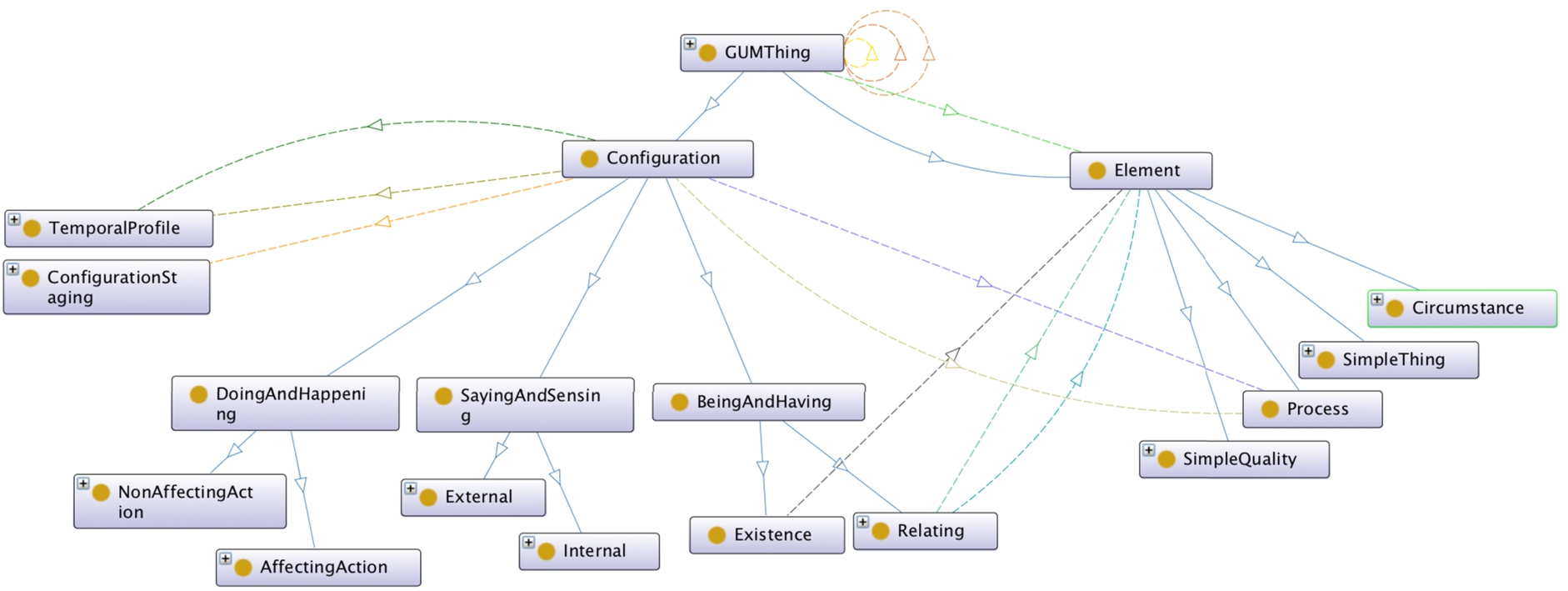
The upper taxonomy of categories in GUM.
Another useful graphical representation for the relationships between categories is that given in Fig. 2, drawing on the notation adopted for DOLCE in Masolo et al. (2003b, Fig. 5). This sets out the formal dependencies among the top-level GUM
Several very general modeling principles already follow from these distinctions. First, all modeling is oriented to a process view of phenomena – this follows from the centrality of the
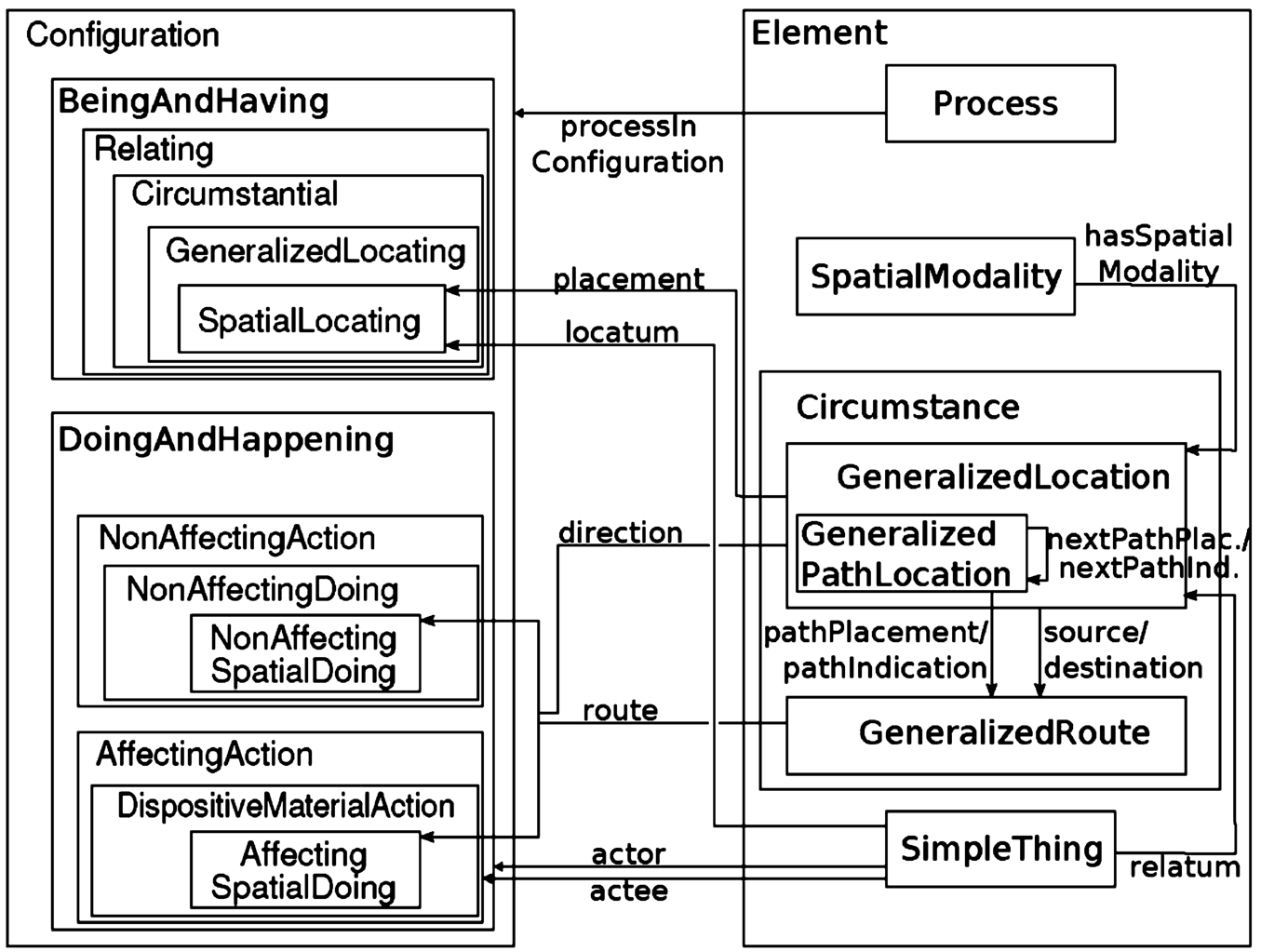
Dependencies between the principal GUM
All of the categories shown so far exhibit further diversification motivated by grammatical alternations observed in language use.
The category
The
The examples given so far have emphasized that the linguistic semantics according to GUM must be seen as characterizing descriptions of some articulated events, objects, situations, etc. In the technical terms of the linguistic theory used, the semantics construes events, objects, etc., assigning them particular organizational properties. GUM-descriptions therefore make no direct claims about the world, and so also relate to descriptions in the sense of Gangemi and Mika’s (2003) ‘Descriptions and Situations’ ontological extension for DOLCE. Establishing the precise relationships between these approaches would be a valuable investigation: GUM is then best seen as a foundational ontology of the content of a certain kind of description. Adopting an indirect relationship between semantics and the world in this way reflects and supports the observed flexibility of natural language use while still allowing underspecified semantic commitments to be reliably identified. Depending on their contexts of use, terms may take on quite different properties and so an appropriate semantics needs to be made responsive to this property without compromising the coherence of its own internal organization.
The ontological design principle of rigidity (e.g., Welty and Andersen, 2005) consequently applies here as well and motivates the maintenance of a strict ‘two-level semantics’ (cf., e.g., Lang and Maienborn, 2011) whereby semantic specifications only describe entities in the world; they do not give a referential semantics and properties of entities in the world. A classic statement of this was given by Hobbs over two decades ago in relation to the ‘ontological’ status of a spatial entity such as a ‘road’: “When we are planning a trip, we view it as a line. When we are driving on it, we have to worry about our placement to the right or left, so we think of it as a surface. When we hit a pothole, it becomes a volume for us.” (Hobbs, 1995, 820)
This means that the selection of some linguistic category, such as ‘road’, cannot be taken as a neutral labelling of the world. There may be considerable uncertainty as to where the limits of applicability of a term might lie and to what follows from such an application once made; this problem has received considerable study in the area of geographic entities (Bennett, 2001; Smith and Mark, 2003). As will be illustrated below, this consideration is also a further reason why it is beneficial to maintain an explicit connection to the mechanisms of linguistic expression. ‘Road’ is a lexical item, not an ontological category, but how we construct grammaticized embeddings of this lexical item leads directly via their GUM modeling to constraints-in-use (such as dimensionality, etc.) for which it should be possible to find further ontological evidence. Precisely which grounding will vary depending on the GUM categories ascribed.
In summary, GUM is an ontology-like organization of categories and relations that has been designed to provide grammatically-responsive semantics for any linguistic expressions. Specifications employing GUM generalize away from specific grammatical forms, while still maintaining sufficient contact with those forms to support natural language analysis and generation more straightforwardly. One of the most important roles of GUM methodologically is consequently to help distinguish and isolate cases of linguistic ambiguity, i.e., underspecification and potential divergences in what any linguistic expression, including those used in more philosophical discussions, are committing to. The resulting GUM descriptions may then provide more secure points of attachment for formalization that are not linguistically bound, since these no longer need to concern themselves with linguistic variability.
In the examples analyzed below we shall see how this can be a valuable step in providing ontological descriptions of particular cases. The areas selected in this special issue are areas where there is already considerable agreement in the formal ontology community concerning just what the phenomena at issue are, but this cannot in general be guaranteed to be the case. Indeed, in many areas there is still extensive discussion concerning modeling choices. This is actually illustrated in the last example discussed, characterizing the nature of ‘marriage’: here modeling proposals vary quite dramatically. In contrast, the characterization of the examples from the GUM perspective proceeds independently of any such discussions: it is not necessary to make philosophical commitments since the motivations drawn on are subject to linguistic analysis rather than requiring contextualized interpretations to begin. Nonetheless, the strong alignment assumed between grammatical organization and semantic distinctions means that the GUM analysis will isolate certain entities and relations, with particular interrelationships, that appear to be intrinsic to the descriptions of the phenomena at issue. This is how these phenomena are construed at the human-level, particularly when engaged for linguistic expression.
Distinct proposals for axiomatizations of the phenomena described can then be inter-related via their mappings to the GUM linguistic semantics – for example, contrasting formalizations of time and events may be related by placing them in correspondence with GUM semantic specifications, since particular kinds of temporal relations and temporal profiles of events are made grammatically manifest. A similar strategy can be explored in terms of simulations (cf. Bergen, 2012) as we mention further below. In this sense, GUM might serve as a ‘meta’-ontology relating both diverse proposals for formalizations and natural language correspondences. The notion of relating ontological modules by mapping rather than direct inclusion is particularly relevant here. Such mappings are to be seen as structured relations between theories as illustrated for spatial representations in, for example, Bateman et al. (2007). An approach of this kind might even be considered as establishing a rather different notion of ‘ontology design patterns’ (cf. Gangemi, 2005; Janowicz et al., 2016) that is more aligned with natural language expressions. Since we can ‘talk about’ any domain, i.e., produce language describing that domain, the GUM organization supporting this is automatically guaranteed a high degree of genericity and re-usability, a re-usability that extends to drawing relations both across potential axiomatizations and between different perspectives on phenomena within single axiomatizations. Just as ontology design patterns are intended to be independent of the ontological commitments made by specific ontologies, GUM is similarly to be seen as offering a further level of abstract description that might be applicable to differing formalizations of particular areas of concern.
This relationship between GUM specifications and other areas of potential foundational ontologies helps characterize the GUM placement of the case study areas as follows. In each case, the distinctions only occur in GUM specifications to the extent to which they are grammaticized.
Continuant vs. occurrent: this distinction is generally construed linguistically by means of ‘verbal’ expressions and ‘nominal’ expressions. In GUM this broad grammatical reactance underwrites the basic Independent entity vs. dependent entity: GUM maintains the grammatically motivated distinction between Processes vs. events: GUM maintains the distinction between a Properties, qualities, quantities: properties and qualities of diverse kinds are distinguished grammatically in many languages. These different reactancies are used to populate the Functions, Roles: many functions and roles are treated in a broad range of languages as analogous to kinds of ‘possession’: and so are placed within the
For many of these distinctions, it would be possible to consider importing into the GUM definitions stronger sets of constraints taken from more foundational characterizations to the extent that these are considered sufficiently stable; prior to formalization candidate constructs may be maintained as ‘interpretation policies’ as noted above. In general, however, the GUM definitions err on the side of caution in setting constraints so as to avoid compromising the flexibility of the language use supported. In addition, there are certainly areas of ontological interest which appear never to be grammaticized. This is itself an interesting phenomenon worthy of more research and may perhaps be indicative of notions that are so unvarying as part of the human mesoscopic layer that no language would ‘consider’ their grammaticization necessary. Conversely, some distinctions of general ontological interest may turn out to be ‘expressible on demand’ rather than warranting being baked into semantic alternations: many of the distinct kinds of collections identified by Wood and Galton (2009) appear to be of this kind although, again, more refined corpus studies may yet reveal grammatical reactancies here as well.
The original incarnations of the Penman Upper Model received formalizations in several languages and knowledge representation systems, as standardized description logics were still some time away. Within the Penman project, the upper model was primarily represented in the Loom knowledge representation language (MacGregor, 1993), a representational form itself influenced by the Knowledge Interchange Format (KIF) used in several ontology projects and extended with automatic classification, role reification and further capabilities for reasoning. Currently, versions of GUM are maintained in OWL-DL. This representation is relatively straightforward given the similarly straightforward nature of the axiomatization pursued within GUM. The current version of GUM (including the spatial ontology module) lies within
Since GUM is not intended to operate independently of other ontological descriptions for the areas it covers, it is presumed that in actual situations of use there will be links defined heterogeneously with further ontologies and reasoning components. GUM only contributes those aspects of a description of any situation, event or object that need to be made explicit when considering verbalization. Other aspects, relevant for other concerns, may best be captured in separate foundational ontologies. The design principles of GUM consider such modularizations to be critical for allowing each ontological module to focus on the classes of distinctions relevant for its aims. Merging potentially incompatible criteria for classification is generally to be avoided. In important respects, this approach is inherently committed to multi-perspectival ontologies and to heterogeneous ontologies in particular and avoids prejudgements concerning which perspectives may be considered ‘basic’ or ‘foundational’ as ideological positions. Within this design approach, each ontological component needs to be free to address its own class of requirements and problems; relating across such ontologies – as is now, for example, supported by the Distributed Ontology Language standard (DOL: Mossakowski et al., 2013) – is a distinct task. This is then the general challenge of mediation between ontological organizations that have been motivated by domain and application, on the one hand, and organizations motivated by the needs of expressing that information in natural language, on the other. These distinct purposes do not necessarily lead to organizational structures that align. In short, use of GUM is always to be seen in combination with further ontological (and other) components in heterogeneous environments of representation and reasoning (cf. Bateman and Space, 2013; Bateman et al., 2018).
Traditionally, the form of semantic expressions used when discussing GUM descriptions of particular cases has been the semantic specification of the original Penman system: Kasper’s (1989) Sentence Plan Language (SPL).1
Many examples of SPL specifications are included in the linguistic resources available with the KPML natural language generation system (Bateman, 1997) as illustrations of use.
Specifications in GUM are centered around ‘events’, or what in linguistic semantics are often termed eventualities: this is strongly motivated by grammatical concerns since events are the most natural correlates of grammatical clauses, which are themselves the units most transparently (i.e., iconically) linked to semantics. Many specifications according to GUM are consequently expressed as Neo-Davidsonian conjunctions of events and relations between those events and further entities (cf. Higginbotham, 1985; Parsons, 1990; Maienborn, 2011). Different types of events are distinguished primarily by the kinds of relations that they may enter into and the types of entities that are permitted to fill those relations. The broadest categories of eventualities used in GUM are the
Use of GUM to provide semantic specifications for any linguistically expressed descriptions generally begins by identifying the discourse referents that any linguistic description introduces and then adding constraints to those referents as motivated by the grammatical forms deployed. The constraints follow directly from the definitions of GUM categories and determine those semantic configurations that the specific linguistic expressions commit to. Since linguistic expressions are commonly incomplete and underspecified, assigning a GUM-description will also usually provide a fully explicit template of information that is technically ‘missing’ from the information actually present. Filling in such missing information is always a primary task in providing fully contextualized interpretations, which are themselves a prerequisite for further ontological analyses. Assigning GUM descriptions renders this often implicit process open to examination. When GUM is used in actual NLP systems, additional semantic or lexical features required for non-propositional aspects of the semantics (e.g., interaction, speech acts, information statuses and similar) are typically provided; these will not be considered further here although we will need to indicate some aspects in the formalizations offered. This will be shown with certain extra-logical notations that will be introduced as we proceed.
In order to illustrate the approach, and before proceeding to its application for the set example cases discussed below, we will consider the construction of a GUM specification for the simple sentence: “On Tuesday Mary gave the boy a book”. Several discourse entities are straightforwardly projected by this clause: the eventuality of Mary’s giving this specific book to the boy at that time is
Finally, there are several additional facets of the specification enforced by the GUM definition of
Since the current paper does not focus on lexical semantics, the precise internal contents of
The designated purpose of GUM of providing a level of linguistic semantics also serves a methodological role during the formalization of specific cases. In many respects, producing a formalization is pursued in an analogous fashion to the task of performing natural language analysis conforming to the guidelines that GUM provides. This means that one does not, at first, consider what the examples might ‘mean’ independently of their linguistic organization. On the contrary, their potential meanings are derived from that analysis. This is then an important contribution to avoiding arbitrary modeling decisions: in all cases, it is the grammatical patterns involved that serve to guide description.
The semantic characterizations resulting from this procedure then mediate between (primarily) linguistic representations of states of affairs, actions, plans and so on, on the one hand, and contextualized interpretations of their meanings on the other. Modularization of this kind is an effective way of avoiding, or at least placing reasonable bounds around, the task of general world modeling. It is necessary to consider only the degree of detail demanded to create the semantic specifications. The method that is pursued for addressing each of the examples in this section follows this strategy. In each case, the linguistic units expressing the situations to be considered are translated into semantic specifications making use of the GUM categories, thereby respecting explicit modeling strategies and decisions.
The basic assumption of the framework is then that the organization supporting such modeling is far from arbitrary: instead it reflects cultures’ implicit and historically-driven ‘theories’ of the human world. Descriptions unfold with respect to developing models of the situation just as the language expresses or reproduces those models. The function of a GUM description is to provide precisely the anchor points, or links, that demarcate where ontological descriptions at other levels of abstraction may hook into human-scale descriptions. Maintaining certain aspects of a complete semantic description outside of the GUM description opens up the door to further experimentation with a range of theoretical treatments of those areas: it is not necessary, for example, to commit to particular models of space, or time, or of properties (cf., e.g., Bateman, 2010b). What is motivated grammatically appears to be restricted to descriptions of temporal entities (which may be extended or not) with respect to which configurations may be situated and which may themselves be placed in particular orders that help determine how collections of
Composition/constitution
“There is a four-legged table made of wood. Some time later, a leg of the table is replaced. Even later, the table is demolished so it ceases to exist although the wood is still there after the demolition.”
As noted above, modeling with respect to GUM is always event-based. Concretely, this means that we consider the example as a short mini-narrative where several things happen. We proceed by analyzing the narrative rather than by assuming that we know what the intended issues here are meant to be. This leads us to explicitly confront areas of potential ambiguity and to demarcate where precisely various sources of knowledge must come from. This in turn provides guidance for the modularities that need to be adopted when working towards an ontological description. We do not, therefore, consider the questions of composition and constitution and their behaviors over time that are intended here before doing the narrative analysis because the GUM-based treatment will lead us to these considerations in any case. This is one of the main methodological gains of the entire approach.
First, the specific mini-narrative at issue brings together six distinct
The adoption of
There is a significant further aspect of the consideration of a table’s parts that has much broader implications, however. The fact that tables have parts (and so lend themselves to the corresponding use of grammatical constructions presupposing parthood) is itself a contingent social fact bound primarily to the lexical item (or family of lexical items) that help define what is to be considered a table and what not. An adequate description needs then to separate out the commitments made according to the social definition of table and the ontological characterization that holds of whatever social definition that is adopted. This relates to notions of artifacts and design. For current purposes, we will talk of ‘plans’, ‘blueprints’, or ‘semantic schemas’, which articulate sets of descriptions which establish the properties that are to hold of any entity. These blueprints are considered small narrative units in their own right and so their contents are also to be characterized in terms of the categories provided by GUM. Such ‘narratives’ correspond to what might in some approaches be considered ‘ontologies’ of the entities so defined (e.g., ‘tables’); Bateman (2019) presents more from this, essentially semiotic, perspective on ontological specifications and we will return to this particularly in the discussion of the final example case below.
A blueprint, or semantic schema, for tables might then state that tables have certain parts, such as legs. The GUM-semantics provides the means of saying that certain entities have certain parts, but does not pronounce on this further. It is therefore considered part of lexical knowledge concerning ‘tables’ that they stand in a generalized possession relationship with ‘legs’ and, in a different sense, ‘head’, but not, for example, with ‘bones’, ‘arms’, and so on. Blueprints in general also need to make use of the further possible circumstantial modification of
Finally for this first sentence, since all of the information additional to the existential is expressed without clauses, their corresponding temporal profiles and anchoring on the timeline are inherited from that of the existence configuration
The corresponding eventuality of the following sentence is described as being straightforwardly anchored into the timeline at some point following the time of reference of the first sentence. ‘Replace’ instantiates a further subcategory of
Formally, this indicates that the set of expressions in which such underlined entities occur are placed within a larger discourse structure tree such that the antecedent of the underlined discourse referent is accessible. Variables with generally be numbered successively within each separate example to aid the discussion. All such variables are consequently distinct discourse entities.
This ‘reversal’ is actually managed at the level of the ‘participant’ roles,
The overall meaning of the sentence is then gained from a unification of the specific lexical semantics of the verb ‘replace’ and the semantic frame given by the GUM-description. For the lexical semantic component there are several possibilities discussed in the literature but again, grammatical reactancies lead to a minimal commitment that is necessary regardless of the specific semantics taken. In particular, it must be specified that there is some ‘pre-state’ allowing elements to be picked out, and a ‘post-state’ in which one or more of the elements picked out are no longer present. The importance of having semantic access to internal event structures of this kind is shown in grammatical reactancies such as the ‘imperfective paradox’ discussed by Pustejovsky (1991) and others:
John is running. John is building a house.
Although both configurations are ongoing, they are viewed ‘from within’ their unfolding and, at that point, the second case has not yet reached its culmination. Semantic classes of verbs can then be characterized as belonging to one of three basic event types: states, processes and transitions according to their pre- and post-state behaviors (Pustejovsky, 1991, 56). Using these semantic descriptions to construct a model of the example situation concerning the table then gives us two intervals corresponding to the two ‘part-of’
In the next sentence, the table is ‘demolished’, which is also a straightforward case of the
Different verb choices would lead to quite different characterizations. ‘Demolish’ may, for example, be distinguished from the verb ‘dismantle’, which may well leave the parts intact. In both these cases, GUM says nothing about what happens to the material associated with the entity under discussion. This is in general correct – what is left following the demolition depends entirely on the details of the demolition process. The lexical semantics does not involve any change of the material and so no modification of the material quality attributed to the object is entailed: this is the general approach taken to successive discourse construction, descriptions continue to ‘hold’ until they are retracted. But the situation can be quite different with a different class of verbs: for example, the verb ‘burn’ would typically not leave the material unaffected. This then requires attention to the status of the wood as a dependent entity with respect to the table when combined within a
“Mr. Potter is the teacher of class 2C at Shapism School and resigns at the beginning of the spring break. After the spring break, Mrs. Bumblebee replaces Mr. Potter as the teacher of 2C. Also, student Mary left the class at the beginning of the break and a new student, John, joins in when the break ends.”
This case study example is intended to focus on how roles, the fillers of roles and organizations interact under change. Again, we will see how the GUM analysis leads to these issues directly. As before, the sentences are analyzed one after the other as if an automatic semantic analysis of the narrative was being performed, thereby anchoring the terms of discussion. The first clause introduces several discourse referents as
Concepts classified as
The discourse entities introduced directly by the current example following the principles illustrated previously are: Mr. Potter:
The second part of the sentence is then a simple
Certain uniqueness conditions are grammaticized, such as ‘the teacher of the class’ vs. ‘a student of the class’, but these follow more generally from identifiability for all descriptions, not only role configurations.
When Mrs Bumblebee (
The final sentence offers a good further example of the value of adopting a two-level semantics where the linguistic commitments are not immediately cashed out in referential semantics. The verb ‘leave’ is a straightforward spatial
Thus, in addition to a simple spatial contextualization, unpacking the metaphor to refer to a change in role status is equally (in fact, given the discourse context, more) likely. With the role playing interpretation foregrounded, the termination of the role relationship can be encoded directly in GUM making use of the temporal profiles defined for all the
“A flower is red in the summer. As time passes, the color changes. In autumn the flower is brown.”
GUM models attributions of properties as a further subclass of
The GUM representation of the first color attribution (
In the second sentence, the nominal phrase ‘the color’ picks out a referent by the type of property attributed. As the phrase is interpreted in context, it can be seen as an abbreviated form of ‘the color of the flower’; this is a pragmatic interpretation and so is a defeasible inference, not a logical entailment. Nevertheless, it is crucial to take this extended semantics into account when producing the semantic analysis corresponding to its use. The nominal phrase acts analogously to a nominalization of the color ascription focusing on the attribute role. This means that it is not talking of any one color that the flower may have, but the filler of the attribute role of the configuration of color ascription whatever that might be. Such constructions occur frequently with descriptions generated from linguistic expressions and have received a variety of treatments in the literature; this is also similar to the role-player nominalizations of the previous example. In the combinatorial categorial grammar treatment of Bateman et al. (2010), ‘unsaturated’ semantic descriptions are taken as lambda expressions which are combined compositionally by function application during parsing (cf. Steedman, 2000). In the present case, therefore, ‘the color of the flower’ may be considered as being equivalent to a lambda expression for ‘x’ with the following GUM specification as the body of the expression:
The second sentence then says that this attribute changes. ‘Change’ is straightforwardly classified as a configuration of type
In the final sentence, the GUM specification is very similar to that of the first sentence, but with a different explicit color given (‘brown’: “A man is walking when suddenly he starts walking faster and then breaks into a run.”
This example is also focused on change and turns out, in many respects, to be quite similar to the previous example. The GUM modeling focuses again on the temporal profiles of the
The second sentence makes explicit just what component of the range of possible additional circumstantial relations is relevant for the present case. The adverbial ‘faster’, as a comparative for ‘speed’, introduces a discourse referent related to a
Phase terms (‘start’, ‘finish’, ‘continue’) have distinctive grammaticalizations; some languages, e.g., Chinese, build these into complex components of their aspect systems. It would also be interesting, therefore, to contrast expressions involving ‘start’, ‘breaking into’ and so on in languages that make different temporal commitments; a consideration of, for example, the Chinese aspect system within a similar framework is given in Yang and Bateman (2002).
Finally, in the third sentence, ‘breaking into’ expresses an intensified variant of ‘start’ with more or less the same semantic description. What is then different is that the classification of the configuration also changes. Note, however, that the fact that ‘walking faster’ can become ‘running’ is a matter for the lexical semantics of the respective categories. This might be represented in many ways – for example, by capturing the commonality between ‘walking’ and ‘running’ in terms of a mode of locomotion using legs and feet with a (socially defined) boundary depending on speed (or, more conventionalized, whether at least one foot is on the ground at all times, etc.). The precise conditions for selecting ‘walking’ or ‘running’ are then, again, just as with tables and their ‘legs’, or with classes and their teachers, subject to the social definitions given in a corresponding semantic schema for types of locomotion. What the three configurations together describe is a kind of activity (foot-based locomotion) whose rate of unfolding increases over the three time periods constructed. One might express this in various ways, such as, for example: “the man moved faster and faster” or “the man started moving slowly, then moved faster, and then faster still”. The fact that different ‘modes’ of locomotion, or gaits, correspond to different solutions to combined body-part movements in a system (cf., e.g., Granatosky et al., 2018) is considered the responsibility of a strictly separate module, whose transitions may, or may not, correlate with the socio-cultural linguistic labeling.
“A man is walking to the station, but before he gets there, he turns around and goes home.”
In this example, there is more explicit use of spatial semantics and, in particular, the combination of spatial and lexical verb semantics to determine whether events are bounded, continuous, completed, and so on. Pustejovsky (1991) gives examples of such phenomena with the sentences:
Mary walked. Mary walked to the store. Mary walked for 30 minutes.
These all have different temporal ‘profiles’ and so combine differently with further grammatical constructions. In GUM terms, the first is a straightforward unbounded
Without further information, therefore, the use of ‘walk’ in the present tense in the first part of the sentence in example (4) would be unbounded and continuous. However, since it is modified further by the spatial location ‘to the station’, the eventuality described becomes an accomplishment. The closing boundary of the eventuality is defined by the actor of the eventuality being in or at the location given. GUM models this as a particular
The expression ‘before he gets there’ in the second part of the sentence builds a temporal relation between the descriptions of the times associated with the two configurations. More specifically, it may be interpreted as constructing a description of a time within the time interval over which
Concept evolution
“A marriage is a contract that is regulated by civil and social constraints. These constraints can change but the meaning of marriage continues over time.”
On the surface, this example is a case of a label being maintained while the criteria for the application of the label change, although there is also a suggestion that the label has some ‘core’, or ‘basic’ meaning that does not change. The translation of this mini-narrative into corresponding GUM specifications is straightforward but also revealing of a considerable range of ambiguity in what might be intended. On the one hand, this is again considered one of the benefits of adopting the GUM method – i.e., one is forced to consider ambiguities or unclarities in what one is attempting to model. On the other hand, it also enables important parallels to be drawn with certain aspects of what we have seen in the previous examples. In particular, the central role of descriptions is made very clear.
The first sentence is a statement of identity, which is modelled in GUM with the
The example is multiply ambiguous, however: particularly in its unpacking of just what is being given a meaning, i.e., which entity stands in the domain role of the signification configuration. First, one might assume that what is intended is something of the form ‘the meaning of “marriage”’, which is just an association of a lexical item (or
There are further readings of ‘meaning’: for example, the statement might be read as saying the significance of marriage as an institution does not change; this moves in a different direction again.
It is consequently plausible that a society would attempt to regulate activities with particular social significance in various ways, for example, by establishing contracts. The first sentence is an attempt to fix (by identification) marriage in this way. This leads into another very different area of formalization concerned with narratives of social order and regulation. The example states that these may change in their details, which is again unexceptional since any description may be changed. The scope or range of a lexical label is a social convention which may change over time, possibly quite idiosyncratically. More interesting is the role that such descriptions may be expected by a society to play – i.e., as providing identity criteria for the acceptance or rejection of certain sets of activities and relationships in relation to the designated class (contract). This belongs to the meaning of ‘contracts’, which is yet another narrative. This situation is consequently a further, more explicitly articulated form of social artifact design: an abstract semantic schema is created as a contract and it is this narrative that defines acceptable instances. The contents of the schema is constituted by a set of definitions and so these definitions might also be given a GUM description. This is to move quite explicitly in the direction of embedding GUM categories within explicitly modelled descriptions in the sense of the Descriptions and Situations ontological extension for DOLCE mentioned above (Gangemi and Mika, 2003; Presutti and Gangemi, 2016). A detailed exploration of an explicit embedding of GUM specifications as formal ‘descriptions’ would consequently be very interesting but has not been undertaken so far.
At a somewhat deeper level, however, the idea that there is some ‘meaning of marriage’ that is constant is not tenable despite the example’s assertion: it is simply the case that there are ‘folk’-narratives independently of the formulated contracts that similarly offer ways of explaining what is intended with ‘marriage’ and which distinguish situations where it would be said to apply. There are just as few grounds for believing that these are unchangeable as there are for assuming that social contracts do not change. It would be difficult even to express this with a GUM specification: the grammatical reactancies for ‘meaning’ are similar to those for color and several other properties and temporal dependence is consequently baked in (cf. Bateman, 2004b). The force of the last part of the example is then the bare assertion that ‘marriage’ has some core meaning which never changes. If this is arguable at all, it would be a task of sociology or anthropology rather than of ontology.
The discussion here consequently leads directly to a consideration of the semiotically self-embedding nature of ontology (Presutti and Gangemi, 2016; Bateman, 2019). Ontologies are similar to the social contracts of marriage in that they are descriptions, expressed with certain more or less formal languages, that attempt to fix their objects of description in specific respects. We might then offer a final extended case study example for discussion:
“An ontology is a formalization that is regulated by ontologists. These formalizations can change but the meaning of ontology continues over time.”
Positions probably vary on this: the GUM position is that this would be modeled precisely as the ‘marriage’ case was, with judgements of the possibility of such core meanings following similarly. Moreover, although it might be thought that replacing ‘marriage’ or ‘ontology’ with ‘walking’ moves us to safer (ontological) ground, the GUM position is, again, that such boundaries are by no means as clear as often assumed.
In the 1980s and 1990s the Penman Upper Model, the predecessor to GUM, was often adopted as an overarching set of categories for a variety of application domains – thereby serving some of the organizational roles of a foundational ontology – even though the design principles upon which GUM was built explicitly anchored the details of its categories and relationships to linguistic concerns. GUM’s aim was to cover all linguistic expressions, thus providing a suitable level of abstraction for engagement with resources exhibiting broad linguistic coverage. In part, this usage reflected a lack of appropriate ontological resources at that time, which is now a less acute problem. It also reflected, however, the fact that the categories provided by GUM were achieving a degree of generality and reusability uncharacteristic of many domain ontologies or models proposed. The reasons for this follow directly from the design principles and the linguistic theory informing GUM’s development process in that the process of interpretation is turned into a process of grammatically-guided semantic analysis.
Practically, GUM was consequently used as the type hierarchy standing behind typed semantic specifications deployed for automatic natural language generation systems (in various languages), as a target for analysis for automatic analysis components, and as a point of comparison across languages for studies of translation and cross-language relationships. This involves, for example, providing semantic type checks to establish the semantic well-formedness of semantic expressions. Building on this basic functionality, uses and applications of GUM and its predecessors to date then include:
creation of the large-scale Sensus interlingual knowledge base for machine translation, which drew on several components including the Penman Upper Model (Hovy and Knight, 1993),
adoption as meta-organization for modeling various domains for natural language generation and dialogue systems (DiMarco et al., 1995; Bateman et al., 2007),
use as a flexible interlingua for multilingual natural language generation in instructional texts (cf., e.g., Rösner and Stede, 1994; Hartley and Paris, 1997; Kruijff et al., 2000),
development of two-level semantics for spatial language (Bateman, 2010a),
experiments in heterogeneous reasoning spanning symbolic representations and simulation for robotics and human-robot interaction (Bateman et al., 2018,2019; Pomarlan and Bateman, 2020).
The introduction of a layer of domain-independent semantics between syntactic analysis/generation and domain knowledge as pursued within GUM has emerged in several distinct approaches. Within a semantic parsing and interpretation context, it has been argued that such a semantic layer improves portability and re-use of components within dialogue systems (Dzikovksa et al., 2007); within a generation context, it has been argued similarly that compositional semantics needs characterizations that capture how language decomposes entities and that this is, again, independent of domain-specific organization (Stone, 2003). Within the spatial domain, we also see language-motivated characterizations proposed by Mavridis and Roy as a kind of ‘parsing’ of “situations into ontological types and relations that reflect human language semantics” (Mavridis and Roy, 2006). Here, just as in the GUM case, the relationship to language is intended to support automatic natural language processing, while the relationship to situations and ontological types is intended to ease their formal interpretation and contextualization. The Generalized Upper Model approach as a whole also shows some similarities with the proposals of Cimiano and Reyle (2006), who argue that linguistic semantics should incorporate aspects of foundational ontologies. This they term foundational semantics, which “…is concerned with identifying that abstract meaning layer which remains constant across domains and applications. … From a theoretical point of view, foundational semantics aims at identifying the core components of the domain-independent meaning layer as well as to clarify their interplay, thus contributing to the understanding of the principles of semantic construction.”
Footnotes
Acknowledgements
The Generalized Upper Model is the result of efforts of many people and institutions that have supported the longterm development of the ontology. The ideas reported here would not have been possible without that development, including the work of William Mann, Christian Matthiessen, Michael A.K. Halliday, Robert Kasper, Johanna Moore, Eduard Hovy, Yigal Arens, Renate Henschel, Fabio Rinaldi, Robert Ross, Thora Tenbrink, Mihai Pomarlan and others. Work on the ontology has been carried out at locations including USC/ISI (Los Angeles), the former GMD-Institute IPSI in Darmstadt, and Bremen University as components of research supported by a broad range of funding agencies, including the US NSF, DARPA, AFOSR, the GMD, the European Commission, and the German DFG – particularly in the DFG collaborative research centers for ‘Spatial Cognition’ (SFB/TR8) and ‘Everyday Activity and Science Engineering’ (SFB 1320).