dolce, the first top-level (foundational) ontology to be axiomatized, has remained stable for twenty years and today is broadly used in a variety of domains. dolce is inspired by cognitive and linguistic considerations and aims to model a commonsense view of reality, like the one human beings exploit in everyday life in areas as diverse as socio-technical systems, manufacturing, financial transactions and cultural heritage. dolce clearly lists the ontological choices it is based upon, relies on philosophical principles, is richly formalized, and is built according to well-established ontological methodologies, e.g. OntoClean. Because of these features, it has inspired most of the existing top-level ontologies and has been used to develop or improve standards and public domain resources (e.g. CIDOC CRM, DBpedia and WordNet). Being a foundational ontology, dolce is not directly concerned with domain knowledge. Its purpose is to provide the general categories and relations needed to give a coherent view of reality, to integrate domain knowledge, and to mediate across domains. In these 20 years dolce has shown that applied ontologies can be stable and that interoperability across reference and domain ontologies is a reality. This paper briefly introduces the ontology and shows how to use it on a few modeling cases.
provides general categories and relations that can be reused in different application scenarios by specializing them to the specific domains to be modeled.
In order to rely on well-established modeling principles and theoretical bases, it is a common practice for the categories and relations of foundational ontologies to be philosophically grounded. This is one of the reasons why the ontological analysis preceding modeling is of paramount importance. A careful choice and characterization of categories and relations produces indeed ontologies that have higher chances of being interoperable, or at least of understanding potential obstacles to interoperability. In particular, when this strategy is applied to foundational ontologies, interoperability is possible also between the domain ontologies aligned to them.
From a philosophical perspective, dolce adopts a descriptive (rather than referentialist) metaphysics, as its main purpose is to make explicit already existing conceptualizations through the use of categories whose structure is influenced by natural language, the makeup of human cognition, and social practices. As a consequence, such categories are mostly situated at a mesoscopic level, and may change while scientific knowledge or social consensus evolve. Also, dolce’s domain of discourse is formed by particulars, while properties and relations are taken to be universals.
Once the intended meaning of the terms denoting the relevant ontology categories has been analyzed, it should be expressed in a way that is as semantically transparent as possible. To this aim, dolce is equipped with a rich axiomatization in first-order modal logic. Such richness greatly enhances expressiveness but, on the other hand, it makes foundational ontologies non computable, due to the well-known trade-off between formal expressiveness and computability. For this reason, approximated and partial translations expressed in application-oriented languages are often provided, as is the case for dolce.3
Given the emphasis on formal expressivity, recall that foundational ontologies are not directly used for applications; rather, they provide conceptual handles to solve cases of misunderstandings due to the limitations of expressiveness of the application languages.
A bit of history of dolce
The first comprehensive presentation of dolce appeared in the deliverables of the WonderWeb project in the early 2000s and in particular (Masolo et al., 2003). Following this work, several application-oriented, “lite” versions were later published, including dolce-lite, dolce-ultralite, and dolce-zero (Paulheim and Gangemi, 2015), see (Presutti and Gangemi, 2016) for a summary, and widely used (see also Section 5). The present article is mainly based on the work of Masolo et al. (2003) with the addition of concepts, e.g. roles, as introduced by Borgo and Masolo (2009).
The analysis underlying the formalization of dolce leverages the techniques of ontological engineering and the study of classes’ meta-properties of the OntoClean methodology, firstly developed in the early 2000s by Guarino and Welty (2002) and later revised by Guarino and Welty (2009) and Guarino (2009).
A later work presented by Masolo et al. (2004) introduced social roles and concepts within dolce through a reification pattern, allowing in this way to introduce them as particulars into the domain of discourse.
In 2009, was introduced in Borgo and Masolo (2009). The main purpose behind this work was that of simplifying the whole system, making it more usable in applications, and at the same time acceptable under different philosophical stands. Such simplification was also intended to facilitate the task of further extending the ontology. In particular, some of the changes introduced by are: the adoption of the notion of concept as an ontology category, a better explanation on how to distinguish and formalize properties, the formalization of the notion of resemblance to facilitate the use of qualities, and the possibility of having more quality spaces associated to the same quality. Further changes include the definition of different parthood relations depending on ontological categories, the introduction of a notion of time regularity, and a simplification concerning the most basic categories, which in dolce were called ‘endurant’ and ‘perdurant’ and which become ‘object’ and ‘event’ in and can be distinguished based on whether they have space or time as main dimension, respectively.
Leaving aside these theoretical studies, dolce has remained fixed over the years fulfilling the purpose of top-level ontologies to provide a solid and stable basis for modeling different domains, in this way ensuring interoperability of reference and domain ontologies that use dolce. Through the years, dolce has been enriched with modules to extend and specialize it. These modules facilitate the application and coherent use of the ontology. Some extensions tackle knowledge representation’s specific issues, like the modeling of roles by Masolo et al. (2004), of artifacts by Vieu et al. (2008) and by Borgo et al. (2014), and of modules by Ferrario and Porello (2015). Others showed a possible integration with machine learning and in particular computer vision (Conigliaro et al., 2017). Extensions to the modeling of social (Bottazzi and Ferrario, 2009; Porello et al., 2013,2014a) and cognitive aspects (Ferrario and Oltramari, 2004; Biccheri et al., 2020) have also been proposed. Today dolce is becoming part of the ISO 21838 standard, under development, and is available also in CLIF, a syntax of Common Logic (2018).4
dolce in CLIF, OWL etc. can be found at http://www.loa.istc.cnr.it/index.php/dolce/ together with additional papers and materials.
The remaining of the paper is organized as follows: Section 2 introduces the most fundamental categories and relations of dolce, which are axiomatized in Section 3. With the aim of enhancing understanding, Section 4 shows the application of dolce’s axioms to five modeling examples. Before looking at the structure of the ontology, we shall spend some words on its history.
Principles and structure of dolce
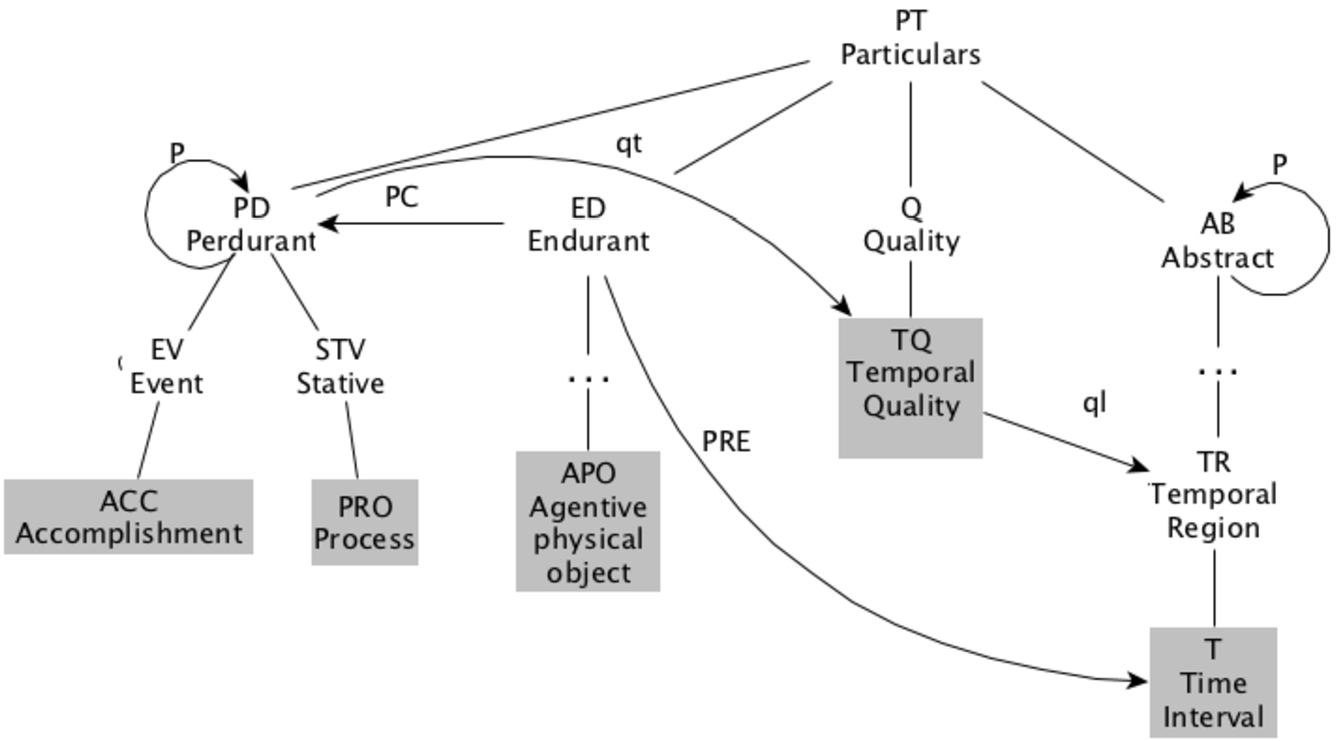
As depicted in the taxonomy in Fig. 1, the basic categories of dolce are endurant (aka continuant), perdurant (occurrent), quality, and abstract.
The taxonomy of extended with the subcategories Concept, Role, and Artefact.
I. Continuant vs. occurrent. The distinction between endurants and perdurants is inspired by the philosophical debate about change in time. In particular, while endurants may acquire and lose properties and parts through time, perdurants are fixed in time. Their fundamental difference concerns therefore their presence in time: endurants are wholly present (i.e., with all their parts) at any time in which they are present; differently, perdurants can be partially present, so that at any time in which they unfold only a part of them is present. Examples of endurants are a table, a person, a cat, or a planet, while examples of perdurants are a tennis match, a conference talk or a manufacturing process producing a certain item.
The relation connecting endurants and perdurants is called participation. An endurant can be in time by participating in a perdurant, and perdurants happen in time by having endurants as participants. For instance, a person is in time by participating to her own life, and a conference talk happens if at least one presenter (or attendant) participates to it.
II. Independent vs. dependent entity. This distinction is found across the entire taxonomy of dolce. For instance, features (e.g., edges, holes, bumps, etc.) are endurants whose existence depends on some physical object (the feature bearer), while physical objects are independent entities, i.e., their existence does not require other endurants to exist. Note that if we take a notion of cross-categorical dependence, only abstract entities turn out to be independent in dolce. For instance, since a physical object necessarily participates in an event (namely, its life), every physical object requires the existence of at least one event (and vice versa).
III. Processes vs. events. In dolce processes and events are special types of perdurants. As it can be seen from Fig. 1, dolce covers various classes of perdurant following taxonomic distinctions found in both philosophy and linguistics. In particular, a perdurant(-type) is stative or eventive according to whether it holds of the mereological sum of two of its instances, i.e. if it is cumulative or not. Common examples of stative perdurants are states; e.g., a sitting state is stative because the sum of two sittings is still a sitting. Among stative perdurants, processes are cumulative but not homeomeric, namely, they have parts of different types; e.g., there are (even very short) temporal parts of a running that are not themselves runnings. Finally, eventive occurrences (events) are not cumulative, and they are called achievements if they are atomic, otherwise they are accomplishments.5
As said in the Introduction, endurants are called ‘objects’, and perdurants ‘events’ in dolce-core. This terminological difference is due to changes in the formalization of the ontology even though the two systems largely overlap.
IV. Properties, qualities, quantities.dolce covers these entities through the general notion of quality.6
Recall that ‘property’ is generally used in analytic metaphysics as something which can be instantiated. We treat property here in a more restricted sense; informally, as synonym of ‘characteristic’ or ‘attribute’.
Qualities are, roughly speaking, what can be perceived and measured; they are particulars inhering in endurants or perdurants. For example, when we talk about the red of a rose, we are talking about a particular quality (that specific red) which inheres in a particular endurant (that specific rose). See also Section 4.3.1. Qualities are therefore specific to their bearers (this is why they are called individual qualities in dolce), and they are present at each time in which their bearers are present. Depending on the entities in which they inhere (qualities are dependent entities indeed), dolce identifies qualities of different types, namely, physical, temporal or abstract qualities. Moreover, since complex qualities can have qualities themselves, dolce includes a notion of direct quality to distinguish qualities of endurants, perdurants and abstracts, from qualities of qualities.
To compare qualities of the same kind, e.g., the color of a rose and the color of a book cover, the category of quale is introduced. A quale is the position occupied by an individual quality within a quality space.7
Quality spaces in dolce are based on Gärdenfors’ conceptual spaces (Gärdenfors, 2000).
In our example, if the rose and the book cover exhibit the same shade of red, their individual colors occupy the same position (quale) in the color space. Hence, the two qualities are distinct but they have the same quale (within the same color space).
V. Function and role.dolce does not formalize functions and roles, although these have been widely investigated and represented in dolce-driven approaches (Borgo et al., 2010; Masolo et al., 2004). Roles are represented as (social) concepts, which are connected to other entities (like endurants, perdurants, and abstracts) by the relation of classification. In particular, roles are concepts that are anti-rigid and founded, meaning that (i) they have dynamic properties8
For instance, each role can be played by different entities at the same or at different times, the same entity can play a role at different times or discontinuously, or it can play different roles at the same or at different times.
and (ii) they have a relational nature, i.e. they depend on other roles and on contexts.
VI. Relations. An important relation in dolce is parthood, which is time-indexed when connecting endurants and a-temporal when holding between perdurants or abstracts, i.e. between entities that do not change in time. Constitution is another temporalized relation in dolce, holding between either endurants or perdurants. It is often used to single out entities that are spatio-temporally co-located but nonetheless distinguishable for their histories, persistence conditions, or relational properties. A typical example of constitution is the relation between a statue and the amount of matter it is built with. The former started to exist at a later moment with respect to the latter; the latter can survive the destruction of the former and only for the former the existence of a sculptor is a necessary condition of existence.
The last basic category of the ontology is that of abstracts. These are entities that have neither spatial nor temporal qualities and are not qualities themselves. We will not deal with them in the current paper, so it should suffice to give a few examples: quality regions (and therefore also quality spaces), sets, and facts. Also, although dolce has other important categories and relations, in the present paper we will focus especially on those just presented, as they will be discussed in the following in the light of their axiomatization and used for the formalization of the cases in Section 4.
The formalization of dolce in first-order logic
The formal theory of is written in the first-order quantified modal logic QS5, including the Barcan and the converse Barcan formula, cf. (Fitting and Mendelsohn, 2012). These assumptions entail a possibilistic view of the entities: the domain of quantification contains all possible entities, regardless of their actual existence.
Here we present an excerpt of the axiomatization, focusing on the axioms required for the subsequent examples, that provides a general view of the approach. An exhaustive presentation of was given by Masolo et al. (2003) and a proof of consistency was provided by Kutz and Mossakowski (2011). In the following paragraphs, next to each axiom and definition we report the label of that formula in the primary presentation, cf. (Masolo et al., 2003). is here extended to include the category of Concepts (C) and Roles (RL) and the relation of classification (CF), as we shall see below; their formalization is taken from (Masolo et al., 2004). 9
A CLIF version of DOLCE plus the theory of concepts and roles from (Masolo et al., 2004) is formalized and proved consistent by means of Mace4. The theory the proof of consistency and further material can be downloaded at http://www.loa.istc.cnr.it/index.php/dolce/.
Taxonomy
As said, the taxonomy of is shown in Fig. 1. We omit in the following the taxonomic axioms which can be found in (Masolo et al., 2003). With respect to the original version, we include in this paper the categories Concept and Role as specializations of Non-Agentive Social Object, and the category Artefact as specialization of Non-Agentive Physical Object. These will be used in the formalization of the examples.
Mereology
assumes two primitive parthood relations: atemporal ( for ‘x is part of y’) and time-dependent ( for ‘x is part of y at time t’) parthood. The same predicate symbol is used for both relations. The first follows the principles of the General Extensional Mereology (), whereas temporary parthood drops the antisymmetry axioms, cf. (Masolo et al., 2003, p. 33).
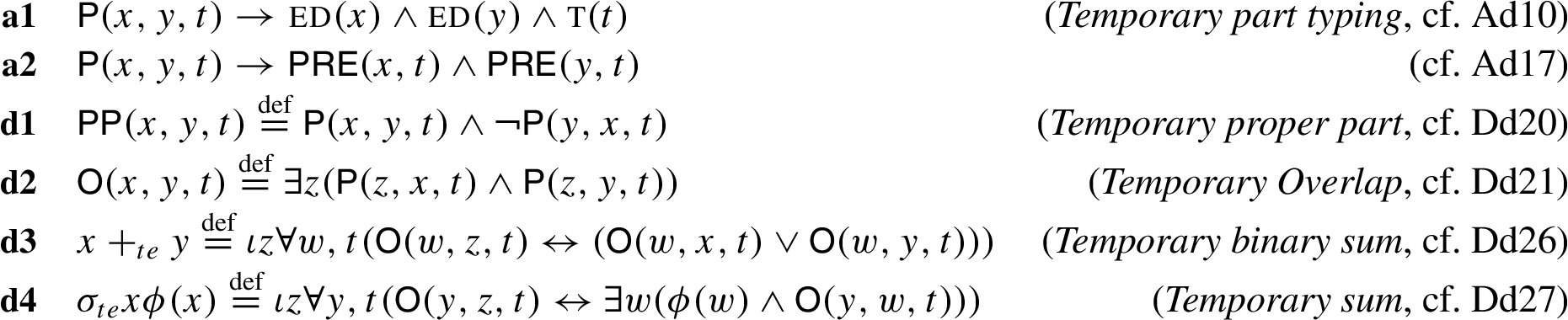
Here we give some axioms and definitions relative to temporary parthood, which we will use in Section 4.1 (in the rest of this section Ddn and Adn are the labels of definitions and axioms, respectively, used in (Masolo et al., 2003)). In the formulas, reads ‘x is present at time t’; reads ‘x is a proper part of y at t’ and reads ‘x and y overlap at time t’. The expression reads ‘the temporary sum of x and y’, and reads ‘the termporary fusion of each x that satisfies ϕ’. After the formulas we give a description in natural language.
Axiom (a1) states that temporary parthood holds only between two endurants at some time, axiom (a2) states that to have a parthood relationship both the part and the whole must be present, while (d1) states that a proper part is any part which does not contain the whole itself. (d2) defines overlap as a relation that holds on a pair of entities at the time when they have a common part. Using overlap, one can define binary and unrestricted sums, see cf. (d3) and (d4). These definitions characterize new entities: the sum of two entities and the fusion (sum of possibly infinite entities) of all the entities that satisfy a given formula ϕ, where ϕ does not contain time variables. Finally, note that in dolce sum (fusion) is defined also on events and on abstracts, thus including the sum (fusion) of times. We do not report these latter definitions since they are standard (cf. Dd18 and Dd19). We use the same notation (+ and σ) for sum and fusion with or without the temporal parameter depending on the entities to which it applies.
Quality and quale
The relation being a quality of () is primitive in dolce. Its full characterization is in (Masolo et al., 2003, p. 35). To be able to say that ‘x is a quality of y of type ϕ’ we extend it relatively to a type as follows:
where is an abbreviation for the statement that ϕ is a leaf in the dolce hierarchy of qualities (i.e. it is a minimal category in the quality branch of Fig. 1, cf. (Masolo et al., 2003, p. 27)).
Then, dolce defines the temporal quale (relation ), i.e., the position occupied by an individual quality within a quality space, as follows (recall that is the temporal location category, see Fig. 1):
From (d6) the temporal quale of a perdurant is the quale associated to the time location quality () of the perdurant, and from (d7) the temporal quale of an endurant is the sum of all the times during which the endurant participates () to some perdurant. (The participation relation is formally introduced below.) The temporal quale of a quality () is defined in a similar way (Masolo et al., 2003, p. 28). Finally, the temporal quale of an entity is given by the collection of all the previous definitions, (d8).
Qualities are classified in dolce as physical, temporal, and abstract qualities as stated below where the formulas add that a quality inheres in one and only one entity ( reads ‘x is a quality of y’):
Time and existence
Actual existence in is represented by means of the being present at () relation. The assumption here is that things exist if they have a temporal quale.
Further properties of are described in (Masolo et al., 2003), Section 4.3.8.
Participation
The participation () relation connects endurants, perdurants, and times, i.e. endurants participate in perdurants at a certain time (a6). Here we write for ‘x participates in y at time t’. (a7) states that a perdurant has at least one participant and (a8) that an endurant participates in at least one perdurant. Axiom (a9) says that for an endurant to participate in a perdurant they must be present at the same time. We also introduce the relation of constant participation (), cf. (d10), i.e., participation during the whole perdurant, which we will use in Sections 4.4 and 4.5.
Constitution
The constitution relation is mainly used here to model the scenario in Section 4.1. We report only a few axioms required to model the scenario ( reads ‘x constitutes y at time t’).
(a11) states that applies to pairs of endurants or of perdurants and a time. (a12) states that only physical endurants can constitute another physical endurant. (a13) states that constitution is asymmetric.
Concepts, roles, and classification
As anticipated, the relation of classification () is not in (Masolo et al., 2003) as it applies to the category Concept (), and to its subcategories including Role (), which informally collects particulars that classify, as introduced in (Masolo et al., 2004). We thus take the following axioms from the latter work ( stands for ‘at the time t, x is classified by the concept y’):
The classification relationship applies to an endurant, a concept and a time (a14), requires the endurant to be present when it is classified (a15), and is not symmetrical (a16). A concept can classify other concepts but not what the latter classify, this is stated to avoid circularity (a17). Roles (RL) are defined as concepts that are anti-rigid (d10) and founded (d11). Informally, the foundation property (FD) holds for a concept that is defined by means of another concept such that the instances of the latter are all external to (not part of) the instances of the former (Masolo et al., 2004).
Analysis and formalization in dolce: Examples
We present in the following sections how to formalize the five given cases according to dolce. Since to model some cases it is helpful to use a temporal ordering relation and since dolce does not formalize any, we introduce one here as follows: ‘<’ is an ordering relation over atomic and convex regions of time (usually, these are understood as time instants and time intervals) such that if holds, then and are ordered and non overlapping, i.e., . We write to mean that and are ordered, may properly overlap (i.e., they overlap but none is completely included in the other), and, given t their overlapping region, then holds.
Case 1: Composition/constitution
“There is a four-legged table made of wood. Some time later, a leg of the table is replaced. Even later, the table is demolished so it ceases to exist although the wood is still there after the demolition.”
dolce provides two ways to model this and similar examples. The first option, which we call artifact-based and we follow here, considers entities like tables and legs as ontological entities on their own because of their artifactual status, namely, the fact that tables and the legs are intentionally produced products. The second option, called role-based, considers table and leg as roles of objects. In this view, indeed, some objects play the role of table and leg in a given context but not necessarily. We do not use this second modeling approach for Case 1 and exemplify it for Case 2 (see next section) where the adoption of the role perspective is more natural. Note that dolce is neutral with respect to the choice between these two modeling approaches: it entirely depends on what one takes as essential properties of an entity, that is, how one answers the question: is ‘being a table’ an essential property for that object or is it only an accidental condition? In this way, by using dolce, the knowledge engineer is free to choose the option that best matches their modeling purposes and application concerns.
Tables and legs are objects whose kinds provide criteria for their persistence in time. We shall assume that a table remains the same object whenever it has a suitable shape and the right functionalities, even though some of its legs may be substituted. For simplicity, let us assume that a table is identified by a tabletop, i.e., no matter what happens, a table remains the same entity provided that its tabletop is not substituted or destroyed. Clearly, when a leg is substituted, the quantity of wood that constitutes the table changes. It follows that the existence of the table does not imply that it is made of the same matter throughout its whole life. Allowing the possibility that some entities keep existing while some of their parts change (or even cease to exist) is a design characteristic of dolce. More precisely, the ontology allows distinguishing between quantities of matter (e.g., the wood of which a table is made), the object constituted by the matter (that object made of that wood), and the artifact (the table, i.e., the functional object (Mizoguchi et al., 2016)).
The constitution and composition relations in dolce capture distinct forms of dependence: the former is the dependence holding between entities with different essential properties (intercategorical) like the dependence of a table from the matter it is made of; the latter holds between entities with the same essential properties (intracategorical) like the dependence of a table from the tabletop and the legs. It follows that constitution connects elements belonging to distinct categories and that are related by an existential co-temporal dependence. Here, it holds between elements of the category Matter (the considered amount of wood) and elements of the category Physical Object (the object made of that wood), since a material object exists at time t only if there exists at t a quantity of matter that constitutes it. The composition relation (expressed in dolce by parthood restricted to the category at stake) holds instead among elements of the same category which are bound to form a more complex element. These are generally called composing parts or components. In this case, composition implies that the existence of the composed object requires the co-temporal existence of its composing objects.
The dolce categories that we use for the artifact-based modeling of this case are: matter (), physical object (), and Time (t). We will also use the Artefact category, as introduced by Borgo and Vieu (2009) and two new subclasses of it introduced specifically for this scenario, i.e., Table and TableLeg.11
One could avoid the use of the Artefact category and treat table and leg as mere objects. However, the introduction of domain-driven categories at intermediate layers, e.g. Artefact, is considered good practice in applications.
In terms of relations we use: being subclass (), parthood (), constitution () and being present (). We also use the sum operator (+), and the order relation (<) for time.
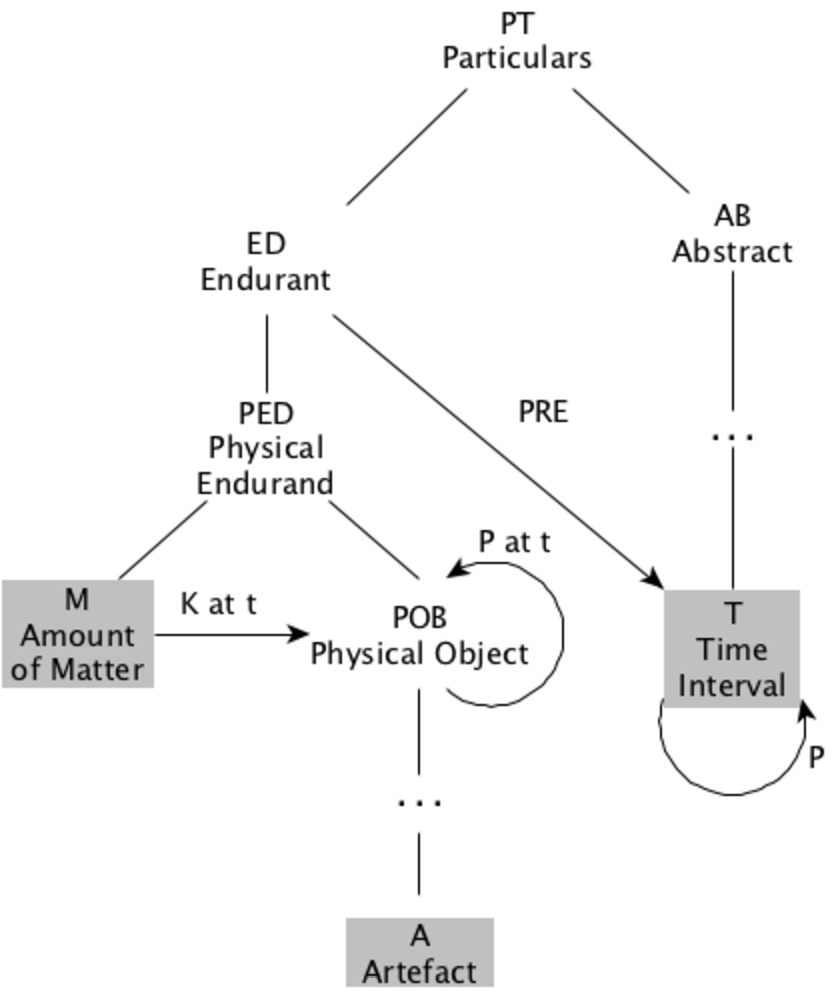
Figure 2 depicts the portion of the dolce taxonomy and relationships considered in this case. For the sake of simplicity, relationships like parthood () and constitution () are restricted in the figure to the classes relevant for the representation of the example. Also, in all figures, ternary relations are shown in a simplified manner (e.g., at t).
Fragment of the dolce taxonomy and relevant relationships for Case 1.
Formally, Case 1 can be expressed as follows.
Taxonomic claims:
The previous formulas state that an artifact is a physical object, that table, tabletop and the legs are artifacts, and that wood is matter. Formula (6) represents the elements and the temporal constraints ( and are the elements which are substituted for the original table parts).
The formula above states that T is a table; are legs and so is ; is an amount of wood and so are and (informally, these are the amounts of wood of which the tabletop, the legs, and the new leg are made of, respectively); , and are temporal instants or intervals such that t is earlier than and is earlier than .
Stating the elements’ presence:
Formula (7) states that the table T is present at t and ; the legs are present at t and except for which is not present at ; is present at ; and are present at and except for which nothing is said about and ; is present at and .
Relational claims:
Formula (8) states that the tabletop is component of the table T at t and ; the legs are components of T at t; the legs and are components of T at ; and are constituents of the tabletop and legs (respectively) at t and ; is a constituent of at t; is a constituent of at .
Since constitution is transitive and distributes over parthood, it follows that the table T is constituted by the sum of and at t, and by that of and at .
The modeling presented above is mainly focused on objects: the table as a whole and the legs and tabletop as its components. In this view, the perdurants during which the table changes are not modeled. In dolce one can explicitly introduce such perdurants, like the replacement and the demolition accomplishments. This second approach would make explicit the modeling of how and why the changes happen. The two views can be integrated in a single model since the essential relationships between the whole, its components and the material they are made of remain unchanged. Other modeling views, like the functional or the role-based modelings, are also possible in dolce.
Case 2: Roles
“Mr. Potter is the teacher of class 2C at Shapism School and resigns at the beginning of the spring break. After the spring break, Mrs. Bumblebee replaces Mr. Potter as the teacher of 2C. Also, student Mary left the class at the beginning of the break and a new student, John, joins in when the break ends.”
This case requires to model social roles, thus we follow the role-based modeling approach briefly mentioned in discussing Case 1. Roles are properties that an entity can have temporarily (roles can be acquired and lost at will), and they depend on an external entity, often indicated as the context, which (perhaps implicitly) defines them. In this example, the role of student and teacher are defined within a school system, which we shall assume to stand for the context of the example.
To model Case 2, we need four instances of Person, namely Mr. Potter, Mrs. Bumblebee, Mary, and John, as well as two instances of Object, namely, class 2C and Shapism School.12
For the sake of simplicity, we ignore that a school and a class are complex objects, namely, an organization and a group. These specializations of the category Object can be modeled in dolce by introducing the subcategories Organization and Group following the work of Porello et al. (2014b). Also, we do not model the ‘spring break’ in detail and limit ourselves to see it as a generic, yet finite and temporally located, interval of time.
At first, say at time , we have that Mr. Potter has the role of teacher (at the Shapism School’s class 2C), technically writing that such role property holds for Mr. Potter at . At the same time, , the property does not hold for Mrs. Bumblebee. During the spring break period, say at , the property holds for neither, even though the role property continues to exist, since the entities that define it (the Shapism School and the Shapism School’s class 2C) continue to exist during the break. After the spring break, at , Mrs. Bumblebee has the (Shapism School’s class 2C) teacher role and Mr. Potter has not. The role teacher is played by a person at , by nobody at , and by another person at . The Shapism School’s class 2C teacher role exists and does not change during the whole period. Since the teacher role can be played by one person at a time, usually one says that Mrs. Bumblebee replaced Mr Potter in that teacher role.
Similarly, at first Mary has the student role (at the Shapism School’s class 2C) and John has not. Only the persons who are students before the break and do not leave the class have the student role during the break. Those people, now including John, have the Shapism School’s class 2C student role after the break. In this case, however, one cannot say that John substituted Mary since, differently from teacher roles, which are characterized by individual rights and duties (an English teacher and a math teacher must satisfy different requirements and have duties tailored to the discipline they are hired for), the class 2C student role does not differentiate among players.
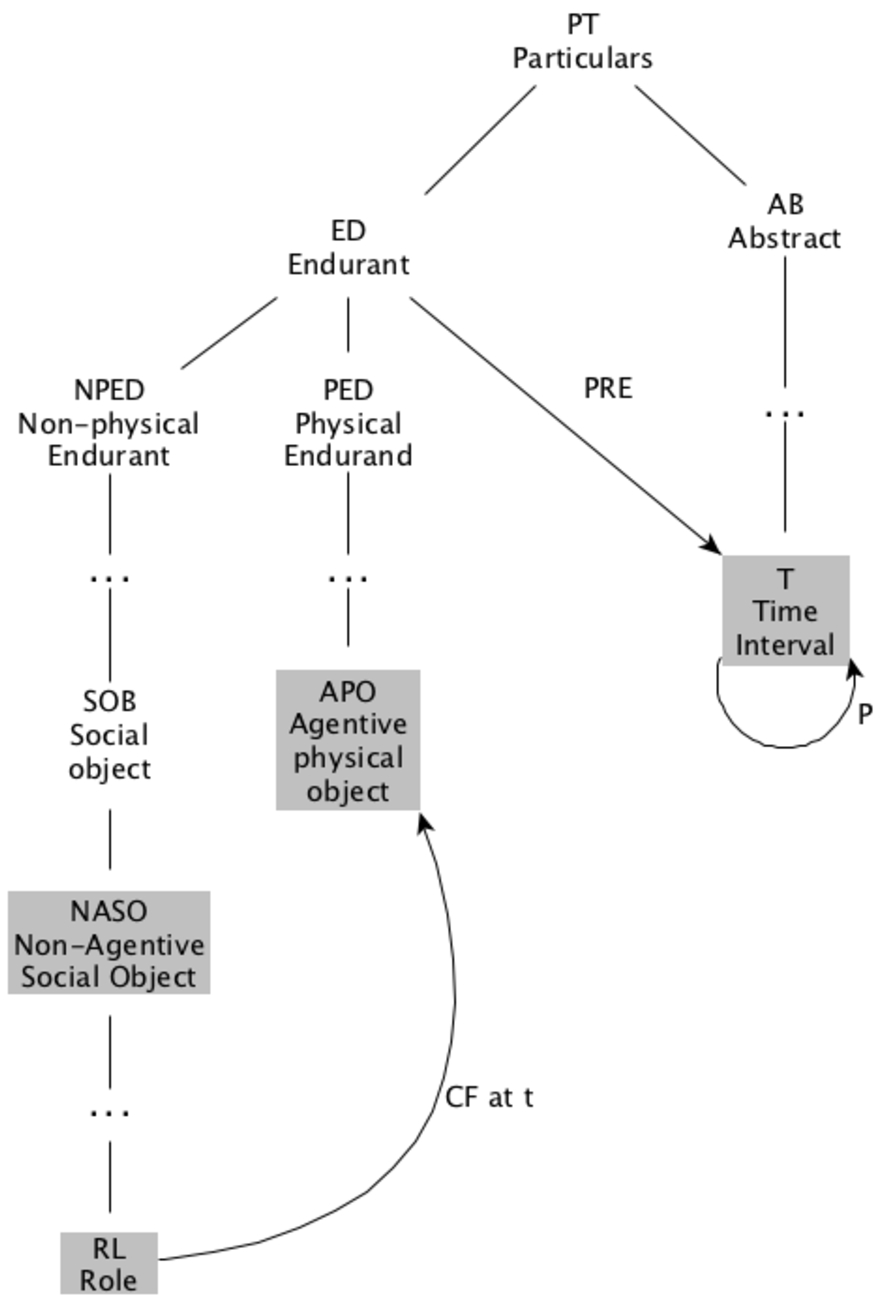
The dolce categories that we need for modeling this case are: agentive physical object (), non-agentive social object (), and Time (t). We will also use the Teacher and Student roles as specializations of the Role category (, a subcategory of ) from (Masolo et al., 2004). In terms of relations we use: being subclass (), being present (), time order (<), mereological sum (+), and the classify relation () also introduced in (Masolo et al., 2004). Figure 3 depicts some relevant classes and relationships for this case.
Fragment of the dolce taxonomy and relevant relationships for Case 2.
Formally, Case 2 can be expressed as follows.
Taxonomic claims:
The previous formulas state that a person is an agentive physical object, a functional role is a role and a role is a non-agentive social object.
Functional role characterization:
Formula (12) states that a functional role (y) can classify only one entity at each time.
The elements and the temporal constraints:
Formula (13) states that Potter, Bumblebee, Mary, and John are persons; that 2CTeacher and 2CStudent are roles and that the first of these is a functional role. Finally, the formula says that are times and indicates their ordering.
Stating the elements’ presence:
Formula (14) states that Potter, Bumblebee, Mary, and John exist at least at the listed times.
Relational claims:
Formula (15) states that: 2CTeacher holds for nobody at ; Potter satisfies 2CTeacher at only; Bumblebee satisfies 2CTeacher at only; Mary satisfies 2CStudent at only; John satisfies 2CStudent at only; neither Mary nor John satisfies 2CStudent at .
The model presented here is the most natural approach for this kind of scenarios in dolce.
Property change
Case 3.1: Color change
“A flower is red in the summer. As time passes, the color changes. In autumn the flower is brown.”
We have seen how to understand and model essential properties in Case 1 and roles (dynamic, contextual properties) in Case 2. To model Case 3.1, we use individual qualities, that is, properties as manifested by an object. These are properties that an object must have, they are necessary for its existence. For instance, in the case of material objects, these include mass, color, and speed. Having qualities is necessary for objects, although the value they take may change in time.
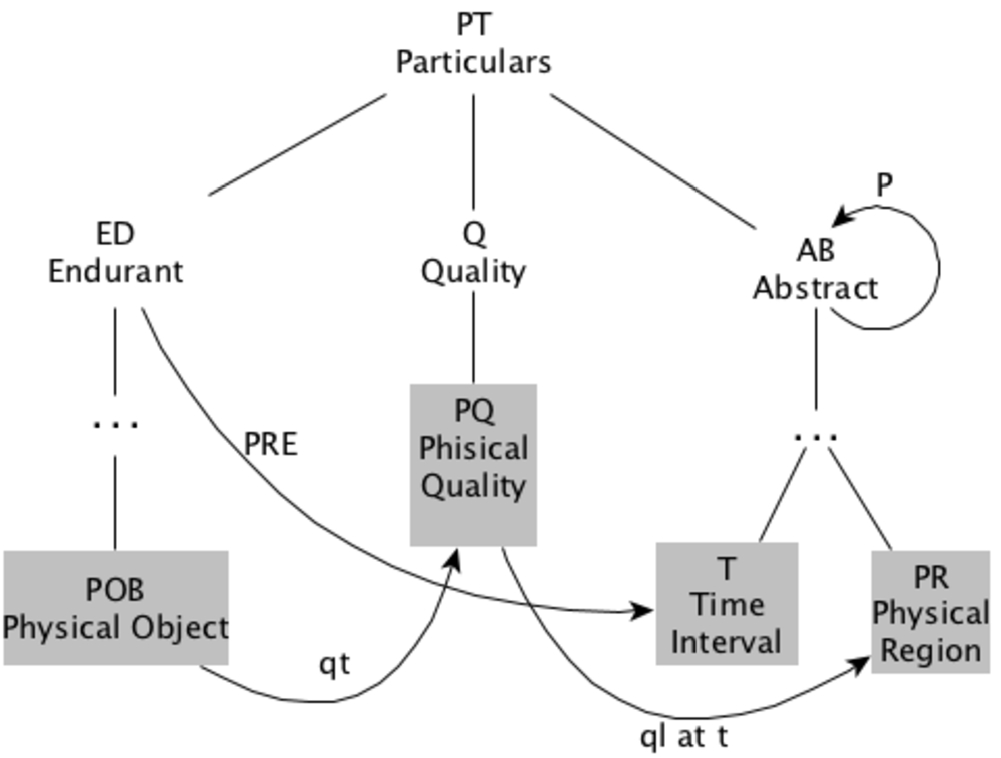
The dolce categories needed to model Case 3.1 are: physical object (pob), physical quality (pq), physical (quality) space (pr), and time (t). We will also use Flower as specialization of the pob category, as specialization of the pq category, and as specialization of the pr category. For relations we use: being subclass (), inherence (), being present (), parthood (), time order (<), and (the relation) quale (). Figure 4 depicts some relevant classes and relations used for representing Case 3.1.
Fragment of the dolce taxonomy and relevant relationships for Case 3.1.
Formally, Case 3.1 can be expressed as follows.
Taxonomic claims:
The previous formulas state that a flower is a physical object, a color quality is a quality of physical endurants and a color space is one of the spaces in the physical region.
The elements we need to model this case are:
Formula (19) states that F is a flower, q is a color quality, Summer and Autumn are times (thus, these are not modeled as seasons in this example) and so are and . The following formula states that the flower F is present during the Summer and the Autumn.
Stating the elements’ presence:
Relational claims:
Formula (21) states that: q is the color quality of flower F; q has value l at time in the summer and has value at time in the autumn where l is located in the red region and in the brown region (both regions in the color space). Finally, it states that Summer is before Autumn.
One can model that the flower takes all the shades from red to brown by adding the following formula (here stands for the property of self-connected region, a property which is defined from the connection relation C in the standard way, cf. (Casati and Varzi, 1996):
Formula (22), combined with the earlier formulas, states that there exists a path (p) in the space of colors which has the given red and brown colors of the flower as endpoints, and such that the flower takes all the colors in the path during the Summer and Autumn. In a similar way, one can also model that the change of color has no jumps. For instance, preventing the flower from suddenly jumping from red to light brown, then back to scarlet etc.
The model presented here follows the approach that best exploits dolce’s treatment of qualities.
Case 3.2: Speed change
“A man is walking when suddenly he starts walking faster and then breaks into a run.”
This example focuses on a change that occurs during an event. The event is divided in three parts, in the first part the man is walking, that is, there is a movement based on a repeated regular movement which is a process in dolce. In the second part, there is again a movement which is repeated at an increasing frequency until the desired speed is reached.13
One can argue that the quality that distinguishes walking from running is not speed but how the feet touches the ground or a combination of this and the speed quality. In these cases, the modeling approach is analogous to the one we provide here, what changes is only the quality one considers.
For this reason, we model the second part of the event as an accomplishment whose completion point is the achievement of the desired speed. Finally, the third part is a movement based on a repeated regular movement (running) which is similar to the first movement but with different characteristics. From this analysis, we model Case 3.2 as an event composed of three ordered subevents.
The dolce categories that we need for modeling Case 3.2 are: agentive physical object (APO), process (PRO), time quality (TQ), accomplishment (ACC), quale (ql), and time (T). In terms of relations we use: being subclass (), constant participation (), parthood (), quality of (), being present (), time order (<), mereological sum (+), and (the relation) quale (). Figure 5 depicts (some of) the classes and relationships relevant for representing Case 3.2.
Fragment of the dolce taxonomy and relevant relationships for Case 3.2.
Formally, Case 3.2 can be expressed as follows.
Taxonomic claims:
The formulas above state that a person is an agentive physical object, speed is a quality of perdurants, a space of speed measure is a physical region, walking and running are processes, speeding up is an accomplishment. The elements and the temporal constraints:
The formula says that p is a person, that there is a perdurant e, a walking perdurant , a speeding-up perdurant , a running perdurant , that s and are speed qualities, and that are times.
The following formula states that p exists during the time :
Relational claims (note that dolce already ensures that the quale “l” is in the speed space):
This formula says that and are locations in . It also states that and are qualities of the perdurants and , respectively, and have locations and . Finally, it states that p constantly participates in the perdurant e which is the sum of the perdurants .
We can now characterize the core property of walking and of running: these are events across which the speed of the participant is qualitatively stable. This is what formula (32) states by enforcing the speed quality of a walking (or of a running) perdurant to remain in the same position during the perdurant, say within the range for walking or for running.14
In dolce this can be done by measuring the quality in a qualitative speed space. For instance, take a space with two values only, say, ‘regular speed’ and ‘varying speed’. When an event has only limited speed variations (e.g., according to the granularity of that space), the associated speed quale is ‘regular speed’.
A speeding up event is an event in which the frequency of a process increases. In the specific case, the change leads to move from a walking to a running process. To characterize events in which speed regularly changes, we introduce formula (33): this formula states that there is at least one speed change during the event, and that any speed change during the event can only increase the speed (here is the ordering in the speed quality space).
dolce and these formulas for the specific Case 3.2 suffice to model the example of this section. To model continuity in speed change, one can use the approach exploited in formula (22).
As for the previous case, the model presented here shows the most natural modeling approach for this kind of scenarios in dolce.
Case 4: Event change
“A man is walking to the station, but before he gets there, he turns around and goes home.”
Following the viewpoint of dolce, this case is composed of (sub)events that correspond to the execution of distinct plans: reaching the station and reaching home. The first event (a man walking to the station) and the third (a man going home) are processes that are intended to be parts of a plan execution, that is, parts of distinct accomplishments. The intermediate event is an accomplishment (turning towards a direction) which is part of the second plan, namely, reaching home. To model this case, we need to include in the formalization the purpose of the (sub) events.
The dolce categories that we need for modeling Case 4 are: physical object (pob), agentive physical object (), concept (c), process (pro), accomplishment (acc), temporal quality (tq), and time (t). We will also use and as specialization of the quality category. In terms of relations we use: subsumption (), constant participation (), being present (), mereological sum (+), parthood (), quale (), inherence (), classification (), temporal order (<). In addition, we introduce the new relationship ExecutesPlan to connect a perdurant to a plan. This relation is used to state that an event complies with the plan requirements. For instance, if a plan p states that a person must go first to point A and then to point B, then any event e that takes that person to point A satisfies because it executes the plan even though it does not complete it. Figure 6 depicts some relevant classes and relationships.
Fragment of the dolce taxonomy and relevant relationships for Case 4.
Formally, Case 4 can be expressed as follows.
Taxonomic claims:
The previous formulas state that a person is an agentive physical object and that direction and speed qualities are qualities of perdurants.
The elements we need to model this case are a person, a perdurant, two walking and a turning events, two plans and three times:
Stating the temporal constraints and the elements’ presence:
Formula (41) states the ordering of the times, that is the time of perdurant , that person a is present all the times, that plan is present during and plan is during and . It also says that plan is not present during and while plan is not present during .
The following formula binds the use of the execution relation to pairs of one perdurant and one concept, we do not characterize it further:
We now write and for the initial and final time of event :
Formula (43) states that the direction quality s of the event e changes during the turning subevent , and that event executes plan and event executes plan . Finally, it states that and span the whole event e and that person a participates to the whole event.
To state that an event x is a walking event, we can use a formula similar to the one introduced in Case 3.2, reported below as (44). To characterize the core property of a turning event y, we use formula (45) where and are as in formula (43) and write , and for the temporal interval of event y and for its initial and final instants, respectively.15
For completeness, one should add the symmetric condition for .
The modeling approach we followed here is the preferred one in dolce for this kind of scenarios.
Case 5: Concept evolution
Background: marriage is a contract between two people that is present in most social and cultural systems and it can change in major (e. g. gender constraints) and minor (e.g. marriage breaking procedures) aspects. “Marriage is a contract that is regulated by civil and social constraints. These constraints can change but the meaning of marriage continues over time.”
There is disagreement about the nature of concepts, including whether concepts can change in time while preserving identity. Some argue that concepts have a stable nature (their characterizations cannot change in time), others argue the opposite (Masolo et al., 2019). Similarly to the case of artifacts presented in Section 4.1, dolce does not prescribe the adoption of one or the other view, allowing in this way the knowledge engineer to select the approach that better fits with their modeling needs and world-view. For instance, the example mentioned above assumes that concepts can persist through time while partially changing in their characterization. In particular, it points to a social scenario where the concepts characterizing a socio-cultural system are associated with different rules across time because of the legal and cultural evolution of the society. We shall therefore take this perspective for the sake of this case.
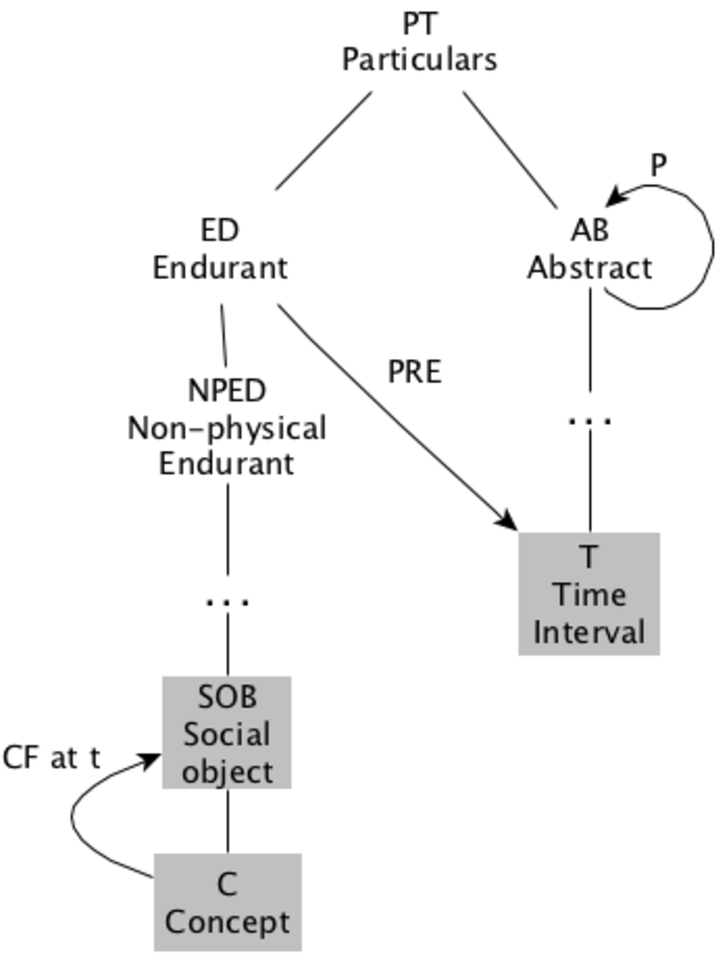
The dolce categories that we need for modeling Case 5 are: social object (sob), concept (c), and time (t). In terms of relations, we use: subsumption (), being present (), and classification (). Figure 7 depicts the dolce classes and relationships used for Case 5.
Fragment of the dolce taxonomy and relevant relationships for Case 5.
Formally, Case 5 can be expressed as follows.
Taxonomic claims (a social relationship, , holds for various types of unions between people; the notions of social marriage and legal marriage are intended to be elements in the dolce category of concepts):
The elements and the temporal constraints that we need are: a social relationship M, a social concept of marriage , two legal concepts of marriage and two times:
The social relationship holds in both times and so does the social marriage, one legal marriage concept exists at t, the other at . Then, the elements’ presence is as follows:
The relational claims are simple: first the two legal concepts are different; second if the social relationship is classified by the social marriage concept at a time, then it has to satisfy the legal concept existing at that very time.
The same concept of social marriage () persists through time, from t to while changing its legal characterization (from to ). For to classify a marriage relationship M at t, it is necessary that M is also classified as a legal marriage (so satisfying concept is necessary at t for ), while at it is necessary that M is classified by which now depends on .
The model presented here is quite natural in dolce for this kind of scenarios. By changing the assumptions we made in the initial discussion of this case, other approaches can be put forward like, e.g., the use of role theory applied to concepts. Note also that these modeling approaches are not limited to purely social concepts. They apply to technology-dependent concepts like, e.g., that of road which has different qualifications across history (e.g. in ancient Rome, during the 19th century or today).
Ontology usage and community impact
Foundational ontologies enjoy a double-edged reputation in several communities, spanning across conceptual modeling, semantic web, natural language processing, etc. They are intuitively needed by most data-intensive applications, but their precise utility at different steps of design methodologies is not widely agreed, and certainly not for the same reasons. As a consequence, the wide application of dolce ranges from the simple reuse of a few categories, to delving into full-fledged axiomatic versions. We provide here a quick description of the OWL version of dolce, a list of application areas and specific reuse cases, with a few comments on the current opportunity for foundational approaches to ontology design. (For the new CLIF and OWL versions of dolce produced for the ISO 21838 standard under development, see http://www.loa.istc.cnr.it/index.php/dolce/).
dolce “lite” versions take into account the requirements from semantic web modeling practices, and the need for simplified semantics as in natural language processing lexicons. They also address the need for some extensions of dolce categories, by reusing the d&s (Description and Situations) ontology pattern framework, which was early designed to overcome the expressivity limits of OWL, later much facilitated by punning in OWL2 (2012) (i.e. the ability to use a constant as the name for a class, an individual, or a binary relation).
(dul) OWL ontology was intended to popularize dolce to the Semantic Web community. dul uses dolce, d&s, and a few more ontology design patterns (Plan,17
and Collection, that extend dolce. Presutti and Gangemi (2016) give an account of dul as an architecture of ontology design patterns inspired by those integrated theories, and Gangemi (2008) offers an integrated axiomatization of plans, information objects and collections in d&s. dul is the result of various refinements and integrations of the OWL versions of those theories. The main motivations why dul was conceived include: (i) intuitive terminology (e.g. substituting Endurant and Perdurant with Object and Event), (ii) lighter axiomatization (e.g. giving up some predicate indexing), (iii) integration of other theories, (iv) semantic-web-oriented OWL2 modeling styles.
As reported in (Presutti and Gangemi, 2016), even a non-exhaustive search makes one stumble upon the great variety of dul reuse, citing 25 large ontology projects for: e-learning systems, water quality systems; in multimedia: annotation facets, content annotation, audiovisual formal descriptions; in medicine: for modelling intracranial aneurysms, annotating medical images and neuroimages, and for modelling biomedical research; law; events; geo-spatial data; robotics and automation; industry and smart products, textile manufacturing; cybersecurity; enterprise integration; process mining; disaster management; semantic sensor networks; customer relationship management.
In addition, dul has been applied as a tool to improve existing semantic resources. This has happened for example in identifying and fixing millions of inconsistencies in DBpedia, on-the-go discovering modelling anti-patterns that were completely opaque to the axioms of the DBpedia ontology (Paulheim and Gangemi, 2015). Another example is the dul application to improve the quality of lexical resources, from the very inception of dolce, used to reorganize the WordNet top level and causing Princeton WordNet developers to include the individual/class distinction in their lexicon (Gangemi et al., 2003), to the recent massive Framester knowledge graph (Gangemi et al., 2016), which unifies many different linguistic databases under a frame semantics, and maps them to widely used ontologies under a common dul hat. Several other standard or de facto standard are based on or compatible with dul, e.g., CIDOC CRM (CIDOC Conceptual Reference Model),19
An important lesson learnt is that dolce can be used to foster different design approaches:
as an upper ontology, in order to support a minimal agreement about a few distinctions;
as an expressive axiomatic theory, in order to associate one’s ontological commitment to well-defined criteria, and to perform (detailed) meaning negotiation;
as a coherence/consistency stabilizer, able to reveal problems in a conceptualization against both its domain schema, and the data. This approach could also be used to reveal unwanted inferences, even when no inconsistency emerges;
as a source of patterns that improve the quality of ontologies by applying the good practices encoded in dolce, and eventually ameliorating semantic interoperability.
Especially (3) and (4) are central to the current needs of the huge knowledge graphs maintained by the Web stakeholders, but also (2) is finally emerging as a potential tool to help clarifying the underlying semantics in domains that have been less prone to formalization in the past (e.g. sociology).
Footnotes
Acknowledgements
Over the years many people have contributed to the application of dolce, to the discussion of the best modeling approaches, and to the development of dolce’s modular extensions. We take the opportunity to thank in particular Emanuele Bottazzi, Francesco Compagno and Alessandro Oltramari. dolce was conceptualized and developed as part of the European project WonderWeb (IST-2001-33052) and many public and industrial projects reused it since then. Among these, the authors thank the European project OntoCommons (GA 958371) for co-funding the writing of this paper.
References
1.
Biccheri, L., Ferrario, R. & Porello, D. (2020). Needs and intentionality. In B.Brodaric and F.Neuhaus (Eds.), Formal Ontology in Information Systems – Proceedings of the 11th International Conference, FOIS 2020. Frontiers in Artificial Intelligence and Applications (Vol. 330, pp. 125–139). Amsterdam, The Netherlands: IOS Press.
2.
Borgo, S., Carrara, M., Garbacz, P. & Vermaas, P.E. (2010). Formalizations of functions within the DOLCE ontology. In Proceedings of the Eighth International Symposium on Tools and Methods of Competitive Engineering TMCE (Vol. 1 (pp. 113–126). Citeseer.
3.
Borgo, S., Franssen, M., Garbacz, P., Kitamura, Y., Mizoguchi, R. & Vermaas, P.E. (2014). Technical artifacts: An integrated perspective. Appl. Ontology, 9(3–4), 217–235. doi:10.3233/AO-140137.
4.
Borgo, S. & Masolo, C. (2009). Foundational choices in DOLCE. In S.Staab and R.Studer (Eds.), Handbook on Ontologies (2nd ed.). Springer.
5.
Borgo, S. & Vieu, L. (2009). Artifacts in formal ontology. In A.Meijers (Ed.), Handbook of the Philosophy of the Technological Sciences. Technology and Engineering Sciences (Vol. 9, pp. 273–307). Elsevier. doi:10.1016/B978-0-444-51667-1.50015-X.
6.
Bottazzi, E. & Ferrario, R. (2009). Preliminaries to a DOLCE ontology of organizations. International Journal of Business Process Integration and Management, Special Issue on Vocabularies, Ontologies and Business Rules for Enterprise Modeling, 4(4), 225–238.
7.
Casati, R. & Varzi, A.C. (Eds.) (1996). Events. Aldershot: Dartmund.
8.
Conigliaro, D., Ferrario, R., Hudelot, C. & Porello, D. (2017). Integrating computer vision algorithms and ontologies for spectator crowd behavior analysis. In V.Murino, M.Cristani, S.Shah and S.Savarese (Eds.), Group and Crowd Behavior for Computer Vision (1st ed., pp. 297–319). Academic Press. doi:10.1016/B978-0-12-809276-7.00016-3.
9.
Ferrario, R. & Oltramari, A. (2004). Towards a computational ontology of mind. In A.C.Varzi and L.Vieu (Eds.), Formal Ontology in Information Systems, Proceedigs of the Intl. Conf. FOIS 2004 (pp. 287–297). IOS Press.
10.
Ferrario, R. & Porello, D. (2015). Towards a conceptualization of sociomaterial entanglement. In H.Christiansen, I.Stojanovic and G.A.Papadopoulos (Eds.), Modeling and Using Context – 9th International and Interdisciplinary Conference. Proceedings. Lecture Notes in Computer ScienceCONTEXT 2015, Lanarca, Cyprus, November 2-6, 2015. (Vol. 9405, pp. 32–46). Springer. doi:10.1007/978-3-319-25591-0_3.
Gangemi, A. (2008). Norms and plans as unification criteria for social collectives. Autonomous Agents and Multi-Agent Systems, 17(1), 70–112. doi:10.1007/s10458-008-9038-9.
13.
Gangemi, A., Alam, M., Asprino, L., Presutti, V. & Recupero, D.R. (2016). Framester: A wide coverage linguistic linked data hub. In EKAW.
14.
Gangemi, A., Guarino, N., Masolo, C. & Oltramari, A. (2003). Sweetening WORDNET with DOLCE. AI Mag., 24(3), 13–24. doi:10.1609/aimag.v24i3.1715.
15.
Gärdenfors, P. (2000). Conceptual Spaces: The Geometry of Thought. Cambridge, Massachussetts: MIT Press.
16.
Guarino, N. (2009). The ontological level: Revisiting 30 years of knowledge representation. In A.Borgida, V.K.Chaudhri, P.Giorgini and E.S.K.Yu (Eds.), Conceptual Modeling: Foundations and Applications – Essays in Honor of John Mylopoulos. Lecture Notes in Computer Science (Vol. 5600, pp. 52–67). Springer. doi:10.1007/978-3-642-02463-4_4.
17.
Guarino, N. & Welty, C. (2009). An overview of OntoClean. In S.Staab and R.Studer (Eds.), Handbook on Ontologies. International Handbooks on Information Systems (pp. 201–220). Berlin Heidelberg: Springer. doi:10.1007/978-3-540-92673-3_9.
18.
Guarino, N. & Welty, C.A. (2002). Evaluating ontological decisions with OntoClean. Commun. ACM, 45(2), 61–65. doi:10.1145/503124.503150.
19.
ISO 24707 (2018). ISO/IEC-24707:2018 – Information technology – Common Logic (CL): a framework for a family of logic-based languages. International Organization for Standardization.
20.
Kutz, O. & Mossakowski, T. (2011). A modular consistency proof for DOLCE. In W.Burgard and D.Roth (Eds.), Proceedings of the Twenty-Fifth AAAI Conference on Artificial Intelligence, AAAI 2011, San Francisco, California, USA, August 7–11, 2011, AAAI Press. http://www.aaai.org/ocs/index.php/AAAI/AAAI11/paper/view/3754.
21.
Masolo, C., Borgo, S., Gangemi, A., Guarino, N. & Oltramari, A. (2003). WonderWeb Deliverable D18. Technical report, CNR.
22.
Masolo, C., Sanfilippo, E., Lamé, M. & Pittet, P. (2019). Modeling concept drift for historical research in the digital humanities. In 1st International Workshop on Ontologies for Digital Humanities and Their Social Analysis (WODHSA).
23.
Masolo, C., Vieu, L., Bottazzi, E., Catenacci, C., Ferrario, R., Gangemi, A. & Guarino, N. (2004). Social roles and their descriptions. In Proceedings of the 9th International Conference on the Principles of Knowledge Representation and Reasoning (pp. 267–277).
24.
Mizoguchi, R., Kitamura, Y. & Borgo, S. (2016). A unifying definition for artifact and biological functions. Appl. Ontology, 11(2), 129–154. doi:10.3233/AO-160165.
25.
Paulheim, H. & Gangemi, A. (2015). Serving DBpedia with DOLCE – more than just adding a cherry on top. In The Semantic Web – ISWC 2015. ISWC 2015, Part I (pp. 180–196). Cham: Springer. doi:10.1007/978-3-319-25007-6_11.
26.
Porello, D., Bottazzi, E. & Ferrario, R. (2014a). The ontology of group agency. In P.Garbacz and O.Kutz (Eds.), Formal Ontology in Information Systems, Proceedigs of the Intl. Conf. FOIS 2014. Frontiers in Artificial Intelligence and Its Applications (Vol. 267, pp. 183–196). IOS Press.
27.
Porello, D., Bottazzi, E. & Ferrario, R. (2014b). The ontology of group agency. In FOIS (pp. 183–196).
28.
Porello, D., Setti, F., Ferrario, R. & Cristani, M. (2013). Multiagent socio-technical systems. An ontological approach. In T.Balke, F.Dignum, M.B.Riemsdijk and A.K.Chopra (Eds.), Coordination, Organisations, Institutions and Norms in Agent Systems IX (COIN 2013). LNAI (Vol. 8368, pp. 42–63). Springer.
29.
Presutti, V. & Gangemi, A. (2016). Dolce+D&S ultralite and its main ontology design patterns. Ontology Engineering with Ontology Design Patterns, 25, 81–103.
30.
Vieu, L., Borgo, S. & Masolo, C. (2008). Artefacts and roles: Modelling strategies in a multiplicative ontology. In C.Eschenbach and M.Grüninger (Eds.), Frontiers in Artificial Intelligence and Applications, Formal Ontology in Information Systems, Proceedings of the Fifth International Conference, FOIS 2008, Saarbrücken, Germany, October 31st – November 3rd (Vol. 183, pp. 121–134). IOS Press. doi:10.3233/978-1-58603-923-3-121.
31.
W3C OWL Working Group (2012). OWL 2 Web Ontology Language Document Overview (Second Edition) – W3C Recommendation 11 December 2012. World Wide Web Consortium (W3C). http://www.w3.org/TR/owl2-overview/.