The aim of this paper is to study the asymptotic behaviour of a wide class of incompressible quasi-Newtonian fluids flowing through a thin 3D pipe, with prescribed pressure variance at the ends. The small parameter is given by the ratio between the diameter of the cross section and the length. We prove that, if the domain satisfies a particular geometric condition at the ends, a complete asymptotic expansion can be obtained.
We deal with incompressible complex fluids flowing through thin 3D pipes, with prescribed pressure at the ends. Since, in anisotropic domains, the equations are not exactly solvable, it is very natural to look for an approximate solution. The very nature of the thin domain makes it computationally undesirable to employ standard numerical techniques. We show that, by formally expressing the rescaled solution as a power series of a small parameter ε, the problem of finding the its coefficients is considerable less complex. Finally, we prove error estimates of all orders to justify the validity of the above mentioned expansion. There exists a considerable amount of literature published on subjects related to fluid flow in thin domains – we shall mention only a few connected to our problem. The asymptotic behaviour of the Navier–Stokes flow in 2D thin domains has been studied in [2]. In [6] the curvature effects on the quasi-Newtonian flow in thin pipes are considered, while the inertial term is neglected. A more general quasi-Newtonian flow in a thin 3D slab has been studied in [7]. Finally, it is worth mentioning that the first mathematical investigation of the quasi-Newtonian fluids was done in [3] and [4]. While we restrict ourselves to the stationary case and we disregard the curvature effects, let us emphasise the strengths of this paper:
Taking into account the inertial term – which makes it more difficult to obtain an existence result.
Working with physically feasible boundary conditions and considering a general, abstract viscosity law.
Obtaining a complete asymptotic expansion provided that the domain satisfies a particular geometric condition. We emphasise this fact, since, as we shall prove, if no condition is imposed on the domain the result is no longer true.
The model we discuss is based on [5]. Let us then consider the stationary flow of a quasi-Newtonian incompressible fluid, whose equations are written as
with u the velocity, p the pressure and η the viscosity function depending on
where
While we shall work with a general η, we will later see how it applies to a realistic model (for instance, the case of Carreau fluids).
Consider now a small parameter (throughout this material we shall always have ). Suppose that the fluid flows through a simply connected, thin domain of the form
where are sufficiently regular domains – we also suppose the application is also smooth enough ( regularity is sufficient). For the sake of simplicity we are going to assume – and the three-part boundary of is given by the following:
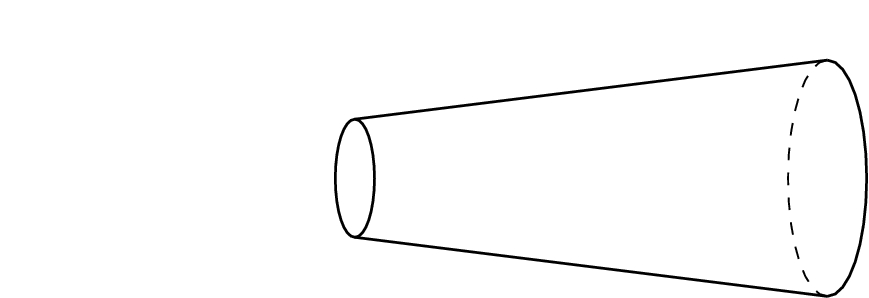
(see Fig. 1). Moreover, we suppose that and are perpendicular on .
Thin, anisotropic domain.
We make the conventions , , . With respect to the boundary conditions, we impose
with given constants. Note that the second condition is equivalent to on .
In the next section we prove the existence of the solution using a classical approximation technique, while in the final section we derive a complete asymptotic expansion with respect to the small parameter ε.
The existence theorem
The proof of the existence of the solution is based on classical compactness and monotony arguments, and is very similar to the one in [5]. There are two main differences; the first one is that we use different boundary conditions, the importance of which shall become apparent when discussing the asymptotic expansion. On the other hand, there is the problem of controlling the inertial term. While the author of [5] uses a specific property of the viscosity function, we shall use the smallness of ε together with some sharp Poincaré and Sobolev type of inequalities for thin domains.
We call the system given by (1) and (2) problem (P). We say that is a solution of (P) if it satisfies (1) in the sense of distributions and (2) in the sense of traces.
We will suppose that is a function satisfying the following properties:
Let us note that (5) is equivalent to the fact that the mapping is increasing. In particular, this is true if η is differentiable and
In order to introduce the variational problem, let us consider the space
We will say that is the solution of the variational problem henceforth denoted () if it satisfies
(we are systematically going to use Einstein’s summation convention). Consider now the space
Define the application by
and by
where represents the duality between and X. It is clear that L is well defined and . The problem () can be rewritten as: findsuch that
It is a simple matter to verify that if is a smooth solution of (P) then u is a solution of (). Conversely, the following is true.
Let u be a solution of (). Then there existssuch thatsatisfy (1) in the sense of distributions and (2) in the sense of traces.
Let W be the complement of V in X. The proof of the theorem relies on the following lemma.
The operatoris an isomorphism. Consequently, so is the adjoint.
The one-to-one part is clear. To prove the that it is also onto, let . Then if
we have and so by a well-known result (see [1]) we find there is such that . Pick now any with
Then and we get
so by the above mentioned result we obtain a with . Combining the results we can write where . Hence if (, ) is the decomposition of ψ in X then we have found such that . □
Returning to the proof of Theorem 1, consider T be the restriction of to W. Clearly and so by Lemma 1 there is with . Let with the decomposition with , .
By taking in the above equation we get readily that u satisfies the first equation of (1) in the sense of distributions. □
Henceforth, will always mean the norm on unless otherwise specified. In virtue of a Poincaré inequality – see further Lemma 4 – it follows that is a norm on V equivalent to the norm – and from now on we will consider V endowed with this norm.
A simple calculation – integrating twice by parts – shows that if then
Since is dense in X it follows that for all
so we can write
Let us consider the mapping defined by
The operator A is continuous and monotone, i.e. satisfies
First we prove continuity. Let in V. Obviously we can choose a subsequence such that
We can write
We look at the two terms separately. We have
with
owing to the continuity and the boundedness of η, (8) and the use of Lebesgue’s dominated convergence theorem. Secondly,
Therefore from (9), (10) and (11) we derive
We have actually proven more. From any subsequence of we can choose a subsequence for which (12) holds. Therefore we have in , showing the continuity of A.
To prove the monotony of A, let us write
From the elementary Cauchy–Schwarz inequality
we deduce
and the conclusion follows from (5). □
Define now by
Ifweakly in V, thenweakly in.
Taking into account the compact inclusion of V into we deduce that we can choose a subsequence such that strongly in . Pick any . We can write
The second term is convergent to 0 since the mapping is linear continuous on V, while for the first one we can write
and since is bounded being weakly convergent, we obtain that . Reasoning the same as in Lemma 2, we get the desired result. □
We continue with a technical result, that will prove very useful lemma.
For anysuch thatonin the sense of traces, the following inequalities hold:for someindependent of ε. Moreover, for allwe have
The first is a classical Poincaré inequality in thin domains – see, for instance Proposition 2.1 in [8].
For the second part, use Proposition 2.3 in [8] and the first part of this lemma to find that the embedding constant of in is independent of ε. Let us call this constant c. By the interpolation inequality we obtain
and so the conclusion is attained with .
Lastly, let us consider the scalar function given by
By Green’s formula, we can write the following
and since , an application of Cauchy–Schwarz and the first part of this lemma ensures the proof. □
Henceforth, we shall denote by C various constants independent of ε.
Assume that η satisfies (3)–(5). Providedis small enough, there exists a solution u of the variational problem () satisfying
Since V is a separable space, let dense in V; moreover, let be the finite-dimensional subspace generated by . We begin by showing the approximate problem: Find such that
has at least one solution .
Let us consider the applications defined by
We intend to use the following classical result, whose proof can be found in [4].
Leta continuous mapping such that, for some,Then there exists ξ withsuch that.
By Lemma 4 we get
Also we have
so we obtain
Hence if , then for
, and so we can apply Lemma 5 to find , with . Clearly is independent of n so we can choose a subsequence still denoted by such that
Moreover, we have
Clearly is bounded in , hence we can choose another subsequence such that
Let us now fix . Then for all we have
By Lemma 3 and (15) we can pass to the limit as to get
Since this is true for all n and is dense in V, it easily follows
To conclude, it rests to prove . Since is the solution of the approximate problem, we can write
Using similar arguments as those in the proof of Lemma 3 we derive , and so
By Lemma 2, we have
Using (17) we can pass to the limit in the above equation to get
By taking in (16) we get , so that
which can be further written as
Using the continuity of A, we derive the desired result. □
Asymptotic expansion
In what follows, we make the following convention: if then we will denote the application defined by
We will denote by the norm on Ω. Moreover, we will also systematically use the dummy index k to represent either summation for , either the repeated index. We can write
with . An elementary calculation shows that
The above estimate, as well as fair intuitions leads us to formally write
where , are independent of ε for all , . The boundary conditions are expected to become
Writing (formally) the Taylor expansion of η in 0 and plugging in the above expansion, we arrive at
where depends only on for . Note .
Plugging in the expansions and identifying the coefficients of in the second equation, of in the first equation and taking (18) into account we get and
Observe that we can solve for , where W is the unique solution of the problem
where signifies the Laplacian in two variables – . To find let us use (a priori) the following compatibility relation
If we define
then
Due to the imposed regularity requirements, we have and . It is easy to check that satisfy (
P
1
0
) in the classical sense, and that verifies (
C
0
) for all . The key ingredient for that – and a property which we shall further use – is that whenever satisfies on Γ, in virtue of Reynolds’ transport theorem
Moreover, we have .
To determine all we proceed by complete induction. Let . Assume we have found (sufficiently) smooth such that for all and for all (nothing if ). We show how to determine , , such that
Again, plugging in the expansion and identifying in the second and third equation the coefficients of and in the last one those of , together with (18), we obtain
with
for . Observe that are known, since they depend on terms with and with – moreover, they are smooth by the induction hypothesis. In virtue of the compatibility
it follows (see [1]) that the Stokes system has a unique regular solution that satisfies (
P
k
j−1
) in the classical sense. Note that is determined up to a constant (for every ). Hence we can write
where is fixed and is to be determined.
Finally, plugging the expansion in the first equation and identifying the coefficients of and using once again (18) we get
with
We can separate into two problems
and
The first problem is a homogeneous Dirichlet, and so it has a uniquely determined solution, say . Observe that the second problem has the solution , where W as previously introduced. Note that if
then we define
where C, can be determined uniquely by the restrictions . Hence we have completely found
Again, it is fairly easy to see that is regular, satisfies (
P
1
j
) in the classical sense and also the condition (
C
j
). This ends the induction step, and thereby we have determined , for all .
Before we continue, we introduce some terminology. We call Ω perfect near the boundary – or () – if there exists such that for all and for all . Given Ω a () domain we say that has the () property if for all , and for all , . Whenever these terms are 0 we say that is 0 near the boundary. Obviously, if has the () property then all the derivatives up to the order m enjoy the same property; moreover, whenever . Finally, it is trivial to see that sum/product of functions with the () property has it also, while if one terms is 0 near the boundary then so is the product.
Assume that Ω is (). Then
We shall prove by induction the following: , , have the () property, for all and . Observe that, by definition, has the () property. This implies near the boundary, so that the Stokes system (
P
k
j−1
) with has only trivial solution near the boundary – which completes the first step of induction. Next, assume we have been able to prove the statement for all . Looking at , note that it has the () property, being a combination of terms that have the () property – it follows easily that has the () property. For more can be told – not only does it have the () property, but, since it is a combination of the terms of the form and (, ) then it is 0 near the boundary – hence the system (
P
k
j−1
) (with in place of j) has only trivial solution near the boundary, thus completing the induction. □
Let
Observe that, if Ω is (), owing to Lemma 6, and with for all . We can now state the main result in this section.
Letbe fixed. Suppose that Ω is (), η satisfies (3)–(5) and, in addition,Then the following estimates hold:
In order to simplify the calculations, let us introduce for defined by
Multiplying Eq. (
P
1
j
) by and adding for we obtain
Using (20) we can write the Taylor development (up to the order n, with the Lagrange remainder) of η in 0, and so we derive – properly this time
for some (actually, ). It is an easy matter to verify that for . If and then a simple calculation shows
and so we have
where the rest is given by
Observe that all the terms in the above development contain powers of ε of at least , and since we proved all are sufficiently regular (at least ), we can write . In a completely similar manner it can be proved that for we have
with . Combining the three equations we obtain
with the rest satisfying
Multiplying (22) by a test and integrating over we obtain
By taking in (7) and (24) and subtracting the two we get
Note that
using the inequalities in Lemma 4, (13) and the elementary following
so that if is the term on right-hand side in (25) then
provided ε is small enough. Again, if is the term on the left-hand side in (25) then
Using (19) in (27) and taking into account the elementary , it follows – after a Cauchy–Schwarz that
for small enough ε – to derive the second part of the above inequality we have used the trivial
Combining (26) and (28) we get
In order to obtain the pressure estimate, we are going to use the following result.
LetwithandThen there existssuch that
As usual, let be given by . Since we can use a classical result (see [1]) to find a with and . We can now define
Clearly and on . To conclude, let us observe that
so that the conclusion is achieved, with the constant explicitly given by
Returning to the proof of the theorem, let us note that, since p is defined up to a constant we can choose it such that
From Lemma 7, it follows that there exists such that:
Consider the first equation in (1) – understood in distributional sense – and (22). By subtracting the two and then applying we obtain
Proceeding in a very similar manner to the way we determined the velocity estimates – while also using these estimates – it is easy to establish
Together with (29), this completes the proof. □
Domain without the property.
We conclude by making some observations.
Consider the concrete case of a Carreau fluid, whose viscosity law can be expressed as
Note that condition (20) is verified for all , while if we have
and, if then
which easily implies that (4) and (19) are satisfied. Lastly, if then
from which follows that, if , (5) is also verified. Hence, provided , all the conditions are satisfied, so the results proved can be applied for these types of fluids.
It is easy to see that, if we add (19) to the conditions verified by η in Theorem 1, we can prove that the solution is unique. The proof mimics the one for the velocity estimate in Theorem 2.
The () condition on Ω is sufficient – whether is it necessary or not it is not clear. However, some geometric imposition is definitely required to obtain the desired result. To see this, let us suppose that , with (the open disk centered at with radius ) – see Fig. 2.
We are going to show that, in spite of the simplicity of the geometry, the estimate (21) does not hold even for . Assume the contrary. An elementary calculation leads us to
for some constant so that
and so the Stokes system (
P
k
j−1
), for and , has non-trivial solution. Assume, with no loss of generality, that . It is immediate to see that
and so the trace inequality yields
But since this holds for all and the member on left-hand side and C are independent of ε, it follows that , which is a contradiction.
References
1.
G.P.Galdi, An Introduction to the Mathematical Theory of the Navier–Stokes Equation, 2nd edn, Springer, 2011.
2.
O.Gipouloux and E.Mariušić-Paloka, Asymptotic Behaviour of the Incompressible Newtonian Flow Through Thin Constricted Fracture, Multiscale Problems in Science and Technology, Springer, 2000.
3.
O.A.Ladyzhenskahya, On modification of the Navier–Stokes equations for high velocity gradients, Zap. Nauchn. Sem. LOMI7 (1968), 126–154.
4.
J.L.Lions, Quelques Méthodes de Résolution des Problèmes aux Limites Non Linéaires, Dunod-Gauthier Villars, 1969.
5.
W.G.Litvinov, Models for laminar and turbulent flows of viscous and nonlinear viscous fluids, in: Recent Developments in the Theoretical Fluid Mechanics, G.P.Galdi and J.Necas, eds, Pitman Research Notes in Mathematics Series, Vol. 291, 1992, pp. 78–102.
6.
S.Marusic, The asymptotic behaviour of quasi-Newtonian flow through a very thin or a very long curved pipe, Asymptotic Analysis21 (2001), 73–89.
7.
J.M.Sac-Épée and K.Taous, On a wide class of nonlinear models for non-Newtonian fluids with mixed boundary conditions in thin domains, Asymptotic Analysis44 (2005), 151–171.
8.
R.Temam and M.Ziane, Navier–Stokes equations in three dimensional thin domains with various boundary conditions, Advances in Differential Equations1(4) (1996), 499–546.