By introducing an isentropic Euler system with a new version of extended Chaplygin gas equation of state, we study two kinds of occurrence mechanism on the phenomenon of concentration and the formation of delta shock waves in the zero-exponent limit of solutions to the extended Chaplygin gas equations as the two exponents tend to zero wholly or partly. The Riemann problem is first solved. Then, we show that, as both the two exponents tend to zero, that is, the extended Chaplygin gas pressure tends to a constant, any two-shock-wave Riemann solution of the extended Chaplygin gas equations converges to a delta-shock solution to the zero-pressure flow system, and the intermediate density between the two shocks tends to a weighted δ-measure which forms a delta shock wave; any two-rarefaction-wave Riemann solution tends to a two-contact-discontinuity solution to the zero-pressure flow system, and the nonvacuum intermediate state in between tends to a vacuum. It is also shown that, as one of the exponents goes to zero, namely, the extended Chaplygin gas pressure approaches to some special generalized Chaplygin gas pressure, any two-shock-wave Riemann solution tends to a delta-shock solution to the generalized Chaplygin gas equations.
It is universally acknowledged that the accelerating expansion of the universe may be interpreted by dark energy that owns negative pressure. Several phenomenological models for dark energy have been proposed. One of them is an interesting model based on the state equation of Chaplygin gas with the constant , which is connected to string theory and was initially introduced by Chaplygin [4], Tsien [29], and von Karman [30] as a suitable mathematical approximation to compute the lifting force on an airplane wing in aerodynamics. The reason to choose Chaplygin gas equation is on account of the observational data that the equation of state parameter for dark energy can be less than .
In order to obtain more consistent results with observational data, the Chaplygin gas equation has been further extended to the generalized Chaplygin gas equation [22] and the modified Chaplygin gas equation [1], where and . It is clear that the modified Chaplygin gas equation is essentially a two fluid model, because it has two sectors, of which the first one gives an ordinary fluid obeying a linear barotropic equation of state, while the second one is in connection with some power of the inverse of energy density. Nevertheless, it is still possible to consider barotropic fluid with quadratic equation of state or even higher order equation of state, such as the extended Chaplygin gas equation , where (), which was introduced by Pourhassan and Kahya [21] as a candidate for inflation and predict the values of gas parameters for a physically viable cosmological model, and recovers all the above Chaplygin type gas models by suitably choosing the parameters and α. For more details on extended Chaplygin gas, we refer to [11,13,17,18,20], etc. However, it is observed that, in the all works [11,13,17,18,20,21] mentioned, the exponent k of each term is restricted to be a positive integer.
In view of that, in this paper we would like to modify the extended Chaplygin gas model such that the resulting equation of state recovers any kind of barotropic fluid, even for the one whose exponent of the barotropic term enjoys a fractional order. To this end, we would like to suggest the isentropic Euler system with a new version of extended Chaplygin gas equation of state as follows
where and u represent the density and velocity, respectively, and the extended Chaplygin gas equation pressure is taken as
with two positive constants A and B. Obviously, the extended Chaplygin gas equation (1.2) reduces to the modified Chaplygin gas equation when . While if and is assumed to be an integer, the state equation (1.2) was proposed by Naji [17,18] as a possible phenomenological model to study the evolution of dark energy density. In this paper, the adiabatic exponent γ is restricted in the interval so that this new model of extended Chaplygin gas allows us to cover a barotropic fluid with a state equation of fractional order. To our knowledge, the Riemann problem for the system (1.1) when and was not solved before in the literature. This is one hand.
On the other hand, it is only when and that we can explore the limit behavior of Riemann solutions to the extended Chaplygin gas equations (1.1) as the two parameters γ and α tend to zero wholly or partly. Concretely speaking, as the two exponents , the extended Chaplygin gas pressure tends to a constant , and the system (1.1) transforms to nothing but the zero-pressure flow model
which is also called the pressureless fluid dynamics or transport equations. The zero-pressure flow model (1.3) can be used to describe the physical phenomenon of an aggregate of sticky free particles [3] or explain the formation of large-scale structures in the universe [23,32]. A great many scholars have extensively studied the zero-pressure flow model since 1994, they show that delta shock waves and vacuum states do occur in the Riemann solutions. The delta shock wave, physically, expresses the process of concentration of mass, while the vacuum state demonstrates the appearance of cavitation. Both concentration and cavitation are very interesting natural phenomena.
In the related investigations of delta shock waves, exploring the phenomena of concentration and cavitation and the formation of delta shock waves and vacuum states in solutions has been a hot topic. In these studies related, an effective way called the vanishing pressure limit method is adopted more or less. This method dates back to the earlier papers by Li [15] and Chen and Liu [5,6], in which they studied the asymptotic properties of solutions to the compressible Euler equations as pressure or temperature tends to zero. Nowadays, the vanishing pressure limit method has been successfully applied to study the limits of solutions to various kinds of Chaplygin type gas equations. For example, Yang and Wang [33,34] and Liu et al. [16] studied the vanishing pressure limit and flux-approximation limit of solutions to the isentropic Euler equations for modified Chaplygin gas, respectively. Cheng and Yang [7] as well as Pan and Han [19] respectively discussed the approaching Chaplygin pressure limit and vanishing Chaplygin gas pressure limit of solutions to the Aw–Rascle traffic flow model. See also Sheng et al. [26] and Zhang et al. [38] for the generalized Chaplygin gas equations; Tong and Shen [28] for the isentropic Euler system with extended Chaplygin gas. Specifically, the vanishing pressure limit of solutions to the extended Chaplygin gas equations (1.1) for and was studied by Zhang [37]. Besides, the vanishing pressure limit method has also been applied to the relativistic Euler equations for Chaplygin type gas equations, such as the Chaplygin gas by Yin and Song [36], the generalized Chaplygin gas by Li and Shao [14], the modified Chaplygin gas by Yang and Zhang [35,40] and the extended Chaplygin gas by Zhang et al. [39]. One can find that, to some extent, all these works on this topic are mainly based on the idea that one may vanish pressure via imposing the coefficients of the pressure term tend to zero wholly or partly.
However, as we have mentioned above, if the exponents in (1.1), namely, the extended Chaplygin gas pressure (1.2) tends to a constant , then the zero-pressure flow system (1.3) can be also obtained. That is to say, the system (1.3) can be derived as a limiting system of the extended Chaplygin gas equations (1.1) by taking the zero-exponent limit, which is obviously quite different from the vanishing pressure limit. Observing this fact, by studying the limiting behavior of Riemann solutions to the Euler equations for compressible fluids with the pressure () as the adiabatic exponent γ goes to zero, Ibrahim et al. [12] recently showed that the limit solution of the Euler equations for power law forms the delta shock wave of the zero-pressure flow in the distribution sense, which actually corresponds to the special case of (1.1) and (1.2) when and . This work has been recently extended to the isentropic Euler equations for power law with a Coulomb-like friction term by Sheng and Shao [24]. See also Sheng and Shao [25] for the limiting behavior of Riemann solutions to the Euler equations of one-dimensional compressible fluid flow as the pressure exponent of tends to one. But one can find that, on the one hand, there is only one perturbed parameter imposed on exponent in the works [12,24,25]. On the other hand, the formation of vacuum state is not mentioned in [12,25].
Motivated by [12,24,25] and the vanishing pressure limit method, we in this paper introduce the extended Chaplygin gas equations (1.1), which contains two independent perturbed exponents α and γ, to explore the phenomena of concentration and cavitation as well as the formation of delta shock waves and vacuum states in solutions as α and γ tend to zero wholly or partly, which corresponds to a vanishing exponent limit of solutions in contrast to the vanishing pressure limit. This is obviously different from the previous works in which only one exponent of pressure is perturbed.
It is noticed that, for fixed α, when , the extended Chaplygin gas pressure (1.2) tends to a special kind of original (generalized) Chaplygin gas pressure with (). Please see [8,9] for this equation of pressure state. In this case the system (1.1) formally reduces to the generalized Chaplygin gas equations
when or the (pure) Chaplygin gas equations when . The one-dimensional Riemann problem for (1.4) was considered in 1998 by Brenier [2] and the solutions with concentration were obtained. Then, the one-dimensional and two-dimensional Riemann problems were studied by Guo et al. [10] and the general solutions were established. What is more, Wang [31] solved the Riemann problem for the one-dimensional generalized Chaplygin gas dynamics by the weak asymptotic method. In these results, delta shock waves do occur in solutions, but the vacuum states do not.
The main goal of the present paper is to explore the occurrence mechanism of the phenomenon of concentration and the formation of delta shock wave in the extended Chaplygin gas equations (1.1) as the two exponents α and γ vanish wholly or partly. To this end, we shall study the limit behaviors of Riemann solutions to the extended Chaplygin gas equations (1.1) as the pressure tends to a constant, or approaches to the generalized Chaplygin gas. Just for convenience, for the systems (1.1) and (1.4), we will mainly pay attention to the situation when , since the case for can be discussed with only a little modification.
The novelty of this paper mainly comes from the following three observations. First, a new model (1.2) for extended Chaplygin gas when adiabatic exponent γ belongs to is introduced, which makes it possible for extended Chaplygin gas to cover a barotropic fluid whose adiabatic exponent is of fractional order. The Riemann problem for the extended Chaplygin gas equations (1.1) with and is solved for the first time. Second, different from the previous works on the vanishing pressure limit method, which is based on letting the coefficients of pressure term tend to zero wholly or partly, we in this paper introduce the vanishing exponent limit method, or called the zero-exponent limit approach, to study the phenomenon of concentration and cavitation as well as the formation of delta shock waves and vacuums in the Riemann solutions of the extended Chaplygin gas equations. To some extent, it not only extends the results and proofs for the Euler equations for power law [12] and the one-dimensional compressible fluid flow [25], which involve only one perturbed exponent, but also makes up for the discussion of the formation of vacuum state in vanishing exponent limit, which is not mentioned in their works. Finally, as far as the occurrence mechanism on the phenomenon of concentration and the formation of delta shock wave is concerned, by letting the exponents α and γ tend to zero wholly or partly, we investigate two kinds of interesting zero-exponent limit behaviors of Riemann solutions to the extended Chaplygin gas equations (1.1). Although the results obtained here are similar to those in [33,34,37], etc., we actually provide a new angle of view, from the aspect of zero-exponent limit, for studying the phenomenon of concentration and the formation of delta shock wave in extended Chaplygin gas equations. These motivate the discussion of the paper presented.
In what follows, we outlook the context of each section of this paper.
In Sections 2 and 3, the delta shock waves and vacuum states for the zero-pressure flow model (1.3) as well as the Riemann solutions of the generalized Chaplygin gas equations (1.4) are briefly reviewed, respectively.
Section 4 considers the Riemann problem for (1.1) with the initial data
where and are arbitrary constants. The elementary waves consist of backward (forward) rarefaction wave (), backward (forward) shock wave (). By virtue of the phase plane analysis method, four different structures of Riemann solutions are constructed: , , , .
In Section 5, we study the zero-exponent limit of Riemann solutions to (1.1) and (1.5) as . It is shown that, as , any Riemann solution containing two shock waves and to the extended Chaplygin gas equations (1.1) tends to a delta-shock solution to the zero-pressure flow model (1.3), and the intermediate density between the two shocks tends to a weighted δ-measure that forms a delta shock wave; any Riemann solution involving two rarefaction waves and to the extended Chaplygin gas equations (1.1) converges to a two-contact-discontinuity solution to the zero-pressure flow (1.3), whose intermediate state in between tends to a vacuum state as . Theses results indicate that, the delta shock waves for the zero-pressure flow model result from a phenomenon of concentration, while the vacuum states result from a phenomenon of cavitation in the zero-exponent limit process. From this point of view, our work is significantly different from those of the zero-pressure limit mentioned in [5–7,14–16,19,26,28,33–40], etc. In some sense, it also extends the previous results and proofs in [12].
In Section 6, we discuss the single-parameter zero-exponent limit of Riemann solutions to the extended Chaplygin gas equations (1.1) and (1.5) as the adiabatic exponent . Concretely, it is proved that, as , that is, as the extended Chaplygin gas pressure tends to the generalized Chaplygin gas pressure, any Riemann solution containing two shocks and to the extended Chaplygin gas equations (1.1) converges to the delta-shock solution to the generalized Chaplygin gas equations (1.4), and the intermediate density between the two shocks turns to be an extreme concentration in the form of a weighted δ-measure that forms a delta shock wave. What is more, it is also shown that any Riemann solution involving two rarefaction waves and to the extended Chaplygin gas equations (1.1) tends to the two-rarefaction-wave (two-contact-discontinuity, for ) solution to the generalized Chaplygin gas equations (1.4), and the intermediate state between the two rarefaction waves (two contact discontinuities) is a nonvacuum state. Consequently, the delta shock wave for the generalized Chaplygin gas equations (1.4) results from a phenomenon of concentration in the partly vanishing exponent limit process. Finally, the conclusions are drawn in Section 7.
Delta shocks and vacuums for the zero-pressure flow
Let us begin with reviewing the delta shock waves and vacuum states for the zero-pressure flow system (1.3).
When considering a smooth solution, the system (1.3) can be rewritten as
with the characteristic equation
which defines a repeated eigenvalue when , so the system (1.3) is not strictly hyperbolic. Moreover, one can easily check that there exists only one right eigenvector satisfying , which implies that the characteristic field is linearly degenerate.
Noting that the equations and the Riemann data are invariant under uniform stretching of coordinates: (β is constant), it follows that if the solution is unique, then the solution must depend on alone. Therefore, we can look for the self-similar solutions of (1.3) and (1.5) as follows
for which the Riemann problem (1.3) and (1.5) is reduced to the following boundary value problem of the ordinary differential equations
As in [27], we can construct the solution of (1.3), (1.5) by two cases.
When , the solution consisting of two contact discontinuities and a vacuum state can be expressed as
in which is an arbitrary smooth function.
However, when , a solution with Dirac delta distribution at the jump should be constructed. To do so, we define a weighted delta function supported on a curve.
A two-dimensional weighted delta function supported on a smooth curve S parameterized as , () is defined by
for all test functions .
Based on this definition, we can introduce a family of delta-shock solutions with the parameter σ to construct the solution of (1.3), which takes the form
where , and
where denotes the jump of h across the discontinuity, σ is the velocity of the delta shock wave, and the characteristic function that is 0 when and 1 when .
Moreover, for zero-pressure flow (1.3), the definition of solutions in the distributional sense is given as follows.
A pair consists of a solution of (1.3) in the sense of distributions, if it satisfies
for any test function , where
Then, the unique solution of (1.3), (1.5) involving a δ-measure with parameter σ can be constructed as follows
where , σ and obey the generalized Rankine–Hugoniot relation
and the entropy condition
which means that the characteristics on both sides of the discontinuity are incoming.
With the initial data , , by solving the generalized Rankine–Hugoniot relation (2.8) under the entropy condition (2.9), we have
which is just the delta-shock solution of (1.3) defined by (2.2) and (2.3).
Riemann solution to the generalized Chaplygin gas equations
For readers’ convenience, this section solves the Riemann problem (1.5) for the generalized Chaplygin gas equations (1.4).
The eigenvalues for system (1.4) are
and the associated right eigenvectors are
respectively. Then, for , one can check that (), so both the characteristic fields are genuinely nonlinear and the corresponding elementary waves are rarefaction waves or shock waves.
As done in Section 2, under the self-similar transformation , we can also look for the self-similar solution of (1.4) and (1.5), then the Riemann problem (1.4) and (1.5) is reduced to the boundary value problem
which provides either the general constant solution or the singular solutions called the centered rarefaction waves. More precisely, for a given state , the possible states that can be connected to the state by a centered backward (forward) rarefaction wave is symbolized by ().
By a similar discussion as will be used in Section 4, one can calculate that the backward and forward rarefaction wave curves passing through the state are given by
and
One can check that () on ().
Similarly, for a given state , we can obtain or .
The bounded discontinuity at should obey the Rankine–Hugoniot condition
For a given state , the possible states that can be connected to the state by a backward or forward shock wave are symbolized by or . Then, by solving (3.6) under the Lax shock inequalities gives the backward shock wave curve
and the forward shock wave curve
One can prove that () on ().
Similarly, for a given state , we can obtain or .
What is more, since the Riemann solution of (1.4) and (1.5) should be constructed via using the analysis method in phase plane, so it is necessary to further discuss the asymptotic curves of the wave curves , , and in phase plane, namely, the -plane. To this end, we have
The backward shock curvehas its asymptote, the forward shock curvehas the asymptote, and the forward rarefaction wave curvehas its asymptote.
Now, suppose that is the intermediate state in the sense that and are connected by a backward shock wave and that and are connected by a forward shock wave , then we have
for , and
for . Then, it is clear from the above two equations that
If , then it follows from (3.9) that
In [31], it has been proved in detail that unless , the inequality (3.10) does not hold. Thus, one can summarize the following result
If, thendoes not intersect.
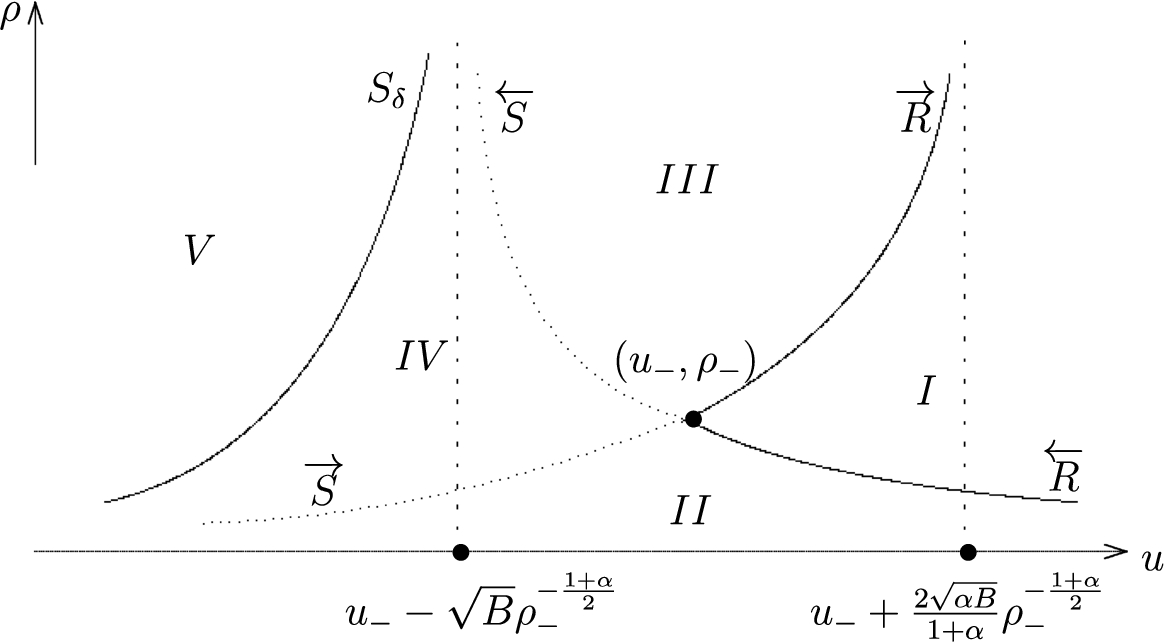
From Lemma 3.2, we know that, when , we cannot connect the states by two shocks and in -plane, the phase plane, which tells us that in this situation the solutions must be constructed in the nonclassical sense. Thus, in the -plane, for any given left state , we draw the elementary wave curves passing through this point. The backward shock wave curve has the asymptotic line , and the forward rarefaction wave curve , . Besides, motivated by Lemma 3.2, we draw a curve as follows
which can be viewed as the boundary of the region where nonclassical solutions appear. Then, the phase plane is divided into five regions I, , , and , as shown in Fig. 1.
Using these elementary waves: shocks and rarefaction waves, one can construct the solutions of (1.4) and (1.5) by virtue of the analysis method in phase plane. For example, when , starting from the point , we draw the curve , then it must intersect with at a unique point, so the two constant states can be connected by and , as well as an intermediate constant state between them. Therefore, according to the right state in the different region, one can construct the unique global Riemann solution connecting two constant states as follows:
However, when , one has , that is, , so we need to seek a nonclassical solution. In fact, from the above discussions, we know that the nonclassical solution may occur under the condition that . In this situation, we have
namely,
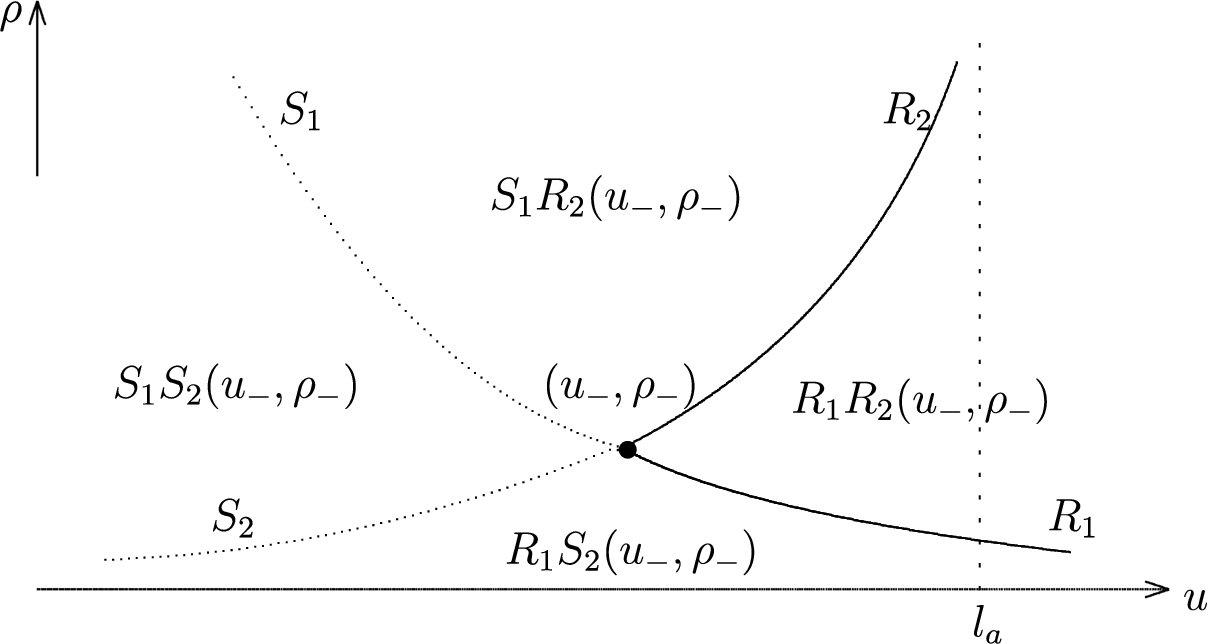
which means that the characteristic lines from initial data will overlap in the domain Ω, as shown in Fig. 2. So singularity must happen in Ω. It is well known that the singularity is impossible to be a jump with finite amplitude, which implies that there is no solution that is piecewise smooth and bounded.
Analysis of characteristics for delta-shock of (1.4).
Hence, motivated by [26,31,34], etc., the solution for (1.4) with delta distribution at the jump (i.e., the delta-shock solution) should be constructed, which is, under the Definition 2.1,
where , and
where is defined as
By Definition 2.2, one can prove that if (3.12)–(3.14) are the solutions of (1.4), then this kind of discontinuity solution must satisfy the generalized Rankin–Hugoniot relations
In addition, to guarantee the uniqueness, the discontinuity must obey the entropy condition
which ensures that all the characteristic lines on both sides of the discontinuity are in-coming. A discontinuity satisfying (3.15) and (3.16) is called a delta shock wave to the system (1.4).
By solving the generalized Rankine–Hugoniot relation (3.15) with initial data and , we have
as , and
as .
Thus, when , the solution of (1.4) consists of a delta shock wave. That is, the two states and can be directly connected by a delta shock wave.
So far, we have completed the construction of the Riemann solutions to the system (1.4).
When , the system (1.4) corresponds to Chaplygin gas equations. One can check from (3.1) and (3.2) that (), which implies that both the characteristic fields are linearly degenerate and the elementary waves involve only contact discontinuities. That is to say, at this time, both the backward (forward) rarefaction wave and the backward (forward) shock wave become the backward (forward) contact discontinuity.
Riemann problem to the extended Chaplygin gas equations
The system (1.1) has two eigenvalues
with two associated right eigenvectors
Since one can check that
for , so (1.4) is strictly hyperbolic and the characteristics are genuinely nonlinear.
By a self-similar transformation , the Riemann problem (1.4) and (1.5) is reduced to a boundary value problem
which provides either the constant solution or the backward rarefaction wave
or the forward rarefaction wave
We can deduce from (4.4) and (4.5) that
Similarly, for , we have
The equalities (4.6) and (4.7) show that the velocity of backward (forward) rarefaction wave () is monotonically decreasing (increasing) with respect to ρ.
Considering that and , we have, by integrating the second equations of (4.4) and (4.5) respectively,
and
The rarefaction wave curves enjoy the following geometric properties.
For the rarefaction wave curvesandbased on, we havewhereis a constant.
For the back rarefaction wave curve , it follows from the second equation of (4.8) that
Similarly, one has on .
Now, let us investigate the geometric properties of rarefaction wave curves. We will consider curve first. In this situation,
where
Denoted by
then one can calculate that
which implies that . Noting that
so . Owing to (4.10), we know that on .
Let us turn to . Along this curve, one has
where is defined in (4.11). Since and , thus exists, which means that along . This finishes the proof of Lemma 4.1. □
For the bounded discontinuity at , it satisfies the Rankine–Hugoniot condition
where ω is the velocity of the shock.
Moreover, in order to identify the admissible solution, the shock wave should satisfy the stability condition
for associating with ; and
for associating with .
It yields from the first equation of (4.14) that
Together with (4.17) and (4.19), we have
which means that and for .
Similarly, (4.18) and (4.19) yield that
which implies that and for .
Thereby, associating with , we obtain the backward shock wave
and associating with , we get the forward shock wave
Moreover, we have the following result
For the shock wave curves based on the left state, we have
Differentiating u with respect to ρ in (4.15) gives that
Noting that , the above equality shows that on since , and on since . Furthermore, from the second equations of (4.22) and (4.23), one can easily observe that on , and on . The proof is completed. □
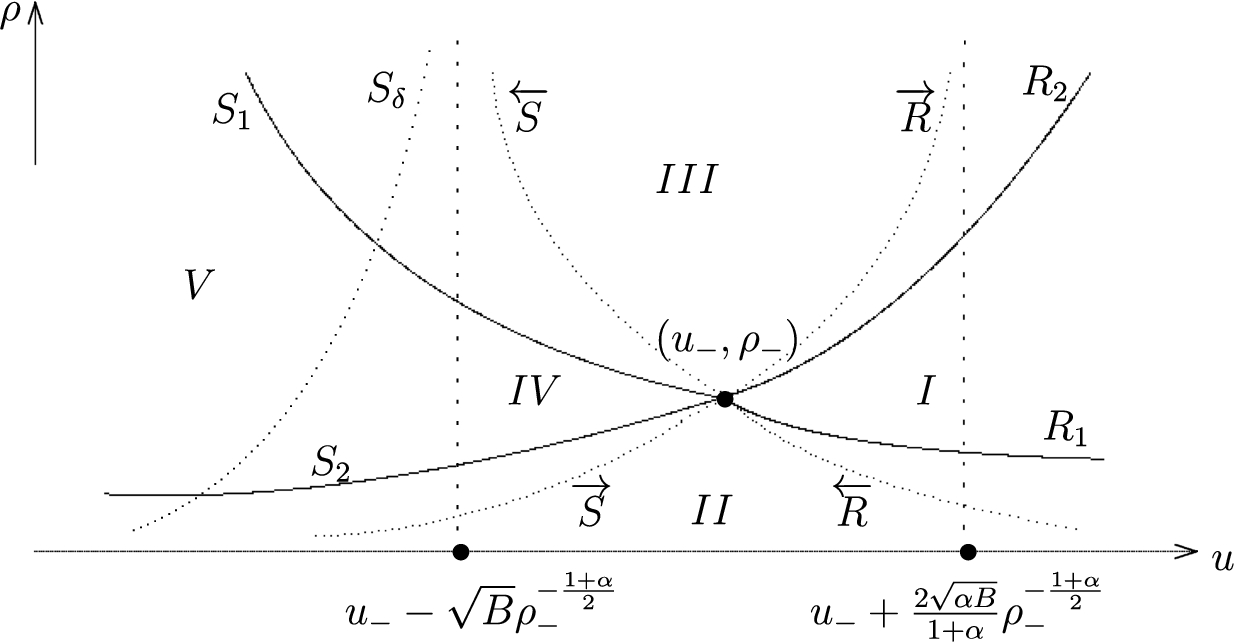
According to the geometric properties of the curves for rarefaction wave and shock wave, we know that, for the given left state , the half-upper -phase plane is divided into four regions by the curves , , and starting from the point , as shown in Fig. 3. These four regions, denoted by , , and , respectively, correspond to four kinds of configurations of Riemann solutions to the extended Chaplygin gas equations (1.1), which can be represented by the symbols , , or , respectively, where the symbol “+” means “followed by”.
In this section, we study the limits of Riemann solutions to the extended Chaplygin gas equations (1.1) with the initial data (1.5) as both the two exponents , that is, the extended Chaplygin gas pressure tends to a constant . We will first discuss the formation of delta shock waves in the Riemann solutions of (1.1) and (1.5) in the case with , then analyze the formation of vacuum states in the case with and , as .
Limit behavior of Riemann solutions as
For each pair of fixed α and γ, if and are connected by a with speed , and that and are connected by a with speed , then it follows that
and
We have, together with (5.1) and (5.2),
In order to discuss the limit behavior of Riemann solutions of (1.1) and (1.5) as , we should prove some useful lemmas.
It holds thatand
Set , . This lemma will be proved by the following three steps.
(i). At first, we show that . Here, just for convenience of the prove, we suppose that . If , then by the continuity of , there exists a sequence such that
for some . Then, substituting the sequence into the right of (5.3) and taking the limit yields that
which contradicts with the fact that . Hence, we have .
(ii). We show that . If , then denoted by . By a similar method used above, one can also obtain a contradiction when taking limit in (5.3). Therefore, or . However, from the entropy condition we know that , which yields that .
(iii). Noticing that
Thus, letting in (5.3), one has
from which we can solve that . The proof is finished. □
.
By a direct computation, we have
Form the generalized Rankine–Hugoniot condition (4.14), we can derive that
and
Thus, Lemma 5.2 is right. □
and
The first equations of the Rankine–Hugoniot relation (4.14) for and read
from which one has
Similarly, we obtain from the second equations of the Rankine–Hugoniot relation (4.14) for and that
which yields that
This is the end of the proof. □
The above lemmas imply that, as the exponents α and γ tend to zero, the two shock waves and will coincide, and the intermediate density becomes singular. Moreover, the velocities , and approach the quantity σ, which uniquely determines the delta-shock solution of (1.3) as the limit of the Riemann solutions to (1.1) and (1.5).
Formation of delta shock waves as
Now, as the exponents α and γ vanish, we give the following theorem to well characterize the limits of solutions of (1.1) in the case .
Let. For each pair of fixed, assume thatis a solution containing two shocksandof (
1.1
), (
1.5
) constructed in Section
4
. Then,andconverge in the sense of distributions as, and the limit functions ρ andare the sums of a step function and a Dirac delta function with weightsrespectively, which form the delta-shock solution of (
1.3
), (
1.5
).
(i). Set . For any fixed , the two-shock Riemann solution of (1.1) reads
which satisfies
and
for any .
(ii). Let us discuss the limits of and depending on ξ. The first integral on the left of (5.5) can be decomposed as
For the first and last terms of (5.6), it can be calculated that
where , .
While for the second term, the limit of which when equals
We turn to the second term on the left of (5.5), by Lemmas 5.1–5.2, one has
in which θ is defined in Lemma 5.1.
Thereby, by substituting (5.9) and (5.10) into (5.5), we immediately obtain that,
for any test function .
In a similar manner, from (5.4), we can prove that
where , .
(iii). Finally, we check the limits of and depending on time t. Then,
holds for any by using (5.11), in which according to Definition 2.1.
Analogously, we can conclude that
in which . We finish the proof of Theorem 5.1. □
Formation of vacuums as
In this section, we discuss the limit behavior of solutions to Riemann problem (1.1), (1.5) when with as , which corresponds to the formation of vacuums. At this time, the Riemann solution involves two rarefaction waves and with an intermediate state besides two constant states and , which satisfies
and
We conclude the following theorem.
Let. For each pair of fixed, assume thatis a solution containing two rarefaction wavesandof (
1.1
), (
1.5
) constructed in Section
4
. Then, as, the two rarefaction waves become two contact discontinuities () connecting the constant statesand vacuum state (), which form a vacuum solution of (
1.3
) and (
1.5
).
From the second equations of (5.15) and (5.16), one can get that
Without loss of generality, we suppose that , then by taking the limit in (5.17), we have , which contradicts with . Thus, . That is, the vacuum occurs. In addition, it directly yields from the first equations of (5.15) and (5.16) that , which shows that, as α and γ drop to zero, the two rarefaction waves and become two contact discontinuities , respectively. Then the desired conclusion is reached. □
Formation of delta shocks and two-rarefaction wave as
In this section, we fix and consider the limits of Riemann solutions of (1.1) as . At this time, the extended Chaplygin gas pressure approaches to a special kind of generalized Chaplygin gas pressure .
Relationships of elementary wave curves.
From Sections 3 and 4, one can easily observe that, as , the backward (forward) rarefaction wave curve () of (1.1) approaches to the backward (forward) rarefaction wave curve () of (1.4), and the backward (forward) shock wave curve () of (1.1) tends to the backward (forward) shock wave curve () of (1.4) when . See Fig. 4.
Formation of delta-shock solution as
We study the formation of the delta shock waves in the limit of solutions of (1.1) and (1.5) in the case , that is, , as the adiabatic exponent .
When, there exists a positive parametersuch thatas.
In view of , we have
As a result,
or written as
All states connected with by a backward shock wave or a forward shock wave should satisfy
or
When , then for any . While if and , then from (6.3), (6.4) and Fig. 4, we can deduce that
or
which yield that
Since from (6.2) one can obtain that
it follows that there exists some small enough such that (6.7) holds when . That is to say, for . The proof is complete. □
When , the Riemann solution of (1.1) and (1.5) contains a backward shock wave plus a forward shock wave and the intermediate state , besides two constant states . We then have
and
Here, and are the propagation speeds of and , respectively. Similar to that in Section 5, one has the following lemmas.
The desired result can be proved by a similar argument as used in Lemma 5.1. Here, just to be convenient and complete, we show the outline of the proof. If , then by taking the limit of (6.10) as , one has
which leads to, together with (6.1),
which is not true. Thus, we have . Based on this fact, we further obtain from (6.10) that
Then, we have
from which one can solve that . We finish the proof. □
Let, then
Observing Lemma 6.2, from the second equation of (6.8), we have
Analogously, from the second equation of (6.9), one has
What is more, by a similar analysis as in Lemma 5.2, we can check that . The proof is finished. □
Using Rankine–Hugoniot relation for shock waves, as done in Lemma 5.3, we have
and
By Lemma 6.4, we can observe that
from which, and noting that , we immediately obtain the following result
For thementioned in this section, we havefor, andfor.
Lemmas 6.2–6.4 imply that when the adiabatic exponent , the intermediate density becomes unbounded, and the velocities and () tend to quantity , which uniquely determines the delta-shock solution of (1.4) as the limit of the Riemann solutions of (1.1) and is actually consistent with the generalized Rankine–Hugoniot relation (3.15) and the entropy condition (3.16), as proposed for the delta-shock solution to the generalized Chaplygin gas equations in Section 3.
Finally, by virtue of a similar discussion in Theorem 5.1, we conclude the following result.
Let. For any fixed, suppose thatis a two-shock-wave solution of (
1.1
) and (
1.5
) forconstructed in Section
4
. Then, as,andconverge in the sense of distributions, and the limit functions ofandare the sums of a step function and a Dirac delta function with weightsrespectively, which form the delta-shock solution of the generalized Chaplygin gas equations (
1.4
) with the initial data (
1.5
).
Formation of two-rarefaction-wave solution as
In what follows, by imposing , we study the formation of the two-rarefaction-wave solution in the solutions of (1.1) and (1.5) when for .
When, there exists a positive parametersuch thatas.
When , we can observe from Fig. 4 together with (3.4) and (3.5) that the following results are true
and
Thus, for , we have,
All states connected with via a backward rarefaction wave or a forward rarefaction wave satisfy
When , the conclusion is obvious. When and , we can see intuitively from Fig. 4 together with (6.15) and (6.16) that
and
that is
Taking on both sides of (6.19), it becomes nothing but (6.14), which yields that there exists some small enough such that (6.19) holds when . Therefore, it is clear that as . The proof is finished. □
When , the Riemann solution of (1.1) and (1.5) contains two rarefaction waves and with the intermediate state besides two constant states , which is
and
Here, is determined by
Furthermore, letting , one has
Letting in (6.20) and (6.21), then for , and become the backward rarefaction wave and the forward rarefaction wave , respectively, as follows
and
As a conclusion, in this case we have the following
Let. For any fixed, assume thatis the two-shock-wave solution of (
1.1
) and (
1.5
) forconstructed in Section
4
. Then, as, the limit of the Riemann solutionis expressed aswhich is just the solution of the generalized Chaplygin gas equations (
1.4
) with the initial data (
1.5
) containing a nonvacuum state and two rarefaction wavesandfor.
For the case and , since from Remark 3.1 we know that (1.4) corresponds to the Chaplygin gas equations, so one can prove that, as the adiabatic exponent , both the backward (forward) rarefaction wave curve () and the backward (forward) shock wave curve () of the extended Chaplygin gas equations (1.1) tend to the backward (forward) contact discontinuity curve of the Chaplygin gas equations (1.4).
Conclusion
A new model for extended Chaplygin gas is introduced. By the Riemann problem, the phenomenon of concentration and cavitation as well as the formation of delta shock waves and vacuums are analyzed via using the vanishing exponent limit method. By letting the perturbed exponents tend to zero wholly or partly, two kinds of interesting zero-exponent limit behaviors of solutions are investigated, which to some extent provides us a new angle of view to study the phenomenon of concentration and cavitation. In fact, it is more natural to consider the equations (1.1) with a sour term like [24], or study it in the relativistic version as in [35,39,40], etc. Of course, these may need more complicated calculation, derivation and analysis. We leave them for our future studies.
Footnotes
Acknowledgements
This work was supported by National Natural Science Foundation of China (11501488), Yunnan Applied Basic Research Projects (2018FD015), Scientific Research Foundation Project of Yunnan Education Department (2018JS150), Nan Hu Young Scholar Supporting Program of XYNU, Natural Science Foundation of Hebei Province (A2019105110) and Science and Technology Foundation of Hebei Education Department (QN2018307).
References
1.
H.B.Benaoum, Accelerated universe from modified Chaplygin gas and tachyonic fluid, arXiv:hep-th/0205140.
2.
Y.Brenier, Solutions with concentration to the Riemann problem for the one-dimensional Chaplygin gas equations, J. Math. Fluid Mech.7(3) (2005), S326–S331. doi:10.1007/s00021-005-0162-x.
3.
Y.Brenier and E.Grenier, Sticky particles and scalar conservation laws, SIAM J. Numer. Anal.35 (1998), 2317–2328. doi:10.1137/S0036142997317353.
4.
S.Chaplygin, On gas jets, Sci. Mem. Moscow Univ. Math. Phys.21 (1904), 1–121.
5.
G.Chen and H.Liu, Formation of delta-shocks and vacuum states in the vanishing pressure limit of solutions to the Euler equations for isentropic fluids, SIAM J. Math. Anal.34 (2003), 925–938. doi:10.1137/S0036141001399350.
6.
G.Chen and H.Liu, Concentration and cavitation in the vanishing pressure limit of solutions to the Euler equations for nonisentropic fluids, Physica D189 (2004), 141–165. doi:10.1016/j.physd.2003.09.039.
7.
H.Cheng and H.Yang, Approaching Chaplygin pressure limit of solutions to the Aw–Rascle model, J. Math. Anal. Appl.416 (2014), 839–854. doi:10.1016/j.jmaa.2014.03.010.
8.
R.Courant and K.O.Friedrichs, Supersonic Flow and Shock Waves, Interscience Publishers Inc., New York, 1948.
9.
B.Ding, I.Witt and H.Yin, The global smooth symmetric solution to 2-D full compressible Euler system of Chaplygin gases, J. Differential Equations258(2) (2015), 445–482. doi:10.1016/j.jde.2014.09.018.
10.
L.Guo, W.Sheng and T.Zhang, The two-dimensional Riemann problem for isentropic Chaplygin gas dynamic system, Commun. Pure Appl. Anal.9 (2010), 431–458. doi:10.3934/cpaa.2010.9.431.
11.
Y.Heydarzade, F.Darabi and K.Atazadeh, Einstein static universe on the brane supported by extended Chaplygin gas, Astrophys Space Sci.361(8) (2016), 250. doi:10.1007/s10509-016-2836-7.
12.
M.Ibrahim, F.Liu and S.Liu, Concentration of mass in the pressureless limit of Euler equations for power law, Nonlinear Analysis: Real World Applications47 (2019), 224–235. doi:10.1016/j.nonrwa.2018.10.015.
13.
E.O.Kahya and B.Pourhassan, Observational constraints on the extended Chaplygin gas inflation, Astrophys Space Sci.353(2) (2014), 677–682. doi:10.1007/s10509-014-2069-6.
14.
H.Li and Z.Shao, Delta shocks and vacuum states in vanishing pressure limits of solutions to the relativistic Euler equations for generalized Chaplygin gas, Commun. Pure Appl. Anal.15(6) (2016), 2373–2400. doi:10.3934/cpaa.2016041.
15.
J.Li, Note on the compressible Euler equations with zero temperature, Appl. Math. Lett.14 (2001), 519–523. doi:10.1016/S0893-9659(00)00187-7.
16.
J.Liu, J.Liang and H.Yang, Delta shock waves as flux-approximation limit of solutions to the modified Chaplygin gas equations, Acta Applicandae Mathematicae (2019). doi:10.1007/s10440-019-00280-2.
17.
J.Naji, Extended Chaplygin gas equation of state with bulk and shear viscosities, Astrophys Space Sci.350(1) (2014), 333–338. doi:10.1007/s10509-013-1714-9.
18.
J.Naji, S.Heydari and R.Darabi, New version of viscous Chaplygin gas cosmology with varying gravitational constant, Canadian Journal of Physics92(12) (2014), 1556–1561. doi:10.1139/cjp-2014-0226.
19.
L.Pan and X.Han, The Aw–Rascle traffic model with Chaplygin pressure, J. Math. Anal. Appl.401(1) (2013), 379–387. doi:10.1016/j.jmaa.2012.12.022.
20.
B.C.Paul, P.Thakur and A.Saha, Observational constraints on extended Chaplygin gas cosmologies, Pramana – J. Phys.89(2) (2017), 29. doi:10.1007/s12043-017-1417-9.
21.
B.Pourhassan and E.O.Kahya, Extended Chaplygin gas model, Results in Physics4 (2014), 101–102. doi:10.1016/j.rinp.2014.05.007.
22.
M.R.Setare, Interacting holographic generalized Chaplygin gas model, Phys. Lett. B654 (2007), 1–6. doi:10.1016/j.physletb.2007.08.038.
23.
S.F.Shandarin and Ya.B.Zeldovich, The large-scale structure of the universe: Turbulence, intermittency, structures in a self-gravitating medium, Rev. Modern Phys.61 (1989), 185–220. doi:10.1103/RevModPhys.61.185.
24.
S.Sheng and Z.Shao, The vanishing adiabatic exponent limits of Riemann solutions to the isentropic Euler equations for power law with a Coulomb-like friction term, J. Math. Phys.60(10) (2019), 101504. doi:10.1063/1.5108863.
25.
S.Sheng and Z.Shao, Concentration of mass in the pressureless limit of the Euler equations of one-dimensional compressible fluid flow, Nonlinear Analysis: Real World Applications52 (2020), 103039. doi:10.1016/j.nonrwa.2019.103039.
26.
W.Sheng, G.Wang and G.Yin, Delta wave and vacuum state for generalized Chaplygin gas dynamics system as pressure vanishes, Nonlinear Analysis: Real World Applications22 (2015), 115–128. doi:10.1016/j.nonrwa.2014.08.007.
27.
W.Sheng and T.Zhang, The Riemann problem for transportation equation in gas dynamics, Mem. Am. Math. Soc.137(654) (1999), 1–77.
28.
M.Tong and C.Shen, The limits of Riemann solutions for the isentropic Euler system with extended Chaplygin gas, Applicable Analysis (2018). doi:10.1080/00036811.2018.1469009.
29.
H.Tsien, Two dimensional subsonic flow of compressible fluids, J. Aeron. Sci.6 (1939), 399–407. doi:10.2514/8.916.
30.
T.von Karman, Compressibility effects in aerodynamics, J. Aeron. Sci.8 (1941), 337–365. doi:10.2514/8.10737.
31.
G.Wang, The Riemann problem for one dimensional generalized Chaplygin gas dynamics, J. Math. Anal. Appl.403(2) (2013), 434–450. doi:10.1016/j.jmaa.2013.02.026.
32.
E.Weinan, Yu.G.Rykov and Ya.G.Sinai, Generalized variational principles, global weak solutions and behavior with random initial data for systems of conservation laws arising in adhesion particle dynamics, Comm. Math. Phys.177 (1996), 349–380. doi:10.1007/BF02101897.
33.
H.Yang and J.Wang, Delta-shocks and vacuum states in the vanishing pressure limit of solutions to the isentropic Euler equations for modified Chaplygin gas, J. Math. Anal. Appl.413 (2014), 800–820. doi:10.1016/j.jmaa.2013.12.025.
34.
H.Yang and J.Wang, Concentration in vanishing pressure limit of solutions to the modified Chaplygin gas equations, J. Math. Phys.57(11) (2016), 111504. doi:10.1063/1.4967299.
35.
H.Yang and Y.Zhang, Pressure and flux-approximation to the isentropic relativistic Euler equations for modified Chaplygin gas, J. Math. Phys.60(7) (2019), 071502. doi:10.1063/1.5093531.
36.
G.Yin and K.Song, Vanishing pressure limits of Riemann solutions to the isentropic relativistic Euler system for Chaplygin gas, J. Math. Anal. Appl.411 (2014), 506–521. doi:10.1016/j.jmaa.2013.09.050.
37.
Q.Zhang, Concentration in the flux approximation limit of Riemann solutions to the extended Chaplygin gas equations, J. of Math. (PRC)39(4) (2019), 504–528.
38.
Y.Zhang, Y.Pang and J.Wang, Concentration and cavitation in the vanishing pressure limit of solutions to the generalized Chaplygin Euler equations of compressible fluid flow, Eur. J. Mech. B Fluids78 (2019), 252–262. doi:10.1016/j.euromechflu.2019.103515.
39.
Y.Zhang, M.Sun and X.Lin, Solutions with concentration and cavitation to the Riemann problem for the isentropic relativistic Euler system for the extended Chaplygin gas, Open Mathematics17(1) (2019), 220–241. doi:10.1515/math-2019-0017.
40.
Y.Zhang and H.Yang, Limits of solutions to the relativistic Euler equations for modified Chaplygin gas by flux approximation, Acta Applicandae Mathematicae (2019). doi:10.1007/s10440-019-00286-w.