



Abstract
In the present paper, we are concerned with the semilinear viscoelastic wave equation in an inhomogeneous medium Ω subject to two localized dampings. The first one is of the type viscoelastic and is distributed around a neighborhood ω of the boundary according to the Geometric Control Condition. The second one is a frictional damping and we consider it hurting the geometric condition of control. We show that the energy of the wave equation goes uniformly and exponentially to zero for all initial data of finite energy taken in bounded sets of finite energy phase-space.
Introduction
Description of the problem
This article is devoted to the analysis of the exponential and uniform decay rates of solutions to the wave equation subject to two localized dampings:
The function f satisfies the following hypotheses:
ω geometrically controls Ω, i.e. there exists
Assumption 1.2 is the so called Geometric Control Condition (G.C.C.). It is well-known that it is necessary and sufficient for stabilization and control of the linear wave equation, see [2,5,7,8,13,29] and the references therein. For this reason and since in the present paper we do not have any control of the geodesics because of the inhomogeneous medium we consider ω a neighbourhood of the whole boundary
It is important to observe that Assumption 1.2 is not obviously fulfilled for every matrix
When we do not have any control on the geodesics of the metric for all for all geodesic
The best way to do this is by using the ideas introduced in Cavalcanti et al. [7,8], namely,

Geodesic entering the damped area.
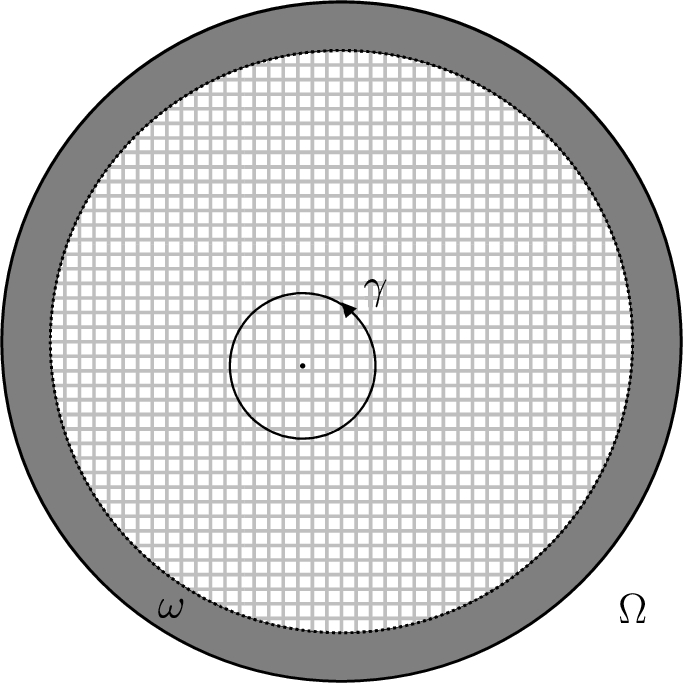
Totally distributed damping.
The following assumptions are made on the functions
We assume that
One of the main ingredients for the stabilization of the system (1.1) is a Unique Continuation Principle, so we assume the following hypothesis:

The Kelvin–Voigt damping
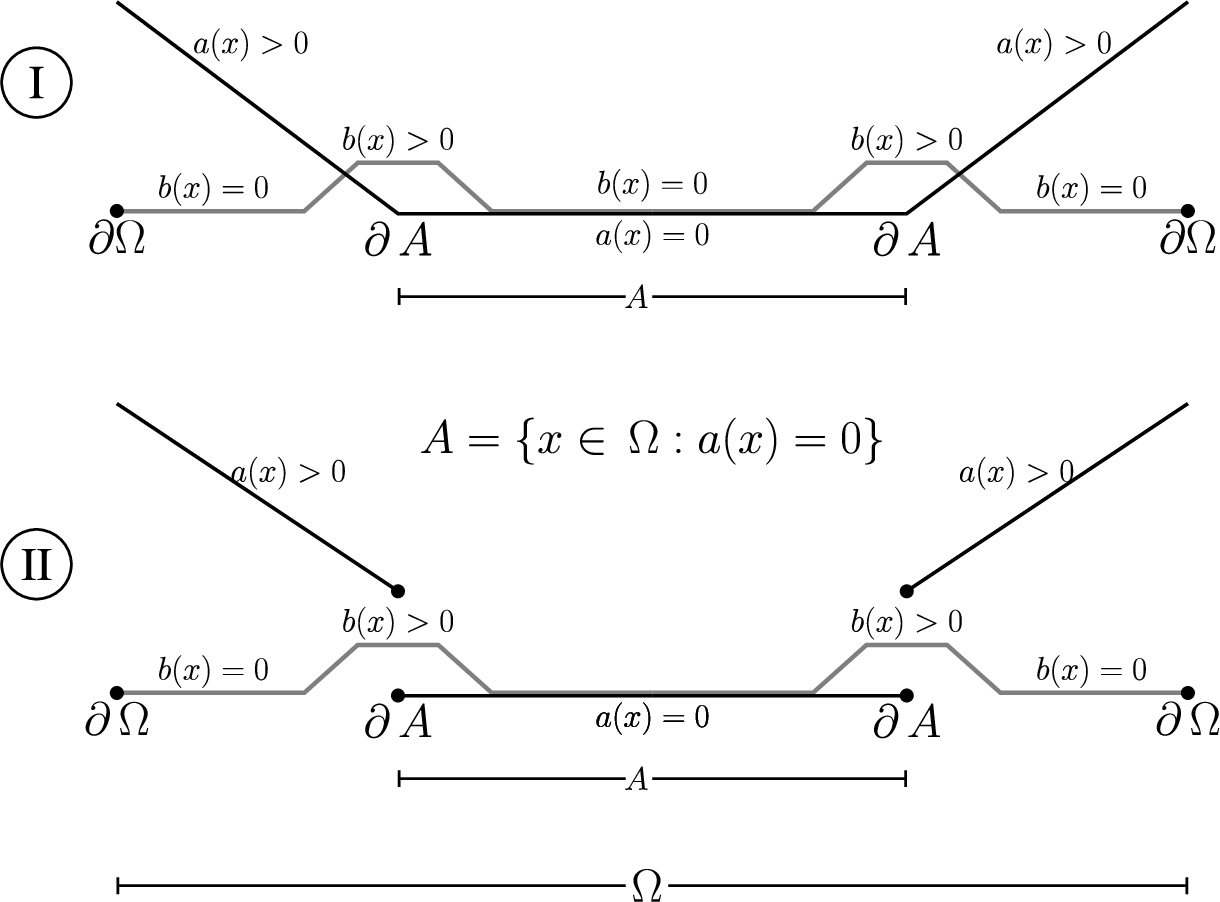
Admissible geometries for the Kelvin–Voigt and frictional dissipations
For every
This type of condition in Assumption 1.5 is generally assumed in control/stabilization statements and the possibility to overcome it to every setting seems to be an open question. However, there is concrete examples where Assumption 1.5 holds, for example, if
The paper is organized as follows. In Section 2 we give some notation and we establish the well-posedness to problem (1.1). In Section 3 we give the proof of the stabilization which consists our main result. In the Appendix we recall some basic results of microlocal analysis.
The decay properties of solutions to the wave equation have been widely studied by many authors under different conditions. Among the numerous papers regarding the wave equation we mention the following references: [1–3,5,7,8,11–13,16–18,20–22,25–27,29,30,32,34] and [36] and a long list of references therein.
The study of problem (1.1) presents two main points of difficulty. The first one is to deal with the viscoelastic damping of Kelvin–Voigt type, which generates an unbounded operator. In addition, the domain consists of two different materials, that is, there is an interaction between the elastic component (the portion of Ω where
When
In [10], the authors studied an equation of the type
In [24], Liu and Rao study the problem posed in higher dimensions and, even considering more regular damping coefficient and smooth initial data, they conclude that there is a loss of regularity which makes it difficult to apply the multiplier method. To bypass these difficulties, the authors were forced to make several technical assumptions on the damping coefficient. Tebou in [33], relaxed the damping coefficients hypothesis as well as the conditions on the feedback control region, but he had to impose a certain constraint on the gradient of the damping coefficient, which will not be required in our current study.
The main contribution of the present paper is to prove the exponential stability of problem (1.1), which generalizes the previous results given in [10] to the semilinear case in the inhomogeneous medium Ω. In particular, the method allows us to consider an inhomogeneous medium subject to a Kelvin–Voigt type damping acting in a neighborhood of the boundary or in a mesh totally distributed in the domain with measure arbitrarily small.
In order to obtain the desired stability result for the wave equation subject to the Kelvin–Voigt and frictional dampings, we combined the presence of the two dissipations in order to use some results present in the literature. The method of proof combines an observability inequality, microlocal analysis tools and unique continuation properties. We also emphasize that the usual multiplier technique,
In what follows we are going to explain briefly the methodology we are going to use.
In the presence of both dissipative effects, the energy identity associated to problem (1.1) is given by
In what follows, given
It is worth mentioning that if
Let
To circumvent this difficulty, we use the fact that the frictional damping is effective in the neighbourhood
From convergence (1.12) we deduce that μ propagates along the bicharacteristic flow of the operator
Consequently, we get that
In light of convergence (1.13) and an argument of equipartition of energy, we can conclude that
Well-posedness
We consider the weak phase space
Assume that the hypotheses on the nonlinear term f specified in Assumption
1.1
are satisfied and the initial data
Moreover, if
First of all the operator (Global Well-Posedness).
Let
The energy identity reads as follows
Thus, our goal is to prove the observability inequality established in the following lemma.
For all
Our proof relies on contradiction arguments. So, if (3.2) is false, then there exists
In particular, for each
Then, we obtain a sequence
Equivalently
Since
Consequently
Let
Case (a):
For
Taking (3.5), (3.7), (3.8), (3.9) and (3.10) into consideration we obtain
Defining
From Assumption 1.5 we deduce that
Case (b):
Setting
According to (3.12), for each
Note that
In order to achieve the contradiction we are going to prove that
Indeed, initially, we observe that (3.15) yields the existence of a subsequence of
For some eventual subsequence, we have that
If
The above problem yields, for
Again, by Assumption 1.5, we conclude that
Suppose that
Therefore,
Passing to the limit in (3.14) as
By employing Assumption 1.5 again we obtain that
Then, in both cases
Now, let’s consider
Let us analyse the terms on the right hand side of (3.37).
Analysis of
Employing convergence (3.36), we deduce that
Analysis of
We trivially obtain from (3.13) that
Analysis of
Recalling convergence (3.13), we deduce that
The above convergences yield
Let μ be the microlocal defect measure associated with
On the other hand, Poincaré inequality combined with the existence of the dissipative effects, yield
Our goal is to propagate the convergence of
At this point, the presence of the frictional damping in the neighbourhood
Furthermore, from Proposition A.1 and Theorem A.4 found in the Appendix, we deduce that
The above convergence yields that μ propagates along the bicharacteristic flow of the operator
Then, we prove that
Multiplying equation (3.14) by
Considering the convergences (3.13), (3.17)–(3.19) and (3.42) and employing the fact that
In addition, using the definition of functions f and F and taking advantage of property (1.6), the last convergence implies
Convergences (3.42), (3.44) and (3.45) establish that
Using the energy identity we deduce that
Then, according to (3.16), the desired contradiction is achieved and we finish the proof. □
In what follows, we are going to conclude the exponential stability to the problem (1.1).
Thanks to inequality (3.2), the energy identity (1.8) and the fact that the map
Repeating the same steps for
Defining
Under the Assumptions
1.1
,
1.3
,
1.4
and
1.5
, there exist positive constants C and γ such that the following exponential decay holds
Footnotes
Acknowledgements
Research of Marcelo M. Cavalcanti is partially supported by the CNPq Grant 300631/2003-0.
Research of Victor Hugo Gonzalez Martinez is supported by CAPES.