



Abstract
BACKGROUND:
With the increasing aging of population, the incidence rate of diseases such as fracture and osteoporosis has been increasing. The demand for implant in Department of orthopedics has increased. The elastic modulus of the existing solid metal implant is much higher than that of human bone tissue, and it is easy to produce stress shielding effect after operation, which causes complications such as loosening of prosthesis and low fusion efficiency.
OBJECTIVE:
In order to solve the mismatch of elastic modulus between solid metal orthopedic implants and human bone tissue, metal structures with excellent mechanical properties were prepared.
METHODS:
The porous structure was designed by spatial dot matrix method, and the metal porous structure was prepared based on selective laser melting 3D printing technology. The residual stress in the preparation process was eliminated by vacuum annealing heat treatment, and the static compression experiment was carried out to study the effects of different pore shape and porosity parameters on the compressive yield strength and elastic modulus of porous structure. The performance changes of porous structure before and after heat treatment were compared, and the porous structure meeting the performance requirements of human bone tissue was selected.
RESULTS:
The porous structure prepared by selective laser melting technology met the requirements of human bone tissue. The elastic modulus was as low as 0.74 GPa and the compressive yield strength is 201.91 MPa; After annealing heat treatment, the compressive yield strength of porous structure decreased, the maximum change was 3.69%, the elastic modulus increased, and the maximum change was 8.69%.
CONCLUSIONS:
For the porous structure with the same pore shape, the lower the porosity, the better the mechanical properties of the porous structure. For the same porosity, the comprehensive mechanical properties of dodecahedral porous structure were the best and octahedral porous structure was the worst; the porous structure after annealing heat treatment was more conducive to meet the performance requirements of human bone tissue.
Introduction
Titanium, titanium alloy, stainless steel and other metallic materials have become the most commonly used orthopedic implant materials in the medical field due to their good biocompatibility and mechanical properties [1]. However, the solid metal implant has obvious shortcomings: Its elastic modulus (100–110 Gpa) is much higher than that of human bone tissue (0.1–30 Gpa), which tends to produce the “stress shielding” effect [2], so that most of the stress of bone tissue is absorbed by the implant, resulting in lack of sufficient stress stimulation of bone tissue, bone resorption, loosening and failure of implant, and affecting the effect of postoperative recovery [3].
In recent years, in order to reduce the disadvantages caused by the “stress shelding” effect, the researchers have done a lot of research [4,5]. They found that it was very difficult to directly change the material surface properties of materials to reduce the elastic modulus [6], but the metal body can be lightweight and made into a porous structure to reduce the elastic modulus of implants. The metal porous structure was conducive to the adhesion, proliferation and differentiation of bone cells, and greatly reduced the occurrence of postoperative complications [7]. With the emergence and development of additive manufacturing technology, selective laser melting technology and electron beam melting technology can produce porous structures with controllable porosity and pore diameter size [8,9], which can be used as implants to simulate trabecular structure of human bone. Kas et al. [10] prepared dodecahedral porous structures with porosity of 60%–80% by selective laser melting technology, and the research showed that the mechanical properties of different pore gradients were quite different. Song et al. [11] designed and prepared porous structures with four porosity, evaluated their mechanical properties through compression tests, and studied to reduce the “stress shielding” effect to meet the implantation conditions. Zhang et al. [12] proposed to make structures with different pore shapes under the condition of constant pore parameters. By studying its elastic modulus and yield strength, it was proved that the structure of humanoid bone scaffold was conducive to the elimination of stress shielding. The above scholars have conducted various studies on the design and performance analysis of porous structures to reduce the “stress shielding” effect and better match with human bone tissue. However, the above studies have less comparative analysis on the performance of different porous structures, and the impact of the performance of different porous structures on the stress shielding effect needs to be further studied. The compressive yield strength of human bone tissue is close to 190 MPa, and the compressive yield strength of porous structure designed and prepared should be close to this. Considering that the 3D printing of selective laser melting has the forming characteristics of rapid heating and rapid cooling, and there will be residual stress in the formed parts, which will affect the fatigue performance, the researchers [13–15] eliminated the residual stress through annealing heat treatment, so as to change the mechanical properties of the formed parts, slightly reduce the strength and improve the fatigue characteristics. However, the formed parts studied were solid samples, and there is a lack of research on the changes of mechanical properties of formed parts with porous structure before and after heat treatment.
In view of the “stress shielding” effect of implants in the field of orthopedics and medical treatment, we propose to design porous structures with different pore shapes and porosity according to the spatial dot matrix method, prepare the porous structures by selective laser melting 3D printing technology, analyze their elastic modulus and compressive yield strength, and explore the influence differences on the mechanical properties of porous structures before and after heat treatment. Finally, we hope to find a porous structure that meets the requirements of human bone tissue and has excellent mechanical properties, so that the implant can better match human bone tissue.
Materials and methods
Design of porous structural with different pore shapes
In this paper, hexahedron, octahedron and dodecahedron porous structures with controllable porosity were designed and constructed in NX12.0 based on spatial point array method, as shown in Fig. 1. The wire diameter was set to d, and the porosity of porous structure was characterized by volume method:
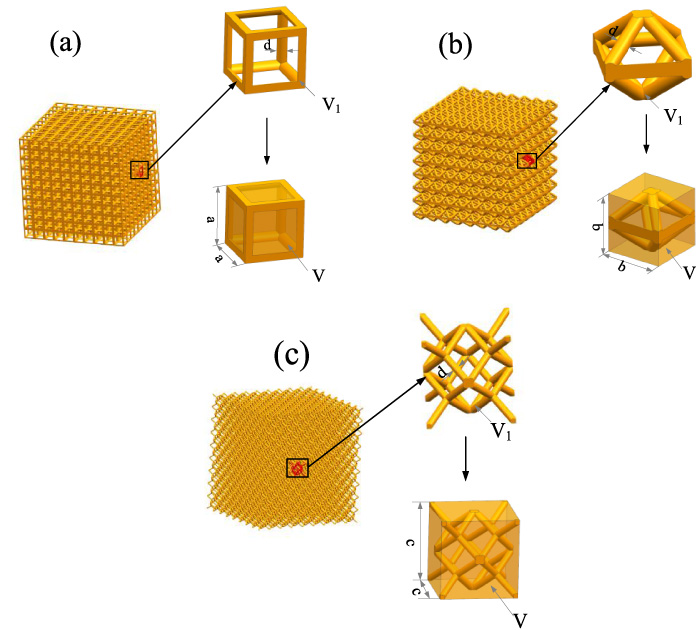
Porous structure with different pore shapes. (a) Hexahedral porous structure, (b) Octahedral porous structure, (c) Dodecahedral porous structure.
V 1 was measured by NX12.0, and V = i 3, i = a, b, c. By adjusting the size of a, b and c and changing V and V 1, the porous structure with different pore shapes can be realized, and the porosity can be controlled.
The porosity of human cancellous bone is about 60%–90%, and the porosity in this range is considered to be the most conducive to bone growth [16]. Many scholars [17–19] conducted experiments in vivo or in vitro, and the results showed that in the scaffolds within this porosity range, the cell activity was higher and the bone extension depth was better. In this paper, the porous structures of hexahedron, octahedron and dodecahedron with wire diameter d of 0.25 mm and porosity of 66%, 76% and 86% were designed and selected for experimental research. The corresponding parameters are shown in Table 1.
Characteristic parameters of porous structure with different porosity
According to the designed cell parameters of porous structure with different pore shape and porosity, 10 × 10 × 10 mm porous structure models were built using 3-matic lightweight module. Due to the limitation of design size, there would be incomplete cell structure around the porous structure, and there were errors in the theoretical porosity, but they were all within the allowable error range. A solid layer of 10 × 10 × 0.2 mm, served as the support for 3D printing, was constructed at the bottom of the porous structure. The porous structure models with different pore shape parameters are shown in Fig. 2.
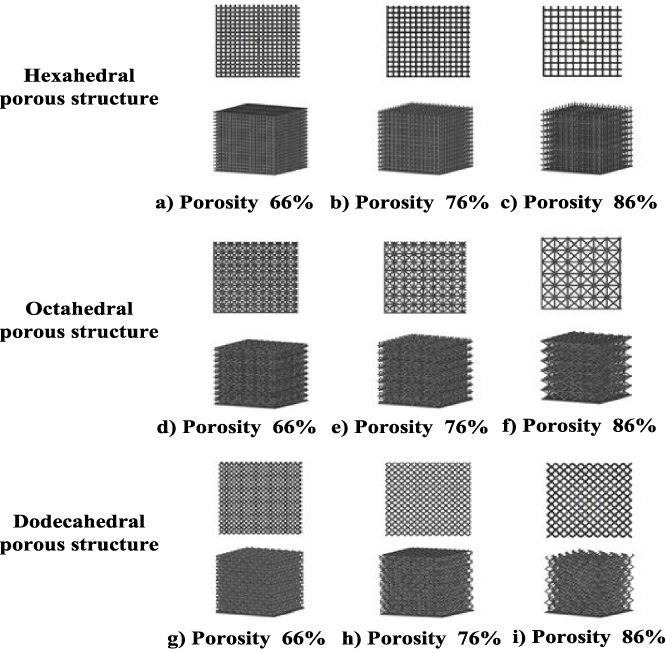
Porous structure model.
Titanium alloy has good biocompatibility, mechanical properties, fatigue resistance and corrosion resistance. Among them, Ti6Al4V is the most widely used and the most mature technology. Compared with other kinds of titanium alloys, it has the advantages of low cost and low density, and has become the preferred material for orthopaedic implants. The porous structures were fabricated using M2 cusing by Concept Laser, and Ti6Al4V ELI powders with a diameter of 15–45 μm were produced by AP&C. The power layer thickness was set as 30 μm and the laser power was 130 W. The sample blocks of 10 × 10 × 10.2 mm were fabricated as shown in Fig. 3.
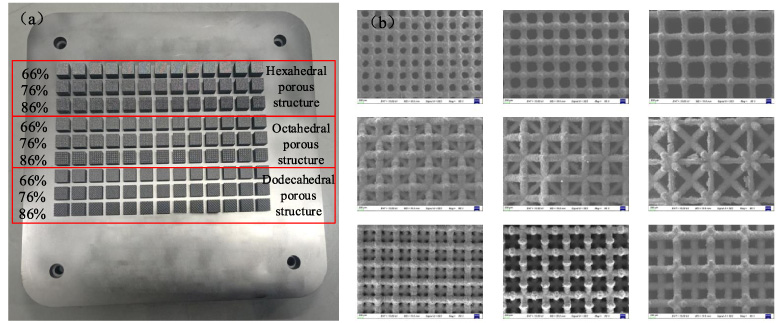
Sample blocks of porous structure prepared. (a) Porous samples with different parameters, (b) SEM images of different porous structures at 60× magnification.
Researchers have studied the effect of heat treatment on Laser 3D printed Ti6Al4V solid parts, found that 800 °C annealing heat treatment can make the formed parts have good comprehensiveness [13,14]. In order to study whether the residual stress also affects the properties of porous structure, vacuum annealing heat treatment was carried out for some prepared porous structure samples. To prevent the oxidation of samples, vacuumed the furnace to 10−3 Pa, filled it with argon, then vacuumed it to below 10−3 Pa, started heating, raised the temperature to 800 °C after 2 h, kept the temperature for 2 h, and then cooled it to room temperature with the furnace. The theoretical process of heat treatment is shown in Fig. 4. After heat treatment, the compression test was carried out to compare the changes of mechanical properties before and after heat treatment.
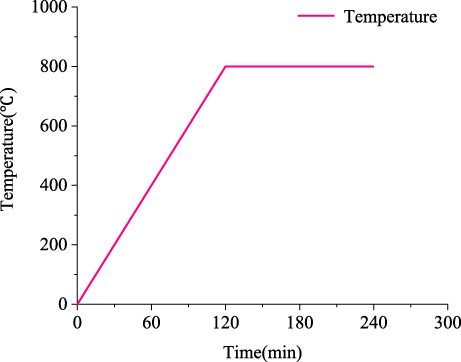
Heat treatment process of porous structure.
Static compression tests were carried out using MTS CMT5105 electronic universal testing machine on porous samples before and after heat treatment. The main parameters of the experimental process were as follows: compression speed 1 mm/min, displacement control, compression strain to 40%, length, width and thickness of the test sample block to 10 mm, and the original gauge distance to 10 mm. Five groups of sample blocks for each parameter were tested, shown in Fig. 5. The stress-strain curves of samples were fitted by origin, and the mechanical properties of porous structures were characterized by compressive yield strength and elastic modulus with different parameters.
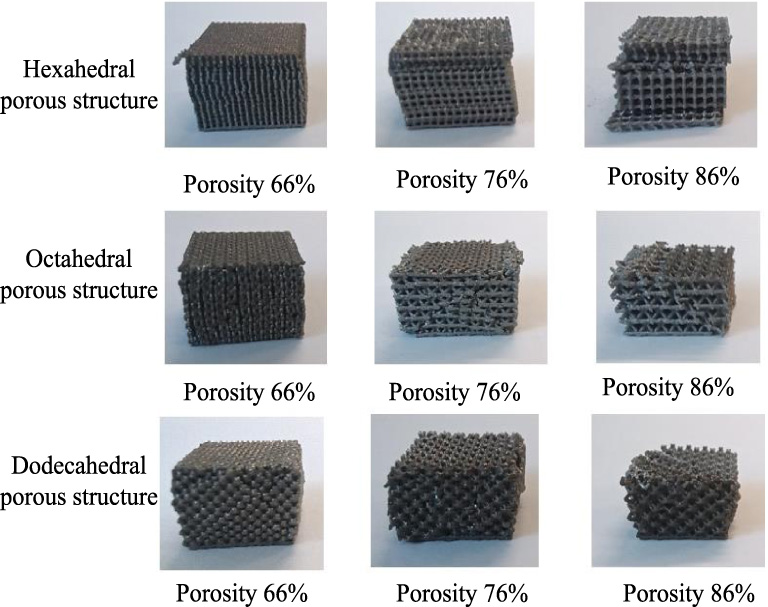
Porous structure samples after compression test.
According to Chinese national standard GB/T31930-2015/ISO 13314:2011, the specified compressive stress at 0.2% strain can be used to represent the compressive yield strength, as shown in Fig. 6, “l” is the quasi elastic gradient and “a” is the compressive yield strength.
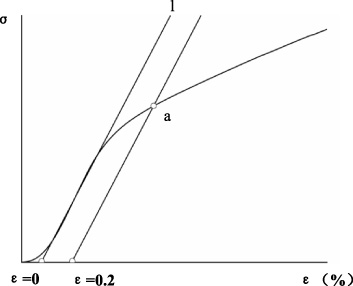
Expression method of compressive yield strength.
Stress-strain analysis of porous structures
Five groups of porous sample compression experimental data of each characteristic parameter before and after heat treatment were fitted with origin to obtain the stress-strain curves of porous structures with different porosity before and after heat treatment, as shown in Fig. 7. The appropriate curve segments were intercepted according to the curve law and the requirements of the method for calculating compressive yield strength. The porous structure with porosity of 66% had less displacement mutation times during the experiment and excellent overall mechanical properties. Its strain was intercepted by 40%, as shown in Fig. 7a and d. For the porous structure with a porosity of 76%, several displacement mutations began to appear during the experiment, indicating that the mechanical properties decreased, but the overall trend changed little. The strain was intercepted by 20%, as shown in Fig. 7b and e. The porous structure with porosity of 86% had obvious displacement mutation and layer by layer fracture during the experiment. Its mechanical properties are poor, and the stress-strain curve is wavy. After the experiment, the hexagonal porous structure had layered fracture, the octahedral porous structure had oblique fracture, and the dodecahedral porous structure had no obvious fracture. The strain was intercepted by 10%, as shown in Fig. 7c and f.
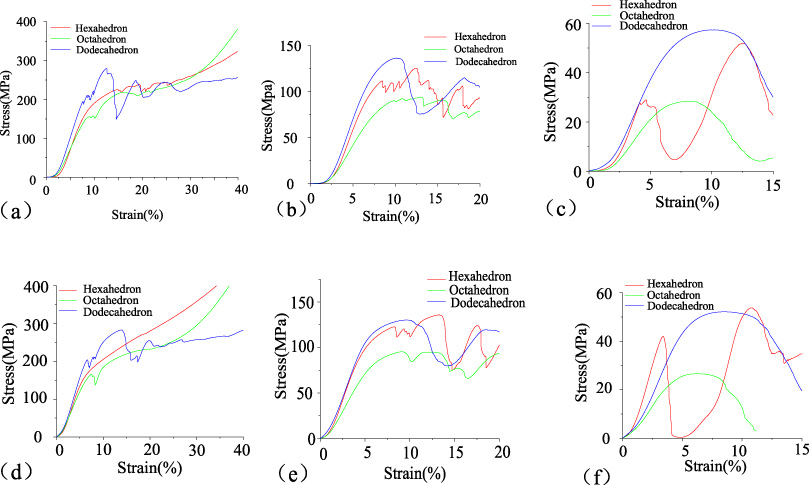
Stress-strain curves of porous structures with different porosity before and after heat treatment. (a) Stress-strain curve of porous structure with porosity of 66% before heat treatment, (b) Stress-strain curve of porous structure with porosity of 76% before heat treatment, (c) Stress-strain curve of porous structure with porosity of 86% before heat treatment, (d) Stress-strain curve of porous structure with porosity of 66% after heat treatment, (e) Stress-strain curve of porous structure with porosity of 76% after heat treatment, (f) Stress-strain curve of porous structure with porosity of 86% after heat treatment.
Through the calculation method of the elastic modulus output by the universal testing machine in the compression test and the compressive yield strength in the previous section, the data of the compressive yield strength and elastic modulus of the porous structure before and after heat treatment were obtained, as shown in Table 2. The experimental data before and after heat treatment were tested by t-test (P < 0.05), which were significantly different.
Mechanical properties of porous structure before and after heat treatment
Mechanical properties of porous structure before and after heat treatment
The maximum compressive yield strength (dodecahedral porous structure with porosity of 66%) was 201.91 MPa, which meets the performance requirements of human bone tissue. The minimum elastic modulus was 0.74 GPa (octahedral porous structure with porosity of 86%), which matches the elastic modulus range of human cortical bone and cancellous bone, and can reduce or eliminate the harm caused by stress shielding effect. As shown in Fig. 8, the compressive yield strength and elastic modulus of porous structures with different porosity before and after heat treatment were compared. After heat treatment, the compressive yield strength decreased by 3.69% and the elastic modulus increased by 8.69%. Compared with the solid samples before and after annealing heat treatment [20], the change trend of compressive yield strength and elastic modulus of porous structure was the same, but the change rate decreased.
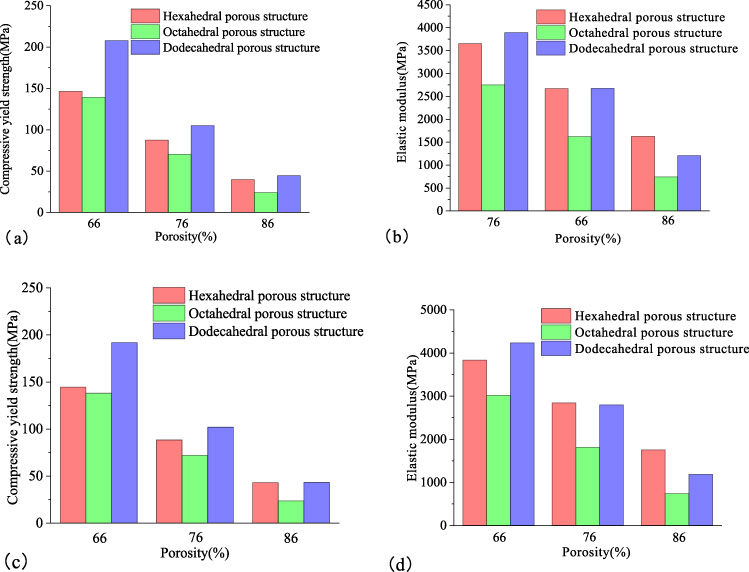
Comparison of mechanical properties of porous structures with different porosity before and after heat treatment. (a) Comparison of compressive yield strength of porous structures with different porosity before heat treatment, (b) Comparison of elastic modulus of porous structures with different porosity before heat treatment, (c) Comparison of compressive yield strength of porous structures with different porosity after heat treatment, (d) Comparison of elastic modulus of porous structures with different porosity after heat treatment.
With the increase of porosity of porous structure, the size of unit cell became larger, and the number of unit cell in porous structure with the same volume decreased, resulting in a downward trend in compressive yield strength and elastic modulus. With the same porosity, the comprehensive mechanical properties of octahedral porous structure were significantly lower than those of dodecahedral and hexahedral porous structure, which may be related to the stability of octahedral structure designed by this method. Dodecahedral porous structure had the highest compressive yield strength. During the experiment, compared with hexahedron, there was no obvious delamination fracture. When the porosity was low, the elastic modulus of dodecahedral porous structure was also the highest. However, as the porosity increased to 86%, the elastic modulus of hexahedral porous structure exceeded that of dodecahedron. The reason may be that when the porosity was too high, the number of unit cells of dodecahedron decreased, making the structural stability slightly lower than that of hexahedron. The porous structure selected for bone tissue engineering should not only meet the requirements of mechanical properties, but also meet the growth of bone cells. The porous structure with 66% porosity designed in this paper has the best mechanical properties, followed by 76% porous structure. However, from the experimental process and the distribution of stress-strain curve, there was no obvious delamination fracture. When determining the best porous structure, the cell growth effect should also be analyzed according to biological experiments or animal experiments.
In general, the compressive yield strength decreases slightly and the elastic modulus increases after heat treatment. Some data showed that they were inconsistent with the conclusion, which may be due to the deviation of a porous structure sample in the preparation process and experimental process, resulting in the change of the average value. The elastic modulus can reflect the stiffness of porous structure. Within the range of meeting the elastic modulus of human bone tissue, the larger its value indicates that the porous structure has stronger resistance to deformation. Vacuum annealing heat treatment of porous structure prepared by selective laser melting technology is conducive to meet the performance requirements of human bone tissue.
Selective laser melting technology has the characteristics of rapid cooling and rapid prototyping. This process will cause residual tensile stress in the parts, which may produce warpage, cracking and other deformation. After implantation into the human body, stress corrosion may occur under the joint action of body fluids, thus affecting the performance and service life of the products. Therefore, the purpose of vacuum annealing heat treatment on the prepared porous structure is to reduce or eliminate the residual stress and improve the fatigue performance. At the same time, as a part of orthopaedic implant products, porous structures can be shot peened and nitrided to increase compressive stress before making products, so as to minimize the impact of residual stress.
Conclusion
In this study, in order to solve the mismatch of elastic modulus between solid metal orthopedic implants and human bone tissue, metal structures with excellent mechanical properties were prepared. The effects of different parameters on the mechanical properties of porous structures were explored. The porous structures with different pore shapes and porosity were prepared and annealed respectively, followed by static compression experiments. The effects of different pore shapes, porosity and heat treatment on the mechanical properties of porous structures were compared and analyzed. The findings of this study were summarized as follows:
(1) The porous structure prepared by selective laser melting technology can effectively reduce the elastic modulus of solid metal to 0.74 GPa, which matched the elastic modulus of human bone tissue, and the compressive yield strength reached 201.91 MPa, which met the requirements of human bone tissue.
(2) With the increase of porosity, the compressive yield strength and elastic modulus of porous structures with different pore shapes decreased significantly. With the same porosity, the comprehensive mechanical properties of dodecahedral porous structure were the best and that of octahedral porous structure were the worst. When the porosity was 66%, the mechanical properties of porous structure were the best.
(3) Before and after annealing heat treatment, the compressive yield strength of porous structure decreased, the maximum change was 3.69%, and the elastic modulus increased, the maximum change was 8.69%. We found the porous structure after annealing heat treatment was more conducive to meet the performance requirements of human bone tissue.
Footnotes
Conflict of interest
The authors declare no conflict of interest.
Funding
The study was supported by the Key Research and Development Project of Hebei Province in 2021, No. 21372004D (to JHR, CJB) and the Hebei Postgraduate Innovation Funding Project in 2021, No. CXZZSS2021049 (to CJB).