



Abstract
BACKGROUND:
Exercises are usually prescribed in association with orthotic intervention for management of idiopathic scoliosis, however the role of these exercises on the efficacy of brace and/or balance is not clear yet.
OBJECTIVES:
To investigate the role of exercise (the Blount and Moe protocol) on static balance and Cobb angle changes in adolescents with spinal deformities during weaning from brace.
METHODS:
Seventeen brace users were allocated into 3 groups (good, moderate, and weak), according to their exercise quality and quantity static balance was evaluated on 4 conditions (standing on a platform/foam; with/without brace) using a force platform. Center of pressure displacement parameters were compared among the 3 groups. The mean Cobb angles of scoliosis and kyphosis at the beginning of brace use and at the start of the weaning phase were compared in general and among the 3 analogous groups.
RESULTS:
No significant difference was found in the static balance parameters and also in Cobb angles among the 3 groups. However, scoliosis and kyphosis Cobb angles were improved significantly as a result of using the brace (
CONCLUSIONS:
The exercise quantity and quality in association with bracing, up to the weaning phase, has no effect on static balance and changes in scoliosis and kyphosis, but the curvature of scoliosis and kyphosis is reduced after wearing a brace.
Introduction
Idiopathic scoliosis and hyperkyphosis are common spinal deformities that occur during adolescence [1, 2, 3, 4]. Orthotic management is the most indicated treatment approach in these spinal deformities [5, 6].
There are different orthotic options as Chenaue, Lyonnaise and Sforsesco, which their effectiveness on Cobb angle, has been confirmed [7, 8, 9], however one of the most effective orthotic approach for hyperkyphosis and scoliosis especially in high thoracic curves is reported to be the Milwaukee brace in conjunction with the associated exercises [10, 11, 12].
Researchers have emphasized that spinal deformities are inherently associated with balance disturbance [13, 14, 15]. In fact, a postural component, in addition to structural deformation, might be responsible for the balance disturbance in spinal deformities [16, 17, 18, 19]. Orthotic management impacts postural alignment and muscular performance by restricting spinal motion; therefore,as studies have shown, orthotic treatment deteriorates balance performance as well [20, 21, 22, 23]. Furthermore, balance system disorder has been suggested as one of the hypothesized causes of adolescent idiopathic scoliosis (AIS), which means that an efficient treatment protocol for AIS should consider body posture parameters and quality of standing stability [15, 24, 25]. Therefore, using exercise protocols beside brace as a treatment method with the aim of improving balance performance appears logical [26]. Although other exercise approaches such as SEAS and Schroth exercise protocols are commonly implemented alone or in combination with brace [27], which activate a reflex of self-correction of posture as well as improvement of self-awareness of general body alignment [28], the Blount and Moe protocol is a standard protocol which has the most record of employment in conjunction with Milwaukee brace with the aim of minimizing the negative effects of brace use on the functioning of muscles and probable balance aspects [29].
Exercise has been suggested to not only affect balance [30, 31, 32], but it is also an important parameter for predicting the amount of correction in the Cobb angle as a result of brace use [33, 34]. When considering the role of quality and quantity of exercise on the postural system and Cobb angle, the weaning phase is the best period to study because the patient has already used the brace for a long time and his/herpostural alignment is not only approaching normal but his/her dependence on brace should also be reduced in this stage,and thus, the patient needs to rely more on muscles. The purpose of this study was to investigate the effect of quality and quantity of exercise on static balance and scoliosis and kyphosis Cobb angle in adolescents with spinal deformities during the brace weaning phase.
Materials and methods
Participants
Volunteers, 12 to 18 years,with spinal deformity who had been prescribed with brace (Fig. 1) and associated exercises (based on the Blount and Moe protocol) according to SRS criteria by an orthopedic surgeon [35] were considered to participate in this study. The volunteers had completed their full-time brace (according to their parent view) usage (23 hour per day) until either approaching skeletal maturity or complete correction of the curve and then, the weaning phase (decreasing the wearing time) had been started.
A sample Milwaukee brace, used by participants in this study.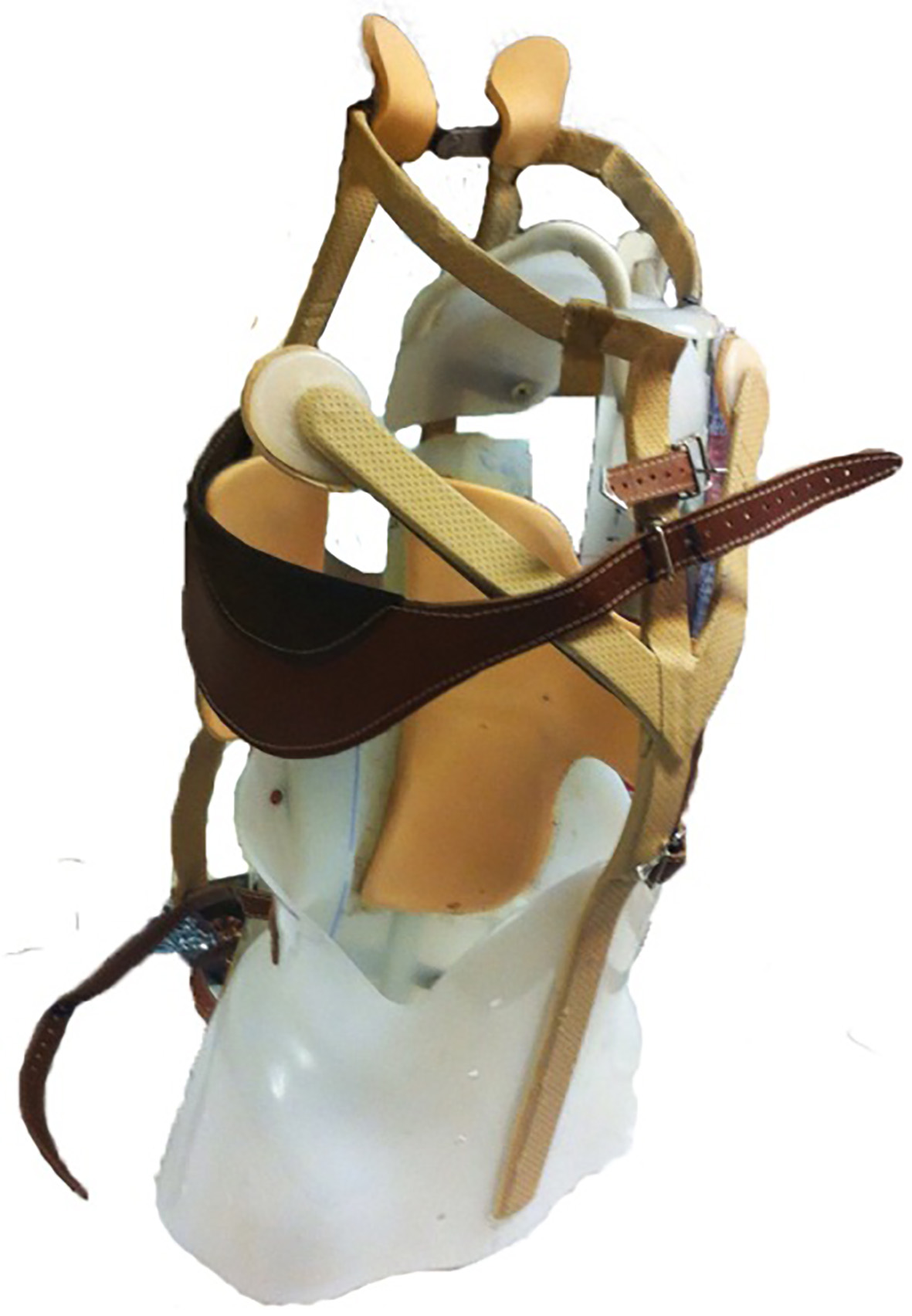
The participants had been recommended to perform the exercises 2 hours a day (1 hour in and 1 hour out of brace) [29]. After receiving the brace, all participants had been trained either using a brochure or under the instruction of a physiotherapist, at the start of routine treatment, before this research, in order to perform the exercises correctly according to the exercise protocol of Moe and Blount [36]. Conventionally, the protocol of exercises is started after one session training or according to a brochure with no future professional supervision. The same method was employed in this study while more contemporary methods such as Schroth and SEAS indicate supervision at two weeks intervals.
Categories of quantity and quality of exercise used in the current study
The study was performed during the weaning phase and the balance test was done during this time, and the compliance to exercise was calculated according to a retrospective approach.
Exclusion criteria contained severe visual or hearing impairment, musculoskeletal pain with a score
The number of participants required to gain a power of 0.8 was calculated using the G-Power software (University of Düsseldorf, Düsseldorf, Germany) [37], which provided a minimum sample of 14 participants. An amount
The present study was approved by the Ethics Committee of Iran University of Medical Sciences (letter no. 1675). The procedure, amount of required contribution, and the aims of the study were explained to each participant, and a written consent form was voluntarily signed by each of the participants.
The study design was cross-sectional. To determine exercise quantity, each participant and one of the parents were asked retrospectively about the mean hours of exercise performed each week during the last year (during weaning phase and may full time brace wear). Both were blinded to each other’s answer. In case of a difference of 5 h between the 2 answers, the other parent was also asked. The participants were asked to perform the exercise 14 h per week, and they were grouped based on their mean hours of exercise: “completely exercising group” (score 1), more than 7 h per week; “irregularly exercising group” (score 2), between 4 and 7 h per week; and “not exercising group” (score 3), fewer than 4 h per week (Table 1).
Demographic parameters of the participants
Demographic parameters of the participants
Values are mean
The quality of exercise was evaluated by an expert physiotherapist for each participant and for each particular exercise (of a set of 10 different exercises): level 1, exercise was performed correctly and the purpose of the exercise had been accomplished; level 2, exercise was performed not fully in a correct way and the aim had not been obtained; level 3, exercise was not only performed in incorrect manner but also had some adverse effects [38]. The total score has been computed using the average of all 10 exercises, with a score of 1 indicating the best, and score 3, the worst. Participants were assigned into 3 groups: group 1 (mean score of
The quality and quantity of exercise scores were multiplied, and the final compliance score was determined as level 1 (good), total score of 1
A force platform (model 9260AA6; Kistler, Winterthur, Switzerland) with a sampling rate of 100 Hz was used.
Curve characteristics of each participant
Curve characteristics of each participant
Balance tests were performed by all participants by standing barefoot on the force platform with their heels 20 cm wide apart, their foot in 15
Cobb angle was measured on a Posteroarnterior/ Lateral view x-rays without brace, at the start of treatment and also 4 hours out of brace, at the start of weaning phase by an orthopedic surgeon on the basis of the routine x rays needed for following the treatment effects.
Statistical analysis
Data were analyzed statistically using the SPSS software package version 16 (SPSS, Chicago, IL, USA). The comparison of balance and Cobb angle parameters among the 3 different groups was analyzed using nonparametric equivalent of 1-way ANOVA which is Kruskal-Wallis tests. The comparison of the Cobb angle parameter before and after treatment using a brace was performed by nonparametric equivalent of 2-tailed paired samples
Results
Seventeen participants (12 girls, 5 boys) with a mean age of 15
Comparison of balance parameters among the 3 groups in the AP and ML directions
Comparison of balance parameters among the 3 groups in the AP and ML directions
Difference is significant at
Statistical analysis indicated no significant difference in balance parameters among the 3 different exercise groups in the weaning phase in all conditions (standing on firm or foam surface, with or without brace) (Table 4).
The results of the analysis also indicated no significant difference in the Cobb angle among the 3 groups at the beginning of the weaning phase (Table 5), but the use of brace improved the Cobb angle significantly during full-time brace wearing (
Comparing the Cobb angle among the 3 different groups
Difference is significant at
Comparing the Cobb angle before and after treatment by brace (
Values are mean
The Milwaukee brace and associated exercises based on the Blount and Moe protocol are commonly prescribed for idiopathic scoliosis and hyperkyphosis. The efficacy of bracing on the natural history of spinal deformities has been well established, but the question whether an exercise based on the Blount and Moe protocol would be helpful from the point of view of improving Cobb angle and balance aspect remained.
The main results of the present study revealed that static balance parameters such as COP displacement in AP and ML directions did not show any significant difference among the 3 groups in all situations with and without brace on firm and foam surfaces. Although there is no similar study on this topic to compare the results with,this finding can be explained in two different ways.
First, according to Dalleau et al. [24] and Nault et al. [25], there is a stronger correlation between body posture parameters and standing stability in adolescents with spinal deformity compared with the asymptomatic control group. Their studies show that changes in the orientation of body segments are important in standing stability [24, 25]. Although, Blount and Moe contains little number of exercises with the aim of curve correction, such as shifting the torso away from the thoracic pad, the main part of the protocol comprises isometric exercises focusing on pelvic tilt. Therefore, perhaps this is the reason why the protocol cannot change the alignment of segments and as a result is not effective on balance performance. The second explanation is the other reason that has been hypothesized for balance dysfunction in patients with scoliosis, i.e., problems in the central processing of balance control. This rationale may be supported by reports on problems in central processing of balance control systems in scoliosis [22, 25, 44]. The Blount and Moe exercise protocol may have no direct effect on the central processing of balance control in the central nervous system.
As a result, the quality and quantity of exercise according to Blount and Moe might have no effect on balance, because balance impairment in patients with spinal deformity is under the control of body posture parameters and central processing of balance.
The present study did not confirm a significant effect of exercise performance on kyphosis and scoliosis Cobb angles. No significant differences were noted among the 3 different groups in both kyphosis and scoliosis Cobb angles. Zaina et al. evaluated the effect of different exercise protocols in association with bracing on the Cobb angle of scoliotic patients and showed that exercise can prevent the restoration of the curve in the weaning phase, when patients are not using brace full time, by maintaining the performance of postural muscles and preventing postural collapse after the removal of the brace [45]. Meanwhile, Carman et al. investigated the effect of exercise on the Cobb angle at the end of treatment by brace and concluded that exercise has no significant effect on scoliosis Cobb angle [46]. Additionally, Mehdikhani et al., during a retrospective study, reported that following an exercise program has no role in preventing loss of correction after a minimum of 2 years of treatment by Milwaukee brace in hyperkyphotic patients [47]. Therefore, based on these articles and the results of the present study, it is concluded that despite the effectiveness of exercise in managing spinal deformity, the Blount and Moe protocol might not be effective, at least till the start of the weaning phase. However, some studies showed the efficacy of other exercise protocols on the Cobb angle, for instance, the Scientific Exercise Approach to Scoliosis protocol, which is aimed at spinal stabilization and is effective in restoring the Cobb angle, inhibiting curve progression, and promoting balance performance [28, 48, 49]. However, the Blount and Moe protocol is the most prescribed protocol in conjunction with the Milwaukee brace [29], and based on the results of this study,it is recommended to be replaced with a more specific exercise protocol to cover all aspects of treatment objectives.
Based on the findings of the current study, the use of brace improved the Cobb angle significantly during full-time brace wearing. This concept was already shown by some previous studies [5, 10, 50]; however, the current study provides new information regarding the limited time duration, which is from the beginning of brace use up to the start of the weaning phase.
This is the first study that examined the effect of exercise performance in association with brace on static balance. Previous studies have only investigated the efficacy of bracing on the balance of patients with spinal deformity. Furthermore,this study is the only one that targeted the weaning phase of brace use, which is a critical phase, as exercise can help maintain the improvement in postural muscles.
One limitation of this study was the subjective method of estimating the quantity of exercise. In the lack of any other classification for evaluating the quantity of Blount and Moe exercise protocol, the authors found this method as the most reasonable and feasible approach.
It is recommended to evaluate the findings on a larger sample size as the post study power calculation revealed less value (Power
Conclusion
There might not be any difference between group of patients who follow exercise instruction and who don’t follow exercise based on Blount and Moe protocol in promoting balance or in improving the efficacy of bracing up to the start of weaning phase.
Suggestion
It is proposed to consider the effectiveness of exercise protocols on angle of trunk rotation, pain, and back muscle strength, in future studies.
Also, the generalizability of these results can be strengthened with recruitment of more subjects while modification of the employed exercise protocols would provide a more comprehensive conclusion.
Moreover, it is suggested for future studies to add another group as “exercise only” in order to evaluate direct effect of therapeutic exercise while this was not possible in this study as Blount and Moe has been advised to be performed in conjunction with brace which is not the case for new protocols.
Furthermore, it is proposed to evaluate the postural imbalance as well as flexibility of the spine before/after the application of therapeutic exercises in future studies.
Clinical implication
The results of this study are important when planning an appropriate exercise protocol in association with bracing in the management of spinal deformity.
Footnotes
Acknowledgments
The authors express their gratitude to physiotherapist Bahar Shaghayegh Fard who checked the quality of the exercises. The authors would also like to thank the participants of this study.
Conflict of interest
The authors report no conflict of interest with respect to the research, authorship and/or publication of this article.