



Abstract
INTRODUCTION:
Multiple sclerosis (MS) is a heterogeneous disease with an unknown etiology. Both genetic and environmental factors lead to MS disease. Recent studies have revealed the inhibitory role of T regulatory cells in the MS disease. Forkhead box P3 (FOXP3) gene is a transcript of the CD4+CD25+FOXP3 and T regulatory cells that is recently introduced as a factor in determining the lineage of immune cells. Based on these assumptions we investigate the expression of this gene in the peripheral blood of fifty MS patients in comparison to fifty controls.
MATERIAL AND METHODS:
In this case-control study, we investigate the FOXP3 expression in fifty MS patients (30 females (60%) and 20 males (40%), mean age
RESULTS:
The expression level of FOXP3 gene was not significantly different between MS patients and controls (p: 0.79). In addition the expression level of the gene was not significantly different between male and female (p: 0.8, p: 0.79, respectively).
CONCLUSION:
Although, the FOXP3 gene is one of the most important genes in the regulation of the immune cells, according to no significant results of this study it may concluded that the expression of the gene is not different between MS patients and healthy controls at least at mRNA level. So it seems that investigating the protein level of FOXP3, related LNCs and microRNAs could be useful to investigate the relation between this gene and the disease. However, the clinical relevance of FOXP3 in patients with regard to their therapy needs to be further explored by evaluation of genetic background in relation to immune responses in MS patients.
Introduction
Multiple sclerosis (MS) disease is one of the most common inflammatory diseases of central nervous system (CNS (which is considered as a T-cell mediated autoimmune disease. In this disease, the nerves of CNS go under inflammation and destruction by the myelin membrane to be targeted [1, 2]. Unfortunately, the recent epidemiological surveys demonstrate that the rate of incidence of this disease is increasing among the universal society and Iran population is not an exception [3, 4]. MS disease leads to various disabilities among the individuals during its pathogenesis and since this disorder involves the young people more than other society individuals, so that it leads to omission of efficient powers of society [5].
Although the mechanisms related to the creation of this disease is not well understood in molecular and cellular aspect, but researchers underline two genetic and environmental agents along with each other in myelin destruction and pathogenesis of MS [6, 7]. The studies of families and twins have shown that genetic is a major agent in 20–40 folds incidence of MS. The incidence of this disease among first degree people is higher than its incidence among the common population. The higher accommodation rate for identical twins (34-25%) comparing to un-conventional twins indicates the high role of heredity in its incidence.
The inflammatory damages show the autoimmune trait of MS, in this regard association of several gene polymorphisms and expression assessment expression involving in immune system in Iranian patients were investigated previously [8, 9, 10, 11, 12]. Treg cells have an important role in regulation of immune system, maintenance of tolerance and prevention of immune diseases. Therefore, the alteration of their numbers or function can be effective in occurrence of autoimmune diseases [13]. Treg cells has an important role in immune responses and maintenance of environmental tolerance by its anti-inflammatory cytokines such as TGF, IL10, and IL35, Forkhead box P3 (FOXP3) gene which has a role in apoptosis pathway is one of the important agents in distribution regulation and function of Treg cells, alteration in expression of FOXP3 gene can lead to defect in regulation of immune system and mutation in the mentioned gene can lead to distribution of immune diseases [14, 15]. Therefore, it is possible that the alteration in expression of FOXP3 gene is determinative of capacity of disease gaining, such as MS which leads to demyelination and destruction of nervous system. Therefore, the aim of the present study was the evaluation of FOXP3 gene expression in MS patients comparing to control group.
Materials and methods
Subjects and controls
In this case-control study, fifty patients were confirmed by neurologist according to McDonald criteria. The patients were collected at Iran’s MS Society Clinic. Fifty healthy age and sex matched individuals were selected among persons who had no familial history of MS disease and their healthy status was confirmed by a neurologist.
Sampling
After getting consciously written consents from patients and controls sampling was performed. Three milliliters of venous blood was transformed to an EDTA tube. The study was approved by a local Ethical Committee of Shahid Beheshti University of Medical Sciences.
RNA extraction and cDNA
RNA extraction from blood was performed according to blood RNA extraction kit of GeneAll HybridR
Real time PCR
Real time PCR, calculates the amount of produced fragment during each cycle of proliferation (with fluorescent evaluation). Real time PCR was designed using 5 mM dedicated primers for two genes of HGPRT (housekeeping gene that was used as the reference gene for quantitating the relative levels of target gene) and FOXP3 using Allele ID 7 software (Premier Biosoft, Palo Alto, USA). The sequences of the probes and primers are shown in Table 1. BiosystemsTaqMan
Primers and probes sequences used for real time PCR
Primers and probes sequences used for real time PCR
Independent t-test was used in order to data analysis. The Pearson correlation coefficient was applied to identify the level of correlation between the variables under study. The p value for the level of significance was set at
Results
Demographic characteristics
In the present study, 50 MS patients (30 women and 20 men) were selected as patient group and 50 healthy age and sex matched individuals (30 women and 20 men) without any familial history of autoimmune diseases were evaluated, the mean age of patients was 33.3
Demographic and clinical features of MS patients and healthy controls
Demographic and clinical features of MS patients and healthy controls
The results of study showed that FOXP3 has shown reduction of expression in patient group comparing to healthy group, although this difference was not significant (
FOXP3 expression levels in RR-MS patients compared with control group
FOXP3 expression levels in RR-MS patients compared with control group
The actual data points of FOXP3 expression level in the RR-MS patients, controls and their gender category. On each box, the central mark indicates the median, and the bottom and top edges of the box indicate the 25th and 75th percentiles, respectively. 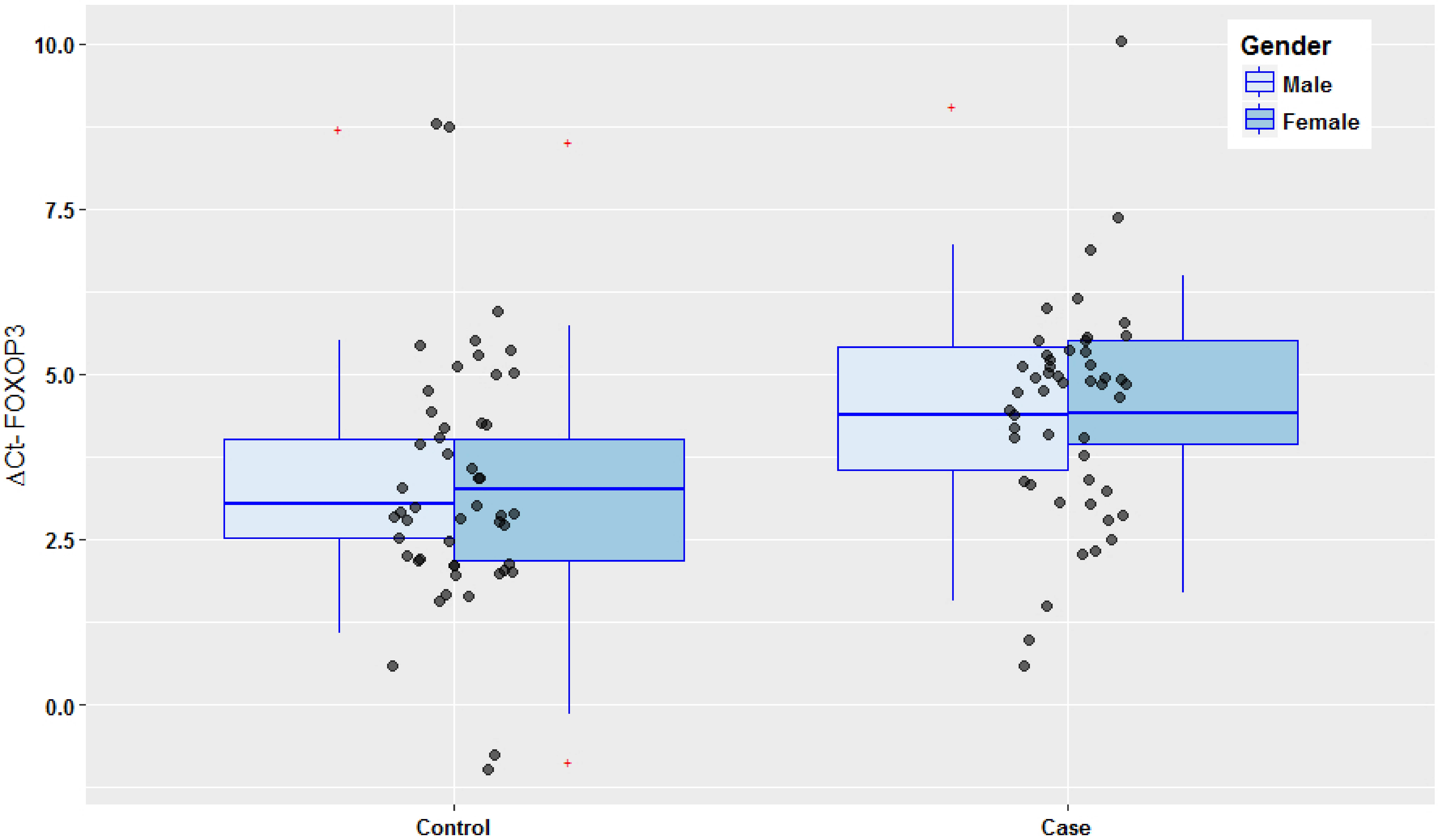
Although the exact reason of multiple sclerosis disease is not determined, but various studies have shown that the immune system cells play an effective role in its occurrence, such as the role of FOXP3 that is Treg transcription factor, as mutation at FOXP3 gene might lead to distribution of autoimmune diseases such as multiple sclerosis [16]. The patients suffering this disease have a disorder in messaging and expression of FOXP3 gene in Treg cells. Decreasing of FOXP3 leads to defection in immunity regulation by Treg cells which can play role in occurrence of multiple sclerosis disease [17].
In the present study, the expression of FOXP3 gene in blood lymphocyte T cells was evaluated in 50 MS patients and 50 controls by Real-time PCR. Previously, some studies have demonstrated that defect in function of FOXP3 gene leads to inhibition of Treg 1 cells activity. Also, the cooperation of lack of inhibitory function by regulatory Tcells of CD25+ CD4+ and MS, diabetes II and psoriasis is reported [18, 19]. Defect in regulatory function of CD4+CD25+ T-cells which is observed in FOXP3-null mutation mice and leads to incidence of autoimmune diseases in such mice, underlines the vital role of FOXP3 gene as the major player of genetic mechanism of dominant self-tolerance [20].
In study of Venken et al. the decreasing of FOXP3 gene expression in cerebro-spinal fluid of MS patients comparing to healthy people was observed. These findings indicate that alteration in expression of FOXP3 gene plays a role in pathogenesis of this disease and confirms this matter that reduction of expression of FOXP3 gene in Treg cells is involved in pathogenesis of MS disease [21]. In another study, Huan et al., reported a decreased level of FOXP3 in MS patients and also reported a defect in FOXP3 signaling and expression level of protein in regulatory T-cells of CD4+CD25+ in MS patients that this case is related to decrease of immune regulation in peripheral blood that the resulted immune irregularity might underlie MS catching [16].
In another study, Venken et al. evaluated the expression level of FOXP3 gene in single regulatory T cells of CD4+CD25 in both groups of relapsing-remitting multiple sclerosis and secondary progressive (SP) and also comparison with healthy control people using flow-cytometry technique and therefore, this study showed the numbers of reduced CD4+CD25 foxp3+ cells in peripheral blood and the decreased expression level of FOXP3 protein in intended cells from RR-MS comparing to the healthy control [21]. This result accompanied with suppression of function of these cells among MS patients. On the other hand, the RR-MS patients treated with interferon beta drug, showed the renewed numbers of regulatory FOXP3+ T cells. Moreover, the increased percent of regulatory CD4+CD25 FOXP3+ T cells in RR-MS patients was observed comparing to SP-MS patients and the expression of CD103 and CD49d gene was observed in healthy people. These results showed accompaniment with the increase numbers of CD27+CD25 CD4+ T cells in CSF of RR-MS patients comparing to their blood. Finally, this study reported the inappropriate expression of FOXP3 gene at level of single-cells which accompanies with function disorder of regulatory T-cells in RR-MS patients [22]. The alterations of FOXP3 gene expression might be under effect of functional variants located in promoter or upstream of gene which are the possible mechanisms effecting on gene transcription regulation. The evaluation of variants reporting rs2232365 which locates in locus of attachment to upstream DNA and it is possible that be effective in regulation of FOXP3 gene were evaluated. This polymorphism in population Iranian MS patients was evaluated for accompaniment with the increased risk of MS catching and showed accompaniment with the increased risk of this disease catching [23]. In other recent studies it has shown that DNA methylation alterations in Protected Reinforcement Elements Areas of FOXP3 gene can be effective on expression of this gene [24]. It seems that the locus of FOXP3 gene directly is equipped with a regulatory mechanism. In this field it is shown that the long non-coding Flicr RNA can be effective on expression of this gene by effect on DNA access to FOXP3 gene expression as a negative regulatory agent [25]. However, in this study, the expression of FOXP3 gene was not statistically significant in comparing case and control group. Also, the expression of this gene in men and women did not show any significant difference. Despite the lack of difference at mRNA level of gene expression between groups, it could be attended that how differences at protein level of this gene or between special subcategories of patients are in comparing to the control group.
Conclusion
The results harvested from this study indicate a partial decreasing of expression of FOXP3 gene between MS patients comparing to healthy people which was not statistically significant, but with regards to previous studies the expression or polymorphism of FOXP3 gene might be effective in pathogenesis of MS, although this hypothesis requires more research on protein level of FOXP3, related LNCs and microRNAs. However, the clinical relevance of FOXP3 in patients with regard to their therapy needs to be further explored by evaluation of genetic background in relation to immune responses in MS patients.
Footnotes
Conflict of interest
The authors declare that they have no conflict of interest.