



Abstract
This study’s intentionality was to analyze the influence of employee commitment and service performance on the marketing and sales processes in Lippo Cikarang Bekasi, Inc, one of big financial services company in Indonesia. The failure of marketing and sales was not highlighted from the marketing strategy but judging from the competence of employees who were inconsistent with the knowledge or expertise that a superior performer carries. Path analysis was applied on the data collected from 218 questionnaires respondent. The results show that competence along with knowledge, ideals, motivation, personal characteristics, self-concept, and skill indicators, had a positive significant effect on employee commitment. Through commitment, a competence indictor had a significantly positive effect on service performance. This Suggests that workload can increase commitment and thereby indirectly improve service performance. According to its multiple facets, employee commitment appears to have a significant effect on service performance, the later construct operationalized via its accessibility, courtesy, credibility, reliability, responsiveness, security and tangibility indicators. Competence is a top priority in completing job responsibilities.

Introduction
People’s self-development plays an important role in determining the quality of an organization. Personnel self-development can be defined as the preparation of employees to have different or higher responsibilities within the organization. The development usually deals with the increased intellectual or emotional capabilities needed to perform better jobs. Personnel self-development rests on the fact that individual employees need knowledge, skills, and abilities to develop in order to work well. Competence demonstrates the main characteristic of behavior that describes the motives, personal characteristics, self-concept, values, knowledge, or skills of superior performers in the workplace. Furthermore, Nurmasitha et al. reported that there was a positive correlation between the competence of employees and the quality of service which was created because of high commitment [1].
Competence shows the underlying characteristics of behaviors that describe the motives, personal characteristics, self-concept, values, knowledge, or skills, which are performed by a superior performer in the workplace. The workload is an important aspect of every organization, as it is one indicator that can improve employee performance [2]. The workload is widely acknowledged since the 1970s. Many experts have proposed several definitions of workload and since it is a multi-dimensional concept it is difficult to reach a conclusion about an exact definition [3]. Munandar provides an interpreting of workload as being a condition of the job in the job description that must be completed within a certain time limit [4]. Tarwaka explained that workload is a case that arises from the interaction between the demands of work duties, skills, and perceptions of workers [5]. Meanwhile, workload analysis identified both the number of employees and the qualifications of employees required to achieve organizational purposes [6]. Commitment can be interpreted as a strong acceptance by the individual of the purposes and values of the organization, and they strive to work and have a strong desire to stay in the organization.
The organization will operate continuously if all employees have an awareness of accomplishing their workload. The workload is a condition of the job description which has to be completed within a certain time limit. A study about the influence of workload on service performance was conducted by Widiastuti which stated that workload positively affects the performance of employees [7]. The parameters in the present study include competence, workload, employee commitment, and service performance. This study’s intentionality was to analyze the influence of commitment to service performance, direct and indirect influence of competence on service performance, and the direct and indirect influence of workload on service performance through employee commitment in Sales and Marketing Division of Lippo Cikarang Bekasi, Inc.
Materials and methods
Data sampling and measurement
The study was conducted at Lippo Cikarang Bekasi, Inc. Lippo Cikarang Bekasi Company is one of the companies engaged in financial services where the part studied was a sales and marketing division employees who experience a decline. Researchers do not see capitalization but highlight failures resulting from human resource capacity. The object of the research was Lippo Cikarang Bekasi, Inc., while the analysis unit involved 500 employees of the Sales and Marketing Division of Lippo Cikarang Bekasi, Inc. The respondents in this study were employees who met certain criteria (141 respondents). The data were obtained from primary and secondary sources. Primary data are the data obtained directly through interviews with respondents or by compiling and distributing questionnaires to the respondents. While secondary data were collected from other groups as supplementary data.
The variables used in this study were: independent variable (competence and workload); intervening variable (employee commitment); and the dependent variable (service performance). An operational definition is a definition that provides an operational need to measure those variables. Competence shows the underlying characteristics of behaviors that describe the motives, characteristics, self-concept, values, knowledge, or skills that a superior performer demonstrates in the workplace [8]. Competence is measured by the following indicators: knowledge, skill, self-concept, values, personal characteristics, and motives [2].
The workload can be defined as the job which needs to be finished, certain aspects of the worker in finishing the jobs, and also the subjective psychological experience of the worker [9]. Thus, workload indicators include the number of jobs; the number of jobs which can be completed; that the job is finished as a very pleasant thing. Commitment is a strong acceptance by the individual of the purposes and values of the organization and the individual has a strong desire to remain in the organization. Commitment can be measured according to Soekidjan with the following indicators: affective commitment; continuance commitment; and normative commitment [10]. Service performance is evaluated by using an indicator of service performance which was developed by Zeithaml et al., including tangibility, reliability, responsiveness, courtesy, credibility, security, and accessibility. The measurement scale in this research will involve using a Likert scale with the following alternative answers: 1. strongly disagree; 2. Disagree; 3. Neutral; 4. Agree; 5. strongly agree [11].
There are two concepts to measure data quality, which is reliability and validity. A validity test was conducted by correlating the score of answers obtained on each item with the total score of the entire item. The instrument was considered valid if the value of r > 0.3. While the reliability test is a measurement of internal consistency reliability by calculating the alpha coefficient (α), If Cronbach’s alpha is >0.6 then the research data are considered reliable for use as input in the process of data analysis [11].
Data analysis
Data were analyzed using inferential statistics to test the influence of service performance variables through the hypotheses formulated in this study. The analytical model involved a path analysis method using the SPSS software program for Windows. Paths according to the hypotheses were described on Fig. 1. The results of this study met the assumption of path analysis with the BLUE (Best Linear Unbiased Estimator) requirement. The equations for the path analysis model are described below:
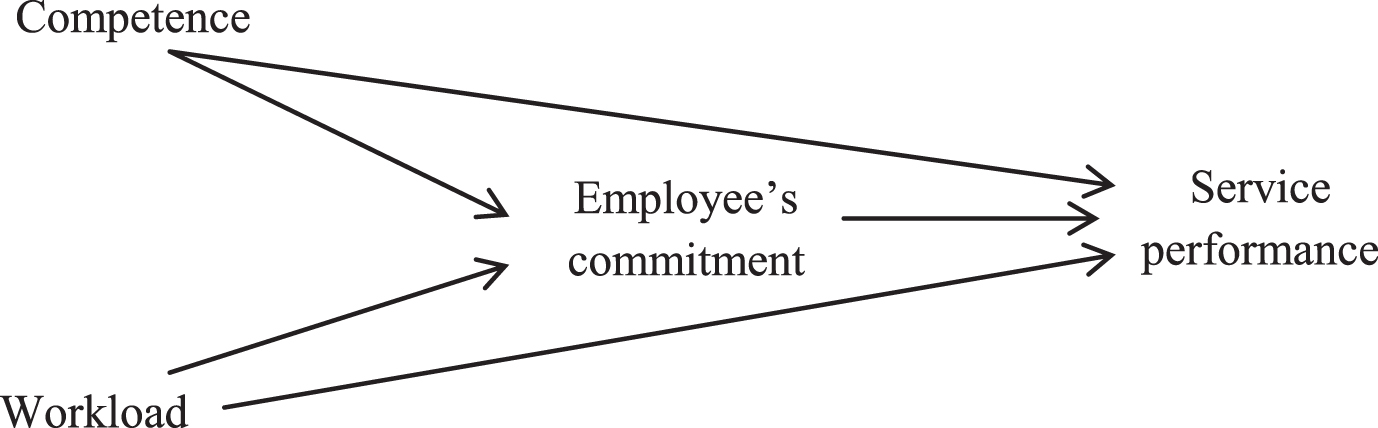
Path analysis model.
According to Table 1, competence (X1) has a significant direct positive influence on employee commitment (Y1) in the Sales and Marketing Division of Lippo Cikarang Bekasi, Inc. with a significant t-value of (0.002) <0.05. Workload (X2) also has a direct significant impact on employee commitment (Y1) in the Sales and Marketing Division of Lippo Cikarang Bekasi, Inc. with a significant t-value of (0.012) <0.05. The second stage test results of indirect influence with path analysis (Table 2) show that competence has an indirectly significant influence on service performance through employee commitment in the Sales and Marketing Division of Lippo Cikarang Bekasi, Inc. with a t-value of 0.032 <0.05. Workload has an indirectly significant and positive influence on service performance through employee commitment in the Sales and Marketing Division of Lippo Cikarang Bekasi, Inc. with a t-value of 0.032 <0.05.
First stage test result of direct influence with path analysis
First stage test result of direct influence with path analysis
Second stage test result of indirect influence with path analysis
Path analysis was conducted by identifying path coefficients on each path of triming theory (Solimun, 2003). The coefficient of direct influence was equal to the regression by using the p-value and t-test. The insignificant paths were removed, so the model was supported by empirical data. The path coefficient/path of indirect effect was obtained by multiplying the path coefficient between variables. The first phase path analysis showed that there is a direct significant influence between competence and employee commitment in the Sales and Marketing Division of Lippo Cikarang Bekasi, Inc. (path PY1.X1), while the value of the path coefficient (PY1) is 0.711 with a significance (t-value) of 0.000 (Fig. 2). This indicates that applied competence could increase employee commitment. There is a significant direct influence on workload and employee commitment in the Sales and Marketing Division of Lippo Cikarang Bekasi, Inc. (path PY1.X2), while the value of the path coefficient (PY1) is 0.872 and significance (t-value) is 0.003 <0.05 (Fig. 2). This indicates that workload is capable of increasing employee commitment in the Sales and Marketing Division of Lippo Cikarang Bekasi, Inc.
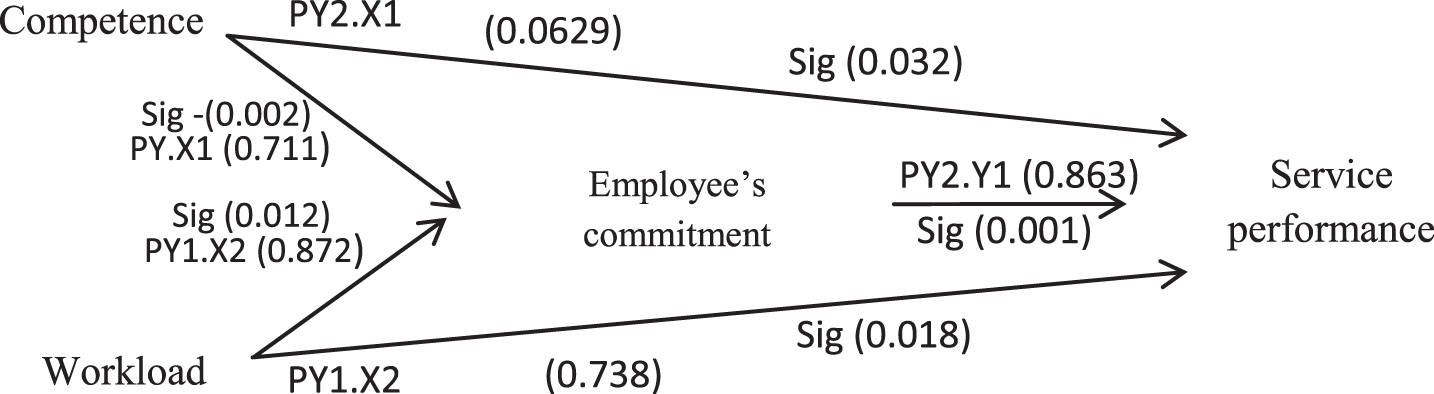
Final Model.
The second stage of path analysis showed that there is an indirect significant influence between competence and service performance through employee commitment in the Sales and Marketing Division of Lippo Cikarang Bekasi, Inc. (path PY2.X1), while the value of the path coefficient (PY2) is 0.629 and significance (t-value) is 0.032 <0.05 (Fig. 2). This indicates that competence indirectly improves service performance through employee commitment in the Sales and Marketing Division of Lippo Cikarang Bekasi, Inc. There is an indirect significant and positive influence on workload and service performance through employee commitment in the Sales and Marketing Division of Lippo Cikarang Bekasi, Inc. (path PY2.X2), while the value of the path coefficient (PY2) is 0.738 and significance (t-value) is 0.008 <0.05. This indicates that workload indirectly improves service performance through employee commitment in the Sales and Marketing Division of Lippo Cikarang Bekasi, Inc. There is a direct significant and positive influence between employee commitment and service performance in the Sales and Marketing Division of Lippo Cikarang Bekasi, Inc. (path PY2.Y1), with the value of the path coefficient (PY2) being 0.863 and significance (t-value) is 0.001 <0.05 (Fig. 2). This indicates that employee commitment directly improves service performance in the Sales and Marketing Division of Lippo Cikarang Bekasi, Inc.
The influence of competence on service performance in the sales and marketing division of Lippo Cikarang Bekasi, Inc.
Based on the statistical test results, competence had a significant and positive influence on service performance in the Sales and Marketing Division of Lippo Cikarang Bekasi, Inc. The hypothesis was accepted. This indicated that competence will improve service performance in the Sales and Marketing Division of Lippo Cikarang Bekasi, Inc. with indicators including that the job is completed according to knowledge, the employee is able to comprehend the administration system in the workplace, and the employee is able to comprehend the service system in the workplace. Competency with indicator; the job is finished in accordance with the capability. A job finished with capability is capable of improving service performance of the Sales and Marketing Division of Lippo Cikarang Bekasi, Inc. Competence with self-concept indicators including the employee obeys the social norms in finishing the jobs and work according to applicable regulations. While an indicator of personal characteristics including that the employee is responsive in finishing the job will improve service performance of the Sales and Marketing Division of Lippo Cikarang Bekasi, Inc. While competence with indicators: the employee has a self-controlling in completing the job and employee always prioritize the public interest. This indicator will improve the service performance of the Sales and Marketing Division of Lippo Cikarang Bekasi, Inc.
The responses regarding the competence variables stated very well/good, descriptively. This was indicated by a mean value of 4.2. The results of this study explained that the competence of employees will improve the service performance of the Sales and Marketing Division of Lippo Cikarang Bekasi, Inc. This study does not concur with the research by Adha and Ibrahim stated that there was no significant influence between variable X (competence of employee) and variable Y (performance of public service) [12]. This fact explained that the competence of employees (variable X) did not always have a significant influence on the performance of public services (variable Y). This study supported the results of research by Nurmasitha et al., which proved that there was a positive influence of the competence variable on the quality of service at the Population and Civil Registry of Sidoarjo Regency [1]. This study also supported the concept developed by Michael Zwell which reported that competence is not an ability that cannot be influenced. There are several factors that can affect a person’s competency skills, including beliefs and values, skills, experience, personality characteristics, motivation, emotional issues, intellectual ability, and organizational culture [13].
Direct and indirect influence of workload on service performance at Lippo Cikarang Bekasi, Inc.
Workload had a significant positive effect on service performance in the Sales and Marketing Division of Lippo Cikarang Bekasi, Inc. The hypothesis was accepted. The results of this study proved that workload had a significant influence on service performance in the Sales and Marketing Division of Lippo Cikarang Bekasi, Inc. This also suggests that workload with external factor indicator items including employee responsibility for the job; completing the job in accordance with authority; completing the job in accordance with time limits; and completing the job along with the enough rest time will improve service performance in the Sales and Marketing Division of Lippo Cikarang Bekasi, Inc. Meanwhile, the workload has some internal factor indicator items including an organization which ensures the health status of the employee; in finishing the jobs the employee strives to maintain the trust given by the organization, and the employee is motivated to finish the job. These indicators will improve service performance in the Sales and Marketing Division of Lippo Cikarang Bekasi, Inc.
The responses regarding the workload variables stated very well/good, descriptively. This was indicated by a mean value of 4.2. The results of this study explained that the amount of workload of employees will improve the service performance of the Sales and Marketing Division of Lippo Cikarang Bekasi, Inc. This study was in line with research by Widiastuti which stated that workload was positively related to service performance [7].
Influence of commitment on service performance in the sales and marketing division of Lippo Cikarang Bekasi, Inc.
The results of the statistical tests showed that there was a significant positive influence of commitment on service performance in the Sales and Marketing Division of Lippo Cikarang Bekasi, Inc. The hypothesis was accepted. This showed that commitment had a significant effect on service performance in the Sales and Marketing Division of Lippo Cikarang Bekasi, Inc. This research proved that commitment with affective commitment item indicators including that organizational problems are an employee’s problems; the organization is part of the employee’s family; and the employee always spends their time working will improve the service performance of the Sales and Marketing Division of Lippo Cikarang Bekasi, Inc.
Commitment to continuance commitment item indicators include that the employee continues working in the organization although there are interesting offers to leave the job; the employee will not leave the organization at any risk; it is difficult to leave the organization’s commitment; feeling guilty about leaving the organization; the employee feels obliged to accompany the leader when there is a problem; and the employee has high dedication. These indicators will improve the service performance of the Sales and Marketing Division of Lippo Cikarang Bekasi, Inc. The responses regarding the commitment variables stated very well/good, descriptively. This was indicated by a mean value of 4.2. The results of this study indicated that commitment of employees will improve the service performance of the Sales and Marketing Division of Lippo Cikarang Bekasi, Inc.
This research is in line with that of Hidayat which stated that three models of commitment components described multi-dimensionality in commitment building in relation to more support of service quality. In short, based on this study both effective and sustainable commitment had a significant influence on service quality [14–16]. The main causes of resignations include payment and promotion practices, the size of the company, supervisory style, interaction patterns among group members, the terms of office and personality and interest to the profession [8, 18].
Conclusion
In summary, the conclusions of this study are as follows: The responses regarding the competence variables agreed descriptively with a mean value of 4.21. Competence with indicators including knowledge, skills, self-concept, values, personal characteristics, and motives have a positive direct influence on employee commitment. Competence has an indirectly significant positive effect on service performance through employee’s commitment to the Sales and Marketing Division of Lippo Cikarang Bekasi, Inc. Thus, the hypothesis is accepted. The responses regarding the workload variables agreed descriptively with a mean value of 4.21. The workload with indicators including the number of assigned jobs, the number of completed jobs, and the job which was done as a very pleasant thing had a direct positive significant effect on employee commitment in the Sales and Marketing Division of Lippo Cikarang Bekasi, Inc. Thus, the hypothesis is accepted. The responses regarding the commitment variables agreed descriptively with a mean value of 4.2. Employee commitment with an affective commitment indicator, continuance commitment, and normative commitment has a significant positive influence on service performance with indicators: tangibility, reliability, responsiveness, courtesy, credibility, security, and accessibility on the Sales and Marketing Division of Lippo Cikarang Bekasi, Inc. Thus, the hypothesis is accepted.