



Abstract
BACKGROUND:
Competition for positions in higher education institutions cannot be separated from the political approach taken by individuals. Political behavior as a factor in achieving individual career goals in higher education institutions was studied.
OBJECTIVE:
This study aimed to investigate the antecedents of political behavior and their effect among leaders in State Islamic Universities in West Java, revealing the interaction between organizational political climate and supervisory political support.
METHODS:
A systematic sampling method was used, with a sample size of 427 leaders of State Islamic Universities. Data were analyzed by using Hierarchical Regression Analysis (HRA) to test the hypotheses using STATA 13 software.
RESULTS:
Results indicated perception of political will was significantly and positively related to political behavior. Organizational political climate also had a significantly moderating effect on the correlation between political will and behavior. Political behavior effect on career success was largely positive, and the relationship between the perception of political behavior and career success was moderated by supervisory political support.
CONCLUSIONS:
Government support for employee careers could take the form of the promotion of political behavior, strengthened by supervisory political support. Fostering political behavior among employees, by utilizing organizational political climate as an environmental factor would increase both individual and organizational success.
Keywords


Introduction
Currently, universities are required to have adaptive and proactive capabilities in dealing with organizational change — capabilities that are needed to meet market expectations and needs [1]. Likewise, employees in higher education institutions are required to improve the quality of their contribution so that they have the opportunity to fill strategic positions. In higher education institutions, being a leader in an organization is an aspiration and a matter of pride for every individual. It is this perception that makes individuals compete to reach a position as leader and strive to advance their organization. Individuals who succeed as leaders in organizations are inseparable from their motivation and their need to get ahead. In addition, they also have the desire to occupy strategic positions within the organization, and are willing to compete for such positions. One way to achieve a position in an organization is through a political approach [2, 3]. An individual that uses a political strategy to achieve their desires and expectations tends to behave politically within the organization.
In this study, we are interested in analyzing the antecedents and consequences of political behavior in higher education by considering the interaction of individual and environmental factors. Political behavior plays a critical role in the work environment in achieving the expectations and goals of individuals and groups [4]. By behaving politically, one can develop opportunities within the organization in the future [5, 6]. However, some individuals do not want to be involved in political behavior within organizations [4], since political behavior only prioritizes the interests of individuals and groups and ignores the interests of the organization [7]. As a result, organizational development is hampered because the organization has not found the right person for the required position [5].
In Indonesia, competition for the achievement of position in higher education cannot be separated from the political approach taken [8]. One of the political policies in higher education is the policy of determining positions in strategic parts by the use of direct appointment systems by superiors. This policy triggers the growth of political behavior in strategic officers so that they tend to defend their position with various approaches towards their superiors. So it is not uncommon that an environment dominated by political behavior can create extreme competition between individuals, which triggers a high level of stress and conflict [9].
Political behavior at low, mid and higher levels of leadership at State Islamic Universities in West Java provides a unique opportunity for study, since political behavior arises among academics who should prioritize the professional aspects, competencies and innovations in higher education institutions [10]. One unique factor is the context in which position is determined at the State Islamic Universities of West Java where a direct appointment system is used by superiors. These conditions create political behavior among the upper-class university leaders. As a result, individuals who have never occupied a position previously are less likely to have opportunities since there is no close connection with leaders. This unique context provides an opportunity to study and monitor the effect of political behavior on individual career success in higher education.
Empirically, previous studies have found that political behavior is formed directly by political will [5], personality [11], political climate, trust, and affective commitment [4]. Furthermore, political behavior has been shown to have a direct effect on emotional labor [5] and personal power [12]. However, these studies did not pay specific attention to the environmental factors that also shape political behavior. This study aims to develop the environmental factors, for example, the organizational political climate that shape the political behavior of individuals in higher education in West Java.
One further difference in this study lies in the consequences of political behavior, in terms of career success. In previous studies, the consequences of political behavior have shown a direct effect on emotional labor in South America [5] and on the personal power of employees in six electronics companies in China [12]. This study considers career success as a consequence of political behavior because career success is relatively new in political behavior research among college employees, especially in State Islamic Universities in West Java.
The study is not limited to political behavior as the antecedent that influences career success. The influence of political behavior on career success is strengthened by the presence of political support supervisors which is an environmental factor that can strengthen the relationship between political behavior and career success in higher education institutions. Supervisory political support at higher education institutions is something new to consider, especially as an external factor strengthening the relationship between political behavior and career success.
This study has several contributions to make in both academic and managerial practice fields. Firstly, the study analyzed and confirmed the effect of “need for achievement” and the “intrinsic motivation” on political behavior in the context of employees in a higher education institution. Secondly, the organizational political climate was studied as an environmental factor that could strengthen the direct correlation between “need for achievement” and “intrinsic motivation” and political behavior. Thirdly, the relationship between political behavior and career success in higher education institutions was studied, whereas previous research on political behavior was conducted solely within companies. Fourthly, to complement and strengthen the correlation between political behavior and career success, “supervisory political support” was used as an alternative factor for employees hoping to accelerate their careers at higher education institutions. Finally, the study shows very significant results which the Indonesian Government may find useful when making decisions related to careers in higher education institutions.
Literature review and hypotheses development
Political will and political behavior
Political behavior is a critical component that influences organizational processes, both in the formation of interpersonal activities and organizational ones [5]. Political behavior forms part of individual behavior which plays an essential role in the work environment and it also creates opportunities for employees to achieve their expected career goals [3]. However, it is not uncommon for employees to see politics as a phenomenon that has purely negative consequences for the organization [7].
A factor that can influence political behavior is the “need for achievement” inherent in the individual [5, 12]. Need for achievement deals with unconscious motives and encourages individuals to excel or to improve their performance. It refers to the extent to which individuals are motivated to achieve success and excellence in performing difficult and challenging tasks [13]. Employees who have a need for achievement tend to work competitively, excel in every job, and enjoy the challenges and difficulties they face [14]. In addition, they also build individual perceptions, attitudes, and behaviors specifically to achieve their interests [15]. This need builds an individual’s expectation, which is based on a standard of personal excellence [16]. When expectations can be reached, it can have a positive effect on an individual. However, if expectations are not achieved, it has a negative impact.
In a previous study results showed that personal competence could trigger individuals to behave politically in organizations [11]. Personal competence is related to feelings of superiority that individuals may have, so they are attracted to political behavior. Employee’ achievements shape the confidence and positive attitude of individuals to behave politically. Another similar study also stated that the need for achievement has a positive impact on the formation of individual political behavior within organizations [5]. These findings are supported by Liu et al. [12]. The need for achievement in individuals plays a strong role in the creation of employee political behavior allowing individuals to form strong patterns in achieving the goals and expectations they have planned.
According to Mintzberg [17], if individuals want to associate themselves with political behavior, they must have strong political motivation and desire. Individual motivation is a factor that shapes the political behavior of employees in organizations. Intended individual motivation is “intrinsic motivation” and someone who has intrinsic motivation will look for fun, personal challenges at work, and to achieve their own interests. Intrinsic motivation shapes a person’s attitude and behavior patterns in attaining their goals. In other words, intrinsic motivation shapes the political behavior of individuals within an organization [5, 12]. In addition, individuals who have intrinsic motivation will self-motivate to achieve their expectations by taking actions that support their goals.
The effect on political behavior of intrinsic motivation is supported by the results of a previous study which stated that intrinsic motivation had a positive impact on the formation of individual political behavior in an organization [5]. That research is also supported by Liu et al. [12] who conducted a study on 6 electronics companies in China. The intrinsic motivation that is present in individuals plays a substantial role in creating an employee’s political behavior.
The moderating effect of organizational political climate
Environment is one of the factors recognized as shaping individual behavior in organizations [18, 19]. In addition, an environment is a place where individuals interact with leaders and co-workers. The concept of environment creates psychological stimuli, characteristics that originate from environmental dominance and determine the motivation and behavior of individuals [20]. When politics dominates the environment, an organizational political climate emerges as a new environment that can create political behavior. An organizational political climate encourages members of the organization to use their abilities and strengths in achieving their expected goals [12, 21]. An organizational political climate may include ingratiation, exchange of benefits, rationality, assertiveness, upward appeal, and coalitions [22]. Organizational political climate is a shared perception in building and using power to solve problems related to policy and procedure decision-making, resource allocation, individual and team achievement, and organizational goals [21]. This understanding reveals that organizational political climate is not an abstract concept or attitude but that it can also be used for action. That is to say, individuals will be actively involved in politics if their workplace environment is political [4], and that this perception builds the political behavior of individuals in the organization in which they work.
The result of another previous study states that organizational political climate has an effect on the job attitude of employees of private and public companies in Israel [20]. The findings are also supported by Kidron & Peretz [4], who stated that organizational political climate has an effect on the political behavior of employees and managers in the public sector. Organizational political climate was evidenced in that study as strengthening the correlation between intrinsic motivation and political behavior. A similar study also supports the view that political perceptions in organizations strengthen the relationship between intrinsic motivation and employee political behavior [12].
It is clear that organizational political climate acts as an environmental factor that can strengthen the correlation between intrinsic motivation and individual political behavior. In general, organizational political climate is a political construct used to understand individual integrative experiences in the workplace or in organizational settings [4]. This understanding can encourage the motivation and needs of individuals to take political action to meet their interests.
According to trait activation theory, “the expression of behavior of a trait requires the arousal of that trait with the condition that the environment is relevant to the trait” [12, 23]. The theory states that the environment that is relevant to the trait of the individual plays a role in the process of forming individual political behavior within the organization. Thus, the relevant environmental interaction in this study is organizational political climate, which can strengthen the correlation between individual traits, namely political will and political behavior.
Besides strengthening the effect of intrinsic motivation on political behavior, organizational political climate can also strengthen the relationship between the “need for achievement” and political behavior. An employee behaves politically in an organization because of their need to achieve their goals of strategic position, high income, and incentives [2, 3]. Furthermore, these needs tend to be stronger if employees are in organizations which favor a political climate. In other words, an organizational political climate supports the relationship between the need for achievement and political behavior among employees in an organization, especially in higher education.
Theoretically, the need for achievement in trait attribution theory is a factor that comes from the individual, while organizational political climate is an environmental factor. According to trait attribution theory, both individual and environmental factors can shape individual behavior within organizations [24], and political behavior is a result of the interaction between individual factors and environmental factors. This theory is further supported by a study which states that the perception of politics in organizations strengthens the correlation between the need for achievement and the political behavior of employees in organizations [12]. Organizational politics could shape a person’s attitudes and behavior in an organization [20]. In addition, organizational political climate has been shown to trigger the political behavior of employees and managers in the public sector [4]. Thus, it is clear that organizational political climate is an environmental factor that can strengthen the correlation between the need for achievement and political behavior.
Political behavior and career success
Individual perception of career achievement depends on the interpretation of events or the situations in which they work. In large or small organizations, that achievement is obtained by occupying a lead position in the organizational structure. However, achieving success in an organization is also determined by employee attitude and behavior in seeing the opportunities that exist within the organization [25, 26]. Attitudes and behavior shape the individual within the organization by acting for the betterment of the individual and the organization. If individuals choose to remain silent within the organization, then the opportunity for career achievement is impeded [27, 28]. That is to say, that careers in the work environment are determined by the competencies and opportunities owned within the organization [15]. Career means every position owned by an individual in the organization [29], and one career benefit is in keeping individual performance oriented towards achieving organizational goals. Career success can be seen as achieving the desired results related to work in each person’s work experience from time to time [30, 31]. Career success can also be interpreted as the real or perceived achievement of individuals as a result of their accumulated work experience [32, 33]. In addition, individuals who build successful careers tend to be open to experiences so that they can occupy positions without restriction. So, individuals that choose a more active role in the organizational planning and development process are more likely to achieve success in their career. However, for an employee, achieving a career takes time because a career is determined by the political behavior of the individual employee [32].
A previous study reveals that political behavior can have a negative effect on job satisfaction, and on affective and normative commitment [34]. However, political behavior also has a positive effect on speed to market [35], emotional labor [5], and personal power [12]. In this study, political behavior has been shown to build employee career success within the organization and the impact of political behavior on employees in organizations can provide opportunities for the individual in reaching their desired position.
The moderating effect of supervisor political support
Political support is an external resource based on commitment and policy direction [36]. Supervisors can inform subordinate perceptions about the political environment through the influence of their behavior [37], and they play a large role in shaping the behavior of subordinates. Supervisors have the power and position to give orders to subordinates for the advancement of the organization. Therefore, a supervisor must be competent in giving direction to subordinates. In addition, supervisors must display political behavior themselves to assimilate with subordinates who behave politically [38]. Supervisory political behavior refers to the extent to which supervisors use interpersonal influence to achieve team and personal goals through informal means [39]. When a supervisor has the goal of creating success for subordinates, they use political behavior to support subordinates and supervisory political support is an action taken through informal means, without sanction to improve the welfare of a subordinate [37].
Supervisory political support can strengthen the effect of political behavior on individual career success and is an environmental factor that can influence political behavior. Results from a previous study showed that environmental factors strengthened the effect of political behavior on marketing acceleration performed by company employees in Turkey [35]. In another previous study related to supervisory political support, it was stated that supervisory political support strengthened the correlation between political perception and job satisfaction, work engagement, and organizational citizenship behavior, among employees in a manufacturing company [37].
If the supervisor supports subordinates with supervisory political support, then individuals with political behavior can achieve success in their careers. Political behavior therefore is in line with the political support of a supervisor in the organization. Conversely, if the supervisor does not provide political support to subordinates, careers in these cases will be hampered in reaching the top. To facilitate career success then, subordinates must be close to his supervisors in the organization [40], because attitudes from superiors play an essential role in supporting the success of individual careers [29].
According to attribution theory, internal and external factors determine a person’s behavior. Internal factors come from within the individual, while external factors come from the individual’s environment [41]. Political behavior is an internal factor emanating from the internal, personal side of employees and it can shape individual career success, while supervisory political support is an external factor that comes from the environment in which employees work, which can strengthen their political behavior in achieving career success. In addition, political behavior and political support from superiors have one and the same goal, which is a shared political interest. Thus, attribution theory is the basis of the interaction of supervisory political support on the correlation between political behavior and career success for employees within the organization.
The conceptual model that shows the role of political climate and supervisor political support on relationship political will, political behavior, and career success are presented in Fig. 1.
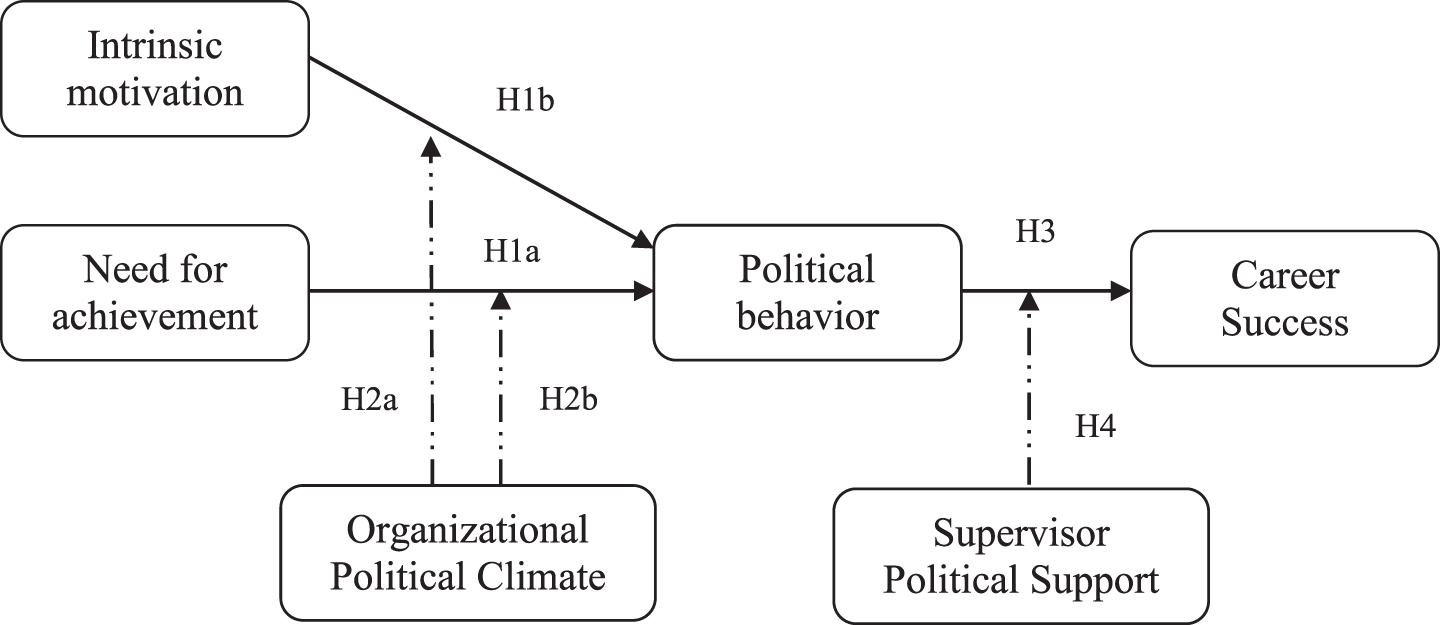
Conceptual Model.
To test the hypotheses in this study, the researchers collected data from a range of low, mid, and high-level university leaders who were selected randomly from State Islamic Universities in West Java. Questionnaires were distributed among (N = 496) units, departments, and faculty leaders through systematic sampling and the confidentiality of the responses was assured. Cases with suspicious responses and missing values were deleted. In total, the response rate was 86% (N = 427). Of the respondents, 74% were male, with an average age of 32 years; 69.4% were married, and their average tenure at the university was 6.9 years. The rate of high school graduates was 3.4%, vocational high school graduates was 0.9%, associate degree graduates was 8.4%, university graduates was 81.1%, and Masters/PhD graduates was 6.2%.
Hierarchical Regression Analysis (HRA) was the method used for this study, which sought to analyze and explain the position of moderating variables, and whether the moderating variable becomes a pure moderating variable, quasi-moderating variable or non-moderating variable [42, 43]. Besides this, the test intended to discover how the role of the moderating variable between the independent variable and the dependent variable performed, and whether it could strengthen or weaken the correlation [44]. To simplify the statistical analysis of HRA, the researchers used STATA 13 Software.
Measurement
All variables were quantified on a 5-point Likert scale from “strongly disagree = 1” to “strongly agree = 5”. The details of the measurement of each construct are as follows:
“Intrinsic motivation” was measured with the 6-item scale developed by references [5, 45]. Sample items from this scale included: “I feel a sense of personal satisfaction when I do this job well”. Cronbach’s alpha was 0.6816; “Need for achievement” was measured with the 5-item scale developed by reference [5, 46]. Sample items from this scale included, “I do my best work when my job assignments are fairly difficult”. Cronbach’s alpha was 0.6533; Organizational political climate was measured by a 6-item scale developed by the study at [22]. Sample items from this scale included, “Remind him or her of past favors that I did for him/her”. Cronbach’s alpha was 0.7622; Supervisory political support was measured with the 6-item scale developed by reference [37]. Sample items from this scale included, “My boss works behind the scenes to make sure that I have the things I need to do a good job”. Cronbach’s alpha was 0.9340; Political behavior was measured with the 6-item scale developed by reference [5]. Sample items from this scale included, “I spend time at politicking work”. Cronbach’s alpha was 0.7894; Career success was measured with the 5-item scale developed by reference [32]. Sample items from this scale included, “the conditions of my life are excellent”. Cronbach’s alpha was 0.7201.
Data analysis and results
The correlations and descriptive statistics of the study variables are shown in Table 1. Meanwhile, Tables 2 and 3 show the regression results.
Mean, standard deviation, correlation, and reliability
Mean, standard deviation, correlation, and reliability
N = 427; *p < 0.05; **p < 0.01, two-tailed test.
Summary of hierarchical regression analysis for organizational political climate as a moderating variable for the correlation between need for achievement, intrinsic motivation and political behavior
N = 427; *p < 0.05; **p < 0.01.
Summary of hierarchical regression analysis for supervisor political support as a moderating variable for the correlation between political behavior and career success
N = 427; *p < 0.05; **p < 0.01.
Mean, standard deviation, correlation, and reliability of study variables are reported in Table 1. The results in Table 1 reveal that all direct correlations were significant. Specifically, “need for achievement” was positively correlated with political behavior among the leaders of State Islamic Universities in West Java (r = 0.4914, p < 0.000). “Intrinsic motivation” was positively correlated with political behavior among the leaders of State Islamic Universities in West Java (r = 0.3691, p < 0.000), organizational political climate was positively correlated with political behavior among the leaders of State Islamic Universities in West Java (r = 0.1284, p < 0.008), supervisory political support was positively correlated with career success among the leaders of State Islamic Universities in West Java (r = 0.3401, p < 0.000), and political behavior was positively correlated with career success among the leaders of State Islamic Universities n West Java (r = 0.3368, p < 0.000). These findings provided general support for all hypotheses. All Cronbach’s alpha coefficients for the multiple-item scales exceeded 0.60, which indicated acceptable scale reliability.
Hierarchical Regression Analysis (see Table 2) was used to test hypothesis 1a, 1b, 2a, and 2b. Model 1 showed that hypothesis 1a, “need for achievement” had a positive effect on political behavior among the leaders of State Islamic Universities in West Java (β 1 = 0.424, p < 0.000). Hypothesis 1b, “intrinsic motivation” had a positive effect on political behavior among the leaders of State Islamic Universities in West Java (β 1 = 0.239, p < 0.000). Both hypothesis 1a and 1b results indicated that moderating variable β 1 had a significant value. Model 2 showed that organizational political climate had a positive effect on political behavior among the leaders of State Islamic Universities in West Java (β 2 = 0.143, p < 0.000). Moderating variable β 2 showed a significant value. In Model 3, hypothesis 2a showed that the effect of the “need for achievement” on political behavior was moderated by the organizational political climate among the leaders of State Islamic Universities in West Java (β 3 = –0.079, p < 0.275). Furthermore, hypothesis 2b showed that the effect of “intrinsic motivation” on political behavior was moderated by the organizational political climate among the leaders of State Islamic Universities in West Java (β 3 = –0.079, p < 0.711). The model was able to account for 32.74% of the variance, F = 40.99, p < .000, R2 = 0.3274. Both hypothesis 2a and 2b results indicated that the value of moderating variable β 3 was not significant. Based on the moderated HRA test, it was shown that β 1 was significant, β 2 was significant, and that β 3 was not significant. Thus it can be concluded that organizational political climate was a pure moderator on the correlation between the “need for achievement”, “intrinsic motivation” and political behavior among the leaders of State Islamic Universities in West Java [42, 43].
Moderated regression analysis (see Table 3) was used to test hypothesis 3 and 4. Model 1 showed that hypothesis 3, political behavior, had a positive effect on career success among the leaders of State Islamic Universities in West Java (β 1 = 0.359, p < 0.000). The result of hypothesis 3 showed that the value of β 1 was significant. Model 2 showed that supervisory political support had a positive effect on career success among the leaders of State Islamic Universities in West Java (β 2 = 0.257, p < 0.000). The value of the moderating variable β 2 was significant. In Model 3, hypothesis 4 showed that the effect of political behavior on career success was moderated by supervisory political support (β 3 = –0.049, p < 0.467). The model was able to account for 21.44% of the variance, F = 38.48, p < .000, R2 = 0.2144. Hypothesis 4 result indicated that the value of β 3 was not significant. Based on the moderated regression analysis test, it was shown that β 1 was significant, β 2 was significant, and that β 3 was not significant. Then supervisory political support was the pure moderating variable on the correlation between political behavior and career success among the leaders of State Islamic Universities in West Java [42, 43]
Given the increasing amount of research on organizational political behavior in answering and predicting problems, this study attempts to clarify the effect of political behavior on career success by offering the integration of several theories. The study findings indicate that political behavior and career were essential variables in increasing the success of individuals within the organization. This study is consistent with a previous study, which found that politics and career success were correlated [32], whereas political behavior was influenced by the “need for achievement” and “intrinsic motivation” [5, 12]. In addition, we also evidenced that the correlation between the “need for achievement” and “intrinsic motivation” with political behavior was moderated by the organizational political climate and that the relationship between political behavior and career success was moderated by supervisory political support.
This study confirms that the “need for achievement” and “intrinsic motivation” have a positive effect on political behavior. This study found that leaders at the State Islamic University have political behavior that is triggered by their need for achievement. So, needs are a driving factor in the political behavior of leaders in the work environment. As an example of the need for achievement, the leaders at the State Islamic Universities in West Java implement a group regeneration system that focuses on nurturing the generation that has the potential to lead the organization in the future. They maintain this system to achieve the goals previously planned both individually and in groups. Consequently, leaders in higher education institutions were found to trigger political behavior. In addition, this study also confirms the results published in previous studies [5, 12].
Furthermore, the “intrinsic motivational” factor in leaders proved to be a major contribution in increasing the political behavior of leaders in the organization. Motivation is an encouragement from within the individual to achieve planned goals [24, 47], and in Indonesian educational institutions, leaders have a strong desire to behave politically. This desire is applied to the steps taken by leaders in occupying strategic positions both before and after they have achieved such positions. They also tend to work as passionately and as well as possible, and this tendency is an indication that leaders have a strong desire to behave politically in higher education institutions. This study supports the opinion of Mintzberg [17], who stated that strong motivation and desire in politics could trigger political behavior.
Another factor that could strengthen the correlation between the “need for achievement” and “intrinsic motivation” with political behavior was the organizational political climate. This factor shapes political behavior externally to the individual, meaning that political behavior is formed by the environment of the employee’s organization [48]. The effect of the political climate on organizations contributes significantly to leaders increasing their motivation and their need for political behavior [49]. The political climate within the organization shapes the perceptions of individuals in organizations in assimilating themselves with political behavior [4]. The political climate is the environment formed by the political habits of the employees in the organization. The accumulation of these habits is a supporting factor that must be considered when an organizational climate change is desired [19, 50]. The political climate in an organization can shape the habits, perceptions, and the behavior of individuals so that it can affect the changes in themselves and in the organization.
At higher education institutions, especially at State Islamic Universities in West Java, the political climate is evident. Leaders tend to engage in political behavior, because their motivations and needs are aligned with the political climate.
One consequence of political behavior within organizations is the creation of opportunities for individuals to develop and achieve their goals [5]. Therefore, the personality of an individual in an organization can shape that employee’s behavior to be successful in their career [51]. This study has evidenced that individual career success is determined by the political behavior of employees in the organization. Every employee hopes to achieve a successful career so that they can fulfil their life’s goals. The political behavior approach is seen as being very effective in achieving individual careers within the organization [32].
In higher education institutions, especially those at the State Islamic Universities in West Java, leaders have a high tendency towards political behavior. They achieve positions through a political approach to their supervisors or by performing exposure to their supervisors. This behavior can be categorized as a political approach in organizations. This tendency in employees towards political behavior in achieving career success is largely driven by economic factors (position, salary, incentives, and bonuses), and these factors can meet their life needs if employees achieve career success in higher education institutions.
Someone who behaves politically tends to create more opportunities within the organization and they create these opportunities to make the career they want. However, political behavior alone is not enough to achieve an individual’s career in the organization. An employee also needs political support from superiors to achieve goals. The facts show that supervisory political support tends to be more pronounced in higher education institutions because leaders have a political contract with their superiors to achieve agreed targets. Political contracts made by leaders relate to the work that must be achieved by officials in the higher education environment.
Political support from superiors is a factor that can strengthen the correlation between the political behavior of employees and their career success. The more political support given by superiors to employees, the closer the employees get to successful careers within the organization.
Conclusions
The findings of this study make an essential contribution to the science of how political behavior relates to employees in an organization. Firstly, the results show that “need for achievement” and the “intrinsic motivation” have a partially positive effect on political behavior. The results also confirm previous research on the correlation between political will and political behavior [5, 12]. Secondly, the positive relationship between need for achievement and the intrinsic motivation on political behavior are shown to be strengthened by organizational political climate. The findings show that political behavior arises due to the support of the political climate in the organization. Thirdly, the results find that political behavior has a positive effect on employee career success in the organization. This confirms the result of previous research which showed that political behavior had a positive impact on career success [32]. Fourthly, the study indicates that supervisory political support strengthens the positive correlation between political behavior and the career success of employees in the organization.
Practical implications
Overall this study contributes significantly to increasing the individual career success of employees in higher education. The findings could be useful to the Indonesian Government in implementing specific policies on improving careers in higher education institutions as part of the support that comes from superiors. Another important contribution this study makes would be in shaping career planning for lecturers and employees at the State Islamic Universities in West Java. Career planning could then be implemented among lecturers and staffs to increase awareness of the importance of political behavior in advancing a career.
Furthermore, the Government is expected to increase compensation for employees in higher education institutions since this is an individual goal in achieving a career. Increased compensation and salary bands must be transparent so that each employee has access to the compensation they will get based on the performance they provide [52]. Transparent policies and increased compensation can also maintain fairness within the organization [53, 55].
From the political behavior viewpoint, this study confirms that there is political behavior among academics in State Islamic Universities in West Java. This political behavior is not always negative, but also showed positive sides that need to be considered by leaders in the development of the institution [56]. Political behavior in government institutions cannot be eliminated, but it needs to be re-directed positively towards employees for their advancement and that of their organizations. Therefore, the Government needs to provide guidance to university employees on the importance of how political behavior leads to a positive impact that can enhance their careers. However, this should not negate the values, norms, and progress of higher education institutions.
Furthermore, this study finds that “intrinsic motivation” and the “need for individual achievement” in organizations ware factors that could increase political behavior. It also reveals that employee needs related to high positions and benefits are the goals and expectations of employee achievement that can be achieved through political behavior. Leaders in higher education institutions tend to behave politically because they have the goal of achieving material (salary, incentive, bonus) or non-material (recognition) needs. Therefore, government guidance is needed for leaders and employees on the benefits of political behavior. The Government also needs to increase incentives and bonuses for leaders and employees as a reward for achievement.
Limitation and future directions
This study also shows the potential for political behavior to be developed within organizations to maintain organizational advancement. Future research on these findings at group level would be constructive in confirming positive political behavior as this study has focused solely on the effects at individual level. Further research may also explain the multi-level phenomenon of political behavior of employees in the organization. Mediating the variables in individual career successes, such as personal power, work engagement, organizational commitment, and network position could form the basis for future research in this subject. Experimental methods in examining political behavior within the organization could further enhance new research into the effects of political behavior on career success.
Finally, to complement this study, researchers could use alternative economic variables such as (incentives, bonuses, salaries) as factors that may have an effect on political behavior in higher education institutions.
Footnotes
Acknowledgments
The author would like to express sincere gratitude for the moral and material support of UIN Sunan Gunung Djati Bandung for the completion of this article.
Author contributions
CONCEPTION: Fauzan Ali Rasyid and M Sandi Marta
METHODOLOGY: Fauzan Ali Rasyid and M Sandi Marta
DATA COLLECTION: M Sandi Marta
INTERPRETATION OR ANALYSIS OF DATA: Fauzan Ali Rasyid and M Sandi Marta
PREPARATION OF THE MANUSCRIPT: M Sandi Marta
REVISION FOR IMPORTANT INTELLECTUAL CONTENT: Fauzan Ali Rasyid and M Sandi Marta
SUPERVISION: Fauzan Ali Rasyid