



Abstract
BACKGROUND:
Employee satisfaction, employee engagement and turnover intention have always been hot issues in the study of sustainable human resource management. Understanding the relationship among the three is critical for both researchers and human resource practitioners.
OBJECTIVE:
This study aims to distinguish the effects of employee satisfaction on employee engagement and turnover intentions, and explore the mediating roles of employee engagement and the moderating effects of position level.
METHODS:
Structural equation modelling and questionnaire.
RESULTS:
Pay satisfaction, satisfaction with supervisor, satisfaction with work itself, and satisfaction with promotion have positive impacts on employee engagement significantly. Pay satisfaction, satisfaction with supervisor, satisfaction with promotion, satisfaction with co-workers have negative impacts on turnover intention. Employee engagement has a negative impact on turnover intention. Employee engagement partially mediates the relationships between satisfaction with supervisor and turnover intention as well as satisfaction with promotion and turnover intention. The moderating roles of position level between satisfaction with supervisor, satisfaction with co-workers and turnover intention have been supported by data.
CONCLUSIONS:
This paper validates the relationship among employee satisfaction, employee engagement and turnover intention, and the moderating role of position level systematically. Some suggestions are provided for practitioners in the area of human resource management.



Introduction
Human resource is always considered as a key source of sustained competitive advantage because of meeting the criteria of being valuable, inimitable, rare and non-substitutable [1]. The development, promotion, and usage of human resources have always been the focus of research by scholars worldwide. With the development of Chinese society, economy and culture, the professional values of employees have undergone great changes. The level of human needs has increased with the demand structure becoming more diversified. This makes significant changes of employee satisfaction (ES) and employee engagement (EE), and also leads to more diversified reasons for employees turnover intention (TI).
According to the “2021 Resignation and Salary Adjustment Research Report” released by 51job.com, the turnover rate of the manufacturing industry in 2020 is 17.8%, which is the highest among all industries in China. Although the employee turnover rate in China has been declining in recent years, manufacturing companies are still facing severe human resource shortages due to the gradual weakening of China’s demographic dividend and the “limited supply” of labor. According to a report (https://tv.cctv.com/2021/04/19/VIDEIu0e2n2Lg1vzEOQ344Sh210419.shtml) in CCTV Finance, in many developed manufacturing areas of China, recruitment difficulties have existed for many years. According to a report (https://jingji.cctv.com/2021/04/06/ARTIsBTKSeeYTl5CMdWi3gNy210406.shtml) in Economic Information Daily, with the improvement of COVID-19 epidemic situation and the accelerated resumption of work and production, the structural contradiction between labor supply and demand has become prominent in China. The manufacturing industry is in short supply of skilled workers and high-end talents, while the service industry and the Internet industry are absorbing more labors. Under the current severe labor supply situation in the manufacturing industry, in addition to vigorously recruiting new employees, manufacturing companies should also do their utmost to retain existing talents to minimize the increase of human resource costs and other harms caused by human resource shortages.
Therefore, It is necessary to discuss issues related to employee satisfaction, employee engagement, and turnover intention under the new situation. It is also necessary to use management tools to promote employee satisfaction and engagement, and inhibit the occurrence and development of employee turnover intention, and then to reduce the employee turnover rate which helps to improve core competitiveness of companies.
Studies have shown that satisfied employees are more dedicated and more willing to pay for the organization [2]. On the contrary, unsatisfied employees tend to reduce their investment in work due to psychological distortions at work, which may lead to a decline in overall performance in an organization. Employees are more likely to have negative job morale and turnover intention [3, 4], which depends on the position and needs of employee groups they belong to. There are many existing studies researches on employee satisfaction, employee engagement, and employee turnover intention, but most of these studies focus on the relationship between only two of them [5]. However, few studies discuss the interaction among these three, especially in the context of Chinese characteristics.
In view of the multidimensional structure of employee satisfaction [2, 6], the study of employee satisfaction outcome variables is mainly divided into two categories: one is to consider employee satisfaction as an overall variable and to study the impact on other variables [7], and the other is to study one dimension variable’s relationship with other variables [3, 8]. Few studies discuss the relationships between the various dimensions that constitute employee satisfaction and their integration. Therefore, it is necessary to test the impacts of different states of employee satisfaction on employee engagement and turnover intention.
In addition, the diversity of human resource cannot be ignored in the management process of organizations, which may affect the links between employee satisfaction and turnover intention [9]. Position level is a deep-level diversity of employee. Prior studies have examined the moderating effect of position on the relationship between employee attitudes and employee behavioural intention [9–11]. However, few previous researches discussed the moderating effect of position level on the link between employee satisfaction and turnover intention, especially between the different dimensions of employee satisfaction and turnover intention.
In order to solve the problems discussed above, the purpose of this paper is to use the employee questionnaire data of Chinese companies to empirically analyze the relationship among employee satisfaction, employee engagement and employee turnover intention. Moreover, we also test the moderating effects of employees’ position level on the link of employee satisfaction and turnover intention. The results of this study will provide inspiration for human resource management research and practice.
Compared with the prior researches, the main contributions of this paper mainly includes three parts. First, few prior researches discussed the heterogeneous influence of employee satisfaction as a multidimensional construct on employee engagement and turnover intention [9, 13]. This paper divides the employee satisfaction into five dimensions and investigates the different effects of different dimensions on employee engagement and turnover intention. This provides insights for scholars to understand the heterogeneity of the impact of employee satisfaction. Second, this paper validates the direct and indirect effects of employee satisfaction on turnover intention and test the mediating role of employee engagement between five dimensions of employee satisafaction and turnover intention, which strengthens the existing knowledge body of the weakening mechanism for the employee turnover intention. Third, previous studies have given less consideration to individual characteristics of employees when discussing the relationship between employee satisfaction and turnover intention [7–9]. Especially, no research considered both the multi-dimensional characteristics of employee satisfaction and the moderating effect of position level when considering the antecedents of turnover intention. This paper examines the moderating effect of position level, which provides new ideas for scholars to study the role of position characteristics in the generating mechanism of turnover intention.
Literature review and hypotheses
Relationships between ES and EE as well as ES and TI
Employee satisfaction is defined as an enjoyable emotional state that results from evaluating a person’s work compensation [14]. As a kind of attitudinal variable, employee satisfaction includes cognitive and emotional responses to individuals and their workplace requirements and necessities [15] or individuals’ positive or negative judgments on a job or work situation [16]. It is generally believed that employee satisfaction is a multi-dimensional comprehensive concept. Researchers have different ways of measuring it, such as the Overall Job Satisfaction Scale [17], the Job Description Index [18], the Job Satisfaction Survey [19], and Job in General Scale [20]. Yang et al. [21] analyzed whether the Job Satisfaction Survey developed by Spector [19] was suitable for Chinese population. They used empirical data to determine an employee satisfaction scale including five dimensions: pay satisfaction, satisfaction with promotion, satisfaction with supervisor, satisfaction with co-workers, and satisfaction with work itself.
Employee satisfaction is often considered as an antecedent variable of other variables, such as employee engagement and turnover intention [22–25]. Employee engagement refers to a positive, real and work-related mental state that does not focus on any specific object, event, person or behavior [26]. Employee satisfaction and employee engagement have long been areas of interest to scholars and practitioners [27, 28]. Many scholars believe that employee satisfaction has a positive effect on employee engagement [22–25]. Huang et al. [29] studied the impact of high-performance work systems (HPWS) on Chinese employees’ attitudes and employee engagement, and found that job satisfaction and positive emotion could form a high level of employee engagement. Davies et al. [30] verified that employee characteristics could adjust the impact of employer brand image on employee satisfaction and engagement, and found that employee satisfaction partially mediated the impact of employer brand image on engagement. Djoemadi et al. [13] studied samples of three different management levels (including senior leaders, line managers, and supervisors) in the Indonesian telecommunications industry and believed that job satisfaction could improve employee engagement. Shuck et al. [31] tested two mutually opposed structural models, and the results showed that job satisfaction was a prerequisite for employee engagement. Employee satisfaction is a positive psychological state from employees’ perceptions of their work, and employee engagement refers that employees put their full energy and positive emotions into their work. We believe that employees feel satisfied (employee satisfaction), and they will put their own experiences and emotions into work (employee engagement).
Employee turnover intention refers to the employee’s intentional and planned resignation [4], which is a subjective psychological attitude. In the era of information flow increasing, employees’ career choice becomes freer. Therefore, it is critical for companies to reduce the turnover rate of employees. Turnover intention is a reliable indicator of actual voluntary turnover and severely affected by employee satisfaction [32]. Zhang et al. [33] found that job satisfaction had a direct negative relationship with employees’ willingness to leave. Wang et al. [12] studied the relationship between the professional identity, employee engagement, job satisfaction, and turnover intention of Chinese hotel employees, and verified the negative impact of job satisfaction on turnover intention. Bamfo et al. [34] found that the satisfaction of front-line employees in the banking industry had a significant negative impact on turnover intention. DiPietro et al. [35] constructed and verified that job satisfaction had a significant negative impact on employees’ turnover intention in the context of restaurant chain stores. When employees are dissatisfied with their work, their desire to stay in the organization begins to become weaker, and eventually they will decide to leave the organization [36].
Next, we discuss the definitions of five dimensions of employee satisfaction and impacts of them on employee engagement and turnover intention respectively.
Pay satisfaction (PS). Pay satisfaction is defined as the sum of employees’ general positive effects and feelings of the payment [37], as an important aspect of employee satisfaction. In order to better understand the connotation of pay satisfaction, many scholars have divided the concept of pay satisfaction into four dimensions: pay level, pay raise, benefits, and pay structure [5, 38]. Pay satisfaction is considered as an important factor in promoting employee engagement, which in turn affects employee performance. This is because employees who receive reasonable compensation are more likely to be loyal to the organization and create more value for the organization [22]. In addition, pay satisfaction is one of the factors that affect turnover intention [39]. Pay satisfaction has a major impact on employee turnover intentions which in turn affects the company’s key performance [40]. Because of the fact that more money for employees is always better, those who do not have enough compensation will compare their own with other employees in similar companies and generate the intention to quit [22]. Therefore, we assume that: Pay satisfaction has a positive impact on employee engagement significantly. Pay satisfaction has a negative impact on turnover intention significantly.
Satisfaction with supervisor (SS). Fila et al. [41], Edgar and Geare [42] believed that the employee-supervisor relationship was a key factor that affects employee satisfaction. Many studies have revealed the relationship between employee satisfaction and supervisor leadership behavior [43, 44]. As a result, satisfaction with supervisor is an important dimension constituting employee satisfaction. The quality and nature of supervision to the employees affect the employee’s perception of workplace and employee satisfaction [45]. So employees are more concerned with their relationship with supervisors, which is positively related to employee’s loyalty and work engagement [23]. On the contrary, bad relationships with supervisors will make employees start thinking about leaving. Therefore, we assume that: Satisfaction with supervisor has a positive impact on employee engagement significantly. Satisfaction with supervisor has a negative impact on turnover intention significantly.
Satisfaction with co-workers (SC). The relationship between employees and co-workers is also an important source of employee satisfaction [46]. Many authors, for example, Kahn [47] discussed the importance of co-worker relationships to employee engagement. Treating co-workers as one kind of support is considered as an important resource of work to promote the achievement of work goals and is significantly related to employee engagement. If an employee is satisfied with his co-workers, he or she will be more inclined to stay in the company instead of leaving the company to a new environment. Therefore, we assume that: Satisfaction with co-workers has a positive impact on employee engagement significantly. Satisfaction with co-workers has a negative impact on turnover intention significantly.
Satisfaction with promotion (SP). The promotional opportunity is one of the factors that employees will consider when choosing their work, and promotional opportunity also influences the working attitude of employees [48]. When employees have perceived a higher chance of promotion, they tend to be more dedicated and consistent with the needs of the organization [49]. Greater promotion opportunities are also negatively related to the turnover intention, especially for employees with more traditional career development strategies [50]. Similar to the pay level, communicating with employees about their promotion opportunities may bring benefits to employees, and thus employees will be more motivated to participate in the work of the organization [24]. Therefore, we assume that: Satisfaction with promotion has a positive impact on employee engagement significantly. Satisfaction with promotion has a negative impact on turnover intention significantly.
Satisfaction with work itself (SW). Satisfaction with work itself has long been considered as an important aspect of employees’ attitude towards work [14, 51]. Herzberg et al. [25] motivator-hygiene theory believes that employee satisfaction comes from inherent factors of the job itself. For decades, researches on employee turnover have revealed that employees’ satisfaction with work itself can promote employee’s active participation at work and is negatively related to employee turnover intentions or behavior [52–54]. Therefore, we assume that: Satisfaction with work itself has a positive impact on employee engagement significantly. Satisfaction with work itself has a negative impact on turnover intention significantly.
Relationship between EE and TI
A meaningful construct that reduce voluntary turnover is work engagement [55]. Employees with high engagement are less likely to look for new job opportunities elsewhere [56]. According to existing researches, low-level engagement results in a high employee turnover rate, while a dedicated employee has a low turnover intention [57, 58]. Based on the theory of organizational commitment, Zhang et al. [33] found that social media usage indirectly reduces employees’ willingness to leave by increasing employee engagement and organizational commitment. Kang and Sung [59] proposed an employee turnover intention model based on perception of organizational justice from the perspective of relationship management and human resource management. The results showed that employees’ high awareness of organizational justice affected work engagement, which in turn had a negative impact on turnover intentions, and employee engagement played a part of the mediating role in this process. On the basis of resource protection theory, Wang et al. [12] explored the relationship between professional identity, employee engagement, job satisfaction, and turnover intention of Chinese hotel employees. The results showed that employee engagement had a negative impact on turnover intention. Employees with higher engagement have greater sense of belonging to the organization and reduce the willingness to leave [56], which in turn reduces employee turnover. Therefore, we assume that: Employee engagement has a negative impact on turnover intention significantly.
Moderating effect of position level on the link between ES and TI
To explore the relationships among the three deeply, we consider the different effects for employees at different level positions. In this section, we discuss the moderating role of position level on the relationship between employee satisfaction and turnover intention.
Generally, the diversity of human resource cannot be ignored in the management process of organizations. Garib [60] suggested employee diversity should be properly managed by organizations to improve the productivity. Diversity represents to the distribution of personal attributes among interdependent employees of a workplace [61]. Most work groups today are characterized by varieties in career paths, gender, education level, age, ethnicity, values, nationality, and personalities [62].
Position level is a deep-level diversity of employee. Both the Career Adaptability Theory [63] and Power Distance Theory [64] emphasize the differences in career planning and behavioural decisions of employees at different position levels. Prior studies have examined the moderating effect of job position on the relationship between employee attitudes and employee behaviour [9–11]. Considering the nature of the works, employees at different position levels, such as managers, technicians, and front-line employees, may have different attitudes towards work. There may be different-strength impacts of work attitudes on employee behaviours among different-position employees [9].
Position level is one of the important factors that affect the employee’s turnover intention [9, 11]. The employees at different position levels in the organization have different resources and pressures. On the one hand, the employees at higher level can master more information and resources than employees at lower level. According to Career Adaptability Theory, senior managers tend to have stronger occupational adaptability and stronger self-efficacy than grassroots employees [65, 66]. When employees are dissatisfied with their current job, senior managers with higher professional adaptability can obtain richer job information and have more opportunities to find new proper positions [67]. In addition, the stronger professional qualities and work experience of senior managers make it easier for them to work in the new organization and further match new positions with their career goals [68] and personal values [69]. In contrast, it is difficult for grassroots employees to obtain new job recruitment information that is more suitable for them due to the limitations of their own abilities and information sources. In addition, the grass-roots jobs in the organization are highly substitutable. Therefore, when looking for new jobs, the grass-roots employees can only find positions that are similar to the existing working conditions because they are difficult to be qualified for more professional jobs [70]. On the other hand, employees at higher position need to face greater professional pressures than employees at lower position [71]. Because senior management positions require strong professional quality and high responsibility, the work pressure of senior managers is often greater, and their burnout is stronger [72]. If senior managers are dissatisfied with their current jobs, the pressure they face will make it difficult for them to continue to be passive in their current positions, which will result in turnover intention [73].
Therefore, we assume that position level positively moderates the negative relationship between employee satisfaction and turnover intention. We assume that: The impact of pay satisfaction on turnover intention is stronger for higher-position-level employees than that for lower-position-level employees. The impact of satisfaction with supervisor on turnover intention is stronger for higher-position-level employees than that for lower-position-level employees. The impact of satisfaction with co-workers on turnover intention is stronger for higher-position-level employees than that for lower-position-level employees. The impact of satisfaction with promotion on turnover intention is stronger for higher-position-level employees than that for lower-position-level employees. The impact of satisfaction with work itself on turnover intention is stronger for higher-position-level employees than that for lower-position-level employees.
Mediating roles of EE
Based on the contents in Sections 2.1 and 2.2, we assume that employee engagement plays mediating roles in the relationships between five dimensions and turnover intention. The hypotheses about mediating effects are as follows: Employee engagement mediates the relationships between five dimensions of employee satisfaction and turnover intention. Employee engagement mediates the relationship between pay satisfaction and turnover intention. Employee engagement mediates the relationship between satisfaction with supervisior and turnover intention. Employee engagement mediates the relationship between satisfaction with co-wokers and turnover intention. Employee engagement mediates the relationship between satisfaction with promotion and turnover intention. H5e: Employee engagement mediates the relationship between satisfaction with work itself and turnover intention.
The theoretical model we established is shown in Fig. 1.
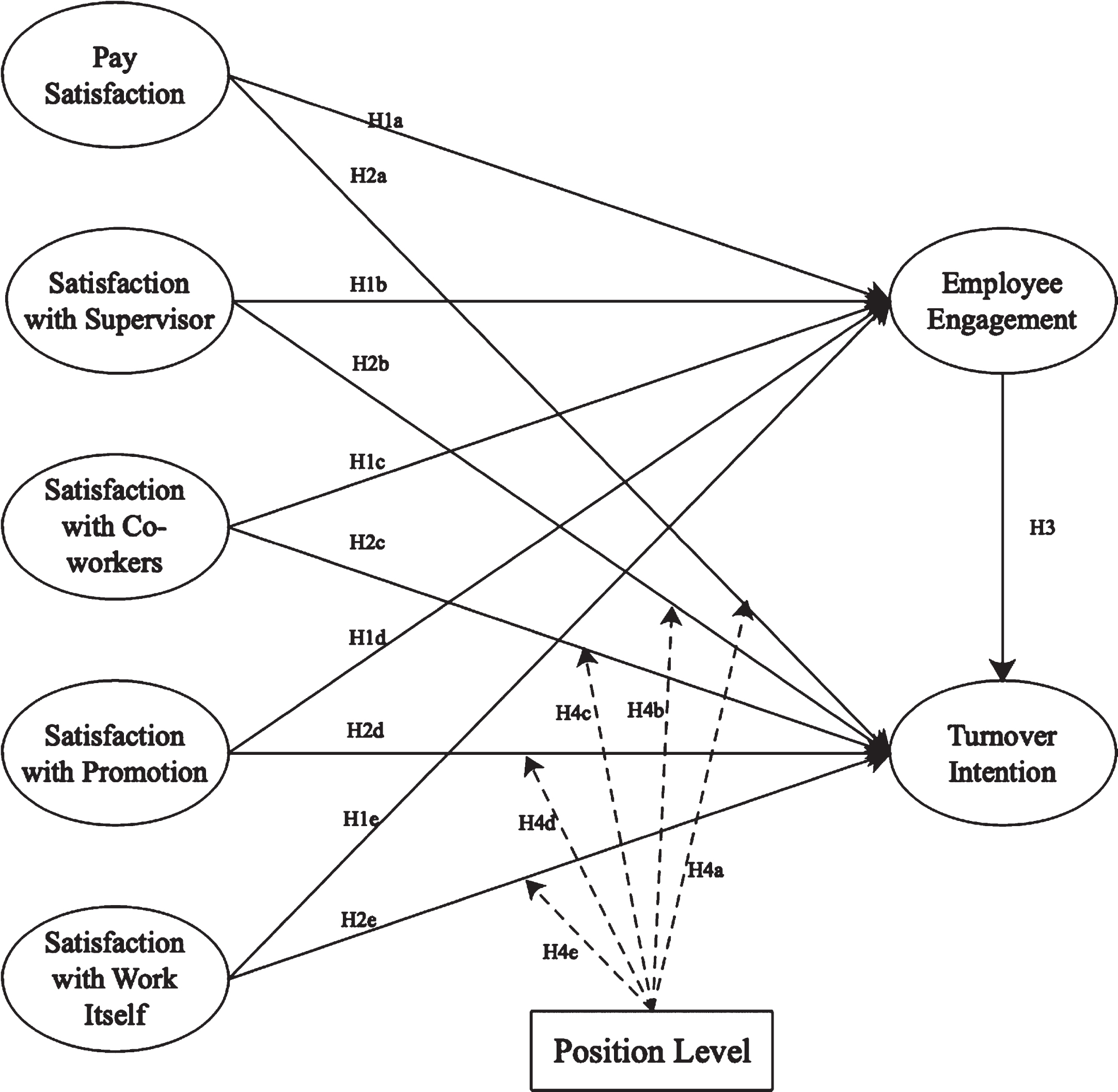
Theoretical model.
Sample and data collection
In order to test the above hypotheses and the whole model, this study collected empirical data by issuing questionnaires. The data sources for the questionnaire were mainly from enterprise employees in China. We investigated 13 pharmaceutical manufacturing companies in Shandong Province. The reason why we choose Shandong Province to investigate is the scale of the pharmaceutical industry in Shandong Province accounts for one-seventh of the total pharmaceutical industry in China. The pharmaceutical companies we selected are all in the China Top 100 Pharmaceutical Industry List. The employee groups of these 13 pharmaceutical manufacturing companies are large enough and sufficiently diverse that they can represent the employee groups of the Chinese pharmaceutical industry. A snowball offline questionnaire survey was implemented to collect the data using paper-version. The HR departments of the investigated companies are responsible for the issuance and collection of questionnaires. We recovered 1321 questionnaires in total, and 1219 questionnaires remain valid after excluding the ones with incomplete information or obviously false behaviors.
Table 1 provides the demographic profile of the respondents. As shown in Table 1, the number of men is almost twice the number of women. The sample is generally well distributed in position, years of work, and education.
Demographic characteristics of the sample
Demographic characteristics of the sample
The questionnaire is mainly composed of four parts. The first part is the basic information of the respondent, the second part is the employee satisfaction survey, the third part is the employee engagement survey, and the fourth part is the employee turnover intention survey.
The measurement of employee satisfaction is mainly divided into five dimensions, including pay satisfaction, satisfaction with supervisors, satisfaction with co-workers, satisfaction with promotion, and satisfaction with work itself. In order to clarify impacts of each dimension of employee satisfaction on employee engagement and employee turnover intention, this study measures the five variables of employee satisfaction separately.
In order to ensure the accuracy, completeness and applicability of the measurement scale, we have adopted the following procedures when designing the scale. First, we reviewed literatures on employee satisfaction [14, 75], employee engagement [8, 26], and employee turnover intentions [8, 53], in order to conclude the relevant indicators. Also, we organized six HR experts and five HR practitioners to evaluate the indicators and structure of the questionnaire, and make appropriate modifications to the scale according to feedback suggestions. We conducted pre-surveys of the employees from two companies and conducted preliminary statistical analysis of the pre-survey data. According to the analysis results, we eliminated five measurement items with high crossover factors, and completed the questionnaire design.
After the prior work, the final version of questionnaire contains 3 items of pay satisfaction, 6 items of satisfaction with supervisor, 6 items of satisfaction with co-workers, 4 items of satisfaction with work itself, 3 items of satisfaction with promotion, 4 items of turnover intention, and 3 items of employee engagement. Table 2 clearly shows the measurement items for each variable. In this study, seven-point Likert scale has been used in the questionnaire.
Variable and measurement item
Variable and measurement item
In this paper, PLS-SEM is used to estimate the hypothesis model presented in the previous paper, and Smart PLS 3.4.2 software is used for data processing. PLS-SEM is a nonparametric, multivariate method for estimating path models with latent variables [76]. This study has a certain exploratory and structural complexity, making the PLS-SEM method applicable to the model of this study [76, 77]. With regard to the investigative nature of this study, it is reflected in its exploration of the interrelationships between employee satisfaction, employee engagement and turnover intention, which is the least discussed issue in the published research literature. As for the structural complexity, it is reflected in the inclusion of moderating variables such as position level in the relationships.
Results
Assessment of measurement model
We test internal consistency reliability, convergent validity, and discriminant validity by assessing the measurement model [76]. Internal consistency reliability will be assessed through composite reliability (CR) scores. As shown in Table 3, CR scores of seven constructs are higher than the recommended criterion of 0.8 [78]. The Cronbach’s alpha of all constructs is all above 0.7 [79], showing high internal consistency.
Convergence validity
Convergence validity
Also, we examine the convergent validity by calculating factor loadings and average variance extracted (AVE). As shown in Table 4, the factor loadings of all constructs are greater than 0.7. AVE scores are also higher than the recommended threshold of 0.5 [78]. The convergent validity of this study is adequate.
Cross loadings
Finally, discriminate validity is determined by comparing the AVE square roots of the constructs and corresponding with the absolute value of correlation coefficients among the constructs [78]. The AVE square roots of constructs in the diagonal rows exceed the correlation coefficients among the constructs, which is shown in Table 5. Factor loadings are all greater than the cross loadings. The discriminate validity passes the test in this study.
Fornell-Larcker Criterion
Firstly, we test the interrelationships among the dimensions of employee satisfaction, employee engagement and turnover intention by assessing the structure model. We carry out the Bootstrap algorithm (N = 5000) to attain the path coefficients and test the significance results of them [78]. As shown in Table 6, the hypotheses we proposed are supported except H1c and H2e. The “Original Sample” in Table 6 refers to the path coefficient β estimated by original sample.
Path Coefficients
Path Coefficients
***p < 0.001, **p < 0.01, *p < 0.05. PS = Pay Satisfaction, SS = Satisfaction with Supervisor, SC = Satisfaction with Co-workers, SP = Satisfaction with Promotion, SW = Satisfaction with Work Itself, EE = Employee Engagement, TI = Turnover Intention.
Next, we test the moderating effects of position level on the relationships between the dimensions of employee satisfaction and turnover intention by using the Bootstrap algorithm (N = 5000) of Smart PLS 3. The “Original Sample” in Table 7 refers to the values of moderating effects estimated by original sample. According to the outcomes in Table 7 and Fig. 2., only two moderating effects are supported by the data. One is the moderating effect of position level on the link between satisfaction with supervisor and turnover intention with β of 0.096, t of 2.773, p of 0.006. The other is satisfaction with co-workers with β of –0.141, t of 3.474, p of 0.001). That means the impacts of satisfaction with supervisor on turnover intention are stronger for higher-position-level employees than that for lower-position-level employees, supporting the H4b, while the impacts of satisfaction with co-workers on turnover intention are stronger for lower-position-level employees than that for higher-position-level employees, which is contrary to the H4c.
Moderating effects
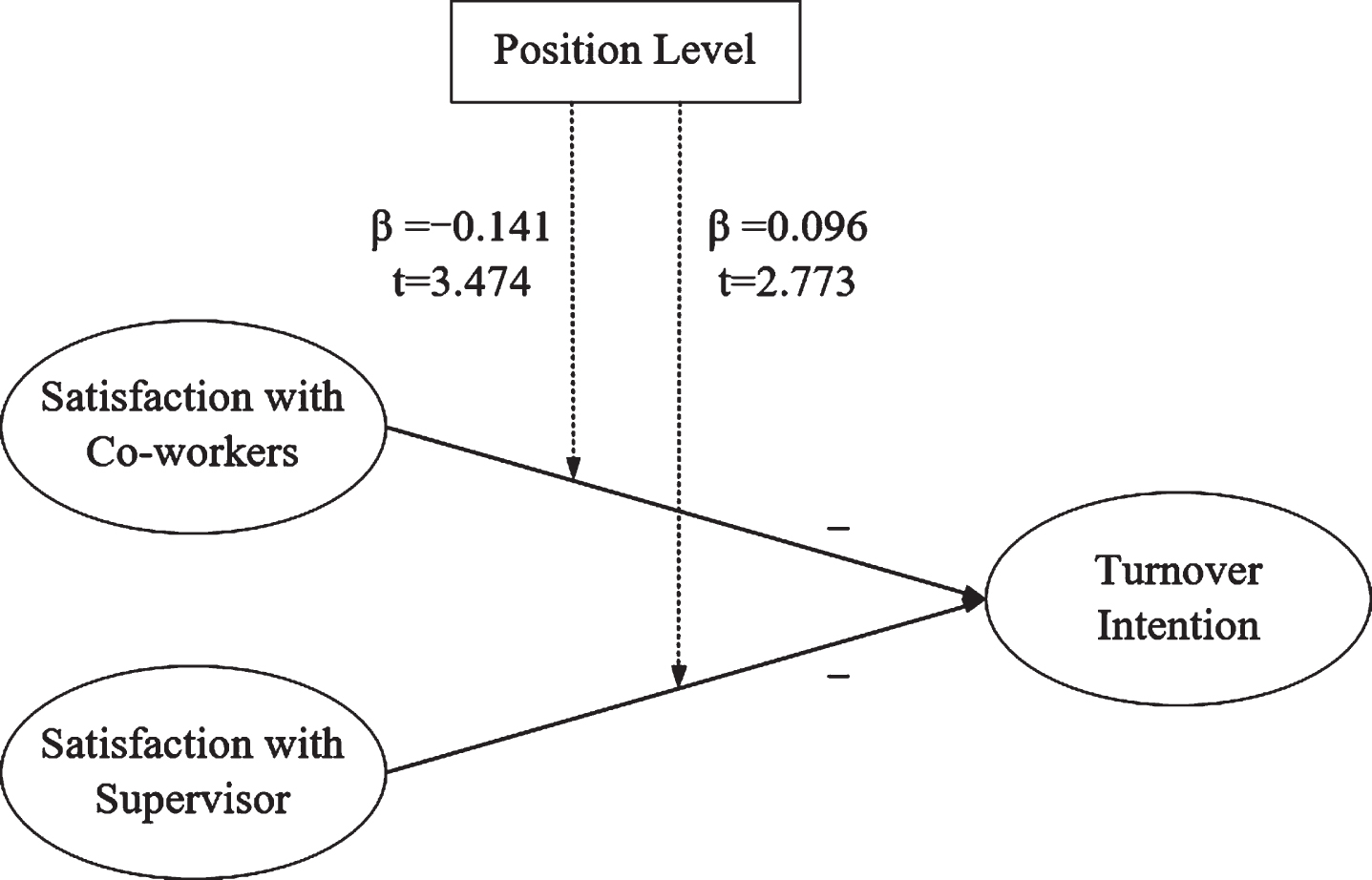
Results of moderating effects.
Next, we examine the mediating roles of employee engagement in relating five dimensions of employee satisfaction and turnover intention. Table 8 shows the indirect effects, direct effects and total effects of each variables. The “Original Sample” in Table 8 refers to the values of indirect effects, direct effects and total effects estimated by original sample. Results show that employee engagement mediates the Satisfaction with Supervisor–Turnover Intention relationship significantly (β= –0.030, t = 2.521, VAF = 0.2500), which supports H5b. Moreover, the results demonstrate that employee engagement mediates the Satisfaction with Promotion–Turnover Intention relationship significantly (β= –0.025, t = 2.310, VAF =0.2193), which supports H5d. This suggests that employee engagement partially mediates the relationships between Satisfaction with Supervisor and Turnover Intention as well as Satisfaction with Promotion and Turnover Intention. On the other hand, H5a and H5c are not supported by the data according to VAF < 0.20 in Table 8. In addition, the total effect of Satisfaction with work itself on Turnover intention is not significant (β= –0.013, t = 0.417). According to classical mediation effect analysis of Baron and Kenny [80], the discussion of mediation effect should be based on the premise that the total effect is significant. Therefore, this study will not further explore the mediating role of Employee Engagement in the relationship between Satisfaction with Work Itself and Turnover Intention.
Mediating effects
***p < 0.001, **p < 0.01, *p < 0.05. PS = Pay Satisfaction, SS = Satisfaction with Supervisor, SC = Satisfaction with Co-workers, SP = Satisfaction with Promotion, EE = Employee Engagement, TI = Turnover Intention.
Major conclusions
In order to clarify the relationships among employee satisfaction, employee engagement, and employee turnover intentions, we design scales for seven constructs, collect questionnaire data from China, and test the significance of the relationships using PLS-SEM methods. The main conclusions we draw are as follows: Pay satisfaction, satisfaction with supervisor, satisfaction with work itself, and satisfaction with promotion have positive impacts on employee engagement, while satisfaction with co-workers has no positive impact on employee engagement. Satisfaction with work itself plays the most impotant role in the relationship between employee satisfaction and employee engagement. Pay satisfaction, satisfaction with supervisor, satisfaction with promotion, satisfaction with co-workers have negative impacts on turnover intention, while satisfaction with work itself doesn’t show significant negative impact on turnover intention. Satisfaction with co-workers has the highest path coefficient of 0.303 with p < 0.001 in the relationship between employee satisfaction and turnover intention. Employee engagement has a negative impact on turnover intention significantly (path coefficient is –0.176, p < 0.001). Position level plays moderating roles on the relationship between satisfaction with supervisor, satisfaction with co-workers and turnover intention (path coefficients are 0.096 and -0.141, p < 0.01 and p < 0.001, respectively). Employee engagement partially mediates the relationships between Satisfaction with Supervisor and Turnover Intention as well as Satisfaction with Promotion and Turnover Intention.
Theoretical implications
The main theoretical contributions of this article are as follows: Firstly, we use empirical data from China to analyse the SEM, in order to clarify the relationships between employee satisfaction, employee engagement, and turnover intention. The results of this paper show that Pay Satisfaction, Satisfaction with Supervisor, Satisfaction with Promotion, and Satisfaction with Work Itself have positive significant effects on Employee Engagement, which is consistent with the conclusions of most scholars [22–25]. Pay Satisfaction, Satisfaction with Supervisor, Satisfaction with Co-workers, Satisfaction with Promotion have negative significant effects on Turnover Intention. Employee Engagement has a negative significant effect on turnover intention, which is in line with managerial practice and previous researches [32].
Secondly, it is also discussed in this paper that each dimension of employee satisfaction influences employee engagement and turnover intention respectively. We can determine the power of the impact of independent variables on dependent variables according to the path coefficients. Moreover, partially mediating roles of employee engagement in the influence paths between dimensions of employee satisfaction and turnover intention are tested and discussed in the paper, which provides more insights to help researchers understand the complicated relating mechanism in the knowledge body of sustainable human resource.
Thirdly, it is worth noting that satisfaction with co-workers has no positive impact on employee engagement. Biron and Boon [81] advocated that low performers seem to be more sensitive to relationships with colleagues. Performance data obtained from different sources may show different patterns of results. Thus, satisfaction with co-workers may not have impact on employee engagement under certain circumstances. In addition, satisfaction with work itself has no negative impact on turnover intention indicated by the data significantly. The reason may be that job seekers always find out all work conditions before determining participating a company, and the work itself will not be the key cause of quitting after joining.
Finally, moderating effects of position level are examined by the data concerning satisfaction with supervisor, satisfaction with co-workers and turnover intention. According to the results, the relationships between satisfaction with co-workers, satisfaction with supervisor and turnover intention shows heterogeneity for employees at various position levels, which is rarely discussed in the existing literature. As for higher-position employees, their supervisors in work may have a greater impact on turnover rate. The opposite is true for low-level employees. The reason is, comparatively speaking, when high-position employees make decisions or execute the company’s strategy, their participation and attitude are more affected by direct supervisors because of pyramid organizational structure. In addition, the moderating effect on the link between satisfaction with co-workers and turnover intention for low-position employees is stronger than that for higher managers. Low-position employees usually have the same work tasks and work condition with their co-workers so that they are more likely to consider resigning if they are not satisfied with co-workers because of the peer pressure and competition, while high-position employees are faced with different situations.
Practical implications
The results of this study are also useful for business management practitioners for the following reasons. Firstly, managers of companies should focus on the key dimensions of employee satisfaction, such as satisfaction with work itself and satisfaction with co-workers, and take measures to improve different levels of employee dimensions to enhance employee satisfaction and reduce turnover rate.
Additionally, some aspects of each dimensions of employee satisfaction should be put into higher places by companies. According to the factor loadings, companies are supposed to provide satisfying salaries, enough opportunities of promotion and necessary feedback system for employees. Supervisors should believe their subordinates, provide support as well as guidance and create democratic atmosphere of decision-making for subordinates.
Moreover, the moderating roles of position level suggest the managers that it is necessary to adopt differentiated approaches to manage satisfaction and engagement of employees in different positions. Companies should pay more attention to the relationships and corporations between high-position employees with their supervisors, and take measures to improve the corporations and relationships between low-position employees with their co-workers at the same time.
Limitations and suggestions for future research
This study has several limitations. First, the samples in this paper come from Chinese firms. Due to the difference of companies among different industries and regions, there may be some deviation in the sample structure, so future research needs to be extended to discuss the causes of the homogeneity or heterogeneity among industries from different regions.
Second, cross-sectional data from the survey are used in this study. This may not accurately verify the causality among variables. Future research should study hypothetical models in a longitudinal way to test the direction of the proposed causal relationship.
Third, we only considered one of employee diversity variables (position level) as the moderator of the link between dimensions of employee satisfaction and turnover intention. According to Mikolajczak et al. [62], employee diversity can be reflected in many aspects such as career paths, gender, education level, age, ethnicity, values, nationality, and personalities. Future research can categorize employee diversity and explore their moderating role systematically.
Footnotes
Acknowledgments
This work was supported by the National Natural Science Foundation of China [72072104]; and National Office for Philosophy and Social Sciences [18ZDA079].
Author contributions
CONCEPTION: Decheng Wen
METHODOLOGY: Decheng Wen and Dongwei Yan
DATA COLLECTION: Dongwei Yan and Xiaojing Sun
INTERPRETATION OR ANALYSIS OF DATA: Dongwei Yan and Xiaojing Sun
PREPARATION OF THE MANUSCRIPT: Decheng Wen and Dongwei Yan
REVISION FOR IMPORTANT INTELLECTUAL CONTENT: Decheng Wen
SUPERVISION: Decheng Wen