



Abstract
In this study, as a strategic decision-making problem, personnel selection is considered for an organization. Personnel selection is very important issue, matching the qualified personnel with the appropriate vacant position considering the assessment of the organization from each interviewee’s in the uncertain environment, for the enterprise performance of the organization. In such problems, the presented candidates for the organization should be evaluated based on the criteria that are determined by the organization. For selecting the most suitable personnel, based on the preferred criteria goaled by the organization and satisfied by the candidates, a fuzzy decision-making approach is proposed. The proposed approach allows an opportunity to evaluate personnel under uncertain enviroment determining the criteria as fuzzy numbers. To show the applicability of our approach, an implementation and its Matlab code is presented. Furthermore, this approach can be applied to the many fields for solving the selection problems in imprecise enviroment and the Matlab code can be adapted to the related problems easily.
Introduction
In today’s business world, “evaluation of human resources” points out using the efficient and accurate workforce. Human resources management is concerned with the management of people within organizations, focusing on process and on systems. Human resources management includes many activities such as human resource planning, personel selection, career development, performance evaluation, salary management and training.
Determining the appropriate personnel for the organization is the most important task of the human resources management. Because, employing non-ideal personnel causes missing possible opportunities and loss of money and time for the organization. Personnel selection is made real among the candidates that will able to work according to the task definition and will able to use their self competencies for the organization. Personnel selection is based on matching with work requirements and candidate’s competencies.
Possible dependencies between the criteria in the personnel selection model being neglected in the most of the existing studies. In personnel selection model is not possible to assume that each criterion is independent from other criteria. Any criteria in the model could be related to, or dependent on other criteria. This can be represented as a drawback. It needs a suitable and flexible method to evaluate the performance of each candidate according to different requirements of the job in relation to each criterion.
Fuzzy decision making along with their extensions have provided a wide range of tools that are able to deal with uncertainty in different types of problems such as personnel selection.
Multi-criteria assessment and ranking can be applied for solving the problems of personnel selection, as well as for other problems arising from the human act. Analytic Hierarchy Process (AHP), in order to make the recruitment process reasonable and to achieve the goal of personnel selection, is one of Multi Criteria decision making methods derived from paired comparisons. TOPSIS technique is based on criteria of qualitative character, which are hierarchically structured by multiple experts to intellectually support decisions made in personnel selection problem. TOPSIS method can conduct for evaluation of the candidates during solution of hiring problems. According to our approach, candidates are evaluated considering the criteria coming from the request of organization and the candidate’s competencies or qualifications. Because the results of these evaluations contain some indefinite and incomplete information, using fuzzy approach is more convenient to represent ambigious information.
In the literature, studies have been carried out using different methods in order to make the selection of personnel objectively. Liang and Wang [15] developed an algorithm using fuzzy set theory for personnel selection problem. They used subjective criteria such as personality, leadership, experience and objective criteria such as general ability, business knowledge, analytical thinking ability in the developed algorithm. Hooper et al. [8] developed a rule-based system using factors such as rank, military education level, civil education level, height, weight, registry for the selection of personnel in the US Army Total Personnel Command. Yaakob and Kawata [22] studied fuzzy methodology to find better working personnel. They evaluated the criteria of speed, quality, leadership, professional knowledge and confidence by using fuzzy triangular numbers. Karsak [11] combined with fuzzy set theory and fuzzy linear programming technique for personnel selection problem. Because of the ambiguity of the subjective criteria related to the characteristics of the candidates, he decided to the fuzzy multi-purpose programming approach. Butkiewicz [3] proposed a fuzzy model that is indexed to performance by using fuzzy operators at different t norms with linguistic and numerical valued variables for personnel selection in a tourism agency. Tavana et al. [20] proposed a Fuzzy Inference System (FIS) using linguistic variables for player selection and team formation in the football. First they used FIS to select players and then they created teams with the best combinations from the selected players. Ibadov [9] defined an algorithm for the selection of a subcontractor company in the construction sector. This algorithm was mathematically based on fuzzy set theory using criteria such as selection, reputation, technical skills, financial situation and organizational skills.
In the literature, Multi-Criteria Decision Making Methods are used effectively for the personnel selection. Ruan and Cebeci [4] aimed to provide an analytical tool for choosing the highest quality consultant that best provides customer satisfaction in a textile firm. They interviewed the clients of the three Turkish consulting firms and identified the most important criteria. They successfully used the fuzzy Analytic Hierarchy Process (AHP) to compare these consulting firms. Bruno et al. [2] proposed a model based on the integration of AHP and fuzzy set theory for the supplier selection problem in a multi-stakeholder environment. They tried to understand the difference between theory and practice. Keršulienė and Turskis [13] developed a decision-making approach consisting of a combination of fuzzy weights, fuzzy AHP and triangular fuzzy numbers for an accounting chief selection in a firm. Kelemenis and Askounis [12] proposed a new approach based on TOPSIS (Technique for Order Preference by Similarity to Ideal Solution) for the selection of senior management team member. They considered the fuzzy TOPSIS method with veto threshold values. Sang et al. [18] proposed an analytical solution using the fuzzy TOPSIS method based on the Karnik-Mendel algorithm for the selection of personnel in a firm. Wang [21] used Gray Relational Analysis (GRA) and TOPSIS methods for selection of research and development personnel. In the study, the linguistic variables indicating the criterial weights and the qualifications of the candidates were expressed in gray numbers, the ranking was made according to the gray relation degrees. Dağdeviren [6] proposed a hybrid model using the Analytic Networking Process (ANP) and modified TOPSIS to support the process of personnel selection in production systems. Rouyendegh and Erkan [17] used the fuzzy ELECTRE (Elimination and Choice Expressing Reality) algorithm to select the best academic personnel among five personnel according with ten qualitative criteria. Kabak et al. [10] performed an sniper selection by applying fuzzy Analytic Network Process to find criterion weights. After that they ordered by fuzzy TOPSIS and fuzzy ELECTRE techniques. Chen et al. [5] used the PROMETHEE (Preference Ranking Organization Method for Enrichment of Evaluations) method with the helping linguistic variables. Baležentis et al. [1] evaluated the best candidate using MULTI MOORA method among the four candidates with eight criteria consisting of linguistic variables for personnel selection in a firm. Dereli et al. [7] defined the personnel selection procedure by combining the Matlab fuzzy tool and the PROMETHEE method. They evaluated the degree of harmony between employer needs and the characteristics of employees considering the criteria such as foreign language knowledge, computer knowledge, experience, age, military service, gender, non-smoking personnel, driving license and education.
The recruitment problem by applying the fuzzy decision-making approach is handeled by a few researchers in existing literature.
The comparison of various methods in the selection of personnel may help in finding out the accuracy, appropriateness, suitability, fairness and practicality efficiently [16].
In this paper, we presented a methodology that there is no restriction on the number of alternatives and criteria while applying. Subjectivity of decision-maker in the decision-making process is reduced. Our method opens up the new opportunities of application and development of decision making methods not only in the selection of personnel. And it is also combines expert evaluation and testing indicators hierarchical layout. It is suggested that this type of research could be extended to other areas of human activities. For example, for providing job satisfaction in an organization by using linguistic statements instead of mathematical statements in small, middle or large companies, our presented approach can be also used converting linguistic statements to fuzzy values.
Due to the uncertain, vague and lack of information for the candidates, the main purpose of this study is to present a novel and efficient fuzzy decision-making approach, using minimazing and maximazing method, in addition to the methods widely used in the literature for the personnel selection. With this method, a single feasible solution is computed that optimizes the worst case. We examined worst-case analysis from the of classical Decision Theory. This analysis can be expressed in the framework of Wald’s famous Maximin paradigm for decision-making under uncertainty. Wald’s maximin paradigm exemplifies an approach to dealing with uncertainty and variability that, however, can arguably be described as natural and intuitive. The paradigm prescribes ranking decisions. The Maximin criterion is a pessimistic approach. It chooses the alternative whose outcome is the least bad. This criterion appeals to the cautious decision maker who seeks ensurance.
The Maximin paradigm can be given more than one mathematical formulation.
Two most commonly equivalent formulations are the classical formulation and the mathematical programming formulation.
Both formulations employ the following three basic, simple, intuitive, abstract constructs:
A decision space, D.A set consisting of all the decisions available to the decision maker.
State spaces
A real-valued function
The decision situation represented by this model is as follows: the decision maker (DM) is intent on selecting a decision that will optimize the value generated by the objective function
The Classical formulation that is presented below has two forms, depending on whether the DM seeks to maximize or minimize the objective function:
This paper is organized as follows: Section 2 presen-ts brief information and fuzzy operations. After our proposed approach is introduced in Section 3, the presented approach is illustrated by an example in Section 4, the conclusion is given in Section 5 and discussed the advantages of the proposed approach.
The determined criteria of the Human Resources department and membership functions
The algorithm of the proposed approach.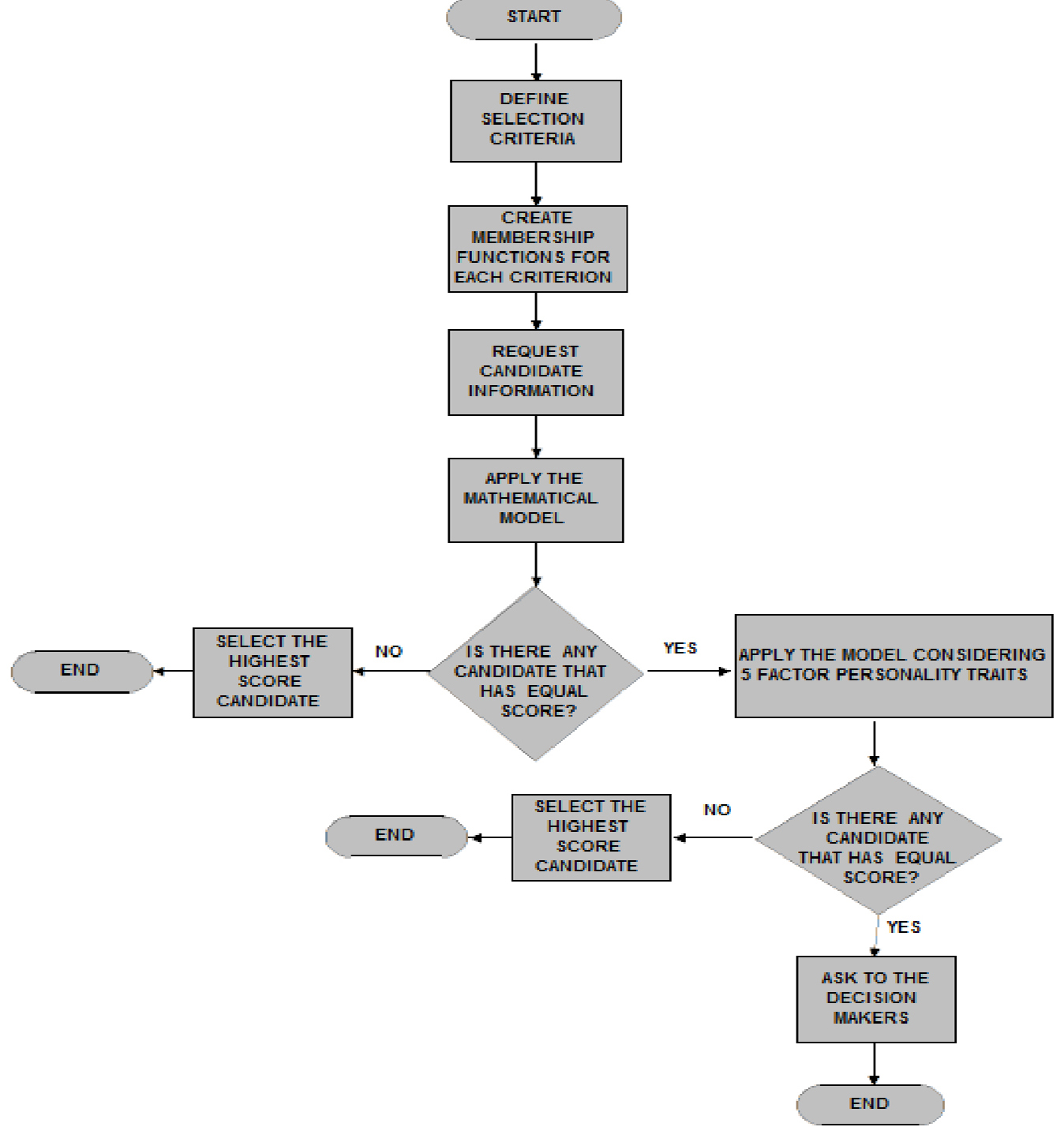
In this section, brief information are presented.
where
L-function is special case of a trapezoidal function.
Intersection: The membership function of the intersection of two fuzzy sets
Union: The membership function of the union is defined as:
Complement: The membership function of the complement is defined as:
where
The determined criteria considering the inventory studies and membership functions
The determined criteria considering the inventory studies and membership functions
In this section, a new fuzzy approach is presented for the personnel selection problem who will work in an organization. Unlike the methods widely used in the literature, the minimizing and maximazing method was considered because of providing us with a relatively precise selection point. The constructed fuzzy decision making approach is adapted to the MATLAB software and is presented in Appendix A.
Minimazing and maximazing method is presented below:
After we find the score of each candidate from this approach, the maximum score is selected as:
The flow-chart of the proposed approach is presented in Fig. 1.
Implementation of our proposed approach
The determined criteria of the Human Resources department and membership functions are described in Table 1.
The criteria have been determined in Table 2 by considering the inventory studies. This inventory was taken from a website
Request of organization: A small-scale organization wants to recruit a human resources manager who is 12 years experienced, 30 years old, Bachelor degree, 3800 USD salary expectancy, SQL knowledge, English speaking at a good level, Social, Sensitive, Kind, Self-Disciplined and Creative
Qualifications of candidates:
1st candidate: 3 years experience, 24 years old, Bachelor degree, 4000 USD salary expectancy, SAP knowledge, Good command of English, Energetic, Worried, Collaborative, Obedient and Dreamer. 2nd candidate: 16 years experience, 36 years old, Bachelor degree, 4500 USD salary expectancy, Gams program knowledge, Good command of English, Social, Sensitive, Kind, Self-Disciplined and Creative. 3rd candidate: 10 years experience, 34 years old, Doctorate degree, 4200 USD salary expectancy, Lingo program knowledge, Superior English, Energetic, Sensitive, Kind, Successful and Dreamer.
Using Matlab codes based on our approach, membership values are found of each candidate for each criterion and the scores are determined for each candidate. Since there are candidates that have equal score, considering the 5 factor personality traits (Extroversion, Neuroticism, Agreeableness, Conscientiousness, Openness to experience), the proposed approach is applied again. Finally, 2nd candidate is determined as the most appropriate personnel for the position.
Selecting the best personnel among many alternatives is a multi-criteria decision making (MCDM) problem. The necessity of dealing with uncertainty in real world problems has been a long-term research challenge. Traditional methods of multi-criteria assessment and ordering cannot effectively solve the problem of the group decision making under imprecise and linguistic information. Various decision making approaches have been proposed to solve the problem. When personnel selection that depends on the firm’s specific targets, and the availiability of the individual preferences of Decision Maker(s) (DM), are combined, there becomes a highly complex situation. It is not easy for the DM to select appropriate personnel who satisfy all the requirements among various criteria.
In this study, based on the determined criteria, a fuzzy decision-making approach is proposed for solving the personnel selection problem. Considering the criteria referring to the request of organization and the criteria that are satisfied by the candidates, our approach is presented. The approach is able to reflect the vagueness related with the candidates’ qualifications and decision maker(s)’ expectations. While criteria are increasing, the number of rules created at the rule base will be increase exponentially. Thus, using the Matlab fuzzy tool would not be efficient. Matlab software based on our proposed approach deals with this situation succesfully. To demonstrate the efficiency of our approach, an implementation is presented. Meanwhile, when the number of candidates increased and the parameters changed, our approach can be applied easily. Our model also allows to workers to evaluate themselves, and to draw career maps. Thus, suggested model also answers the requirements of organization by classifying its workers. Besides these, this approach can be applied to different selection problems such as machine selection, supplier selection and software selection.
Footnotes
Appendix A: Matlab Codes
function [y] = triangular_function(x,a,b,c) if x <= a y = 0; elseif x <= b y = (x-a)/(b-a); elseif x <= c y = (c-x)/(c-b); else y = 0; end
function [y] = Lshaped_function(x,a,b) if x <= a y = 0; elseif x <= b y = (x-a)/(b-a); else y = 1; end
function PARAMETERS = parameters(CR|ITER|ION) fprintf(’Selection of Parameters…..’); PARAMETERS = zeros(3,CR|ITER|ION); for k = 1: CR|ITER|ION if k == 1 fprintf(’Parameters of experience:’); elseif k==2 fprintf(’Parameters of age:’); elseif k==3 fprintf(’Parameters of education:’); elseif k==4 fprintf(’Parameters of salary expectancy (USD):’ ); elseif k==5 fprintf(’Parameters of computer skills:’); elseif k==6 fprintf(’Parameters of foreign language:’); elseif k==7 fprintf(’Parameters of extroversion:’); elseif k==8 fprintf(’Parameters of neuroticism:’); elseif k==9 fprintf(’Parameters of agreeableness:’); elseif k==10 fprintf(’Parameters of conscientiousness:’); elseif k==11 fprintf(’Parameters of openness to experience:’); end a_d = input(’Enter the 1st parameter value: ’, ’s’); PARAMETERS(1,k) = str2double(a_d); b_d = input(’Enter the 2nd parameter value: ’, ’s’); PARAMETERS(2,k) = str2double(b_d);
if k<=4 c_d = input(’Enter the 3rd parameter value: ’, ’s’); PARAMETERS(3,k) = str2double(c_d); end end function output = info(k, n, PARAMETERS) if n == 0 fprintf(’Requested from personnel , ’); else fprintf(’For end if k == 1 fprintf(’enter the value of experience’); elseif k==2 fprintf(’enter the value of age’); elseif k==3 fprintf(’enter the value of education’); elseif k==4 fprintf(’enter the value of salary expectancy (USD)’ ); elseif k==5 fprintf(’enter the value of computer skills’); elseif k==6 fprintf(’enter the value of foreign language’); elseif k==7 fprintf(’enter the value of extroversion’); elseif k==8 fprintf(’enter the value of neuroticism’); elseif k==9 fprintf(’enter the value of agreeableness’); elseif k==10 fprintf(’enter the value of conscientiousness’); elseif k==11 fprintf(’enter the value of openness to experience’); end x_d = input(’: ’, ’s’); x = str2double(x_d); if k<=4 output = triangular_function(x,PARAMETERS(1,k), PARAMETERS(2,k), PARAMETERS(3,k)); else output = Lshaped_function(x,PARAMETERS(1,k),PARAMETERS(2,k)); end function P = Calculate_P(P, intro_criterion, CR|ITER|ION, index, COM, PER) for n = index Pmin = max(COM(intro_criterion),PER(intro_criterion, n)); for k = intro_criterion +1: CR|ITER|ION temp = max(COM(k),PER(k, n)); if temp < Pmin Pmin = temp; end end P(n) = Pmin; fprintf(’Pend N_str = input(’Number of candidate personnel: ’, ’s’); N = str2double(N_str); CR|ITER|ION = 11; PER = zeros(CR|ITER|ION, N); COM = zeros(CR|ITER|ION,1); PARAMETERS = parameters (CR|ITER|ION);
for n = 1:N for k = 1: CR|ITER|ION PER(k, n) = info(k, n, PARAMETERS); end end for k = 1: CR|ITER|ION Pin = info(k, 0, PARAMETERS); COM(k)=1-Pin; end P = zeros(1,N); P = Calculate_P(P, 1, CR|ITER|ION, 1:N, COM, PER); P_max = max(P); binary_max_P = (P_max == P); max_index = find(binary_max_P); if length(max_index) == 1 fprintf(’Selected personnel = Pelse fprintf(’Selection is repeated among the biggest same scores …’) P = Calculate_P(P, 7, CR|ITER|ION, max_index, COM, PER); P_max_new = max(P(max_index)); binary_max_P_new = (P_max_new == P); max_index_new = find(binary_max_P_new); fprintf(’Last decision:’); for tt = 1:length(max_index) fprintf(’Pend fprintf(’numbers are equal scores ,so evaluation was repeated with new criteria.’); if length(max_index_new) == 1 fprintf(’Selected personnel = Pelse for tt = 1:length(max_index_new) fprintf(’Pend fprintf(’numbers are equal scores again , so ask to the decision makers.’); end end