



Abstract
Restaurants operate in a dynamic highly competitive business environment with slim profit margin, changing customers, and costs incurring from materials and labour. Despite a solid demand for restaurant meals, the restaurant industry has a high failure rate, especially within the first three years of commencement. As the most important marketing, sales, and operational tool, a menu list must be well designed and well planned for profitability and competitive advantage. Menu Analysis (MA) or Menu Engineering (ME) refer to the broad range of techniques and procedures applied for effective marketing and operational decisions on menus. Choice of dishes is the food and beverage manager or the decision maker’s (DM) challenge which is a critical strategy decision. Quantitative or precise measures required for accurate evaluation of the effectiveness of a menu item is difficult to obtain. This pioneer study presents a Menu Management Decision Support Model (MMDSM) that applies Fuzzy Multicriteria Decision Making (FMCDM) approach to deal with the inherent imprecision in input using qualitative linguistic input values and obtain reliable outputs with increased decision options. Improving the widely used ME model with two inputs, the MMDSM includes four input parameters of Profit Factor, Popularity, Contribution Margin, and Sales Price related to each Menu Item. The MMDSM is successfully tested with a case study having one hundred and sixty-one Menu Item details from a U.S. restaurant. The results are verified by conducting a sensitivity analysis and the model can be developed into a commercial application.
Keywords
Introduction
The restaurant industry remains an integral part of a nation’s tourism and plays a critical role in the social and cultural acts. The U.S. economy is an example with approximately 780 billion dollars in annual restaurant sales from more than one million restaurants [1]. Despite a solid demand for restaurant meals, it is a highly competitive business environment with a failure rate close to 60% in the first three years after opening [2]. To be competitive and sustainable, the food and beverage manager or the decision maker (DM) should evaluate the menu items on a continual basis to decide whether to retain, modify, or replace these items.
The terms Menu Analysis and Menu Engineering refer to the broad range of techniques and procedures applied for enabling effective marketing, sales, and operational decisions [3]. The first quantitative Menu Analysis Model (MAM) [4], a four quadrants matrix model derives four possible combinations: high popularity and high food cost percent, low popularity and low food cost percent, high popularity and low food cost percent, and low food cost percent and high popularity. This model is depicted in Fig. 1. The average food cost axis is defined as the line of division between high and low quadrants. Further development of a Menu Engineering Model (MEM) [5] incorporated contribution margin, defined as the difference between the sales price of an item and the cost of food product/s to produce that item. The Cost Margin Analysis Model (CMAM) [6] incorporated a weighted average contribution margin (gross profit), also called “profit factor,” and food cost.
Original four quadrant model.
Taylor and Brown [7] have conducted a critical review of all ME techniques and points out that one of the quantitative measures of popularity used in ME is incomplete as there are many elements that impact popularity which are difficult to quantify. Menu design, marketing efforts, customer satisfaction, dining ambience are examples. To accurately evaluate the effectiveness of a menu and individual menu items, it is essential to include influential elements which are too difficult to measure precisely using quantitative methods. The Activity Based Costing (ABC) for integrating costs with ME developed by Linassi, Alberton, and Marinho [8] still lacks a holistic approach to accurately incorporate all costs. To rectify the problems with the existing models, the authors strongly recommend a comprehensive menu analysis model that uses a qualitative menu analysis approach that could facilitate the DM to conduct a systematic assessment of menu items to identify the most efficient menu items.
This seminal research study attempts to fill this gap by developing a Menu Management Decision Support Model (MMDSM) which is a comprehensive model enabling qualitative menu analysis dealing with the inherent imprecision in the input parameters. The MMDSM automates the menu analysis process and provides the DM with appropriate decision strategy options for various combinations of input parameter values. This study is motivated by the needs of the DM after conducting reviews on the different menu analysis models developed as part of previous studies.
The rest of the article is organized as follows: Section 2 provides a literature review presenting the theoretical concepts behind fuzzy multi-criteria decision making (FMCDM) and an overview of applications related to this field. Section 3 establishes the necessary theoretical foundations, defining the input parameters and the model. Section 4 shows its application to a case study and the sensitivity analysis. Finally, Section 5 addresses the conclusions and future works.
Commencing with the applications in engineering, fuzzy multi-criteria decision making (FMCDM) is applied in management and business, science, and technology to support the subjective evaluation of performance criteria by decision makers (DMs). In real world situations, decision making can be uncertain due to incomplete information available as well as natural language words being used to articulate thinking. Often, this can lead to differences in the perception of boundaries of the set described by the same word by different people. Such problems are overcome by using linguistic variables in fuzzy systems with a well-defined range of values. Bellman and Zadeh [9] and Zimmermann [10] applied fuzzy sets to the MCDM field. According to Yager [11], the fuzzy set of a decision is the intersection of the whole fuzzy goals.
FMCDM can be categorized into the two main approaches of fuzzy multi-objective decision making (FMODM) and fuzzy multi-attribute decision-making (FMADM). The FMODM approach is generally applied to achieve the DM’s objectives, such as optimal resource utilization and quality improvement, and fuzzy weights can be assigned to reflect the relative importance of the objectives [12]. The FMADM approach is used where the DM’s decision making is dependent upon the selection criteria. To cater to the variety of decision problems, several solutions techniques have been proposed which can be mainly classified as: methods using complete aggregations, and those using partial aggregations. Examples of methods using complete aggregations include: VIKOR, TOPSIS, MAUA, and WASPAS. The ANP, AHP, PROMETHE, and ELECTRE are examples using partial aggregation which involve pair-wise comparisons of the alternatives.
The FMCDM tools and techniques have been widely used in the business and management field in the management areas of marketing, quality, economics, information, human resources, organizational performance, risk, knowledge, inventory, supplier selection, supply chain, and strategy issues. Erdem and Göçen [13] have developed an integrated decision support system (DSS) for the improvement of supplier evaluation and order allocation. The authors have used a two-stage process in which Analytic Hierarchy Process (AHP) is applied for supplier evaluation followed by use of goal programming (GP) for order allocation. A multi-criteria decision support model for evaluating the performance of an ongoing partnership in different periods is developed by [14]. The partnership is one of the strategy decisions, and this model can be used to obtain a partnership performance index, which captures partnership drivers and performance measures. The authors have applied interpretive structural modeling (ISM), AHP, and fuzzy logic (FL) to address the interdependency, importance of, and the uncertainty in performance measures. Customer repurchase rate for a full-service restaurant is a critical aspect for restaurateurs, and Chen [15] has developed a model using fuzzy cognitive map (FCM) and structural equation model (SEM) that develops the customer repurchase rate. The decision support system proposed by [16] is a revised model of the inventory allocation decision support model proposed by Xie and Petrovic [17] and considers the inventory shortage, ordering and transportation costs. An efficient inventory management and control is essential to all companies dealing with inventory. Gilan, Sebt, and Shahhosseini [18] have applied the computing with words (CWW) approach and the Linguistic Weighted Average (LWA) for competency-based selection of human resources in construction firms. Zadeh [19, 20] proposed CWW where the premises are assumed to be expressed as propositions in natural language and the fuzzy inference rules are applied to “propagate the constraints from premises to conclusions.”
Fuzzy logic and other intelligent techniques have been applied in the restaurant industry. These include: fuzzy-rule based classification to understand brand categorization of quick service restaurants [21], integration of Importance-Performance and Gap Analysis (IPGA), and decision making trial and evaluation laboratory (DEMATEL) to explore the service quality improvement priority of fine-dining restaurants [22]. A decision support model, applying fuzzy sets and fuzzy similarity measures, is developed for tourists to choose restaurants [23]. Another example is the application of fuzzy set qualitative comparative analysis (fsQCA) to understand customer satisfaction and stickiness for a chain restaurant [24].
Research method
The readability and clarity of this study are improved by defining several terms. Section 3.1 presents the basic definitions and explanations of terms used in this Section and later Sections. The Menu Management Decision Support Model (MMDSM) is presented in Section 3.2 This Section also provides a brief introduction of fuzzy set theory applied in this study with membership functions. The implementation of the model is detailed in Section 3.3 with logical steps, application of fuzzy sets, and examples of intermediate and final results.
Basic definitions
The MMDSM model is developed using the four criteria of: C
The Profit Factor is indicative of how a Menu Item performs among the rest of the Menu Items within the same category, whereas the Popularity Index shows the sales performance of a Menu Item among all the displayed list of Menu Items. As per [6], Profit Factor is indicative of the combined effect of Contribution Margin and Popularity. The Contribution Margin and Popularity Index are computed by the software included in the Electronic Point of Sale Terminal (EPOST). In the original four quadrant model, shown in Fig. 1, a Menu Item gets placed in one of the four quadrants, limiting the DM’s choice to one of the four options.
Menu management decision support model (MMDSM)
The MMDSM proposed in this study extends the original four quadrant model with two more inputs, thus providing potential to include another twelve strategy options.
Fuzzy set theory
Fuzzy set theory is an extension to the set theory, that introduced a new concept for modelling using natural language terms and assigning a degree of membership taking values from the set [0, 1] as opposed to the crisp logic of ‘true’ or ‘false’ [26]. A membership function defines the grade to which a variable
The fuzzy set
where
Triangular Fuzzy membership functions are very commonly used due to its simplicity and ease of computing. The triangular fuzzy number (TFN),
Triangular fuzzy membership function.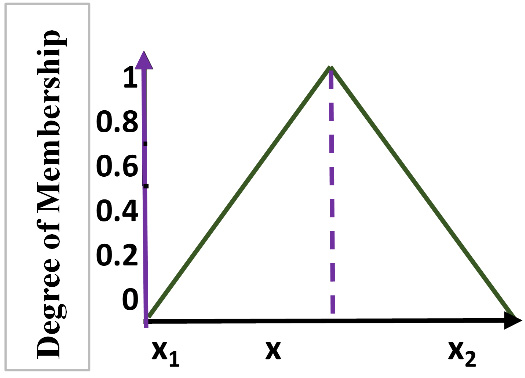
Just as numerical variables take numerical values, in fuzzy logic, linguistic variables take on linguistic values which are words such as ‘high’, ‘low’ with associated degrees of membership in the set [27]. The linguistic variables can be represented using triangular fuzzy numbers (TFN).
Fuzzy set operations
or operator: union of fuzzy sets [28]. The union of two fuzzy sets
and operator: intersection of fuzzy sets. The intersection of two fuzzy sets
Fuzzy rules
Fuzzy rules can be used to produce an aggregate result evaluating a number of conditions with different outcomes, like the traditional if-then rules in expert systems. Mamdani-type [29] fuzzy rule takes the form:
Structure of menu management decision support model.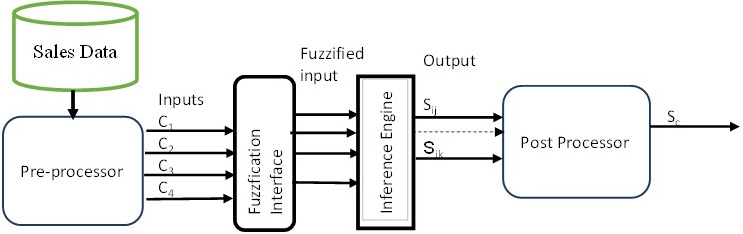
If
The structure of the MMDSM model consists of:
a pre-processor that takes sales data from the database and computes the four inputs. a fuzzification interface. an inference engine that relates the fuzzified input and the rules to produce decision alternatives. a post processor that produces one output which is the suggested decision alternative.
The model structure is illustrated in Fig. 3. The four input parameters used are the four criteria of Popularity Index C
Variables used in the model
The variables used in the model are listed below.
j: the number of strategies the DM can choose in decision making.
The criteria values C
Popularity index
Contribution Margin
Sales Price
Profit Factor
The criteria values for menu items,
Pseudocode for the MMDSM implemented in Java
Algorithmic steps to compute the strategy decision outcomes.
The outputs are derived from the data set using the Fuzzy Inference System (FIS) and applying the Fuzzy Rules. Fuzzy rules execute in parallel, and the same input values may cause more than one rule to execute, and these results are fuzzified values. The final strategy decision is the strategy with the maximum strength obtained by using the fuzzy or operator or
IF C
IF C
Execution of the and operator produces one fuzzified output in the range 0–1 indicating the strength of the corresponding strategy. As multiple rules execute in parallel producing a set of strategy values
The model is verified by using actual data obtained from a U.S. restaurant and implementing the logical steps given in Table 1 using a Java program.
The membership functions are chosen after analysing the input data and in consultation with the DM. The linguistic values used are ‘low’ for below average and ‘high’ for above average values. Average performance of a menu item is not critical requiring decisions. This study has used the left_triangle and right_triangle fuzzy membership functions. For example, the Popularity index
The actual data from a U.S. restaurant used in this study include the selling price of each Menu Item, food cost, and number of items sold. Using these values, the Contribution Margin in dollars, Popularity Index, and Profit Factor are calculated using Eqs (4)–(7). An example set of values calculated are given in Table 2. The average values are calculated across all Menu Items, and these are used for the division between ‘high’ (above average) and ‘low’ (below average).
Sample menu items with criteria values
Sample menu items with criteria values
The criteria values calculated for a set of Menu Item.
The inputs corresponding to each Menu Item are represented by a set of membership values obtained by using the membership functions (MFs) shown in Fig. 4. There are overlapping areas in the fuzzy membership functions resulting in more than one fuzzified value which can be represented by
Sample menu items with fuzzified criteria values
Membership functions of popularity index, sales price, contribution margin, and profit factor.
Sample of strategy selection rules
Strategy decision outcome based on the membership values of the four criteria. Each criterion can have a membership value indicated by linguistic variable low (L) or High (H).
Each of the four criteria has two membership functions which generate 16 rules. Six of these rules are shown in Table 4. There are five alternative approaches used for marketing strategy, and these include: promotion, repositioning, retention, elimination, and reprice. A particular Menu Item may be modified following one of the approaches of: presentation, repricing, review costing, and changing recipe to reduce costs. The promotion strategies may include modification of dish presentation, modification of Menu Item displayed in the list by changing its name, description, or by including nutrition information for healthy items.
The recommended strategy decision is derived by combining the different strategy options with varying strengths using the Eq. (9). Table 5 lists the recommended strategy option with strength and rule number for a set of Menu Items.
Sample menu items with decision rules and output
Shows the linguistic values corresponding to the criteria values, outcome, and the strength of the final outcome (0–1) and the rule number executed.
The MMDSM is evaluated following the Mamdani and Assilian [29] fuzzy inferencing system steps given in Section 3.2.
Relation between input parameters for the data set.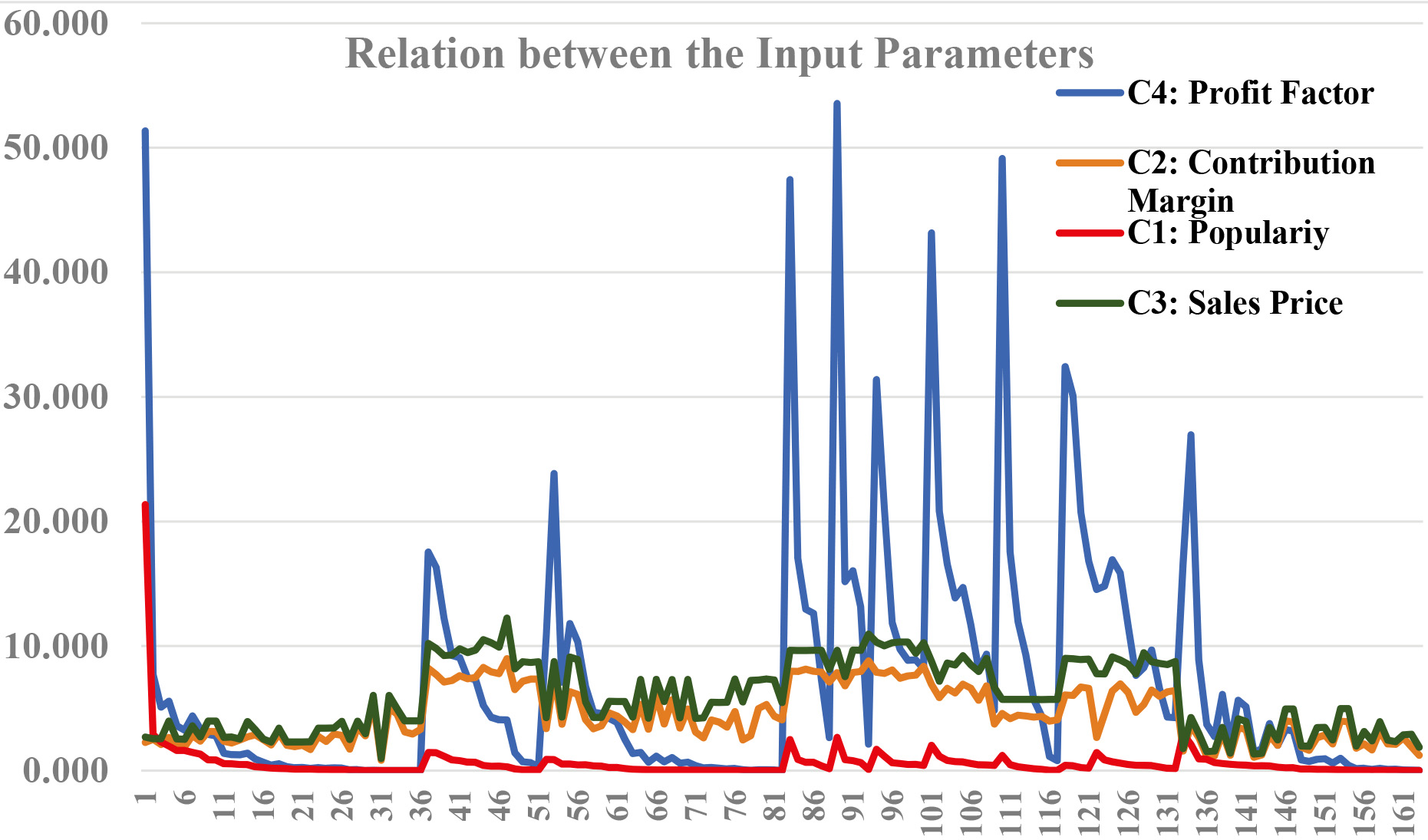
Recommended decision against the input C4: Profit factor.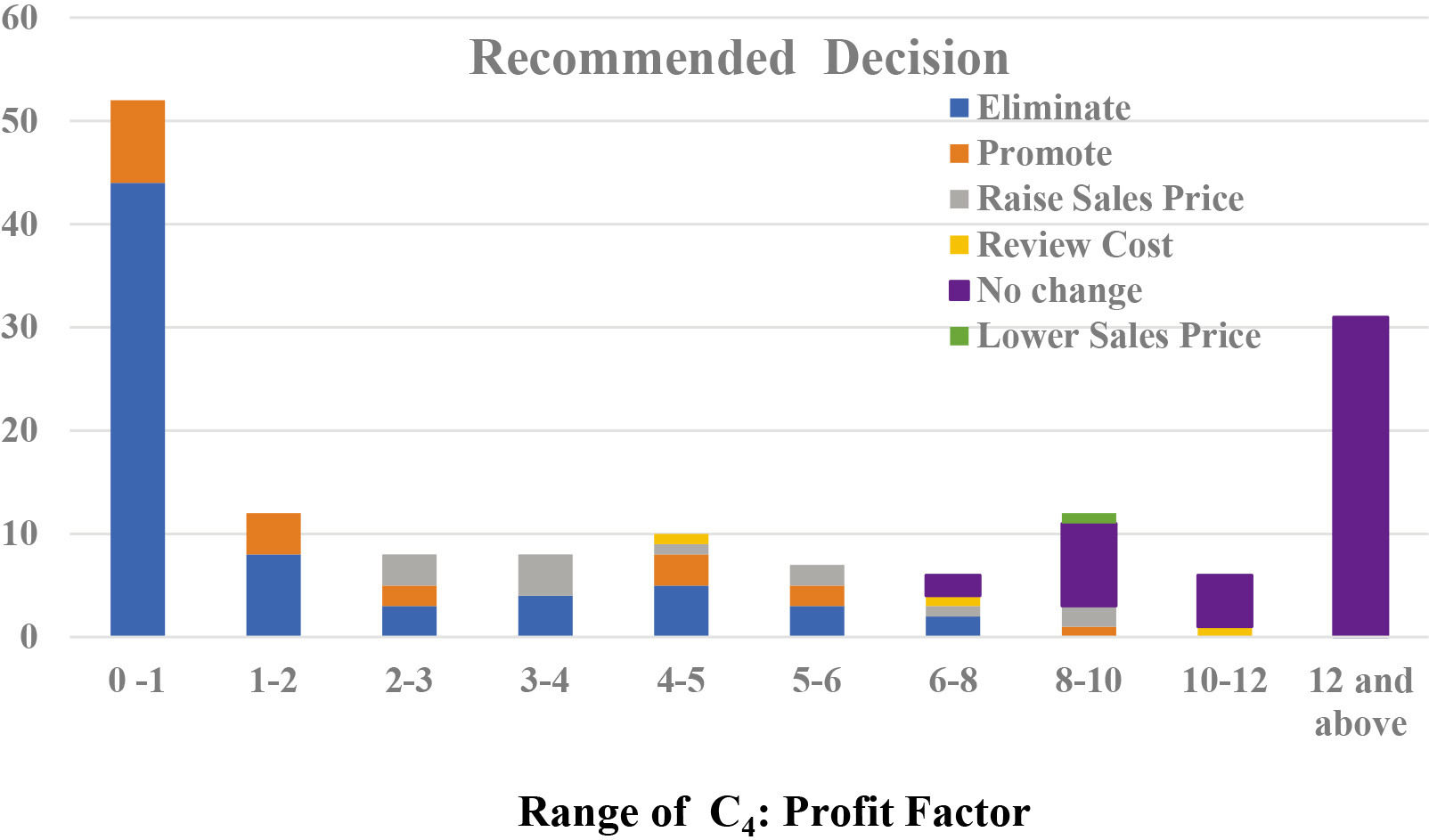
The graph illustrated in Fig. 5 shows the variations of the input parameters and the relation between them for the one hundred and sixty-one (161) Menu Items used. It can be observed from the graph that the C
Figure 6 illustrates the recommended decision, which is the outcome obtained from the experimentation for the one hundred and sixty-one (161) Menu Items. The outcome is plotted against the Profit Factor as this element reflects the combined effect of Popularity and Contribution Margin. Menu Items having very low Profit Factor, below one, the majority (44 Menu Items) have the recommended decisions to eliminate which can be easily arrived. On the other eight of the Menu Items having Profit Factor, below one, are recommended to be promoted which could have been a difficult decision to arrive. There are various recommendations such as ‘promote’, ‘raise sales price,’ and review cost for the Menu Items having middle to higher range (4–10) Profit Factor. The Menu Items with a high Profit Factor above the range of twelve are recommended to retain with no change. The Menu Items having Profit Factor in the middle range are difficult to come to a conclusive decision requiring more comprehensive analysis techniques and tool support for decision making.
Table 5 provides a list of Menu Items with linguistic values for the criteria, the strength of the final decision outcome, and rule number which executed. Even though different rules execute in parallel, the firing strength can be different. These results show that the FMCDM method developed as part of this study can be successfully used to produce reliable recommendations for a DM to make strategic decisions based on automated menu analysis.
It is possible to modify the weight given to each of the inputs in order to increase its priority or influence on the output composition. It is also possible to form different number of menu groups and conduct an analysis for each group, especially for groups with a large number of items. However, equal weights have been considered for each of the inputs in this study. As this is the pioneer study on the application of FMCDM for menu management, further enhancement can be included after observing the effectiveness and requirement for further refinement in consultation with the DM.
This study has successfully developed a Menu Management Decision Support Model (MMDSM) that uses Fuzzy Multi-criteria Decision Making (FMCDM). The model developed has used the four input parameters of Popularity Index, Contribution Margin, Sales Price, and Profit Factor. The model is evaluated with actual data from a US restaurant containing one hundred and sixty-one Menu Items. The sensitivity analysis conducted reveals that the recommendations produced for the Menu Items by the MMDSM is reliable.
This seminal research has explored the opportunity for application of intelligent techniques to facilitate automation of menu management decision making with the support of an expert system. This study has also demonstrated the possibility of a comprehensive model that can accommodate inherent imprecision in input and facilitate intuitive linguistic terms for setting decision rules. The restaurant industry is very dynamic in its operation and requires managers to conduct ongoing menu analysis and make critical strategic decisions.
Further work can be done on prioritising different inputs by adding weights and grouping Menu Items and conducting group wise analysis. The model can also be extended to include other critical decision variables such as labour cost that remains a major bottle neck due to the imprecision.
The model developed here can have the potential to be developed into a cloud-based system that can be conveniently used by large chain restaurants.