



Abstract
The Fuzzy-Weighted Zero-Inconsistency (FWZIC) and Fuzzy-Decision-by-Opinion-Score-Method (FDOSM) are considered the recent advance methods. FDOSM generates a ranking for possible alternatives, while FWZIC produces a weight for criterion. Keeping up with the stream of academic publications on the FDOSM and FWZIC methods is complicated. This study aims to provide a comprehensive review of the literature on the latest advanced methods of MCDM in order to reorganize the findings of the previous literature and provide decisive evidence for ongoing research and future studies. Based on previous literature, the current study used the Prisma method to collect data from multiple databases such as IEEE Xplore®, ScienceDirect, and Web of Science. There were 45 papers discovered relevant to this subject; however, only 23 studies were relevant for the FDOSM & FWZIC study. The results included theoretical and practical implications. Theoretically, additions of new aggregation operators or usage of new fuzzy sets in the FDOSM & FWZIC model to solve the uncertainty problem are the key obstacles. Practically, agriculture and architectural fields are considered to be a hotspot of research. Finally, a number of potential points for future research to develop methods with high certainty and low ambiguity are presented.
Introduction
Finding the optimal decision from a set of alternatives according to various criteria is a challenge that multi-criteria decision-making (MCDM) methods attempt to tackle [1, 2]. MCDM is also an exciting topic in expert systems and operation research because of the intersections between choice options and criteria. The purpose of MCDM is to choose the most appropriate alternative among a set of alternatives using the specified criteria [3, 4]. Many issues in engineering, business, management, and even society can be addressed using MCDM methods [5–8]. Many additional sectors may benefit from the use of MCDM, including the medical and health sciences, sports science, computer networking, and communication [9–13]. MCDM methods can be divided into two categories: Firstly, weighting methods, such as the analytic hierarchy process (AHP), best-worst method (BWM), and FWZIC. Secondly, the ranking approach, such as the technique for order of preference by similarity to ideal solution (TOPSIS), VlseKriterijumska Optimizacija I Kompromisno Resenje (VIKOR), and FDOSM.
Because of the limitations of many MCDM methods at the level of consistency, comparisons, uncertainty and ambiguity, the literature has developed several methods, such as FDOSM and FWZIC. FDOSM is a widely-used technique among the MCDM methods [10]. Its core concept is to identify the best solution by employing the ideal solution concept and the opinion matrix to address actual issues in MCDM (i.e., time consumption, inconsistency, and un-understandable comparisons). Since FDOSM is based on expert judgment, it always makes responsible decisions [14]. The procedure of FDOSM developed a mathematical framework to tackle MCDM issues with a single decision-making scenario and a group decision-making scenario. As shown in Fig. 1. FDOSM was divided into three stages, notably: input data, transformation data, and processing data.
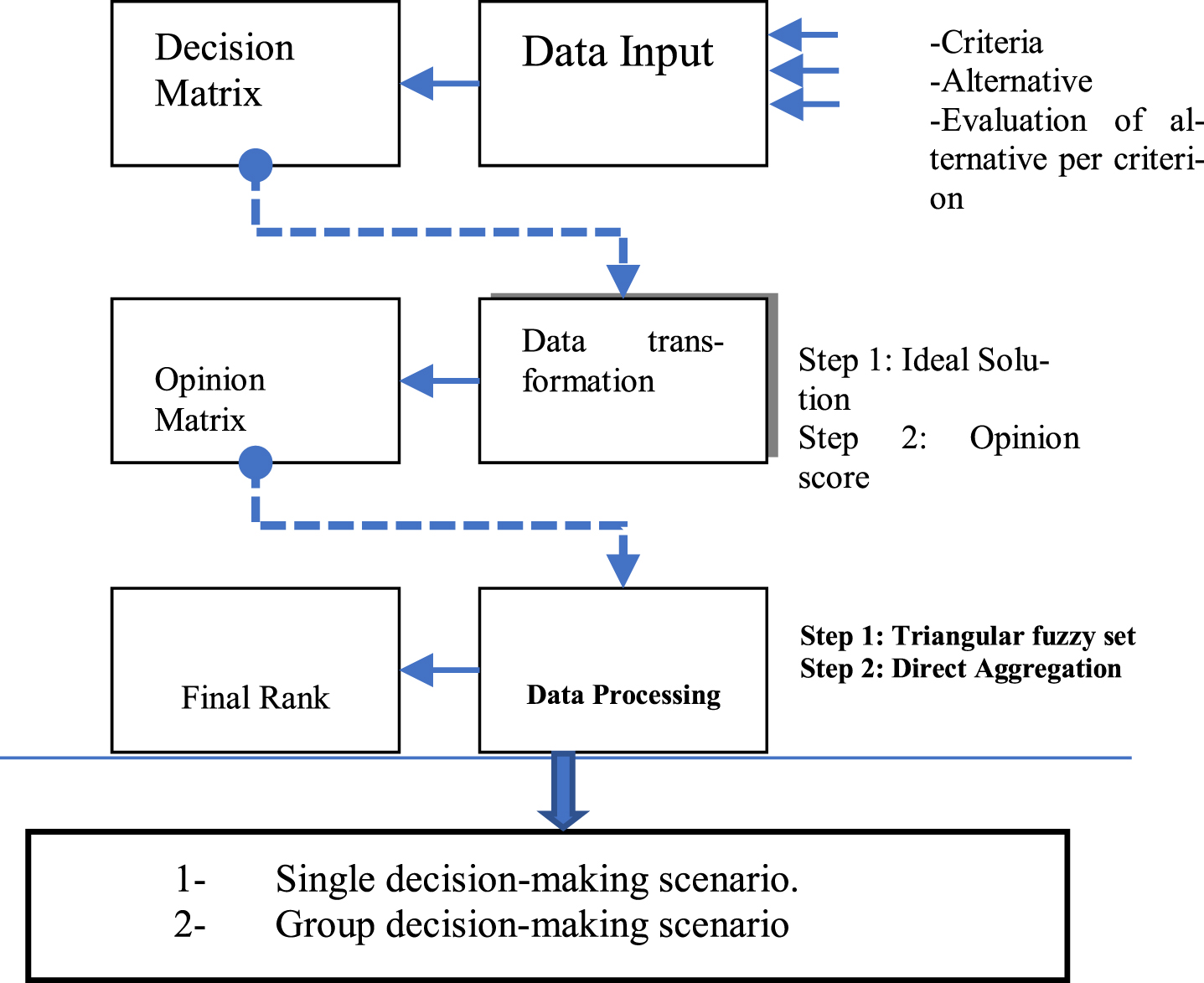
FDOSM methodology [10].
On the other hand, FWZIC was introduced by [15] that used to identify the essential criteria weights without any inconsistency. In order to obtain zero inconsistency, this technique calculates and establishes the local and global weights of each main criterion and sub-criterion. The methodology of FWZIC depends on five steps: (1) determining and discovering the set of assessment criteria; (2) applying structured expert judgment (SEJ); (3) establishing an expert decision matrix (EDM) relying on the cross of criteria and SEJ; (4) implementing a fuzzy member function to the EDM’s outcome; and (5) Calculate the final weight for each criterion. Figure 2 shows the FWZIC’s methodology.
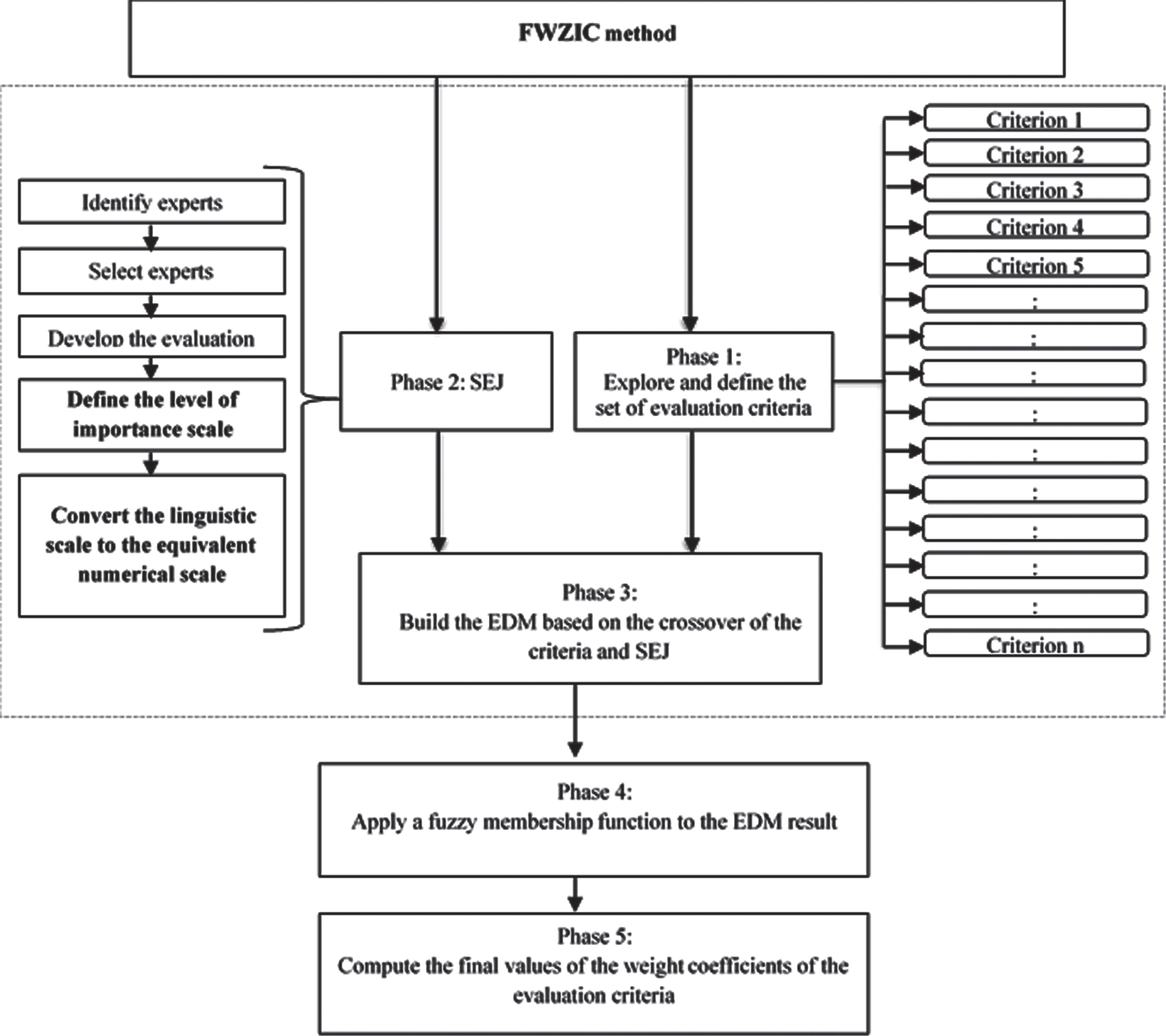
FWZIC steps [15].
There are several MCDM methods that contribute to conducting benchmarking, prioritizing, and classifying alternatives. However, most methods suffer from a problem of consistency and uncertainty. Previous literature has addressed such constraints by suggesting two approaches, FWZIC and FDOSM. The FWZIC method captures the weights of the criteria, and the FDOSM method categorizes and ranks the alternatives. Therefore, FWZIC and FDOSM methods are considered advanced in accurate decision-making. Academics and practitioners are beginning to take advantage of these approaches to address decision-making problems. The literature has investigated different case studies using such methods. However, the use of these methods in the literature was little because of their recent emergence. The impetus for undertaking a systematic review of the FWZIC and FDOSM is to synthesize and critically evaluate the available evidence on the effectiveness and applicability of these two methods in the context of ambiguous decision-making. In addition, identify the strengths and weaknesses of these approaches, their potential applications, and the contexts in which they are most effective. This information could be valuable to researchers and practitioners interested in using fuzzy decision-making methods in their work. In this context, reorganizing the results of the previous literature and conducting a comprehensive analysis of the literature in this field contributes to providing decisive and highly reliable evidence for decision-makers about the usefulness of adopting these methods.
The number of academic publications in terms of FDOSM and FWZIC is increasing, and keeping pace with academic work in such a field becomes futile. In this context, the contributions of operation research scholars have led to huge streams of MCDM methods research. Such a challenge hinders effective information gathering from earlier research [16]. As a result, a comprehensive mapping analysis is needed [17]. However, the use of other methods of review, such as bibliometric, is not feasible due to problems in the objectivity and reliability of the results. The main problem and concern of such a method is that the bibliometric tool depends on a single database such as Scopus or Web of Science. In addition, R-tool uses many studies which may not be specialized. The systematic analysis assumes a critical role in compiling and summarizing the results of previous research on the basis of current knowledge and providing insight according to professional experience and judgment. Hence, academics adopt various tools that use the existing knowledge base to capture and reorganize findings from the previous literature [16]. Among these, the systematic literature review can offer a repeatable and transparent review backed by scientific activity and the statistical measurement of knowledge [18, 19]. This study complements the previous literature by suggesting an integrated conceptual framework that includes cognitive and social psychology and organizational and environmental contingencies based on a systematic literature review.
To the best of our knowledge, there is a rare review that dealt with FDOSM and FWZIC methods. Mainly in the existing overview, we explain FDOSM and FWZIC methods not only regarding Group Decision-Making, Fuzzy environments but also usage in various sectors, comprehensive analysis, and future direction, and describe significant challenges. In addition, this study reveals which authors, institutions, and nations have contributed the most to the development of our knowledge of FDOSM and FWZIC. In this respect, the contributions of this work can be given by: Firstly, adopting the SLR approach to provide an overview of the current information and evidence regarding our mission and assessment and comparison approach and highlight trends for research work on this topic. Secondly, this study also will contribute to filling the research gap in this research field. Thirdly, the proposed classification of the relevant literature in this study could bring many benefits as well. Fourthly, this study identifies potential directions for research in this area, can disclose research gaps, and map the academic papers on automated methods for evaluating tools supporting agriculture in all its fields. In addition, this research is to map out the future directions for FDOSM and FWZIC research and to locate the relevant connections in the current scholarly literature. Furthermore, explain how these approaches help scholars and decision-makers in every field of study confront the global problem. Finally, we introduce the implementations of FDOSM and FWZIC in the fields of sport, sign language, communication services, transportation, health management, and other areas.
There are two separate strategies used in MCDM, the mathematical and the human. The first of them is the use of formulas, specifically the Technique for Order of Preference by Similarity to Ideal Solution technique (TOPSIS) [20, 21]. Whereas the second kind of technique, the Analytic Hierarchy Process (AHP) approach [20], takes into account human preferences in its calculations. Different problems were encountered by the various methods, such as those related to mathematics (normalization [22] and distance measurement [23]). The human technique, on the other hand, has one major drawback (namely, an inconsistent ratio) [24, 25]. Another difficulty faced by the MCDM techniques (i.e., the mathematical and human approaches) was ambiguity and imprecision in the data. Therefore, a comprehensive solution is required to address the aforementioned problems. By combining the concepts of an ideal solution and an opinion matrix, the unique MCDM approach known as the FDOSM is capable of performing well in a fuzzy environment. FDOSM &FWZIC offer reasonable decisions since it relies on the perception of the expert. FDOSM & FWZIC can solve inconsistency, which is the primary issue in the human approach, and reduce the processing time when making comparisons. Also, the number of equations in FDOSM &FWZIC models is reduced. Therefore, these methods provide the information and produce a reasonable decision. Furthermore, in the mathematical approach, the normalisation issues are solved. The ambiguity in the information could also be overcome by utilising fuzzy values. On the one hand, TOPSIS is a common MCDM approach that has been used for many different purposes. It’s also a widely respected MCDM technique. While ambiguity affects TOPSIS in its original form, leading to its extension with the fuzzy triangular set named fuzzy TOPSIS [26]. Compared to fuzzy TOPSIS, FDOSM fared better on 1- Missing data. 2- Immeasurable criteria. 3- Normalisation (the process of unifying data from various scales and types in the decision matrix). 4- The ideal solution (best value under the same criterion). 5- Data that is ambiguous or unclear (fuzziness). As can be seen in Table 1, FDOSM was proven to be more robust than TOPSIS.
Comparison with Fuzzy TOPSIS
Comparison with Fuzzy TOPSIS
While Fuzzy TOPSIS only handled the vagueness and ambiguous information with (n = 1/5), FDOSM was able to solve all of the previously described difficulties (n = 5/5).
To put it another way, traditional BWM is a popular MCDM approach [27]. However, the original versions suffer from several issues, such as ambiguity and uncertainty. The fuzzy number was integrated into this strategy to remedy the latter problem [28]. Despite fuzzy-BWM’s extension to identify ambiguity, it continues to have its shortcomings, especially in comparison to FWZIC. These include the number of comparisons (how many comparisons are to be operated), the nature of comparisons (difficulty comparing two or more items of a different character, such as voice and taste), the weighted task, the inconsistency issue (when an expert provides inconsistent comparisons when determining the weight of a given item), and the weighting process. Table 2 shows the comparison.
Comparison between FWZIC and fuzzy BWM
Therefore, FWZIC is more robust than fuzzy BWM in evaluating and benchmarking criteria weights.
To reach our research goal, we conducted a systematic search. As mentioned previously, the conceptual developments and overwhelming volume of new information in MCDM necessitate adopting a systematic search. Unlike other techniques, a systematic search supports the analysis of a vast body of knowledge, identifying shifts within disciplines, inferring recent trends over time, providing a big picture of MCDM methods, and exploring beneficial outcomes for academics and practitioners [16, 29]. In order to comply with the procedures of systematic reviews, this study followed the PRISMA method. The PRISMA method recommended relying on multiple databases. Several previous works of literature reported the use and adoption of such a method. Therefore, this systematic review follows a procedure used in other papers [30, 31]. Web of Science (WOS), ScienceDirect, and the IEEE Xplore digital library were subscribed to in order to conduct the systematicreview.
In order to find the desired publications, researchers looked through three online resources. (1) IEEE Xplore is the largest and most trustworthy academic database for papers in the disciplines of computer science, electronic technology, and engineering. (2) Web of Science (WoS) indexes interdisciplinary studies throughout the natural and social sciences, computer science, and other fields of study. (3) ScienceDirect is a huge resource for natural sciences and medical fields. These three sources give a comprehensive overview of the research done on the FDOSM AND FWZIC and their applications in a wide variety ofdisciplines.
Study selection
The study selection procedure included an intensive search of relevant publications, which depended on two iterations. Firstly, the titles and abstracts of the papers were scanned to exclude unrelated and duplicated papers. Secondly, after carefully reading the full text of the screened papers (from the first iteration step), the papers were filtered. After that, 3 experts in the field of MCDM were used to check the screening steps.
Search
Colleague experts in the field of MCDM were used to identify potential keywords associated with FDOSM and FWZIC. In addition, according to the keywords identified in the previous studies in the field of MCDM, the most common keywords (FDOSM & FWZIC) were determined. Hence, other researchers reviewed the whole procedure. Consequently, the following search terms were used in November 2022. We employed this query (“Fuzzy decision by opinion score method” OR “FDOSM” OR “fuzzy weighted zero inconsistency” OR “FWZIC”) as shown in Fig. 1 to obtain the relevant articles. In addition, the authors used the technique in each dataset, excluding textbooks and reports while including journal and conference articles.
Eligibility criteria
Each paper that fulfilled the requirements mentioned in Fig. 3 has been included. Our first goal was to classify studies of FDOSM and FWZIC into broad, overarching categories. After duplicates were removed, the remaining articles underwent two rounds of screening and filtering to see whether they met the necessary requirements for inclusion. The following are the grounds for disqualification: 1- The articles are written in languages other than English. 2- Any articles that don’t include FDOSM and FWZIC as main methods.
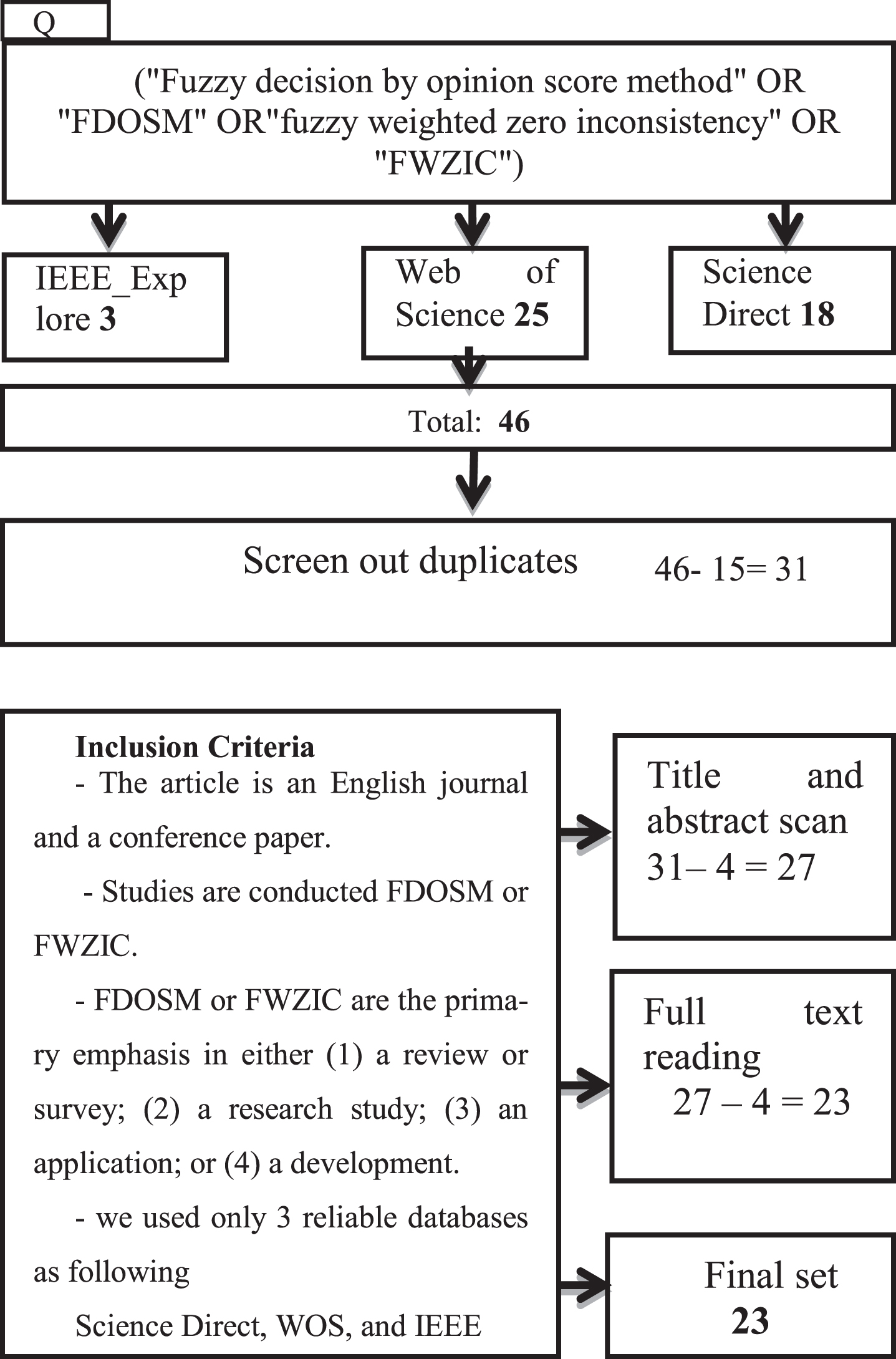
Search Query.
All of the articles that were selected from the different sources and assigned to their primary categories were put into an EXCEL® file for easy reference. Four authors performed full-text readings of articles and pointed out a large set of important highlights and comments on the reviewed efforts and in a running classification of articles in a refined taxonomy. All highlights and comments were put in the body of the texts. The important findings were summarised, tabulated, and described. Word and Excel documents were used to save several of the related information, involving the surveyed article list, source indexes, summary, and description tables, purposes, review sources, used datasets, number of experts, validation techniques, and different related figures. These data were provided in the supplemental materials as a complete reference for the results.
Findings and summary statistics of publications
Over 3 years, from 2020 to 2022, the first query results reached 46 articles: 18 from Science-Direct, 3 from IEEE Xplore, and 25 from WOS. There were 15 instances of duplicate content while searching the various databases. By first reviewing the titles and abstracts, we were able to narrow the number of papers down to 31 from the initial. Full-text reading led to the elimination of 27 papers, leaving the remaining 23 to be the final selection. These publications were reviewed extensively in order to lay up a plan for future study in this developing field. The taxonomy demonstrated in Fig. 4 was employed to evaluate the main streams of research relying on FDOSM and FWZIC and their general application in various fields. This taxonomy exemplifies the extensive growth of several fields of research and practical use. The categorisation involves several categories and subcategories. The first category included health care, the second category was signing language, the third category was communication, followed by sustainability, and tourism and the last category was others.
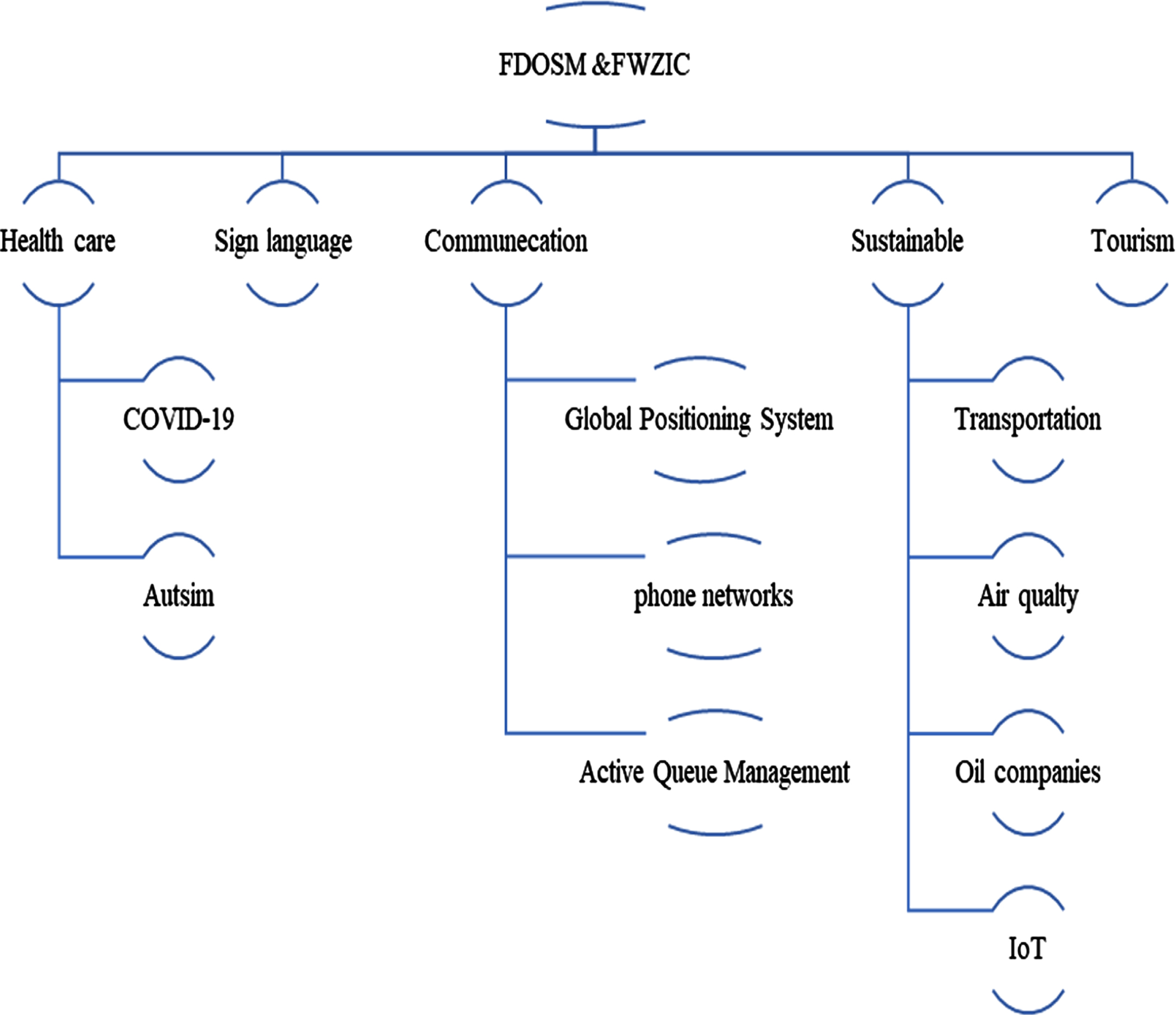
The taxonomy.
This section shows the implementation of FDOSM & FWZIC with COVID-19 and autism. This category discussed two vital subcategories: distribution of COVID-19 vaccination doses, prioritisation of patients and mesenchymal stem cells.
Firstly, the global community has been hit hard by the coronavirus disease 2019 (COVID-19) pandemic during the last three years, making the requirement for vaccination all the more urgent [32]. The World Health Organization recommends equitable distribution of the COVID-19 vaccination so that people who want it can access it [33]. However, the COVID-19 vaccine distribution is an MCDM problem due to the following issues: the need to include several criteria for distribution, the significant differences across the criteria, and the rise in problem complexity due to data fluctuation among the provided criteria. An MCDM-based strategy is required to resolve this complex challenge. A.S. Albahri et al. in 2022 [34] tried to solve the problems mentioned above using q-rung orthopair fuzzy environment with FDOSM and FWZIC. After developing the q-ROFWZIC approach for weighing assessment criteria, the second step was to include it in the q-ROFDOSM to rank potential solutions according to how much each criterion mattered. In addition, the case study contained 300 alternatives and five criteria. The criterion that was used to evaluate patients to receive the vaccine is membership of patients (C1), chronic illness (C2), age (C3), location severity (C4), and disability (C5). The allocation criteria are consistently weighted based on the opinions of the three experts. The weight outcomes of the five criteria are generated based on the q values (i.e., q = 1, 3, 5, 7, 10) employed in q-ROFS. Age (C3) obtained the first essential criterion for all q-ROFWZIC values of 1, 3, 5, 7, and 10, while location severity (C4) received the fifth essential criterion. In order to get the final rank, q-ROFDOSM provided the best alternative, P281 was the first, and the second one was P221 for all q values. In these cases, 290 out of 300 alternatives (96.67%) got different arrangement ranks at all these T values, while only 10 alternatives (3.33%) did not change. Finally, two evaluation procedures were used. (1) Systematic ranking,(2) Sensitivity analysis. Secondly, M.A. Alsalem et al. In 2021 [35] used the same decision matrix to distribute the COVID-19 vaccine with a new fuzzy set named T-spherical fuzzy sets. Given these drawbacks of fuzzy sets, the idea of T-spherical fuzzy sets (T-SFSs) was created. More information can be captured with the T-SFSs structure because there are no limits on the constants used to define them, and this structure can also deal with data uncertainty [36]. Membership, non-membership, and hesitation degrees in the T-SFSs may each be assigned any value in the range [0,1]. Degrees of membership, non-membership, and reluctance in this situation should not add up to more than 1. Which value of T is selected is up to the decision-makers. Furthermore, the T-SFSs structure may exactly characterise the choice knowledge by a value that can dynamically modify the scope of information expression and convey the expert’s decision-making awareness as a whole [35]. The criteria were weighted based on the opinions of the three experts. The weight outcomes of the five criteria are generated based on the T values (i.e., q = 1, 3, 5, 7, 10) employed in q-ROFS. Age (C3) obtained the first essential criterion for all T-SFWZIC values of 1, 3, 5, 7, and 10, while location severity (C4) received the fifth essential criterion. T-SFDOSM provided the best alternative, P281 was the first, and the second one was P221 for all T values, according to all 3 experts. Finally, two evaluation procedures were used. (1) Systematic ranking,(2) Sensitivity analysis. Thirdly, O.S. Albahri et al. In 2022 [37], to distribute the COVID-19 vaccine, a new type of fuzzy was used and combined with the weighting and ranking method. By combining a modified version of the PFWZIC and PFDOSM approaches, their study introduced a unique homogeneous Pythagorean fuzzy framework for allocating the dosage of COVID-19 vaccination. The authors found that (1) PFWZIC’s criteria for distributing vaccines were successfully weighted. (2) The final distribution outcome considered prioritising the PFDOSM-based group. Third, a systematic ranking was applied to the order in which vaccination recipients were prioritised; this ranking is backed by strong correlation findings across nine scenarios with varying criterion weights values.In addition, the results could assist accelerate vaccine throughout the globe and ensure that everyone has the same level of protection against COVID-19. Finally the authors used 3 expert for each method [37].
Despite the scarcity of mesenchymal stem cells (MSCs), their transfusion has been proven to be effective in treating patients with COVID-19. Prioritizing COVID-19 patients in need of MSC transfusion according to several criteria is a multi-attribute decision-analysis (MADA) challenge. One of the most advanced fuzzy sets for dealing with uncertainty is the Fermatean fuzzy set. This work has sparked new ideas for developing FWZIC and FDOSM in a homogenous Fermatean fuzzy set. A new type of FWZIC, called Fermatean FWZIC (F-FWZIC), was developed to weigh the significance of the criterion. A novel type of FDOSM called Fermatean FDOSM (F-FDOSM) was developed to prioritise MSC administration to COVID-19-positive patients [38]. The patients were divided into three cases: moderate, severe, and critical. The patients were divided into three cases: moderate, severe, and critical. By using F-FWZIC in the moderate range, pneumonia symptoms (PS) were assigned the highest weight (0.445) and fatigue (FA) the lowest (0.116). The oxygen partial pressure ratio to inspired oxygen fraction (PaO2/FiO2) was greatest in the severe category (0.409). Meanwhile, MV was given the smallest weight (0.299). In critical care, admission and monitoring (ICAM) were given the most weight, whereas mechanical ventilation was given the least (MV). After extracting the weight of each criterion, the FDOSM function is ready to be executed and gives the final ranking to the patients. The patient with the highest score will be in first place, while the patient with the lowest score will be in last place. In the first category, patient number twenty-six was in the first place, and in the second category, patient number forty-four took first place. Finally, the last category, patient number sixty-one, was in the first place.
The authors utilised the Fermatean-FDOSM [39] to analyse and assess the machine learning approaches employed to classify the COVID-19 data set because one of the most modern fuzzy for managing ambiguity is the Fermatean fuzzy set. The decision matrix was created using 8 machine-learning techniques and nine evaluation criteria (Training time, Testing time, AUC, CA, F1 score, Precision, Recall, Log Loss, and Specificity). The strongest machine-learning approach in this research study is “Neural Network, whereas the worst machine-learning technique is “AdaBoost. In addition, when the authors compared the basic FDSOM and TOPSIS, the Fermatean-FDOSM output was more rational. Finally, the authors employed objective validation to evaluate their findings.
Given the disgraceful importance of Machine Learning and decision-making theories in the medical diagnostic field, scientists are making more attempts to get the optimal diagnosis of autism spectrum disorder (ASD) by using machine learning techniques (ML). In order to create effective diagnostic models, assess them, and establish industry standards, the authors [40] provide a three-stage framework that incorporates MCDM and ML. First, the medical tests and sociodemographic variables of the new ASD dataset are identified and preprocessed. Second, there are 15 new models introduced throughout the process of constructing hybrid diagnostic models by using the intersection of three FS methods and five ML algorithms. Fuzzy-weighted zero-inconsistency (FWZIC) is a strategy based on the opinions of four psychiatric specialists that assigns weights to the chosen medical tests and sociodemographic characteristics from each FS methodology before feeding them into five ML algorithms. Thirdly (I)create a dynamic decision matrix for all produced models using seven assessment metrics (ii) All 15 models are ranked on seven different criteria using the FDOSM (Fuzzy Decision by Opinion Score Method) for comparison. Lastly, the final result refers that the random forest was the best among the 15 models. Table 3 shows the summary of the study in the health field.
Summary of studies of the health field
Summary of studies of the health field
Table 3 includes 6 studies, the 34%, 16%, and 50% solved theoretical, practical, and theoretical & practical problems, respectively. The theoretical & practical side was the biggest contributor to these methods due to the use of the advanced MCDM method to find accurate solutions to the problems of vaccine distribution, giving priority to patients admitting hospitals, and determining the priorities of patients to distribute stem cells.
This section shows the implementation of FDOSM & FWZIC with Sign language. This category discussed three vital extensions.
First, due to their inability to speak/hear, deaf and dumb persons interact with others using their hands rather than their voices. DataGlove is a way of gathering gesture-related data that employs a variety of sensors [41]. Many developers and inventors have created gloves to aid impaired individuals in their daily lives. Despite various previous research, the primary challenge was how we could evaluate and assess real-time SLRSs to determine the ideal system. In 2022, Mohammed et al. [42] developed FDOSM into a Pythagorean fuzzy set based on the Integrated hybrid arithmetic mean (IHAM) operator (named PFDOSM-IHAM) to evaluate the sign language recognition system (SLRS) effectively. The opinion matrices were produced with the assistance of three experts, as well as the outcomes can be seen following. (1) There are differences in the personal evaluation results of SLRS according to the decision maker. (2) According to the group evaluation findings, the 29th real-time SLRS was the best, while the 6th (SLRS) was assigned the worst system. (3) In the evaluation, the statistical test shows that the PFDOSM-IHAM benchmarked systems are being systematically ranked. (4) A comparison of the suggested PFDOSM-IHAM approach to other well-known MCDM methods based on Pythagorean fuzzy numbers verified its efficacy.
Second, an impressive feature of the Interval-Valued Pythagorean Fuzzy Set (IVPFS) is its capacity to convey ambiguous information resulting from unclear data and limited understanding of stakeholders. To address the problems of ambiguity and uncertainty, Mohammed et al. (2022) [7] introduced an IVPFS version of FDOSM (called IVP-FDOSM). The highlighted issues of assessing the real-time SLRSs taking into account the multiple criteria of hand gesture identification and sensor glove views have been resolved using the expanded technique. The vital relevance of DMs’ perspective on each criterion was brought to light by the real-time SLRS evaluation findings. It’s worth noting that the top-ranked real-time SLRS (rank = 1) had the best score, and the bottom-ranked one had the poorest. The better system was (S10), and the poorest one was (S6) based on the outcomes of all DMs. Finally, two methods were used to evaluate IVP-FDOSM. Firstly, arithmetic mean. Next, compare IVP-FDOSM to different MCDM techniques.
Third, based on the benefits of Cubic Pythagorean fuzzy sets, one of the most advanced fuzzy environments lately is provided to tackle the uncertainty issue. Alamoodi et al. [43] suggested extending it with FWZIC and FDOSM. In order to weight the assessment criteria, this proposed method, dubbed (CP-FWZIC), was created. Next, created CP-FDOSM for rating alternatives. At first, the CP-FWZIC-based SLRS benchmarking findings were seen, including weights for each of the assessment criteria. Misclassification Error was the criteria with the lowest weight, whereas ‘Dataset’ (C1) was given the most importance (C4). As determined by the CP-FDOSM concept, the (SLRS 10) has been found to be the most effective system (0.891461). On the other hand, (SLRS 16) came in dead last with a score of (0.799196). In this study, three experts were used for each method. In addition, two types of validation were employed. Table 4 is shown the summary of the studies.
Summary of studies of the Sign language field
Summary of studies of the Sign language field
Table 4 has three studies that solved theoretical, practical, and theoretical & practical problems, where the authors applied Cubic Pythagorean to solve theoretical issues. At the same time, Interval-Valued Pythagorean was used to bridge Theoretical & practical issues.
This section shows the papers that develop FDOSM & FWZIC in communication fields. Firstly, Packets are delayed for all subsequent packets while they wait in the buffer. There is a negative impact on network performance due to the delay in the buffer, which affects all networks’ resources. When the number of packets waiting in line equals the buffer’s capacity, packet loss is a major problem for network administrators. The objective was to prevent packet loss and buffer overload. AAQM carries out this procedure to reduce errors while avoiding unnecessary packet dropouts. Several AQM approaches are offered, each with its own unique mechanism for estimating the state and for responding to that estimation. We use three sets of assessment criteria (complexity, performance, and overhead) to assess the AQM approaches, with a subset of criteria for every primary criterion. Mahmoud et al. [12] An evaluation approach for Active Queue Management (AQM) using FDOSM in Fuzzy Type-2 was introduced. Type-2 fuzzy is the most popular since it can describe uncertainty and is easy to implement computationally. Furthermore, the membership function can be defined with the assistance of fuzzy type-2 widely. To better assess and compare AQM techniques, authors expand FDOSM’s scope to include interval type-2 trapezoidal (IT2T). In the end, the best method, fuzzy GRED, was reported by GDM. Conversely, fuzzy BLUE was the worst technique. The results are checked for accuracy using a statistical procedure called the mean.
Again, Osama et al. [44] employed the same decision matrix, but this time they utilised the FDOSM technique in conjunction with multiple aggregation functions. A wide variety of technical tasks performed by scientists rely heavily on aggregation functions. There are numerous MCDM-related issues that rely heavily on these features. The current research adds to and seeks to broaden FDOSM by drawing on four distinct aggregation methods inherent to the direct aggregation strategy. as a result, Blue is the top AQM method overall, whereas, with regard to the direct aggregation, Fuzzy RED was in last place, as for Fuzzy BLUE, it was in last place in the other aggregation.
Secondly. the Global Positioning System (GPS) is an increasingly popular instrument, with billions of individuals using it every day. Waze GPS alone has over 100 million active users. Power usage is a significant problem brought about by portable electronics. A power-balancing strategy was presented using FDOSM techniques and a GPS that could be adjusted to suit different needs. There were nine possible paths to take (GPS mode) in this case study, and they were ranked using three criteria (i.e. power, Tno-pos, and accuracy). Two primary scenarios were presented to get the final outcome, (1) internal aggregation and (2) Externa aggregation. The M8 was the best, and the M0 was the worst in both [45].
Thirdly, in comparison to LTE technology, Long-Term Evolution-Advanced (LTE-A) represents a huge step forward. Regarding mobile phone networks, LTE-A is the fastest and is broken up into generations. Because of complications, including important criteria, data variation, and multi-criteria difficulties, MCDM was required to analyse and benchmark the several protocols used under LTE-A. Four factors, 3 experts, and 9 alternatives were employed to determine the outcome of this study. In light of this, the authors extended the FDOSM into the 2-tuple-FDOSM. Two-tuple has the benefit over other fuzzy sets because its domain is continuous, enabling it to convey any knowledge of relevance to the discourse world. In addition, A 2-tuple employs two parameters to convert linguistic terms to fuzzy numbers. The outcome referred to the A4 as the best alternative and A1 as the worst. Finally, the results were compared with TOPSIS, and it was found that the use of C-FDOSM outperformed.
Finally, in the context of MPSoCs-based IoT, using appropriate criteria to evaluate countermeasure techniques against Denial-of-Service Attack countermeasure techniques (DoS A-CTs) results in performance increases and stable Multi-Processor System-On-Chip (MPSoC) infrastructure. Accordingly, MCDM approaches are useful for developing a system for selecting the most effective countermeasure strategy against DoS assaults in MPSoCs-based IoT. For the purpose of weighing and ranking countermeasure strategies against DoS assaults in the environment of MPSoCs-based IoT, the current work seeks to propose four main criteria and 13 sub-criteria, and integrated CRITIC approach with Fermatean-FDOSM for decision-making under uncertainty. Those interested in doing decision-theory-based research on MPSoCs-based Internet of Things and Network-on-Chip (NoC) communication security might use the findings of this study as a road map [46]. Table 5 is shown the summary.
Summary of studies in the Communication field
Summary of studies in the Communication field
Table 5 includes 5 studies; the theoretical & practical side was the major contributor to the communication field in 3 studies.
Sustainable urbanisation may be achieved through several approaches, such as implementing strict standards in the modern urban transportation policy, using the advantages of automobiles, and improving the quality of the infrastructure. Building eco-friendly cars, expanding equitable access to public transportation options, and boosting connectivity should all be at the forefront of the city’s new mobility policy. To pick the optimum pavement approach for attaining sustainable transportation, AL-Humairi et al. [6] introduced a method based on a novel extension of fuzzy termed multi-layer dual hesitant fuzzy (DH-FWZIC) to give weights to the pavement’s assessment criteria, followed by a dual hesitant fuzzy (DH-FDOSM) for choosing the optimal strategy for reaching sustainable transportation. This research modified the choice matrix by including 30 criteria and 4 techniques. According to the results, implementing the advice of four paving experts who weighted the importance of every factor used to generate the final decision matrix might reduce the severity of the UHI phenomenon and climate change problems. Improving people’s health will be a major side effect of resolving problems with pedestrians’ vision and reducing the negative effects of heat on them. This research will be useful for both current and future contractors and researchers since it provides a framework for selecting the most effective paving method.
As we live in the age of global warming, numerous organizations have created electric vehicle (EV)-based multiple fuel supply system modelling approaches (FSSMAs). However, there is presently no top-tier method that simultaneously meets all crucial requirements, such as those pertaining to “sustainability” and “fuel consideration”. In addition, there are challenges associated with doing a comparative analysis of the FSSMA alternatives to identify the most environmentally friendly options. Therefore, the authors in 2022 [47] presented a unique FSSMA for EV benchmarking by combining two existing approaches: the measurement of alternatives and ranking according to the compromise solution (MARCOS) and the Pythagorean probabilistic hesitant fuzzy sets and fuzzy weighted zero inconsistency (PPH-FWZIC). Various assessment criteria, trade-offs between criteria, and data variance difficulties were addressed in the MARCOS approach, while the PPM-FWZIC method was devised to address the priority problem. Both methods were then used to provide a baseline for the FSSMA for EV options. Both sensitivity analysis and the Spearman correlation coefficient were used to verify the accuracy of the findings. In addition, benchmark research using a benchmarking checklist is compared to the current study.
The techniques that MCDM has spawned have been the subject of much theoretical scrutiny in recent years. Most recently, the fuzzy decision by opinion score method (FDOSM) has shown its efficacy in addressing problems with older techniques. However, both the original FDOSM method and its expanded form were founded on classic fuzzy set theory, which has its limitations when it comes to concurrently address the membership and non-membership hesitancy that may undermine the reliability of any decision made by a committee. As a result, this research discussed the efficacy of such membership in assessing and ranking the DAS systems and then developed FDOSM into an intuitionistic environment that considers the hesitating index in the membership concept. Thirty-nine DASs were assessed using 14 DASs criteria. Here are the findings from the investigation: (1) The three-person panel utilised for evaluation produced a wide range of individual findings, but all agreed that the DAS#1 system was the best. (2) DAS#1 is the best system overall, and the results of the suggested GDMs confirmed this [48].
The benchmarking of blockchain-based IoT healthcare Industry 4.0 systems fall within the multi-criteria decision-making (MCDM) dilemma due to the assessment, relevance, and variable nature of many security and privacy aspects. FWZIC, a relatively new MCDM weighting approach, is shown to be an efficient approach to subjectively weight the assessment criteria without introducing inconsistencies. However, Sarah et al. [49] created a new version of FWZIC for weighting the safety and privacy qualities, namely spherical FWZIC, due to the benefits of spherical fuzzy sets in presenting a variety of alternatives to decision-makers and effectively dealing with ambiguity, hesitation, and uncertainty called(S-FWZIC). The findings were the following: Firstly, the GRA-TOPSIS and BES optimization approach successfully ranks the systems, while the S-FWZIC method accurately values the security and privacy attributes, with access control receiving the greatest significance weight of 0.2070 and integrity receiving the lowest (0.0646). Using sensitivity analysis, we found that the findings were very consistent across all of the considered situations in which the relative importance of the criterion was altered. By considering the implications of this paper, managers of health groups and the designers of such systems may make more informed decisions about which system is most suited to their needs.
Alhamzah et al. in 2022 [50] used FWZIC & MULTIMOORA to evaluate oil companies. Their work refers to the fact that there is no way to construct a long-term transportation network without the help of international oil companies (IOCs). The lack of research on which IOCs are the most and least effective at facilitating environmentally friendly oil transport is a pressing benchmarking issue that needs to be addressed immediately. Despite this restriction, IOC benchmarking is classified as a complicated issue of MCDM due to the usage of many assessment criteria, each with its own unique datasets and varied relative value. For a sustainable infrastructure, this research proposes a new approach to benchmarking oil firms by incorporating linear Diophantine fuzzy rough sets (LDFRSs) into MCDM techniques. The two-step procedure that is being suggested is as follows. Assigning levels to IOC assessment criteria is the first step in developing an assessment decision matrix. In the second stage, we create two fuzzy MCDM techniques: the LDFRS combined with the FWZIC method (henceforth referred to as LDFRS-FWZIC) to assign relative importance to each IOC’s criteria, and the LDFRS combined with the MULTIMOORA method (henceforth referred to as LDFRS-MULTIMOORA) to evaluate the IOCs. The following resulted from the information I LDFRS-FWZIC can weigh the various criteria used to rank IOCs accurately. Cost leadership (C2-1) had the greatest final weight of 0.2594, while prioritisation of other external problems (C1-2) and inadequate supply (C1-3) received the lowest final weight of 0.1148. To further elaborate on (ii), LDFRS-MULTIMOORA is capable of providing accurate benchmarks for the IOCs. IOC11 came in first, while IOC4 landed at the bottom (twelfth) spot. A sensitivity analysis was performed to test how reliable the newly created fuzzy MCDM techniques were.
Nations around the world are working to improve urban air quality, slow global warming, provide energy supplies, and lessen the negative effects of air pollution on people’s health. The auto sector is a primary driver of these worries. The move toward electric vehicles (EVs) as a mode of transport in the framework of Industry 5.0 takes into account three factors: economic, environmental, and social changes, and is thus an example of sustainable mobility. For this reason, a lot of work is being put into making sustainable transportation modeling techniques (ISTMA) compatible with electronic passenger vehicles (EPVs) so that industry 5.0 may thrive. Because of the five fundamental issues— multiple evaluation criteria, the varying priorities of these criteria, the presence of several levels of criteria diminishes the weight of criteria with sub-criteria, criteria trade-offs, and data variation— the choice of the most sustainable ISTMA for EPV in the context of Industry 5.0 falls under the MCDM problem. In order to assess ISTMA, a new decision matrix was developed and combines probabilistic hesitant fuzzy sets with FWZIC (P-H-FWZIC), and the MULTIMOORA technique was suggested. According to the output of the P-H-FWZIC, the (“Sustainability”) criteria has the greatest weight value of (0.4722), followed by the (“Supply Side”) criterion with weight values of (0.3667). Based on the results of MULTIMOORA, the three most sustainable EPV strategies in the context of Industry 5.0 are ISTMA1, ISTMA7, and ISTMA2 [51].
Factors inside rooms that may have an effect on people’s respiratory health are referred to as having poor indoor air quality (IAQ). Patients and staff alike would benefit greatly from hospitals with high standards of indoor air quality (IAQ). Several issues with indoor air quality (IAQ) and their associated thresholds and strategies to give a knowledge-based mechanism for labeling pollution levels have been brought to light recently and need an immediate remedy. Because of this, it is important to undertake a systematic review before constructing a new taxonomy study on IAQ sensor technology based on the Internet of things for use in healthcare facilities. As such, the current research intends to formulate an IAQ methodology that includes the nine pollutants suggested for hospitals. The created approach made use of both real-world and simulated IAQ pollutant datasets to make predictions about pollution levels in hospitals at three different times. Initial steps include locating two IAQ datasets (one actual and one simulated on a massive scale). For the second part, consider: To begin, we use the Multi-Criteria Decision Making theory’s Interval type 2 trapezoidal-fuzzy weighted with zero inconsistency (IT2TR-FWZIC) technique to assign the necessary weights to the nine pollutants. Second, we’re working on a new methodology based on IT2TR-FWZIC. Experimental findings verified the prediction model’s effectiveness; the outcomes met the difficulties and overcame the problems [52]. Table 6 shows the summary of the studies.
Summary of studies of the Sustainable field
Summary of studies of the Sustainable field
In Table 6, all the studies mentioned in this field dealt with issues from a theoretical & practical point of view.
The term “smart tourism” has recently emerged to characterise technological innovations that use sensors, vast troves of open data, and novel communication channels. The assessment of intelligent e-tourism data management systems comes under the challenge of MCDM. Three pieces of evidence back up this assertion: The evaluation, the significance of criteria, and the fluctuation of data among these criteria are all factors that should be thought about in light of 12 clever fundamental principles. Therefore, an MCDM approach is necessary to deal with the intricacy of the problem. To wrap things up, Krishnan et al. in 2021 [53] provide a decision-making approach that relies on the Vlsekriterijumska Optimizcija I Kaompromisno Resenje (VIKOR) method and the integration of interval type 2 trapezoidal fuzzy FWZIC (IT2TRFWZIC) for assessing and comparing the performance of intelligent e-tourism data management systems. Here are the findings: (1) The relative importance of the criterion varies significantly (12 key concepts). When comparing criteria, the real-time criterion has the greatest significance weight (0.098), while the augmented reality criterion has the lowest (0.068). (2) Accurate category and subcategory-level evaluations and benchmarking of the intelligent e-tourism data management solutions.
Although smart e-tourism apps have been examined and benchmarked in the previous study, challenges with data ambiguity and vagueness persist. Therefore, A. H. Alamoodi et al. [54] evaluate the applications while expanding FDOSM and FWZIC in a new fuzzy environment to solve the aforementioned problems. Since the neutrosophic fuzzy set is capable of handling ambiguous and unclear information, it is employed for this purpose. The neutrosophic FWZIC (NS-FWZIC) technique is used as the foundation for determining the weight of each feature in smart e-tourism applications. After that, the weight produced by the NS-FWZIC is used with the NS-FDOSM to evaluate smart applications. Results show that (1) Real-time is given the most weight At (0.402), while augmented reality gets the least (0.005). With regard to the NS-FDOSM, the results for the first class were that the A2 was the best, while in the second class, the A4 was the first, the A17 ranked first for the third class, and also the A34 took the first place for the fourth class; finally, the A43 was the best application in the last class. Table 7. Summary of studies of the tourism field, where the studies that solved theoretical & practical problems.
Summary of studies of the Sustainable field
Summary of studies of the Sustainable field
This study describes the most related research on state-of-the-art FWZIC & FDOSM. One of the goals of this paper is to draw attention to recent developments regarding MCDM methods (i.e., FWZIC & FDOSM). This systematic review is the first review as it does not focus on methods only but focusing on recent developments and their application in various research fields. A classification of the published studies is presented. Designing a classification of publications in a scientific field, particularly a new one, might provide numerous advantages. The vast quantity of articles on the topic and the lack of any type of organisation might make it difficult for a fresh researcher to study FWZIC & FDOSM and hence fail to gain an overview in this field. In addition, the articles dealt with applications in many areas to solve problems, and others developed the methods. A classification of the research in this field is useful for organising the myriad of published works and related endeavours into an understandable, practical, and cohesive structure. However, the taxonomy’s standardised approach yields valuable information for study in a number of different ways. To begin, it provides a framework for future studies in the area. For instance, the current study’s taxonomy of FWZIC & FDOSM reveals that academics are leaning toward extending the methods, suggesting a potential direction for future work in this field. In addition, a taxonomy may help find research gaps. The strengths and weaknesses in the breadth of research in each area are shown by categorising the literature on FWZIC & FDOSM applications. Along with an assessment of a sufficient and representative subset of the literature, the taxonomy draws attention to the dearth of using the methods (FWZIC & FDOSM) in the field of agriculture. The literature pays a lot of attention to developing FWZIC & FDOSM in order to reduce uncertainty. Academic work in this field often involves an effort to integrate MCDM methods with new fuzzy sets. Finally, the suggested taxonomy in this study utilises common words for academics to discuss and develop new works, such as development articles and evaluations on FDOSM & FWZICT. The results of the study focused on three specific areas of the literature: the motivations, challenges, and recommendations.
Comprehensive science mapping analysis
The accumulation of new works and practical studies has made it more difficult to assemble reliable proof from the existing literature. The constant flow of new theoretical and applied works makes it difficult to stay abreast of the literature. Since reorganising the results of the prior literature, describing difficulties, and identifying research gaps is difficult, some academics have proposed the method of systematic reviews and meta-analysis. Expanding the body of knowledge, strengthening the research strategy, and synthesising the findings from the literature are all accomplished via systematic reviews. The problem of bias and subjectivity persists, even in systematic reviews, since these methods depend on the authors’ viewpoint to rearrange the results of the preceding literature. Several works of literature have proposed approaches for comprehensive scientific research way analysis based on R-tool and VOSviewer to improve transparency in summarising outcomes from the preceding literature [16, 55]. Results are definitive, research gaps are investigated, and literature findings are drawn with great confidence and clarity thanks to the bibliometrics method. These tools are also easy to use and widely available since they are developed and shared by the public. As shown in the next sections, the bibliometric approach was used for this research.
Main information
This section provides a brief summary of the data collected for the research. Table 8 details the scientific output of FDOSM and FWZIC between 2020 and 2022, which includes 23 papers across numerous disciplines.
Basic information
Basic information
In 2020, the number of articles published was low. After that, there was a gradual rise in the number of articles. In addition, until recently, there was no slowdown in the pace of expansion. Although the number of papers is still relatively low because the two approaches were developed at the end of 2020, there was an upward tendency, indicating that these methods have been progressively attracting broad attention. Figure 5 is shown the rise in publication.
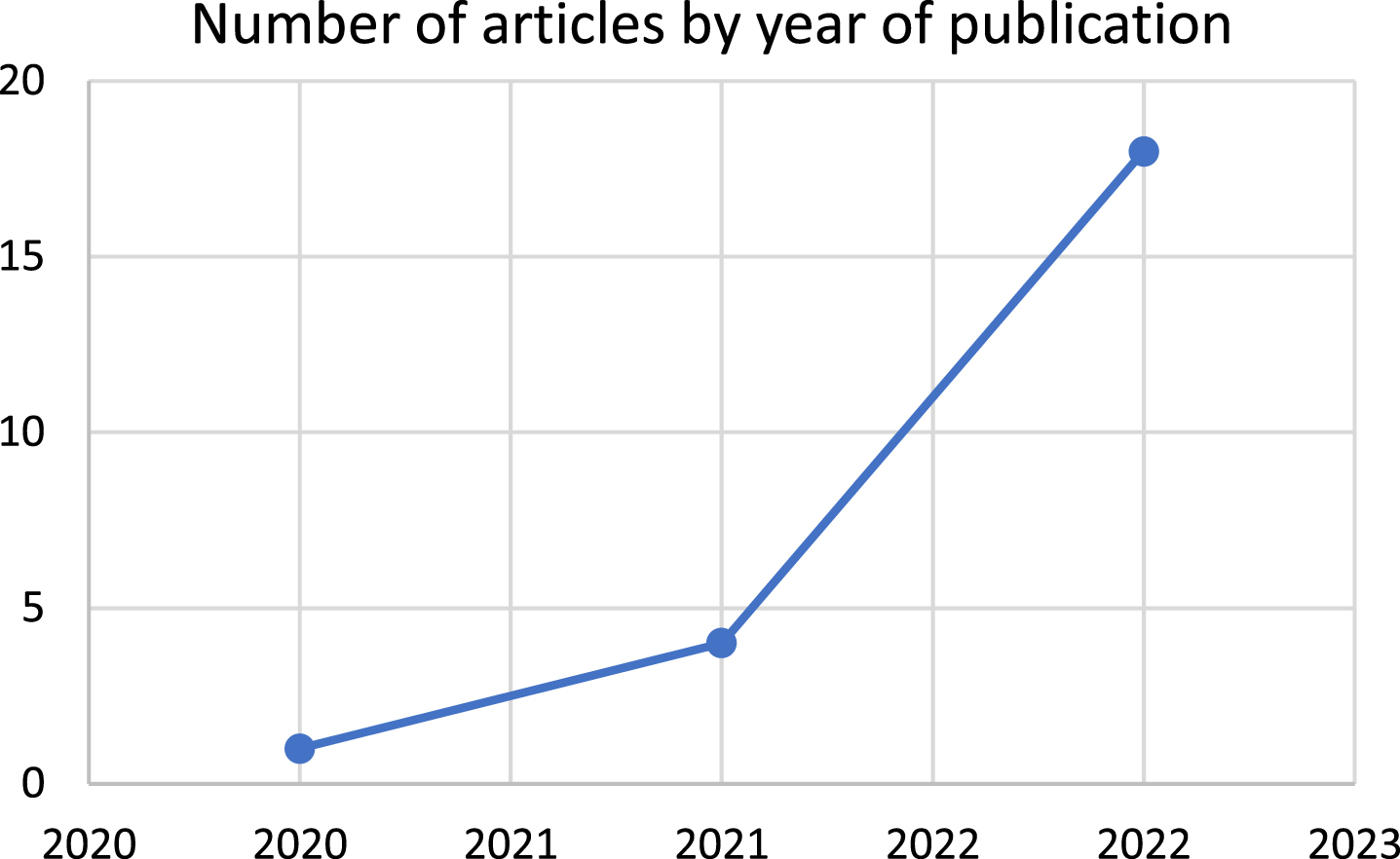
Publication year.
Journals, affiliations, and national borders all have interdependent networks that might provide important information. Thus, in Fig. 6, we propose a novel three-field layout depicting the interplay between the most influential publishing venues (left), affiliations (center), and nations (right) (right). In this context, we found most articles published in IEEE Access, and their authors were mostly from Iraq, China, and Malaysia. University Pendidikan Sultan Idris, Informatics Institute for Postgraduate Studies (IIPS), University Putra Malaysia (UPM), and even universities in Iraq, Australia, and Sweden are interested in utilizing FDOSM & FWZIC FDOSM and FWZIC. In general, many countries worldwide are showing an interest in these techniques. Figure 6 gives a good impression for new authors to rely on.

Three-fields-plot.
In order to shed light on the development of this line of research, it is necessary to identify the works that significantly influence the literature. Along the same line, learning about patterns of citations in the literature might provide insight into the field’s future direction. Table 9 summarises the top 10 papers that significantly impacted the area. The top three significant papers were SALIH MM (2020), ALBAHRI OS (2021), and KRISHNAN (2021). A large percentage of the most essential and powerful papers make theoretical and practical contributions. The theoretical problem and its solution are often described and provided in these contributions. Table 9 is explained the most important studies.
The most important studies
The most important studies
The most common and crucial terms from past research are discussed in this word cloud. Figure 7 provides essential keywords from the research literature in order to provide a high-level summary and rearrange the data.
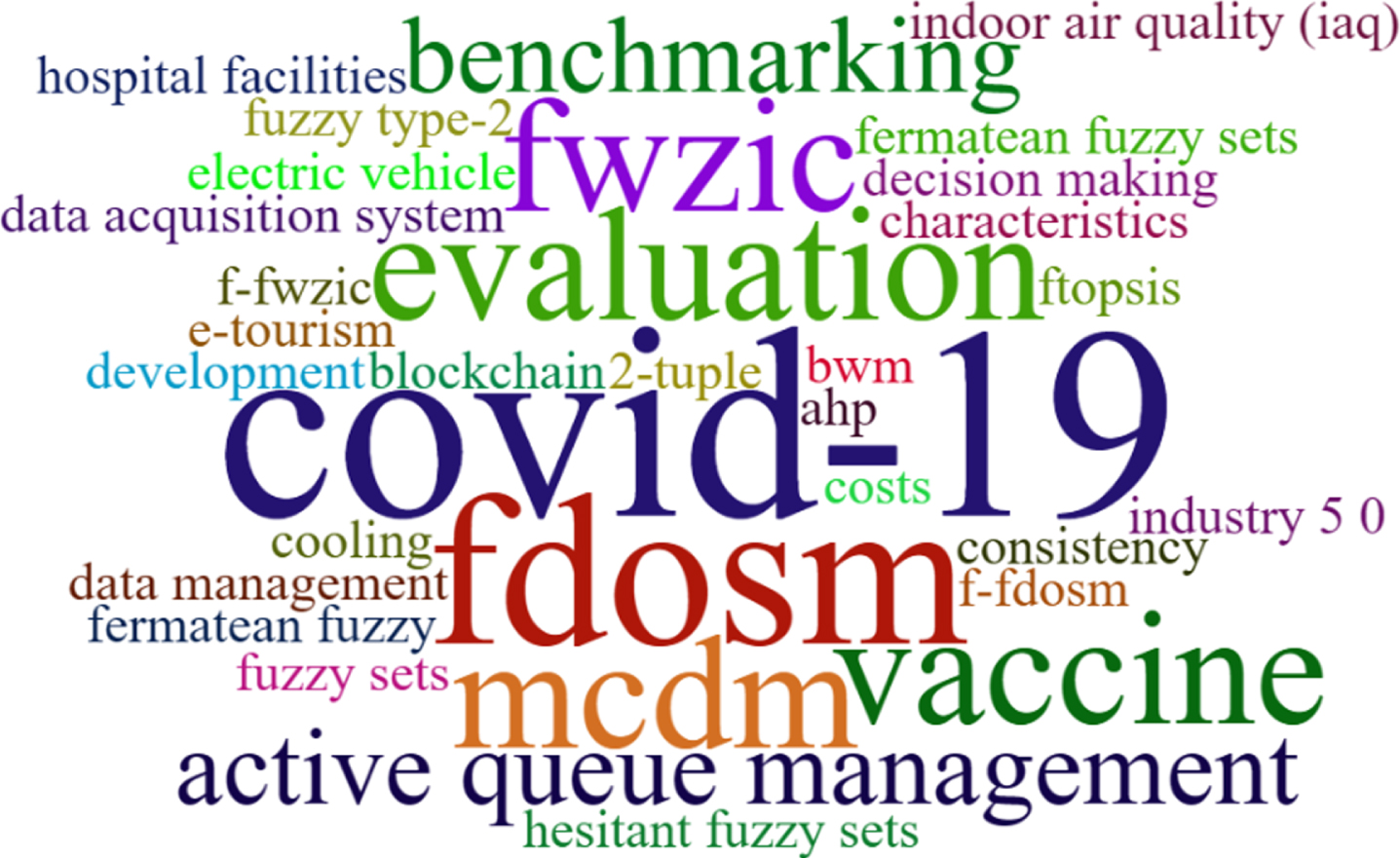
The word cloud.
Figure 7 shows the range of sizes for the keywords. If the keywords are larger, that means they appear more often in the research. Thinner terms suggest that they occur less often in the established literature. In this regard, one of the most important areas of the prior literature is that of COVID-19 evaluation, as well as FDOSM and FWZIC and their extension. Also, the literature makes a lot of efforts to use FDOSM and FWZIC to help researchers in solving real-world problems. Nevertheless, the literature results suggest that aspects of evaluation and ranking are important considerations for progressing in many essential fields such as machine learning, sustainable transportation, and air quality.
Co-occurrence networks are based on frequent terms found in prior research. Co-occurrence analysis is a kind of network structure that may provide important insights about the underlying theoretical framework of a particular area of study to professionals in that field, policymakers, and academics. Figure 8 displays co-occurrence networks to help understand frequently used terms.
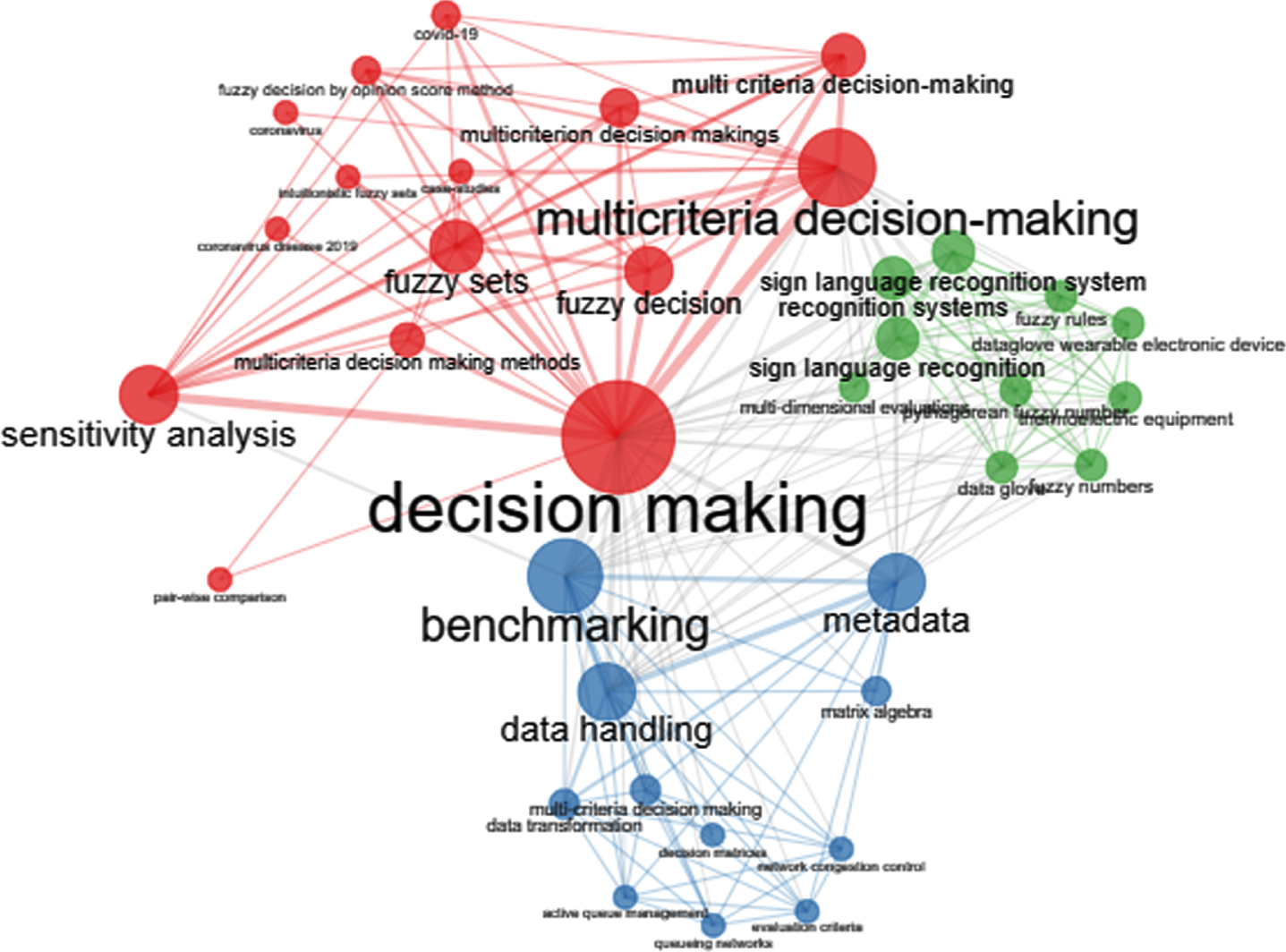
Co-Occurrence.
The co-occurrence represents the network of subjects among the prior literature. It’s made up of a network of lines and knots. The biggest knots in literature stand for the most prevalent ideas. Because policymakers and researchers may utilize data networks to help efforts to rearrange the available information and findings, decision making are among the most prominent terms used by previous researchers.
The scientific collaboration map depicts the interconnectedness of institutions, nations, and authors. When many writers work together on a project, everyone benefits from everyone else’s knowledge and expertise in the subject being developed. Scientific collaboration is also a crucial factor when it comes to fostering the growth of academic and industrial institutions. Figure 9: Graphic map of international agricultural DSTs collaboration.
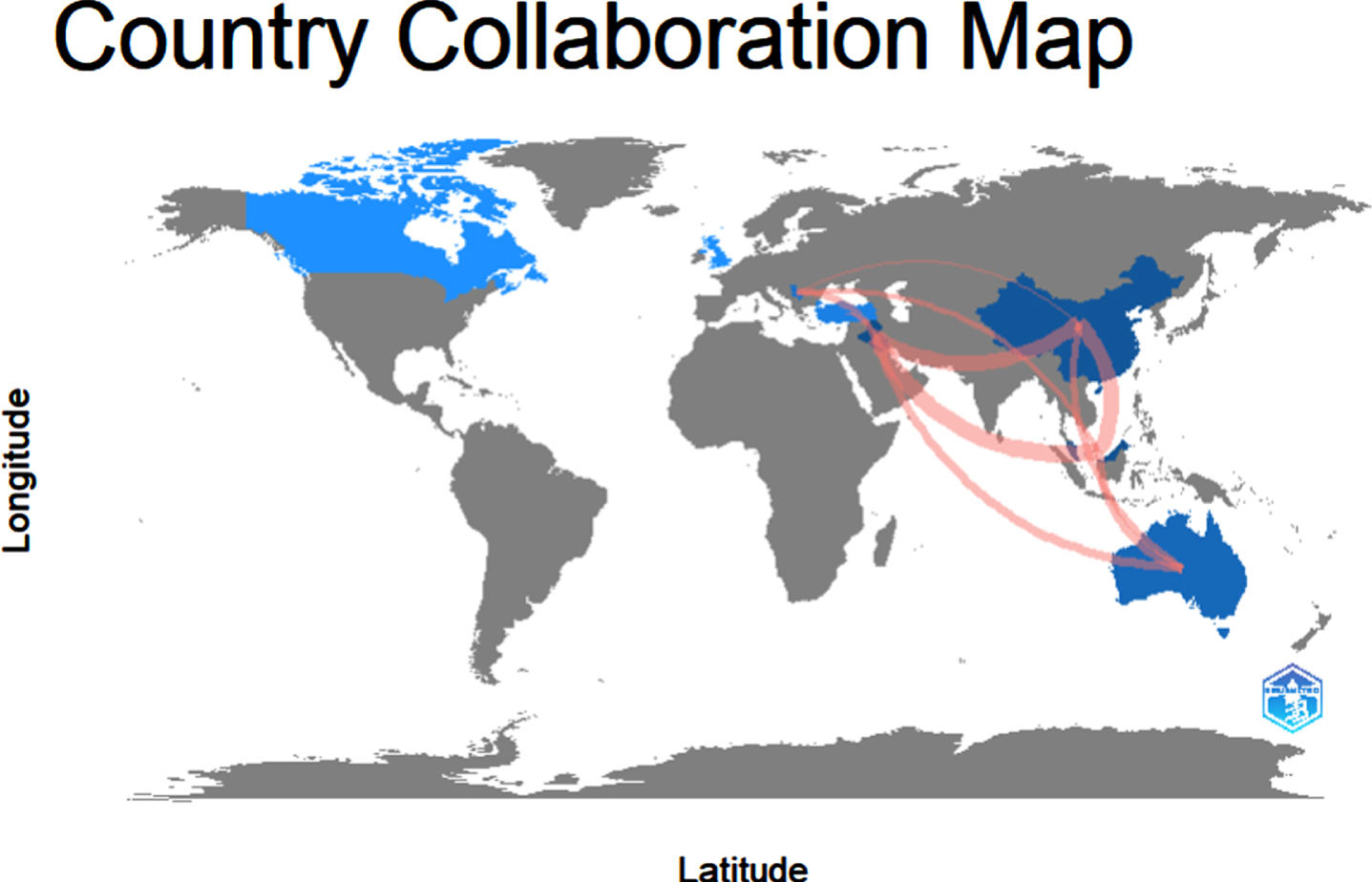
Country collaboration.
There are three distinct colors in the figure. The top scientific producers are represented by the darkest blue. The bright blue refers that there is little scientific production going on. The paucity of scientific output is shown by the grey area. Furthermore, scientific collaboration between countries is represented by red lines. In order to increase understanding, scientists from Europe, Australia, and Asia have been working together (as seen in Fig. 9). In spite of this, scientific collaboration between Africa and the Americas is severely lacking. Furthermore, the absence of international scientific cooperation is a symptom of a lack of familiarity with and understanding of FDOSM & FWZIC. Consequently, researchers and policymakers in the African and Americas continents could also look for more advanced approaches to encourage and improve scientific collaboration and advantage from the knowledge and capabilities of the European and Australian continents in thissector.
The results of this bibliometric analysis have numerous significant implications for the assessment of the research results of the FDOSM & FWZIC techniques. In addition, this bibliometric uncovered a wealth of essential information where academics and researchers could get perceptions on the roles of different nations, journals, universities, and authors in areas of research using FDOSM & FWZIC. Moreover, it records the progress made in science and highlights active research areas and potential future study areas. Additionally, the indicators produced provide a basis for future analysis and assessment. For example, the country’s productivity index can be seen to predict the contribution of that country in the future. The same holds true for several other metrics, like cooperation and citation rates. This section was conducted with the intention of assisting researchers and professionals in their pursuit of furthering these methods.
Many areas of study have been massively affected by FDOSM and FWZIC; however, there are still many open questions and discussions concerning their limitations. Therefore, especially considering the scope of this work, it will be more enlightening to focus on the FDOSM & FWZIC theoretical and practical challenges to propose context-based future research paths.
Limitations and challenges
Uncertainty, ambiguity, and vagueness in information are the biggest issues that researchers face when using MCDM techniques in real-world situations. The preference evaluations of alternatives, however, often include two types of uncertainties [56]: (I) the interpersonal judgmental interaction caused by multiple individuals’ subjective opinions according to their own background, knowledge, expertise, and skills, and (ii) the intrapersonal preference vagueness began from individual expert’s fuzzy and inaccurate impression a priori. Due to these two weaknesses, displaying the weighting of each criterion and ranking alternatives would be inaccurate. Many researchers, for instance, use triangular fuzzy sets (TFSs) [45], interval-valued Pythagorean fuzzy sets [7], and Pythagorean [43], etc., to deal with uncertainty on an intarpersonal level. In addition, to overcome interpersonal ambiguity, some researchers use rough number theories, as shown in [50]. Taking into account the negative effects of both forms of uncertainty, using a single interpersonal or intrapersonal information to deal with uncertainty might negatively impact the reliability and validity of the results [28]. Unfortunately, previous research seldom takes into account both kinds of uncertainty. In addition, the FDOSM technique is based on the comparison of the data of alternatives. When the number of alternatives increases, the work becomes more complicated. Therefore, it is possible to say that when the number of alternatives is too many, it is not preferable to use this method. Moreover, all FDOSM forms compared alternatives by considering the perfect positive solution for every criterion, completely disregarding any possible benefits of using the negative optimal solution that could produce more acceptable and robust results. In terms of FWZIC, FWZIC relies on the opinion of experts as a group, and it cannot produce weights for criteria based on one expert’s opinion. Furthermore, all previous versions of FWZIC disregarded potential discrepancies in criterion weights due to variances in DM preferences for a given criterion. For example, if DM1, DM2, and DM3 allocate the importance scores to X criterion: as unimportant, important, and somewhat important, respectively, the FWZIC will disregard these differences [57, 58]. Finally, the FDOSM & FWZIC results are aggregated and provided on the bases of the direct aggregation operator only.
In terms of practicals, while researchers have already used FDOSM &FWZIC and their improvements to a wide range of real-world decision-making challenges, they can be looking forward to investigating issues in the mechanical, architectural, civil, and agricultural fields. On the other hand, researchers can make integrated systems (web applications) that can be accessed via the internet for evaluation using these methods.
Future direction
Based on previous research of FDOSM &FWZIC, the following are some of the gaps and sectors that have not yet been sufficiently investigated:
Uncertain developments
Uncertain developments in FDOSM and FWZIC are restricted to using only 18 items from the prior uncertainty sets. The use of novel uncertainty sets, such as the Hesitant Linguistic Neutrosophic Number (HLNN), Z cloud rough number (ZCR), the Interval-Valued Neutrosophic Soft Set (IVNSS), the Generalized Interval Neutrosophic Rough Set (GINRS), the Z-number (Z), the cloud fuzzy, possibility theory, regular probability intervals, relative proximity and Basic Uncertain Information (BUI) can add more stability of these methods.
Development method
The challenge of determining the relative weight of several criteria is common in multi-criteria decision-making (MCDM) methods [45]. The final rank result can be significantly affected by the weights assigned to different criteria. Therefore, we believe that extracting the weight from the FDOSM opinion matrix is a new focus for researchers and makes this method integrated (using one method to produce a weight for the criteria and the rank of the alternatives). In addition, by leveraging the respective strengths of FDOSM and FWZIC, a robust approach can be developed for generating weights with enhanced effectiveness.
Integrated approaches
As for the integrated approaches, it can merge As for the integrated approaches, it can merge FDOSM &FWZIC methods with artificial intelligence algorithms, for example, random forest, ANN, and hybrid algorithms. Where the output of the decision-making method is input to the AI algorithms for prediction. This approach has been used with TOPSIS [59]. On the other hand, it is a good opportunity to merge data mining with FDOSM and FWZIC. Because of this, fresh projects might be conducted in this field by combining FDOSM and FWZIC with data mining techniques. For instance, in MCDM methods, data clustering and classification are prerequisites to building a decision matrix. Clustering and classification are tasks that may be implemented by a wide variety of data mining techniques.
Integrated with other MCDM methods
Many significant weighting techniques are neglected to be implemented in the model of FDOSM, such as the Analytical Network Process (ANP), Simos method, Simple Multi-Attribute Rating Technique (SMART), and other objective methods. Along the same line, various ranking methods until now did not combine with FWZIC, like MABAC, COCOs, TOPSIS, and others. It is worth noting that these methods, which were mentioned above, are considered one of the strong, reliable, and frequently used methods in decision-making.
Validation strategy
Adding new alternatives to the existing set or removing weak alternatives is one approach to evaluating the robustness of MADM techniques. It is anticipated that the MADM method’s ranking of the options would not significantly shift under such situations. This technique is called rank reversal issue [58], and significant interest has previously been used to it in the literature [58, 60]. It is vital to use this technique to evaluate our methods.
Case studies
FDOSM & FWZIC have seen hardly any implementation in the farm and agriculture decision support system industry. In addition to the advantages and validity of methods, the field has somewhat neglected FDOSM &FWZIC. Unlike the traditional method in MCDM, FDOSM Method takes the optimal solution and compares it with the rest of the solutions for the same Criteria, giving realistic results. As for FWZIC, the value of inconsistency resulting from many comparisons is equal to zero. Therefore, using them in the agricultural field is necessary, as we live in a crisis of water scarcity, lack of agricultural land, and global warming.
Aggregation operator’s methods
Aggregation operators are important in many fields, such as decision-making [61]. In the literature, several aggregation operators have been developed by researchers to aggregate numerical data in different situations [62, 63]. The objective of the aggregation step is to combine a set of criteria in such a way that the final aggregation output takes the entire single criterion into account. The final selection of classification naturally derives from this set of overall degrees; therefore, valuable classifications are not discarded for failing to meet a few criteria [64]. In addition, we observed that in the future, the number of approaches of aggregation operators would increase for solving MCDM problems such as Geometric Bonferroni Mean (GBM), Bonferroni Mean (BM), ordered weighted averaging (OWA) and other hybrid aggregation. Therefore, further investigation can use this extension for solving multi-criteria group decision-making problems with FDOSM &FWZIC.
Implications
Systematic literature reviews (SLRs) of MCDM methods (FDOSM & FWZIC) can have several implications, including Identifying gaps and areas for future research: An SLR can help identify areas where research on FDOSM & FWZIC is lacking or where more studies are needed. This can guide future research efforts and help researchers prioritize their work. Evaluating the strengths and weaknesses of FDOSM & FWZIC: An SLR can provide an overview of FDOSM & FWZIC, its advantages, and its limitations. This information can help researchers and decision-makers choose the most appropriate MCDM method for their specific needs. Improving the quality of FDOSM & FWZIC studies: An SLR can help researchers identify best practices in FDOSM & FWZIC studies and avoid common mistakes. This can improve the quality of future studies. Furthermore, an SLR of FDOSM & FWZIC can facilitate interdisciplinary research by providing a common framework and vocabulary for researchers in different fields. Conducting an SLR can save researchers time and resources by providing a comprehensive overview of the literature on FDOSM & FWZIC. Instead of having to read and synthesize hundreds of individual studies, researchers can rely on the findings of the SLR to guide their work. Finally, by conducting an SLR of FDOSM & FWZIC, researchers can share their findings with others in the field and promote collaboration and knowledge-sharing. This can lead to new insights, collaborations, and innovations in the field of MCDM.
Conclusion
Among the several MCDM strategies available, FDOSM and FWZIC stand out as particularly useful ones since they eliminate inconsistency (the main problem with the human approach) and speed up comparison processing. In addition, the ambiguity in the information could be overcome. In this study, we investigated 23 prominent papers to provide a comprehensive review of FDOSM and FWZIC. Firstly, we provided a brief bibliometric exploration regarding analysis of journals and publication years while also emphasising the theory of FDOSM & FWZIC and its many features, such as the derivation of the utilities of fuzzy sets, group experts’ structures in the decision-making process, and field of studies. In addition, VOS-Viewer was used to create the bibliometric co-occurrence graph. Second, we created a comprehensive review of improvements of FDOSM & FWZIC supported in the field of study. Third, the problems regarding practical’s were mentioned by classifying them into sectors and case studies. Finally, we provided specific recommendations for further research and development of FDOSM and FWZIC.
The advantages of this survey research include: The current work aims to comprehensively analyse FDOSM & FWZIC by analysing numerous aspects, including theory, significance, fuzzy set extensions, case studies, bibliometric analyses, and future research prospects. This review focuses on two key areas: the reporting and analysis of methods and applications and a bibliometric scan of the relevant literature. A variety of challenges were shown with respect to the theoretical aspects and real-world implementations of FDOSM and FWZIC. The research presented a set of future research directions, especially with regard to regular probability intervals, relative proximity, and basic uncertain information in multi-source evaluation [65]. This investigation provides support for the determination of gaps and areas needing more investigation in the area of FDOSM and FWZIC. A powerful method for efficiently producing weights can be created by combining the advantages of FDOSM and FWZIC. Finally, we deliver the research community with an adequate view of how to benefit from these methods in their studies.
This study is in line with previous literature by having some limitations that open doors and prospects for future research. Firstly, the field is expanding so quickly that a timely survey is complex. Secondly, this research studied just papers that are classified as articles and review papers. Thirdly, we excluded conference papers, books chapter, and reports.