



Abstract
In view of the problems of low detection accuracy, long detection time, and inability to monitor fault data in real time in the fault detection of traditional machinery and equipment, this paper studies the identification and fault detection of industrial machinery based on the Internet of Things (IoT) technology. By using Internet of Things technology to build a mechanical equipment fault detection system, Internet of Things technology can better build diagnostic and early warning modules for the system, so as to achieve the goal of improving the accuracy of equipment fault detection, shortening equipment fault detection time, and remotely monitoring equipment. The fault detection system studied in this paper has an accuracy rate of more than 93.4% to detect different types of fault. The use of Internet of Things technology is conducive to improving the accuracy of mechanical equipment fault detection and realizing real-time monitoring of equipment data.
Keywords
Introduction
During the operation of industrial equipment, faults do not occur suddenly, but rather accumulate under the combined action of various internal or external factors, leading to potential hazards and ultimately leading to equipment performance degradation or damage and even greater harm. Usually, in this situation, equipment operators cannot predict the performance of the equipment in a timely and accurate manner and therefore cannot take preventive measures. If certain state values of mechanical equipment can be changed before a fault occurs, this can lay the foundation for mechanical equipment fault detection. This can be taken early when a fault occurs, minimizing the occurrence of equipment faults, improving productivity, and avoiding economic losses. Therefore, how to study the use of scientific and reasonable methods to detect and monitor faults in industrial mechanical equipment in real time, to help equipment users safely use the equipment and better solve faults in the face of equipment failures, is beneficial for the development of industrial mechanical equipment. This article is based on IoT technology to study the fault detection of industrial mechanical equipment. Using IoT technology can construct a mechanical equipment fault detection system that can monitor industrial mechanical equipment in real time and detect various faults. This system achieves early warning and diagnosis of mechanical equipment faults, improves the maintenance level of mechanical equipment, effectively concentrates and reduces maintenance time, and improves the efficiency of mechanical equipment maintenance, reducing equipment maintenance costs, and improving control over industrial mechanical equipment.
With the continuous progress of today’s technology, equipment fault diagnosis technology has also emerged, as it has helped various production industries generate huge economic benefits, which has accelerated the rapid development of equipment fault diagnosis. Many researchers have conducted in-depth research on mechanical equipment fault diagnosis. Pan Tongyang focused on the problem of zero-order fault detection for rolling bearings, which is an extreme case of class imbalance. To address this issue, a two-stage zero-beat fault identification method was proposed. The results indicated that even if there were no fault data during the training process, the feature generation network could effectively detect typical faults and had practical application value [1]. Li Jipu proposed a new fault diagnosis method called the deep adversarial transfer learning network to detect emerging faults [2]. Sabry Ahmad H believed that many industrial robot systems could not effectively detect potential faults. A fault diagnosis method based on reference power mode was proposed, which could be used for remote monitoring of robot faults [3]. Kovito Maksim Andreevich considered that production machines and equipment generated a lot of data at various stages of the production process. Analyzing the data generated by these devices was crucial to predicting equipment failures, and intelligent data mining provided advanced data analysis techniques that were more conducive to fault detection [4]. However, the research of these scholars on mechanical equipment fault detection is not comprehensive enough, and research based on IoT technology can achieve good results in fault detection.
In the context of IoT and industrial IoT, fault diagnosis based on different methods can further improve the accuracy and efficiency of fault detection. Chi Yuanfang Y reckoned that knowledge-based fault diagnosis methods could effectively provide advanced reasoning and query response services to non-expert users through the improvement of ontology interoperability. Therefore, in the industrial IoT system, knowledge-based fault diagnosis methods were more popular than those based on ordinary models and data-driven diagnosis methods [5]. Bojarajulu Balaganesh provides a new IoT botnet detector based on an improved hybrid classifier. The main components of the proposed work are “preprocessing, feature extraction, feature selection, and attack detection, and the accuracy of the prediction model is 97% [6]. Talukdar Jyotismita introduced and modeled an artificial neural network method for identifying potential risk factors for cardiovascular diseases and, using the Internet of Things technology, generated a prediction list of risk characteristics that are most likely to lead to cardiovascular diseases [7]. Tumula Sridevi proposed an opportunistic energy-saving dynamic self-configuring routing algorithm for Internet of Things applications, which used the residual energy and mobility factors of sensor nodes obtained through the graph theory-based routing tree model to calculate the best route to the base station (BS) [8]. Gupta Sangeeta believes that the Internet of Things (IoT), which is famous for its sensor-based data capture function, is often combined with blockchain technology to ensure safe data storage and access. When data volume exceeds the processing capacity of computers, this combination will in turn use the cloud environment, thus reducing infrastructure and maintenance costs [9]. Overall, there is considerable research on fault detection using IoT technology, but there is relatively little research on the use of IoT technology to detect mechanical equipment faults. To improve this aspect, IoT technology is integrated to conduct research on mechanical equipment fault detection.
Equipment fault diagnosis technology, also known as mechanical inspection equipment, is a special technology which includes monitoring the status parameters of equipment, discovering abnormal situations, analyzing the causes of equipment failures, and predicting the future status of the equipment. The use of industrial mechanical equipment technology has promoted the development of production on the one hand, but on the other hand, there is also a huge crisis, which is that if it fails, it may directly or indirectly cause huge losses. Faced with the various dangers encountered by current mechanical equipment and some shortcomings of traditional industrial mechanical equipment fault detection methods, this article studies industrial mechanical equipment fault detection based on IoT technology. It is found that applying IoT technology to mechanical equipment fault detection can improve the accuracy of various mechanical equipment fault detection and also improve the speed of detecting various fault datasets, effectively improving the service life of industrial mechanical equipment.
The following characteristics primarily illustrate the originality of research on industrial machinery and equipment problem detection and high-performance data processing technologies based on the Internet of Things: 1. Real-time monitoring and early warning: The Internet of Things has made it possible to track the operational status of equipment in real time. Data analysis is used to achieve fault early warning, which significantly increases the precision and promptness of equipment fault detection. 2. Remote maintenance and management: The Internet of Things has made it feasible to remotely repair and manage equipment, which has improved worker productivity, decreased maintenance costs, and altered the type of on-site operation necessary for traditional equipment maintenance. 3. High-performance data analysis: Conventional equipment fault detection techniques rely mostly on professional expertise and manual experience, but are frequently unable to identify defects in a timely and correct manner due to the complexity and variety of equipment operating conditions. With the advent of high-performance data analysis technologies, fault diagnosis can be performed more accurately and efficiently by mining and analyzing equipment operation data in-depth and identifying the patterns and features of equipment failures.
Exploration methods related to fault detection of industrial mechanical equipment
Mechanical equipment failure
Mechanical equipment fault diagnosis is an interdisciplinary field that integrates multiple aspects, such as fault mechanism, sensing technology, signal processing technology, feature extraction, pattern recognition, etc., and is also closely related to modern industry. Applying it to the detection of industrial mechanical equipment faults has always been a hot research topic in this field [8]. The so-called mechanical equipment failure is the phenomenon of partial or complete functional paralysis caused by various aspects of the mechanical equipment deviating from the normal state. The durability of mechanical equipment is related to its usage time and the longer the machine is used, the lower its durability. The occurrence of mechanical equipment failures is unpredictable and it is difficult to understand the timing of the failure during the production process [9]. Therefore, studying the laws and characteristics of mechanical equipment failures is very important. The use, management, maintenance, and repair of mechanical equipment occupy a large part of the entire life cycle of the equipment. Effectively managing mechanical equipment and ensuring its efficient operation is very important thing in enterprises, an important component of production, and the foundation of business establishment.
Feature extraction is an important part of fault pattern recognition, and the specific expression for the transformation from pattern space to feature space is as follows:
Among them,
To obtain the extreme value of
When receiving data, it is usually not possible to directly apply it to the model first, and some planning needs to be done. Data Understanding Stage: In this stage, the main focus is to understand the specific meaning of each data, review background knowledge, and understand the value of the features of the envisioned data. Data Analysis Stage: This stage includes qualitative data analysis and data analysis. The quality of research is usually evaluated through two aspects: completeness and accuracy. The best way to explore the relationship between the data is to find the relationship between each feature and provide some guidance for the next data cleaning stage. Data cleaning stage: Data cleaning is an important part of data analysis, because data cleaning can eliminate useless data. Data separation stage: Data separation often occurs during modeling, and usually all data is divided into three parts: training data, valid data, and test data. Their activities are in turn used to create IoT technology models, evaluate them during model construction, and ultimately evaluate the performance of the trained final model.
Internet of Things technology
The Internet of Things is an important component of the new generation of information technology pioneered by the internet and is also an important foundation for the development of the ‘information’ era. It uses various communication technologies to equip sensors with real objects such as railways, bridges, highways, and buildings, forming a new communication method for remote control or IoT connection and achieving a network of informatization, remote management and intelligent control [10, 11]. Its foundation is the Internet, and the key component is sensors. It is a very practical tool created through the use of the Internet. The IoT terminals connect various electrical or electronic devices to achieve high-speed data exchange and communication between devices. Industrial IoT technology mainly refers to the integration between various advanced devices with sensing and monitoring functions and some technologies. Some technologies refer to control automation technology, modern communication technology, intelligent data analysis technology, and other technologies. After which they are applied to modern commercial production, integrating technology, people, and products in the IoT to improve productivity and create higher business value, improve product quality, and reduce the cost of goods [12, 13].
Construction of mechanical equipment fault detection system based on Internet of Things technology
System design
In recent years, IoT technology has developed rapidly, mainly consisting of the Internet and sensors. Connect physical devices to the network through various sensors, collects various data and finally aggregates these data into intelligent devices, with the ultimate goal of diversification [14, 15]. The core technology of the industrial mechanical equipment fault detection system based on IoT is to study the development and application of IoT technology in the field of industrial mechanical equipment fault detection services and alarm systems. By using this system, the relationships between various sensor nodes of industrial mechanical equipment can be collected, and the data generated during the operation of mechanical equipment can be collected, detected, and monitored. The mechanical equipment fault detection flow chart based on IoT technology is shown in Fig. 1.
Flow chart of mechanical equipment fault detection based on IoT technology.
Intelligent fault diagnosis module
The intelligent fault diagnosis module is responsible for receiving real-time information data generated by mechanical equipment during use and conducting research on abnormal data from important components of mechanical equipment [16, 17]. When the module receives real-time data generated by mechanical equipment, it reviews the data, which requires the data to meet the standards of the fault detection system [18]. If the format does not meet the requirements, the program returns abnormal information, and these returned data can be reconfigured from scratch in the detection system. After the data analysis is completed, the fault diagnosis system returns to the designed system based on the data content to find the corresponding types of industrial mechanical equipment faults [19, 20]. However, if the corresponding fault types are not matched, the module returns the data to the previous step. When the abnormal data in the generated data matches the equivalent mechanical equipment fault type, the intelligent fault diagnosis module can analyze this fault. The intelligent fault diagnosis flow chart is shown in Fig. 2.
Intelligent fault diagnosis flow chart.
The faults of mechanical equipment should not be underestimated. To ensure the operation of the equipment is safe and reliable, inspections should ensure that real-time data can be collected from sensors and displayed on the software interface. It should have certain convenience and can process digital signals in real time. The data of the real-time monitoring module consists of several parts, including communication data, real-time curves, channel panel, and control panel [21, 22]. The data cache uses a static array to store temporary data, the dimension of a static array is defined based on the number of channels in the configuration file, and the length of each packet of data is the length of the array. When the data arrive, each second of data is buffered based on the channel number and displayed in the chart.
Alarm handling function
The system should have an early warning function. When certain parameters are measured to exceed this value, the alarm function aims to inform users about the existence of problems with certain observation values. For most rotating equipment, many aspects of signal abnormalities in time recording are effective evidence of alarms and the calculation is very simple, such as time-domain peak, effective value, spectral component, temperature, pressure, etc. The mechanical recognition fault detection system based on IoT technology not only provides early warning for the good results and highest values of recorded signals but also provides early warning for the average frequency deviation and peak area of the spectrum. In system diagnosis, the yellow and red alarm lines also increase the peak quality of the time domain signal. The specific red-line alarm values and yellow-line alarm values need to be determined based on actual problems. Different problems represent different results, so the alarm values for each channel are also different.
Platform generalization requirements
For most mechanical equipment, the detection point is usually the changing body, and the faults of these equipment can usually be detected using vibration and temperature methods. In terms of time-domain signals, peak and efficiency can be calculated, and spectral components and amplitudes can be compared within the frequency range. For most industrial mechanical components, their time-domain peaks are also deterministic mathematical measures. When designing the system page, it is necessary to be able to display the current measured vibration and temperature data in real time and to compare the vibration and temperature difference of each analysis point by saving the data. The development trend and fault characteristics can be statistically analyzed through long-term data sampling and storage. The interface diagram for the detection and management of mechanical equipment faults based on IoT technology is shown in Fig. 3.
IoT technology-based mechanical equipment fault detection management interface.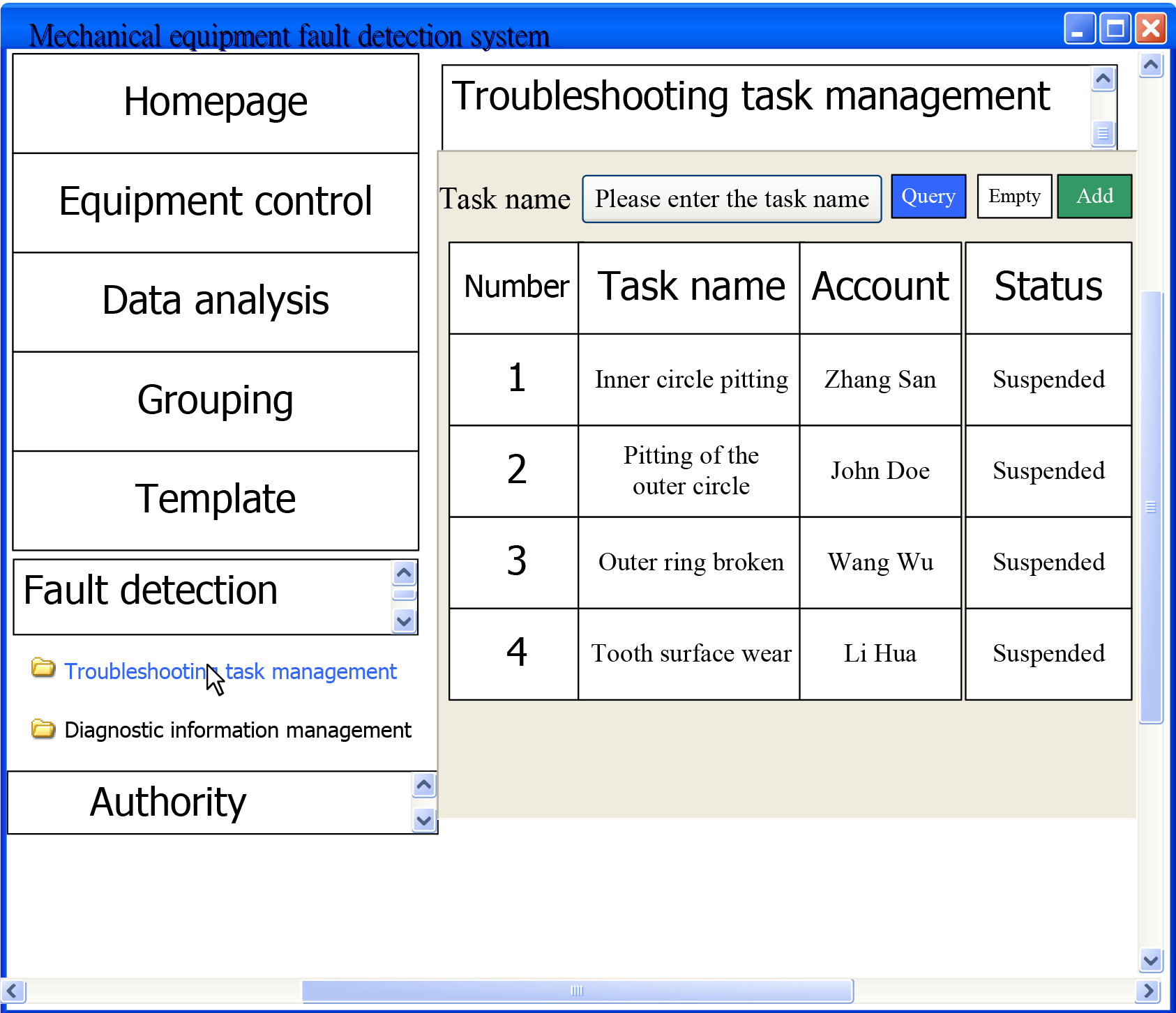
In traditional fault diagnosis methods, most methods cannot directly process the original signal. To solve this problem, the original time-domain signal is converted into a two-dimensional grayscale image and the expression is as follows.
Among them, the original time-domain discrete signal contains
The rotation of the equipment often causes malfunctions, such as between sliding and rolling bearings. To effectively solve these problems, it is necessary to calculate the corresponding data.
Among them,
The natural frequency of the bearing radial bending vibration during free operation is:
Among them,
Sometimes it is possible to determine the existence of a fault, but the location of the fault cannot be determined. Therefore, time domain analysis is usually used as a simple fault-warning diagnosis. The specific expression is as follows:
Among them,
The effective value is used to represent the surface roughness of mechanical equipment caused by the quality of manufacturing equipment or unintentional wear, and the expression is as follows:
Among them,
The study of Internet of Things-based industrial machinery and equipment malfunction detection is an advanced and intricate field. We must have a thorough understanding of the underlying mathematical concepts and application strategies in order to provide a convincing mathematical explanation of the research methodologies in this area. First of all, sensor technology is largely responsible for the use of Internet of Things technology in industrial machinery and equipment defect detection. Real-time data on the equipment’s functioning status can be gathered via these sensors. Second, big data analysis and machine learning are two areas where Internet of Things technology combines capabilities. Massive volumes of equipment data can be processed by these technologies, and valuable information can be extracted. Lastly, appropriate mathematical models and evaluation indicators must be developed in order to offer a solid mathematical justification for the suggested approach.
To confirm the functionality of the equipment failure detection system created in this article and the system created using alternative techniques, use Precision, Recall, and F1 value.
The hardware platform of this experiment is built around a server equipped with a powerful GPU. The software platform employs the Python language to implement performance testing based on industrial equipment failure detection. Installs the Tensorflow deep learning development framework and the Pycharm integrated development environment. Table 1 displays the particular experimental setup and settings.
Conditions and parameters of the experiment
Conditions and parameters of the experiment
In the above, the extracted accuracy rate, the recall rate, and the F1 value are used as the evaluation indicators of the research system in this paper. To further reflect the performance advantages of the research system in this paper, it is compared with the most advanced methods, such as the equipment fault detection system built based on machine learning algorithms, data driven, vibration analysis, voice recognition technology, deep learning, and neural networks. Specific comparison results are shown in Table 2.
Performance comparison of different fault detection systems
As shown in Table 2, it can be found that this article uses Internet of Things technology to build fault detection equipment for industrial equipment, and its performance in all aspects is better than that of systems built by other methods, which can effectively improve fault detection accuracy. The accuracy rate, recall rate, and the value of F1 of the system constructed by the research method in this article are 98.2%, 97.8% and 96.4%, respectively, of which the accuracy rate is 98.2%, which is 7% higher than the fault detection system of the equipment constructed by machine learning algorithms, data-driven, vibration analysis, voice recognition technology, deep learning and neural networks 9% 6.7% 9.8% 11.5% 8.9%.
There are many types of mechanical equipment and the mechanical equipment fault detection system based on the IoT technology not only has high accuracy in identifying and diagnosing industrial machinery, but also has high accuracy in identifying and diagnosing other types of machinery, such as power machinery, general machinery, transportation machinery, construction machinery, agricultural machinery, etc. These five different types of mechanical equipment are studied in conjunction with industrial machinery identification, comparing the experimental results obtained from diagnostic systems based on IoT technology with various mechanical equipment fault detection systems, such as deep learning (DL) algorithm, neural network (NN) algorithm, and energy consumption (EC) based devices. The specific comparison results are shown in Fig. 4.
Accuracy of different fault detection systems for different mechanical equipment detection.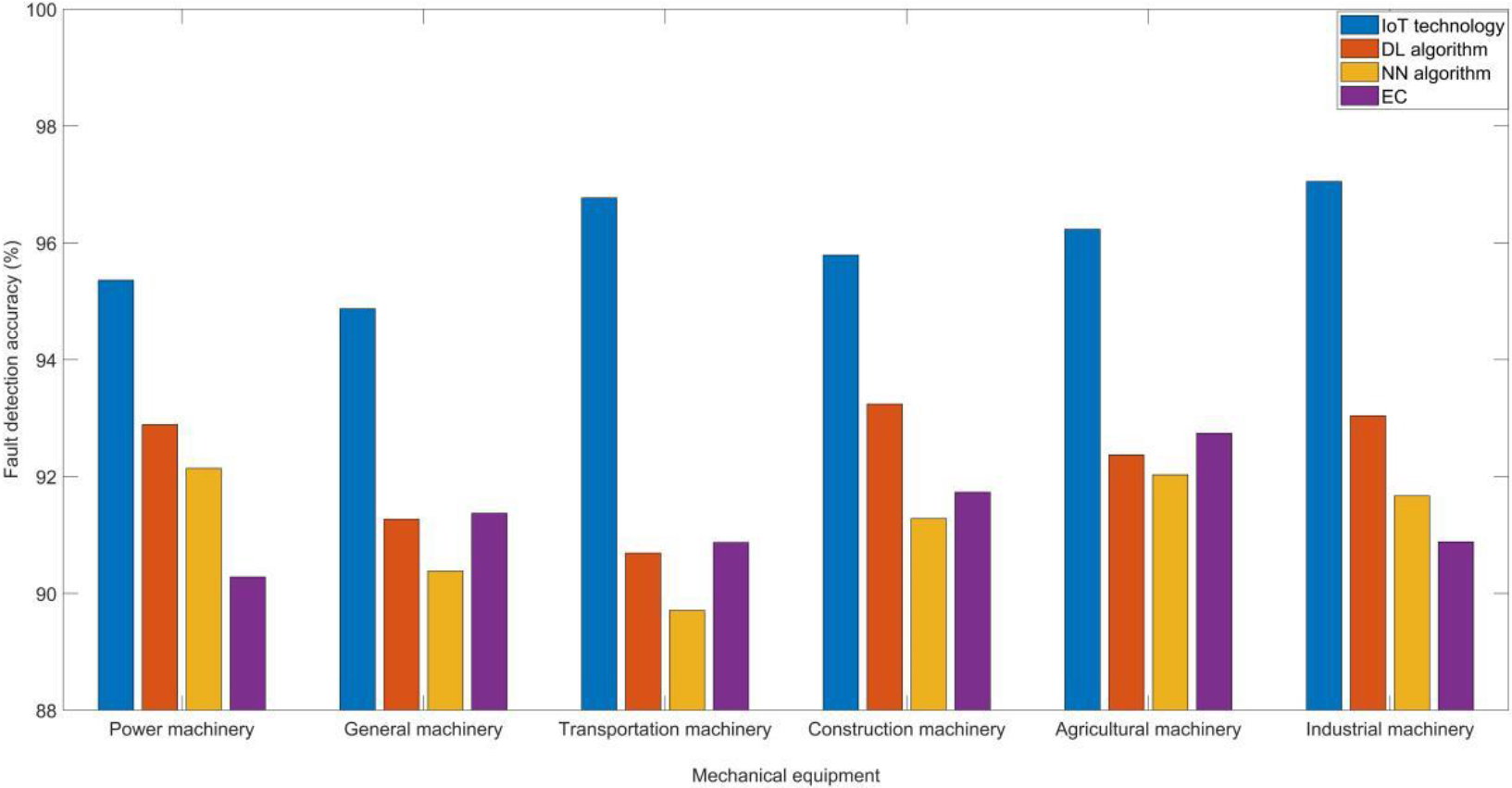
As shown in Fig. 4, the industrial mechanical equipment fault detection system based on IoT technology not only had higher accuracy in detecting industrial mechanical equipment faults than other detection systems, but also had higher accuracy in detecting faults for other types of mechanical equipment than the other three types of equipment fault detection systems. The accuracy of equipment detection systems based on IoT technology for fault detection of different mechanical equipment was above 94.8%, while the detection accuracy of mechanical equipment detection systems based on the DL algorithm, the NN algorithm and the EC was below 93.3%, 92.2% and 92.8%, respectively. Among them, the industrial mechanical equipment fault detection system had the highest detection accuracy for industrial mechanical equipment, with 97.05%, which was 4.01%, 5.38% and 6.17% higher than systems based on the DL algorithm, the NN algorithm and EC, respectively. The industrial mechanical equipment fault detection system based on IoT technology had the lowest detection accuracy for general machinery equipment, only 94.87%, but it was still 3.6%, 4.49% and 3.5% higher than systems based on the DL algorithm, the NN algorithm and EC, respectively. The mechanical fault detection system based on the DL algorithm had the highest detection accuracy for engineering machinery equipment, at 93.24%, but it was still 2.55% lower than systems based on IoT technology. The mechanical fault detection system based on the NN algorithm had the highest detection accuracy for power machinery equipment, 92.14%, but it was still 3.22% lower than systems based on IoT technology. The mechanical fault detection system based on the EC algorithm had the highest detection accuracy for agricultural machinery equipment, with 92.74%, but was still 3.49% lower than the system based on IoT technology. In summary, the use of IoT technology could collect data for different types of mechanical identification and analyze these data to improve the accuracy of fault detection for different mechanical equipment.
For industrial mechanical equipment, machinery bearings are very prone to failure and bearing detection is very important. To demonstrate the superiority of IoT-based industrial mechanical equipment fault detection systems in mechanical equipment bearing detection, different numbers of bearing datasets were randomly extracted and tested. The detection time for different bearing datasets was also different, comparing the detection time with that of other different mechanical equipment fault detection systems, such as those based on DL algorithms, NN algorithms, and EC devices. The specific detection time is shown in Fig. 5.
Time required by different fault detection systems for different bearing datasets.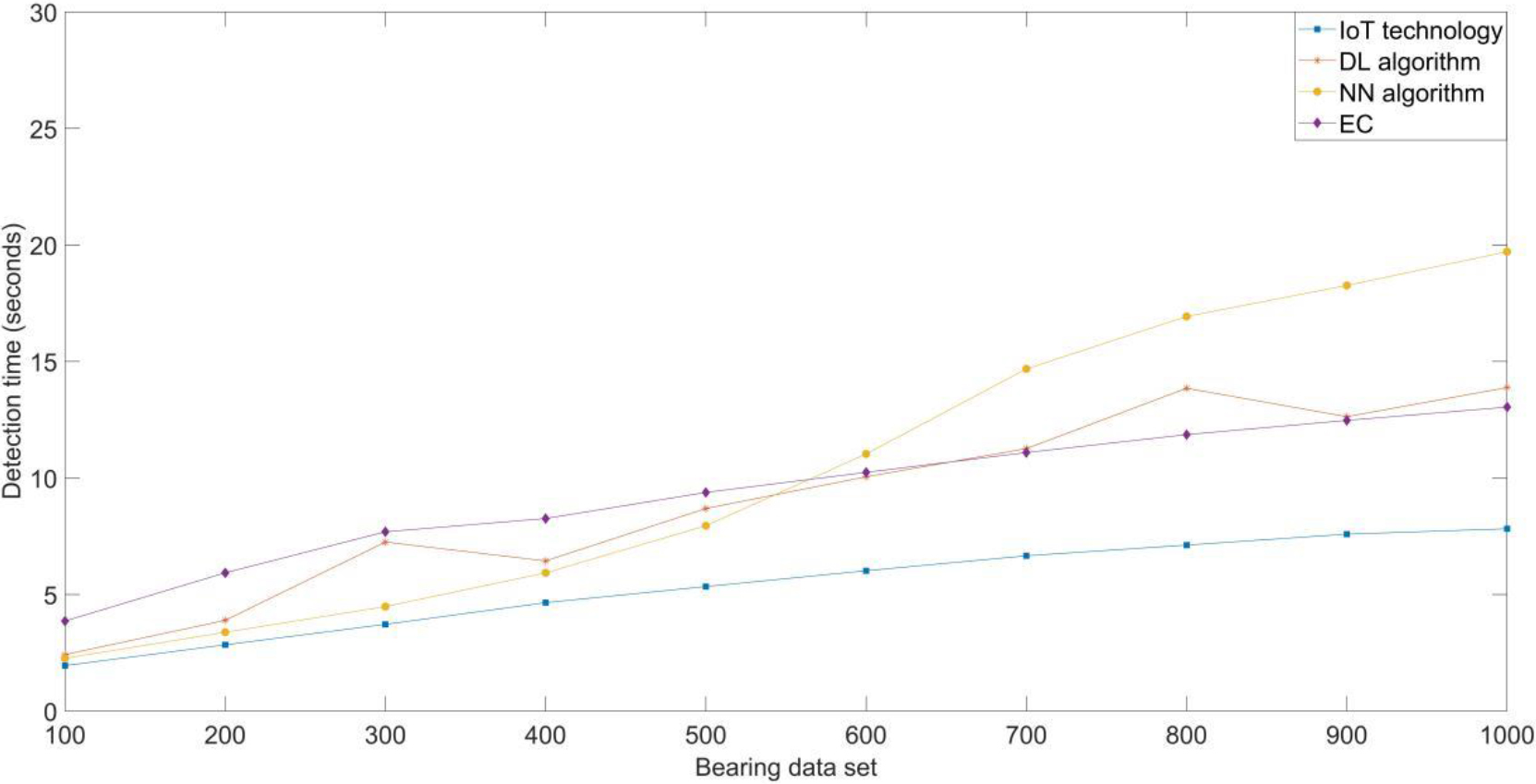
As shown in Fig. 5, different numbers of bearing data sets were extracted for the experiments. It can be found that the mechanical equipment fault detection system based on IoT technology took much less time to detect these bearing data sets than the other three detection systems. The faster the detection speed, the earlier possible fault problems can be discovered. The faults can be solved early to minimize losses. Among them, when the bearing data set was 100, the time required for the mechanical equipment detection system based on IoT technology to detect was 1.95 seconds, which was 0.47 seconds, 0.31 seconds, and 1.91 seconds less than the DL algorithm, NN algorithm, and EC based mechanical equipment detection systems, respectively. When the bearing data set was 1000, the time required for the mechanical equipment detection system based on IoT technology was 7.82 seconds, which was 6.06 seconds, 11.89 seconds and 5.22 seconds less than the mechanical equipment detection systems based on the DL algorithm, NN algorithm and EC, respectively. By analyzing the data in the figure, it can be found that compared to the other three systems, the growth rate of time required by the detection system based on IoT technology is smaller as the bearing dataset data continues to increase. The detection system based on the NN algorithm required more detection time than the IoT technology-based system and less time than the other two when the bearing data set was below 500, but when the bearing data set was above 600, its detection time was much higher than the other three mechanical equipment fault detection systems. The EC-based fault detection system took more time to detect the extracted bearing dataset than the IoT-based system, but when the bearing dataset was greater than 700, its detection time was shorter than that of the DL and NN-based fault detection systems. In summary, the mechanical equipment fault detection system based on IoT technology performed the best.
During the operation of mechanical equipment, various reasons can cause equipment failure. For fault detection, the use of mechanical fault detection systems can accurately determine which type of fault is present, which is beneficial for laying a solid foundation for subsequent equipment maintenance. Industrial mechanical equipment fault detection systems based on IoT technology have high accuracy in detecting different types of fault. Randomly selecting 7 types of mechanical equipment faults for detection, including broken teeth, inner circle pitting, outer circle pitting, outer ring broken, tooth surface wear, rolling element wear and outer ring wear, the detection results of the IoT based system were compared with the other three mechanical equipment fault detection systems. The specific comparison results are shown in Fig. 6.
Comparison results of different mechanical equipment fault detection systems for different fault types of detection accuracy.
As shown in Fig. 6, the accuracy of mechanical equipment fault detection systems based on IoT technology was much higher for different types of mechanical fault detection than the other three systems. Among them, the accuracy of systems based on IoT technology for different fault types detection was above 93.4%, while the accuracy of mechanical equipment detection systems based on the DL algorithm, NN algorithm and EC for different fault types detection was below 92.5%, 93.2%, and 93.3%, respectively. Among the four systems, the IoT-based industrial mechanical equipment fault detection system based on IoT technology had the highest detection accuracy for broken outer rings, at 96.45%, which was 4.57%, 5.17% and 3.87% higher than the systems based on the DL algorithm, the NN algorithm and EC, respectively. The industrial mechanical equipment fault detection system based on IoT technology had the lowest detection accuracy for inner circle pitting faults, only 93.47%, but it was still 2.33%, 0.72% and 1.61% higher than systems based on the DL algorithm, NN algorithm and EC, respectively. The mechanical fault detection system based on the DL algorithm had the highest detection accuracy for outer circle bursting faults, at 92.41%, but it was still 2.67% lower than systems based on IoT technology. The mechanical fault detection system based on the NN algorithm had the highest detection accuracy for broken tooth faults, at 93.12%, but it was still 1.74% lower than systems based on IoT technology. The mechanical fault detection system based on the EC algorithm had the highest detection accuracy for outer ring wear faults, at 93.26%, but it was still 0.67% lower than systems based on IoT technology.
When faults are detected in industrial mechanical equipment, a large amount of data is generated. Real-time monitoring of these data is very important. Only by detecting the data generated by industrial mechanical equipment in real time can abnormal data be detected in a timely manner. Equipment failures that have occurred or are about to occur can be detected in a timely manner, which can minimize losses. Based on IoT technology, fault detection of mechanical equipment can effectively improve the accuracy of the generated data and reduce the error rate of monitoring data. Monitoring 5000 randomly selected mechanical equipment data and conducting different experimental iterations, such as 5, 10, 15, 20, etc., finally, the error rate of data monitoring was taken as the average of different iterations, comparing the final results with the results obtained from the two systems based on the DL algorithm and the NN algorithm. The specific monitoring error rate is shown in Fig. 7.
Comparison of error rates of different mechanical equipment fault detection systems for fault data monitoring.
As shown in Fig. 7, the data generated by the mechanical equipment was monitored in real time and multiple iterative experiments were carried out on these data. The error rate of fault detection systems based on IoT technology for monitoring these data was much lower than the other two systems. The error rate of system monitoring based on IoT technology was less than 5.24%, while the error rates of mechanical equipment detection systems based on the DL algorithm and the NN algorithm for different types of faults were greater than 5.33% and 5.67%, respectively. When the number of experimental iterations was 30, the IoT-based fault detection system had the highest error rate for data monitoring, which was 5.23%. However, it was still 1.18% and 2.08% lower than the mechanical equipment detection system based on the DL algorithm and the NN algorithm, respectively. When the number of experimental iterations was 85, the fault detection system based on IoT technology had the lowest error rate for data monitoring, which was 2.88%, which was 3.03% and 4.93% lower than the detection system based on DL algorithm and NN algorithm based mechanical equipment, respectively. When the number of experimental iterations was 25, the fault detection system based on the DL algorithm had the lowest error rate for data monitoring, only 5.34%, but it was still 1.11% higher than the mechanical equipment detection system based on IoT technology. When the number of experimental iterations was 80, the fault detection system based on the NN algorithm had the lowest error rate for data monitoring, only 5.68%, but was still 2.34% higher than the mechanical equipment detection system based on IoT technology.
In today’s production and construction, mechanical equipment has become irreplaceable, making significant contributions to the production process of many products, improving the efficiency of product production, reducing labor pressure and reducing labor intensity. However, during the operation of mechanical equipment, due to various factors such as environment, wear, and operation, many malfunctions may occur, which can bring some problems to production and construction, reduce production efficiency, affect the entire production and construction, and even potentially cause safety issues. Therefore, it is necessary to pay attention to the faults of mechanical equipment, strengthen the detection and maintenance of mechanical equipment faults and ensure that they work in a good, stable, and safe state. For this reason, this article studied the fault detection of industrial mechanical equipment based on IoT technology. It used the IoT technology to collect data on mechanical equipment, monitor the operation status of various mechanical equipment in real time, predict the performance of mechanical equipment, and timely detect equipment faults to ensure that mechanical equipment can operate normally. However, due to time constraints, there are still some shortcomings in this article. There are still many areas that need to be improved for the module functions of the mechanical equipment fault detection system. This requires more and more detailed research to understand the needs of users, so that they can be iteratively developed and applied in the future. In actual industrial environments, there are many limitations to the diagnosis of mechanical equipment faults, and further research is needed to ensure the reliability and timeliness of the diagnosis by performing a mechanical equipment fault diagnosis.