



Abstract
In this paper, an electromagnetic analysis study of a double-sided linear permanent magnet (PM) motor topology is conducted both for conventional and Halbach array magnet assemblies. Halbach arrays can condense flux lines on the one side of magnet assembly and cancel them on the reverse side, so they enable light motor structures due to the lack of back iron material. By means of the analyses, the critical performance criteria of linear motor are investigated. The designs are verified experimentally. The induced voltages and force production of prototype motors are captured to validate the design study. The findings show that Halbach array magnet assembly type linear motor has superiority for force production and lightness of design.
Introduction
Air core or coreless double-sided linear motors are preferred in many precise applications in industry [1,2]. In conventional designs, mostly PMs are glued on a ferromagnetic material named as back iron. Using back irons to transfer the magnetic flux lines is an efficient but bulky way. By introduction of Halbach array type magnet assembly which concentrates flux lines on the one side and cancels on the other side of magnet arrangement, motor designs become lighter and more compact due to the lack of back iron [3].
As it is obvious in literature and practice, linear motors have a variety of performance evaluation criteria. Mostly for short and limited stroke linear motors, efficiency is no more a performance goodness criterion. Instead, force-to-input power (F∕P 1), force-to-weight (F∕m) and force-to-volume (F∕V ) ratios become important design targets as a result of application specific requirements. Thus a designer must be in pursuit of these evaluation criteria both for cost-effective and applicable designs.
Halbach array electric motors, both for rotating and linear, rise to prominence due to their superior performance features over conventional magnet assembly motors [4,5]. However the designer must always consider a possible layout problem to obtain proper flux distribution in air gap.
Coreless linear motor
In this study, the selected linear motor topology is a double-sided (sandwich type) air core brushless motor type with 3-winding/4-pole arrangement. A linear stroke is provided by guiding the moveable armature winding structure between the two opposing magnet assemblies. For an adequate comparison of performances, the armature and motor driving strategy are kept same for both motor designs. Then the motor operation performance is investigated by implementing Halbach array magnet assembly exchanged with conventional PM arrangement with back iron. The armature with six toroidal windings is kept unchanged so the Halbach array version must satisfy the same pole pitch. For the same value of pole pitch, the permanent magnets are selected with proper dimensions and also PM depth and length are fixed.
The pole pitch (τ
p
) for conventional linear motor is the repeated magnetic zone along both for north and south poles of PMs. The horizontal distance between the magnets also defines the magnet embracing factor, (e). So the pole pitch value in conventional magnet assembly linear motors can be expressed as:
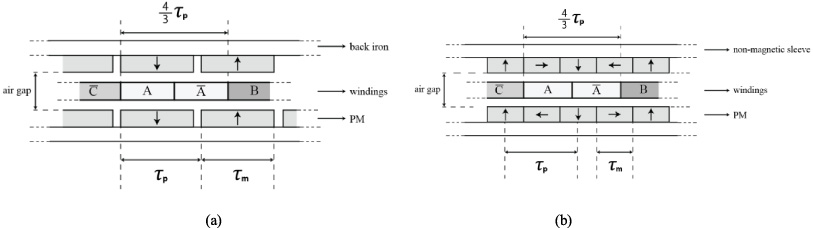
Transformation of conventional type linear motor (a) to Halbach type linear motor (b).
As it is shown in Fig. 1. magnetization directions are represented by arrows and, the only changes made in the motor design are magnet width and magnetization directions which are forming a Halbach array. The pole pitch is 21 mm, the magnet pitches of conventional motor type and Halbach type are 19 mm and 10.5 mm, respectively. The magnet embracing factor of conventional type is 90.4%.
For the both motor structures, the induced voltage waveforms are resembling sinusoidal waveforms. So it is concluded that the motor is suitable for both sinusoidal and trapezoidal brushless motor operation. Force constant and voltage constant are almost equal to each other. So the phase force constant of motor (K
p
) can be given as:
The design effort is started with the search of proper air-gap of double-sided structure. In coreless double-sided linear motor topology, the air gap also is containing phase windings. From the analyses, 8 mm of total air gap is defined as proper length, so the air gap can contain sufficient amount of conductors in its space. As a PM motor, double-sided coreless linear motor is a doubly excited machine which has two magnetic sources: armature and PMs. So the vector current density of windings (J) can be given for the windings as follows:
In this study, first, a conventional magnet assembly brushless linear motor is analysed by using Finite Element Analysis (FEA). N35 type NdFeB permanent magnet is used for the designs. The software used for analysis is ANSYS Maxwell Electromagnetic Analysis package. The flux lines, flux distribution, induced voltage variations, produced force and equivalent circuit parameters are obtained by using 2D and 3D models for both types. According to the analyses and experimental verification, except a few parameter approximations, 2D models are found suitable for simulating the actual motor behaviour. The flux lines and flux density distribution of the conventional type is given in Fig. 2. As it can be seen, the utilization of magnetic materials is adequate. The calculated phase-to-neutral induced voltage of the conventional motor is presented in Fig. 3. The induced voltage can be taken as pure sinusoidal due to the winding and flux distribution [9–11].
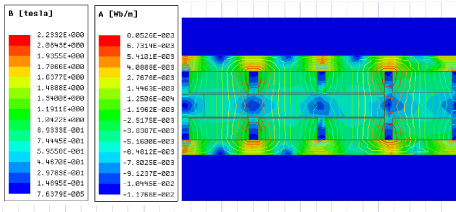
Flux lines and flux density distribution of conventional linear motor.
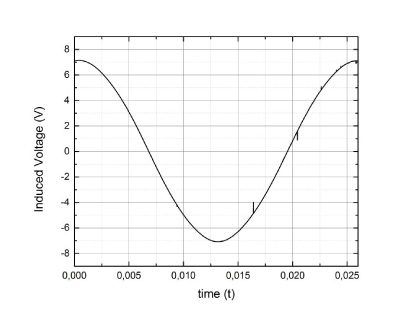
Phase-to-neutral induced voltage of conventional type linear motor (@ 1.5 m/s speed).
Then the same design procedure is applied to Halbach type version. In Fig. 4, the flux lines and flux density distribution of the Halbach array motor are shown. The horizontally magnetized PMs are transferring and condensing the flux lines into air-gap side as it is seen. The phase-to-neutral induced voltage waveform of the Halbach type is also shown in Fig. 5.
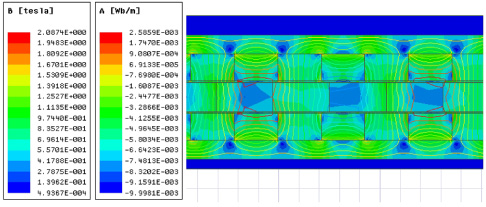
Flux lines and flux density distribution of Halbach array type linear motor.
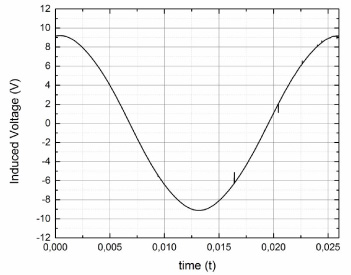
Phase-to-neutral induced voltage of Halbach type linear motor (@ 1.5 m/s speed).
Both motor types are manufactured. The double-sided coreless linear motor structure is seen in Fig. 6. The fundamental parameters and dimensions of the motor and PMs are given in Table 1. The armature, i.e. winding assembly is guided inside of the air gap via a linear slider. The position information for brushless driving is captured by Hall effect sensors. In conventional motor prototype a soft magnetic steel is used for back iron, in the Halbach array version, the PMs are glued on an aluminium part. Various experiments are conducted: the static and dynamic force measurements are realized by using a precise dynamometer. The induced voltage variations, terminal current and armature speed are also captured. The key parameters which show the differences between the conventional and Halbach versions are given in Table 2. The relatively small differences between the analysis and experimental results show the validity of design process. As the FEA material properties, the values provided by manufacturers are used for the designs. However, some small deviations from the assigned parameters may occur in the actual implementations. The PM operation point which defines the air gap flux density and its temperature dependency are important effects on the actual performance of the motor. The measurement errors must also be considered. The force-to-weight ratio which is an essential performance goodness criterion for linear motors is calculated for each design.
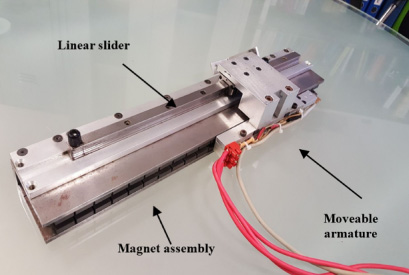
Implemented double-sided coreless linear motor.
Fundamental parameters and dimensions of double-sided coreless linear motor
Analysis and experimental results of both designs
The static force productions of two motor types are given in Fig. 7. As it can be see that there is a substantial difference between the force values due to the difference between the force constants. Also, the force production is slightly decreasing for higher currents due to loading demagnetization of PMs.
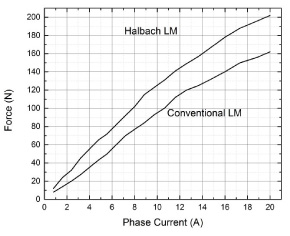
Static force productions of both motor prototypes.
By means of the analyses and experimental work, two similar double-sided linear motors with different magnet arrays, i.e. conventional magnet assembly and Halbach array assembly, are investigated. The calculated results show the superiority of the Halbach version based on the force production. Both motors have sinusoidal flux distribution due to their winding PM arrangements. But for Halbach array type, besides the higher force, another outstanding feature is lightness of the design. The main problem in Halbach type, the need for horizontally magnetized PMs which is increasing the PM costs. The results show that Halbach array version has superior force production capability and force density (F∕m) ratio which is nearly twice of that of conventional type.