



Abstract
This paper presents an analytical method to calculate the air-gap magnetic flux density distribution of a permanent magnet (PM) vernier motor. For this purpose, the air gap permeance, the magneto-motive force (MMF) of rotor magnets and the MMF from stator winding are respectively expressed in the form of Fourier series. The permeance function whose values of the all harmonics are given in terms of geometry, is utilized with the MMF of PMs to analyze the air gap flux density of the vernier machine. In addition, the role of each harmonic components of flux density in the production of back electromotive force (back-EMF) and torque is examined. Finally, the effectiveness and accuracy of the derived expressions are checked with the help of finite element (FE) analysis.
Introduction
The PM vernier motor have received increasing attention for the systems requiring low speed and high torque such as wind power generators, hydraulic motors, etc [1–3]. As is well known, the distribution of the magnetic flux density in the air gap is an important parameter of the any electrical machine design, so, the accurate prediction of magnetic field distribution is prerequisite in the investigation of torque, back-EMF, demagnetization and winding inductance, etc. of the PM vernier motors. In this respect, the air gap flux density of general PM motors can be estimated easily but the PM vernier motor produces the modulation flux as well as the common flux of general PM motors which makes the flux density wave quite complicated [4,5].
In most of the previous studies for the PM vernier machines, the numerical methods such as FE instead of analytical method have been used to calculate the air gap flux density. Generally, the FE provides accurate results of the magnetic field distributions; however, the analysis with FE is very time-consuming, so, proper in the final stage of the machine design. In comparison with FE, the analytical solutions are more desirable in the initial design steps. In fact, there are some prior analytical studies on vernier PM machines, but they focused on the fundamental wave of the magnet MMF and the air gap permeance to investigate the air gap flux density including the flux modulation effects [6,7].
In this paper, therefore, all harmonics of air-gap permeance function and rotor magnet MMF in the form of Fourier series are used to get more accurate air-gap flux density. The air gap flux density due to armature windings with considering all harmonics is also calculated. Using the obtained flux density, the detailed contributions of each harmonic component of the flux density in the production of the back-EMF and torque are investigated. For this purpose, the back-EMF equation is newly derived for PM vernier motor with the consideration of all harmonics. Furthermore, the torque produced by the effect of the both conventional and modulation flux waves is investigated separately. Finally, the analytical calculation results are compared with the FE simulation results to check the accuracy and the effectiveness of the derived expressions.
Calculation of air-gap flux density
Flux density from magnet
The special features in the structure of vernier motor are the uniformly pitched teeth on its surface facing towards its air gap and the large number of magnet rotor poles than stator windings poles. The relation for a PM motor to get the vernier effect, is given by [8]
The MMF is produced by the current flowing through the stator winding and its distribution in the air-gap can be obtained as
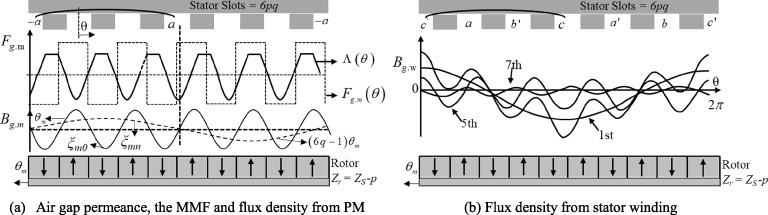
Working principle of vernier motor.
Calculation of Back-EMF
The back EMF waveform of a PM vernier motor can be calculated from air-gap flux density distribution at no load condition with the knowledge of the armature winding distribution. According to Faraday’s law the voltage induced in a single coil is equal to the negative derivative of the flux linked by coil.
The flux linking stator winding can be found as the integral of the flux density over the stator one pole area, and when the distributed winding coil pitch is used in structure, it is given as (11) where D
g
is the air gap diameter and l
stk
is the stack length of motor.
The electromagnetic torque of electrical machine is resulted from the interaction of air gap fluxes from PMs and the stator currents. Since the exact back-EMF of each phase winding is obtained as (14), as an alternative, the torque can be computed by multiplication of the back-EMF and stator currents, as follows.
To verify the validity of the derived analytical expressions, a prototype sample motor with vernier structure is designed. The steel material is used to constituting the rotor and Stator regions, and the analytically obtained results for the motor are compared with FE-simulation results. The specifications in details of the designed machine are shown in Table 1, and the geometry of the machine are depicted in Fig. 2(a). In addition, by using Maxwell (2D) FE analysis the no load flux distribution at 3600 rpm is demonstrated in Fig. 2(b).
Specifications of the FE analysis
Specifications of the FE analysis
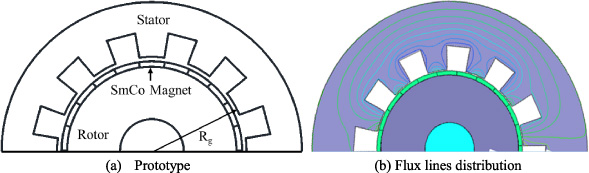
Structure and Flux distribution.
For the designed motor, the analytical calculations of air-gap flux density from magnet were carried out, considering only the fundamental components of MMF from magnet and air gap permeance and considering every harmonic, respectively. The calculated results including FE computation are compared in Fig. 3(a). It shows that the results of the proposed method considering every harmonic are much closer to the FE results. The harmonics of the waveforms of the proposed method and FE are compared in Fig. 3(b), which shows that the both results are in good agreement.
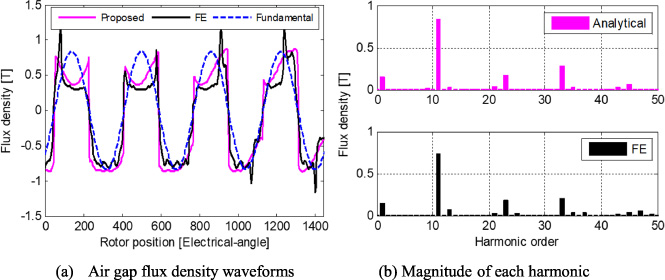
Air gap flux density from magnet.
To find the air flux density from the stator current by using FE, the PMs in Fig. 2(a) are replaced by air gap, and the machine is excited only by the 3-phase currents. The air gap flux density and the magnitudes of its harmonics comparison are given in Fig. 4(a) and (b) respectively. The obtained results shows high accuracy between analytical and FE analysis which also takes into account the harmonics.
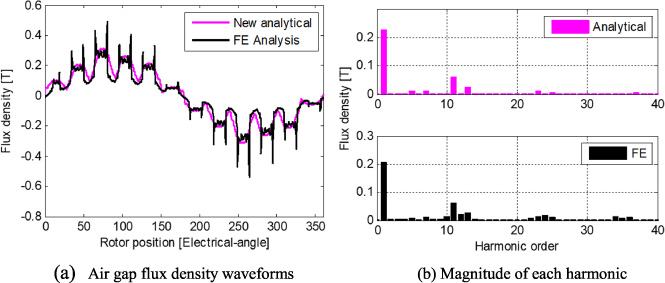
Air gap flux density from stator winding.
To check the validity of (14), the FE analysis is performed at no load conditions to analyze the back EMF where the SmCo magnet material used for this structure. The comparison of back EMF waveforms obtained from analytical and FE are depicted in Fig. 5(a). The obtained results show good agreement between analytical and FE method. The small deviation in the analytical results from FE is due to neglecting the reluctance drop in core by reason of high permeability.
Using (12) and (13), the torques developed by the conventional and the modulation flux are calculated separately when the maximum 5A in phase with the back-EMF are applied to the stator phase windings, the torque results are demonstrated in Fig. 5(b). It shows that the vernier torque is more than twice as high as the conventional torque, clearly proving the benefit of vernier structures over conventional ones in power density. The total torque which is the sum of conventional and vernier torques are compared with that of FE in Fig. 5(c). From the both results, the average values of analytical and FE analysis are similar within about 6% errors. Besides, the many torque ripples can be seen which couldn’t be obtained without considering harmonics and the period of the ripples of them is almost same, indicating the usefulness of the proposed idea. The slight difference of torque wave forms are guessed to be produced because the cogging torque is neglected during the analytical calculations.
Conclusion
In this paper, the analytical expressions of the air gap flux density, back EMF and torque were derived taking into account all the harmonics of the air gap permeance, the stator winding and the magnet. From the calculated air gap flux density and torque results, it was proven the proposed method provides more accurate results than the previous method which considers only the fundamental components of MMFs and permeance. The individual contribution of the modulation and the common fluxes on the torque characteristics were also investigated. Especially, it is very meaningful to be able to get torque characteristics with ripples of the PM vernier motor by using the proposed method. Finally, calculation of the cogging torque can be suggested for future work to get more accurate torque results.
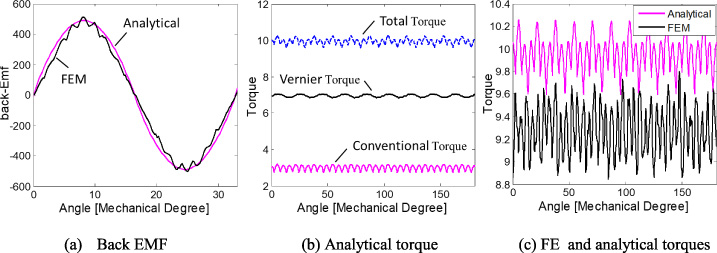
Back-EMF and torque results.
Footnotes
Acknowledgements
This research was supported by Basic Science Research Program through the National Research Foundation of Korea (NRF) funded by the Ministry of Education (NRF-2016R1A6A1A03013567 and NRF-2017R1A2B4009919).