



Abstract
Electromagnetic force due to induced eddy current during plasma disruptions is one of the key design-driving issues for the first wall (FW) in the Tokamak device. In this paper, a method to evaluate the electromagnetic force in the FW is proposed based on inversion of the measured magnetic field. An inversion scheme for reconstruction of eddy current from measured magnetic field is developed based on a newly proposed algorithm that can eliminate the effect of plasma current. To solve this inverse problem, the conjugate gradient (CG) algorithm is adopted in addition with an efficient parameterization strategy of eddy current distribution. To demonstrate the efficiency of the method, a simplified FW plate and plasma current model is considered with the magnetic field simulated with a numerical code of the reduced magnetic vector potential (Ar) formulation. The numerical results show that proper eddy current and electromagnetic force distribution can be predicted even for case of unknown plasma current, which reveals that the proposed method has good potential to be applied to the electromagnetic force evaluation of practical Tokamak problem.
Introduction
The first wall (FW), as one of main plasma facing components in Tokamak structure, subjects to a combination of versatile loads, e.g., inertial, thermal, electromagnetic and pressure loads [1]. In particular, during the plasma disruption, huge transient eddy currents are induced in the FW and other conductive components surrounding the plasmas. Correspondingly, strong electromagnetic forces are generated in the FW which could potentially cause mechanical failure in the FW structure [2–5]. Therefore, the eddy current and corresponding electromagnetic force are very important factors for the structural integrity evaluation of Tokamak structures. For the structural design of FW, the electromagnetic force needs to be properly evaluated in order to verify its structural stability under off-normal conditions. However, how to measure and evaluate the electromagnetic force in the FW and other conductive structures surrounding the plasmas during transient plasma events is still a difficult problem to be solved. Up to now, the direct strain measurement method has been preliminarily investigated to evaluate the loads in the Tokamak in-vessel components [6]. However, it is still difficult to measure the full-field strain distribution and to evaluate the electromagnetic force of practical Tokamak problem.
In the Tokamak structure, if the eddy current in the FW can be properly evaluated, one can simply obtain the electromagnetic force as the major confining magnetic field of Tokamak is known and the FW is usually nonmagnetic material. In view that the magnetic field near by the FW depends on the eddy current inside, one can evaluate the eddy current distribution in the FW through inversion of the measured magnetic field. However, the problem to do so is how to treat the effect of the plasma current under disruptions as it is also unknown in practice, i.e., we need to realize the eddy current reconstruction under the assumption of unknown plasma current. In this work, a method to evaluate the electromagnetic force in the FW through the measured magnetic field and eddy current inversion is developed based on a newly proposed algorithm to eliminate the effect of plasma current and to reconstruct the eddy current distribution. The conjugate gradient (CG) algorithm is adopted to solve this typical inverse problem in addition with an efficient parameterization strategy of eddy current distribution [7–11]. In order to validate the proposed method, a simplified FW plate and plasma current model is employed, where the plasma current and FW plate are approximated as a pulsed cyclic line current and a thin conducting plate respectively. From the magnetic field simulated with a numerical code of the reduced magnetic vector potential (Ar) method, the eddy current and electroamgnetic force in the simplified FW plate are reconstructed. The numerical results show that proper eddy current and electromagnetic force distribution can be obtained even for case of unknown plasma current, which reveals the validity of the proposed method for electromagnetic force evaluation.
Basic principle of electromagnetic force evaluation
There are two difficulties to reconstruct eddy current from the measured magnetic field, i.e., complicated eddy current distribution in the FW plate and the ill-posedness of the inverse problem. More importantly, the influence of plasma current also needs to be considered for present problem. To cope with these difficulties, a parameterization strategy for the distribution of eddy current density is proposed to reduce the number of unknowns. Moreover, a proper selection of magnetic measuring points is adopted to overcome the ill-posedness of the inverse problem [12–14]. In addition, a new inversion algorithm using magnetic field of two measuring surfaces are proposed in this paper to deal with the influence of plasma current on the inverse analysis.
Description of Ar method
In this work, the numerical code of Ar method [15] is utilized to calculate the eddy current density in the simplified FW plate and the magnetic field distribution above the plate to check the validity of the proposed method. The basic principle of the Ar method is as follows:
At first, the whole analysis region is divided into two parts as shown in Fig. 1, where V
t
is the part that includes the conductive material in which standard magnetic potential
Relating to this work, the eddy current

Division of analysis region of the Ar method.
Parameterization method of eddy current distribution
To describe its distribution, the eddy current in the FW plate is subdivided into many small cell currents flowing parallel to the FW plate surface. The corresponding magnetic field can be calculated by making summation on the fields due to each cell current. However, as the number of the current cells is too large, the current density of each cell is impossible to be adopted as unknowns to be reconstructed. If the distribution of the eddy current density in the FW plate can be decomposed with the Fourier series, the unknowns to be reconstructed will become to the coefficients of the Fourier series, whose number is much less than that of the current cells. In this way, the dimension of the inverse problem and its ill-posedness can be significantly improved.
In practice, the x and y component of eddy current density of the k-th cell in a rectangular FW plate at every moment can be discretized as follows based on the Fourier expansion:
For the parameterization of plasma current, we suppose that the plasma current is axisymmetric and can be approximated by a group of cyclic line current of different transient current values. Under such an assumption, the plasma current can be parameterized as vector
To predict the eddy current from measured magnetic field, we have to obtain the correlation between the unknown eddy current parameters and the measured magnetic field at first. By using the Biot-Savart’s law, at every moment the magnetic flux density
By using Eq. (6) and Eq. (7), the total magnetic flux density due to eddy current and plasma current at two near by measurement surfaces at every time instant can be expressed as,
From Eq. (8), by multiplying a sub-matrix [M] to the bottom system of equations and making substraction with the upper system of equations, one can obtain
Taking into account Eq. (10), Eq. (9) can be rewritten as
In Eq. (12), there is no unknowns about plasma current, i.e., the effect of plasma current is eliminated by using magnetic field at two near by surfaces. When P = n, the eddy current parameter
The condition number of Eq. (13) is usually not good due to the ill-posedness underlying inverse problem. Normal solver for system of linear equations is not suitable for Eq. (13). In this study, the CG algorithm is adopted to solve these linear equations. In practice, Eq. (13) is converted to the following optimization problem,
According to the numerical scheme given above, an inversion program is developed to solve the eddy current parameter vector from the measured magnetic fields. Figure 2 shows the flowchart of the eddy current reconstruction solved through inverse analysis.

Flowchart of eddy current reconstruction process.
Once the eddy current is calculated, the electromagnetic force, i.e., the Lorentz force in the FW plate due to induced eddy current can be obtained by using,
Description of simplified FW model
In order to demonstrate the validity and efficiency of the proposed inversion method, a simplified FW plate and plasma current model is developed, as shown in Fig. 3(a). In this figure, the plasma current was approximated as a pulsed line current in a square coil with its length direction parallel to the surface of the FW plate. On the other hand, the FW plate is assumed to be a thin conducting plate of material beryllium (Be). The simplified FW plate is sized at 40 × 40 × 1 mm3, and the conductivity and relative permeability of the plate are selected to be 3.13 × 10⁷ S/m and 1.0 respectively. For the square excitation coil, the outer and inner lengths which are the same as the widths are 99.5 mm and 100.5 mm, and the dimension of cross section of this coil is sized at 1 × 1 mm2. A half-sine pulse current with the current density of 3.2 × 10⁶ A/m2 and the frequency of 1 kHz is employed to simulate the plasma current during disruption. The lift-off between the square coil and the plate is 48.5 mm. As shown in Fig. 3(b), the FW plate is discretized into 1600 cubic finite elements of side length 1 mm. Two planes parallel to the plate and 1 mm and 2 mm above the top surface are adopted as the measurement planes of magnetic field. On the other hand, to calculate the electromagnetic force, a constant toroidal magnetic field of 5 T is considered.
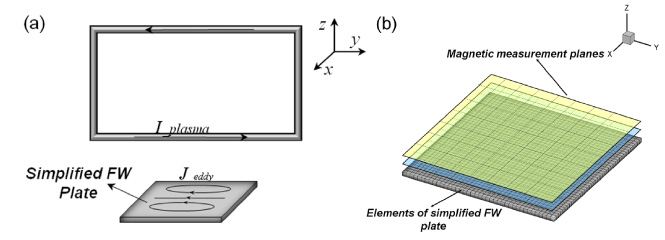
Simplified model of the FW plate.
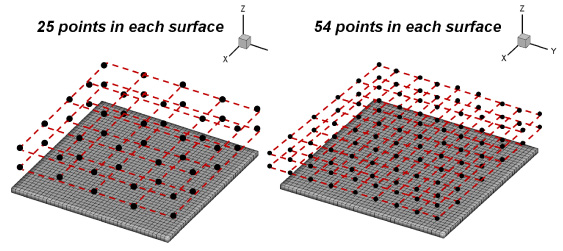
Arrangement of measurement points magnetic field.

Numerical results of eddy current reconstruction with 25 measurment points in each field surface.
Considering the balance of accuracy and number of unknowns, a large number of numerical simulations are performed to determine the order of Fourier series for eddy current parameterization. At last, it was found that 3 order is enough for present problem. Due to the symmetrical property of the numerical example, some coefficients in Eq. (5) are vanished and distribtuion of eddy current density of the k-th cell in the FW plate can be written as follows,

Numerical results of eddy current reconstruction with 54 measurment points in each field surface.
Based on the inversion scheme above, for the case of unknown plasma current, a numerical code has been developed for the reconstruction of eddy current distribution in the simplified FW plate. Figure 4 shows the two planar distributions of magnetic measurement points. The corresponding reconstruction results of eddy current density at the 0.4 ms are shown in Figs 5 and 6. The true eddy current is calculated by the Ar method and the reconstructed value is obtained by the developed inversion scheme. From Fig. 5, one can find that the reconstructed eddy currents show a good agreement with the true values when 25 magnetic meaurement points in each measurement plane are employed. However, from Fig. 6, the reconstruction results are in very good agreement with the true values when increasing the number of the measurement points to 54 in each measurement plane. The results reveal the validity of this inverse method and numerical scheme. If the number of the magnetic measurement points above the FW plate is big enough, the eddy current can be properly reconstructed. In addition, the electromanetic force in the FW plate also can be calculated through Eq. (16), as shown in Fig. 7.

Results of electromagnetic force in the simplified FW plate at 0.4 ms.
In this paper, a method to evaluate the electromagnetic force in the FW is proposed based on inversion of the magnetic field measured inside the vacuum vessel of Tokamak device. An inversion scheme for reconstruction of eddy current from measured magnetic field is developed based on an inversion algorithm using magnetic field at two different measurement surfaces that can efficiently eliminate the effect of plasma current. To solve this typical inverse problem, the CG algorithm is adopted in addition with an efficient parameterization strategy of eddy current distribution. To demonstrate the efficiency of the method, a simplified FW plate and plasma current model is adopted and the magnetic field is used as the numerically simulated signals. The numerical results verify the validity of the proposed method even for case of unknown plasma current, and reveal that the proposed method has good potential to be applied to the electromagnetic force evaluation of practical Tokamak problem.
Footnotes
Acknowledgements
The authors would like to thank the National Key Research and Development Program of China (No. 2017YFF0209703) and the NSFC (No. 51577139, and 51877163) for funding this study.