



Abstract
This paper presented a novel analytical method for calculating magnetic field in the slotted air gap of spoke-type permanent-magnet machines using conformal mapping. Firstly, flux density without slots and complex relative air-gap permeance of slotted air gap are derived from conformal transformation separately. Secondly, they are combined in order to obtain normalized flux density taking account into the slots effect. The finite element (FE) results confirmed the validity of the analytical method for predicting magnetic field and back electromotive force (BEMF) in the slotted air gap of spoke-type permanent-magnet machines. In comparison with FE result, the analytical solution yields higher peak value of cogging torque.
Introduction
Owing to better high-speed mechanical stability, anti-demagnetization performance, flux-weakening capability [1], higher power density, torque density, efficiency, power factor [2–4], concentration effect of magnetic fields [5,6], and lower leakage magnetic flux [7], spoke-type permanent-magnet machines have attracted many scholars’ attention. Magnetic field is very important for performance analysis and electromagnetic design of electrical machines. Especially, cogging torque, radial force and unbalanced magnetic force are not obtained without prediction of magnetic field in the slotted air gap. Correct and credible results can be obtained with finite-element methods accounting for material saturation and all kinds of structure [8,9]. But some important results are sensitive to the FE meshes. Compared to analytical methods, the finite-element methods are very time-consuming. They are good for the adjustment and validation of the final design. Analytical methods are of great benefit to initial design and performance optimization of machines. The computing time for predicting solution is not restricted to the size of machine with analytical methods.
There are some papers that predicted magnetic field and performances of spoke-type permanent-magnet machines by finite-element methods [10–14]. In order to get good performances and reduce the use of expensive rare-earth materials, spoke-type permanent-magnet machines was analyzed in automotive applications. In [10], comprehensive comparisons between the various designs were presented by highlighting the key terms of flux-weakening capability, back EMF, power density, efficiency, torque ripple, and magnet susceptibility to demagnetization. Finally, a prototype machine using ferrites was built and tested. In [11], improved skewing method and sinusoidal PM-shaping method were proposed to minimize torque pulsations for spoke-type interior permanent magnet motors by a 3-D finite-element method. Both methods adopted stepped rotor-PM schemes.
At the same time, some papers have been published to calculate magnetic field of spoke-type permanent-magnet machines with analytical methods [15,16]. In [15], open-circuit magnetic field distribution of spoke-type permanent magnet machines was presented by an analytical field solution using conformal transformation. The cogging torque was predicted according to the variation of magnetic co-energy. Radial component of flux density in the slotted air gap was calculated. Circumferential component did not given out.
According to subdomain model which has been widely applied to surface-mounted permanent-magnet machines [17,18], open circuit magnetic field solution was predicted in parallel double excitation and spoke-type permanent-magnet machines considering semi-closed slots. Too many complicated expressions in the paper are not easy to be comprehended [16].
In [19], Damir Zarko introduced the notion of complex relative air-gap permeance to take into account the effect of slots in surface-mounted permanent-magnet machines using conformal mapping. Field solution in the slotless air gap and relative air-gap permeance of slotted air gap are calculated in the form of complex number separately. Then they are combined to obtain air-gap magnetic field accounting for slots. There are no authors who applied analytical method of conformal mapping for calculating magnetic field in the slotted air gap of spoke-type permanent-magnet machines. In [20], the conformal transformation and flux continuity theorem was used to calculate open-circuit magnetic field in spoke-type permanent-magnet machines. But slots in the stator was not considered.
The analytical method proposed in this manuscript using conformal mapping to calculate magnetic field in the slotted air gap of spoke-type permanent-magnet machines. The accurate magnetic field with conformal mapping has been verified in [15,19] and [20]. In this paper, a novel analytical method is derived for calculating magnetic field in the slotted air gap of spoke-type permanent-magnet machines using conformal mapping. In the presented analytical model, two types of conformal transformation are used to obtain flux density without slots, complex relative air-gap permeance of slotted air gap and final field solution. Finally, back electromotive force(BEMF) and cogging torque is calculated according to flux density distribution.
Analytical field modeling
Normalized flux density
Without slots
In the paper, the analytical method is based on the following assumptions: Infinite permeable iron materials; Negligible end effect; Linear properties of permanent magnet.
In order to obtain generalized field solution for flux density in the slotted air gap of spoke-type permanent-magnet machines with conformal mapping, the two-dimensional model of spoke-type permanent-magnet machine without slots is considered firstly, as shown in Fig. 1. Then complex relative air-gap permeance of slotted air gap will be considered. Z, W, and T planes are used in Schwarz-christoffel transformation and logarithm transformation.
The mapping relationships of the points between field region without slots in Z-plane and W-plane (Fig. 2) are shown in Table 1.

Spoke-type permanent-magnet machine without slots.
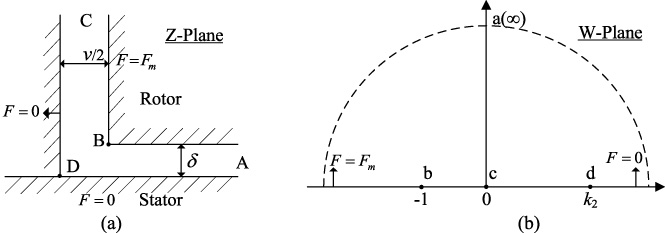
Field region without slots. (a) Z-plane; (b) W-plane.
Mapping relationships of the points between field region without slots in the Z-plane and W-plane
According to Schwarz-Christoffel transformation and mapping relationships in Table 1, the following differential equation can be obtained [20]
After integrating (1) and taking into account the mapping relationships of the points between Z-plane and W-plane, variable z becomes
At the point Q (R
q
, θ), when θ varies from 0 to π∕P, variable z is
Substituting (3) into (2), the equation with the form of complex number can be given by
The field region in the T-plane (Fig. 3) represents two parallel plates extending an infinite distance in both directions. According to logarithm transformation between the W-plane and T-plane, the following equation can be obtained [20]
The flux density in the air gap without slots can be given by

Field region in the T-plane

Slot opening. (a) Z-plane; (b) W-plane.
Substituting (1) and (5) into (6), the flux density can be obtained by
Then the base value of flux density can be written as
The normalized flux density in the air gap without slots
The effect of slots on the magnetic field distribution in the slotted air gap can be obtained according to complex relative air-gap permeance. Air-gap permeance accounting for slots in the rotor and stator can be considered respectively [21,22]. The simplified geometrical figure of slot opening with magnetic potential in Z-plane is shown in Fig. 4(a).
Mapping relationships of the points between slot opening in the Z-Plane and W-Plane
Mapping relationships of the points between slot opening in the Z-Plane and W-Plane
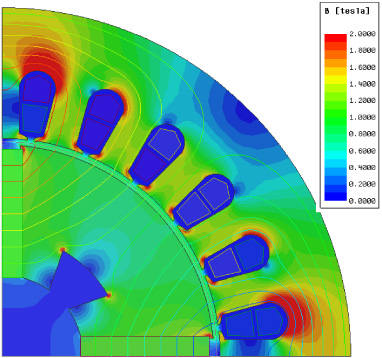
Flux density distribution resulted from FEA.

Normalized flux density per one pole pitch in slotless air gap with different radius. (a) Radial component; (b) Circumferential component.

Complex relative air-gap permeance per one slot pitch in slotted air gap with different radius. (a) Real component; (b) Imaginary component.
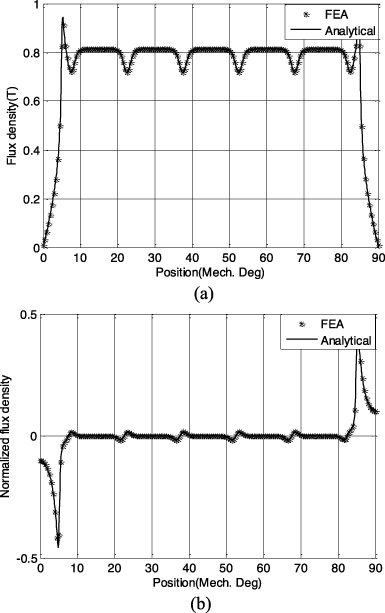
FE and analytically predicted flux density waveforms per one pole pitch in the air-gap at R q = 97.5 mm of motor. (a) Radial component; (b) Circumferential component.

FE and analytically predicted flux density waveforms per one pole pitch in the air-gap at R q = 98.5 mm of motor. (a) Radial component; (b) Circumferential component.
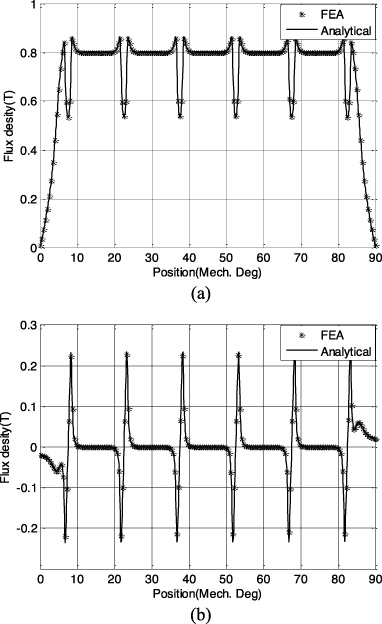
FE and analytically predicted flux density waveforms per one pole pitch in the air-gap at R q = 99.5 mm of motor. (a) Radial component; (b) Circumferential component.
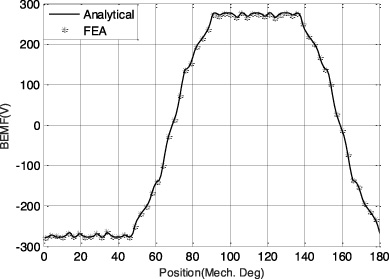
FE and analytically predicted BEMF.
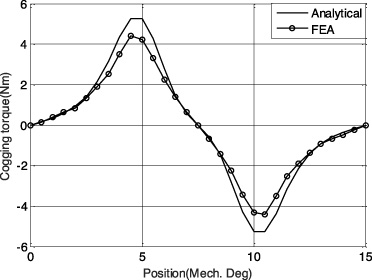
FE and analytically predicted cogging torque.
The mapping relationships of slot opening between Z-plane and W-plane are shown in Table 2. According to Schwarz-Christoffel transformation, Z-plane (as shown in Fig. 4(a)) can be transformed into W-plane (as shown in Fig. 4(b)) by the form [19]
After integrating (11) and taking into account the mapping relationships of Z-plane and W-plane, variable z becomes
According to logarithm transformation (5), the flux density in the slotted air gap can be given by
The derivatives in (15) are defined by conformal transformations between the mapping complex planes
Substituting (16) into (15) yields
Complex relative air-gap permeance in the slotted air gap 𝜆 can be written in the complex form
According to (10) and (19), the normalized radial and tangential components of the flux density in the slotted air gap of spoke-type permanent magnet machines can be given by
According to base value of flux density in (8) and normalized flux density in (20), the final flux density in the slotted air gap can be obtained by
The BEMF can be calculated by
According to Maxwell Stress Theory, torque equation in the integral form can then be written as
The major parameters of the machine are shown in Table 3. The linear FE results of 4-pole/24-slot machine with ideal slots will be used to confirm the validity of analytical method for calculating air-gap magnetic field in spoke-type permanent-magnet machines accounting for slots. Machine structure combined with the flux density distribution resulted from FEA is shown in Fig. 5.
Main parameters of the machine
Main parameters of the machine
Figure 6 shows the normalized flux density results per one pole pitch in slotless air gap with different radius. As can be seen from Fig. 6, the influence of pole tip to normalized flux density in slotless air gap is stronger while the position is closer to rotor in radial direction. Figure 7 shows complex relative air-gap permeance per one slot pitch in slotted air gap with different radius. As can be seen from Fig. 7, influence of tooth tip to complex relative air-gap permeance and the drop of radial component in the central of slot opening are stronger while the position is closer to slot opening in radial direction.
Figure 8 compares FE and analytical predictions of flux density waveforms per one pole pitch in the air-gap at r = 97.5 mm. Figure 9 compares FE and analytical predictions of flux density waveforms per one pole pitch in the air-gap at r = 98.5 mm. Figure 10 compares FE and analytical predictions of flux density waveforms per one pole pitch in the air-gap at r = 99.5 mm. Compared with base value of flux density, the error of flux density is less than 1%. As can be seen from Figs 8, 9 and 10, the analytical predictions of the air-gap magnetic field in the machine are in excellent agreement with FE results.
According to flux density, FE and analytically predicted BEMF and cogging torque are shown in Fig. 11 and Fig. 12. The slots are not skewed. As shown in Fig. 11, the analytical predictions of BEMF is in excellent agreement with FE result. As can be seen from Fig. 12, the analytical solution yields higher peak values of cogging torque. This discrepancy is caused by spatial distortions due to the logarithmic nature of conformal transformations between complex planes containing different air-gap geometries.
This paper derived a novel analytical method for calculating magnetic field of spoke-type permanent-magnet machines accounting for slots in the stator. Flux density without slots, complex relative air-gap permeance of slotted air gap are obtained according to conformal transformation. Then the final field solution accounting for slots is obtained by combining flux density without slots with complex relative air-gap permeance of slotted air gap. Based on the field model, the cogging torque and BEMF is computed too. The investigation shows the developed model has better accuracy in the prediction of flux density and BEMF of the spoke permanent magnet machine accounting for slots. But the accuracy to prediction of cogging torque is not very good.
Footnotes
Acknowledgements
This work was supported by supported by the National Natural Science Foundation of China (grant no. 51507180, 61703157), the Hunan Province Natural Science Foundation, China (grant no. 2019JJ50402, 2020JJ6061, 2019JJ40200), Project supported by the Research Foundation of Education Bureau of Hunan Province, China (grant no. 19B393),the provincial specialty disciplines of higher education institutions in Hunan Province (XJT[2018]469).